
Asymmetric Pane Thickness in Double Glazing: The Trick for Ultimate Sound Insulation

You have a noise problem at home and you've decided to invest in "thick" double glazing. You ask the manufacturer for a 5 mm pane outside and 5 mm inside (the well-known 5-16-5 configuration). The windows are installed, you close the balcony door and… disappointment sets in. The deep rumble of the garbage truck or bus can still be heard disturbingly clearly.

Where did things go wrong? Is the frame to blame? Not necessarily. The mistake lies in a fundamental rule of acoustic physics that many professionals (and consumers) overlook: Thickness alone is not enough. The secret to sound insulation is asymmetry.

Let's see why symmetric panes (like 5-16-5 or 6-16-6) are often the worst choice for urban noise, and how a simple, clever "trick" can give you total silence.

1. The Problem: The Resonance Effect

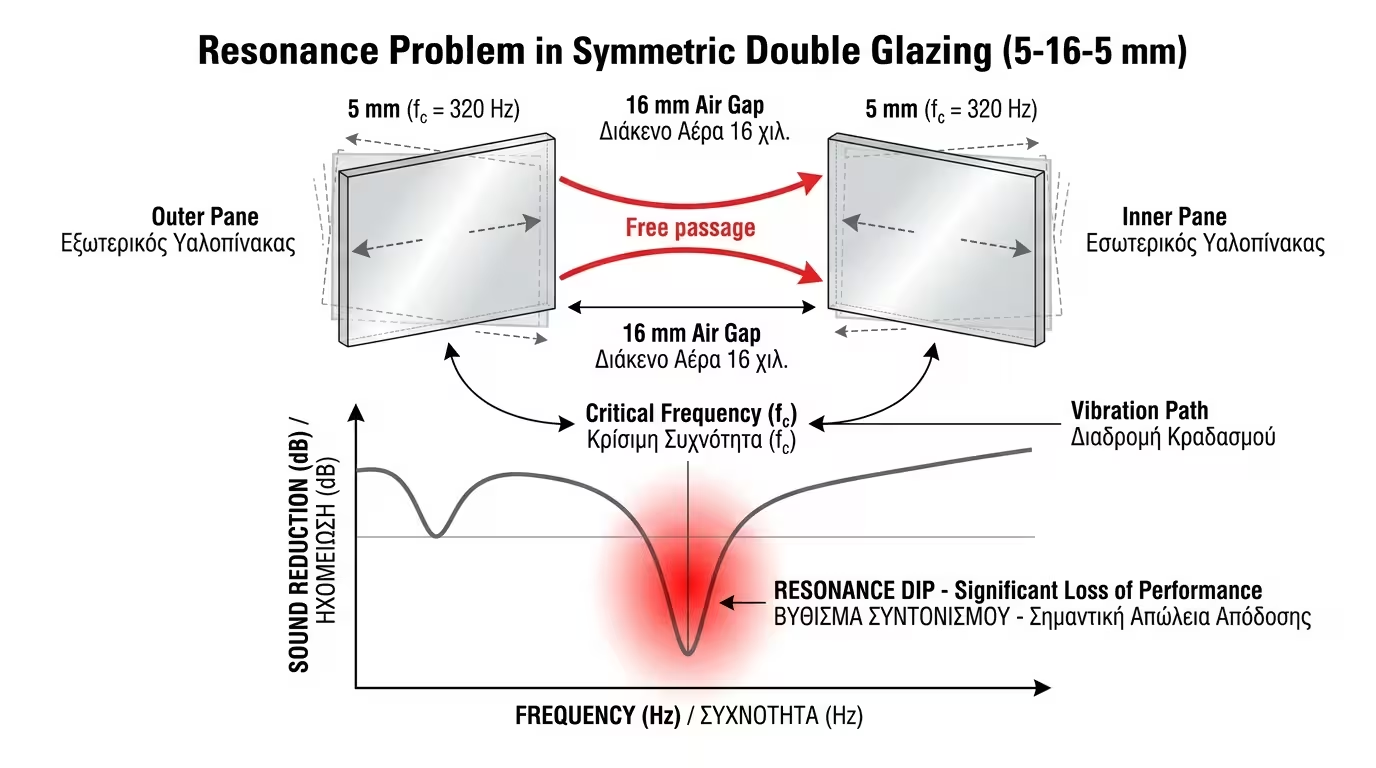
To understand asymmetry, we must first understand how sound travels. Sound is vibration. Every solid object in nature (including glass) has its own natural frequency at which it "loves" to vibrate. This is called the critical frequency (resonance frequency).

Resonance phenomenon in symmetric double glazing - vibration transfer diagram

🔊 Same Thickness = Same Frequency

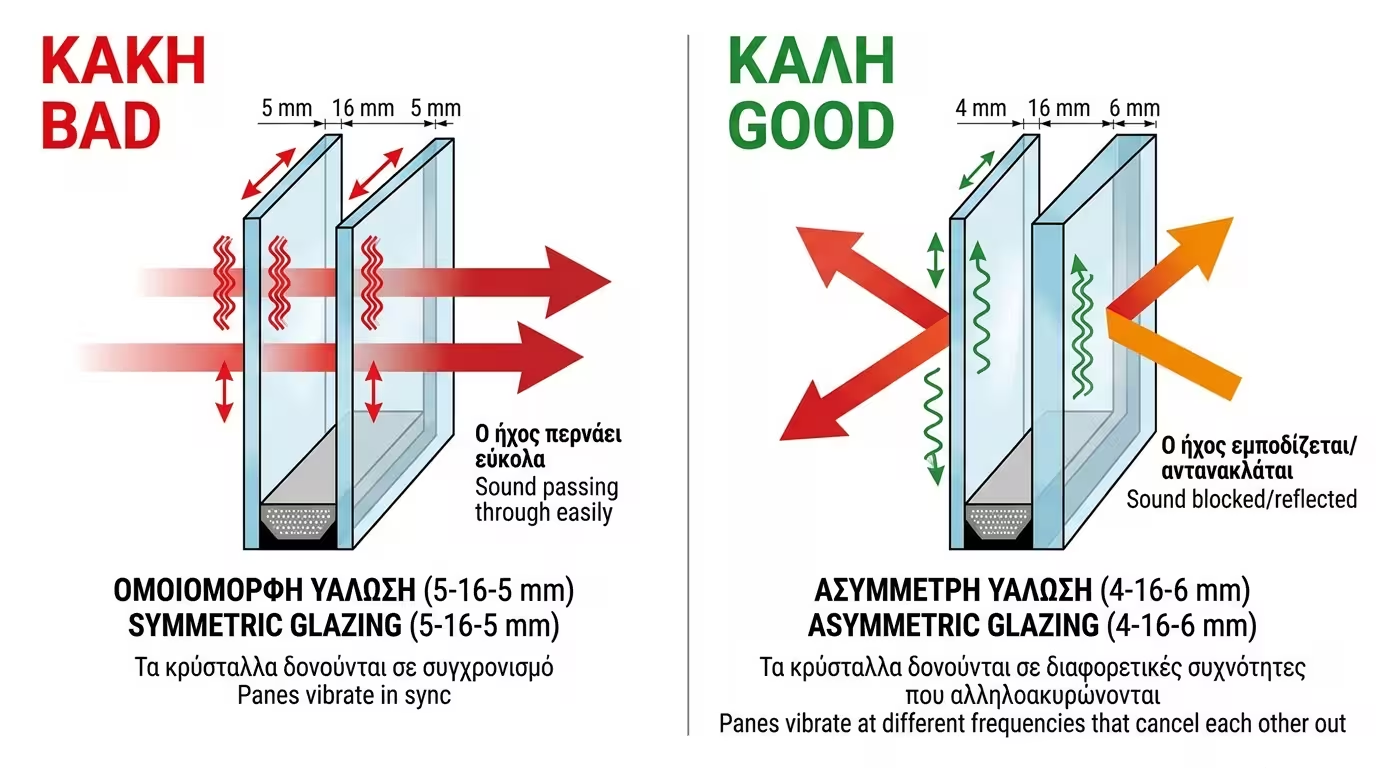
When you have a window with two panes of exactly the same thickness (e.g. 5 mm outside and 5 mm inside), something disastrous happens: the outer pane vibrates at a specific frequency, and because the inner pane is also 5 mm, it has exactly the same resonance frequency.
📡 The "Perfect Receiver"

The inner pane acts as a perfect "receiver" - it immediately picks up the vibration from the outer pane (without any resistance) and transmits it directly into the room. This phenomenon is called a "resonance dip". At that particular frequency, your double window suddenly behaves like a thin, single pane!

2. The Solution: "Breaking" the Rhythm with Asymmetric Thickness

How do we outsmart physics? Quite simply, we ensure the two panes are not the same thickness. Instead of 5-16-5, we choose an asymmetric configuration such as 4-16-6 (i.e. 4 mm pane, 16 mm cavity, 6 mm pane).

Asymmetric pane thickness in double glazing - 4-16-6 vs 5-16-5 configuration

🎯 Different Frequencies

The outer 6 mm pane vibrates at a specific frequency. The inner 4 mm pane is lighter and vibrates at a different frequency. When the vibration passes through the first pane and tries to shake the second, it finds a "wall" that won't cooperate. The frequencies cancel each other out. The sound wave loses its rhythm and is dampened in the intermediate cavity.

📐 The 30% Rule

For asymmetry to work effectively and make a perceptible difference, the industry's golden rule states that one pane must be at least 30% thicker than the other. (E.g. a 4 mm pane with a 6 mm pane, or a 5 mm pane with an 8 mm pane).

3. The "Ultimate" Configuration: Asymmetry + Acoustic PVB

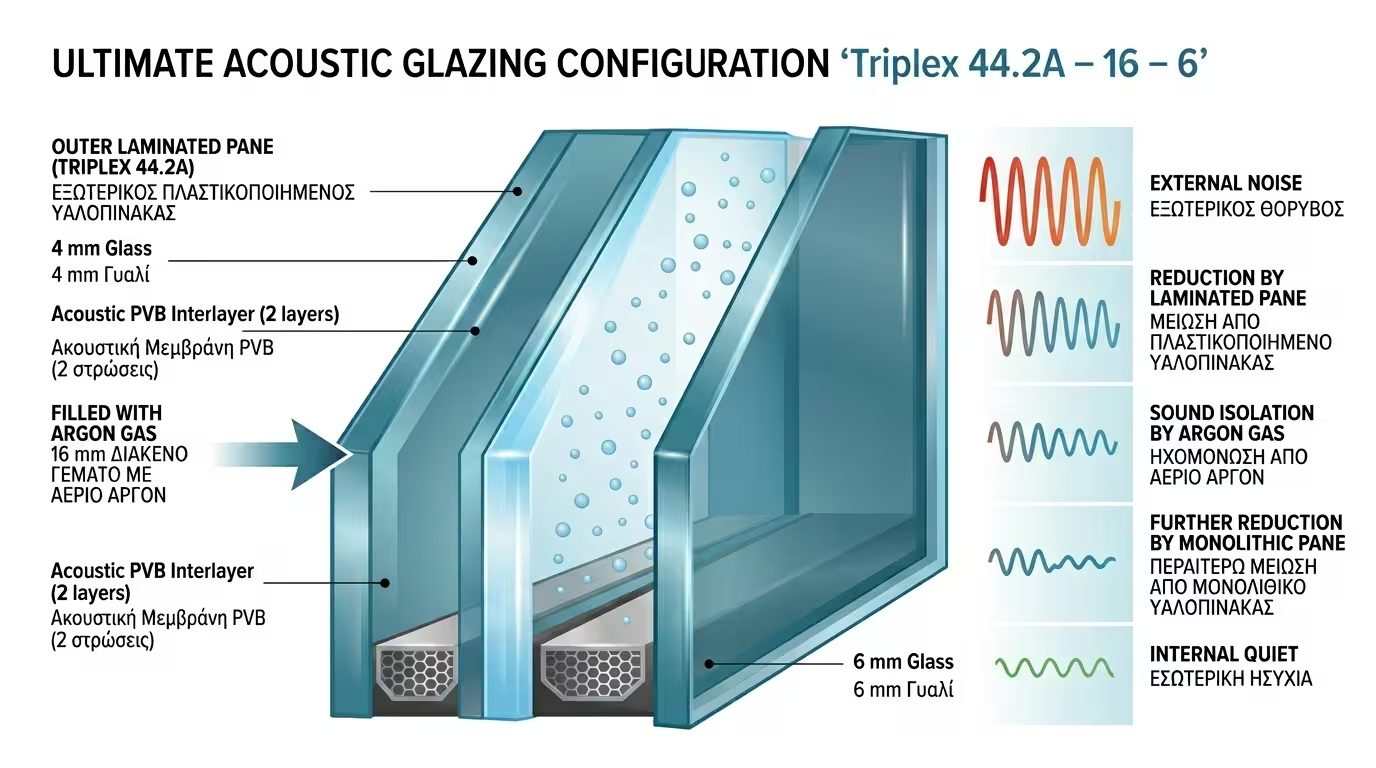
Triplex 44.2A - 16 - 6 configuration: combining asymmetry with acoustic interlayer

If you want to push sound insulation to the highest possible level (e.g. if you live next to an airport or railway lines), the solution is to combine the asymmetry trick with the technology we saw in the previous article: acoustic interlayers.

🧱 Outer: Thick Triplex with Acoustic PVB

A thick, laminated pane with an acoustic interlayer (e.g. Triplex 4+4.Acoustic).

💨 Middle: Wide Cavity with Argon

A wide cavity filled with Argon gas (e.g. 16 mm). Tip: The wider the cavity, the better the bass frequencies are blocked.

🪟 Inner: Single Pane of Different Thickness

A simple, single pane of a different thickness (e.g. 6 mm). With this configuration (Triplex 44.2A - 16 - 6), you exploit both the PVB membrane absorption and the mass asymmetry. Noise simply has no way through.

4. Summary

✅ Asymmetry: The Smart Secret

When it comes to sound insulation, the common-sense approach of "use thicker glass" doesn't always work. Choosing symmetric panes (e.g. 6-14-6) may cost you more in money and weight, while simultaneously delivering poorer acoustic performance than a thinner but cleverly asymmetric system (e.g. 4-16-6).

Related Articles

Glass Panes & Glazing Units: 80% of the Window

Return to category.

Go to category

Preview