
🧱 Internal Plaster & Masonry
The first layer is the interior plaster, followed by the inner masonry leaf - typically a single brick. This wall faces the room.
If you've ever watched a Greek building being constructed in recent decades, the image is familiar: masons raise a row of bricks, place blue or white polystyrene slabs in between, and then build another row on the outside.
This technique is called Cavity Wall Core Insulation. From the 1980s until the KENAK (Building Energy Performance Regulation) came into force in 2010, 90% of homes in Greece were built this way. Although external ETICS insulation has now taken the lead, the cavity wall remains a huge chapter in construction, either because your house is already built this way, or because certain new builds choose it for specific architectural reasons (e.g. exposed stone or brick facades). Let's dissect this wall and see exactly how it works.
A properly built cavity wall (also known as a double-leaf wall with gap) resembles a sandwich. It consists of these layers, from inside (room) to outside:
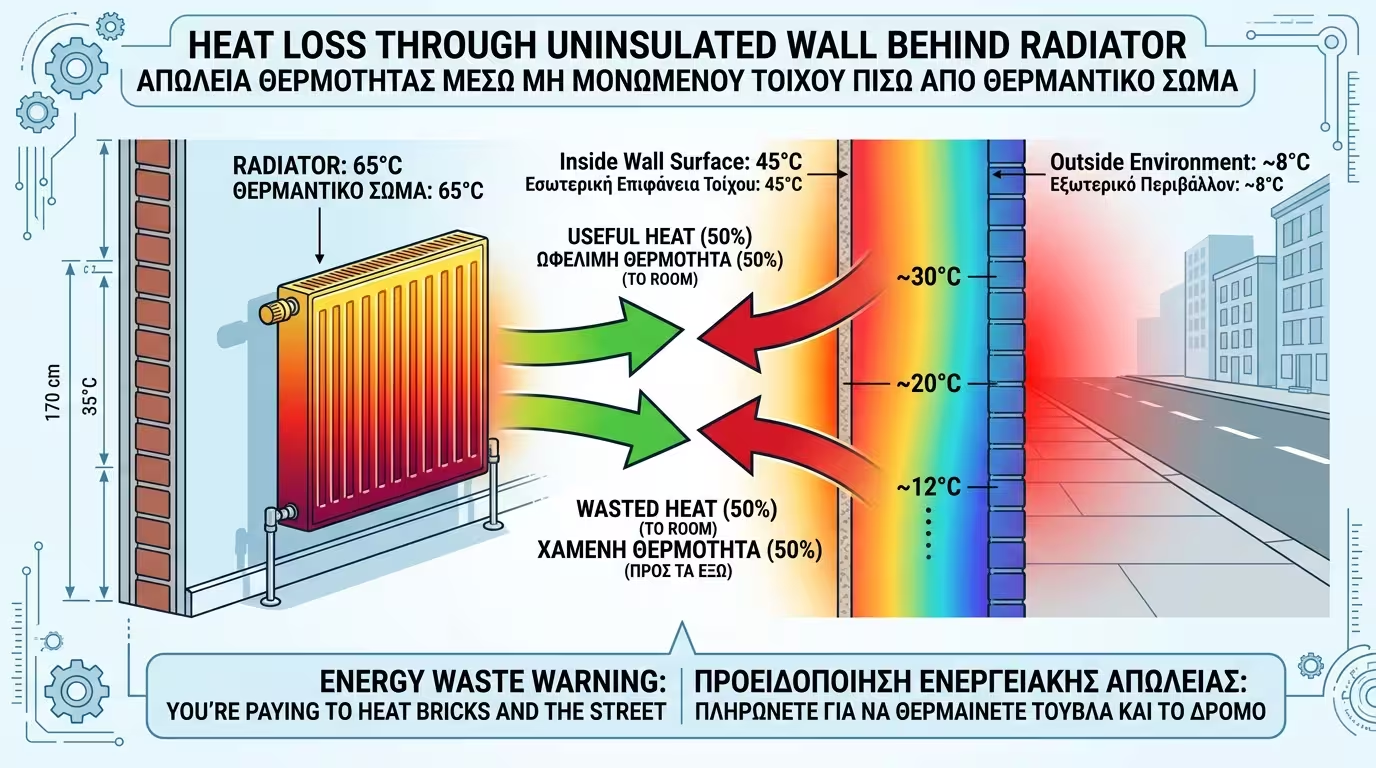
The first layer is the interior plaster, followed by the inner masonry leaf - typically a single brick. This wall faces the room.
This is where the insulation boards go - usually Extruded Polystyrene (XPS), Expanded Polystyrene (EPS) or Rock Wool. This is the "heart" of the system.
A small gap of 2-3 centimetres between the insulation and the outer brick, which helps the wall breathe and prevents moisture transfer. Ideally, this should always be present.
The external brick exposed to the environment, followed by the exterior plaster. This forms the last line of defence against rain and wind.
Why did we (and sometimes still do) build this way? The cavity wall offers significant advantages that cannot be ignored.
The insulation is encased and protected between two walls. It is safe from impacts, weather, birds or rodents. Its service life is essentially equal to the building's.
The inner wall absorbs your radiator's warmth and retains it, while the outer wall absorbs summer heat before it even reaches the insulation (Time Lag).
You can leave the outer wall bare - exposed brick or stone - something that is impossible with ETICS, which "wraps" everything in render.
The alternation of materials (plaster, heavy brick, light insulation, air gap, heavy brick) works as a perfect sound trap, offering superior acoustic comfort.
If core insulation is so good, why did we abandon it for new builds? The key word is: The Structural Frame (Concrete).
In traditional cavity wall construction, insulation goes only between the bricks. However, the house also has columns, beams and slabs made of reinforced concrete (ring beams). These elements interrupt the wall.
If the beams and columns remain uninsulated (as was usual in the past), heat finds its way out through them. Your house is insulated at the bricks but "bleeds" energy through the concrete.
Let's take the 10x10 Model and assume we build its walls as a cavity wall with 5cm EPS in the core.
If we measure only the brick section, the U-Value is excellent, approximately 0.55 W/(m²K).
Yet the wall also contains columns/beams (roughly 25% of the façade area), which we left uninsulated. There the U-Value is 3.00 W/(m²K)!
The average (overall wall U-Value) shoots up to about 1.15 W/(m²K). We paid for double masonry and insulation, but because of thermal bridges we lose almost double the energy compared to an ETICS system of the same thickness that would wrap everything.
💡 Conclusion: Core insulation is an excellent and durable system. However, to be considered energy-efficient by today's standards, it requires careful design so that all columns and beams are also insulated (externally), ensuring continuity with the core insulation without leaving any gaps.
Return to category.
Go to categoryReturn to the central guide.
Go to guide