
1️⃣ Endoscopic Inspection
The technician drills a small hole and inserts a camera inside the wall to confirm the cavity is clean (no construction debris) and has sufficient width (at least 4-5cm).
In Greece, a huge percentage of buildings constructed in the 1970s and 1980s were built using the cavity wall method. Masons would build the inner wall, leave a 5 to 10cm air gap, then build the outer wall. At the time, many mistakenly believed that "trapped air insulates on its own", so they never placed insulation material in the middle.
If you live in such a house, you have a "lottery ticket" waiting to be cashed. You don't need to clad the house inside or out. You can simply fill that void using the blow-in insulation (insufflation) method. Let's see how this "invisible" and impressively fast renovation works.
Insufflation is a specialist procedure in which a team fills the empty cavity of your wall with loose insulation material, using air-pressure machines (compressors). The process is almost surgical:
The technician drills a small hole and inserts a camera inside the wall to confirm the cavity is clean (no construction debris) and has sufficient width (at least 4-5cm).
Small holes (2-3cm diameter) are drilled into the wall, either from the external or internal side, at specific intervals.
Through a hose, the machine "blows" insulation into the wall under high pressure. The material swirls and fills every crack, corner and void, from bottom to top.
The holes are filled and painted. Within hours, it's as if the team was never there!
We can't insert rigid boards into the wall, so we use loose-fill materials:
They look like tiny balls. Often mixed with a special adhesive at the nozzle, so once inside the wall they bond together forming a solid, impenetrable mass that doesn't settle over time.
An excellent solution offering top-tier thermal insulation, sound insulation and absolute fire protection simultaneously.
An ecological material made from recycled paper, treated with boron salts for fire and insect protection. Ideal for timber-frame constructions and roofs.
Insufflation stands out as the easiest, fastest and most cost-effective insulation solution for existing buildings with wall cavities.
Forget scaffolding, planning permits, demolition and dust. An average detached house can be fully insulated in 1 to 2 days.
The house looks exactly the same externally (ideal for listed or stone buildings) and you don't lose a single centimetre of interior space.
Because the material enters under air pressure, it "embraces" pipes, cables and brick irregularities, sealing spots that rigid boards could never reach.
Typically 30% to 50% cheaper than installing a full external ETICS system.
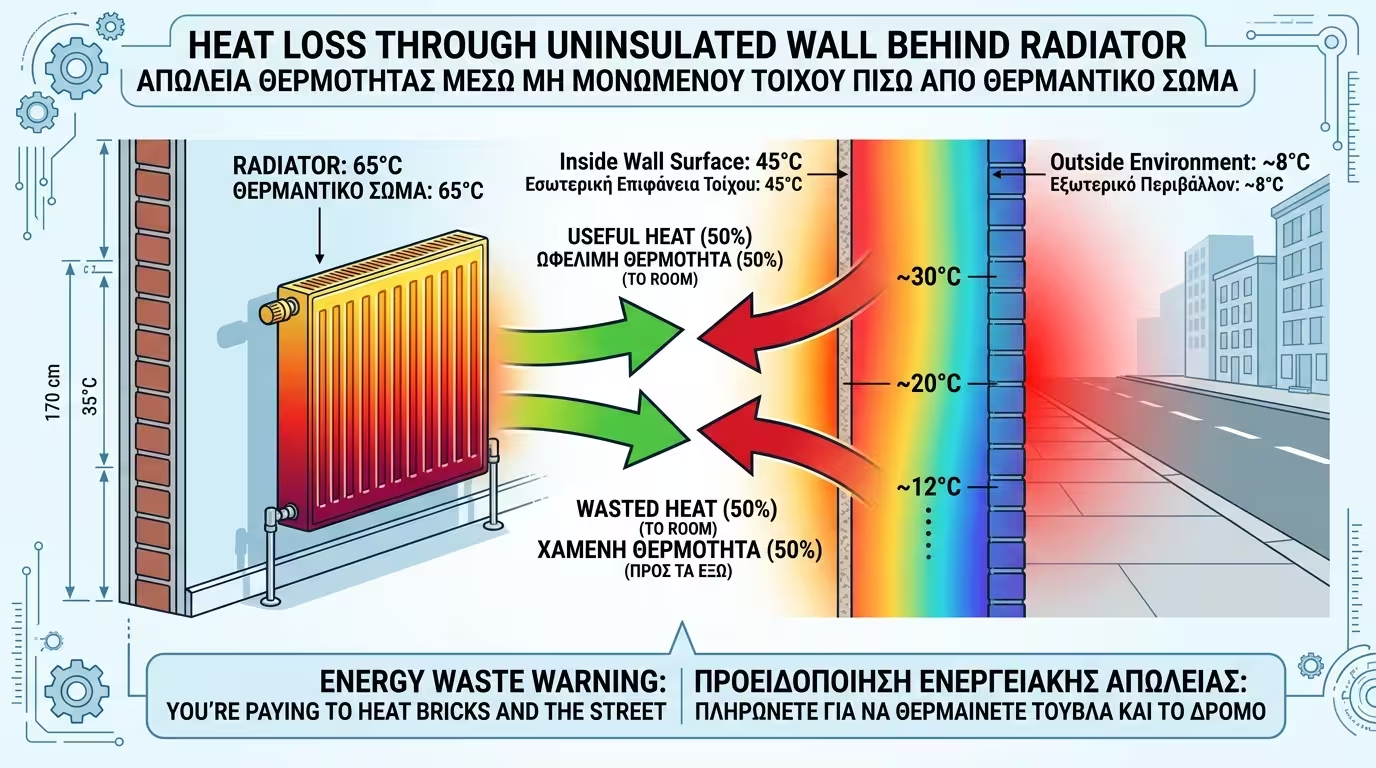
Let's assume our digital house was built in 1985 as a cavity wall with a 6cm air gap in the middle (wall U-Value: 1.80 W/m²K). The house is an energy sieve.
We call the insufflation team and fill those 6cm with graphite EPS beads. The brick wall U-Value plummets to 0.48 W/m²K! We've reduced heat transfer losses through the masonry by approximately 70%.
Although the wall is now perfectly insulated, the concrete beams and columns (which have no cavity) remain uninsulated. Energy will still leak there (thermal bridges). However, the overall improvement at such low cost and zero disruption is enormous.
💡 Conclusion: If your house has empty cavity walls, insufflation is the biggest energy "gift" you can give yourself. It is the smartest, best value-for-money intervention before you even consider external ETICS.
Return to category.
Go to categoryReturn to the central guide.
Go to guide