Thermal Bridges in Cavity Walls - How to Properly Insulate Columns &
Ring Beams
As we saw in the first article of this section, core insulation in the
cavity wall does an excellent job of insulating the… bricks. But what
about the remaining
25% to 30% of a building's façade, which is made of reinforced
concrete (columns, beams, slabs and ring beams)?
In older buildings, these elements were left completely bare. The
result? Heat from the house found an open "motorway" to escape outside.
These leakage points are called Thermal Bridges. If
you're building with a cavity wall today, eliminating these bridges is
legally (per KENAK) and practically mandatory. Let's see how it's done
correctly.
1. The Problem: Why Concrete "Kills" the Insulation
In a typical Greek house, the structural frame (concrete skeleton)
accounts for
20-30% of the external wall area. The reason it creates
thermal bridges is physical:
🌡️ Concrete vs Brick Conductivity
Concrete is an excellent heat conductor - it cools and heats far
faster than brick. Reinforced concrete has a thermal conductivity of λ ≈ 2.0 W/mK, whereas a hollow brick is only 0.4 W/mK. Beams
and columns conduct heat 5 times faster than the rest
of the wall.
🔥 Energy Haemorrhage
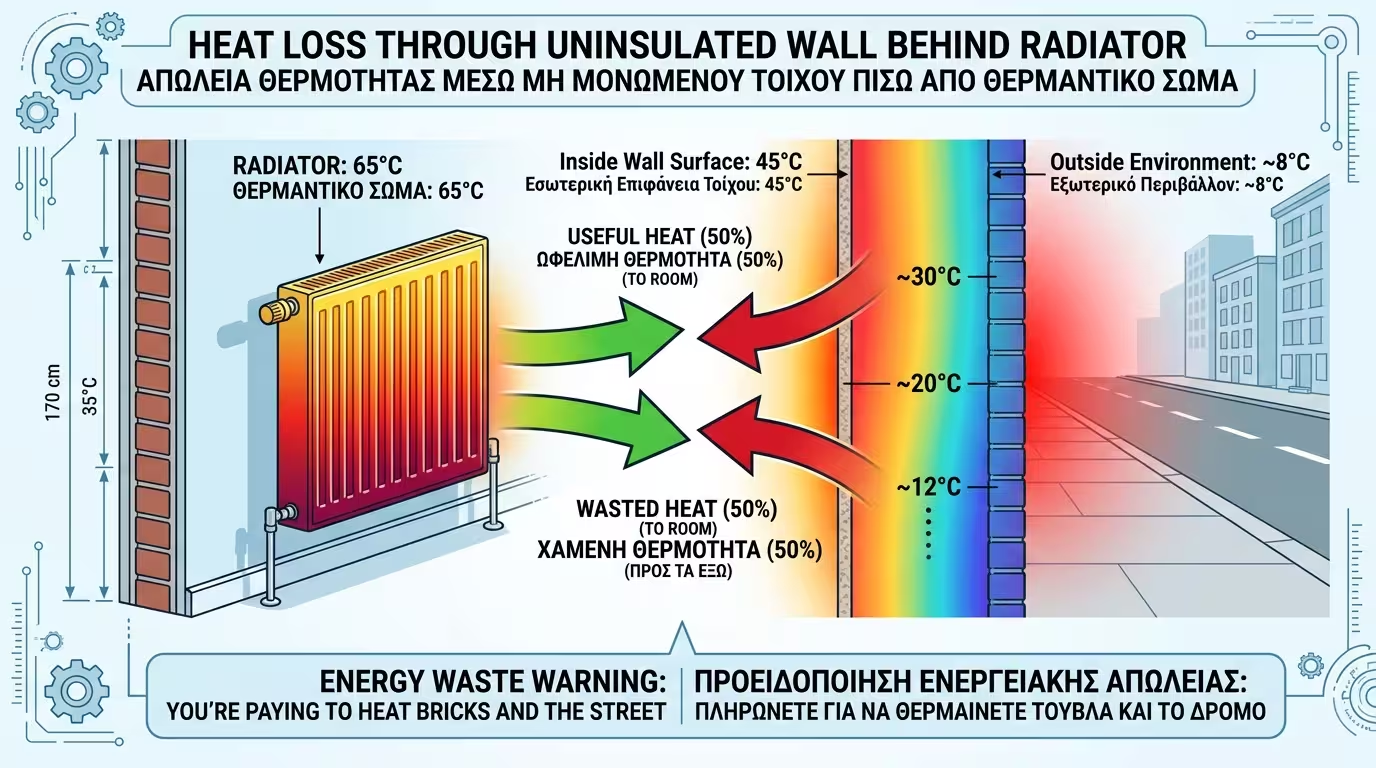
When you have a cavity wall with insulation in the middle, but the
column at the edge of the wall is uninsulated, the radiator works
overtime to compensate for the heat escaping through the concrete.
🧊 Cold Spots & Mould
In winter, the inner surface of an uninsulated column can drop to
8-10°C, while the adjacent wall maintains 18°C.
Room moisture condenses on the cold surface - which is why in older
homes you see black mould high up in the corners of the ceiling
(where beam meets column).
2. The Solution: External Sheathing & "Split" Formwork
The solution must be designed before the concrete is poured.
The structural engineer and architect must collaborate so that every
column, beam and ring beam is insulated.
🏗️ Column Insulation: External Sheathing
Columns cannot be "split" down the middle (they'd lose strength).
They must be
externally clad with special XPS boards (5cm) with a
scored (rough) or grooved surface. These are placed
inside the formwork before the concrete is poured. When the concrete
sets, it "embraces" the rough XPS surface and they become one body.
🔨 Ring Beam Insulation: "Split" Formwork
Ring beams (horizontal concrete strips that tie the brickwork) in
older buildings were poured across the full width of the cavity
wall, cutting the insulation in two. Today, a 5cm XPS strip is placed in the middle of the formwork. This way, the ring beam "splits"
into two parts while the insulation remains continuous from floor to ceiling.
3. "Marrying" the Core and Column Insulation
The biggest challenge is not insulating the column or wall in
isolation. It's joining the two insulations without gaps.
🔗 The Joint: The Most Critical Point
The most critical point in construction is the joint. The column's
external insulation must overlap (lap over) the insulation
inside the cavity wall. Not a single millimetre of gap should remain between
the column's XPS and the brickwork XPS. Every joint is sealed with
special foam tape or polyurethane foam.
🧱 Scored Surface
If the column's external face is to be plastered, the XPS board must
have a
scored (grooved) surface so the render bonds well. If
instead the outer wall is exposed brick, the column insulation will be
"hidden" behind it.
4. The 10x10 Model Experiment
Let's take the 10x10 Model again (cavity wall, 5cm EPS in the core):
❌ Before (Uninsulated Concrete)
Average wall U-Value: 1.15 W/m²K. Mould in corners,
enormous thermal losses.
✅ After (Insulated Concrete)
Columns/beams insulated with 5cm scored XPS. Average U-Value: 0.45 W/m²K. Consumption reduction: 40%.
🏆 Gain
Column inner surface temperature rises from 8°C to 17°C. No more mould, uniform temperature at every point in the house.
💡 Conclusion: If you're building a new home with a cavity
wall, insulating the core is only half the job. The other half - insulating columns and ring beams - is what determines whether you'll have a truly warm, mould-free, energy-efficient
home.