
Paints for Building Facades
Return to category.
Go to categoryWhat "Breathable Paint" Really Means , and Why You Should Never Ignore It on Exterior Facades
If you request a quote for painting a building facade, you will very likely hear the word "breathable." The term is used as a quality marker , almost as marketing , but in reality it refers to a very specific physical property: the ability of a material to allow water vapor to pass through it.
In a building, this property is not a luxury. Masonry produces, absorbs and transports moisture. If the outer paint layer blocks this natural flow, moisture gets trapped , and damage begins silently, from the inside out.
In physics, water vapor always moves from high vapor pressure to low. In winter, this means from the warm interior of the building towards the cold exterior. Along the way, it passes through the mass of the wall , plaster, brick, concrete, whatever material is there.
If at the last layer , the paint , the path is blocked, the vapor does not disappear. It condenses inside the wall or beneath the paint film. The moisture that accumulates there causes blistering, delamination, mold , problems that are often wrongly attributed to "poor quality paint."
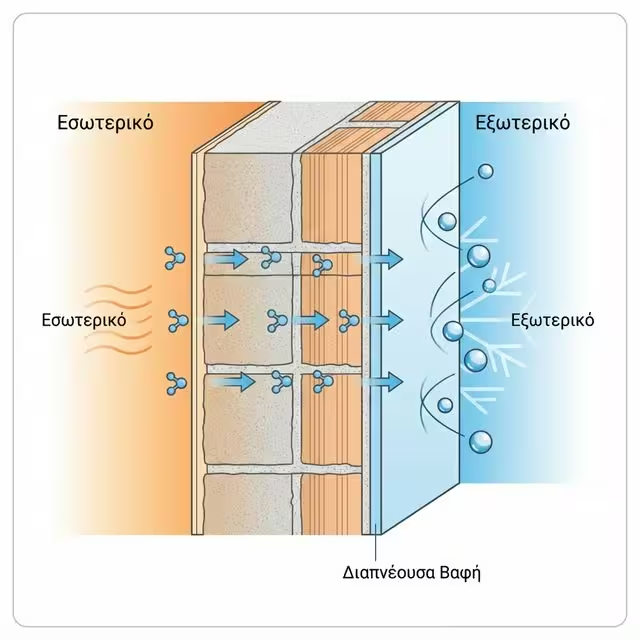
"Breathability" of a material is not simply "yes or no" , it is measurable. The parameter that quantifies it is called Sd value (equivalent air layer thickness). It shows how thick a layer of still air would present the same resistance to vapor diffusion. The unit is meters (m).
For example, a paint with Sd = 0.05 m behaves as if there are only 5 centimeters of air in front of it , vapor passes through very easily. A paint with Sd = 2.0 m is like a 2-meter wall of air - essentially, it blocks vapor entirely.
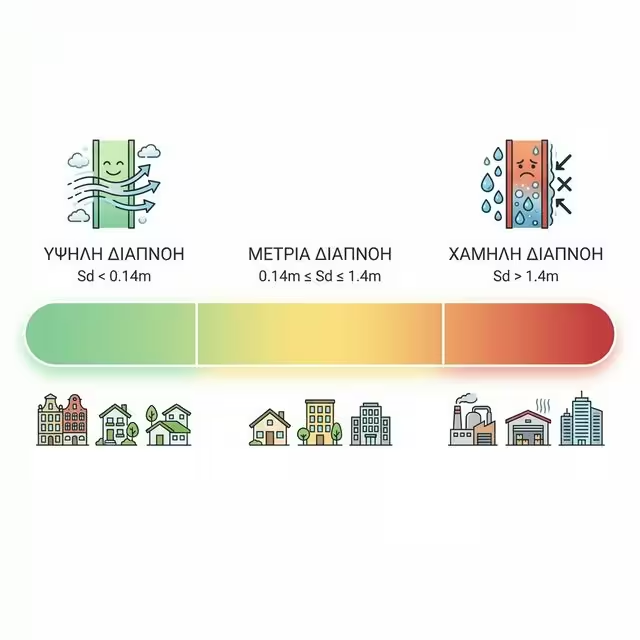
| Sd value | Category | What it means in practice |
|---|---|---|
| < 0.14 m | Highly breathable | Ideal for older buildings or humid climates , the masonry "breathes" freely |
| 0.14 – 1.4 m | Moderate breathability | Acceptable for most applications , as long as there is no pre-existing moisture problem |
| > 1.4 m | Low breathability | Risk of moisture trapping , unsuitable for apartment buildings without external insulation |
The rule is simple: the lower the Sd, the more freely the masonry breathes. However, it is not enough to look at the paint alone , the entire system (primer + intermediate coats + topcoat) must be evaluated as a whole.
A single-family home can tolerate some margin of error. In apartment buildings, however, the situation is significantly more demanding. Dozens of households produce moisture (cooking, bathing, breathing), the north-facing side receives rain without sun, and many walls have thermal bridges due to older construction practices.
If in this environment a coating system is applied that repels rain but does not allow vapor to escape, a "trap" is created: moisture gets in but cannot get out. The result appears after 1–2 years , and is usually wrongly attributed to paint quality.
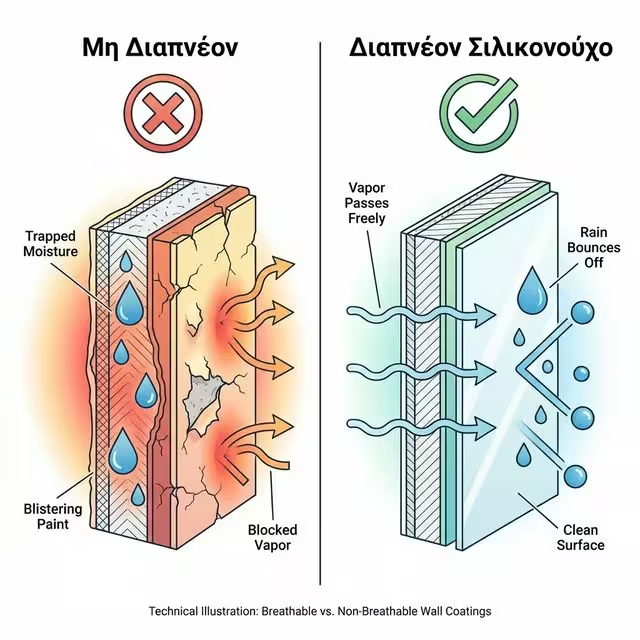
The ideal coating must do two opposite things simultaneously: repel rain (hydrophobicity) but allow vapor to pass through (breathability). This balance is not automatic , and not all systems deliver it.
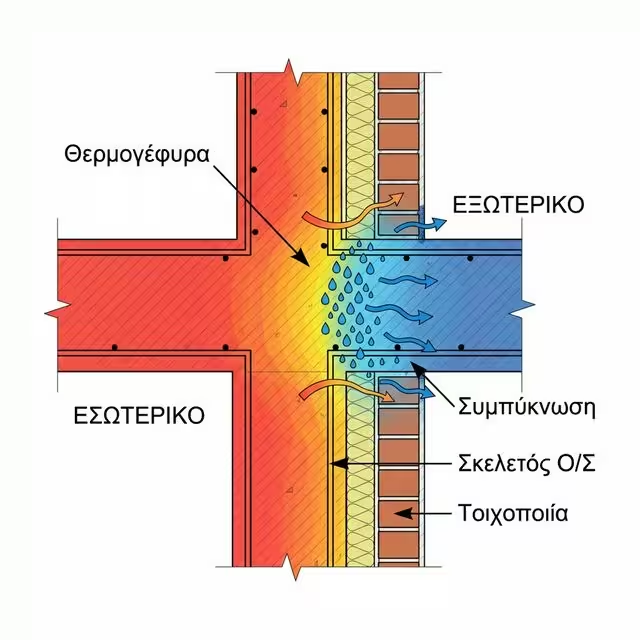
In most Greek buildings constructed before 2010, thermal bridges exist: points where the structural frame (columns, beams) is in direct contact with the outside air. At these points the interior surface cools down enough to drop below the dew point , the point where water vapor turns into liquid water.
Condensation is not always visible. It often happens inside the wall mass , at a depth that cannot be seen but rots the materials. If the exterior coating system does not allow this moisture to evaporate gradually, it accumulates year after year. The results: paint peeling around beam zones, efflorescence (white stains), mold, and ultimately the premature need to repaint the entire facade.
Acrylic exterior paints are the most common choice in the Greek market , primarily because of cost. A quality acrylic can offer decent breathability (Sd around 0.1–0.5 m), but its hydrophobicity is moderate: it absorbs some water.
Silicone-based systems work with different chemistry. The silicone resin creates micropores that let water vapor pass through, while actively repelling liquid water droplets. This combination - low Sd + low water absorption , is the reason silicone-based coatings are considered superior in demanding environments: coastal zones, exposed north-facing facades, buildings with a history of moisture issues.
This does not mean acrylics are "bad" , it means the choice must be made using technical criteria, based on the actual conditions of each facade, and not solely on price.
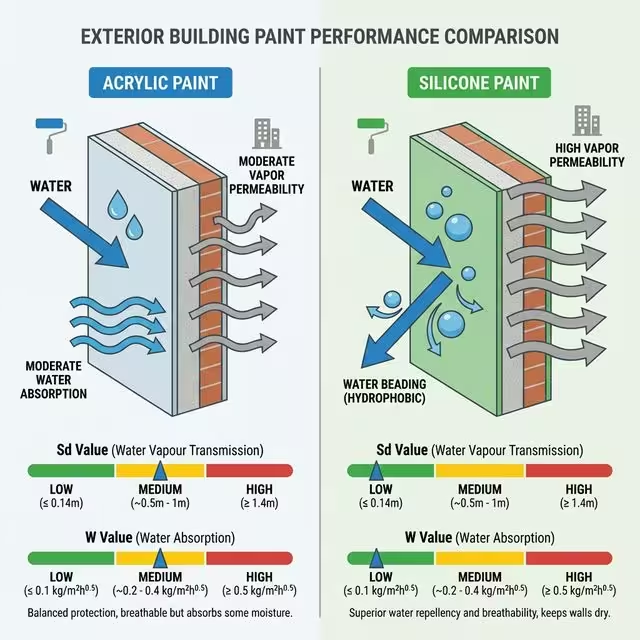
A complete technical evaluation of an exterior wall coating system does not rely on a single number. It requires two parameters examined together:
Sd shows how easily vapor leaves the wall (the "breathing"). W (capillary water absorption coefficient) shows how easily liquid water enters the wall (the "sponge effect").
A system with low W but high Sd (e.g., elastomeric acrylic) may look impressive for the first few years, but can then blister due to trapped moisture. Conversely, a system with low Sd but high W will let rain water be absorbed , equally problematic.
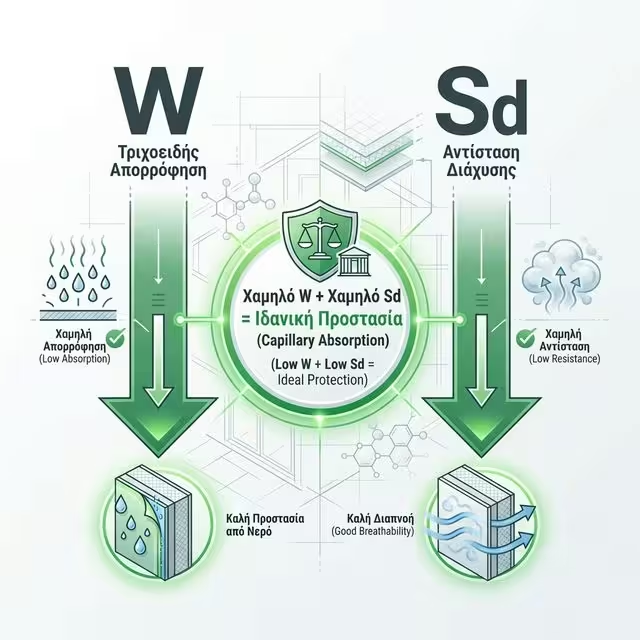
The technical goal is clear: low W (minimal water absorption) + low Sd (high breathability). With this combination, the coating repels rain but allows internal moisture to escape gradually.
The right solution is not "the most expensive paint" , it is the one that matches the physics of the substrate and the climatic conditions of each facade.
When comparing quotes for facade painting, ask for the Technical Data Sheet (TDS) of each product. That is where you will find the Sd and W values , if they are not listed, there is reason for concern. Quality systems publish these values because they are competitive.
Ask the contractor exactly which system they propose (primer + intermediate coats + topcoats) and why. A proper answer includes reference to resin type, film thickness and substrate condition. An answer like "we'll apply two coats of acrylic" tells you nothing.
"Breathability" is not a buzzword. It is a measurable physical property, a critical factor for long-term durability, and a key criterion for selecting an exterior wall coating system. If ignored, even the most expensive paint can fail within a few years.
The right facade coating must combine hydrophobicity, breathability and correct film thickness , based on technical evaluation, not cost alone.
Return to category.
Go to categoryReturn to the central guide.
Go to guide