🏠 Occupied home
An occupied home is a residential property already used as the potential beneficiary's main residence according to the income-tax return for tax year 2025 and onwards.
The Anakenizo 2026 scheme, officially titled "Home Renovation", is not a simple subsidy for isolated works.
It covers the renovation and mild energy upgrade of older homes, with specific criteria for the owner, the property, the works, the payment flows, and the future use of the dwelling.
Before moving forward, an owner has to answer six core questions: can I enter the scheme, how much money can I get, what works can and must I carry out, what is the process from application to payment, what obligations apply after completion, and what could cause rejection or repayment?
This guide gathers the points that matter to the end user, meaning the owner or household considering an application, and focuses on the parts that practically affect decision-making, cost, execution, and ongoing obligations.
The first and most important question is whether the owner and the property qualify. The scheme is aimed at natural persons, meaning private individuals, not companies.
The decision separates dwellings into two basic categories: vacant homes and occupied homes.
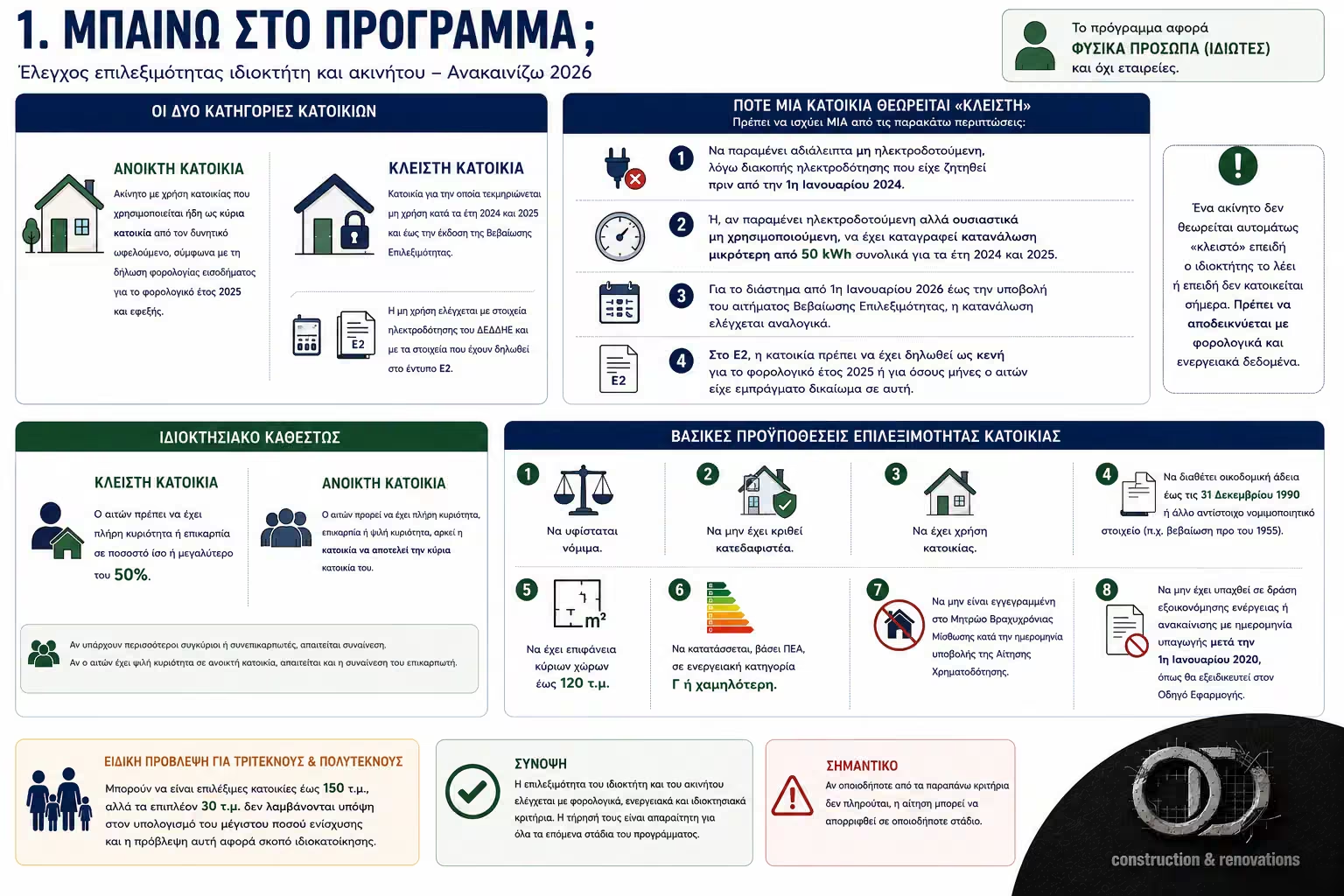
An occupied home is a residential property already used as the potential beneficiary's main residence according to the income-tax return for tax year 2025 and onwards.
A vacant home is one for which non-use is documented during 2024 and 2025 and until the Eligibility Certificate is issued, based on DEDDIE electricity data and information declared in form E2.
To be treated as vacant, the dwelling must either remain continuously disconnected from electricity following a disconnection requested before January 1, 2024, or, if still electrified but essentially unused, show total consumption below 50 kWh for 2024 and 2025. From January 1, 2026 until the eligibility request, consumption is checked on a proportional basis.
In the E2 form, the dwelling must be declared as vacant for tax year 2025 or for the months during which the applicant held a real right over it. A home is not automatically considered vacant just because the owner says so or because nobody lives there today.
For a vacant home, the applicant must hold full ownership or usufruct of at least 50%. For an occupied home, the applicant may hold full ownership, usufruct, or bare ownership, provided the property is the applicant's main residence.
To qualify, the dwelling must legally exist, must not have been designated for demolition, and must have residential use.
The home must have a building permit issued by December 31, 1990 or another equivalent legalization document, such as a pre-1955 certification.
Main spaces must not exceed 120 sq.m., and the property must fall under energy class C or lower according to the Energy Performance Certificate.
The property must not be registered in the Short-Term Rental Registry on the date the funding application is submitted, and it must not have entered another energy-saving or renovation action with an approval date after January 1, 2020, as the implementation guide will specify.
For families with three or more children, dwellings up to 150 sq.m. may qualify, but the extra 30 sq.m. are not counted in the maximum grant calculation, and this rule is tied to owner occupation.
⚠️ If there are multiple co-owners or co-usufruct holders, consent is required. If the applicant only has bare ownership in an occupied home, the usufruct holder must also consent.
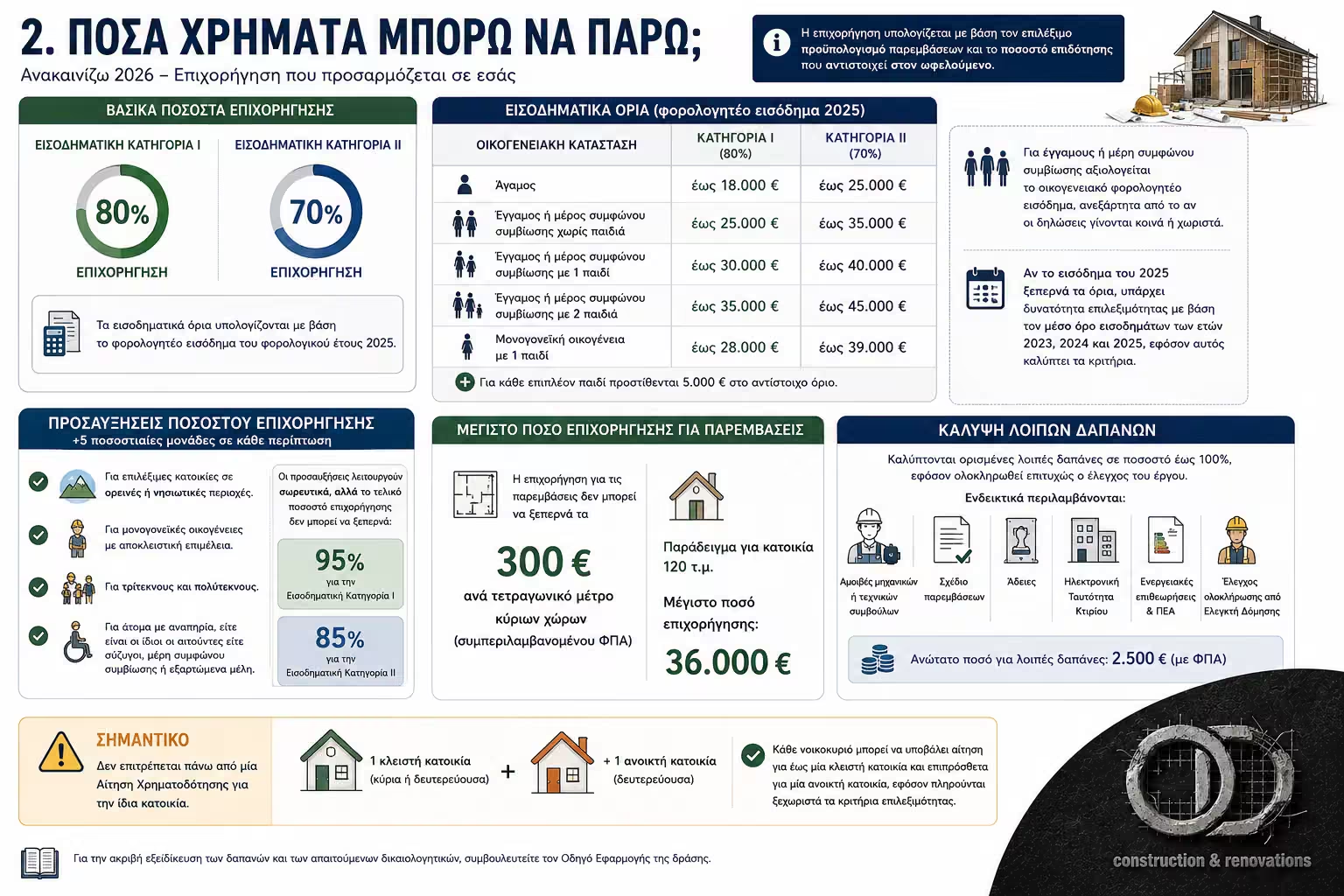
The program does not give everyone the same subsidy rate. The rate depends mainly on the household income category and may increase through specific bonuses.
| Category | Base grant | Indicative 2025 limits |
|---|---|---|
| Income Category I | 80% | Single up to €18,000, married without children up to €25,000 |
| Income Category II | 70% | Single up to €25,000, married without children up to €35,000 |
| With 1 child | 80% / 70% | €30,000 / €40,000 respectively |
| With 2 children | 80% / 70% | €35,000 / €45,000 respectively |
| Single-parent with 1 child | 80% / 70% | €28,000 / €39,000 respectively |
The two main income categories are Category I at 80% and Category II at 70%. For each additional child, €5,000 is added to the relevant income ceiling.
Thresholds are calculated based on taxable income for tax year 2025. For married couples or civil partners, family taxable income is assessed regardless of whether tax returns are filed jointly or separately.
If 2025 income exceeds the thresholds, eligibility may still be possible based on the average income of 2023, 2024, and 2025, provided that average meets the criteria.
Base rates may increase by 5 percentage points for eligible homes in mountain or island areas, single-parent families with sole custody, families with three or more children, and people with disabilities, whether they are the applicants themselves, spouses, civil partners, or dependent members.
Bonuses may apply cumulatively, but the final grant rate cannot exceed 95% for Category I or 85% for Category II.
📐 The subsidy for interventions cannot exceed €300 per square meter of main spaces, VAT included. For a 120 sq.m. home, the maximum grant can reach €36,000.
Certain ancillary costs are also covered at up to 100%, provided the project passes the completion check. These include engineers' or technical consultants' fees, permits, the Building Identity file, energy inspections, EPCs, and the completion check by a building inspector.
The upper limit for those ancillary costs is €2,500 including VAT.
More than one funding application for the same dwelling is not allowed. However, each household may apply for up to one vacant home and, additionally, one occupied home, as long as each case meets the eligibility criteria separately.
The scheme does not subsidize only energy interventions, but neither does it support a purely cosmetic renovation without an energy result. Its logic is combined: the home must be functionally renovated and at the same time upgraded in energy terms.
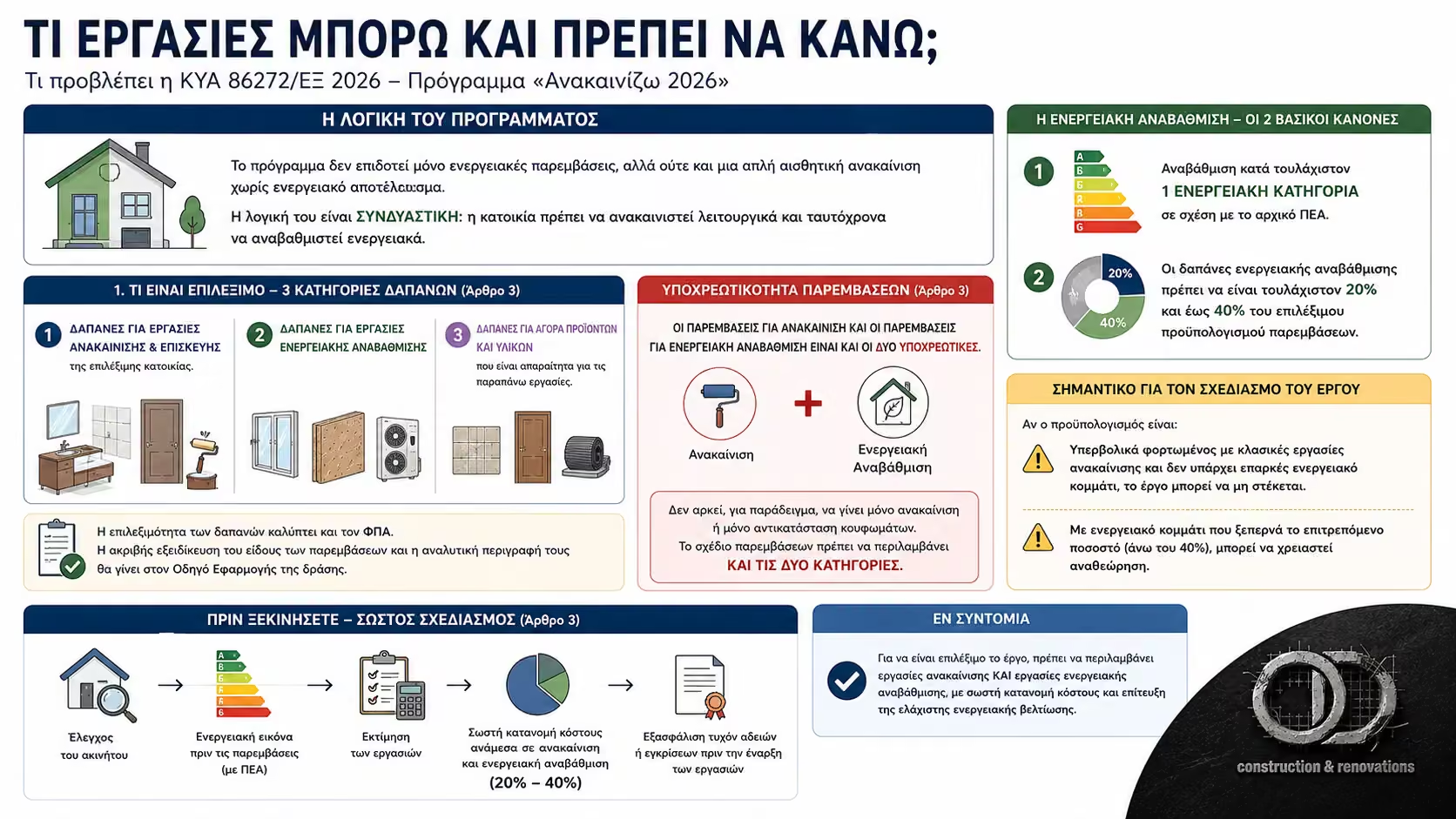
Eligible costs include renovation and repair works for the dwelling, energy-upgrade works, and the purchase of products and materials necessary for those works.
Cost eligibility also covers VAT. The detailed definition of interventions and their analytical description will be set out in the implementation guide.
Renovation interventions and energy-upgrade interventions are both mandatory. A bathroom renovation alone or window replacement alone is not enough.
Energy-upgrade works must improve the dwelling by at least one energy class compared with the initial EPC.
Energy-upgrade costs must account for at least 20% and up to 40% of the eligible intervention budget. If the budget is overloaded with standard renovation works or if the energy scope exceeds the allowed share, the project may need revision.
💡 Before any works begin, the owner should have the technical plan in order: property inspection, pre-intervention energy picture, work estimate, correct cost allocation between renovation and energy upgrade, and any permits or approvals required before work starts.
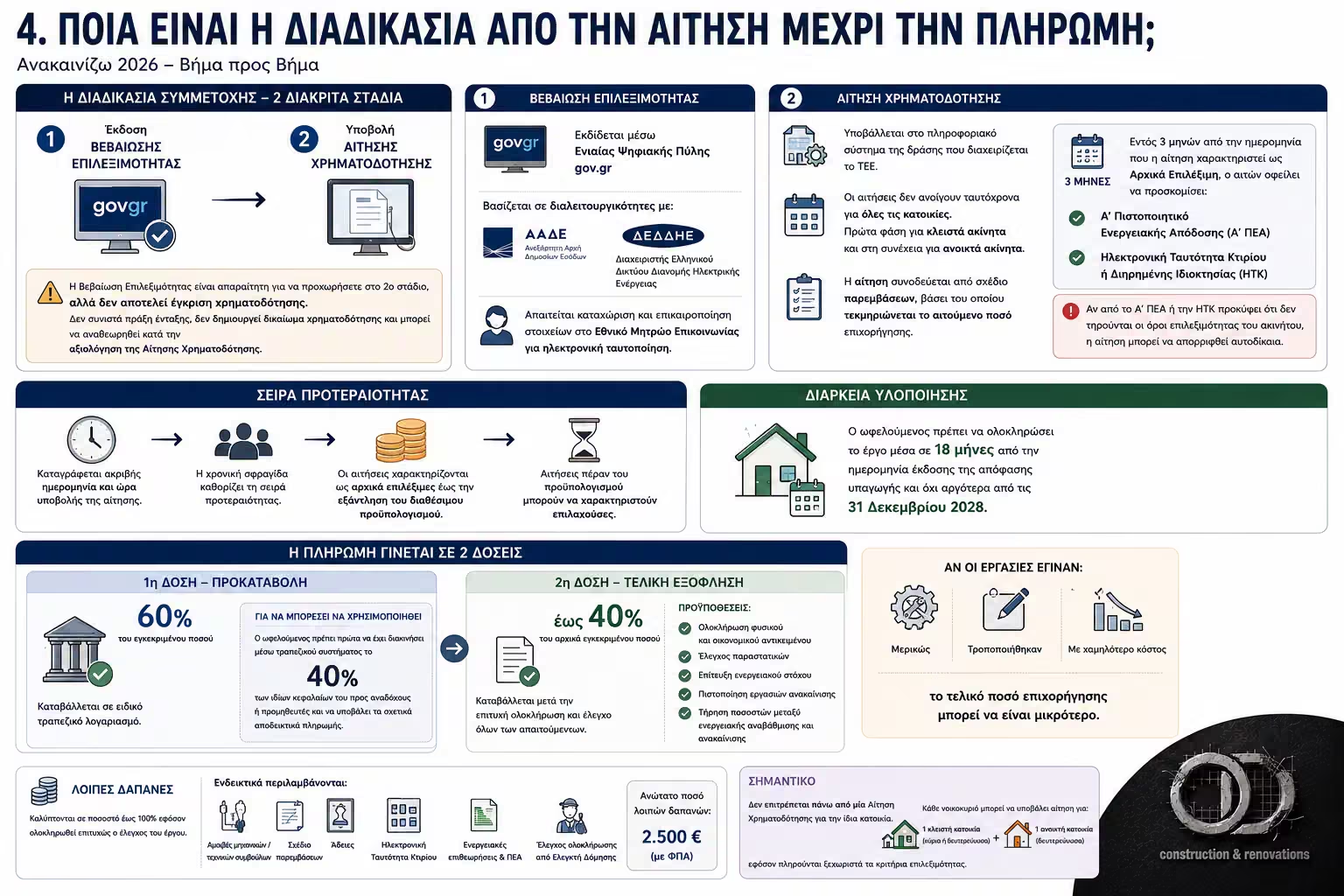
Participation is handled electronically and includes two distinct stages: the Eligibility Certificate first and then the Funding Application.
The Eligibility Certificate is necessary before moving to the second stage, but it does not mean the funding has been approved. It is not an inclusion act, it does not create a financing right, and its data may be revised during evaluation of the Funding Application.
The certificate is issued through gov.gr and relies on interoperability with AADE and DEDDIE. The applicant must have registered and updated details in the National Communication Registry to complete electronic identification.
In the second stage, the Funding Application is submitted through the scheme's information system managed by the Technical Chamber of Greece. Applications do not open simultaneously for all homes: a phase for vacant properties is expected first, followed by a phase for occupied ones.
The application must be accompanied by an intervention plan, and the applicant declares that within 3 months from the date the application is marked Initially Eligible, the initial EPC and the Building Identity file for the building or divided property will be submitted.
An exact date and time are recorded at submission. This timestamp is used for priority order if available resources are exhausted. Applications may be marked initially eligible or placed on a reserve list.
After inclusion, the beneficiary must complete the project within 18 months from the approval decision and no later than December 31, 2028.
Payment is made through a dedicated bank account. The first installment, meaning the advance, corresponds to 60% of the approved amount, but it remains blocked in the dedicated account.
To unlock the first installment, the beneficiary must first move through the banking system 40% of own funds to contractors or suppliers and submit the relevant proof of payment.
After completion of the physical and financial object, invoice checks, achievement of the energy target, certification of the renovation works, and compliance with the required cost ratios, the second installment is paid, up to 40% of the initially approved amount.
If works were partially carried out, modified, or completed at a lower cost, the final payable amount may be smaller.
⚠️ If the initial EPC or the Building Identity file shows that the property does not meet the eligibility conditions, the application may be rejected automatically.
One of the most important points in the program is that obligations do not end when the works are completed. The owner takes on long-term commitments regarding how the dwelling will be used.
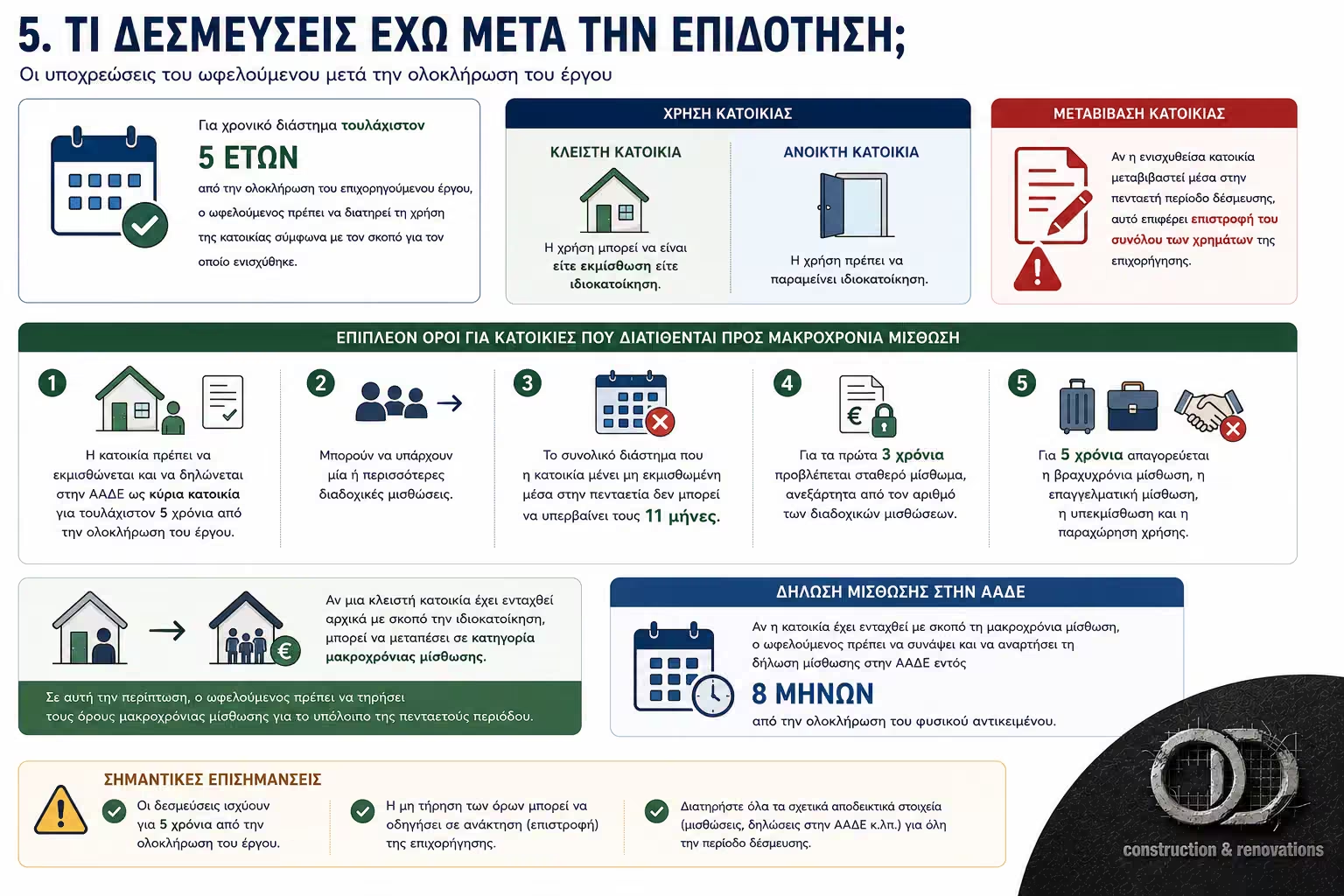
For at least five years after completion of the subsidized project, the beneficiary must maintain the use of the dwelling according to the purpose for which support was granted.
If the dwelling was classified as vacant, its use after completion may be either rental or owner occupation.
If the dwelling was classified as occupied, its use must remain owner occupation.
For dwellings placed on the long-term rental market, the property must be leased and declared to AADE as the tenant's main residence for at least five years after the project is completed. One or more successive leases may be used.
The total non-leased period during the five-year term cannot exceed 11 months. During the first 3 years, a fixed rent is required regardless of how many successive leases are signed.
If a vacant home initially entered the scheme for owner occupation, it may later shift into the long-term rental category. In that case, the beneficiary must comply with the long-term rental conditions for the remaining part of the five-year period.
If the subsidized home is transferred during the five-year commitment period, the beneficiary must return the full subsidy amount.
If the home entered the scheme for long-term rental, the beneficiary must sign and upload the lease declaration to AADE within 8 months from completion of the physical object.
⚠️ For five years, short-term rental, commercial rental, subletting, and free use assignment are prohibited.
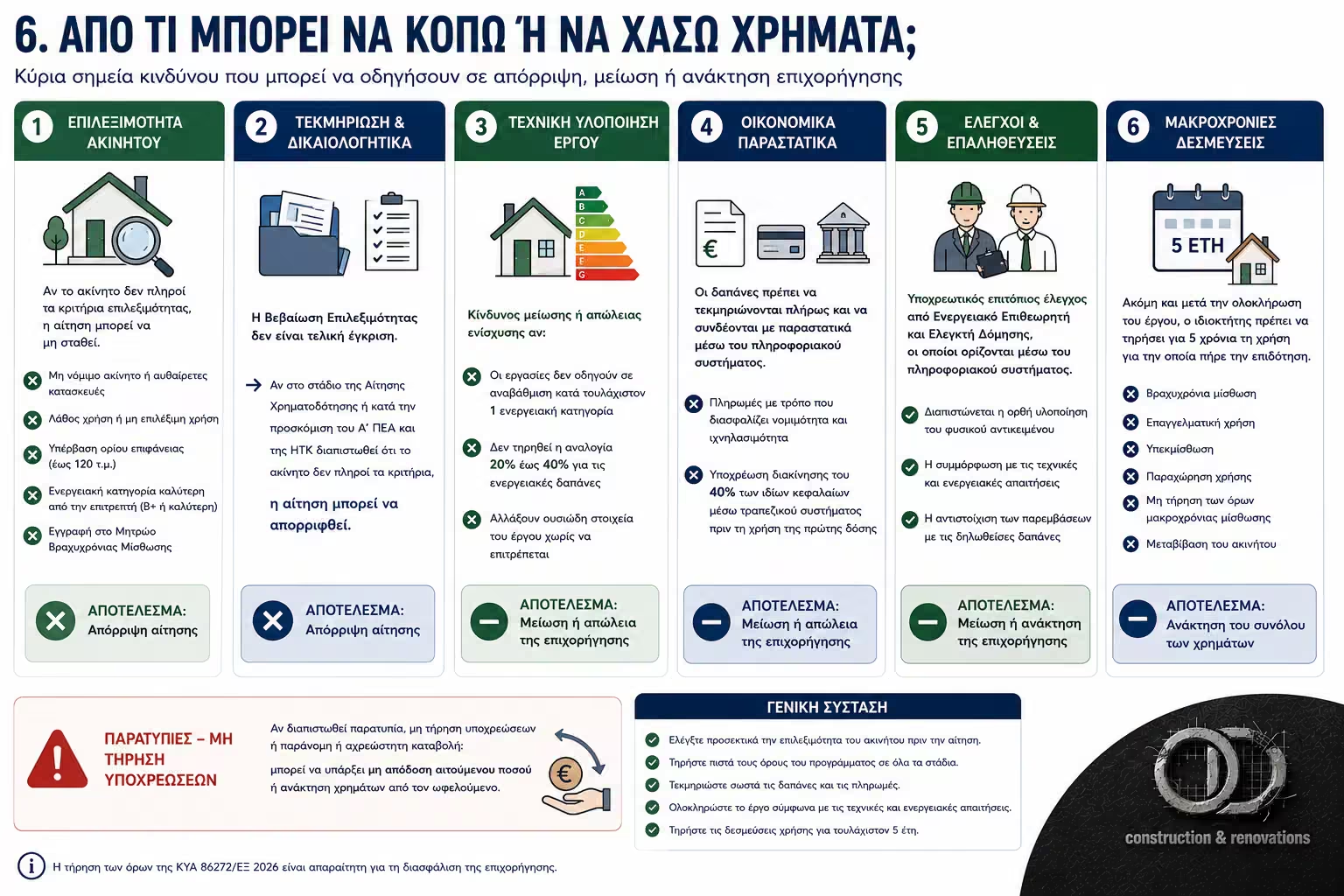
The scheme has several points at which an application may be rejected or a grant may be reduced or recovered. The owner needs to assess risk across multiple layers, not only at submission time.
If the property is not legal, has the wrong use, exceeds the surface limits, has a better energy class than the threshold allows, or is registered in the Short-Term Rental Registry, the application may fail immediately.
The Eligibility Certificate is not a final approval. If during the Funding Application stage or when submitting the initial EPC and the Building Identity file it is found that the property does not meet the criteria, the application may be rejected.
If the works do not achieve at least one energy-class upgrade, if the 20% to 40% ratio for energy costs is not respected, or if core project elements change without authorization, there is a serious risk of reduction or total loss of support.
Costs must be fully documented and linked to the relevant invoices through the information system. Payments must ensure legality and traceability. The need to move 40% of own funds through the banking system before using the first installment must be planned from the start.
A mandatory on-site inspection applies across the subsidized works by an Energy Inspector and a Building Inspector appointed through the scheme's information system. The goal is to verify proper execution of the physical object, compliance with technical and energy requirements, and alignment between declared works and declared costs.
Even if the project is completed correctly, the owner must maintain for five years the use for which the subsidy was granted. Short-term rental, commercial use, subletting, free use assignment, breach of long-term rental conditions, or transfer of the property can all trigger serious consequences.
⚠️ If irregularity, non-compliance, or unlawful or undue payment is found, the requested amount may be withheld or funds may be recovered from the beneficiary.
Anakenizo 2026 may be a major opportunity for owners of older homes, especially where the property genuinely needs substantial renovation and energy improvement. But it is not a program that should be approached casually.
Proper preparation before the application is the most important step. A property may look suitable at first glance but fail because of details such as electricity consumption, the E2 form, ownership rights, the EPC, the Building Identity file, payment flows, or lease commitments.
The final implementation guide will specify many practical details. Until then, owners should treat the ministerial decision as the core framework of rules and prepare with a sound technical and financial plan before moving forward.
If you want to test whether your property stands up technically, fiscally, and operationally before the process opens, a pre-check of the file and the intervention plan is safer than committing money or suppliers too early.
💡 The critical point is not only to submit an application, but to design a project that is eligible, executable, and safe through the full five-year commitment period.
Yes, but non-use must be documented for 2024 and 2025 and up to the Eligibility Certificate, through DEDDIE electricity data and the E2 tax form. For a vacant dwelling, the applicant needs full ownership or usufruct of at least 50%.
The base grant is 80% for Income Category I and 70% for Category II, with possible 5-percentage-point bonuses in specific cases. The final rate cannot exceed 95% or 85% respectively.
No. The intervention plan must include both renovation works and energy-upgrade works. Energy-upgrade costs must represent 20% to 40% of the eligible intervention budget.
There are five-year obligations. If the subsidized dwelling is transferred during the commitment period, the full grant may have to be repaid. Short-term letting is also prohibited and any breach of use conditions may trigger recovery of funds.