
Bathroom Fixtures & Water Equipment
Return to category.
Go to categoryThe shower cabin is one of those options that is often decided too late in the bathroom renovation, when in fact it should have been planned from the beginning. The reason is simple: it's not just a glass that goes over the shower. It's a moving element in a small space, and the way the door opens can make the difference between a comfortable bathroom and one that irritates you every morning.
In a large bathroom, the choices are easier. You can put an opening door, a large fixed glass, and even a walk-in arrangement, without constantly thinking about whether the door will hit the basin or the vanity unit. In most Greek apartments, however, the bathroom is small or narrow. There the cabin has to fit between a basin, a piece of furniture, a sink, an entrance door, a towel rack, a radiator and often a washing machine.
That's why choosing a cabin shouldn't be done only by photo or price. A cabinet may look great in the store, but when it goes into your bathroom it may not open properly. It could be that the door sits on the basin, forces you to enter sideways, drips water out when opened, or leaves such a small opening that daily use becomes uncomfortable.
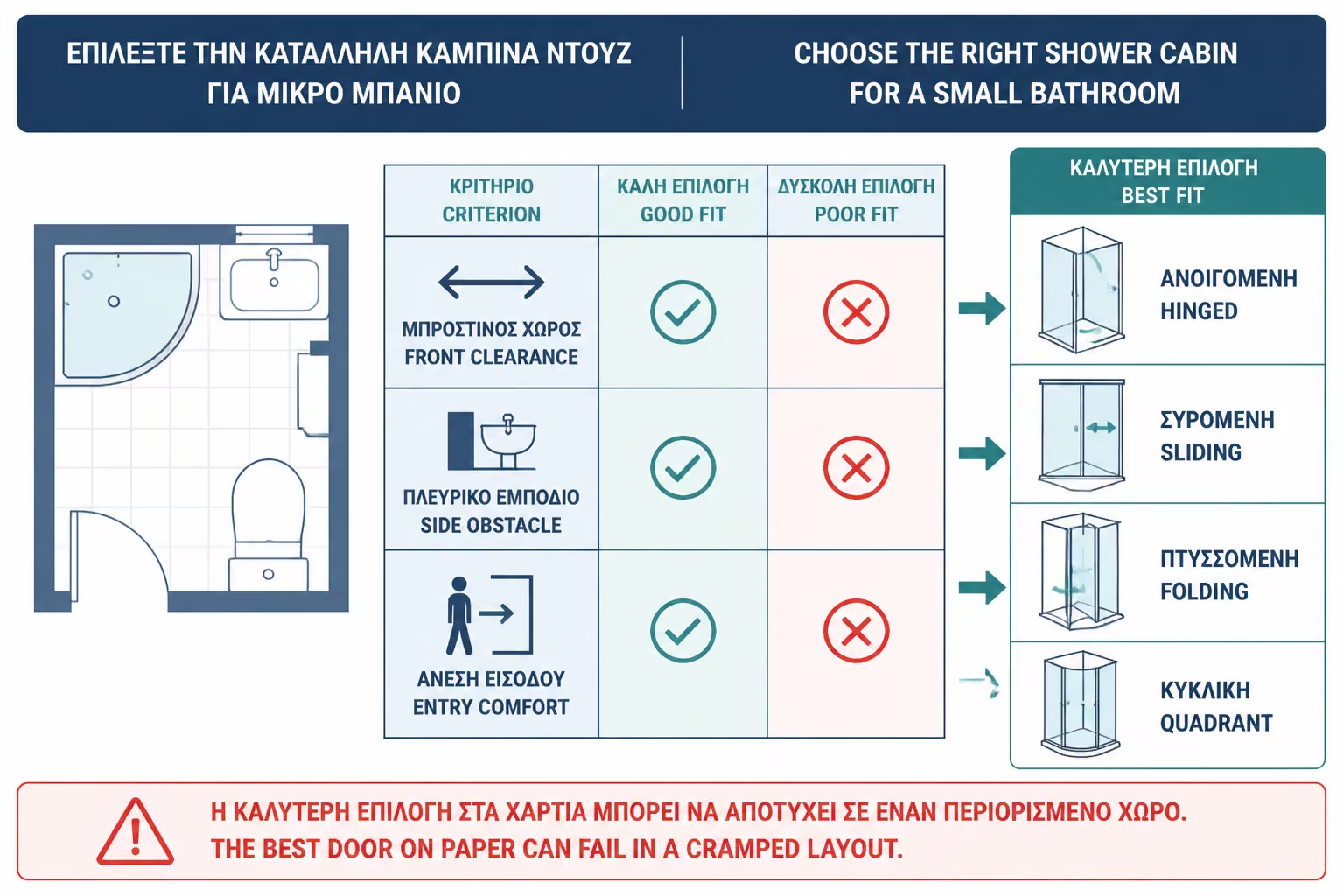
So the right buying guide doesn't start with whether the cabin is "modern". It starts with how it moves in space. Before you decide whether to get an opening, sliding, split or semi-circular one, you need to see the bathroom as a floor plan: where you stand, where you enter, where the door opens, where the water falls and what objects are next to the shower.
In shower cabins, the most critical element is not always the shape. It's the opening. That is, the space the door needs to operate and the clear passage it leaves for someone to enter the shower.
In a narrow bathroom, even 10 centimeters can change the comfort. If the door opens outwards, there must be free space in front of the cab. If there is a pelvis right next to it, the opening can be limited. If there is a vanity unit opposite, the door may not be able to open fully. If the bathroom has a short distance from the entrance door to the shower, the cabin may create a conflict with traffic.
This is also the reason why many times the most beautiful solution is not the most correct. An opening frameless cabin may look great in a showroom, but in a 3 sq.m. bathroom. maybe it's the wrong choice. Conversely, a sliding or split cab may look less impressive in a photo, but work much better in everyday life.
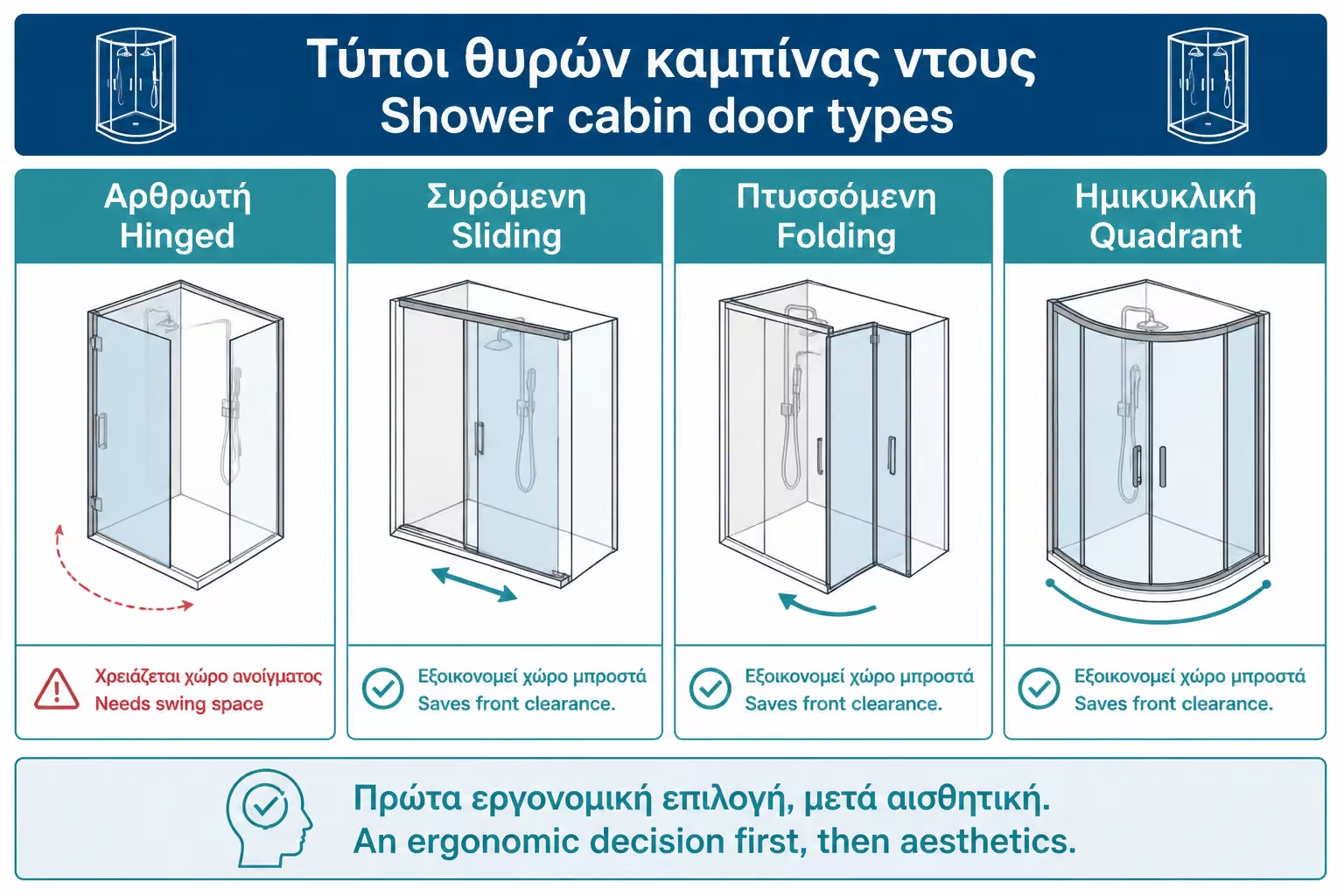
The opening cabin is the simplest and often the most elegant solution. The door opens like a normal door, usually to the outside, with hinges or a pivot mechanism. In frameless versions, with clear crystal and minimal profiles, it can give a very premium effect.
Its big advantage is the comfortable entrance. Compared to a sliding cab, the opening door can leave a larger clear opening. This is important when we want ease of movement, when the user is tall, when there is a need for more comfortable access or when we simply want the cabin to not feel cramped.
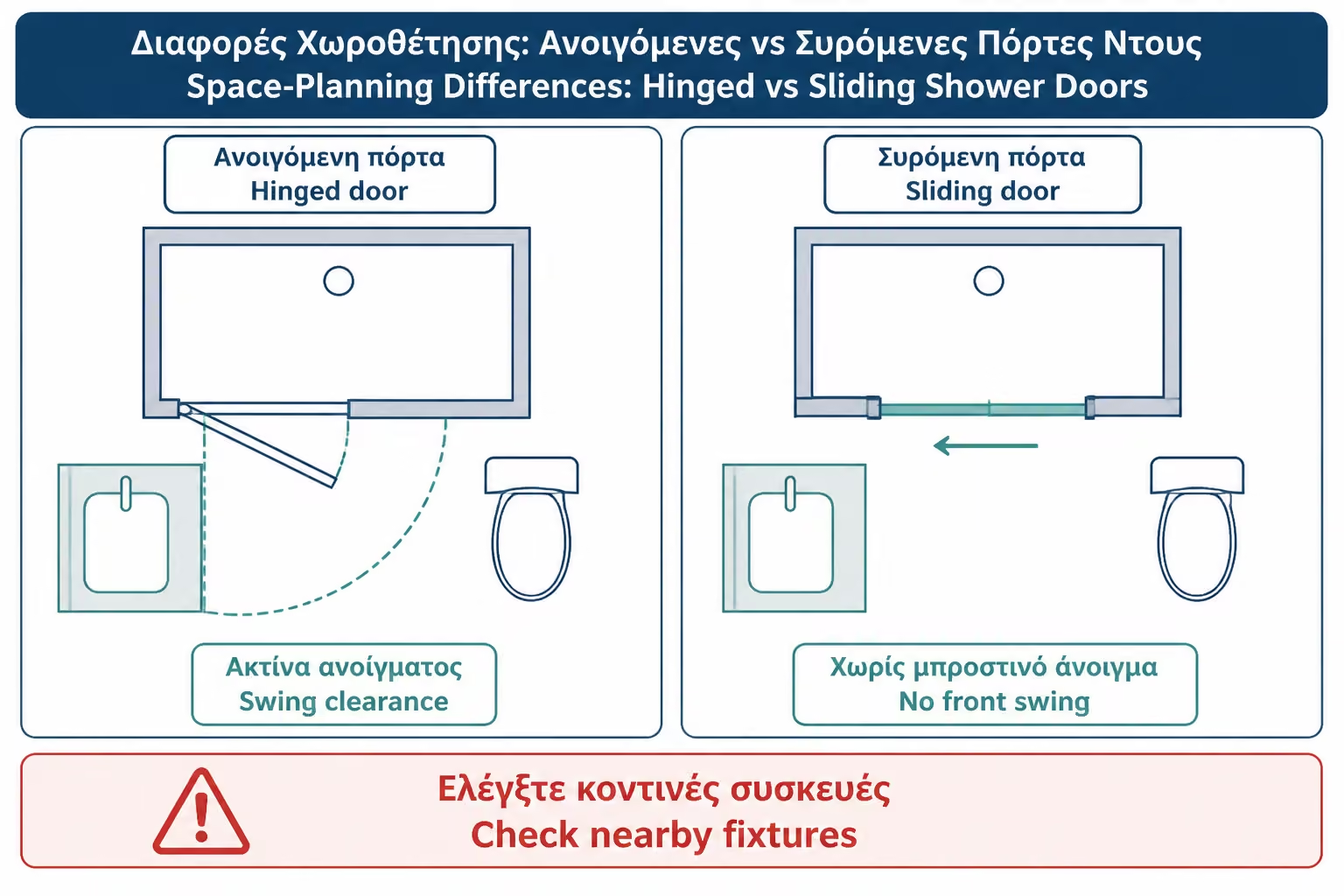
But it has a practical drawback: it needs space in front of it. The door opens and occupies the floor. If there is a basin, sink, washing machine or heater in front, the opening cabin can become a problem. Also, when it opens outwards, the drops left inside the glass can fall on the bathroom floor.
The opening cabin is best suited to bathrooms where there is a comfortable space in front of the shower. It is a very good choice for medium and large bathrooms, for rectangular showers with easy access and for cases where aesthetics are a key criterion. In very narrow bathrooms, a careful check is needed before purchase.
The sliding cabin is one of the most practical options for small bathrooms. The door does not open outwards, but moves parallel to the cabin. So there is no need for a free zone in front of the shower. This is a huge advantage when the basin, furniture or washing machine are close by.
In a narrow bathroom, the sliding door can be the difference between "barely fitting" and "working comfortably". It doesn't hit other sanitary items, doesn't block circulation, and usually keeps water in better because it stays within the contour of the cabin.
Its disadvantage is that it has more mechanisms. Casters, guides, rails and bottom profiles need cleaning and some maintenance. In hard water areas, drivers can pick up salt. Inexpensive sliding cabins often get tired quickly: the wheels are difficult, the door does not roll smoothly or the tires lose their fit.
Therefore, if you choose sliding, it is worth paying attention to the quality of the mechanism. A cheap sliding cab may look good at first, but day-to-day use will tell the difference very quickly. Good rolling, spare wheels, robustness of the profile and ease of cleaning are more important than a small difference in price.
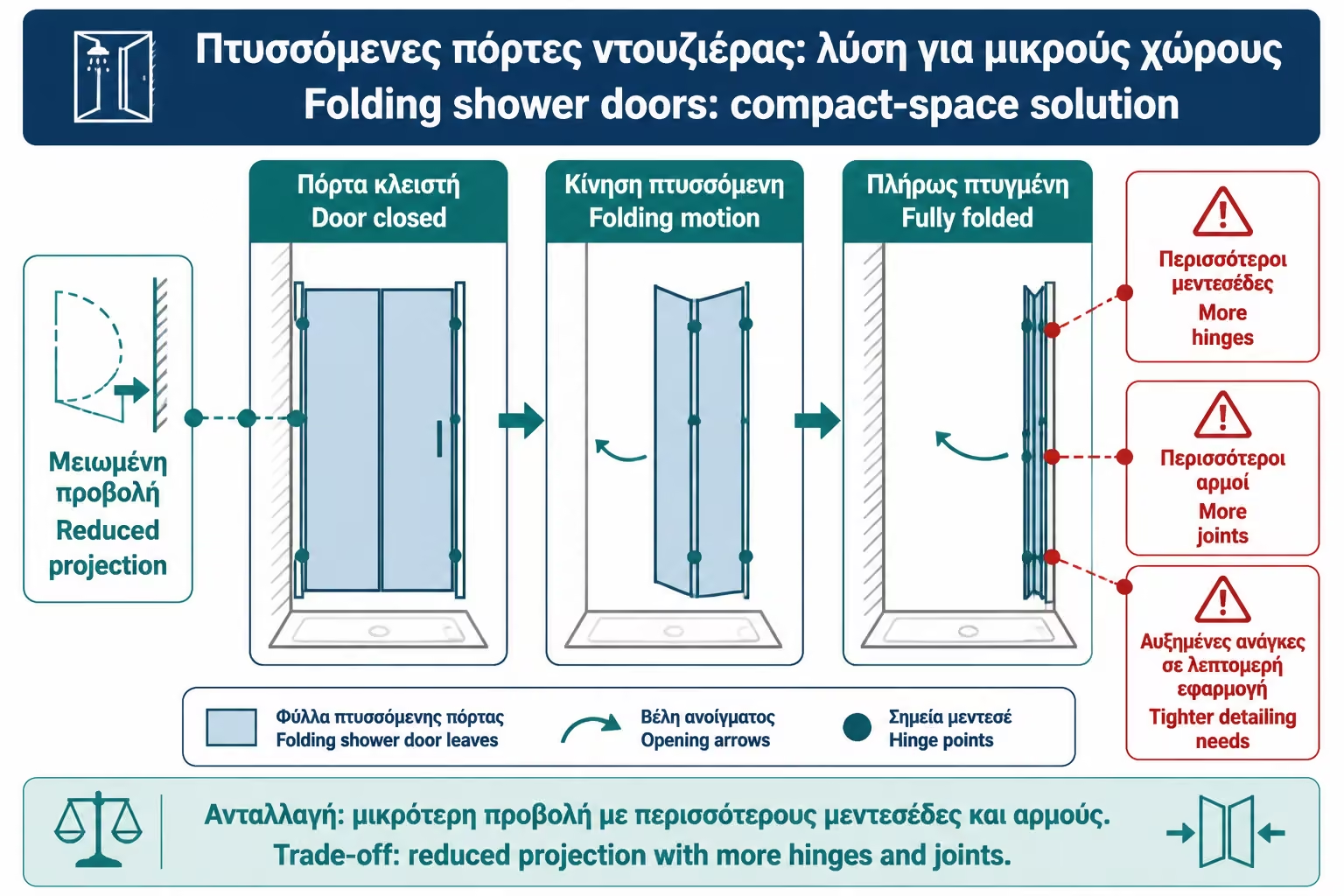
The split cabin, also known as folding or bifold, is a very interesting solution for small bathrooms. The door folds inwards or in sections, greatly reducing the space required for opening. It is essentially a solution that tries to combine the space saving of the sliding door with greater ease of entry.
It is particularly suitable when there is no space in front of the cabin for an opening door, but the sliding one does not leave enough clear opening. In small showers, a folding door can provide a more comfortable entry than a sliding one, because the sheets "collect" rather than permanently covering part of the opening.
The downside is that the split cab has several mechanisms and joints. It needs good quality so that it does not loosen, distort and become difficult to clean. In very economical versions, it can give a feeling of light construction. Also, because it has more moving parts, the tightness and durability of the tires must be checked.
The split cab is a very good solution for smart ergonomics, but should be purchased with care. It's not the cabin we'd choose just because it's cheap. It is the cabin we choose when space is difficult and we want to gain openness without sacrificing all practicality.
The semicircular cabin is very common in small bathrooms, especially in dimensions such as 80×80 or 90×90. Its shape follows a curve, usually with two sliding leaves, and is placed at an angle.
Its great advantage is that it cuts corners. In a small bathroom, a square cabinet can protrude too far and make it difficult to move around the basin or sink. The semi-circular allows smoother traffic. It does not have a sharp outer corner and often makes the space look more comfortable.
It is a solution that is chosen not so much for its premium aesthetics as for its practicality. In very small bathrooms, it can be the best solution because it allows a cabin without "cutting" the space. If the bathroom is narrow and the shower is next to the basin, a semi-circular one can provide much better circulation than a square one.
Its disadvantage is that its interior can be more limited. A semicircular 80×80 does not give the same comfort to the body as a rectangular 80×120. Also, curved doors and guides need proper quality and cleaning. If the wheels are of poor quality, use quickly becomes annoying.
In a bathroom, the cabin is not used once. Used every day. That's why ergonomics matter more than first impressions.
Imagine a small bathroom where the basin is directly in front of the shower. A hinged door may not open fully. Even if it opens, the user has to make a weird move to enter. With a sliding or split door, the same bathroom can work much better.
In another example, a 90x90 corner shower can look heavy if a square cabin with strong profiles is entered. A semicircular can leave more space in front of the pelvis and make the movement more natural. It's not about fashion. It's a matter of geometry.
If there's a practical test before buying, it's this: tape the cabin outline and door opening to the floor. Then try standing, mentally opening the door, walking in, walking out, and moving toward the sink or bathroom door. If this movement is not natural, the cabin is not right, no matter how nice it looks.
When we buy a cabin, we usually look at the overall dimension: 80×80, 90×90, 80×120. But that doesn't always tell us how comfortable we get inside. The critical size is the net inlet opening.
In a sliding cab, a part of the facade is always covered by a fixed or sliding sheet. So the passage may be smaller than one imagines by looking at the overall dimension. In an opening door, the opening can be much more comfortable, as long as there is room in front. In a broken door, the clear opening can be very good for a small space if the mechanism is correct.
Before you buy, don't just stop at the cabin dimension. Ask or measure the net opening. A person should be able to get in and out comfortably, not squeeze each time. This is even more important if the bathroom will be used by an elderly person or someone with limited mobility.
In small bathrooms, the first thought should be: "where will the door go when opened?". If the answer is "on the basin", "on the furniture" or "I don't know", then the opening cabin is probably not the right solution.
For very small bathrooms, the most practical options are usually sliding, split or semi-circular. Sliding is a safe choice when we want no space in front to be occupied. The split is excellent when we want a better opening but don't have room for an opening. The semi-circular is very useful when the shower is in the corner and we want to soften the traffic.
The opening is not prohibited in a small bathroom, but must be confirmed by measurement. If it has enough space in front and doesn't collide with anything, it can give a much cleaner and more comfortable result. But if it is borderline, it is better to avoid it.
In medium and large bathrooms, the options open up. The opening cabin becomes more attractive because it offers a larger entrance, better aesthetics and fewer mechanisms compared to a sliding one. It can be combined with fixed crystal and give a more premium effect.
Sliding remains practical if we want to limit the waters and keep the traffic clear. Split makes sense mainly when there is an obstacle, while semi-circular is usually used in corner layouts that want to save space.
In a large bathroom, it is often worth considering a walk-in solution instead of a completely closed cabin. But if we want to keep the heat better and limit the water, a quality closed cabin remains an excellent choice.
The difference between a good and a bad cabin is not always apparent at first glance. It shows after months of use. A cheap cab might have thin profiles, mediocre wheels, tires that harden fast and guides that pick up salt. At first everything works. Then the door starts to rattle, make noise or not seal well.
The thickness of the crystal also plays a role. 5–6 mm is common in more economical solutions, while 8 mm and above give a more robust feel in better cabins or fixed panels. It does not mean that all thinner glass is bad. But it means that we have to look at the whole: thickness, profile, support, mechanisms and warranty.
In sliding and semicircular cabs, castors are critical. In openables, we look at hinges, rubbers and water drip. In hinges, we look at the joint quality and how firmly the door closes. A good cabin is not only about "beautiful glass". It is a system that opens and closes every day without tiring.
The prices have a wide range, because the cabin can be from a simple standard solution to a custom frameless construction. For a typical Greek bathroom, simple ready-made cabins usually start at more affordable levels, while quality solutions with better crystals, mechanisms and special dimensions go up considerably.
| Cabin type | Indicative purchase cost |
|---|---|
| Simple sliding or square cab | 200–500€ |
| Standard dimension semi-circular cabin | 200–600€ |
| Better cabin with more robust crystal/mechanisms | €500–€1,000 |
| Good quality folding / folding | €350–€900 |
| Opening frameless or semi-frameless | 600–1,500€+ |
| Custom cabin of special dimensions | 1,000–2,500€+ |
| Place | €100–€400+, depending on difficulty |
The prices are indicative. They are affected by dimensions, glass thickness, profiles, mechanisms, anti-lime coating, special order, floor, access and whether corrections are required to the base or walls.
The mistake is to compare only the purchase price. A €250 cabin and a €750 cabin may not really compare. The second can have better glass, better mechanisms, better tightness and longer duration. On the other hand, you don't always need a premium solution. In a secondary WC or rental, a good standard cubicle may be perfectly adequate.
| Bathroom case | More practical option |
|---|---|
| Very narrow bathroom | Sliding or split |
| Shower 80×80 in a corner | Semicircular or sliding |
| Small bathroom with a basin in front of the shower | Sliding / split |
| Medium bathroom with space in front | Opening or sliding |
| Bathroom with elderly user | Large clear opening, often opening or splitting |
| Family bathroom with children | Closed cabin with good tightness |
| Premium aesthetics | Opening frameless or fixed + door |
| Low budget | Standard sliding or semicircular |
The table is not a substitute for measurement. But it gives a first direction.
The right purchase starts with measurement, not model selection. The width of the shower must be measured in more than one place, because the walls are rarely perfectly straight. It must also be checked that the base is horizontal, that the angles are correct and that there is enough room for adjustment in the profiles.
Even more important is to measure the opening space. If it is an opening door, draw the opening radius on the floor. If it is sliding, check the clear passage. If it is a split, see where it folds and how much room it leaves for entry. If it is semi-circular, check how much space it leaves in front of the basin or furniture.
The direction of the bathroom entrance door must also be checked. In small bathrooms, the cubicle door and cubicle door may ergonomically collide, even if they don't literally touch. The bathroom must function as a whole.
The most common mistake is that a cabin is bought based only on the dimensions of the shower. "I have 80x80, so I get 80x80". In practice, this is not enough. We need to know if the walls are straight, if there is an adjustment to the profiles, what the clear opening is and how the door moves.
Second mistake is choosing an opening door in a narrow bathroom without opening control. The result is a cabin that looks good but doesn't open easily. Third mistake is the very cheap sliding cabin with weak mechanisms. At first it seems economical, but after a little use the wheels and guides become the daily problem.
Another mistake is ignoring cleaning. The more profiles, guides and tires a cab has, the more spots there are for salt. If the house has hard water, it is worth considering anti-lime coating on the glass and simpler geometry where possible.
| Inquiry | Yes / No |
|---|---|
| Has the shower been measured at the top, middle and bottom? | Yes / No |
| Do you know the clear cabin entry opening? | Yes / No |
| Has it been checked whether the door is on a basin, a piece of furniture or a washing machine? | Yes / No |
| Is there enough room for an opening door? | Yes / No |
| Are the walls fairly straight or does the cabin have an adjustment? | Yes / No |
| Is the cabin suitable for bathroom use? | Yes / No |
| Have wheels, hinges, tires and profiles been checked? | Yes / No |
| Is there easy access for cleaning? | Yes / No |
| Was placement factored into the total cost? | Yes / No |
| Is there a warranty or spare parts available? | Yes / No |
In a 3 m2 bathroom, where the basin is almost in front of the shower, an opening cabin can be wrong even if it fits in the dimension. The user will have to open the door halfway, twist the body and enter awkwardly. In this case, a sliding or split cabin can be much more comfortable, although it looks less "premium" in the photo.
In another bathroom, 80×80 in the corner, the semicircular cabin can let better circulation than a square one. The curved outer side helps not to "cut" the space in front of the basin. But if the user is tall, the same dimension may seem cramped inside. There it might be worth considering 90×90, if there is space.
In a medium-sized bathroom with an 80×120 shower and clean space in front, an opening door or a semi-frameless solution can provide a more comfortable entrance and a cleaner aesthetic. But if the bathroom is used by children and we want maximum water containment, a closed sliding cabin may be more practical.
Do not buy a shower enclosure based only on the “80×80” or “90×90” dimension. That number only tells you how much space it occupies. It does not tell you whether the door opens properly, whether entry feels comfortable, or whether it will clash with the toilet.
In small bathrooms, door ergonomics matter more than the model's looks. If there is no clear space in front, prefer a sliding, folding, or semicircular solution.
If you choose sliding or semicircular, pay close attention to the mechanisms. If you choose a hinged door, check the opening radius before you place the order.
The right enclosure is the one you do not have to think about every day. It opens comfortably, cleans reasonably, and keeps the water where it belongs.
Buying a shower cabin is not a simple choice between four designs. It's an ergonomic decision. The opening cab gives a clean aesthetic and comfortable entry, but needs space in front. The slide is great for narrow bathrooms, as long as it has good mechanisms. Split or folding is a smart solution when we want to gain openness without taking up space. The semi-circular remains very practical in small corner layouts, because it softens the traffic.
The right choice starts with measurement and use. Where is the pelvis located? Where is the furniture? How much space do we have in front of the shower? Who will use the bathroom? Do we mainly want design, practicality, low cost or ease of cleaning?
In a small bathroom, the best cabinet is not necessarily the most impressive. She is the one who opens properly. In a larger bathroom, we can give more importance to the aesthetics, the thickness of the glass and the frameless effect.
If the cabin is chosen correctly, it becomes almost invisible in everyday life: you enter, shower, exit, and the space remains functional. If the wrong one is selected, it will remind you every day.
Return to category.
Go to categoryReturn to the central guide.
Go to guide