
Bathroom Fixtures & Water Equipment
Return to category.
Go to categoryIn a small WC, the few points make a big difference. It may be that the door opens only marginally, the knees are on the sink, the radiator presses the passage or the space in front of the basin is so narrow that every use seems uncomfortable. In such cases, choosing a basin is not just a matter of aesthetics. It's a matter of functionality.
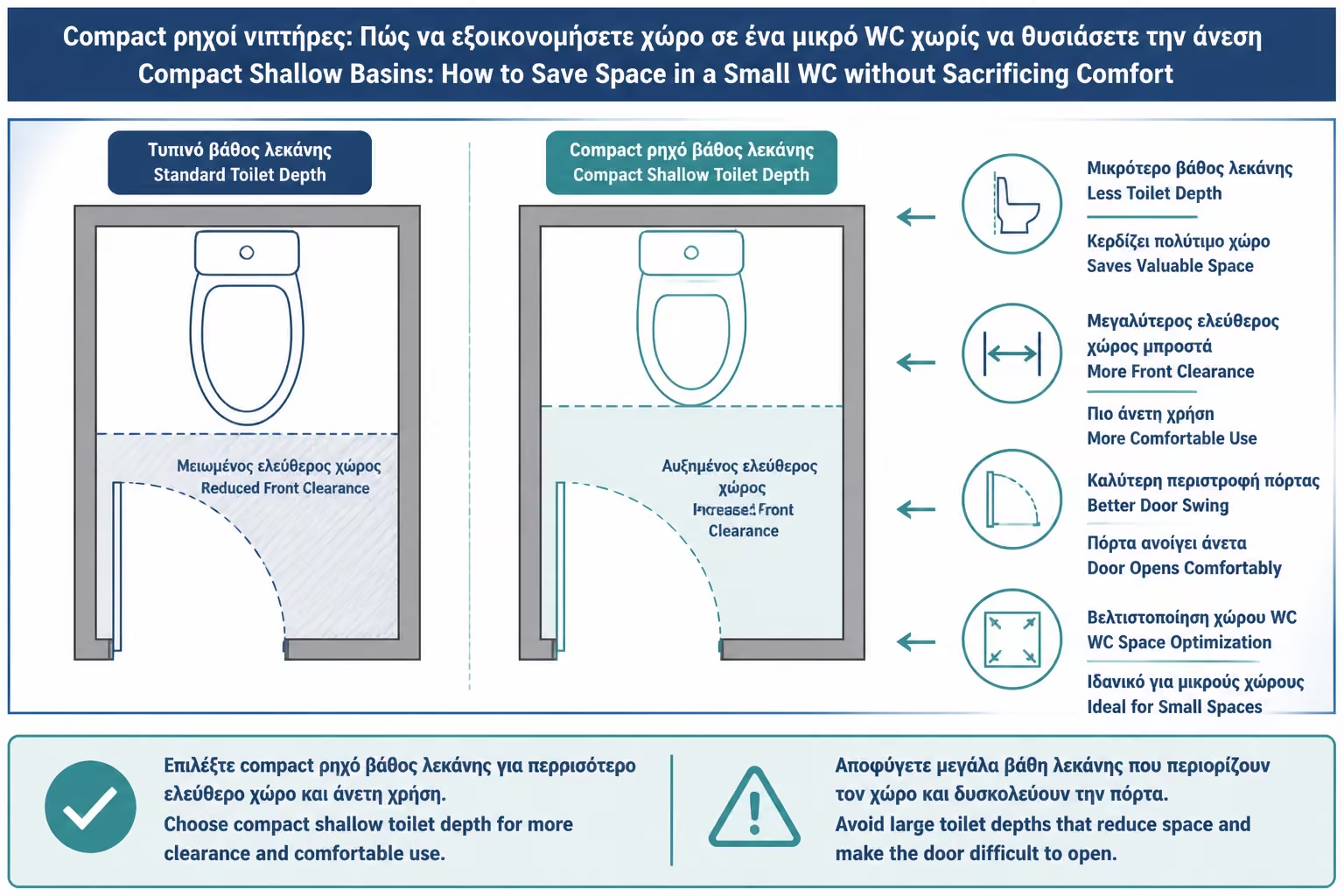
The compact basins of small depth, also known as short projection, were designed exactly for these spaces. They have a smaller projection from the wall to the front to free up space in front of the basin. The difference can be 5, 8 or even 10 cm compared to a deeper basin. In a large bathroom this may seem insignificant. In a 1.00 x 1.40 m WC, however, these centimeters can be the difference between a space that just "fits in" and a space that is comfortably used.
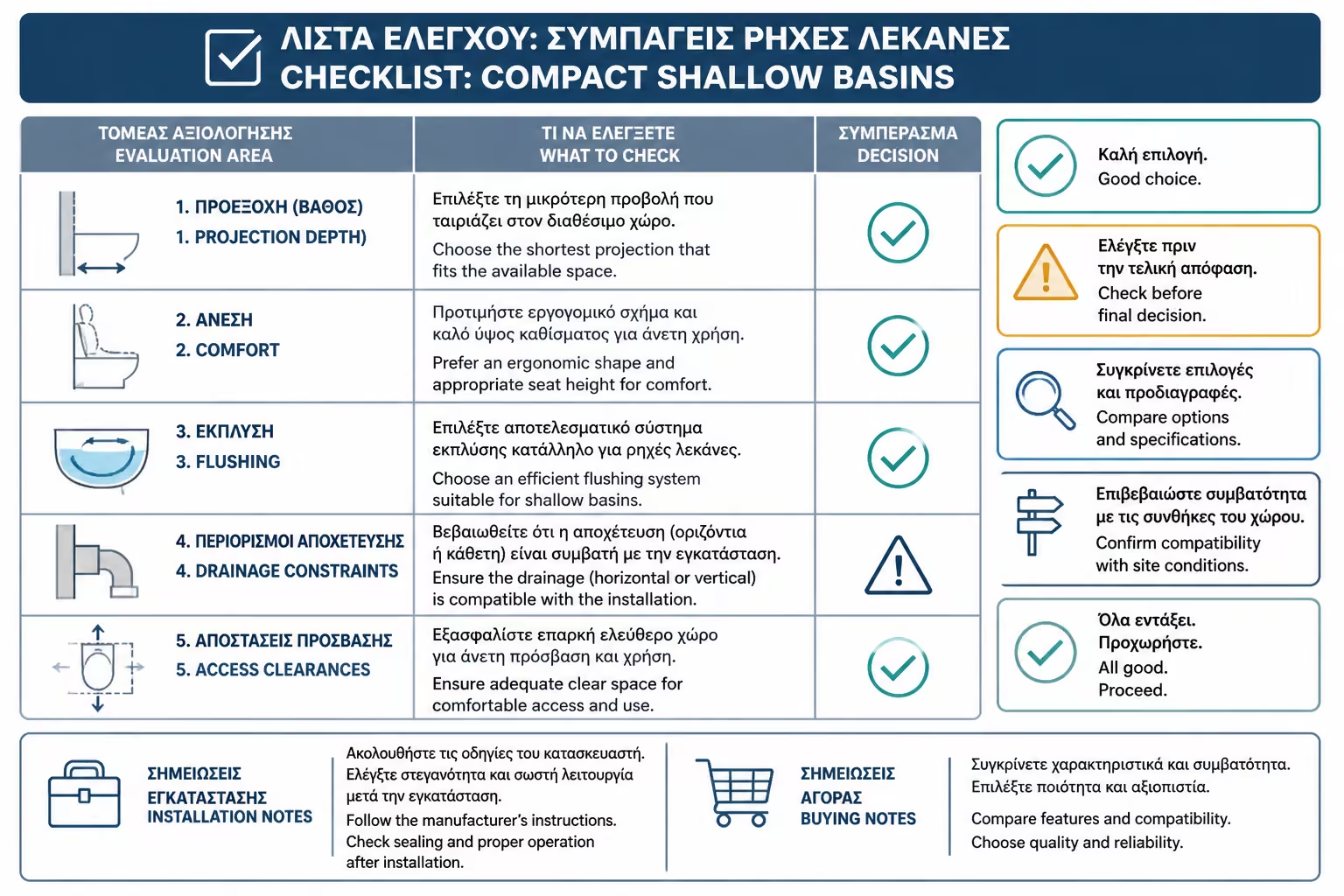
The mistake that is often made is that the owner sees the word compact and thinks that he has automatically found the solution. But a compact basin is not always the right choice for every small bathroom. The depth, width, location of the drain, type of cistern, seat height, lid, distance from the sink and direction of door opening must be checked. If these are not considered together, you can gain five points in the depth and lose the comfort of the seat or make the installation difficult.
In renovations of old apartments, especially in guest WCs or narrow bathrooms of apartment buildings, the choice of basin is often made at the end, when tiles, washbasin, furniture and door have already been decided. That's where the real problems appear: the pan that was liked in the catalog protrudes too far, the door doesn't open fully, the user sits sideways, or the distance from the opposite wall is less than necessary for comfortable use.
The compact basin is a very useful tool, but it is not a magic solution. It can significantly improve a difficult bathroom, as long as it is selected with correct measurements and not just based on the photo. In this guide we will see what "shallow depth" really means, when it is worth it, how much space it can save, what are the dangers of an excessively small basin and how to make the right choice for Greek houses and real renovation conditions.
When we talk about a compact basin, we usually mean a basin with a smaller projection from the wall to the front edge of the porcelain. This projection is the critical size. We are not only interested in whether the basin looks small in the photo, but how many centimeters it actually occupies in the space.
A typical basin can be about 62–68 cm deep, depending on the type and model. A compact basin often runs around 48–56 cm in wall-hung versions or around 56–62 cm in floor-standing solutions with a cistern, depending on geometry and system. In international descriptions, short projection basins are usually considered basins with reduced depth, often up to about 60 cm from the back wall to the front edge.
In the Greek market one can find, for example, hanging compact basins of around 48–50 cm, as well as compact floor sets of around 56 cm projection, depending on the manufacturer and whether a cistern is included. There are 50 × 36 × 35.5 cm models available with a soft-close and quick-release cover, but also small floor solutions with a projection of approximately 56 cm and an integrated cistern.
The important thing is not to confuse "compact" with "narrow". A basin may have a shallow depth but a normal width. This is often a good thing, because it reduces the projection without making the seat uncomfortably small. Conversely, a basin that is too small in all dimensions may solve the space problem but create a new comfort problem.
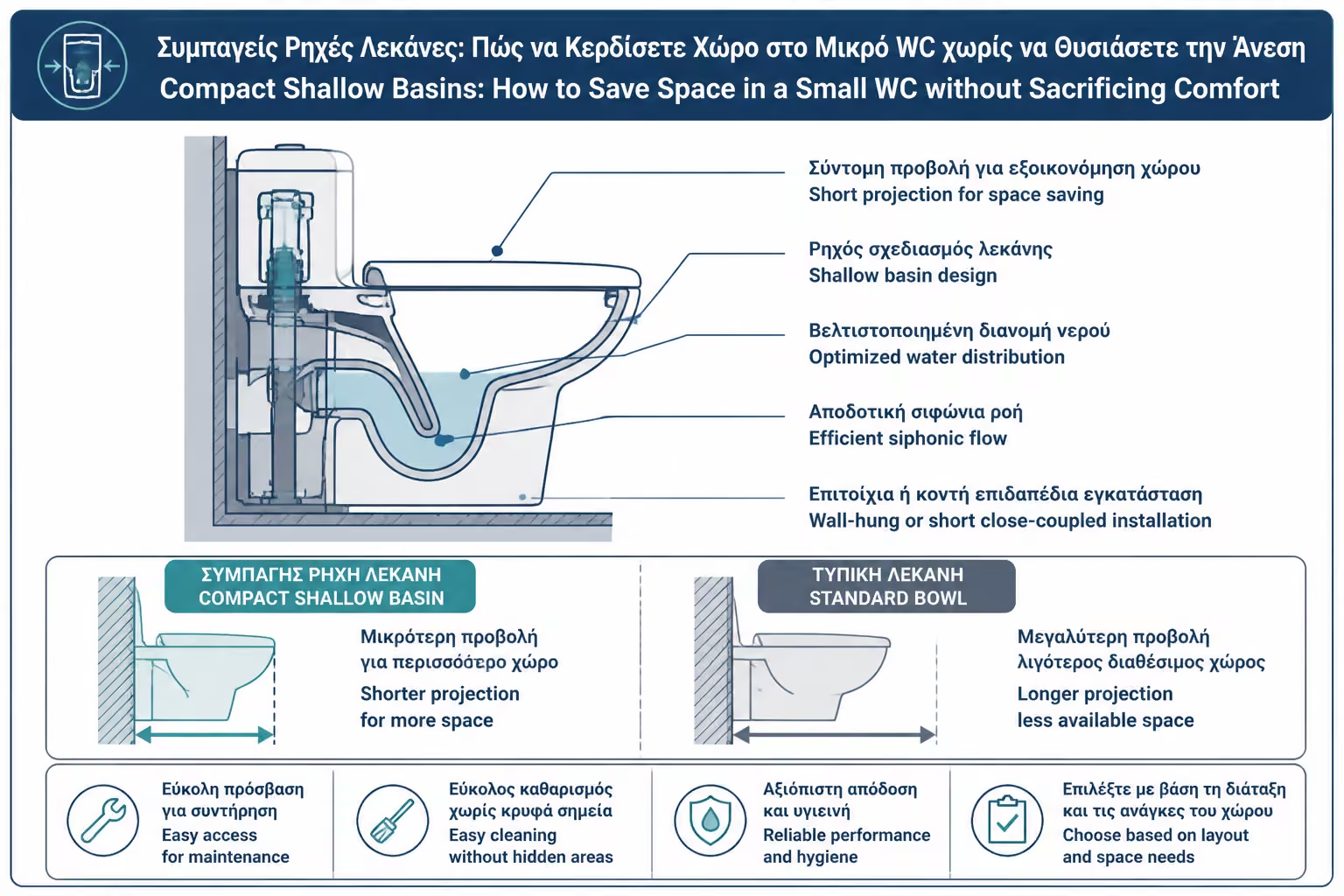
The space you gain with a compact basin is mainly in front of the basin. This means better passage, easier movement, less collision with the door or basin and more comfortable use in a narrow WC.
If you replace an old 66cm deep basin with a 56cm compact, you theoretically gain 10cm. In a bathroom where the free distance in front of the basin was 50 cm, these 10 cm can increase the distance to 60 cm. The difference in feel is huge. It's not just a number on the drawing. It is whether one can stand, turn, bend or open the door without embarrassment.
A classic example is the small guest WC under the stairs or next to the entrance. The space can be 90–100 cm wide and 130–150 cm long. If a deep basin is inserted and a small washbasin opposite, the use becomes pressing. With a compact basin and a proper shallow sink, the space can be made functional without changing the floor plan.
However, the space gain does not work alone. If the basin gets smaller but the sink remains too deep, the problem is simply transferred. If the door opens inwards and falls on the basin, it may need a direction switch, sliding door or smaller frame. The compact basin is part of the solution, not the whole solution.
The compact basin is especially worth it when the limitation lies in the length of the space. That is, when the problem is that there is not enough distance from the back wall of the basin to the opposite wall, the door, the sink or the shower. That's where the depth reduction gives an immediate benefit.
In a narrow bathroom, for example, where the basin is opposite the sink, every centimeter counts. If the user sits and his knees are too close to the furniture, replacing with a compact model can significantly improve comfort. The same applies to bathrooms where the basin is next to the entrance and the door passes too close to its front end.
On the contrary, if the problem is mainly the width, i.e. the basin is squeezed between a wall and a piece of furniture, a compact basin of small depth may not solve much. There you may need a different arrangement, a narrower piece of furniture, a change of position of a file cabinet or even a redesign of the plumbing. The word compact should not be used as a blanket answer to every small bathroom.
There are also cases where the compact pelvis helps aesthetically. In a small bathroom, a deep basin can look disproportionate, visually "eat" the space and make the passage heavier. A smaller projection gives a cleaner line and leaves more of the floor visible, especially if it's a suspended basin.
There are cases where the compact basin is not the best choice, even though the space is small. The most typical example is when it is mainly used by tall people or the elderly who need more seating comfort. A very short pelvis can feel restrictive, even if it technically fits better.
Also, in bathrooms where there is already enough space in front of the basin, the compact option just for aesthetic reasons is not always necessary. A normal pelvis with better ergonomics, a larger seat and a more stable feel may be a better choice. We don't have to downsize everything just because we can.
Care is also needed when the existing drain does not fit easily with the new model. In older installations, the location of the outlet, distance from the wall and type of connection may limit the options. If a compact basin requires extensive plumbing conversions, the cost and inconvenience may not be justified, especially if the benefit is only a few inches.
Another point is the cistern. In floor basins with a cistern, the overall depth depends not only on the cistern, but also on how the cistern sits on the wall. Some compact solutions are indeed smaller, while others look small but do not save as much as the owner expects. That's why we always look at the overall installation dimension, not just the product description.
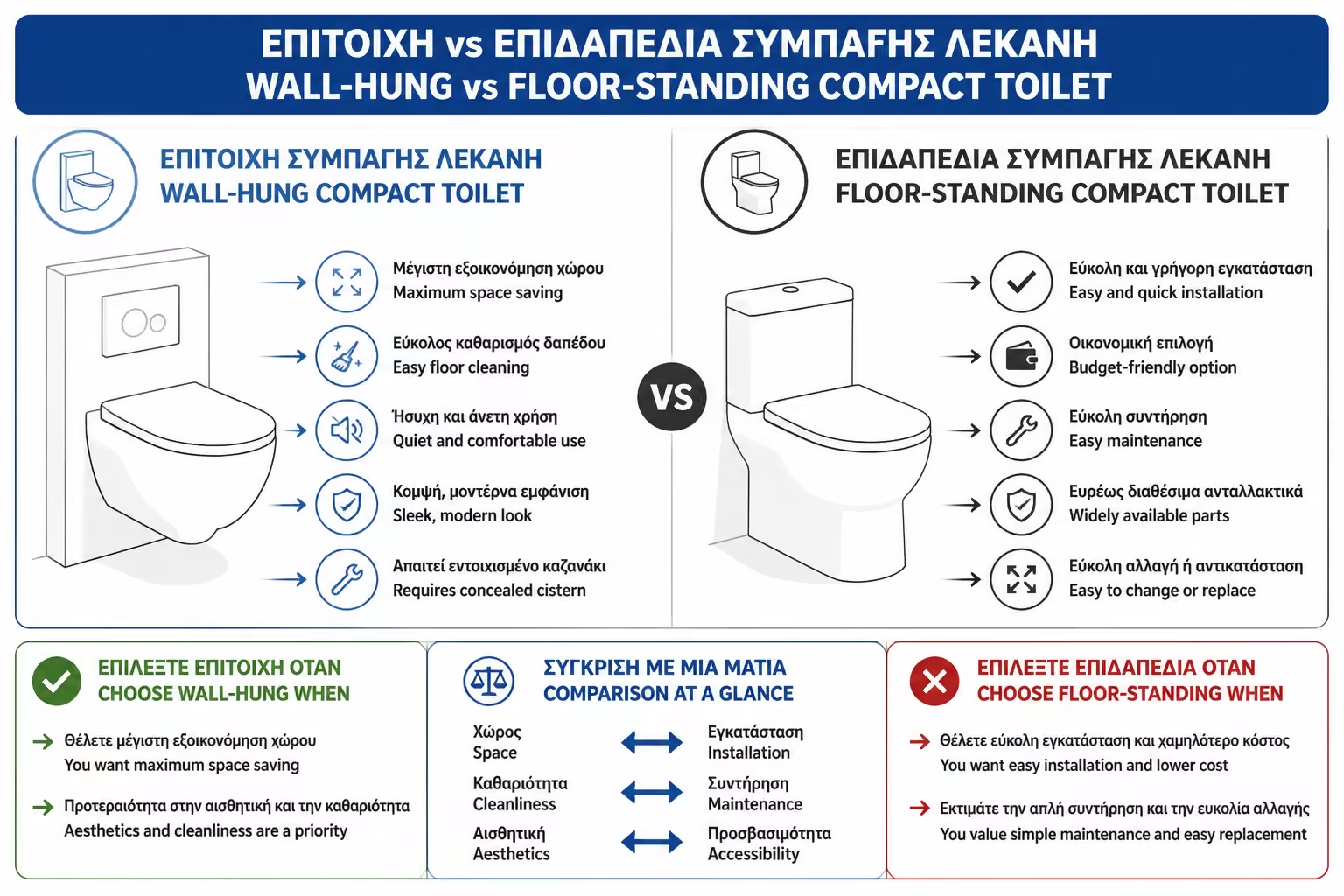
The hanging compact basin is often the most elegant and functional solution for small bathrooms, because it leaves the floor free and makes the space look cleaner. Cleaning under the basin becomes easier, the image is more modern and the projection can be quite small, even about 48–50 cm in some models. There are compact 48–50 cm hanging basins on the market, often with a rimless design and a soft-close cover.
The downside is that it requires a built-in cistern and proper installation. This means cost, technical attention and sufficient depth in the wall or plasterboard/false wall. In a complete bathroom renovation, this can be incorporated properly. In a simple replacement of an old pelvis, however, it may be too much surgery.
The compact floor basin is more practical when we want to replace an old basin without major changes to the installation. There are low-pressure models or spigots with a cistern and a soft-close cover, with a projection of around 56 cm in compact versions. This solution is closer to the classical Greek reality, especially in older apartments where complete reconstruction is not planned.
So the dilemma is not only aesthetic. If you are doing a complete renovation and you can foresee a properly built-in cistern, the hanging compact solution gives better cleaning and a lighter image. If you want a simpler replacement, compact flooring can be more economical and less intrusive.
The main concern with compact basins is whether the smaller projection affects comfort. The answer is: it depends on the design. A well-designed compact basin can be quite comfortable for everyday use, because it reduces the length mainly by the geometry of the porcelain rather than by the useful seat. A bad or too small pelvis, however, can feel restrictive.
The seat must be long and wide enough for the user to sit normally. If the cap is too small or if the inner hole is limited, it becomes inconvenient to use. This is particularly evident in master bathrooms, where the basin is used daily by the whole family. In a guest WC, a smaller basin may be acceptable, because use is shorter and more occasional.
A practical example: in a very small WC, the owner chooses the shortest basin he can find, because he wants to gain as much space as possible. In the drawing everything looks good. But after installation, users feel that they are sitting too close to the wall or that the seat is small. The bathroom won points, but lost ergonomics. The right solution would probably be a compact basin a little bigger, combined with a smaller sink or changing the direction of the door.
So, wherever possible, it's a good idea to see the basin up close before buying. If buying online, look not only at overall depth, but also at seat dimensions, width, shape, and whether the cover is standard or custom.
In a comfortable bathroom, there must be enough space in front of the basin for the user to sit, get up and move around without getting in the way. In practice, the closer the distance drops below about 55–60 cm, the more acutely the narrowness begins to be felt. In very small WCs, we often work with limitations and there is no ideal margin, but we have to know what we are sacrificing.
The compact basin helps right here. If the distance in front is limited, reducing the projection can bring the space into much better balance. It doesn't always need a huge change. Even 6–8 cm can make a difference when the door barely fits or when the user is kneeling in the sink.
Proper checking is done with a tape measure and tape on the floor. Before buying a basin, mark on the floor where the front end of the basin will go. Stand in the space, open the door, try the route to the sink, see where the paper case falls. This simple test reveals problems that cannot be seen on a technical drawing.
In many small bathrooms, the problem is not only the basin, but its relationship with the rest of the elements. If the sink is deep, if the towel rack protrudes or if the piece of furniture has a sharp corner, the compact basin will help but will not solve the feeling of narrowness by itself. The space must be read as a whole.
The combination of a compact hanging basin with a built-in cistern is one of the cleanest solutions for small bathrooms. The cistern is hidden in the wall or in a structure, the basin is suspended, the floor remains free and the space looks bigger. This is especially useful in small WCs, where visual lightness is almost as important as actual centimeters.
However, the built-in faucet doesn't magically make the depth disappear. It needs space inside the wall or in front of the wall. If there is no suitable wall, a false wall is created which can take 12–20 cm, depending on the system and construction. In some cases, this can cancel out some of the gain from the compact basin. In others, the false wall can be cleverly utilized as a shelf or aligned with other installations.
A good example is a narrow bathroom where the back wall of the basin already has plumbing passages or a beam that creates a recess. If the built-in cistern is integrated correctly, the compact hanging basin gives an excellent result. But if the wall is thin and an entire overhang needs to be built, it must be measured whether the final front edge of the basin will actually come further back than a simple floor solution.
Here a technical check is needed before the purchase. The plumber and renovator need to see where the drain is, how deep it is, how the frame will be supported, where the key will fit, and how access will be provided for maintenance.
In old bathrooms, the drainage often determines what can be done. The basin can be posterior, posterior, or have a specific connection to the existing tube. If you buy a compact basin without checking the location of the drain, there is a risk that it will not be connected correctly or that conversions will be required.
Sewer conversions are not always straightforward. It may be necessary to break a floor, change slopes, adapt to pipes, and even intervene in common areas in apartment buildings. In such cases, the cost of the basin is only a small part of the total cost.
An owner may find a very nice compact wall-hung basin, but the old bathroom has a floor drain and a high or low pressure cistern with a different logic. The conversion can be done, but it is not a simple "change of pelvis". It is a small plumbing renovation. If not foreseen, it can significantly increase the cost and time of work.
That's why the correct sequence is: first drainage and supply check, then basin type selection, and finally model selection. Not the other way around.
Many modern compact basins are rimless, i.e. they do not have the classic inner rim under which the water circulates. The advantage is easier cleaning and a clearer image. In small bathrooms, where cleaning is often difficult due to limited space, this is important.
But rimless is not enough as a word. The basin must have a properly designed flush so that the water sufficiently covers the surface without splashing. In quality models, the flow is controlled. In more sloppy or inconsistent systems, there may be spots that don't clean properly or water that is thrown out, especially if the pressure or the cistern doesn't work well.
In compact bowls, the porcelain space is smaller, so flow design is even more important. It is not enough to look only if the pelvis is small and modern. We need to see if it is tested, if it combines correctly with the cistern and if the seat fits well.
For everyday use, a rimless compact basin with a good soft-close and quick-release cover can be an excellent choice, because it combines a shallow depth, easier cleaning and a more modern image. As long as the selection is not made solely from the photo.
In compact basins, the lid is even more important than in standard basins. Because the shape is more special, it is not always easy to find a compatible part. Many compact or slim basins need a specific cover that follows their geometry. If this breaks down after years, replacing it may be more difficult or expensive than you expected.
It is good to check if the cap is included in the price, what material it is made of, if it has a soft-close and if it is quick-release. In small WCs, the quick-release helps a lot, because the space around the basin is limited and cleaning around the hinges becomes more difficult. If you can remove the seat with a click and clean it separately, maintenance becomes much easier.
Soft-close also has value, especially in small spaces where the sound of the lid slamming is more pronounced. But it's not just a matter of noise. In a compact basin, where the seat can be thinner or have a special geometry, the good mechanism also protects the lid itself from rough use.
Before you buy, ask if there is a replacement cover for that model. It's a simple question that can save you trouble in the future.
When we talk about a compact pelvis, everyone looks at the depth. But comfort also depends on the width, height and position of the surrounding components. A shallow basin can be functional, but if it is placed too close to a side wall or if the paper holder is in the wrong position, it will remain awkward to use.
The width of the pelvis usually hovers around 35–37 cm in many models. This is close to standard dimensions and usually not a problem. The problem occurs when the available space on the right and left is small. If the user sits with their shoulder almost against the wall or with their hand on the furniture, the compact projection is not enough.
Height also matters. Hanging basins allow the height to be adjusted during installation, within the limits of the system. This is an advantage, but needs attention. If it goes too low, it becomes uncomfortable for older people. If it goes in too high, it can be difficult for children or shorter users. In a house with different ages, we choose a balanced height, not an extreme solution.
The paper holder should be placed in a position where the user can easily reach it without twisting too much. In very small WCs, this detail is often forgotten and then results in inconvenient use or fittings that are casually placed on furniture and windowsills.
The guest WC is probably the most typical case where a compact basin makes real sense. It is usually small, used for short visits and should be clean, practical and pleasant without taking up too much space.
There you can prioritize small projection, easy cleaning and good aesthetics. You don't necessarily need the biggest or most comfortable pelvis on the market, as long as you don't go to the other end of being too small. A model around 50–56 cm, depending on whether it is hanging or floor standing, can work very well.
In a small WC, the washbasin must be combined with the basin. If the basin is compact but the sink is 45 cm deep, the profit is reduced. A shallow sink, a corner sink or a thin piece of furniture is often needed. Success lies in the combination, not the individual product.
A guest WC can completely change its feel with three right choices: a compact basin, a small washbasin and the right lighting. If a hanging basin is added, the floor looks uniform and the space looks bigger than it is.
In a master bathroom, the compact basin needs more thought. Daily use is more intense, users are more and comfort is more important. If space is really tight, a compact basin can be a lifesaver. However, if there is sufficient length, a normal pelvis may be more comfortable.
The correct approach is to measure the actual need. If there is already 65–70 cm of free space in front of the basin, the compact option may not be necessary. But if the distance is 45–55 cm, then reducing the projection can significantly improve usability.
In a master bathroom, it is worth choosing a better cap, stable mechanism, rimless design and good quality porcelain. The pelvis is not an element that is easily changed every year. If the wrong choice is made, the correction is more difficult than changing an accessory.
Also, in a master bathroom, the relationship with the shower or bathtub must be taken into account. If the compact basin allows the shower to grow a little or leave a better passage, then the gain may be greater than it seems. Sometimes the 8cm gained in the pelvis allows for a much better layout overall.
The prices for compact basins in the Greek market vary considerably depending on the type, the brand, whether a cover is included, whether it is rimless, whether it is suspended or floor-standing and whether it requires a built-in cistern. For example, compact or small basins appear in Greek stores and comparison platforms with prices from around €120–190 for several simple or medium options, while special sets, branded series or complete solutions with a cistern and soft-close cover can go up quite a bit.
| Selection | Indicative cost of Greece 2026 | What to watch out for |
|---|---|---|
| Simple floor compact basin | 120–220€ | If it includes a cistern and a cover or just the basin |
| Compact basin set with cistern and soft-close cover | €150–€350 | Drainage compatibility, mechanism quality, dimensions |
| Hanging compact basin | €140–€300 | It usually does not include a built-in cistern |
| Hanging compact rimless with better cover | €180–€400 | Porcelain quality, cover, spare parts available |
| Built-in cistern with frame | 150–350€+ | Brand, support load, button, service access |
| Mounting/hydraulic adjustments | Wide variation | It depends on old drainage, access, breaks, tiles |
Prices are indicative and should always be read carefully. It costs another to simply replace a floor basin in an existing location, and another to convert to a wall-hung one with a built-in cistern, new framing, plasterboard or masonry, tiling and plumbing adjustments.
It is also important if the price includes VAT, transport, basin cover, cistern, dual flow mechanism, button, supports and labour. Many times the owner compares two products that look similar, but one is a complete set and the other is just porcelain.
A compact basin should not be chosen just because it is cheap. If it doesn't fit the drain, or if it has a bad cap that can't find a replacement, the initial profit can be quickly lost. Conversely, a slightly more expensive solution that fits properly and is easy to clean may be more economical in the long run.
The first mistake is that the owner chooses a basin without planning the entire WC. The basin may be right as a product, but wrong for the particular space. If the door, sink and fittings are not calculated together, the end result can remain cramped.
The second mistake is overemphasis on the smallest possible depth. Sometimes the difference between 48 and 52 cm is not worth it if the smaller pelvis is less comfortable or more difficult to replace. We're not just chasing the lowest number. We are chasing the best balance.
The third mistake is neglecting drainage. This can lead to unanticipated costs, delays or compromises in placement. Especially in old apartment buildings, the plumbing check should precede the purchase.
The fourth mistake is buying without a cap check. In compact basins, the cover is often of special geometry. If it is not of good quality or if there is no spare part, the problem will show itself later.
The fifth mistake is not testing the floor space before installation. A tape showing the projection of the basin, the position of the sink and the path of the door can reveal more than a drawing on paper.
| Inquiry | Yes / No |
|---|---|
| Have you measured the available depth from the back wall to the obstruction opposite? | Yes / No |
| Do you know the projection of the existing basin? | Yes / No |
| Have you calculated how many points you earn with the new model? | Yes / No |
| Have you checked if the drain is compatible with the new basin? | Yes / No |
| Do you know if you need flooring or a suspended solution? | Yes / No |
| If you choose a pendant, is a built-in cistern and support provided? | Yes / No |
| Is the basin comfortable enough for basic home users? | Yes / No |
| Is the cap included in the price? | Yes / No |
| Is the lid soft-close and is there a replacement? | Yes / No |
| Have you checked the position of the sink, door and paper drawer along with the basin? | Yes / No |
| Does the price you are comparing include VAT, transport and full accessories? | Yes / No |
| Has a plumber or technician seen the space before the final purchase? | Yes / No |
If most of the answers are “yes”, then your choice is based on real data. If there are many "no's", there is a risk of buying a compact basin that looks right on the product, but not in your space.
In a compact toilet, the key issue is not only how small it is, but how well it actually works in the room. Do not chase the smallest projection blindly. Measure the existing toilet, mark the new depth on the floor, and check the drain position, the door, the washbasin and actual seating comfort. The right solution is the one that saves space without making daily use awkward or triggering hidden plumbing changes.
Compact basins of small depth are among the most useful solutions for small WCs and narrow bathrooms. They can free up valuable space, improve passage, make the door work better and give a cleaner look to the space. In many Greek homes, where auxiliary WCs and old bathrooms have limited dimensions, the difference of a few centimeters is essential.
But the right choice is not made only with the word "compact". The actual projection, seating comfort, location of the drain, type of cistern, quality of the cover, and the relationship of the basin to the sink, door, and other elements must be considered. A smaller pelvis that is uncomfortable or requires unpredictable adjustments is not always a good solution.
For a guest WC, a compact basin can be an almost ideal choice. For a master bathroom, more attention to ergonomics and quality is needed. In a complete renovation, the hanging compact solution with built-in cistern can give the cleanest result. In simple replacement, a compact floor basin can be more practical and economical.
The final criterion is simple: the bathroom must function better after the change, not just look more modern. If the compact basin is chosen with correct measurements and technical control, it can be one of the smartest interventions in a small space.
Return to category.
Go to categoryReturn to the central guide.
Go to guide