
Bathroom Fixtures & Water Equipment
Return to category.
Go to categoryThe sink is one of the elements of the bathroom that is used more than we realize. It's not just where we wash our hands. It is the place where we shave, brush our teeth, wash our face, leave soaps, cosmetics, toothbrushes, children's items, cleaners and small everyday things. That is why its selection should not be made only based on the photo or the design.
In a bathroom renovation, the sink is often chosen together with the furniture. That's where the real decisions begin: do we want a countertop washbasin, inset in the furniture, under the counter or hanging without furniture? Each solution has a different image, a different way of placement, different cleaning requirements and a different relationship with the storage space.
The mistake that is often made is that the owner chooses "the most beautiful" sink without thinking about how it will be used every day. An undermount sink may look impressive in a showroom, but if the bathroom is used by children, it can pool water around the base. An undermount sink can be extremely easy to clean, but it needs the right countertop, precise cutting and good sealing. A wall-hung washbasin can be practical in a small WC, but it does not provide storage space.
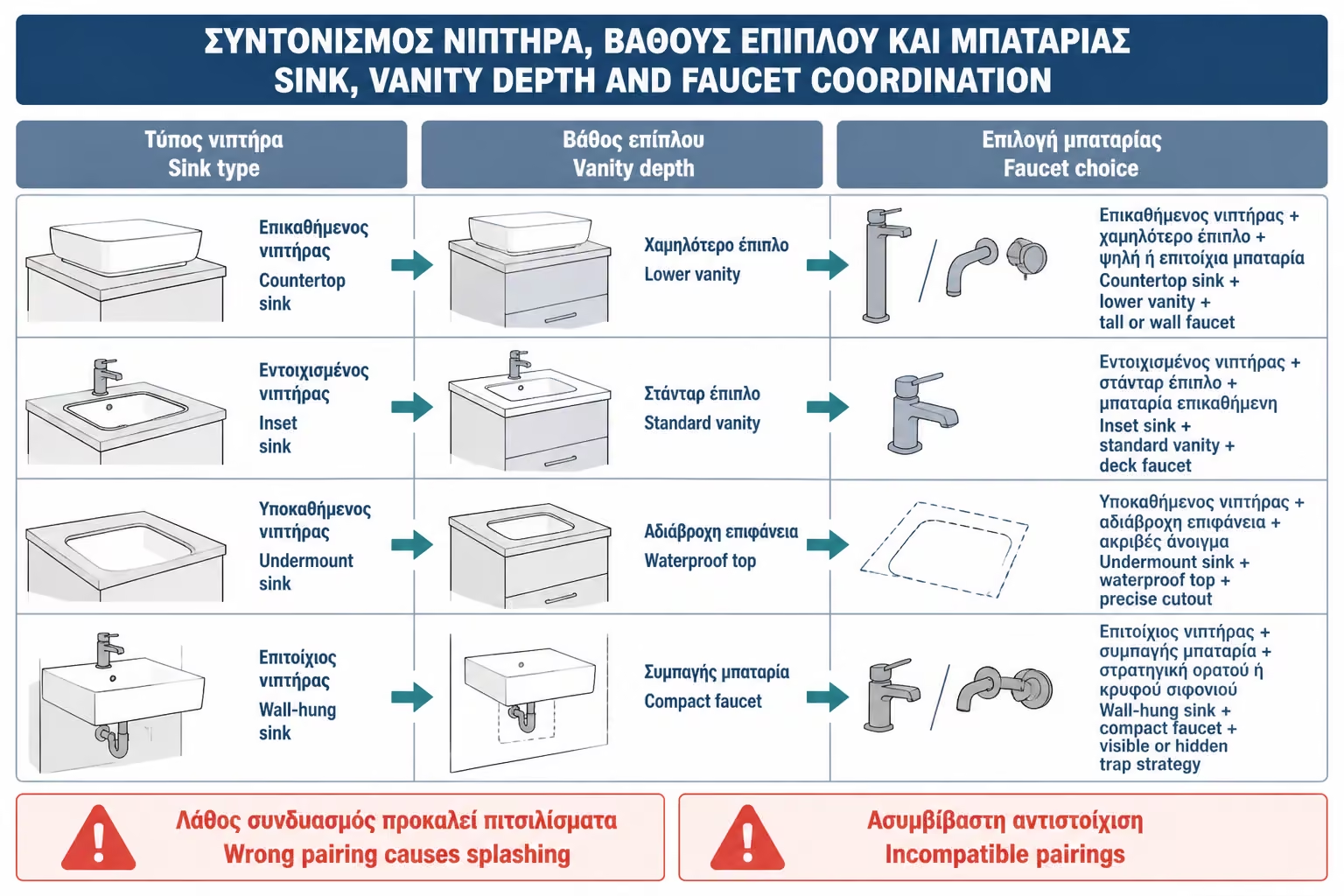
The second mistake is failing to calculate the relationship with the tap. One basin needs a tall deck-mounted tap, another needs a tap mounted on the basin itself, and another works best with a wall-mounted tap. If those decisions are not made together, the result can be splashing, awkward use, the wrong height, or expensive plumbing changes.
In the Greek market, there are now all types of washbasins: countertop, over-mounted, under-mounted, free-standing, inset, semi-inset, wall/hung, with or without a column, made of porcelain, solid surface, marble, stone, inox or special materials. Large Greek stores present exactly this wide range of types and materials, which gives many options but makes the decision more complex.
In this guide we will see what each type of washbasin means, how it is placed, what fits a small or large bathroom, which solution is easier to clean, which gives more storage space, what you should pay attention to in the counter and furniture, and which option makes more sense for your everyday life.
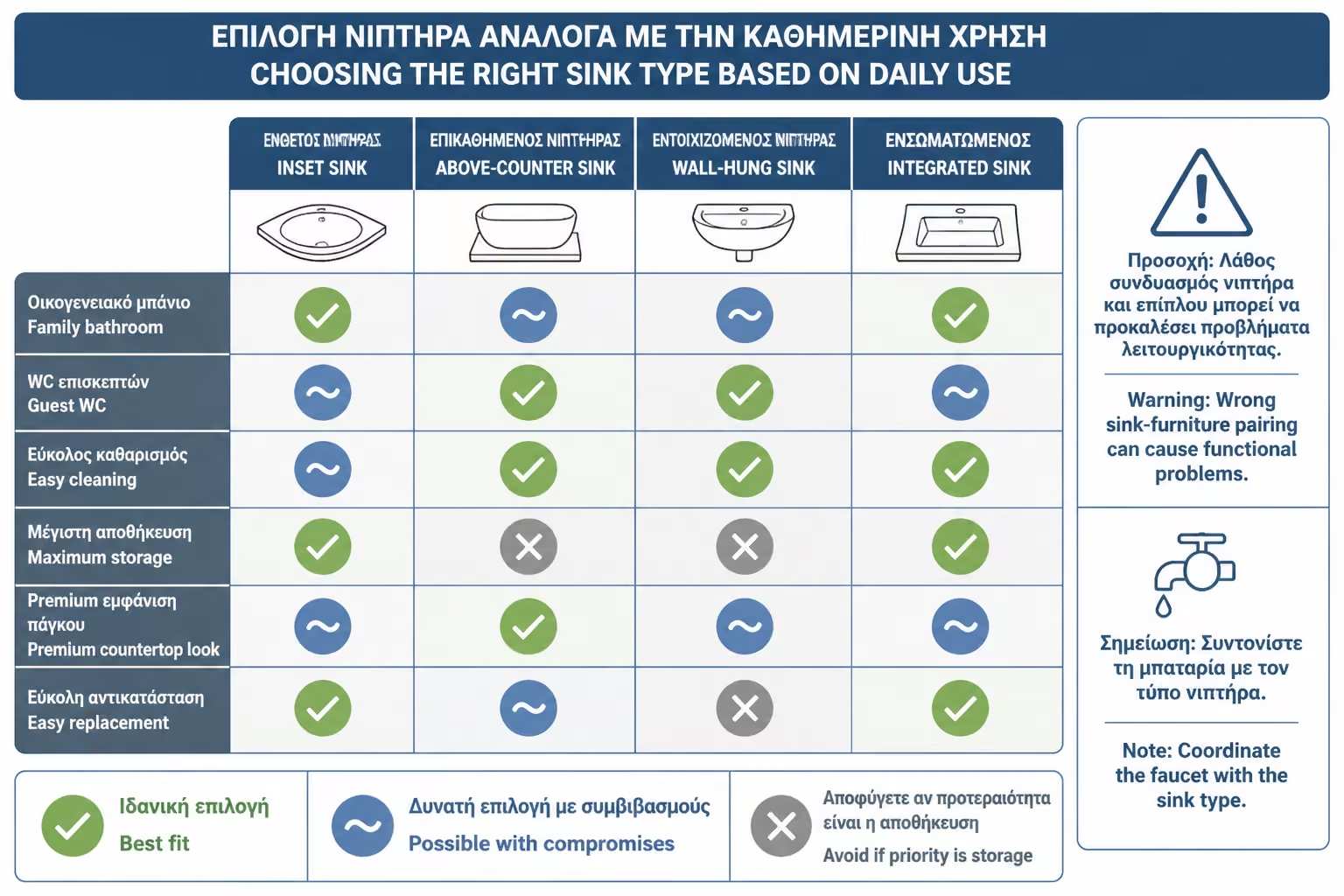
The right sink is not the most impressive one. It is the one that suits how the bathroom is actually used. A main family bathroom has different requirements from a guest WC. A children's bathroom has different needs from a master bathroom. A small apartment bathroom needs different solutions from a larger one with a comfortable countertop.
In an everyday family bathroom, practicality usually comes before pure aesthetics. You want a basin that does not splash water all over the countertop, has enough bowl depth, cleans without much effort, and still leaves room for daily items. In a guest WC, where use is lighter and shorter, you can lean more toward design, even with a small wall-mounted basin or a more sculptural shape.
A practical example: a homeowner chooses a round sink on a wooden countertop because it looks great in the photo. In daily use, however, water stays around the base, the tap is slightly too tall, and the surface needs constant wiping. The result still looks beautiful, but it becomes tiring. If the same sink had gone into a guest WC, it might have been an ideal choice.
That's why the first question is not "which sink do I like?". It is "who will use it, how many times a day and with how much care?".
The terms used in the market can be confusing: surface-mounted, countertop, inset, semi-inset, undermount, wall-hung, wall-mounted, and freestanding. Stores do not always use the labels in exactly the same way, but the basic logic is clear.
A countertop basin sits above the vanity or countertop. An inset basin drops into an opening and usually has a visible rim resting on the surface. An undermount basin is fixed below the countertop so the surface reads as one continuous plane. A wall-mounted basin is fixed directly to the wall and can be used on its own, with a pedestal, or above a vanity.
There are also hybrid solutions. Some sinks can be installed in more than one way. In Greek stores, you can find models that are listed as suitable for hanging, inset or surface mounting, which shows that we should not judge only by the name but also by the manufacturer's instructions.
The type does not affect appearance alone. It affects the countertop cut, the sealing details, the tap choice, the final height, the cleaning routine, the vanity design, and the labour cost. That is why the basin type should be decided before the countertop is ordered, not after it has already been cut.
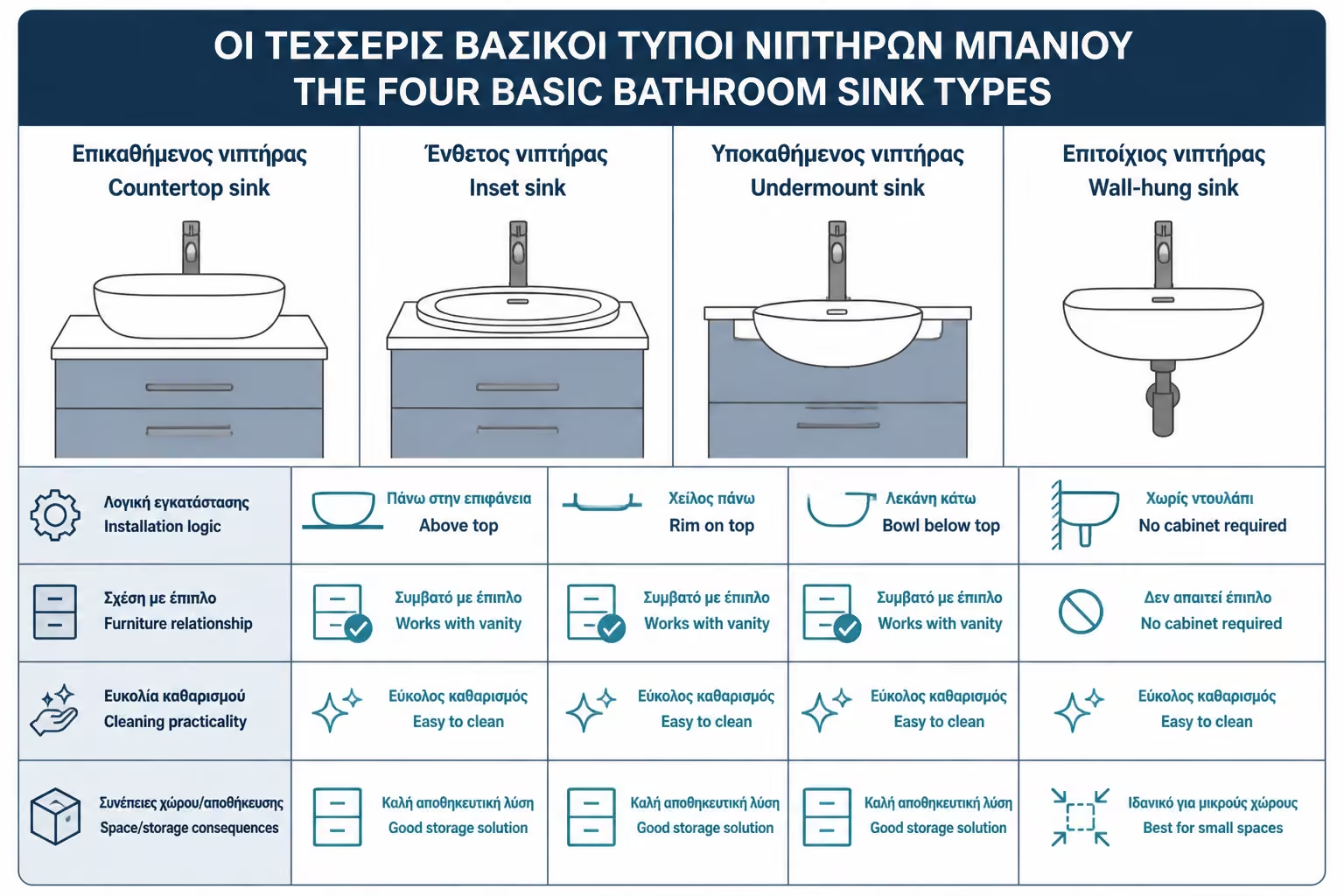
The countertop sink is placed on the counter. It can be round, oval, square, rectangular, thin, deep, white, black, matte, stone or solid surface. It is one of the most popular choices in modern renovations because it gives a strong image and makes the sink the central element of the bathroom.
Its great advantage is aesthetics. A suspended washbasin on a wooden or marble counter creates a boutique hotel feel. Also, its installation can be relatively simple compared to more demanding solutions, because it usually requires an opening for the valve and proper support/sealing at the base. Contemporary installation guides state that countertop basins are often simpler to install, requiring a hole for the drain, silicone on the base and careful positioning.
The downside is the daily care around the base. Where the sink hits the counter, water, soaps and salts can collect. If the counter is wooden or sensitive, it needs very good sealing and frequent wiping. If the bathroom is used by children or by people who never wipe the counter, the countertop sink can get tired.
Be careful with height too. If a basin sits on a standard-height vanity and the bowl itself is tall, the rim can end up too high for comfortable use. That becomes annoying for children and shorter users in particular. With countertop basins, the vanity height always has to be calculated together with the basin height.
The countertop sink is very suitable for bathrooms where aesthetics play an important role and there is enough counter space around it. It is an excellent choice for master bathrooms, guest toilets, bathrooms with custom furniture, wooden counters, stone surfaces or a more architectural design.
In a small WC, a small countertop washbasin can add character without a major cost. Use is usually limited there, so water around the base is less of an issue. In a main family bathroom, though, especially if the countertop tends to collect daily items, practicality needs to be assessed more carefully.
The tap is critical. A countertop basin may need a tall deck-mounted tap or a concealed wall-mounted tap. If the tap is too tall or the water lands in the wrong spot, there will be splashes. If it is too short, the basin will be awkward to use. The distance between spout and bowl should be checked before purchase.
A practical rule of thumb: if you want a strong design statement and you are willing to wipe the counter regularly, a countertop basin can be a very good solution. If you want the most forgiving everyday setup for children, rushed use, and lots of daily items, there may be more practical options.
The inset washbasin is placed inside an opening in the counter or furniture and usually its rim rests on the surface. It is a classic and practical solution, especially in bathroom furniture. It doesn't stick out as much as an overhang and usually gives a calmer image.
The great advantage of the insert is stability and easier daily use. Because the sink sits inside the counter, the height is more controllable and use more intimate. Many inset basins also have a surface around the trough for soap or small items, which is practical in family bathrooms.
Installation is usually simpler than an undermount, because the sink rests on the counter opening. Guides comparing inset and undermount sinks state that insets are more straightforward to install since the countertop acts as a support and the sink is lowered into the cut opening and secured according to the instructions.
The downside is the lip. Water, salt or dirt can collect around the joint of the sink and counter if the silicone is not correct or if cleaning is neglected. Nevertheless, for everyday bathrooms, the built-in sink remains one of the most balanced solutions.
The inset basin is suitable for master bathrooms, family bathrooms, rental properties, and renovations where practicality matters most. It is less dramatic than a countertop basin, but often easier to use every day. If the bathroom is used by children, if the counter gets wet frequently, or if the owner wants easier cleaning without special care, the inset option is a safe choice.
It is also a good solution when buying a ready-made vanity with a basin. Many units come with a basin designed specifically for that piece, so compatibility errors are reduced. This matters in smaller renovations where we want to avoid custom cuts, misunderstandings with the carpenter, or countertop failures.
In budget or mid-range renovations, the inset basin offers a good balance of cost and functionality. It does not necessarily require an expensive countertop, and it does not demand the same level of aesthetic coordination as a countertop basin.
The point of attention is the lip seal. If the silicone breaks down, blackens or opens, water can seep into the furniture. That is why it needs proper placement and periodic inspection.
The undermount sink is placed under the counter. Only the opening and the trough are visible from above. There is no lip on the counter, so the surface looks clean and continuous. This is its great value: the countertop is easy to wipe, without an obstacle around the sink.
In terms of cleanliness, the undermount basin is very practical. Water and small debris can be swept directly into the bowl. There is no visible rim to trap dirt. That is one of its main advantages: the counter is easier to wipe because there is no lip sitting on the surface.
The downside is installation. It needs a countertop made from the right material, precise cutting, proper support from below, and excellent waterproofing. It is not a solution that forgives sloppy work. If the cut is poor, it shows. If the seal fails, water can seep into the counter or vanity. If the countertop is moisture-sensitive, such as plain laminate without proper protection, the whole assembly can become problematic.
For that reason, the undermount sink is better suited to countertops made of marble, granite, quartz, compact surfaces, solid surface, or other materials that can accept proper cutting and sealing. It is not a solution to choose in haste for a cheap ready-made vanity.
The undermount basin suits bathrooms where a cleaner, more premium look matters. It is a very good choice for master bathrooms, custom vanity units, and projects where the countertop material is genuinely high quality rather than a low-cost compromise.
It also suits people who want to clean the counter easily. Unlike the pedestal, it does not have a base around which water collects. Unlike the insert, it does not have a lip on the surface. If installed correctly, it can be one of the cleanest solutions in everyday use.
However, it is not always the best solution on a tight budget. The work is more demanding, the countertop has to be suitable, and the installer has to know exactly what they are doing. If it is done badly, the correction can be expensive because it involves recutting or replacing a countertop, not just swapping a basin.
A practical example: in a bathroom with a custom quartz countertop, an undermount basin can look excellent and be easy to clean. In a ready-made vanity with an economical surface, the same choice can create moisture and cost problems. The solution is not wrong; it just needs the right context.
The wall-hung or wall-mounted basin is fixed directly to the wall. It can be small for a WC or larger for a main bathroom, with or without a pedestal, with or without a semi-pedestal, with a visible trap, or with a vanity underneath. It is the simplest and most classic solution when we do not want a full vanity unit.
Its advantage is that it leaves the floor free. That makes cleaning easier and helps the room feel larger, especially in small bathrooms and WCs. In a very small guest WC, a compact wall-hung basin may be the most practical solution. It does not need a large vanity, it does not visually weigh down the room, and it covers the basic use well.
The downside is storage. If the basin stands on its own, there is no drawer or cabinet for supplies. And if the trap is visible, it has to look decent and be correctly positioned. In tidier solutions, a decorative trap, a semi-pedestal, or a small vanity is used.
Support has to be taken seriously. A wall-hung basin puts load on the wall. If the wall is weak, old masonry, or plasterboard without reinforcement, a proper structural solution is needed. You should not assume every wall can safely take every basin.
The wall-hung washbasin is particularly suitable for small WCs, for bathrooms where we want simplicity, for accessible spaces where clear space is needed under the basin, and for renovations where we do not want or cannot fit a vanity.
In a small WC, a compact wall-hung basin can be much better than a bulky vanity. The space looks more open and movement stays clear. If it is paired with a compact tap and the paper and towel holder are placed correctly, it can make a difficult WC much more functional.
In a master bathroom, a wall-hung sink without a cabinet may not be enough, unless there is other storage space. Many owners reject it because they want drawers. That makes sense. The bathroom needs space for everyday items. If everything ends up on the sink, simplicity is lost.
In accessible bathrooms, the wall-hung sink can be essential because it allows wheelchair access. But there, the height, depth and siphon must be specially designed, so that they do not obstruct the knees and do not create a risk of contact with hot pipes.
The washbasin should never be chosen independently of the vanity. The vanity sets the height, depth, storage capacity, moisture resistance, and much of the final visual result. A beautiful basin on the wrong unit can create daily frustrations.
With countertop basins, the vanity often has to be lower or specially designed so the final height stays ergonomic. With inset basins, the unit and top must accept the cut-out and protect the edge from water. With undermount basins, the countertop material and fabrication quality matter even more. And with wall-mounted basins, the vanity may be secondary or absent altogether.
Vanity depth matters too. In small bathrooms, a deep unit with a large basin can block movement. In those cases, you may need a shallower 35-40 cm vanity paired with a specially chosen compact basin. In larger bathrooms, a 45-50 cm depth usually gives more comfortable use and better storage.
A common mistake is choosing a large basin on a small vanity. It may look attractive in a photo, but it leaves too little free countertop space for soap, a tumbler, toothbrushes, and daily use. The basin should still allow the countertop to function.
The tap and the basin are a pair. It is not enough for them to match aesthetically. They have to work together in the water flow. The spout has to land in the right place inside the bowl, at the right height from the base, so that splashing is avoided.
With countertop basins, tall deck-mounted taps or concealed wall-mounted taps are often used. Tall taps need the right height and the right distance from the bowl. If they are too high over a shallow basin, water will splash out. If they are too short or too far back, the user's hands will hit the rim.
In inset and wall-hung basins, the tap is often mounted on the basin itself. That simplifies the selection, but you still need to check that the basin has a tap hole and overflow, that the waste fits, and that there is enough space behind the bowl.
In undermount basins, the tap is usually placed on the countertop or wall. That means the holes in the countertop have to be planned accurately. If they are cut in the wrong place, correction is difficult and expensive.
Porcelain remains the most classic and practical choice. It is durable, easy to clean, has wide availability, reasonable prices and many sizes. For most homes, a good porcelain sink is a safe choice.
The solid surface gives a more modern, uniform and matte image. It can be used on sinks with slim lines or built-in counters. But it needs attention to scratches, heat, paints and cleaners, depending on the material. Not all solid surfaces are the same.
Natural stone and marble have a special image, but are more demanding. They can stain, need protection, be affected by acidic products and have more surface variation. In guest toilets or design bathrooms they can be impressive. In a heavy-duty family bathroom, realism is needed.
There are also glass, inox, black matt, colored and special washbasins. The Greek market now includes many options in porcelain, inox with PVD coating, marble, stone and finishes such as glossy white or matte black, depending on the series and manufacturer.
Cleaning is one of the most practical selection criteria. A countertop basin needs attention around its base. An inset basin needs cleaning around the rim. An undermount basin allows the countertop to be wiped straight into the bowl. A wall-hung basin leaves the floor free, but its visible trap may need more careful detailing.
| Washbasin type | Cleaning | Main point of attention |
|---|---|---|
| Percher | Needs sweeping around the base | Water and salts on the counter |
| Inlaid | Practical, but has a lip | Silicone and countertop joint |
| Deputy | Very easy countertop wipe-down | Sealing under the counter |
| Hanging | Easy floor | Visible siphon and wall support |
In a bathroom that is cleaned frequently and carefully, all solutions can work. For a bathroom with heavy daily use, the most practical options are usually the inset basin and the correctly designed undermount basin. For a small WC, a wall-hung basin or a compact countertop arrangement may make more sense.
The important thing is not to choose based on the first image alone. Ask yourself: "Where will the water stay? Where will the salt collect? How easily will the sail pass?" The answer often indicates which type is right for you.
In small bathrooms, the spontaneous thought is to fit as small a sink as possible. But this can backfire. A very small and shallow sink can throw water out, not comfortably fit the hands and make every use uncomfortable. You gain points in space but lose functionality.
For guest toilets, a small sink is acceptable because the use is mainly for hand washing. For a master bath, a larger tub is needed. If the wash basin is used for shaving, face washing or daily care, depth and width are of great importance.
The bowl must be deep enough to handle the tap flow. Many slim designer basins are beautiful but shallow. If paired with the wrong tap, they can leave the countertop covered in droplets. This is common with slim-profile countertop basins.
The dimension must be combined with the furniture and the space. In a small bathroom, a 50–60 cm wide sink can be more practical than an impressively large 80 cm one that leaves no counter or passage. In a larger bathroom, a very small sink can look poor and not function comfortably.
The prices of washbasins vary widely depending on type, material, dimensions, brand, colour, finish, and whether the basin is purchased alone or together with a vanity. In the Greek market, simple porcelain basins occupy the lower price bands, while countertop, branded, matte black, stone, or solid-surface models rise significantly. Greek stores, for example, show inset basins around 140 euro and many porcelain countertop or wall-hung models in different sizes and series, while the more specialised options move higher.
| Type / category | Indicative cost of Greece 2026 | What affects the price? |
|---|---|---|
| Simple hanging porcelain basin | €40–€120 | Size, brand, if it has pillar/half pillar |
| Built-in furniture sink | 80–200€ | Dimensions, series, compatibility with furniture |
| Countertop porcelain sink | 70–250€ | Shape, size, brand, color |
| Undermount sink | 90–250€ | Material, dimensions, countertop requirements |
| Black, matte or colored washbasin | 120–350€+ | Finish, material, availability |
| Solid surface / stone / marble | 180–600€+ | Material, weight, special placement |
| Furniture with washbasin | 180–800€+ | Width, hardware quality, countertop, washbasin |
Prices are indicative and depend on the region, the store, VAT, transport, availability, whether the offer covers only the product or product plus installation, and whether a custom countertop, special cutting, or plumbing changes are needed.
The big mistake is comparing only the price of the basin. A countertop basin may require a more expensive tall tap. An undermount basin may require a better countertop and more precise fabrication. A wall-hung basin may look economical but still require wall reinforcement or a decorative trap. The real cost is the whole system: basin, tap, countertop, cabinet, waste, trap, installation, and any plumbing adjustments.
If you want a stronger design statement and do not mind a little more care, a countertop basin is a great choice. It suits bathrooms with a clear design intent, custom countertops, and guest WCs. But it needs the right vanity height, the right tap, and regular wiping around the base.
If you want a practical, safe solution for everyday bathing, the built-in sink is probably the most balanced option. It's not always the most impressive, but it works well, is familiar to use and blends easily with bathroom furniture.
If you want a cleaner countertop line, a more premium look, and easier wipe-down, the undermount basin is a very good solution, as long as you have the right countertop material and a skilled installer. It is not a choice to take lightly.
If you have a small WC, a need for simplicity or want a free floor, the wall-hung washbasin is practical. It does not give storage, but solves problems of space and cleaning.
The first mistake is choosing the basin before deciding on the tap. Basin and tap must be selected together, otherwise there is a risk of splashing, awkward use, or wrongly placed holes.
The second mistake is misjudging the final height. This happens most often with countertop basins. A standard-height vanity may seem fine, but once the basin sits on top, the finished height becomes excessive.
The third mistake is choosing sensitive material for hard daily use. A stone or matte black sink may look great, but if the bathroom is used by children and cleaned with strong cleaners, it may not be practical.
The fourth mistake is underestimating the countertop. It is not just a support. It has to handle water, soap, cleaners, and fabrication cuts. If it is not suitable for the basin type, problems will follow.
The fifth mistake is not leaving free space around the bowl. A very large sink on a small vanity can leave no room for everyday items. The result is clutter, even if the product itself is beautiful.
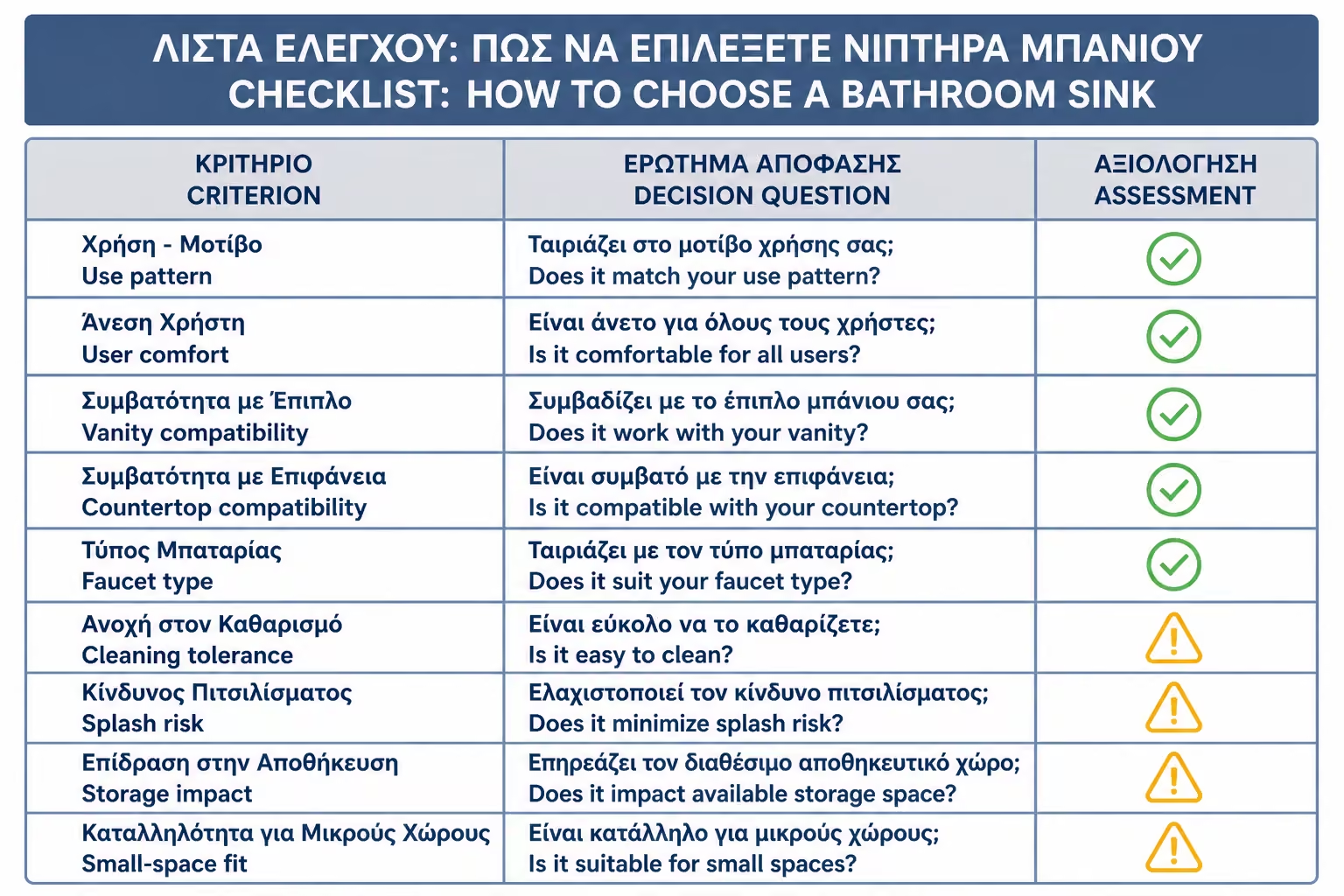
| Inquiry | Yes / No |
|---|---|
| Have you decided whether the sink is for a master bathroom or a guest WC? | Yes / No |
| Have you measured the available width and depth of the space? | Yes / No |
| Have you calculated the final usable height together with the furniture and the washbasin? | Yes / No |
| Has the faucet been selected together with the sink? | Yes / No |
| Does the tap flow land at the correct point in the bowl? | Yes / No |
| Is the countertop material suitable for the type of sink? | Yes / No |
| Does the sink leave enough counter space for everyday items? | Yes / No |
| Is there enough storage space if hanging without furniture is chosen? | Yes / No |
| Will the silicone or sealant be accessible for inspection and maintenance? | Yes / No |
| Is the material easily cleaned with the cleaners you normally use? | Yes / No |
| Does the price include only the sink or also the valve, faucet, countertop, furniture and labor? | Yes / No |
| Has the technician confirmed compatibility with utilities and drainage? | Yes / No |
If you cannot answer most of those questions confidently, it is too early to buy. The basin has to be selected as part of the full system: vanity, countertop, tap, drainage, cleaning, and daily use.
If you keep only one idea from this article, make it this: a washbasin should not be chosen for looks alone, but for how it works with the countertop, the vanity, and the tap.
For an everyday family bathroom, a good inset basin or a properly planned undermount model is often more practical than a highly sculptural countertop sink. In a guest WC, you can lean more toward design. In smaller rooms, a wall-mounted or narrow basin can rescue the whole layout.
Do not buy the basin before you know the final height, the tap type, and the countertop material.
Choosing a sink is one of those decisions that seems simple but strongly affects the daily operation of the bathroom. A countertop basin gives a strong modern image, but it requires attention to height, tap choice, and cleaning around the base. An inset basin is the safest and most practical solution for many everyday bathrooms, with a good balance of cost and usability. An undermount basin gives a cleaner countertop line and a more premium effect, but it requires the right material and precise installation. A wall-hung basin is simple, light, and ideal for small spaces, but it does not provide storage on its own.
There is no single sink that is best for everyone. There is only the right basin for the specific bathroom and the specific daily routine. In a family bathroom, practicality, bowl depth, and ease of cleaning matter greatly. In a guest WC, aesthetics can play a bigger role. In small bathrooms, the dimensions and depth of the vanity are critical. In more premium renovations, countertop quality and installation accuracy often determine the final result.
The best decision is one that sees the washbasin not as an individual product, but as a system: washbasin, faucet, counter, furniture, siphon, valve, cleaning and user. If these are studied together, the bathroom will not just be beautiful on the first day. It will remain practical, clean and comfortable in everyday use.
Return to category.
Go to categoryReturn to the central guide.
Go to guide