
Bathroom Fixtures & Water Equipment
Return to category.
Go to categoryBathroom furniture is one of the most tested elements in a home. It's not just in a damp area. It is located under a sink, next to a battery, near a shower, above pipes, often in a small bathroom without good ventilation. It accepts water vapours, drops, water from washing, cleaning agents, salts, soaps and small leaks that may not be noticed immediately.
That's why, when a piece of bathroom furniture "swells" after two or three years, it's rarely just the exterior that's to blame. Usually the problem lies in the core: the material from which the body, sides, drawers and doors are made. Lacquer, melamine, veneer or finish can protect up to a point. But if the core absorbs water, deformation begins. The cabinet opens at the edges, bulges around the sink, throws off the finish, or breaks at the joints.
In the market you will hear many names: MDF, anhydrous MDF, melamine, plywood, marine plywood, veneer, HPL, PVC, lacquer, bakelite. The owner often only sees the final color and design. But two pieces of furniture that look almost identical on the outside can have completely different behavior in humidity. One may last for years, the other may begin to swell at the first serious leak or from misuse.
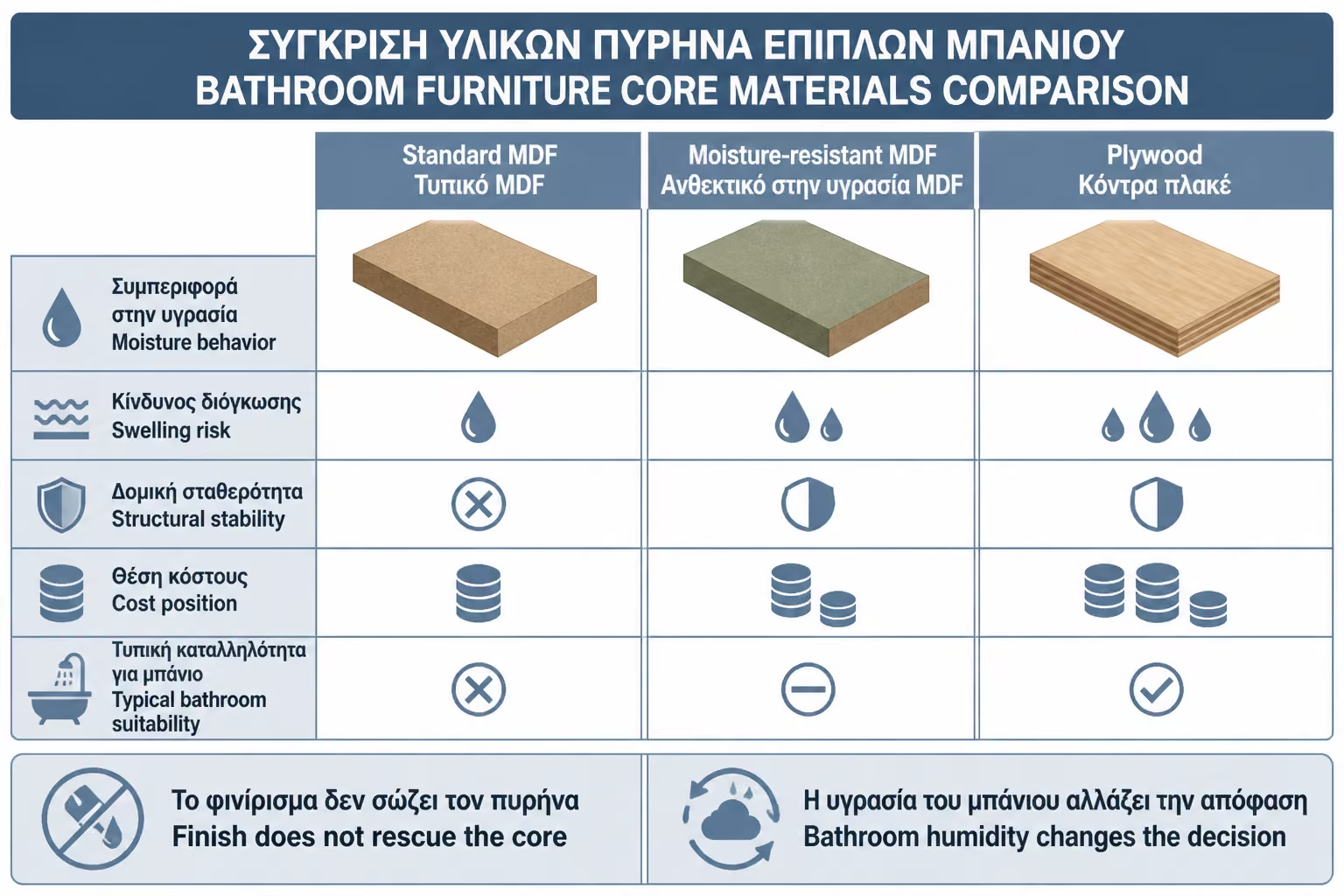
The most critical comparison is between MDF and plywood, especially marine plywood. MDF is economical, smooth, ideal for painting and very common in furniture. But plain MDF is sensitive to moisture and can swell when water gets into the edges or holes. Plywood, and especially marine plywood, is a laminate that behaves better in a wet environment, as long as it's really good quality and properly sealed. Marine-grade plywood is not "waterproof" in the absolute sense, but is manufactured with more durable layers and waterproof adhesives to withstand moisture and water contact much better than typical indoor materials.
In this guide we will look at what MDF, anhydrous MDF and marine plywood mean in practice, where the swelling occurs, which parts of the furniture are most vulnerable, when it is worth paying more for a better core, what to ask the manufacturer or store and how to avoid buying a beautiful piece of furniture that is not made for the real bathroom environment.
A bedroom or living room piece of furniture can last for years even if it is made of economical material, because it is not constantly exposed to moisture. In the bathroom, things are different. The air fills with water vapor after a shower, water falls on the counter, towels stay wet, pipes can sweat, the sink valve can leak and the silicone around the counter can open.
The problem rarely appears overnight. It usually starts from small points. An acne that has not been properly sealed. A screw hole inside the drawer. An opening around the siphon. A spot where water is standing under the sink. At first it looks like a small blister or a slight lifting of the finish. Then the material swells, the door does not close properly, the melamine opens and the furniture starts to look old while the renovation is still recent.
This is why the choice of material in bathroom furniture is more important than in other furniture. It is not enough to be beautiful, to have a nice color or soft-close mechanisms. Its core must be able to withstand the environment where it will enter.
A practical example: in a windowless bathroom with a shower without proper ventilation, a budget MDF cabinet with unprotected edges can quickly swell around the sink or at the bottom. The same design, if made from good marine plywood with properly sealed edges and a good bench, has a much better chance of lasting.
MDF, i.e. Medium Density Fiberboard, is an industrial material made of wood fibers compressed with resins and other binders. It is very popular in furniture making because it has a smooth surface, is easy to work with, can be painted well, can be lacquered and gives a clean result without wood water. It is also more economical than many plywood or solid wood solutions.
For doors, drawer fronts and painted finishes, MDF has significant advantages. Its surface is uniform and allows clear lacquer. It has no water, pinks or unevenness like natural wood. That is why it is widely used in modern furniture with smooth surfaces.
The problem is the humidity. Plain MDF is sensitive to water. If its surface is left protected, it can work well in dry indoor areas. But if water gets through an edge, screw, cut or wear, the material can swell. Materials comparison sources point out that MDF is economical and ideal for smooth painting, but is more vulnerable to moisture and less durable than plywood in wet areas.
In the bathroom, this means that MDF is not automatically wrong, but we need to know where it is used, what quality it is, whether it is waterproof, how the edges are sealed and how exposed it is to water. A good MDF with the right paint can work on doors and facades. A simple MDF in the core of a piece of furniture located under a sink, in a small bathroom with moisture, has a greater risk.
Anhydrous MDF, often green in color at the core, is MDF with improved moisture behavior. It is not waterproof. It is more durable than plain MDF in high humidity conditions, but if left exposed to water, especially at the edges or cuts, it too can swell.
This is critical. Many owners hear "waterproof" and think that the furniture has no problem with water. In practice, anhydrous means better resistance to air humidity and limited exposure, not that it can accept water without consequences. If the silicone around the sink opens and water seeps into the countertop cut every day, even the best MDF can have a problem.
In comparisons of materials for humid areas, it is emphasized that moisture-resistant MDF and marine plywood are different materials: MR MDF has improved moisture resistance and a good surface for painting, while marine plywood has better structural behavior and resistance to more demanding moisture conditions due to its multilayer construction and resistant glues.
Anhydrous MDF can be a reasonable choice in medium bathroom furniture, especially for fronts and painted parts, as long as there is a good finish, correct edges and good ventilation. However, it is not the material that we would choose without thinking for a piece of furniture that will often receive water, for a small bathroom without ventilation or for a property with intense use where no one wipes the counter.
Plywood is a material of thin layers of wood, glued together with alternating fiber direction. This multi-layered structure makes it more stable and durable than many monolithic materials. It is not just "wood on sheet". It is a mechanically more balanced material, with better behavior in distortions and loads.
In the bathroom, its advantage is that it does not react to moisture in the same way as MDF. If it receives moisture, it can be affected, but it does not "swell" as uniformly and destructively as a fibrous material that absorbs water. Its durability depends of course on the quality of the sheets, the glues, the type of wood and the sealing.
Marine plywood is a special class of higher strength. It is made with more durable layers and waterproof glue so that the sheets do not separate easily in a wet environment. But it is important to say it correctly: it does not mean that the furniture can stay permanently in the water without protection. It means that the core has a much better behavior in moisture and occasional contact with water than simpler materials.
For bathroom furniture, marine plywood is especially valuable on the body of the furniture, on the sides, on the bottom, on the drawers and in places near pipes. It is the material that gives greater security when the space is wet, when the piece of furniture is suspended and receives weight or when the owner wants a long-term solution.
The term "marine" is used a lot in the market and not always with the same precision. That's right, it refers to plywood made for better moisture resistance, with appropriate glues and layers. It does not mean that every material named so is of the same quality. There are different categories, thicknesses, origins and qualities.
The value of marine plywood in the bathroom is not that it "doesn't get damaged". Its value is that even if there is moisture, it has a better chance of remaining stable, not immediately swelling at the edges and not disintegrating like an unsuitable MDF or chipboard. This makes it particularly useful on furniture under sinks, where micro-leaks are likely.
But the edges must be protected. Even good plywood has edges from layers of wood. If the edges are left open, they can absorb moisture. That's why build quality is of utmost importance: proper paint, lacquer, HPL, veneer, PVC/ABS edges or other protection, depending on the design. The best material can suffer if we cut it and leave the cut unprotected in the bathroom.
On a practical level, when asking for marine plywood, you should ask about thickness, quality, where it is used and how it is sealed. It is one thing to have only the facade or some part of plywood, and another to be the entire frame of the furniture.
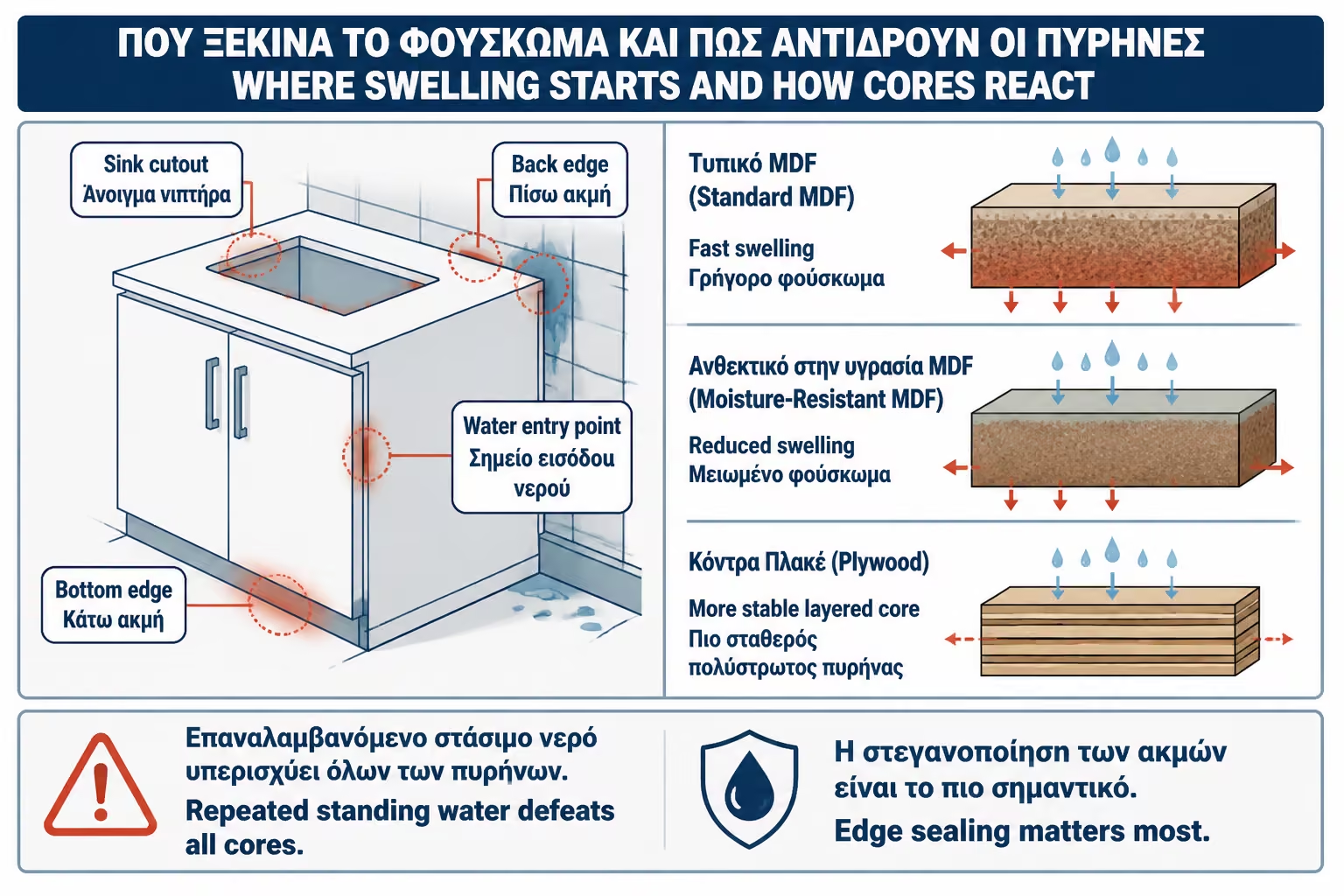
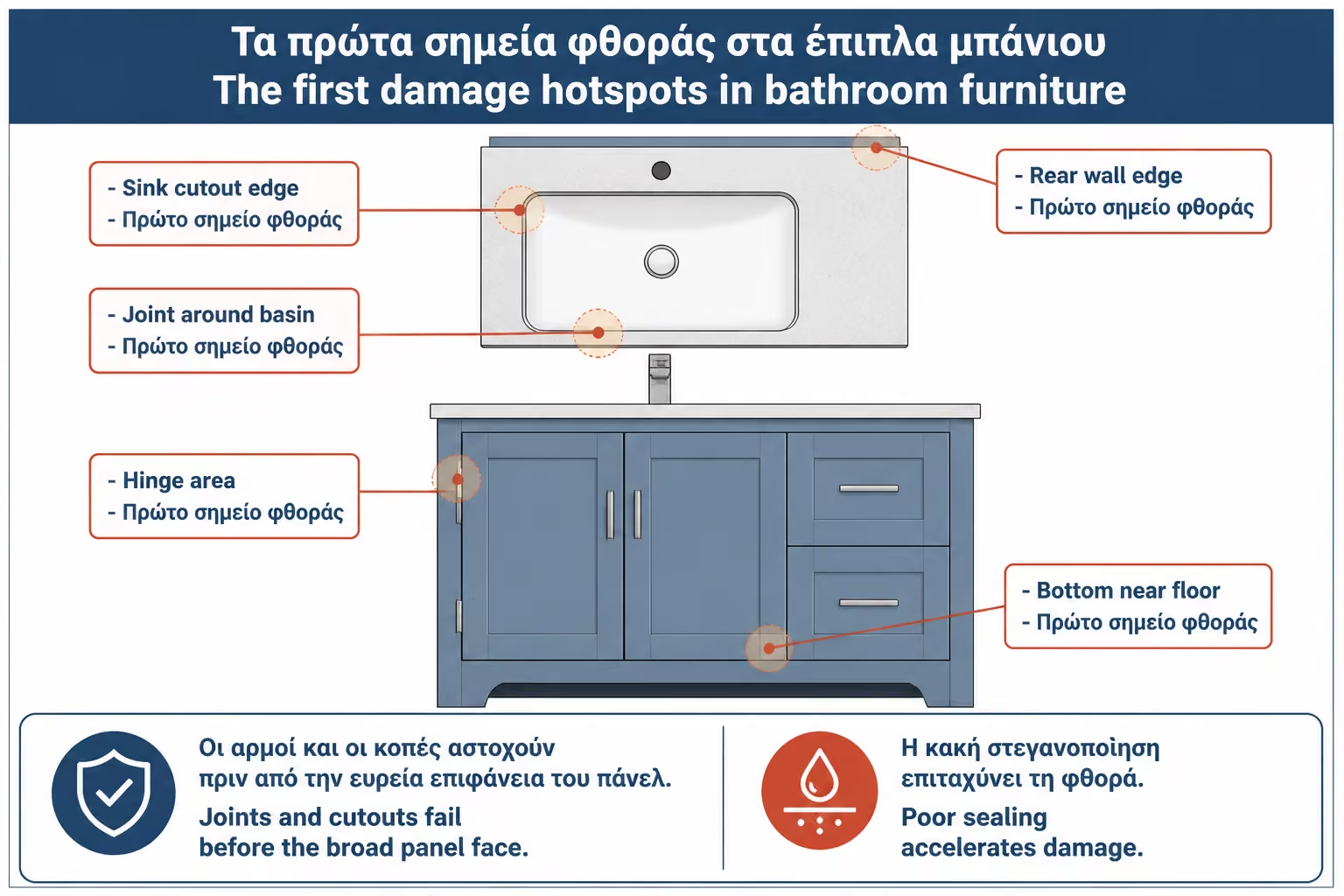
Bloating doesn't happen by accident. There are specific points that are more vulnerable. The first is the upper part of the furniture, around the sink or counter. Water falls there every day and if the joint is not properly sealed, the water gets under the finish.
The second is the edges of doors and drawers. If the lining or lacquer opens slightly, moisture finds an entrance. This is common in budget furniture where the edges are not well protected or where the finish has not gone around properly.
The third point is the bottom of the furniture. If there is a leak from the siphon, from the valve or from the supplies, the water drips into the furniture. Many times the owner realizes this when the bottom is already swollen or the drawer is damaged. On MDF or chipboard, this can be disastrous.
The fourth point is the drilling points: screws, hinges, drawer guides, holes for pipes. Every hole is a potential entry point for moisture if not protected. That is why good bathroom furniture is not only judged by the material of the sheet, but also by the construction detail.
Comparison should not be made with absolute phrases. MDF has a place in furniture. Plywood also has its own advantages. The question is where each material is used and in what environment.
| Criterion | MDF | Marine plywood |
|---|---|---|
| Moisture resistance | Low on plain MDF, better on anthygro | Much better, as long as it is of the right quality and sealed |
| Behavior when water enters | It tends to swell up and hardly comes back | Holds better, less risk of immediate swelling |
| Paint / lacquer | Very good smooth surface | Good, but needs proper edge preparation |
| Structural strength | Good for many uses, but heavy and sensitive to screws/moisture | Better mechanical behavior and screw retention |
| Cost | Usually lower | Usually higher |
| Ideal use | Facades, painted parts, economical solutions with good protection | Body of furniture, wet bathrooms, premium and long-lasting constructions |
| Crucial point | Sealing edges and preventing water | Real sea quality and proper edge protection |
A smart construction can combine materials. Many quality solutions use plywood for the body of the furniture and MDF for doors or facades that need perfect painting. This hybrid approach is often referred to as a practical combination: plywood in the cabinet box for strength and MDF in the fronts for better painting and finishing.
So we don't need to demonize MDF. We must avoid the wrong MDF in the wrong place. For the core of bathroom furniture that will receive moisture, marine plywood has real value.
In addition to MDF and plywood, there is also particle board, i.e. particle board or novopan. It is an even more economical material and is used a lot in cheap furniture. In dry areas it can work, but in the bathroom it is a high-risk material if it does not have very good protection and if it is not a special moisture-resistant category.
Chipboard when it gets water usually swells strongly, loses its cohesion and does not recover. In a cheap bathroom furniture, the problem can start from the bottom or the edges. If the finish is opened, water gets in and the material swells quickly.
It is no coincidence that in material selection guides for wet areas it is emphasized that common MDF and chipboard are not suitable for continuous exposure to moisture without special protection, while for bathrooms moisture-resistant MDF, plywood or special waterproof solutions are preferred, depending on the budget and use.
If you see very affordable bathroom furniture, ask to know the core. If the answer is unclear or if we are talking about simple chipboard, you should know that the lifespan depends on how well it will be protected from water. In a master bathroom, especially with children or daily use, economy can prove expensive.
Many owners only look at the finish: lacquer, matte, glossy, wood look, HPL, melamine. These are important, but they are not enough. The finish is the shield. The core is the body. If the shield is injured and the core is vulnerable, the trouble begins.
Lacquer can give a great look, but if it hits an edge and gets water through, the MDF underneath can swell. Melamine can be practical and economical, but if the edge tape peels off, the edge is exposed. HPL is more durable as a surface, but still the cuts and joints need to be protected.
The bathroom is a space where edges are often more important than large surfaces. A large door can be perfectly protected, but the furniture can be damaged by a small unprotected cut around the siphon. That's why when you buy bathroom furniture, look inside. See the edges, the holes, the connection points, the bottom, the back.
A good piece of furniture is not only visible when it is closed. It shows when you open the drawer and see how it is protected where it is not shown in the photo.
Hanging bathroom furniture has become very popular because it leaves the floor free, is easy to clean underneath and gives a more modern look. In terms of moisture, they have an advantage because they do not step on the floor, so they are not as much at risk from water that pools on the floor. But they have a greater requirement for structural strength and proper support.
In hanging furniture, the body material must hold screws and brackets well. Plywood has an advantage here due to its multi-layered structure. MDF can be used, but the support must be correct and the weight calculated. If the piece of furniture is large, with a stone bench and a heavy sink, the choice of core and method of suspension becomes even more important.
Floor furniture has another problem: it gets stepped on. If the bathroom has water on the floor, poor drainage, frequent mopping or small leaks, the bottom and legs receive moisture. If they are made of sensitive material, they swell at the bottom. That's why floor furniture must have a protected bottom, proper legs or base and durable material.
In small bathrooms with a shower without a good cabin, where water often comes out on the floor, hanging furniture made of good material is usually a safer solution.
No material should live continuously in a bathroom that stays wet. Ventilation is critical. If after each shower the water vapor stays in the room for a while, the surfaces are constantly charged with moisture. This affects finishes, hinges, drawer guides, mirrors, joints and natural furniture.
A piece of marine plywood will hold up better than plain MDF, but that doesn't mean ventilation can be ignored. If the bathroom has no window, mechanical ventilation is not a luxury. It is a key element in the life of the materials. If the fan does not work or does not have sufficient efficiency, the furniture will age faster.
In bathrooms without a window, it is worth giving more importance to the core of the furniture. That's where the difference between plain MDF and marine plywood is most apparent. In a large, well-ventilated bathroom with careful use, a good anhydrous MDF can work quite well. In a small, closed bathroom with daily showers, the risk rises.
Ventilation, sealing and material must work together. There is no single element that saves everything.
Bathroom furniture is not only at risk from air humidity. It is at risk from water that passes through the counter and the sink. If the sink is counter-top, its base must be properly sealed. If inlaid, the lip and cut must be protected. If it is a sub, the bench must be suitable and the joint perfect.
Many times the swelling occurs around the sink hole. This means that the water got into the cut. If the core is MDF or chipboard, damage can progress quickly. If it is marine plywood, there is better strength, but again the cut must be protected.
The same goes for the battery. Water and salts collect around the base of the battery. If the hole in the counter is not protected, moisture passes into the material. On wood-based countertops, this is critical.
Proper construction is not based on the thought "water will not fall". Water will fall in the bathroom. Proper construction anticipates falls and protects vulnerable areas.
Marine plywood is especially valuable in master bathrooms, family bathrooms, small bathrooms without good ventilation, under-sink furniture with frequent use, large-width hanging structures, and custom furniture that you want to last for many years.
It's also worth Airbnb or higher-end rentals where the piece of furniture gets frequent use from people who don't treat it as their own. In such cases, the budget furniture may need replacing sooner than you anticipated. A better material reduces the risk.
It is not necessarily always the only solution. In guest WCs with little use, good ventilation and limited water, a quality anhydrous MDF cabinet with the right finish can be sufficient. In financial renovation where the budget is very limited, a conscious compromise can be made. But it must be conscious, not the result of ignorance.
The basic rule is simple: the more wet, small and heavily used the bathroom, the more the best core is worth. Marine plywood is not always visible at first glance, but it is over the years.
MDF should not be automatically discarded. It can be an acceptable choice when it is non-wet, when it is used on facades and not in highly exposed areas, when the finish is good, when the edges are properly closed and when the bathroom is well ventilated.
For example, a custom build with a marine plywood body and painted MDF doors can be a very good solution. The MDF gives a flawless finish to the exposed surfaces, while the plywood frame provides better durability. This hybrid philosophy is often more balanced than requiring the same hardware everywhere.
MDF is more risky when it is the main core in places that receive moisture, when it is plain and not moisture-proof, when the edges are exposed, when the furniture steps on the floor or when the bathroom is very wet. There the lower cost may seem expensive in the long run.
If you choose MDF, at least ask if it is waterproof, what thickness it is, what finish it will go in, how the edges are closed and what warranty is given for use in a bathroom. Don't settle for the phrase “it's bath-specific” without details.
Bathroom furniture prices vary greatly depending on size, material, mechanisms, finish, sink, counter and whether it is ready-made or custom furniture. In the Greek market there is furniture offered in lacquered MDF or marine plywood versions, which shows that the choice of core is a real commercial criterion and not a theoretical detail.
| Furniture category | Indicative cost of Greece 2026 | Practical observation |
|---|---|---|
| Economical furniture with simple core / melamine | €150–€400 | Only suitable for mild use and low risk of moisture |
| Furniture made of MDF / non-hydrogen MDF with washbasin | 300–800€ | Good middle ground if it has proper edges and finish |
| Furniture with marine plywood body | 600–1,500€+ | Best choice for master bathroom and humidity |
| Custom marine plywood furniture with lacquer / HPL | 1,000–3,000€+ | It depends on dimensions, bench, mechanisms and details |
| Premium furniture with special mechanisms and bench | €2,000+ | It is worth it when the core and build are of corresponding quality |
Prices are indicative and are affected by area, VAT, transport, dimensions, thickness of materials, soft-close mechanisms, bench, washbasin, battery, mirror and installation work. A piece of marine plywood furniture usually costs more, but the cost should be compared to the lifespan. If an inexpensive piece of furniture needs replacement in 2–3 years, the economy was superficial.
Also watch out for offers that compare dissimilar things. Another piece of plain melamine and a basic sink, another piece of anhydrous MDF with lacquer, another piece of marine plywood with a compact bench and good drawer runners. Always ask for a detailed description of materials.
Before you buy, ask to know what the frame is made of, what the fronts are made of, what material the bottoms of the drawers are made of, how the edges are protected, what bench goes in, how the sink and faucet holes are sealed, and what to do in case of a small leak from the faucet.
Don't settle for general answers like "it's waterproof". No wooden or wood-based bathroom furniture should be treated as completely waterproof. The correct phrase is “moisture resistant under proper construction and use”. If someone promises you that nothing will happen to water, ask for written technical specifications.
Also ask about the warranty. Does it cover puffiness from humidity? Under what conditions? What is misuse? If there is a siphon leak, what happens? These answers show how seriously the supplier takes the hardware.
In custom construction, ask the carpenter to tell you clearly: "where plywood will go in, where MDF, how the edges will be painted, what glue/tape/finish will be used and how the cuts will be protected". These details are more important than just changing the paint color.
Even good furniture needs proper use. The first measure is to ensure that no water remains on the counter. After heavy use, a quick wipe around the sink and faucet greatly reduces the risk. This is especially important in counter-top basins, where water can remain around the base.
The second measure is to check the siphon and the valve. Open the drawer or cabinet from time to time and check for moisture, drips or odors. A small leak that goes unnoticed can ruin even good furniture. The difference is that marine plywood will give more reaction time, not that it will survive a permanent leak forever.
The third measure is ventilation. After showering, open a window or let the ventilation work. If water vapor stays in the room, all materials are strained. The furniture, mirror, hinges, paints and joints will age faster.
The fourth measure is to avoid harsh cleaners on edges and finishes. We don't need to "smother" the furniture with chemicals to clean it. Mild detergent, soft cloth and drying is a safer routine.
| Inquiry | Yes / No |
|---|---|
| Do you know what material the frame of the furniture is made of? | Yes / No |
| Do you know if the MDF is plain or anthracite? | Yes / No |
| If it mentions marine plywood, do you know exactly where it is used? | Yes / No |
| Are the edges sealed and protected from moisture? | Yes / No |
| Are the sink, faucet and siphon holes protected from water? | Yes / No |
| Is the furniture hanging or floor-standing and has the corresponding risk of moisture been foreseen? | Yes / No |
| Is the bathroom well ventilated? | Yes / No |
| Is the piece of furniture near a shower or splashing area? | Yes / No |
| Is there easy access to check the siphon and supplies? | Yes / No |
| Does the warranty say anything about moisture or swelling? | Yes / No |
| Have you compared full cost and not just the price of the furniture? | Yes / No |
| Does the choice of material suit the use of the bathroom and not just the color you want? | Yes / No |
If you don't know what the core is from, don't buy just from a photo. In bathroom furniture, the most important thing is often not visible.
If you keep only one idea from this article, make it this: bathroom furniture usually fails not because it “wasn't pretty,” but because the core material could not cope with moisture.
For a main bathroom, a small room with weak ventilation, or a vanity that sees heavy daily use, choose a marine plywood carcass or at least a strong hybrid construction with protected edges. MDF has its place, especially on painted fronts, but plain MDF in an exposed wet-zone core is a risk.
Do not pay only for colour and fittings. Pay for the right material in the parts nobody sees.
The choice of material for the bathroom furniture is one of the most critical decisions of a renovation. The exterior may win you over on day one, but the core will determine whether the piece of furniture stays put or swells after a few years. The bathroom is a difficult environment and does not forgive unsuitable materials, unprotected edges and rough cuts.
MDF is economical, smooth and very useful for painted surfaces, but plain MDF is sensitive to moisture. Anhydrous MDF is better, but not waterproof. Marine plywood offers clearly better behavior in a wet environment and is particularly useful in the frame and in places close to water and piping. But even this needs proper sealing, edge protection and good ventilation.
The best solution is not always to choose the most expensive piece of furniture. It's about choosing the right material to use. In a guest WC, a more economical solution may work. In a master bathroom, family use or bathroom without good ventilation, investing in a better core is usually wiser than saving a few hundred euros.
A good piece of bathroom furniture must be judged from the inside out: frame, edges, cuts, bottom, support, finish, bench and then design. If these are done right, the piece of furniture will not just be beautiful in delivery. It will remain functional and decent over the years.
Return to category.
Go to categoryReturn to the central guide.
Go to guide