
Plumbing & Electrical Bathroom Infrastructure
Return to category.
Go to categoryThe electric water heater is one of the most energy-consuming devices in the house, but for years we operated it almost "blindly". We would turn on the switch on the panel, wait about half an hour, take a bath and—if we remembered—turn it off. If we forgot him, he stayed open. If we opened it too early, it reheated water that we did not use. If we opened it slowly, we waited in the bathrobe. And if we didn't know how much water it had in it or how much energy it used, we were operating by habit rather than actual data.
Smart electric water heaters and smart boilers try to change this logic. Instead of the water heater just working "on/off", it can have digital control, Wi-Fi connection, mobile application, weekly program, notification when the water is ready, energy reports, learning mode and saving functions. Some models learn when you use hot water and try to have it available at the right times, without keeping the whole tank hot all day.
This technology has real value, especially in homes where the electric water heater is used daily but not continuously. If you know that you shower at 7:30 in the morning and at 21:00 at night, there is no reason to heat water from 15:00. If you're away for the weekend, there's no need to keep the water hot. If you return earlier, you can activate it from the mobile. If the device has statistics, you see how much power you are using instead of guessing.
Manufacturers have begun to incorporate such features into actual products. Ariston, for example, states that the Velis Evo Wi-Fi is an electric water heater with twin tank technology, compatibility with the Ariston NET app, “shower ready” notifications, anti-legionella and the ability to save up to 25% through smart control.
But realism is needed. A smart boiler does not change basic physics: to heat water, energy is needed. "Smart" does not mean that hot water is free. It means we reduce unnecessary operating hours, excessive temperatures, wrong programs and forgotten switches. It also means that safety, Legionella, electrical line, leakage relay, safety valve and proper installation remain more important than the app.
A smart electric water heater is a hot water storage heater with digital control and communication capability. It can have Wi-Fi module, mobile application, display, temperature sensors, operating programs, energy monitoring and learning functions. Its basic job remains the same: it heats water in a container with electrical resistance. The difference is that it does it more controllably.
In a classic water heater, the user turns the switch on and off. The device's thermostat keeps the temperature at the set limit, but does not know when the water will be used. In a smart boiler, the device can know the time, program, target temperature, usage and sometimes the amount of "ready" water available for showering.
In simpler models, the smart element is mainly app control: open, close, set temperature and see status. In more sophisticated ones, there is learning: the device monitors when you consume hot water and adjusts the heating. In even more complete ecosystems, it can be combined with photovoltaics, dynamic tariffs, voice assistants or home energy management.
For the owner, the practical difference is simple: he doesn't have to guess. It can know if it has hot water, plan when it will be ready, see how much it is consuming and avoid leaving it on for no reason.
There are two different approaches that are often confused. The first is the real smart boiler, i.e. a device that has integrated smart control, sensors and an app from the manufacturer. The second is a classic water heater to which we add a smart relay, Wi-Fi switch or smart timer to the panel or circuit.
The real smart boiler has the advantage of knowing more about the appliance. It can measure water temperature, give a “shower ready” notification, apply an anti-legionella cycle, calculate energy and work with its own thermostat. It is a more complete solution, but requires the purchase of a new device.
The smart relay on an old water heater is a more economical solution, but more limited. It usually only knows if it is giving or cutting power. It doesn't really know how hot the water is, how many liters are available, if the heater is working properly or if the thermostat is faulty. It can program and remote on/off, but not real water heater management.
The most important thing is safety. The electric water heater is a big load. A smart relay must be rated for the power, installed by an electrician, work with a fuse/leakage relay and not replace a normal thermostat or appliance protections. We don't put any "smart switch" on a 3–5 kW line because it has an app.
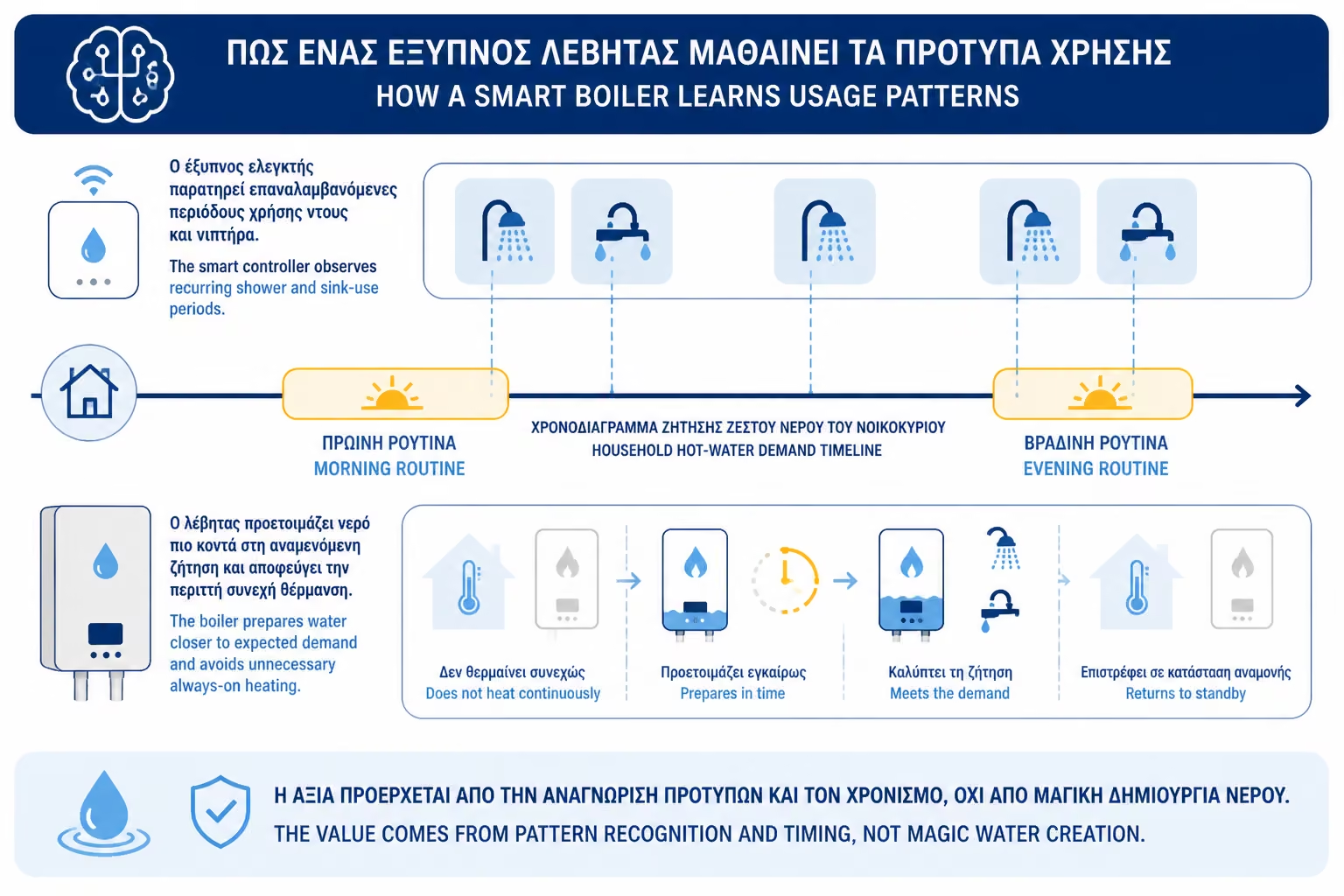
Habit learning is based on observing repeated patterns. The device or application records when you ask for hot water, when the container is empty, when you turn on the water heater, how long it takes to reach temperature and what hours there is consumption. Based on these, it tries to predict when hot water will be needed again.
For example, if you shower every weekday at 07:30, the device can start earlier enough so that the water is ready then, instead of keeping it warm overnight. If on weekends the use is later, he can adjust the schedule. If you go on vacation or activate away mode, it may stop temperature maintenance.
Ariston mentions for its app the possibility of energy reports, optimization tips and savings of up to 25%, while the Velis Evo Wi-Fi is mentioned as a device with app control and shower-ready notifications. This shows the basic direction of the market: less manual operation and more control based on actual use.
But learning is not always perfect. If the family's schedule is irregular, if there are visitors, if someone takes a shower at random times, or if the hot water is also used in the kitchen, the forecast may be less accurate. That's why it's useful to always have a manual boost mode.
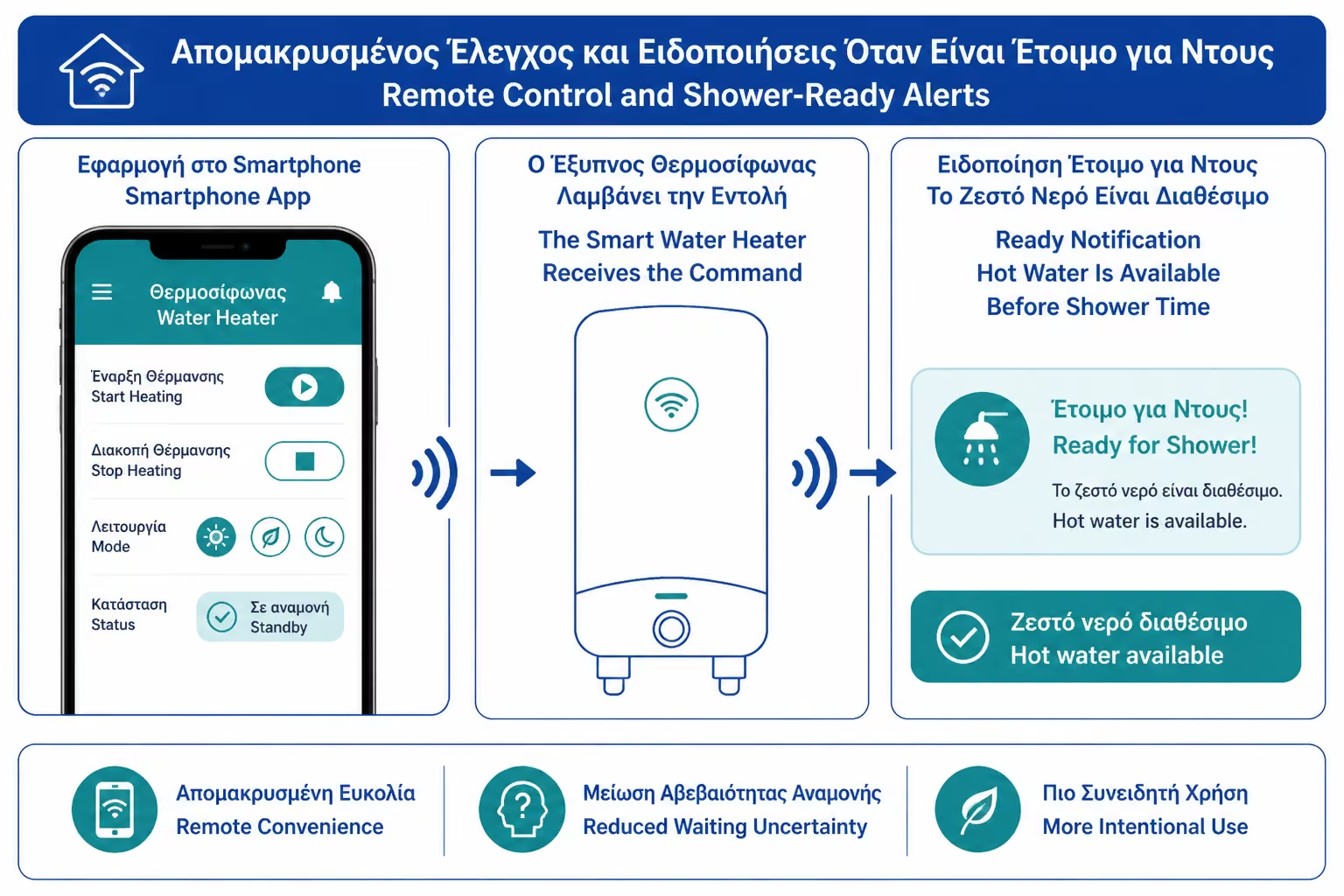
Remote control is perhaps the most obvious advantage. You are away from home and want hot water when you get back. Turn on the water heater from the mobile phone. You're in bed and remember you left it on. You close him from the application. You go away for the weekend and disable the program. You come back early and activate him before you arrive.
This is not just comfort. It's also a savings. The classic switch on the panel often leads to excessive operation because the user turns it on "to be". The app allows for more targeted use. You don't need to turn it on from morning to night. You don't have to keep it on all day because you might need it.
But there must be local handling. If Wi-Fi goes down, if you change routers, if the app is lost, or if the cloud has a problem, the water heater must be able to operate with a physical switch or from the panel. A critical home system should not depend solely on an app.
Remote control is great when it complements a proper thermostat and safe electrical installation. It should not be used to cover a rough connection or the absence of a normal switch.
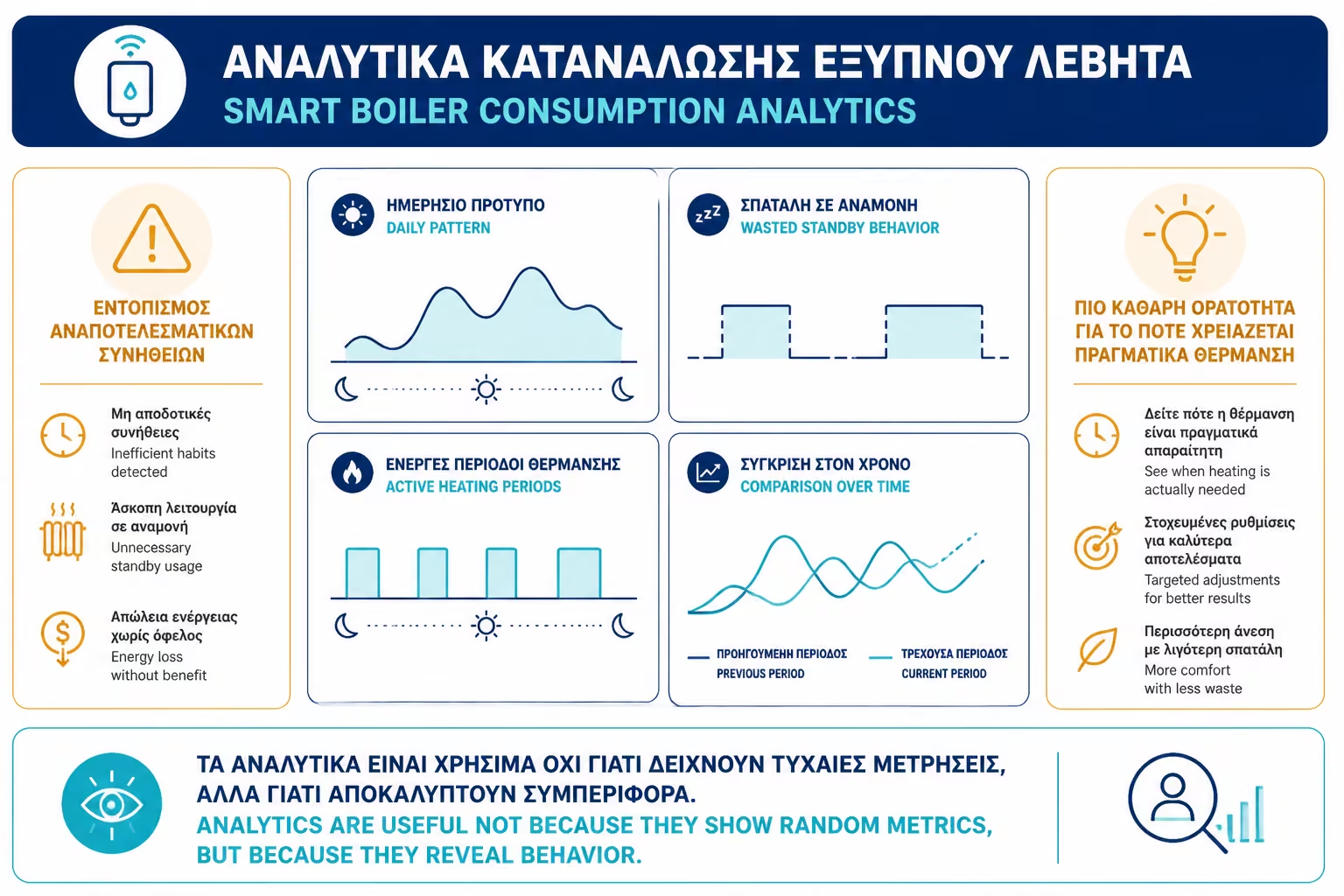
Consumption statistics change the user's relationship with the water heater. If you see how many kWh it consumes per day, week or month, you can understand whether your habits are economical or not. You may find that the water heater works much longer than you thought, or that a small program change significantly reduces consumption.
Energy reports are valuable because they reveal hidden waste. For example, if the water heater heats up every night but ends up not being used, the graph will show this. If the target temperature is too high, it may show in increased consumption. If there are many small activations during the day, maybe the schedule needs to be changed.
But we should not treat the statistics as a high-precision laboratory measurement, unless the device has a real power meter. Some systems calculate consumption based on operating time and resistance power. This gives a good picture, but may not be absolute. For daily optimization, it is usually sufficient.
The important thing is not to stick to charts. Use them for decisions: lower temperature, better program, less pointless boosts, away mode when you are away.
A useful function of smart boilers is the notification that there is enough hot water for a shower. Instead of blindly waiting 30 or 45 minutes, the device can inform you that the water has reached the level of use. The Velis Evo Wi-Fi, for example, reports shower ready notifications through the app.
This is practical for less consumption. Many leave the water heater on longer than necessary "just to be sure". If the device says it is ready, you can use it earlier or stop heating. Also, in families, it can help to know if there is enough water for a second shower.
The amount of hot water available is not always simple. It depends on the temperature of the water in the tank, the temperature of the incoming cold water, the mixing in the mixer, the flow of the shower and the duration of use. A "shower" as a unit of measurement can mean different things to different users. Still, it's more useful than guessing.
In Greek homes with an electric water heater, this function can change habits. If you know the water will be ready in 25 minutes, you don't need to turn it on for an hour.
Storage temperature is a critical issue. The higher the water is heated, the more energy is required and the greater the heat losses. On the other hand, too low a temperature can create a health risk, especially for Legionella in storage systems.
The HSE in the UK states that when Legionella is controlled by temperature, hot water should be stored above 60°C and dispensed above 50°C.
In domestic water heaters, this needs to be balanced against the risk of scalding. Water at 60°C should not flow uncontrollably into a shower or sink, especially if there are children or the elderly. That is why in serious installations, thermostatic mixers or mixing valves can be used, so that the water is stored safely but distributed at a comfortable temperature for use.
Many smart boilers have an anti-legionella function, i.e. periodic heating to a higher temperature. This is useful, but the manufacturer's manual must be followed. The user should not permanently lower the temperature too low for economy without understanding the health risk.
The anti-legionella program periodically heats the water to a higher temperature to reduce the risk of Legionella growth. In smart boilers, this can be done automatically, based on a program or when the device detects that the water has been left for a long time at lower temperatures. Ariston lists anti-legionella as a security feature on the Velis Evo Wi-Fi.
This function should not be disabled simply to reduce consumption. Saving should not come at the expense of hygiene. If the home has low usage, if the water heater is left with lukewarm water for days, or if it is a cottage, the safety loop can be even more important.
On the other hand, anti-legionella doesn't mean you can ignore everything else. If there are pipe dead spots, rarely used fixtures, stagnant showers or poor maintenance, the risk doesn't magically disappear. Temperature is a key measure, not the only concept of hygiene.
For the owner, the correct practice is to leave the function on, read the manual and set the temperature based on the manufacturer's and installer's instructions.
In Greece, many houses have a solar water heater with electric resistance. That's where it gets more interesting. The sun can heat the water for free, while the electric resistance acts as a backup. If smart control is added, unnecessary electric heating can be limited when there is enough solar hot water.
But not all solar is "smart-ready". Many installations have a simple resistance switch. If a smart relay is inserted, it only controls the electrical resistance, not the solar efficiency. For really smart operation, a temperature sensor in the container or a temperature-aware device is needed. Without a sensor, the app can turn it on and off, but it doesn't know if the water is already warmed by the sun.
Solar installation must be checked by an electrician, because the resistance can be a heavy load and the circuit must be properly protected. Also, the solar thermostat and safety devices should not be bypassed. The smart relay does not replace the safety thermostat.
In a well-designed system, smart control can help a lot: activation only when the tank temperature is low and there is a real need, programming before use, remote shutdown and statistics. In a rough system, it just makes it easier to turn on the resistance from afar, without any real information.
As electricity tariffs become more variable, the water heater can act as a controlled load. That is, if we know that we need hot water at 21:00, we may be able to heat it at a more economical time, as long as there are no large heat losses. In countries with dynamic tariffs, this is of particular importance.
Research on domestic electric water heaters shows that optimized scheduling can reduce energy or costs when usage requirements and thermal losses are considered. A recent 2026 pre-publication on deadline-aware control in immersion heaters showed that smarter programming can use significantly less energy in specific models and scenarios than simpler strategies.
In Greek everyday life, the practical lesson is simple: the water heater must work as close as possible to the time of use, unless there is a cheaper tariff or solar production that changes the logic. If you heat water too soon, some of the heat will be lost to the environment. If you heat it too slowly, it won't be ready.
Smart boilers and Wi-Fi controllers can help when they allow scheduling based on time, temperature, cost or energy availability. But this requires proper settings. If you just hit boost every time, you're not using intelligence.
A smart boiler does not correct a wrong choice of capacity. If a house of four people has a very small tank, the water will run out regardless of the app. If a small apartment has an excessively large boiler, more water will be heated than necessary. The right capacity remains key.
The same goes for resistance power. A stronger water heater heats up faster, but requires a proper electrical line. A weaker one might be gentler on the network, but it's slow. The choice must be made based on number of users, habits, water supply, available electrical power, panel and installation location.
Smart features are a control layer on top of proper plumbing and electrical design. If the base device is the wrong size, the app will just make the problem more obvious.
A practical example: a family with two continuous showers buys a small smart boiler because it has a nice fit. The app constantly shows that there is not enough hot water. The problem is not intelligence. It's the capacity.
The electric water heater is a big load. It usually requires a dedicated line, suitable cross section of conductors, suitable fuse, double pole switch, ground, leakage relay and proper connection. If we add smart control, these requirements are not reduced. Instead, it must be checked that the smart controller is suitable for the load.
In previous articles in the electric water heater series, the basic principle remains: we don't just replace a switch with a Wi-Fi device without study. The smart relay must have an appropriate rated voltage, be placed in a panel or box with proper cooling, cooperate with a circuit breaker where necessary and not operate at its limits. Installation must be done by a licensed electrician.
The RCD/leakage relay is critical, especially as the water heater is connected to water and often supplies a bathroom. The IET states that in areas with a bath or shower all circuits must be protected by an RCD up to 30mA.
If the smart boiler is a new device, the manufacturer's instructions are followed. If smart control is added to an old water heater, the existing line is checked first. If the panel is old, maybe the right solution is not a smart relay, but an electrical upgrade.
The smart part should not make us forget the plumbing. The water heater needs a safety valve, proper connection, pressure control, proper venting and regular maintenance. If the mains pressure is high, a pressure reducer may be required. If the safety valve leaks frequently, the system should be checked, not ignored because "the app shows everything is fine".
A smart boiler can provide alerts or diagnostics, but it does not replace hydraulic safety. If the device overheats, if the valve does not work, if the thermostat is damaged or if the pressure is problematic, we are talking about serious issues.
Installation must be done by a plumber and electrician, depending on the project. The plumber checks supplies, valves, pressure, connection, support and drainage. The electrician checks line, protections and connection.
The app can tell you that the water is hot. It doesn't always tell you that the safety valve is properly installed. This remains a technical review.
A smart boiler must be able to work even without internet. If Wi-Fi is lost, basic local control should still be available. If the manufacturer's server has a problem, you should not be left without hot water. If you change routers, you should be able to reconnect the device easily.
Good devices have physical buttons, screen or local mode. The app is an add-on. If a product requires cloud only for core functions, it is more vulnerable. Also, you should check if the app has support, updates and compatibility for your country. Bosch, for example, mentions about the HomeCom Easy app that it provides remote management of hot water and heating appliances, while on a specific page it also mentions a schedule of security updates for the gateway until December 31, 2031.
This is important because smart products have a lifetime that also depends on software. A water heater can live 10–15 years. Will the app be supported as well? Will it work without app if support ends? These questions have real value.
For critical home appliances, go for products that work locally and have a trusted dealership.
A smart boiler can reveal a lot about the habits of the home. When do you wake up, when do you bathe, when are you away, how many people use hot water, when do you come back from vacation. Usually this data is used for program improvement and energy reports, but it remains personal everyday information.
There is no need to panic, but a conscious choice is needed. Read privacy policy, use strong password, enable double verification where available and prefer manufacturers with serious support. If the system supports local control or limited cloud dependence, it is an advantage.
Also, if you're giving access to tenants or technicians, control who sees what. In Airbnb or rentals, remote management can be useful, but it must be done with respect for users' privacy.
Energy data is valuable for the economy, but it is not neutral. It is behavioral data.
Worth it when you use an electric water heater frequently and want better control. It is worth it in homes where the water heater is forgotten to be turned on, in families with a recurring schedule, in vacation homes where you want remote activation, in homes with high electricity costs and users who want to see consumption.
It is also worth it when the old water heater is already due for replacement. If the device is old, has salt, low performance or problems, then buying a smart model can be a logical upgrade. But if the existing water heater is relatively new and correct, a safe timer or smart control on the panel may make more sense, as long as it's done properly by an electrician.
Not worth it if the problem is wrong capacity, bad plumbing, old power line or no RCD. The infrastructure is fixed there first. It's also not worth it if you don't plan on using the app, schedule or stats. If you always open it manually from the panel, the smart features remain unused.
The smart boiler pays off when it changes behaviour. Not when it just adds a screen and Wi-Fi to a bad habit.
In the Greek market of 2026, a simple electric water heater can operate at much lower levels than a smart boiler, depending on capacity and quality. A smart electric water heater or boiler with Wi-Fi, digital control and better insulation can range roughly from €300-800 or more, depending on capacity, brand, tank technology, warranty, app and functions. Premium or slim/twin-tank models can exceed these levels.
Adding a smart relay or Wi-Fi controller to an existing water heater can cost less in materials, around €40–150 for the controller, but proper installation by an electrician, panel changes, possible switch/fuse replacement or adding a suitable contactor can add up to the cost. A secure panel solution should not be compared to a cheap plug-in gadget.
The installation of a new water heater includes hydraulic and electrical parts: support, supplies, safety valve, connection, leakage control, line, grounding, RCD, switch, possible stripping of the old one. The final cost depends on access, space, height, loft, type of water heater, if VAT is included and old installation condition.
Don't judge the purchase by device price alone. Calculate savings, maintenance, service, warranty, safety and the possible need for an electrical upgrade.
Have the electrician check the water heater line, cable cross-section, fuse, bipolar switch, RCD, grounding and compatibility of any smart controller with the load. If a smart relay is put in, ask that it be rated for the power and placed in a safe location, not crammed in without cooling or out of spec.
Ask the plumber to check capacity, pressure, safety valve, supplies, valve drain, support and piping condition. If the old water heater has salts or leaks, the smart upgrade is not a priority. Safe replacement is a priority.
From the supplier, ask for a manual, warranty, app compatibility, information on anti-legionella, energy reports, possibility of local operation, support in Greece and spare parts. Ask what happens if the Wi-Fi goes down, the router changes, or the app stops being supported.
A correct offer must include device, plumbing, electrical connection, app setup, function check and delivery of user instructions. Not just "installing a smart boiler".
The first mistake is to think that smart automatically means economical. The economy comes from schedule and proper usage, not Wi-Fi.
The second mistake is a smart relay in the water heater line without power control and electrical protection. The water heater is a big load.
The third mistake is to lower the temperature too much for economy without anti-legionella and without understanding the health risk.
The fourth mistake is to buy a small smart boiler that does not meet the needs of the family. The app does not generate extra liters of hot water.
The fifth mistake is to ignore the safety valve, pressure and plumbing. Smart control does not replace safety.
The sixth mistake is cloud/app dependency without local handling. The water heater must also work without internet.
The seventh mistake is not using statistics. Unless you're changing habits based on the data, energy reports are just graphs.
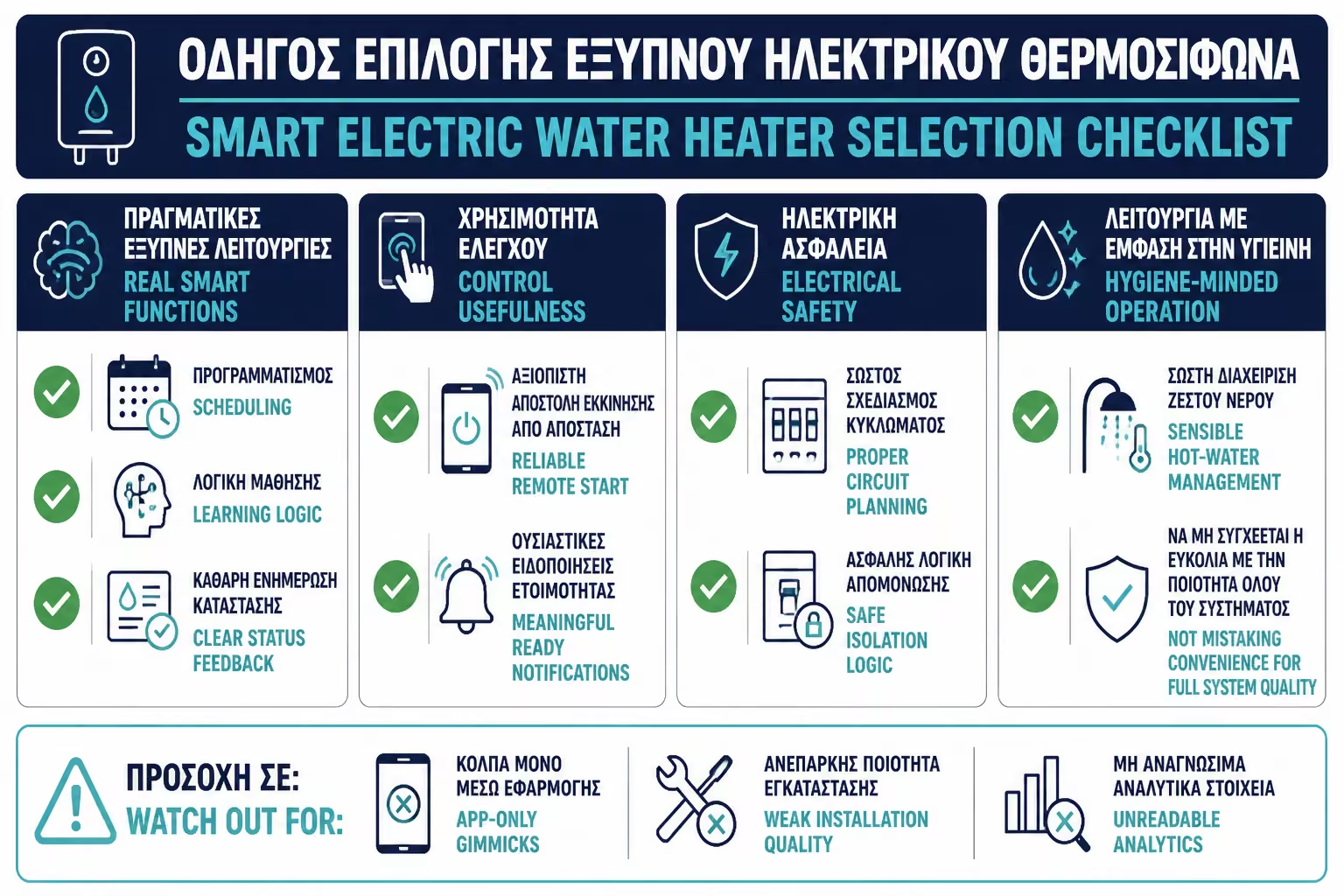
Before you finalize the choice or installation, review the following points first:
| Question | Yes / No |
|---|---|
| Does the existing water heater really need to be replaced or is a safe smart control sufficient? | Yes / No |
| Does the capacity cover the number of users and showering habits? | Yes / No |
| Is the power line suitable for the power of the device? | Yes / No |
| Is there a 30mA RCD/leakage relay and proper grounding? | Yes / No |
| Is there a bipolar switch or a suitable isolation method? | Yes / No |
| Does the device have an anti-legionella function or clear temperature instructions? | Yes / No |
| Does the app really give energy reports or only on/off? | Yes / No |
| Is there local handling if Wi-Fi drops? | Yes / No |
| Is there service, warranty and spare parts on the market? | Yes / No |
| Have you planned usage instead of continuous operation? | Yes / No |
If the answers are not clear, do not start the app. Start from capacity, safety, line and usage.
If you have to keep only one thing, keep this: the smart water heater does not save because it is “smart”. Saves because it heats water at the right time, at the right temperature and for the right use. The app, energy reports and learning are only valuable when they are based on the correct device, correct capacity, safe electrical line, RCD, grounding, safety valve and an active anti-legionella program. If the installation is old or sketchy, we fix the safety first and then add Wi-Fi.
Smart electric water heaters and smart boilers are a very interesting development for Greek homes, especially where the electric water heater is used daily. They can reduce unnecessary operation, provide remote control, alert when water is ready, display consumption statistics and adapt to family habits.
But their value isn't just in Wi-Fi. It lies in the ability to stop the "I open it and see" logic. With the right program, learning, away mode and energy reports, the water heater can work closer to real needs. This reduces consumption, limits forgotten operating hours and makes everyday life more comfortable.
At the same time, we must not forget that we are talking about a powerful electrical device that stores hot water. Correct line, grounding, RCD, double pole switch, safety valve, pressure and Legionella protection are more important than any app. Smart mode should click on safe installation.
For the owner, the best strategy is to start from his real needs: how many people use hot water, what hours, how much capacity is needed, if there is solar, if the line is correct and if he wants simple remote operation or a full smart boiler. Then the choice becomes a technical decision, not a gadget purchase.
The right smart boiler is not the one that just opens from the mobile phone. It's the one that knows when you need hot water — and stops consuming when you don't.
Return to category.
Go to categoryReturn to the central guide.
Go to guide