Cleaner aesthetics
The channel feels more linear and less visually disruptive inside the shower floor.
Linear drains have become extremely popular in modern bathroom renovations. They are mostly used in walk-in showers and built shower zones, where the goal is a cleaner look, larger tile surfaces and a more level visual result.
But a linear drain is not just a nice stainless channel in the floor. It is a real drainage component. It needs proper flow capacity, sufficient installation depth, correct connection to the waste line, proper waterproofing and correctly formed slopes.
If it is selected based on appearance alone, it can create serious problems: standing water, overflow into the bathroom, odors, difficult cleaning, failed waterproofing or even the need to remove tiles.
The right linear drain has to be selected before the floor build-up is finalized, not at the end when everything else has already been fixed.
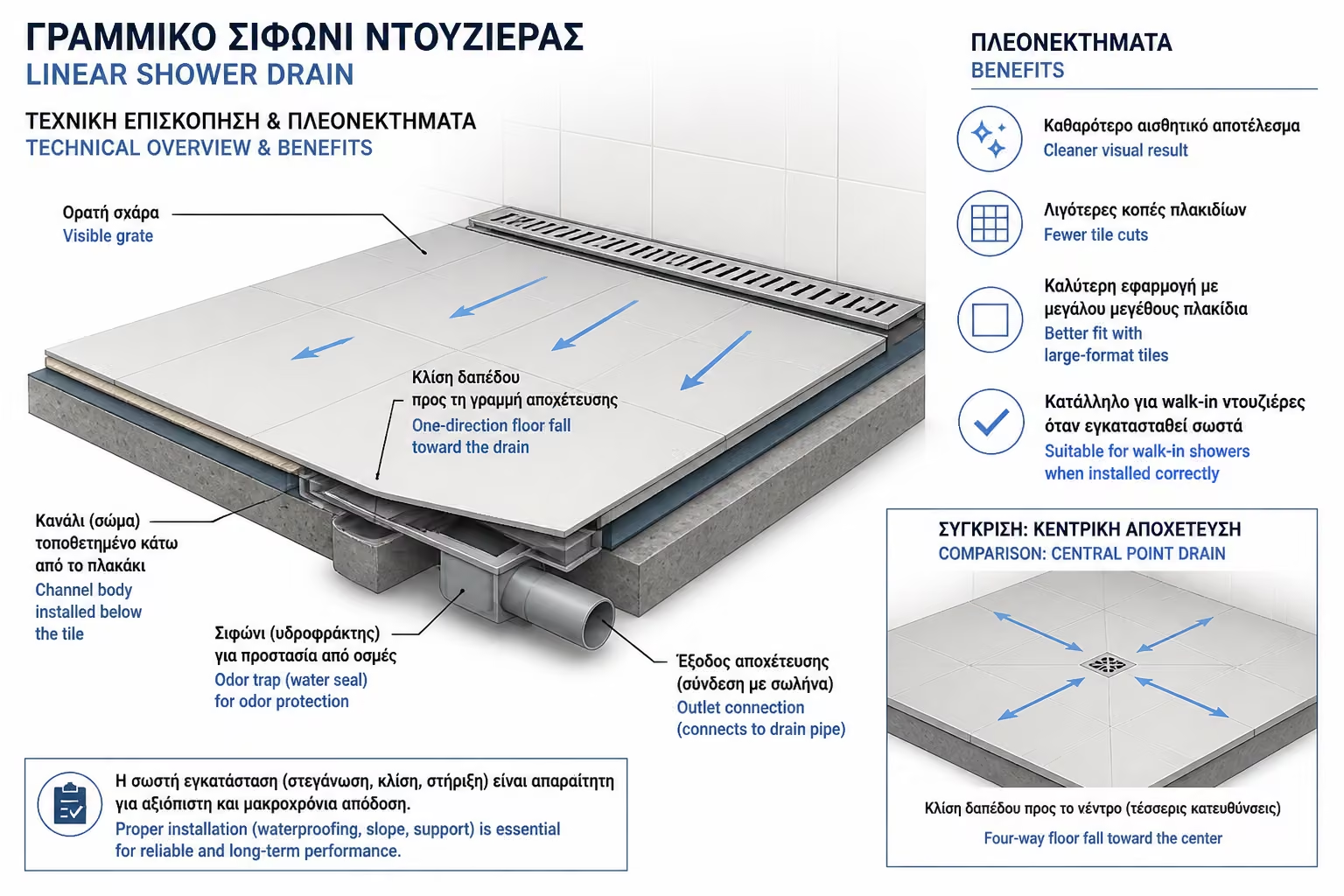
A linear drain is a long, narrow drainage channel placed on the floor of the shower area or at the edge of the shower zone.
Unlike a classic square drain, which collects water at one point, a linear channel collects water along a longer line.
Its success still depends on correct installation. An expensive linear drain installed badly can perform worse than a simple conventional floor drain.
In practice, the main advantages that make a linear drain attractive are the following:
The channel feels more linear and less visually disruptive inside the shower floor.
It supports a cleaner tiled result with fewer awkward cuts around a central drain.
It often allows a simpler and more controlled slope geometry across the shower base.
The drainage line integrates more quietly into the overall design of the shower.
It naturally suits more open, contemporary shower designs without a raised threshold.
It offers more placement flexibility, as long as the technical build-up supports it.
A linear drain mainly makes sense when the goal is a walk-in or built shower with a cleaner, more contemporary look.
It becomes especially useful when several of the following conditions apply:
A linear drain usually works better with larger tile surfaces in the shower base.
It helps when the goal is a single directional slope rather than four-way falls to one point.
It suits shower areas where the design calls for a quieter, more minimal drainage solution.
The assembly needs real space below the finished tile level.
Without reliable waterproofing, the visual upgrade is not worth the technical risk.
The channel has to connect to a waste line that can genuinely support it.
In some richer shower systems, the right linear drain becomes a very practical choice.
When the renovation is aiming for a higher-end visual result, a linear drain often fits better.
It should not be installed just because it looks elegant if the bathroom does not have the required depth, drainage path or technical infrastructure.
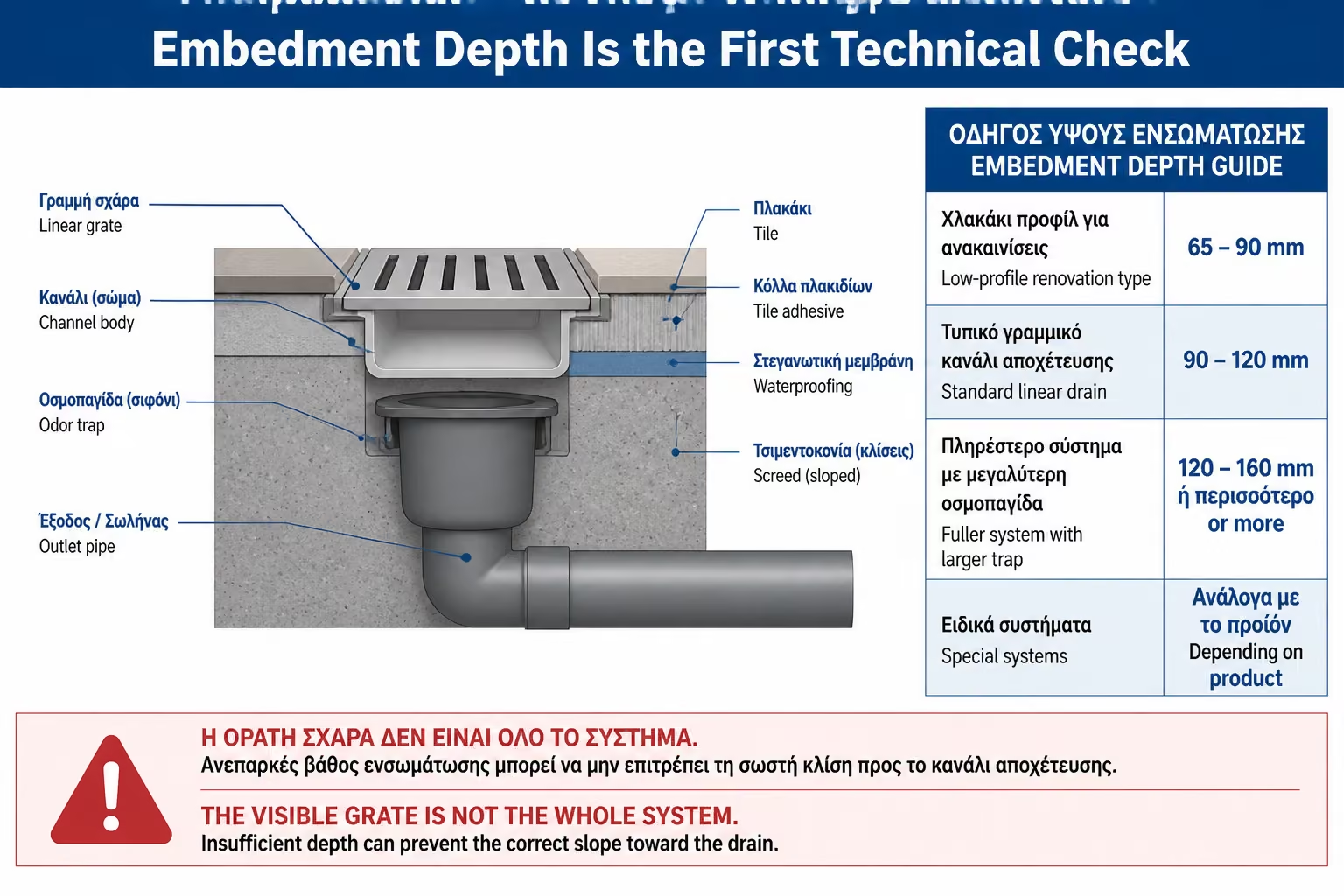
The first thing to check is the available installation depth.
A linear drain is not just the visible grate. Under it, the assembly must accommodate the channel body, the trap, the waste connection, the pipe outlet, the floor build-up, the screed, the waterproofing, the adhesive layer and the final tile finish.
If there is not enough depth, the drain may not fit correctly or may fail to achieve the right slope toward the waste line.
The most common height ranges by product category are summarised in the table below:
| Linear drain type | Indicative required height |
|---|---|
| Low profile / renovation | 65 – 90 mm |
| Standard linear drain | 90 – 120 mm |
| More complete system with a larger odour trap | 120 – 160 mm+ |
| Special solutions / vertical output / complex systems | depending on the product |
The above are indicative. The technical brochure of the specific product should always be checked.
Many homeowners look for the thinnest possible linear drain to make it fit into a renovation. That is understandable, especially in apartments where floor depth is limited.
But an ultra-low-profile drain can come with real limitations.
The available space for the trap can become much more limited.
It is not enough for the drain to fit physically. It also has to handle the water volume.
Tighter internal geometry often means tighter maintenance access as well.
More marginal systems forgive less when hair, residue or installation errors appear.
The entire installation has to be executed with even more accuracy.
The thinner and more marginal the product, the smaller the error margin on site.
So the goal is not simply to buy the thinnest product. The goal is to choose the product that fits while still offering proper drainage and a reliable water trap.
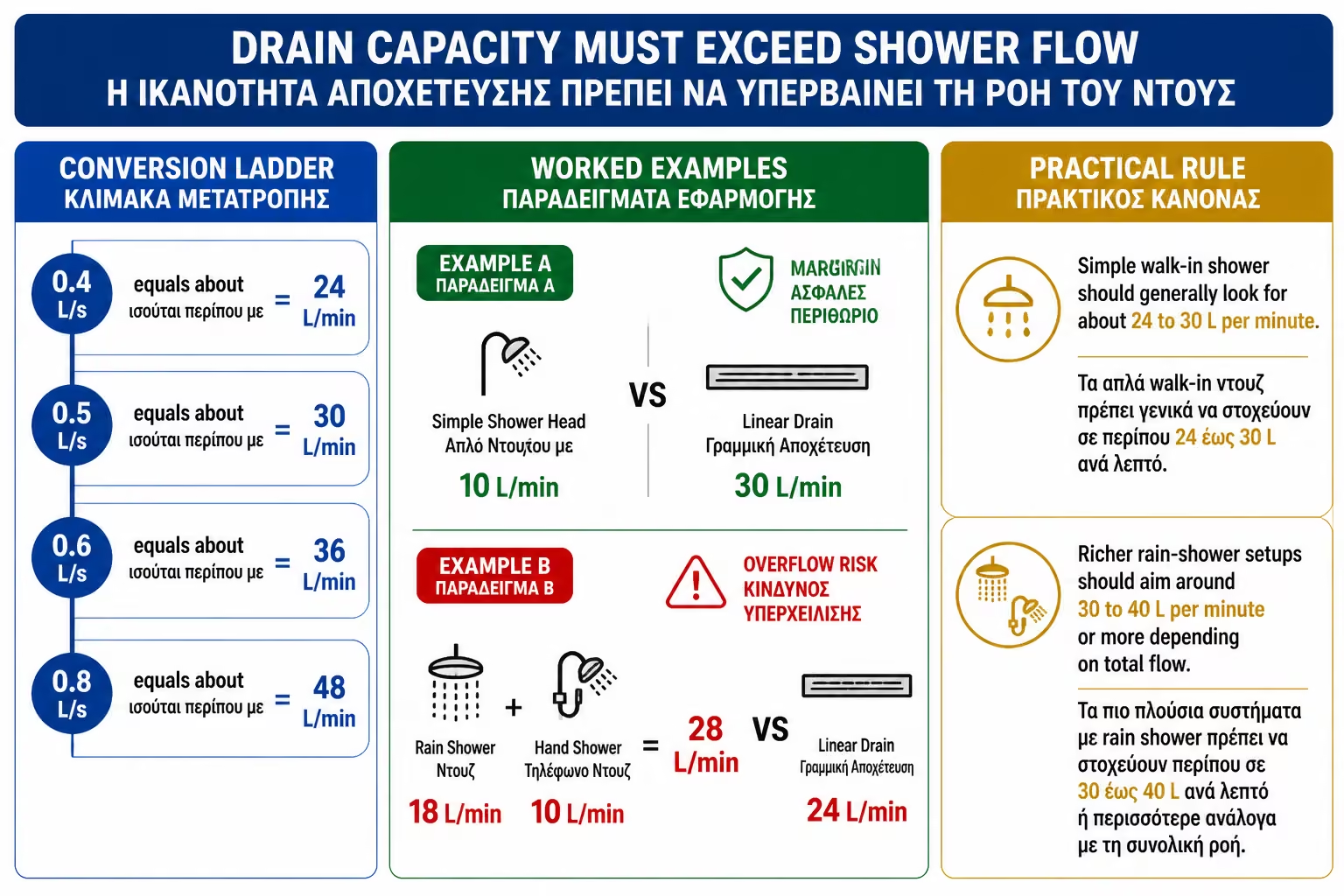
Flow capacity tells you how much water the linear drain can accept without overflowing.
Manufacturers usually state it either in liters per minute or liters per second. For practical reading, 0.4 L/s is about 24 L/min, 0.5 L/s is about 30 L/min, 0.6 L/s is about 36 L/min and 0.8 L/s is about 48 L/min.
A simple hand shower may have a flow of roughly 8–12 L/min. A large rain head can be much higher. If a rain shower, hand shower or body jets operate at the same time, the total output rises quickly.
The drain must be able to remove more water than the shower can deliver.
The basic rule is simple: the flow capacity of the drain must be greater than the maximum shower output.
If a simple shower head delivers around 10 L/min and the linear drain handles 30 L/min, there is comfortable safety margin.
If a rain shower delivers 18 L/min and a hand shower adds another 10 L/min at the same time, total output reaches 28 L/min. In that case, a drain rated at only 24 L/min is already undersized.
In real use, the problem becomes even worse if hair, soap residue, weak slopes or a poor waste connection reduce actual performance.
For a richer shower with a large rain head, it is better to have a runoff of about 30–40 L/min or more, depending on the flow.
For systems with multiple water points, the choice must be made with a specific calculation.
10 L/min
30 L/min
18 L/min
10 L/min
28 L/min
24 L/min
For a simple walk-in shower, look for at least about 24–30 L/min of drain capacity.
The length of the linear drain is not only chosen aesthetically. It also affects the function of the floor.
Typical market lengths usually start at 60 cm and go up to around 120 cm.
Some typical length options and the logic behind them are the following:
Useful in smaller shower zones or in tighter renovation conditions.
A common option for narrower walk-in shower layouts.
A balanced choice for standard showers with a clean one-way slope.
Very common in comfortable walk-in zones with a more premium appearance.
Useful when the shower zone is larger and needs broader visual coverage.
Typically used in large shower areas, provided the waste line and slopes support it.
In many walk-in showers, common choices are 70–90 cm, depending on the width of the shower.
For a quick match between shower width and channel length, see the indicative examples below:
| Shower zone width | Indicative channel length |
|---|---|
| 70 cm | 60-70 cm |
| 80 cm | 70-80 cm |
| 90 cm | 80-90 cm |
| 100 cm | 90 – 100 cm |
| 120 cm | 100 – 120 cm |
It does not always have to exactly match the shower width. But if it is too short, it can create both visual and practical problems in the way water is guided.
The linear drain should usually be related to the width of the shower zone.
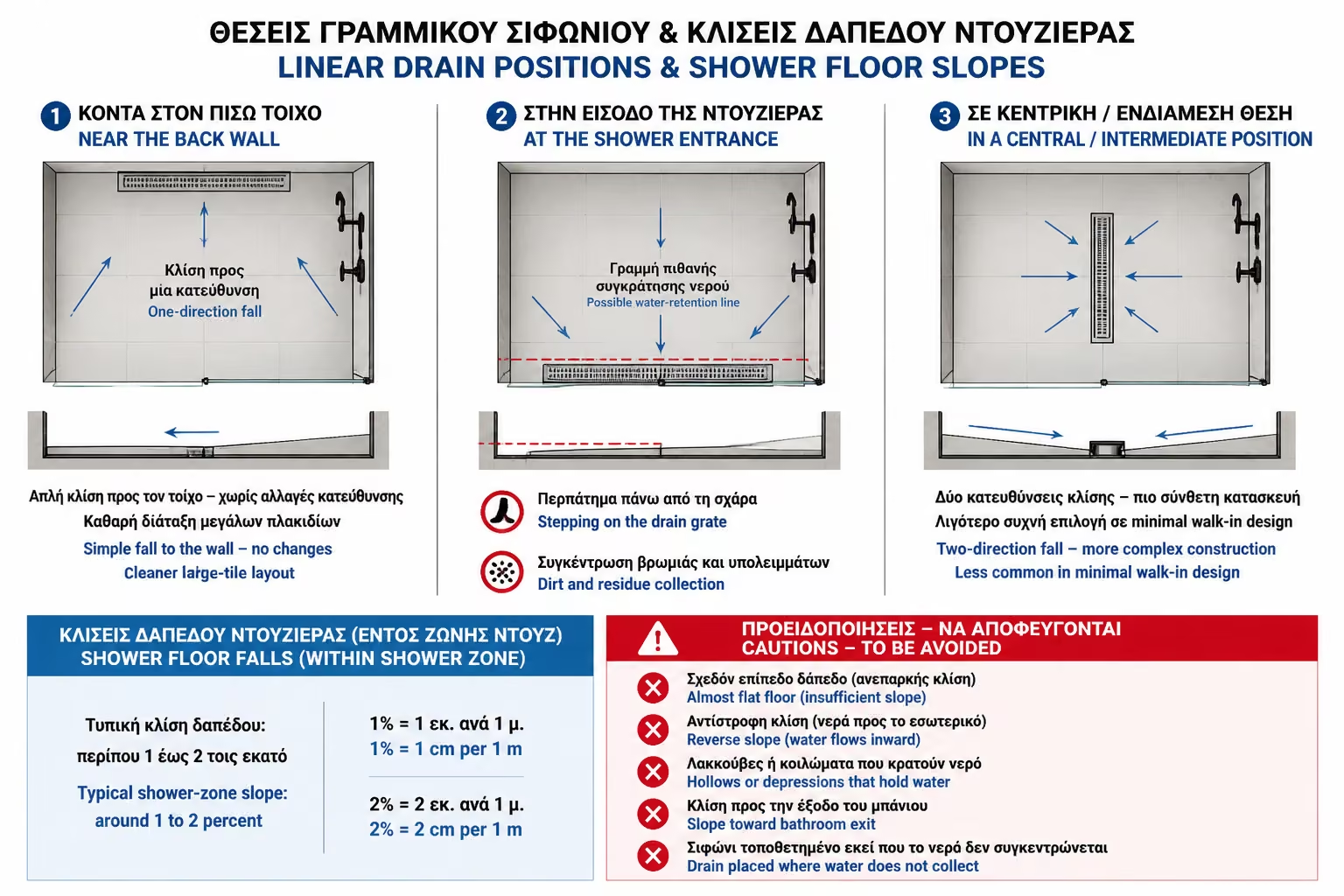
There are three main placement strategies, and each follows a different practical logic.
This is usually the cleanest-looking solution and works very well with a single slope toward the wall.
It gives a quieter visual result, works well with large tiles and keeps the drainage line more discreet.
It requires correct waterproofing at the wall junction, easy cleaning access and a proper waste connection.
It can act as a water-retention line before water escapes into the rest of the bathroom.
It can help in walk-in layouts where water control is needed without a raised threshold.
If placed badly, the user steps on it, it gathers dirt more easily and it demands very accurate slope formation.
This is less common in clean walk-in layouts and is not always ideal for a one-way floor slope.
It may still be justified when the room layout or the waste-line route strongly favors it.
One of the main advantages of a linear drain is that it allows a single directional floor slope.
Instead of shaping four falls toward a small central drain, the floor can be formed with one continuous fall toward the channel.
This is especially useful when large-format tiles are being used.
In practical terms, a 1% slope means roughly 1 cm fall per 1 m of length, while a 2% slope means roughly 2 cm per 1 m.
The exact slope still depends on the product, the tile, the layout and the intended use.
A linear drain does not fix bad floor slopes. It needs the right floor geometry in order to work properly.
The most important practical slope rules are the following:
In a shower zone, the floor often falls about 1% to 2% toward the drain channel.
Avoid a nearly flat floor, reverse slope, local depressions, slope toward the bathroom exit and any channel position that fails to collect the water properly.
The connection of the linear drain must have a sufficient pipe size.
In showers, a Φ50 connection or equivalent cross-section is often used, depending on the system.
If the channel has high drain capacity but the downstream pipe is too small or poorly sloped, real-world performance drops sharply.
The outlet built into the product must suit the flow rate it claims to achieve.
The pipe after the drain must not choke the channel's theoretical capacity.
Without proper fall in the waste line, even a good product will underperform.
The longer the path, the more carefully the downstream drainage route should be checked.
Too many changes in direction make flow less efficient and increase risk.
The final tie-in has to be technically correct, not just convenient on site.
The system should still allow real maintenance where and when it is needed.
Product runoff applies under specific conditions. If the installation is done wrong, the actual runoff will be less.
The linear drain must have an odour trap to prevent smells from returning through the drainage line.
The odour trap holds a quantity of water that acts as a barrier.
In very low-profile products, the odour trap may be shallower. That does not automatically make it bad, but it does require attention:
It is not enough for a trap to exist; it has to be correct for the actual system.
The retained water depth must be sufficient to preserve odor protection in real use.
Maintenance should be possible without turning the bathroom into a small demolition job.
Its everyday job is to keep drain smells out of the shower area.
The overall drainage network affects how stable the trap remains over time.
If the bathroom is not used often, the odour trap may dry out. Then it may just need to be watered periodically.
A linear drain is the place where multiple layers and building materials meet in one very sensitive detail.
The visible surface has to align correctly with the channel and the floor slopes.
The intermediate layers have to work as part of one coordinated system.
This is the most critical defense against future leakage below the finished surface.
The connection has to be technically correct, not merely visually acceptable.
If the drain sits near the wall, the waterproofing detail becomes even more demanding.
This point must be perfectly sealed.
For the sealing to work in practice, the following details need special attention:
The product should provide a serious way to connect into the waterproofing system.
The membrane or brush-on system has to work properly with the chosen drain.
This transition detail is critical and should never be left to guesswork.
Corners are high-risk leakage zones and need careful detailing.
The real protection has to work underneath the visible surface, not only around it.
Silicone is a finishing seal, not a substitute for complete waterproofing.
Silicone in the end is not waterproofing. It is a final seal. The actual waterproofing must be done below the finished surface.
Linear drains look elegant, but they still need regular cleaning.
In real use, they collect hair, soap residue, limescale, shower-product build-up and cleaning residues.
For that reason, the right product should make inspection and cleaning easy.
Access to the inside should be simple and direct.
This helps catch hair and makes routine cleaning much easier.
Without access, periodic maintenance becomes much harder than it should be.
It is not enough to clean only the visible top of the channel.
A serious product should still be supportable after installation.
The owner should know how to maintain the system correctly in day-to-day use.
A linear drain that is not easily cleaned will become a problem, no matter how beautiful it is.
There are two main aesthetic choices, and the better option should be judged by maintenance as well as appearance.
It looks more technical and explicit, and it keeps the drainage point visually obvious.
It usually offers easier access, simpler maintenance and a more practical everyday cleaning routine.
It remains a visible metal element in the floor, it can scratch and it needs descaling over time.
With a tile insert, a tile piece is set into the cover so the channel becomes visually quieter.
It gives a very minimal result, almost disappears into the floor and suits more premium bathrooms.
It may be harder to clean, the drainage slot must stay clear and the tile cutting has to be precise.
For everyday use, especially in a family bathroom, the practicality of cleaning is very important.
To choose the right linear drain size, you have to evaluate the whole system and not just the channel length.
The drain should relate correctly to the full width of the shower zone.
It does not always need to match the width exactly, but it should not feel undersized either.
Position affects slopes, practical use and how the water actually behaves.
The drain has to match the maximum flow rate of the shower system.
The pipe route, size and fall affect the real performance of the installation.
If the product does not fit the available build-up, the selection fails before installation begins.
Large-format tiles work better with certain positions and slope strategies.
Appearance matters, but only after function and waterproofing have been secured.
A beautiful channel that is difficult to maintain quickly becomes the wrong choice.
Length is not the only criterion. Runoff and installation depth are equally important.
As a quick guide, the following combinations are typical in real bathroom projects:
| Case | Common choice |
|---|---|
| Small walk-in zone 70–80 cm | 60–80 cm channel |
| Standard walk-in zone 90 cm | 80–90 cm channel |
| Large zone 100–120 cm | 90–120 cm channel |
| High-output rain shower | Check for 30–40 L/min+ flow capacity |
| Low renovation floor | Low-profile model, with careful attention to flow capacity |
| Large-format tiles | Prefer one-way slope and correct channel placement |
The cost depends on the length, quality, material, cover type, installation depth and waterproofing system.
As a rough guide, the most common product levels and cost ranges are the following:
| Option | Realistic cost |
|---|---|
| Economical linear drain | €50 – €120 |
| Better stainless channel | €120 – €250 |
| Brand name flanged/sealed system | €200 – €400+ |
| Premium tile insert / special length | €300 – €600+ |
| Installation together with screed and waterproofing work | Depends on the project |
A cheap channel is not automatically bad, but failure in a walk-in shower is expensive. That is why it is worth prioritising a product with solid specifications, a proper odour trap and reliable sealing.
The most common mistakes that turn a stylish-looking choice into a technical problem are the following:
The linear drain must first work and then look good.
If the shower delivers more water than the channel can absorb, water will build up in the shower area.
If the body of the drain does not fit correctly, improvised site solutions usually follow.
The most dangerous mistake. It can create moisture under the tiles.
Water does not flow into the channel by itself. The floor geometry has to guide it there.
If it is not easily cleaned, it will clog or smell.
The runoff of the channel also depends on the pipe that follows.
The quote must clearly describe the linear drain.
The quote should clearly state the exact product length included.
Not all linear drains are the same in structure, quality or technical performance.
Drainage capacity is a core technical requirement, not a minor detail.
The quote must show whether the product is compatible with the available floor build-up.
The water-trap arrangement should not remain vague in the product description.
The drain connection has to be described clearly.
The quote should explain how the drain integrates into the downstream drainage system.
Waterproofing has to be stated explicitly, not left as an assumption.
A back-wall installation is not the same thing as an entrance installation.
The quote should make clear how water will be guided into the channel.
If included, it should be specified so the owner knows what is actually being supplied.
The chosen finish affects both aesthetics and maintenance and should be named precisely.
The phrase "linear drain" is not enough. There are big differences in quality and technical capabilities.
Before buying a linear drain, do a real technical review rather than an aesthetic-only selection.
Its stated capacity has to match the maximum shower output.
If it does not fit the floor build-up, the product is effectively ruled out.
The outlet affects how well the drain can tie into the waste system.
Odor protection should be a real system feature, not an assumption.
Routine maintenance should not be difficult or impractical.
Internal access helps enormously with cleaning and inspection.
Without real compatibility, sealing the detail correctly becomes much harder.
This often separates serious systems from improvised ones.
Not every drain performs equally well in open shower layouts without a threshold.
The final fit and appearance depend on this compatibility too.
A good product on paper may still be impossible in the actual project.
Long-term support matters for a permanent floor-installed component.
The warranty also says something about the seriousness of the manufacturer.
Position affects the slopes, the user experience and how the water behaves.
The final check should confirm performance before the project is closed out.
If there are no answers to the above, don't choose it just because it's pretty or cheap.
Before the tiles go in, use the checklist below so no critical technical point is left unchecked:
| Question | Yes / No |
|---|---|
| Has the floor depth been checked? | Yes / No |
| Does the linear drain body fit properly? | Yes / No |
| Is its drain capacity sufficient for the shower output? | Yes / No |
| Is the outlet connected to the correct drainage pipe size? | Yes / No |
| Is there a proper odor trap? | Yes / No |
| Is the channel easy to clean? | Yes / No |
| Have the correct floor slopes been designed? | Yes / No |
| Is waterproofing provided around the channel? | Yes / No |
| Does the length match the shower zone? | Yes / No |
| Has runoff been tested? | Yes / No |
| Is the model mentioned in the quote? | Yes / No |
If many answers are “no”, the linear drain has not been designed correctly.
An owner chooses an economical linear drain because it looks good and has the right length. However, they do not check the installation depth or the drainage capacity.
The bathroom has a large rain shower head. The channel has low drain capacity, and the connection to the waste line follows a difficult route with weak slope.
At first the result looks impressive.
After the first showers, the water does not have time to leave. It gathers in the shower zone and exits to the rest of the bathroom.
The problem is not the walk-in layout. It is the wrong technical choice of linear drain.
In another renovation, before the linear drain is even purchased, the plumber checks the available floor depth, the drain location, the shower output, the shower-zone length, the tile choice, the drain position and the waterproofing strategy.
A channel with sufficient drainage, a correct odour trap, a sealing gasket and a cleanable filter is selected. It is mounted on the back wall, one-way flow is created and run-off is tested before delivery.
The result is both beautiful and functional.
A linear drain is not a decorative accessory. It is a drainage system. Before you buy it, check three things: whether it fits the available floor depth, whether it has enough capacity for the shower output and whether it can be waterproofed correctly into the floor build-up. For a simple walk-in shower, look for at least about 24–30 L/min of drain capacity. For a large rain head or multiple active outlets, you need more capacity and a proper technical check. Do not choose the thinnest or cheapest channel if it does not meet the technical demands. Fixing a bad choice after tiling is difficult and expensive.
Linear drains are an excellent solution for walk-in showers when they are selected and installed correctly.
They offer cleaner aesthetics, support large-format tiles and create a more contemporary shower floor. But they also come with very specific technical requirements.
Before choosing one, you need to check all of the critical technical points in a structured way.
The product has to fit the available floor build-up in real conditions.
The stated L/min capacity has to match the actual shower output.
The drain should always be evaluated against the water volume it must receive.
The selected length should make sense for the size and geometry of the shower zone.
Position affects the visual result, the slopes and the practical behavior of water.
The performance of the channel also depends on the drainage network downstream.
Reliable odor protection is essential for everyday comfort.
Maintenance has to be practical, not just theoretically possible.
A linear drain only works well when the floor correctly guides the water toward it.
The sealing detail around the channel is critical for the long life of the renovation.
Tile thickness, cutting and final fit all have to work properly with the selected product.
The right linear drain is the one that does not draw attention to itself, yet works flawlessly every day.
In a walk-in shower, aesthetics matter. But drainage performance, waterproofing and cleanability are what determine whether the bathroom will remain functional for years.
Return to category.
Go to categoryReturn to the central guide.
Go to guide