
Plumbing & Electrical Bathroom Infrastructure
Return to category.
Go to categoryEquipotential grounding in the bathroom is one of the most important electrical issues that the owner usually never sees. It is not an obvious component like the socket, light or switch. It does not affect the aesthetics of the bathroom and is not visible in the photos of a renovation. Nevertheless, it can be decisive for the security of the space.
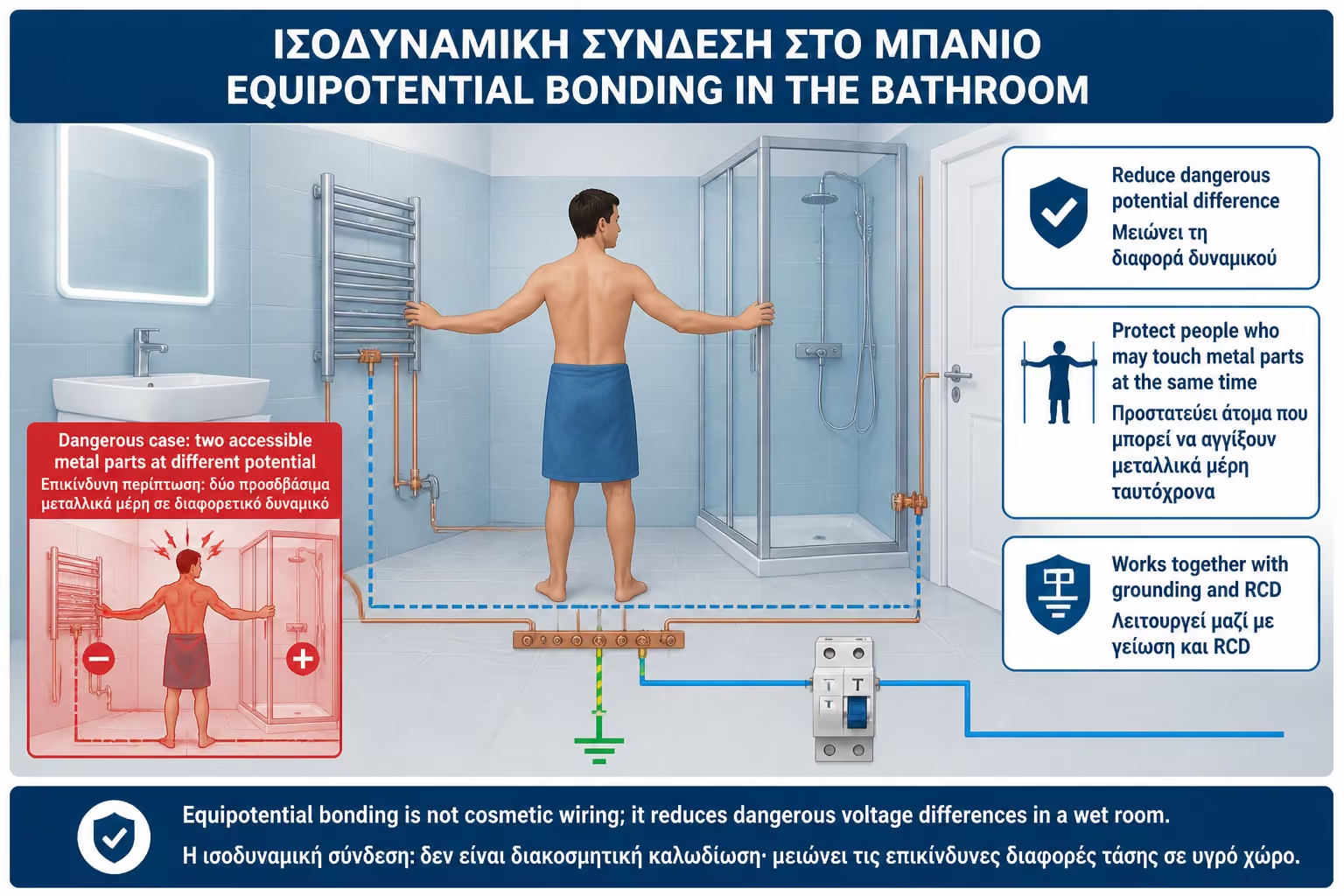
The bathroom is one of the most sensitive areas of the house in terms of electrical risk. There is water, humidity, bare feet, metal batteries, piping, radiators, washing machines, water heaters and electrical appliances. If a dangerous voltage appears in a metal part during a fault, the person can become the "bridge" between two points with different electrical potential. This is exactly what equipotential bonding is trying to reduce.
Simply put, equipotential grounding connects metal parts that may be at a dangerous potential difference to each other and to the grounding system. The goal is not just to "go somewhere", as is often casually said. The aim is to reduce the voltage difference between conductive parts that can be touched by a person at the same time. The IET describes complementary equipotential bonding as the bonding of simultaneously accessible conductive parts to reduce the potential difference between them.
In Greece, the framework for low voltage electrical installations is based on ELOT 60364, which was activated with the Y.A. 101195/2021. The decision states that ELOT 60364 is a Greek standard drawn up based on CENELEC's harmonization documents, mainly the HD 60364 series but also the HD 384 series, and concerns the requirements for electrical installations. For areas with a bath or sprinkler, i.e. a bathtub or shower, part 7-701 has a special role, with ELOT HD 60364-7-701:2024 relating precisely to these special areas and being in force.
In this guide we'll see what equipotential earthing is in the bathroom, what metal parts it may involve, how it protects against electric shock, why it should not be confused with the leakage relay, what changes in old bathrooms with metal pipes or in new bathrooms with plastic networks, and what the owner should ask the licensed electrician before the walls are closed and the tiles installed.
The word "equipotential" sounds difficult, but its practical meaning is simple. We want the metal parts that can be touched at the same time to be, as much as possible, at the same electrical potential. In other words, there should be no dangerous voltage difference between a tap, a metal pipe, a radiator, a metal bathtub or the metal casing of an appliance.
Consider a person stepping out of the shower with wet feet. With one hand they may touch the metal tap and with the other an electrical appliance or heater. If those two metal parts are at different potentials because of a fault, current can pass through the body. Equipotential bonding is intended to reduce that risk.
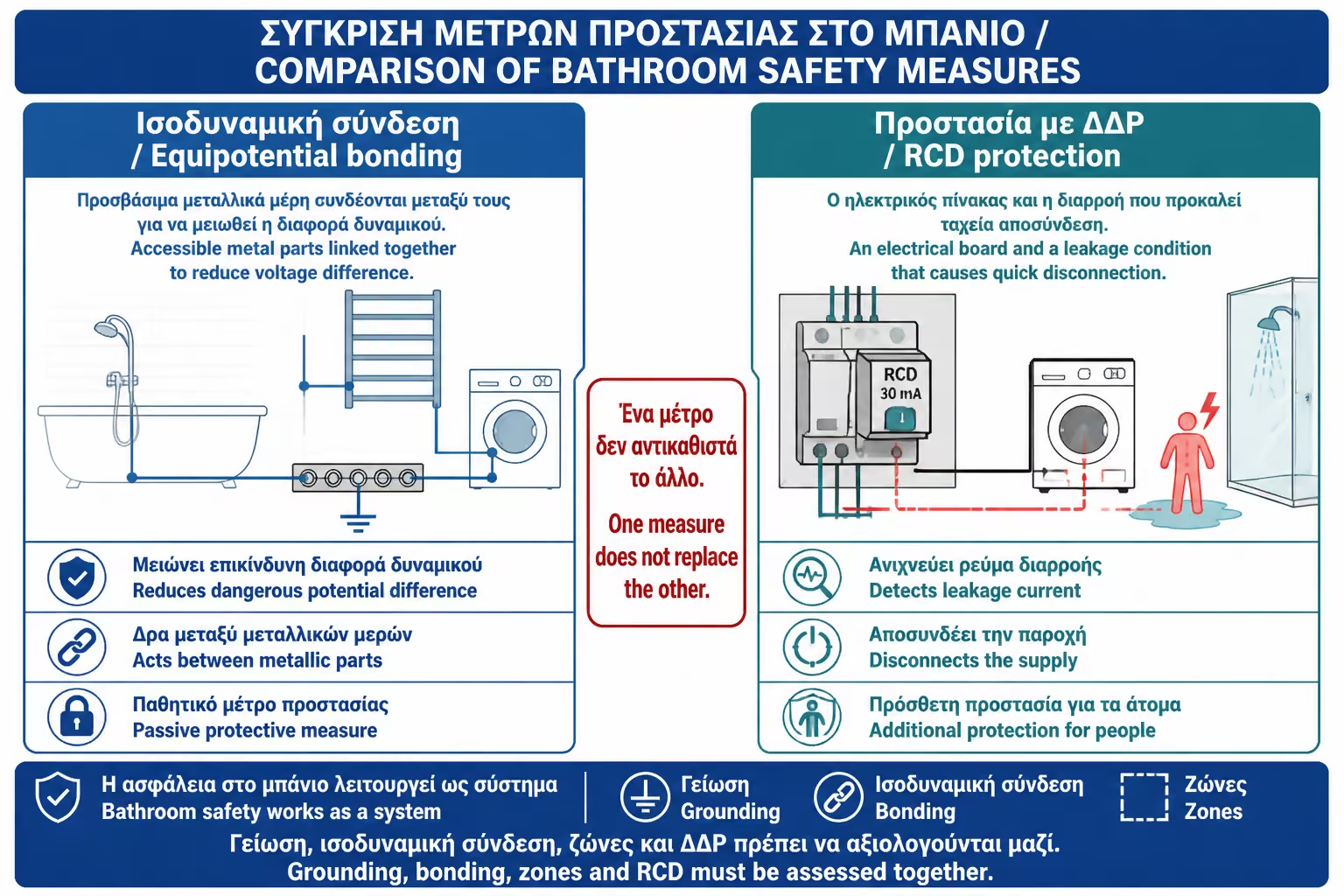
This is not an "extra cable added for formality". It is part of protection against electric shock. Grounding, RCDs, circuit breakers, protection zones, IP ratings and equipotential bonding are not independent of one another. They work as a system.
A practical mistake is to say "I have an RCD, so I do not care about anything else". The RCD is extremely important, but it does not automatically replace every other protective measure. The electrician must check whether the appropriate safeguards are in place for the specific installation and whether the requirements of the regulation are met.
Many people use the word "grounding" for everything. They say "ground the bathtub", "ground the pipes", "ground the radiator". In practice, however, a distinction is needed.
Grounding refers to the connection of the electrical installation to the grounding system, so that in the event of a fault an appropriate current path is created and the protective devices operate. Equipotential bonding refers to the connection of conductive parts to each other and to the protective conductor in order to reduce dangerous potential differences.
There is a main equipotential connection, which concerns the building as a whole, and a supplementary equipotential connection, which concerns special areas or points where the risk is increased. The bathroom is just such a place, because the presence of water and the possibility of contact with metal parts increase the risk.
In practice, the owner does not need to know how the duct will be dimensioned or exactly where the connection will be made. But he must understand that the matter is not solved by a random cable. Requires inspection by a licensed electrician, proper connections, continuity measurements and documentation.
In a dry area, a person usually wears shoes, is not wet, and does not touch many conductive surfaces at the same time. The opposite happens in the bathroom. The body may be wet, the feet bare, the floor wet and the hands touching metal parts.
This situation makes the bathroom more dangerous than other places. A damage that in another room would have less practical danger, in the bathroom can become serious. That is why Section 701 of the standard treats areas with a bathtub or shower as special areas with increased requirements. The international IEC 60364-7-701 specifically addresses electrical installations in spaces containing a fixed bath or shower and the surrounding zones, while pointing out that national requirements should be taken into account where they exist.
A bathroom may have new tiles, a modern shower, an LED mirror and nice lighting, but if the electrical protection is incomplete, the project is not complete. Security is not apparent at first glance. It is shown in the panel, grounds, connections and measurements.
That's why every bathroom renovation should include an electrical check, even if the owner thinks that "we don't bother with electricals". If plumbing, piping, radiators, showers, bathtubs or electrical appliances are changed, the overall behavior of the space also changes.
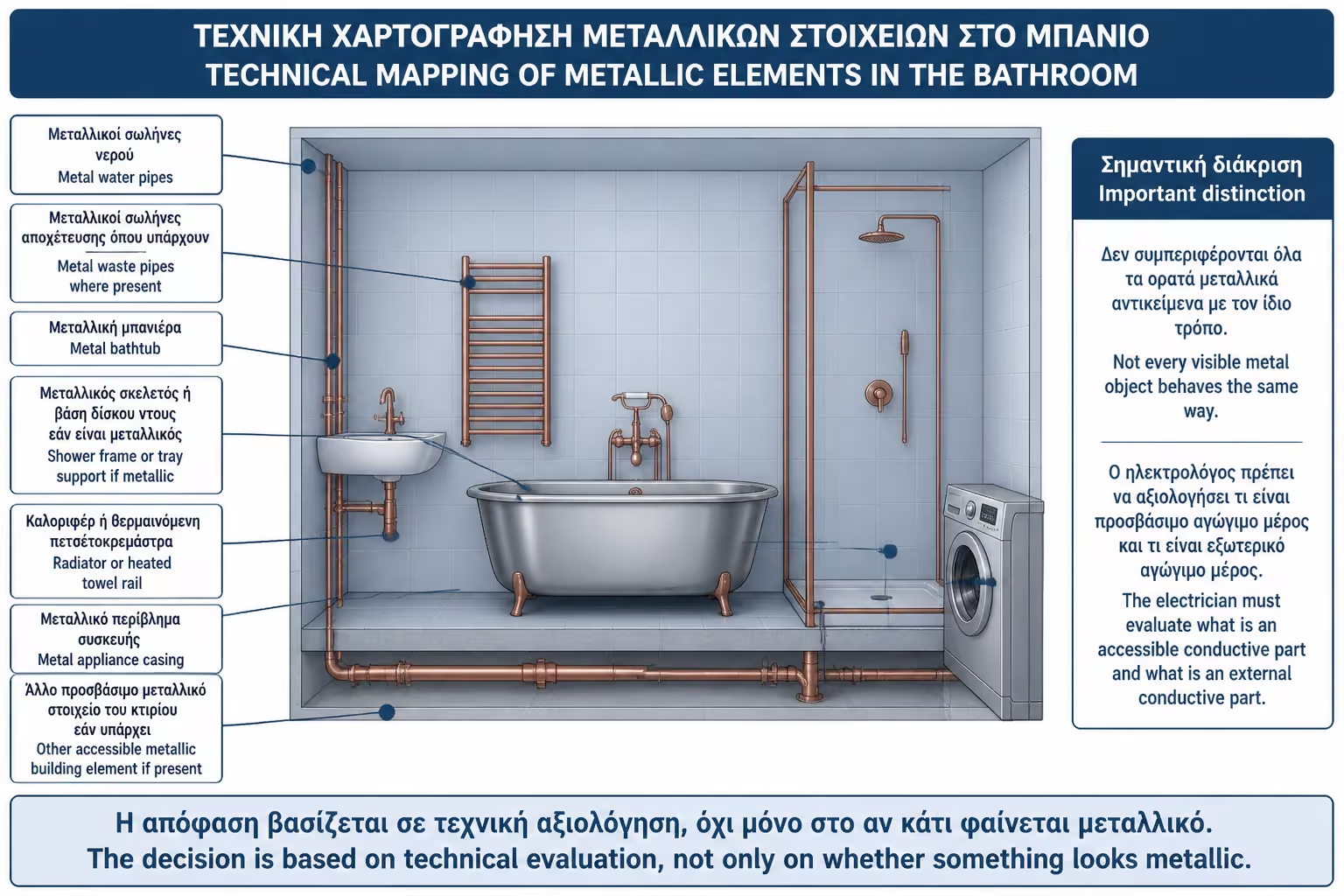
In the bathroom there are many metal elements that can be conductive. It does not mean that every metal object is always connected in the same way or that the owner should start running wires everywhere. It means that the electrician must assess which parts are foreign conductive parts, which are exposed conductive parts and which should be included in the protection.
Common points examined are:
| Metal part | Why does it matter? | What should be done |
|---|---|---|
| Metal water pipes | They may bring in potential from elsewhere in the facility | Check if they are a foreign conductive part and if they are connected correctly |
| Metal drainage pipes | Rarer today, but important in older installations | Technical evaluation by an electrician |
| Metal bathtub | A conductive part may be accessible | Checking the need to connect and how to apply |
| Metal shower legs or frame | They may be near water and user | Check if they are conductive and accessible |
| Radiator body or radiator | Often metallic and accessible with bare hands | Check equipotential protection and grounding |
| Metal casing of devices | Washing machine, water heater, towel rack | Proper grounding through the protective conductor |
| Metal structural elements | In special cases they can be conductive | Technical judgment required |
The important thing is not to make an arbitrary connection based on appearance. A metal object that is isolated may not behave the same as a metal pipe that enters from another space. Accordingly, a plastic pipe does not work like a metal one. The electrician must measure and evaluate, not guess.
Electric shock does not happen only when someone directly touches a bare wire. It can also happen when a metal part becomes energized due to damage. For example, a device with a metal case may have an internal fault. A pipe can carry potential from another point. A metal surface can be at a different potential from a tap.
If two such places have a potential difference and a person touches them at the same time, his body can become a current path. Equipotential bonding reduces this potential difference, while grounding and protective devices help to interrupt the supply in the event of a fault.
A simple example: someone gets out of the shower, touches the metal tap with one hand and an electric heater with the other. If those two parts are not properly integrated into the protection system, a fault can create a dangerous situation. With proper earthing, equipotential bonding and RCD protection, the risk is greatly reduced.
There is no "zero risk" in any electrical installation. But there is proper planning that reduces the risk and makes the protections work as they should.
The leakage relay, usually 30mA for such premises, is a basic protection measure. It interrupts the supply when it detects a current leakage to earth. In the modern approach to Section 701, IET guides state that all circuits supplying equipment in a bath or shower space, such as lighting, power showers and heated towel rails, require an RCD not exceeding 30 mA.
But RCD and equipotential bonding are not the same thing. The RCD detects leakage and cuts out. Equipotential bonding attempts to reduce the potential difference between conductive parts. One should not be used as a flimsy excuse to ignore the other.
In modern practice, additional equipotential bonding may in some cases not be required, provided that certain conditions are met, such as suitable main equipotential protection and RCD protection of all relevant circuits. The IET points out that we must distinguish the main protective equipotential bonding from the supplementary one, while related technical discussions state that the omission of supplementary bonding should not be taken for granted without verification of the conditions.
For the owner, this translates into a simple instruction: don't listen to absolute phrases like "never needed" or "always needed everywhere" without checking. An assessment of the specific installation by a licensed electrician is required.
In old Greek baths, metal piping was much more common. Water pipes, radiators, metal bathtubs and old connections could create an extensive network of conductive parts. In such installations, equipotential protection is particularly important, but at the same time it can be difficult to check visually.
The owner may see a tap on the wall and not know whether the pipes behind it are metal or plastic. The bathroom may have gone through a partial renovation years ago, where some parts were changed and others remained. The tub may have been replaced but not the plumbing. These half-conversions are common and need attention.
A typical example is an old bathroom where the water supply has been changed to a plastic pipe inside the bathroom, but further back, in a common area or in a column, there are metal sections. The owner thinks that "everything is plastic", while in practice there may still be conductive parts entering the space. This is not always visible to the eye.
In old bathrooms, before renovation, the electrician must work with the plumber. It's not enough to just see the board. He needs to know what materials are in the plumbing, what remains metallic, what changes, and what will be accessible after completion.
The use of plastic pipes has changed the behavior of bathrooms quite a bit. Plastic pipes do not act like metal as conductive parts. But this does not mean that equipotential protection disappears as an issue.
First, there may be other metal parts: radiator body, metal towel rail, metal bathtub, metal frames, electrical appliances or metal parts of the installation. Second, in many buildings there are combinations of materials. One part can be plastic and another metal. Thirdly, the existence of plastic pipes does not relieve the need for ground control, RCD and overall electrical safety.
In practice, the answer to "need equipotential?" is not given only by the material of a pipe. Given by facility control. The electrician must see if there are foreign conductive parts, if they are simultaneously accessible, if there is a main equipotential connection, if all circuits are properly protected and if the measurements are acceptable.
A modern bathroom with plastic plumbing can be much safer than an old bathroom, but only if it has been properly designed and tested. Changing hardware does not replace electrical documentation.
The bathtub is one of the points that create many questions. An old metal bathtub behaves differently than an acrylic one. A shower with a metal frame or metal feet has different control points than an all-plastic or ceramic solution.
If the bathtub is metal and accessible as a conductive part, the electrician must check whether it should be connected to the equipotential protection. If it's acrylic, the body itself may not be conductive, but metal parts, batteries, piping, or frames may matter.
In showers, especially in modern walk-in solutions, the issue is not only the tray. There are batteries, linear siphons, metal channels, glass with metal profiles, electric towel rail nearby, lighting and possibly underfloor heating. All this must be evaluated as a whole.
A mistake in renovations is that the plumber and the tiler complete the shower, and the electrician is called at the end only for the mirror or light fixture. If it is then found that a connection or wait should have been provided, the correction becomes difficult. That is why the electrician must be involved before the points are closed.
Electrical appliances in the bathroom are of particular importance. The washing machine has a metal housing, water, motor and electrical supply. The water heater is a high power device and is directly connected to the water supply. The electric towel rail is often located a short distance from a wet user.
These devices must have proper earthing through the protective conductor, suitable line, RCD protection and proper location. If the device is permanently installed, the electrician must also evaluate the manufacturer's requirements.
A common mistake is the washing machine in an old bathroom with a socket without proper grounding or with a multi-socket. The owner sees that the washing machine is working and thinks that there is no problem. But in the event of a fault, the metal enclosure can become dangerous if the grounding and protections are not working properly.
The same applies to electric towel rails that are plugged into an existing outlet. The product may be suitable for bathing, but its position and power may not be correct.
Equipotential protection cannot be checked "by eye". The electrician must check the installation, measure continuity of conductors, see the panel, ground, circuits, metal parts and connections. If there is a renovation, he must also see what will change in the plumbing.
In a proper procedure, the electrician is not limited to putting in a socket or a light. It checks that the bathroom is protected by an RCD, that the earthing is adequate, that there are conductive parts that need to be connected, that the old installation has discontinuities and that the new appliances fit in correctly.
In older houses, it may be necessary to open points, access under the bathtub, check on manholes, panel or radiator bodies. In a new renovation, the inspection should be done before the walls are closed, not after.
The owner should ask for documentation, not just verbal assurance. The phrase "it is grounded" is not enough. It needs to have been checked by a licensed electrician and, where required, to have the corresponding YDE and the accompanying documents.
The Responsible Installer Declaration is not just a piece of paper for PPC or grid operator. It is part of the documentation that the facility has been audited. Y.A. 101195/2021 includes the requirements for electrical installations and refers to checks to establish and document their safe and correct operation.
When a major bathroom renovation, panel change, new line, circuit changes or addition of major electrical equipment is done, it should be discussed with the electrician whether a new or updated DHW is required. It is not right to make changes and leave the installation without documented control.
For equipotential protection, documentation matters because many elements are not visible after completion. Once tiles, furniture, showers and enclosures are installed, the connections may no longer be visible. If they are not checked in time, later confirmation becomes much more difficult.
Good practice is to request an inspection before construction closes and a final inspection after completion.
The lack or failure of equipotential protection is not always immediately apparent. You won't necessarily see sparks, smoke or damage. The bathroom can function normally for years. The problem occurs when there is a fault, current leakage or dangerous potential difference.
A possible scenario is a device with a faulty ground. Another is a metal part that acquires potential from an adjacent installation or from a fault. A third is old piping that does not have proper continuity or has been cut in renovation. In all of these, the user may not notice anything until they come into contact with two parts at the same time.
In practice, equipotential protection is like the brakes of a car. You don't think about her when everything is going well. You need her when something goes wrong. And then it should work immediately.
That's why the phrase "we never had a problem" is not a technical argument. Many installations are dangerous precisely because they have not yet revealed their problem.
The cost depends on the condition of the installation, access, whether it is a complete renovation, whether there is old metal piping, whether new conduits are required and whether panel work is needed. In a bathroom that is already stripped, checking and predicting correct connections is usually easier and more economical than in a finished bathroom with closed surfaces.
In the Greek market of 2026, a basic electrical check may be part of the wider electrical renovation work. For simple cases, testing and minor corrections may have limited costs. However, if a new conductor, access to hidden points, panel change, RCD, new lines or a DHW issue/update is required, the cost increases.
Indicatively, in a bathroom renovation the basic electrical work can be around €250-600 when it comes to limited interventions. A more comprehensive check and upgrade, with new lines, ground check, RCD, provisions for appliances and possible panel changes, can run around €600–€1,200 or more, depending on the project.
The prices depend on the area, the floor, the access, whether materials and VAT are included, whether repairs are needed, whether measurements are required and whether a YDE will be issued. A low bid that simply states “bathroom electrical” does not mean that it includes an equipotential protection check.
The first mistake is to ignore equipotential protection because it "doesn't show". In a renovation, most people deal with tiles, faucets, furniture and lighting. But the most critical electrical points are often hidden.
The second mistake is to assume that plastic piping solves everything. They may reduce some risks, but they do not eliminate the need to control the entire installation.
The third mistake is the rough connection of metal parts by a non-electrician. Equipotential connection is not "put a wire somewhere". It must be done with correct cross-section, correct terminals, correct route and measurement.
The fourth mistake is removing old connections during renovation. Sometimes, a cable that looks "useless" under a bathtub or near a pipe may have been part of the protection. It does not cut without control.
The fifth mistake is to assume that the RCD is always sufficient. The RCD is essential, but the installation must be assessed as a whole.
The owner does not need to give technical instructions to the electrician. But he needs to ask the right questions. Before starting work, it is a good idea to ask to check the grounding, RCD, protection zones, metal parts, piping and appliances that will go into the bathroom.
He must also inform the electrician of all changes that will be made. If the pipes will be changed, if a metal towel rack will be installed, if a washing machine will be installed, if the water heater will be changed, if underfloor heating will be installed, if a metal bathtub or a new shower will be installed. This information affects the electrical evaluation.
A correct quote should state whether it includes earthing testing, RCD protection, new lines, equipotential bonding where required, DHW where required and final testing. If the offer only says "bathroom sockets/lights", it probably doesn't cover all the insurance.
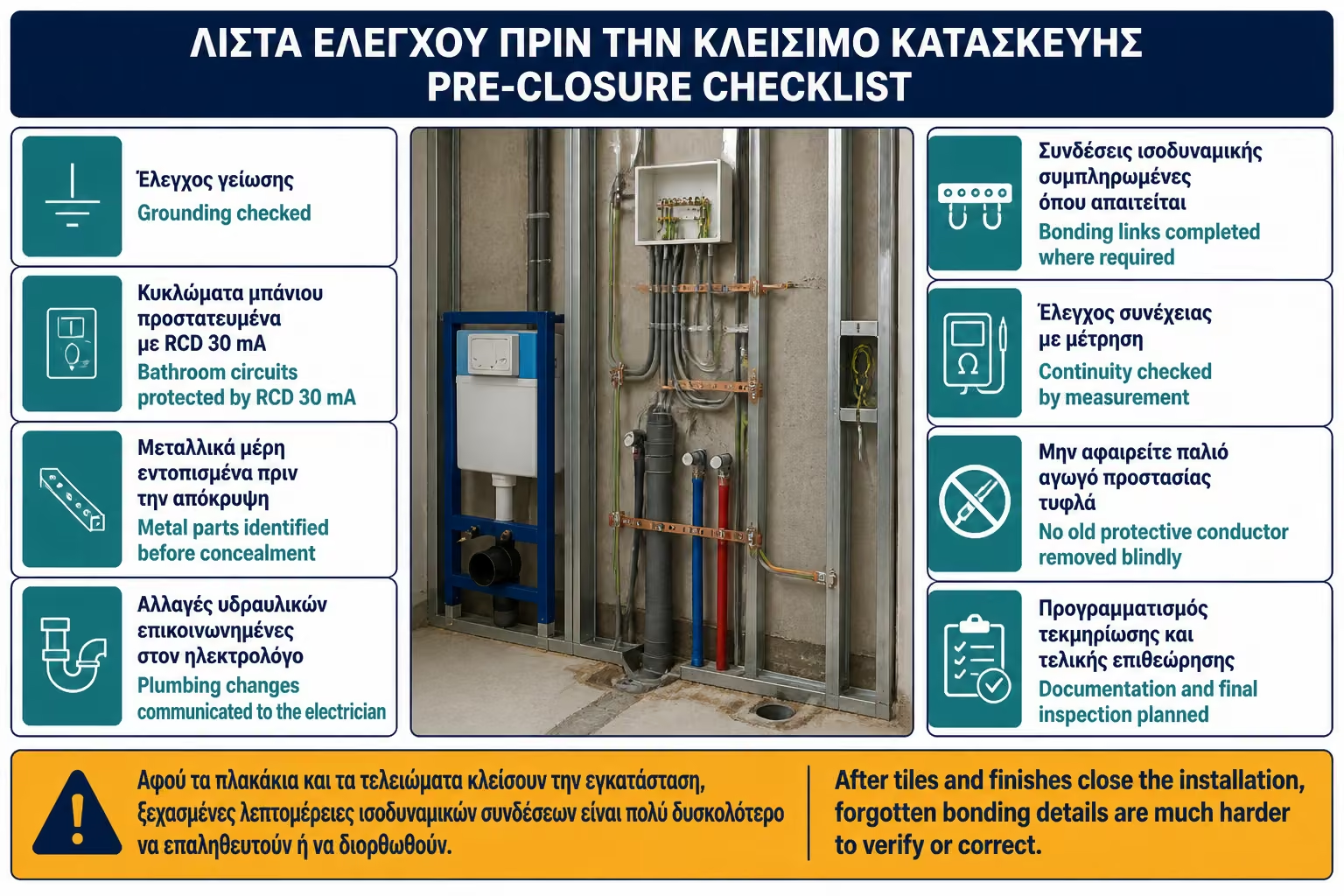
The owner must also request that walls and access points be unsealed before connections are checked. After the tiles, any correction becomes more difficult.
Before the bathroom is considered electrically safe, check the following points first:
| Question | Yes / No |
|---|---|
| Has the installation been grounded by a licensed electrician? | Yes / No |
| Is there a 30mA RCD protecting the bathroom circuits? | Yes / No |
| Have the metal parts accessible to the site been identified? | Yes / No |
| Has the metal piping been checked for foreign conductive parts? | Yes / No |
| Has the metal tub, radiator body or towel rail been checked? | Yes / No |
| Has the electrician been informed of plumbing changes? | Yes / No |
| Has it been avoided to cut old cables or connections without checking? | Yes / No |
| Have continuity measurements been taken and not just a visual check? | Yes / No |
| Has it been discussed whether a YDE or an installation update is required? | Yes / No |
| Has the check been done before the tiles and structures are closed? | Yes / No |
If the answers are unclear, the bathroom should not be considered complete in terms of electrical safety. Equipotential protection is not a decorative stage. It is part of the basic user protection.
If you keep only one thing from this guide, keep this: equipotential bonding is not "a wire added for formality". It is a way to reduce the dangerous voltage difference between metal parts that a person can touch in the bathroom. Do not leave the check until the end, and do not cut old connections just because they look unnecessary. Before the tiles go in, have a licensed electrician check grounding, RCDs, metal parts, piping and appliances. The bathroom should not only be beautiful. It must also be electrically safe.
Equipotential grounding in the bathroom is one of those things that can't be seen, but can make a big difference in safety. Its purpose is not just to connect some metal parts with a cable. Its purpose is to reduce dangerous potential differences in a space where humans are more vulnerable due to water, humidity and direct contact with metal surfaces.
In old bathrooms with metal pipes, radiators and old connections, the inspection is especially important. In new bathrooms with plastic piping, the issue does not go away, because there may be other devices and metal parts that need to be evaluated. In any case, the decision should not be based on assumptions, but on control, measurements and application of the current regulatory framework.
RCD protection, earthing, equipotential bonding, protection zones and suitable materials work together. If a critical piece is missing, the installation may still be problematic, even if everything looks new. That is why, in every bathroom renovation, the electrician should be involved from the beginning, not at the end.
Proper equipotential protection is one of those tasks that the owner will not see every day. But he will know it exists. And in matters of electrical safety, this has far more value than any obvious component.
Return to category.
Go to categoryReturn to the central guide.
Go to guide