
Plumbing & Electrical Bathroom Infrastructure
Return to category.
Go to categoryWhen we buy a lamp, LED mirror, fan or electrical appliance for the bathroom, we often see indications such as IP44, IP65 or IP67. In product descriptions, these indications are often accompanied by words such as "waterproof", "watertight" or "suitable for bathing". But these words, by themselves, are not enough. In the bathroom, a product isn't safe because it looks trendy, because it's LED, or because it generally says it's moisture resistant.
The degree of protection IP is a technical indicator that tells us how protected the housing of a device is against solid bodies and water. However, it does not tell us on its own whether the product can be placed anywhere in the bathroom. To make the right choice, three things must be combined: the IP of the product, the protection zone in which it will be placed and the installation method by a licensed electrician.
The problem in practice is that many owners first buy the product and then ask if it "fits". An LED mirror can be very beautiful, but not suitable for the position above a sink that is next to an open shower. An IP44 luminaire may be acceptable in one part of the bathroom, but inadequate in another. An IP67 product may be highly water resistant, but that doesn't automatically solve voltage, ground, RCD, harness and proper connection issues.
Today, low-voltage electrical installations in Greece are examined in the context of ELOT 60364. For rooms with a bathtub or shower, part 7-701 is of special importance, which concerns rooms that contain a bathtub or shower. ELOT cites the standard ELOT HD 60364-7-701 for these facilities, while the relevant newer amendment ELOT HD 60364-7-701:2024/A11:2024 has an issue date of December 6, 2024 and stage "Effective".
In this guide we'll look at what the IP rating means in practice, how IP44, IP65 and IP67 numbers are read, what the difference is between splashes, water jets and temporary submersion, how IP ratings relate to bathroom zones 0, 1 and 2, and what mistakes an owner should avoid before buying or installing electrical equipment.
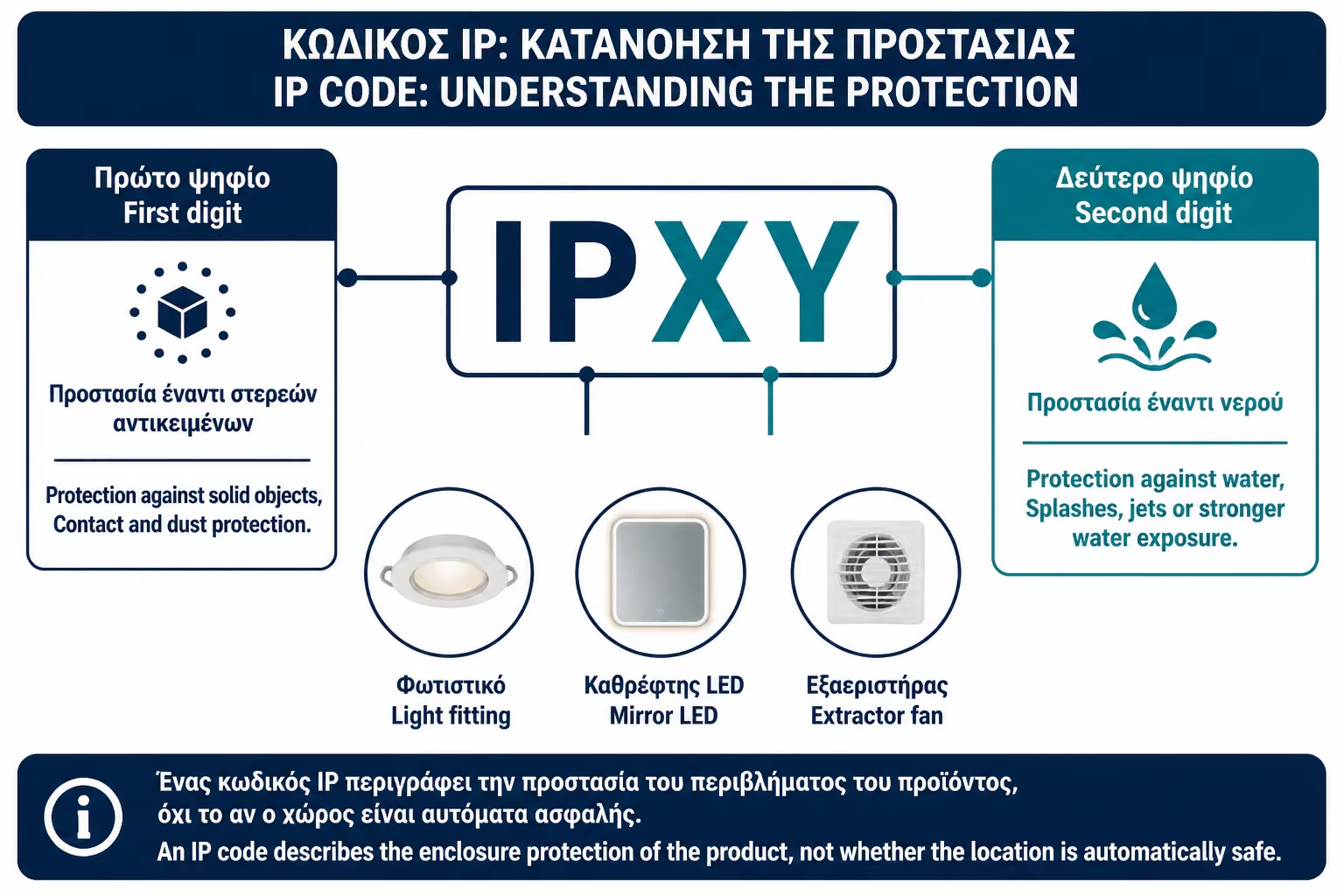
IP comes from the term Ingress Protection. Simply put, it's a way of describing how well the housing of an electrical or electronic device is protected against the ingress of solids and water. The international standard IEC 60529 has been developed precisely to rate the resistance of electrical and electronic device enclosures to dust and liquids.
The IP index usually consists of two numbers. The first number is for protection against solid objects such as dust, tools or fingers. The second number is about water protection. For example, in IP44, the first “4” refers to solid bodies and the second “4” refers to protection against water splashes.
In the bathroom, the second number is especially important, because the main risk is moisture, splashes, water vapour and, in some positions, direct contact with water. But this does not make the first number useless. A proper enclosure must also protect against contact with dangerous parts or the ingress of objects, especially when we are talking about light fittings, fans and electrical boxes.
IP is not a buzzword. It is a specific technical code. That's why it has more value than phrases like "waterproof lamp" or "suitable for humidity". A product without a clear IP indication, especially if it is going to enter a demanding part of the bathroom, should be treated with caution.
To read an IP address, we always look at both digits. The first digit refers to solid protection. The second concerns water. If a product says IP65, it doesn't just mean “better than IP44” in a general way. It means it has specific dust protection and specific water protection.
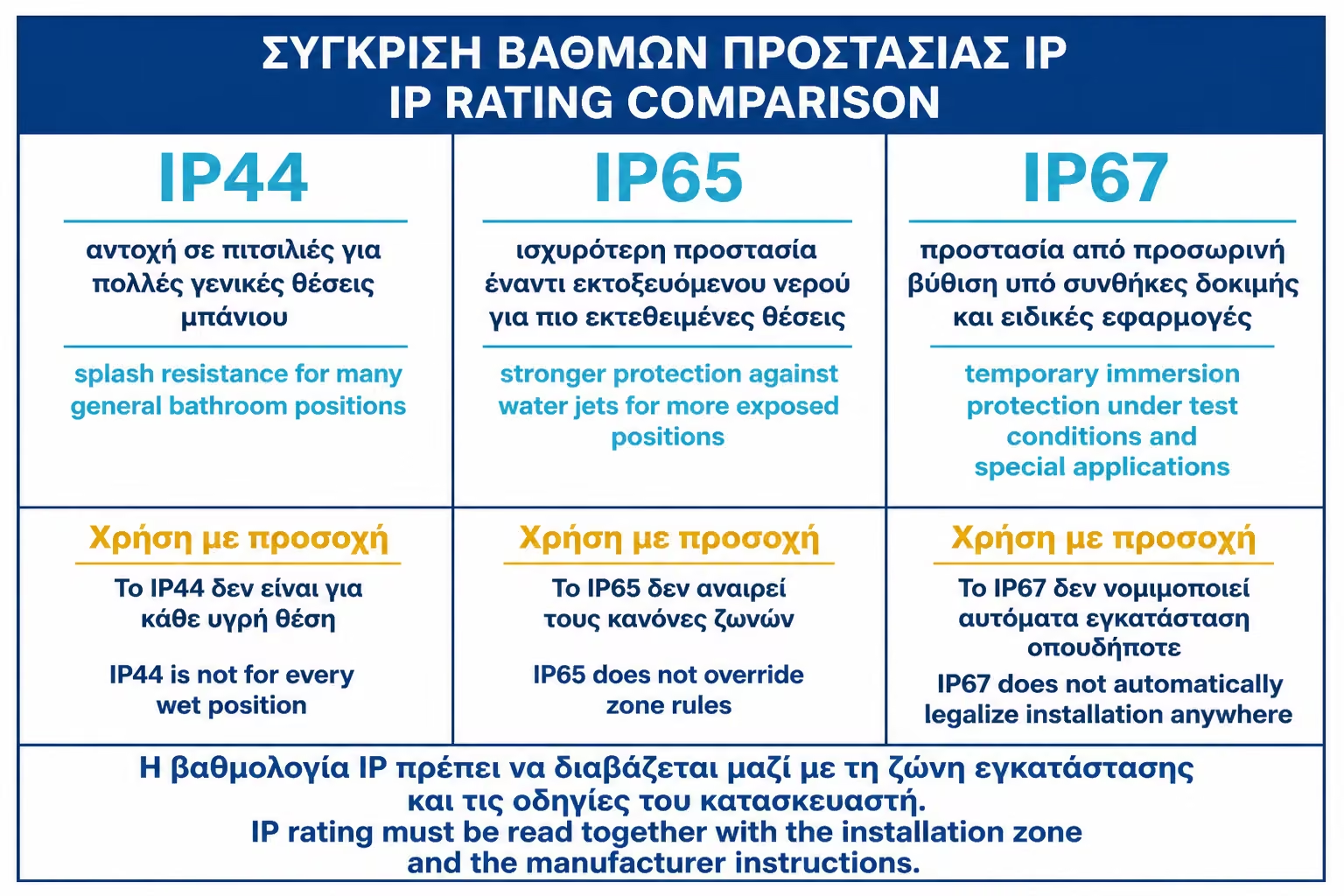
In practice, owners are mainly interested in the indicators they find in bathroom products. The most common are IP20, IP44, IP54, IP65 and IP67. IP20 is common in indoor dry areas, but not an option we'd want in wet or splashy areas of the bathroom. IP44 is very common for lighting and bathroom equipment outside of the most demanding locations. IP65 is stronger protection against water in the form of a jet. IP67 refers to even higher protection, with the possibility of temporary submersion under certain test conditions.
Importantly, IP describes the enclosure's resistance to tested conditions. It does not mean that the product is invulnerable, that it can be misplaced, that it lasts forever, or that the electrical connection can be made haphazardly. An IP65 luminaire can become dangerous if it is opened incorrectly, if a cable is passed without a suitable gland, if the housing is punctured or if it is connected without proper circuit protection.
A practical example: two lamps may say IP65. One should be a branded product with clear installation instructions and correct sealing accessories. The other is a cheap product of dubious quality, with a poor fit on the cap and no proper instructions. The same IP number is no substitute for product quality and proper installation.
IP44 is one of the most common degrees of protection we see in bathroom products. In practice it means that the housing has protection against solid bodies above a certain size and protection against water splashes from various directions.
In everyday language, IP44 is suitable for many places in the bathroom where there is moisture and the possibility of light splashes, but not direct and intense exposure to water. It may involve mirror fixtures, certain fans, cabinets, or other products placed in areas where shower water does not fall directly.
But IP44 does not mean that the product can go into the shower or over a point where water hits it directly. An IP44 luminaire may be adequate in one location and inadequate a few centimeters further if the location changes zones or receives more water.
A frequent mistake is placing an IP44 light above an open walk-in shower, because it "says for a bathroom". If the fixture is located in an area where it receives intense moisture, splashes or possible direct water spray, the electrician must assess whether a higher IP or different equipment is required.
IP65 is considered stronger protection than IP44. The first digit “6” means full protection against dust at the housing level, while the second digit “5” refers to protection against water jets. In practice, for the bathroom, IP65 is often used on fixtures or equipment that can be found in more exposed locations than a simple IP44 fixture.
This does not mean that every IP65 product is suitable for every point in the shower. It means it is more water resistant than an IP44, but location, zone, voltage, RCD protection, earthing and manufacturer's instructions remain critical.
On a practical level, IP65 is often chosen for ceiling lights near or above zones where there is increased humidity, for certain spots in demanding bathrooms, for lighting in areas near a shower or for equipment that may receive more intense exposure. But it should not be treated as a "magical" solution. If an IP65 luminaire is installed incorrectly or opened and closed casually, its watertightness can be lost.
An example from practice: in a bathroom renovation with a false ceiling, the owner requests spots above the shower and spots in the rest of the bathroom. It is not necessary that all spots must be the same. Spots near the shower may require a different IP than spots outside the zones. If the repair shop buys a "spot package" for the whole bathroom, without position control, the wrong choice can be made.
IP67 indicates even higher protection than IP65 against temporary immersion in water under specific test conditions. We often see it in equipment that can be exposed to much more demanding conditions, such as special lighting, outdoor products, LED elements or devices that must withstand intense contact with water.
In the bathroom, IP67 may seem tempting because it sounds “safer”. But it should not be used mechanically. First, it can be overkill for many positions, so it drives up costs for no real reason. Second, a high IP does not mean that the product is allowed in any zone. Third, IP67 does not address all electrical issues such as operating voltage, grounding, RCD, temperature, mounting method and accessibility.
In Zone 0, i.e. inside a bathtub or shower, the requirements are particularly strict. There it is not enough to just look at a high IP rating. Consideration should be given to whether the equipment is permitted in the particular zone, whether it operates at a suitable very low voltage where required, whether the transformer is outside the zone and whether the whole installation is designed for such use.
Simply put: IP67 does not mean "put it where it gets wet". It means that the housing has passed a certain category of water protection. The suitability for a bathroom and for a specific zone remains a matter of electrical study.
The table below helps to understand the basic difference between the most common indicators we see in bathroom products.
| IP index | Practical interpretation | Where it might fit in practice |
|---|---|---|
| IP44 | Protection against solid bodies and water splashes | Bathroom areas with moisture or light splashes, not direct heavy exposure |
| IP54 | Better dust and splash protection than standard equipment | Useful in some places with increased humidity, depending on the zone |
| IP65 | Full protection against dust and water jets | More exposed points, fixtures near shower zones, where the installation allows |
| IP67 | Protection from dust and temporary immersion in water under test conditions | Special applications, not general permission to install anywhere in the bathroom |
The table should not be used as an automated response. The same IP can be right in one bathroom and wrong in another, depending on the location of the shower, the existence of a cabin, the direction of the water, the height, the ventilation, the way of use and the rest of the electrical system.
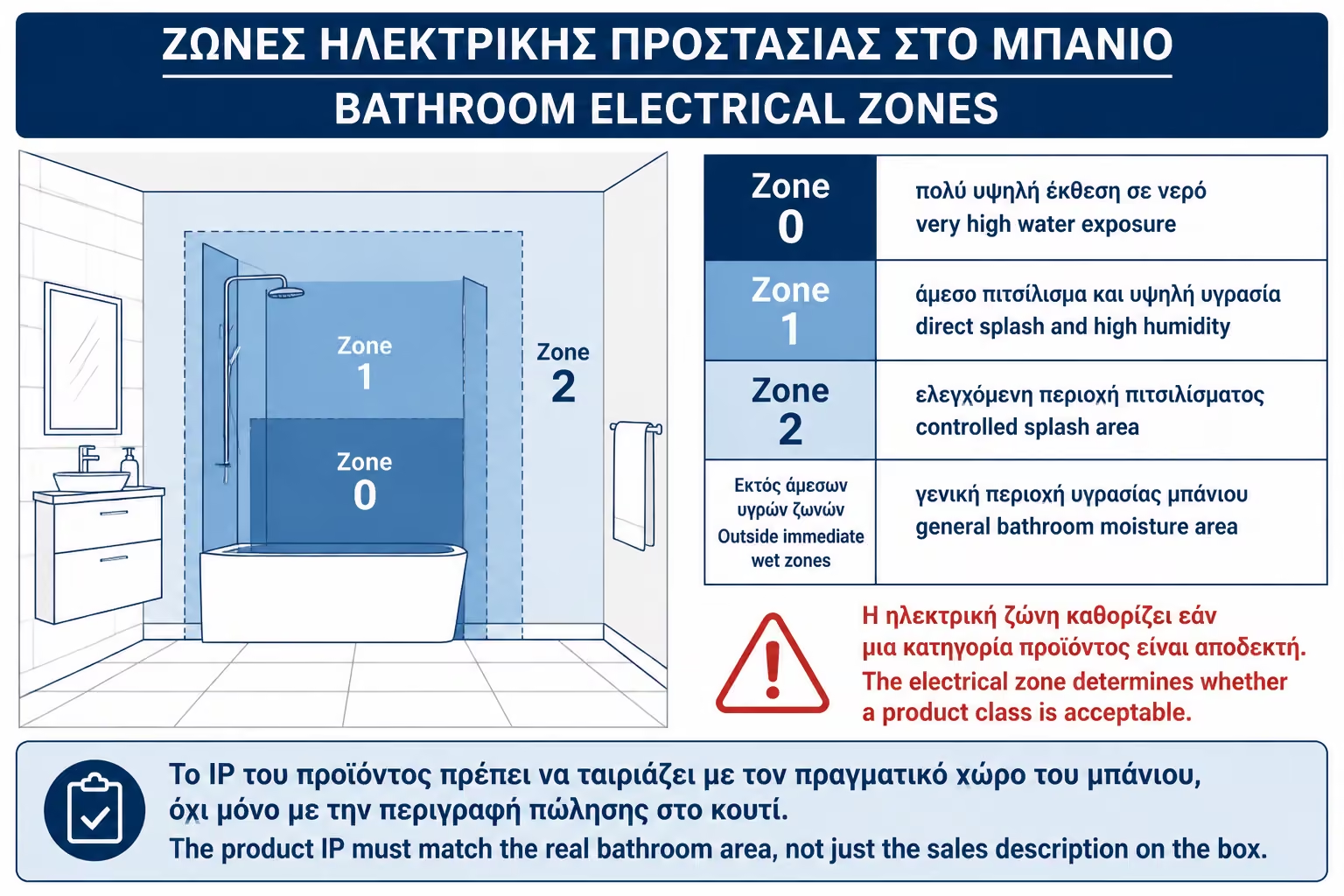
Firewalls and IP are not two separate issues. They work together. The zone tells us how close the spot is to a bathtub or shower. The IP tells us how resistant the device's housing is to water and solid bodies.
Zone 0 is the strictest. There we are talking about the direct presence of water. The equipment must be specifically suitable for such a location and a general indication of “tight” is not sufficient. Zone 1 is above the bathtub or shower and requires equipment suitable for increased exposure. Zone 2 is located around Zone 1 and remains an area of increased caution, usually with a splash guard requirement. In the modern logic of Section 701, all circuits supplying equipment in a tub or shower room require protection with an RCD not exceeding 30 mA.
The mistake is to think that it is enough to buy a high IP. If an IP65 luminaire is in the wrong zone or connected without a proper RCD, the installation may remain problematic. Accordingly, an IP44 may be acceptable in a location outside of heavy exposure, but not over a shower.
In a small bathroom, zones often take up a large part of the space. This means that the choices for sockets, LED mirrors and lighting must be made very carefully. In a large bathroom, there may be more safe places, but again the electrician needs to confirm the zone and IP.
Caution is needed here, because the word "minimum" can lead to wrong conclusions. IP minimums are not a commercial proposition. They are thresholds or practical requirements depending on the zone and type of equipment. In some cases, a higher IP may be chosen for a greater margin of safety or durability.
In general practical reading, Zone 0 requires very high protection against water and special equipment suitable for the area. Zone 1 and Zone 2 are usually associated with at least splash protection, with IPX4 often cited as the minimum level of protection against splashing water from various directions. In places where there may be more intense exposure, cleaning with water or jets, higher protection may be required.
For an owner, it is more useful to think like this: in or very close to the shower, we do not buy anything without checking the relevant zone. Near splashes, we do not buy products without a clear IP rating for a wet area. Farther away from the shower, that still does not mean we ignore RCD protection, earthing and product quality.
A practical example: an IP44 light can be a good choice for the mirror in a bathroom where the mirror is far from the shower. However, if the same mirror is next to a walk-in shower without a fixed partition, the electrician may request a different solution or a different position.
Luminaires are the category where IP ratings appear most often. For general bathroom lighting, an IP44 luminaire may be sufficient in many locations, especially when not directly above the shower or in a high exposure zone. But this is not a rule for all bathrooms.
Above the shower or very close to it, a higher IP such as IP65 is often chosen depending on the zone and location. Especially in false ceilings with recessed spots, not only the IP of the front surface, but also the method of installation, the tightness of the whole, access to water vapor and the quality of the connections must be taken into account.
A common mistake is to buy nice decorative lights without IP for the bathroom. The owner sees them in hotel photos and wants to put them over a bathtub or next to a mirror. However, if the lamp is not properly protected, it can collect moisture, oxidize, create damage or become dangerous.
The correct practice is to decide the position first and then the light fixture. Not the other way around.
LED mirrors are electrical devices, even if in everyday use we see them as furniture. They can have lighting, anti-glare resistance, touch sensor, meter, bluetooth or socket. The more functions they have, the more important it becomes to control the IP and connection method.
An IP44 mirror can be suitable in many over-the-sink locations as long as it is not exposed to heavy water and is properly installed. But if the sink is right next to the open shower, the position must be carefully evaluated. The IP44 label is not enough by itself to say "it fits".
Care must be taken with mirrors that include an integrated socket. The socket is not assessed only as part of the mirror. Its position in relation to the protection zones, circuit protection, earthing and RCD must be checked. A mirror with a built-in socket can be practical, but not in every bathroom and not in every position.
In practice, before buying LED mirror, it is good to send the technical brochure and installation position to the electrician. This can save changes, product returns and rough connections.
Sockets with lids often give the impression that they are "tight" and therefore suitable for bathrooms. In fact, the cap is only one part of the protection. We need to see the IP rating of the socket, its location, if it is in a permitted area, if it is protected by an RCD, if it is properly grounded and if it is safe to use.
An outlet may have a cover, but when used with a hair dryer, charger or other device, the cover remains open. So the protection in real use conditions is not the same as the protection when the socket is closed. This is critical in the bathroom where the user may have wet hands or splashes.
A typical mistake is the outlet next to the sink, near the shower, with a cap and without a correct zone rating. The owner thinks the cap solved the problem. It didn't solve it. If the position is wrong, the socket remains problematic.
The socket in the bathroom should be designed as part of the installation, not as an accessory that goes in at the end because it is "needed somewhere".
The bathroom fan operates in a humid, high-vapour environment. If it is placed near the shower or in a location with heavy moisture exposure, its IP rating becomes very important. It is not enough for it to be small, inexpensive or simply marketed as "for the bathroom". It must be suitable for the exact position.
In windowless bathrooms, the fan often goes into a wall or ceiling near the shower, because that's where the vent is. If the location falls into a protection zone, the electrician must check if the product is allowed there and what IP is required. The power supply should also be checked, especially if the fan is connected to lighting, has a time delay or a humidity sensor.
A common problem is the sloppy addition of a vent after renovation. A cable is run from the nearest light fixture, an uncontrolled fan is inserted, and the owner thinks the humidity problem is solved. But in the bathroom, a bad electrical connection can be a more serious problem than the moisture we are trying to deal with.
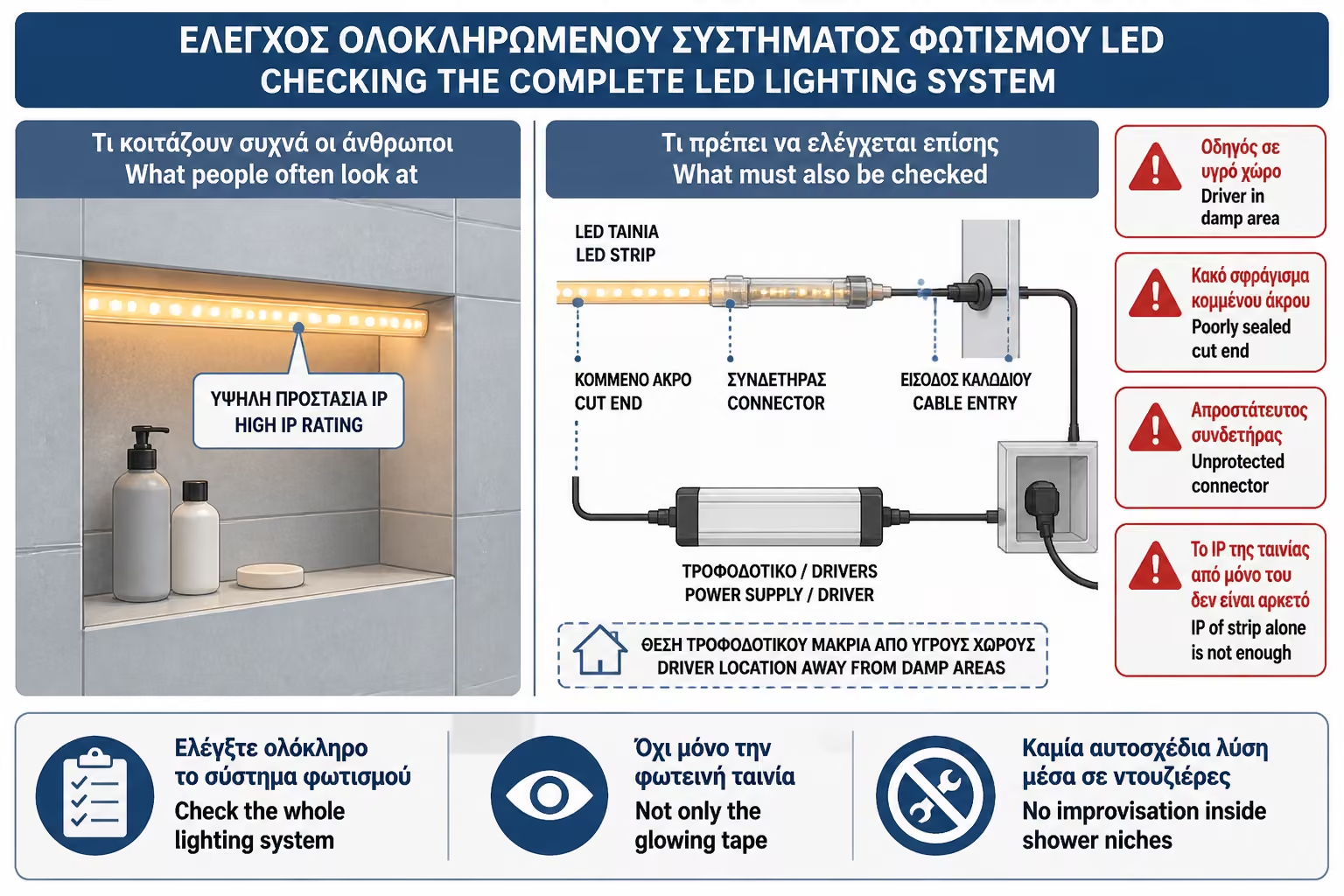
LED strips are very popular in concealed lighting, showers, mirrors and alcoves. But it is one of the products that is often used incorrectly. Many films are sold as “waterproof” because they have a protective coating, but this does not mean that they are suitable for permanent use in a shower or in an area with water vapor.
In LED films, it is not enough to look only at the IP of the film. We also need to check the connections, cuts, terminals, power supply, location of the power supply, operating voltage and mounting method. Many failures do not occur in the bright part itself, but in the joints or where the cable enters the strip.
A practical example is the LED strip in a niche in the shower. The idea may be aesthetically pleasing, but the implementation is demanding. If the tape is cut and sealed roughly, if the power supply is misplaced, or if the joints are not properly protected, the IP of the original packaging loses its value.
In the bathroom, LED strips should only be used with a clear technical design. It is not material for improvisation.
A product with a high IP is not automatically a good product. IP rating is necessary, but it is not the whole of quality. We have to look for reliable signage, installation instructions, suitable accessories, build quality and the possibility of correct installation.
There are products on the market that say high IP but have weak sealing rubbers, poor cap fit or unclear instructions. If the product is opened many times, if the rubber does not fit properly, or if the installer has to make an extra hole for a cable, the actual protection can be significantly reduced.
This is especially important in low-cost products from unknown sources. It does not mean that all budget products are bad, but in the bathroom the criterion should not be only the price. A lamp that costs a little cheaper but does not have proper technical documentation can create more costs later.
The owner should have an electrician check the product before purchase or installation. This is more practical than installing and then finding that it is not suitable.
A product purchased as IP44 or IP65 does not necessarily retain the same protection forever if it wears out, is incorrectly opened, or is installed incorrectly. Rubber seals age. The caps may warp. The screws may rust. Joints may loosen. Dampness can pass gradually.
In a bathroom with heavy use, water vapor and frequent cleaning, fixtures and appliances should be checked periodically. If you see dimness inside a fixture, rust, water, blackening, flickering, fuse dropping or frequent failures, they should not be ignored. They may mean that the seal has been lost or that there is a problem with the connection.
Special care is needed when the bathroom is painted or work is done. If a light is removed and reinserted roughly, if a rubber is lost, or if the cap is not tightened properly, the protection may not be the same. Therefore, any disassembly of electrical equipment in the bathroom must be done by a professional.
IP affects price, but it's not the only factor. Brand, quality, design, material, power, dimmability, warranty and certification also play a big role.
In the Greek market of 2026, a simple IP44 bathroom light can start around €20–50 for basic solutions and go up quite a bit for better quality or design. IP65 recessed or wall-mounted luminaires can often range from around €25–80 per piece, while more branded or specialist solutions can cost more. LED mirrors with IP44 or equivalent protection can start from around €100–180 for simple options and reach considerably higher when they have anti-glare function, sensors, cabinet or premium construction.
These prices are indicative. They depend on the store, the region, the availability, the quality, whether VAT is included and whether we are talking only about the purchase of a product or also about installation. It is also important not to compare only the product price. A cheap light can cost more if it breaks, if it is not properly sealed or if it needs to be replaced after a few months.
In bathroom electronics, the right choice of product and the right installation are a single cost. It makes no sense to buy an expensive product and install it casually, nor to save a few euros on a product that is in a critical zone.
A licensed electrician must be involved in any installation or change of electrical equipment in the bathroom. The owner can choose aesthetics, color, shape and general needs. However, he should not decide on his own whether an IP44 light fitting enters Zone 1, whether an LED mirror is suitable next to a shower or whether a socket with a cover is sufficient.
The electrician should check the zone, IP, circuit, RCD protection, earthing, cable cross-section, manufacturer's instructions and connection method. In old houses, the panel should also be checked, because a new light fixture or a new outlet is not safe if the rest of the system is problematic.
Attention is also needed in the "small" changes. Replacing an old light fixture with a new one, installing an LED mirror or adding a fan may seem like simple tasks. In the bathroom, however, every new connection must be evaluated.
If the technician answers "put whatever you like, everything goes in", this is a bad sign. Not everything goes everywhere in the bathroom.
The first mistake is using a product without a clear IP indication. If a lamp or device is intended for a bathroom, it must have technical characteristics, not just a commercial description.
The second mistake is over-reliance on IP44. It is a useful degree of protection, but not for all points. Not enough for areas with heavy water exposure.
The third mistake is the logic "the bigger the IP, the better everywhere". IP67 can be an exaggeration in many places and does not solve installation, voltage and zone issues alone.
The fourth mistake is buying before planning. If you buy a mirror, light or fan before the position is checked, you may find yourself with a product that does not fit the installation.
The fifth mistake is sloppy installation. A product with a good IP can lose its protection if it is drilled incorrectly, if it is not properly sealed or if inappropriate components are used.
Before you buy anything, run through the following checks first:
| Question | Yes / No |
|---|---|
| Is the exact installation location defined in relation to the shower or bathtub? | Yes / No |
| Has it been checked which protection zone the point is in? | Yes / No |
| Does the product have a clear IP label and not just a “waterproof” description? | Yes / No |
| Is the IP of the product suitable for the specific position and not just "for bathroom" in general? | Yes / No |
| Have the manufacturer's instructions for permitted installation been checked? | Yes / No |
| Is the circuit protected by a suitable 30 mA RCD? | Yes / No |
| Has earthing and proper connection been checked? | Yes / No |
| If it's LED strip, have the joints been tested, not just the strip? | Yes / No |
| If it is an LED mirror, has the technical brochure been sent to the electrician before purchase? | Yes / No |
| Will the installation be done by a licensed electrician? | Yes / No |
If the answer to any of the key questions is “no”, the purchase should wait. It is better to delay the product selection a little than to install equipment that does not suit the position.
If you keep only one thing from this guide, keep this: IP is not a decorative feature and it does not mean “put the device wherever I want”. First we check the protection zone, then we choose the appropriate IP rating, and only then do we proceed with proper installation using RCD protection, earthing and the manufacturer's instructions. For areas with light splashes, IP44 may be enough. For more exposed points near or above the shower, a higher level of protection, such as IP65, is often needed. For special applications with direct contact with water, we do not decide on IP67 alone; we ask for a full electrical assessment.
The IP rating is one of the most useful tools for choosing electrical equipment correctly in the bathroom. It helps us distinguish a simple indoor light fitting from a product designed for moisture, splashes or more demanding water exposure. But IP does not work alone. It must always be combined with the protection zones, ELOT 60364, RCD protection, earthing and proper installation.
IP44 is often sufficient for damp areas and light splashes, but not for places that receive heavy water exposure. IP65 gives greater protection and is often used in more demanding locations, such as lamps near showers. IP67 refers to even more protection, but it is not a general permission to install in the bathroom without a study.
For the owner, the right practice is simple: don't buy first and ask later. Show the electrician the location, the layout of the bathroom and the technical brochure of the product. In this way, equipment will be selected that is not only beautiful, but also suitable for its use and location.
In the bathroom, safety is not judged by the word "waterproof" on the package. It is judged by correct product, zone, IP and installation matching.
Return to category.
Go to categoryReturn to the central guide.
Go to guide