
Plumbing & Electrical Bathroom Infrastructure
Return to category.
Go to categoryIn the bathroom, the location of a socket or a lamp is not a simple matter of ergonomics. It is not enough to say "the hair dryer is convenient there", "I want the LED mirror there" or "the spotlight looks nicer there". The bathroom is a space with water, steam, wet bodies, bare feet, metal taps, piping and short distances. These completely change the logic of the electrical installation.
That is why there are protection zones around the bath or shower. They define how strict the requirements must be for electrical equipment in each area. The closer we are to the point where water falls or collects, the fewer things are allowed and the stronger the protection must be.
In the Greek reality, the matter is even more confused because many owners, craftsmen and articles on the internet still refer to the old context of ELOT HD 384, where we often meet Zones 0, 1, 2 and 3. Today, with ELOT 60364 and especially Section 701 for rooms with a bathtub or shower, the modern approach has changed. ELOT 60364:2020 was legislatively activated with the Y.A. 101195/2021, while ELOT has also published a special part ELOT HD 60364-7-701:2024 for areas containing a shower or sprinkler.
This does not mean that the owner must become an electrician or read standards. But it means that he has to understand the main idea: in the bathroom we don't first decide the position of the socket and then "see if it's possible". We start with the bathtub or shower, define the safety zones, check what is allowed in each area and then design sockets, lamps, mirrors, fans, water heaters or electric towel rails.
In this guide we will explain in practice what Zones 0, 1, 2 and the old Zone 3 are, how they affect the location of any electrical appliance or light fixture, what to look out for in bathtubs, showers and walk-in solutions, and why a "small" movement of an appliance of a few centimeters can change the safety and legality of the installation.
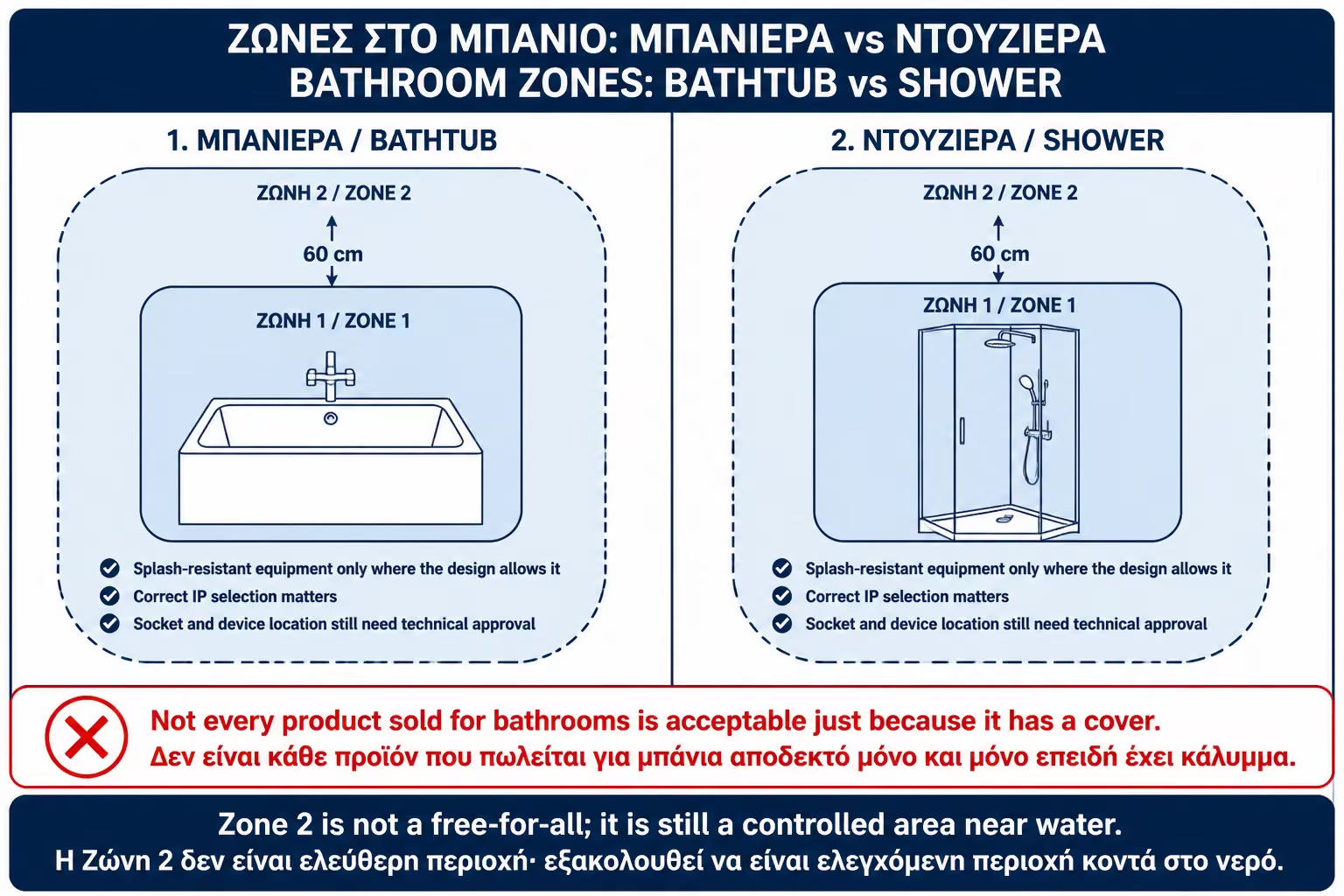
Protection zones are a way of dividing the bathroom according to how close each point is to water. They are not decorative labels or general advice. They are technical safety logic.
The basic idea is simple. The inside of the bathtub or shower is the most dangerous place, because there can be direct contact with water. The area directly above this point is also of high risk, because it receives water, water vapor and contact from a wet body. As we move further away, the risk diminishes, but does not disappear.
This separation affects almost every decision in a bathroom. It affects whether a light can be fitted above the shower, whether a socket is allowed next to the mirror, whether an electric towel rail can be mounted on the wall next to the shower enclosure, whether a fan is in the correct position and what degree of IP protection the equipment must have.
The big mistake is treating the bathroom like a simple room. In a bedroom, a socket goes in where it serves for use and decoration. In the bathroom, the same socket may be acceptable on one wall and inappropriate a few centimetres away because it enters a protection zone.
A point that confuses many owners is the sink. Because there is water in the sink, many believe that protection zones are defined around it as well. In practice, the basic logic of Section 701 zoning concerns the space containing a bathtub or shower. That is, the critical zones are defined in relation to the bath or shower point, not to each faucet in the bathroom.
This does not mean that an outlet next to the sink is always safe. It means that the assessment is made by a combination of factors: distance from bath or shower, possibility of splashing, presence of RCD, degree of IP protection, proper earthing, type of equipment and manufacturer's instructions. In small Greek bathrooms, the sink is often so close to the shower that the mirror socket is practically directly affected by the shower zones.
A practical example: in a large bathroom, an outlet next to the mirror can be located quite far from the bathtub and designed correctly. In a small bathroom of 3 square meters, the same outlet can fall too close to the shower, especially if there is no enclosure or if the shower is a walk-in. So it is not enough to say "it is next to the sink". We need to see the whole arrangement.
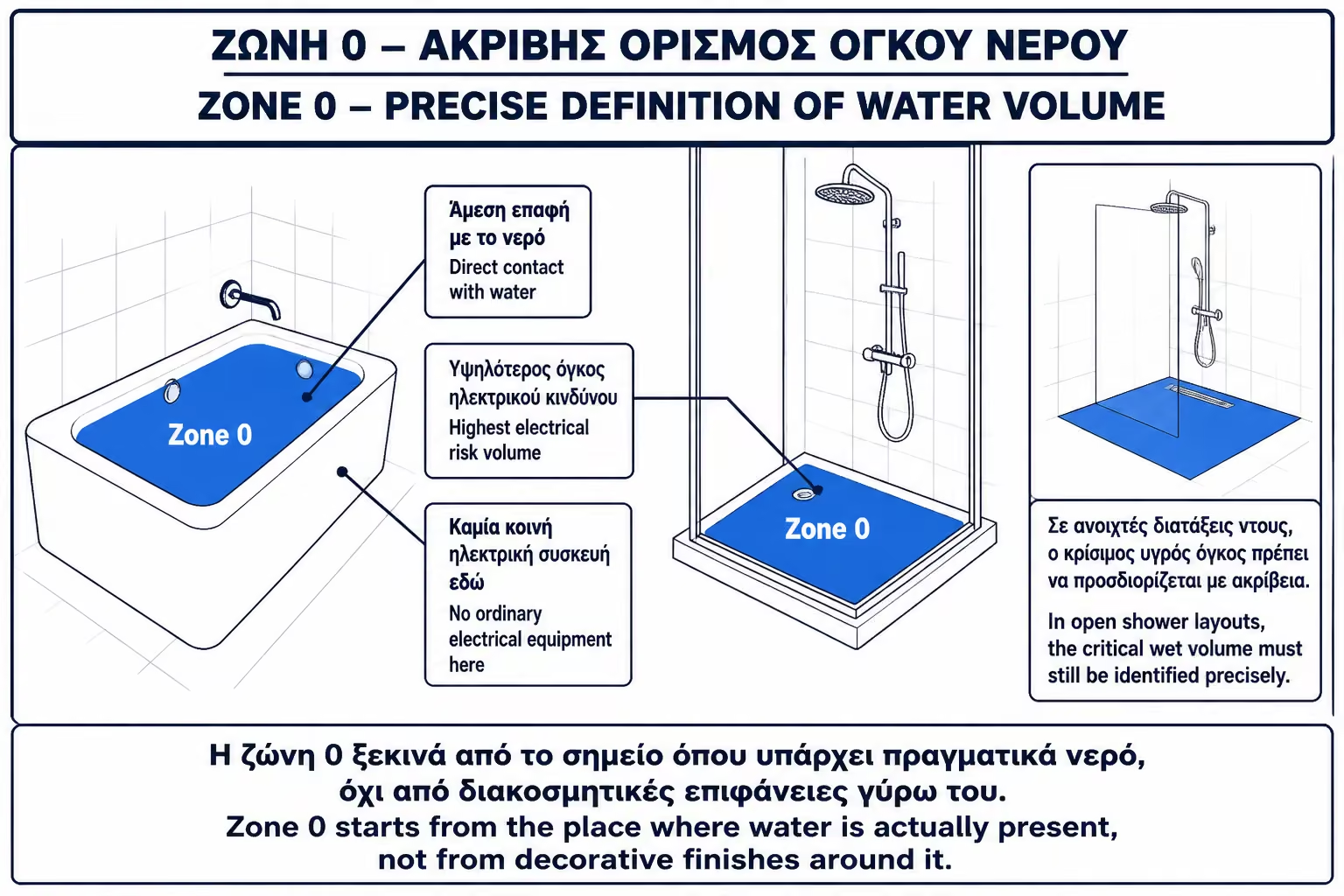
Zone 0 is the inside of the bathtub or shower. It is the area that can be filled with water or receive direct and continuous contact with water. In a classic bathtub, it is the inside of the tub basin. In a tray shower, it is the inside of the tray. In solutions without a visible tray, such as walk-in showers, the definition requires a more careful technical evaluation based on the outlet point, dimensions and final configuration of the floor.
In Zone 0, logic is extremely strict. We do not install conventional electrical appliances, sockets, switches or lights that are not specifically designed for such use. Whatever is placed there must be suitable for the specific environment, with very low voltage where provided and with very high protection against water.
For the owner, the practical translation is simple: inside the bathtub or in the area where the shower water falls directly, we do not place "normal" electrical equipment. We don't put LED tape without a special study, we don't run cables for aesthetic reasons, we don't install switches and we don't improvise with lighting.
A frequent example of a mistake is the desire for "mood lighting" low in the shower or in a recess that gets wet. This may look impressive in photos, but in practice it requires special equipment, correct voltage, correct protection, proper installation and inspection by an electrician. It's not a job that can be solved with a simple commercial "waterproof" LED strip.
Zone 1 is the area immediately above Zone 0, usually up to a certain height above the finished floor or use level. In the earlier presentation of HD 384 it is characteristically stated that Zone 1 is above Zone 0 up to a height of 2.25 m from the floor.
This zone is critical because it is not "in" the water, but right where the user is bathing. It accepts splashes, water vapor, contact from wet hands and in many cases direct water flow from the shower head. That is why the requirements for equipment are strict.
In this area we may find ceiling lights above the shower, fans, special type heaters or equipment provided by the manufacturer for such a position. But not everything we want comes in. Location, IP, power supply, voltage, RCD and manufacturer's instructions should be checked together.
A practical example is the spot above the shower. The owner may want a simple recessed spot for better lighting. But if the spot is inside Zone 1, it cannot be treated as a living room spot. It must be suitable for the specific location, have the correct degree of protection and be connected in accordance with the regulation.
Zone 2 is the adjacent area around Zone 1. It is not where the water falls directly, but it is close enough that there is a risk of splash, water vapor and contact. In many technical presentations, Zone 2 is described as the area extending approximately 60 cm around the bathtub or shower, with corresponding protection requirements.
In practice, Zone 2 is the area where most dilemmas arise. There the owner often wants to put a mirror light, a socket, an electric towel rail, a switch, an LED cabinet or a fan. But because the area is close to the water, not every device is allowed and it is not enough to say "suitable for bathing" on the packaging.
IP indication becomes very important here. For example, equipment located near splashes needs protection against water. IPX4 is often cited as the minimum protection against splashes for zones where such a risk exists. But the exact degree of protection must be assessed based on the site, use, exposure to water and the requirements of the applicable standard.
A classic Greek example is the socket next to the mirror in a bathroom where the shower is less than a meter away. If there is an enclosure, the conditions may be different from an open shower. If the shower phone can be turned towards the outlet, the risk increases. If there is no RCD or proper grounding, the situation becomes even more problematic.
Zone 3 is one of the most common points of confusion. In the older context of ELOT HD 384, bathing areas were often described by four zones: 0, 1, 2 and 3. Zone 3 referred to the area beyond Zone 2, where there were still requirements, but more lenient than the zones very close to the water.
In the modern logic of ELOT 60364 / HD 60364-7-701, the reference to Zone 3 should not be used mechanically as in the old designs. International guides for Section 701 note that the older Zone 3 has been removed and that 30 mA RCD protection for space circuits has become a much more central requirement.
For the owner this means something very practical: if someone shows you an old diagram with Zone 3, it does not necessarily mean that it is wrong as a historical reference, but it should not be the sole criterion for a new installation. In a new renovation or modification, the current standard must be checked and the current requirement must be followed by a licensed electrician.
Simply put, the old Zone 3 should not be used as an excuse for lax solutions. The phrase "it's in Zone 3, so we do whatever we want" is a dangerous oversimplification. Even outside the direct zones, the bathroom remains a wet area and the circuits must have proper protection.
Sockets are where the protection zones become most tangible for the owner. Everyone wants a socket near the mirror. Many also want a second one for an electric toothbrush, trimmer, hair dryer, washing machine or dryer. But in the bathroom, a socket cannot simply go “where it is convenient”.
In Zone 0 and Zone 1, the installation of conventional sockets is essentially outside the reasonable safe installation. In Zone 2, the restrictions remain severe and a special assessment is needed. Outside the zones, the outlet may be more feasible, but not without conditions. It needs RCD protection, proper grounding, proper line, proper location and splash protection.
A common mistake is the socket above the sink, too close to the shower, with a simple cover. The cap does not turn a wrong location into a correct installation. It also does not protect against all usage scenarios: wet hands, open blow dryer, splashes, water vapor or damaged equipment.
In a renovation, the right solution is to decide early on where the mirror will fit, where the user will stand, where the shower is located, if there is an enclosure, if the enclosure door opens towards the socket and if the location is outside the critical zones. These must be decided before the tiles are laid.
Lighting fixtures are a more insidious issue than sockets, because many consider that "since they are on the ceiling, there is no problem". In fact, a fixture above the shower may be within Zone 1. There the requirements are different from a fixture in the center of a large bathroom, away from the tub.
The lamp must be suitable for the zone where it is placed. The IP rating must correspond to the potential exposure to water. The feed must be correct. The circuit must be protected. If the luminaire is metallic, the grounding and the protection class become particularly important.
Caution is also needed in recessed spots. In many renovations, plasterboard or suspended ceilings with spots are installed above the shower. If the choice is made only on the basis of appearance, a product unsuitable for a wet area may be included. Conversely, when the product is chosen correctly, with the appropriate degree of protection and by a licensed electrician, good lighting can be provided without sacrificing safety.
A practical criterion for the owner is not to accept answers like "it's LED, so there's no problem". LED doesn't automatically mean shower safe. The lighting technology is one thing and the electrical safety of the installation is another.
LED mirrors have become very popular. Many have built-in lighting, anti-fog functions, a touch sensor or even a power outlet. But this means that the mirror is not just a decorative object. It is electrical equipment in a humid environment.
The position of the mirror should be considered in relation to the shower or bathtub. If the mirror is far enough away, installation may be simpler. If it is near an open shower or a bathtub used as a shower, the requirements change. It is not enough for the seller to say "it is for the bathroom". IP, protection class, connection method and location must be checked.
A common problem is that the owner first buys the mirror and then asks the electrician to connect it. If the supply point is in the wrong place or the mirror is not suitable for that position, compromises follow. The correct order is the reverse: first the location and supply are planned, then the equipment is selected.
In small bathrooms, it is often better to choose a simpler and safer lighting solution than to squeeze the space for a "smart" mirror with many functions. The more electrical functions an object has in the bathroom, the more important the right design becomes.
The fan seems like a small device, but it is often placed in a position affected by the protection zones. In windowless bathrooms, a fan is necessary to remove water vapor. But that doesn't mean it can fit anywhere there's a hole or vent.
If the fan is near or above the shower, it must be suitable for the zone, properly shielded and securely connected. It should not be powered casually from a nearby, unattended light fixture. The switch, time delay and line must be properly designed.
A classic mistake is adding a fan after the renovation, when the tiles are already in place and the proper electrical provisions were never prepared. Then solutions with visible cables, ducts or improvised connections appear. In a humid area, such solutions should not be accepted without electrical control.
The fan protects against moisture and mold, but its installation must not create a new electrical hazard.
The electric towel rail is one of the devices that often creates a false sense of security. Because it is sold as a bathroom product, many people assume that it can be mounted on any wall. This is not the case.
Its position must be considered in relation to the zones. If it is very close to the shower or bathtub, it must be checked if it is allowed, under what conditions, what IP it has, how it is powered and whether the user can touch it while in the shower or wet. The manufacturer's instruction is very important, but it does not replace the electrical regulation.
The same applies to small electric heaters, infrared heating panels or bathroom heaters. The fact that a body is "bathroom" does not mean that it goes over the bathtub or next to an open shower. The location must be approved by an electrician.
In a small bathroom, the safe place for an electric towel rail may be limited or require a change of layout. This should be discussed before the appliance is purchased, not when the tile has already finished the wall.
The water heater is not always located in the bathroom, but its use is directly connected to it. If there is an electric water heater, boiler or instant heater, its line must be correct, independent where required, protected and checked. It is not a device that should be connected casually or "take power" from wherever it is convenient.
In old apartments, the water heater lines may be old, damaged or with questionable grounding. In a bathroom renovation, it is a mistake to change tiles, sanitary ware and lighting, but not check the water heater line and the panel. Bathroom safety is not limited to the visible areas.
If the water heater is located inside a zoned area, things get even stricter. Location, protection, handling, switch, grounding and RCD should be checked by a licensed electrician.
A practical example: an owner is renovating a bathroom and keeps an old water heater in the attic, with an old fuse and no recent inspection. The bathroom is delivered aesthetically new, but the most powerful electrical appliance serving it remains in questionable condition. This is the wrong priority.
The IP degree of protection indicates the resistance of an electrical equipment against solid bodies and water. In the bathroom, the second digit is particularly important, because it indicates the protection against water, splashes or more intense exposure.
Many owners see the word "waterproof" and think that the product is suitable for any point. This is a dangerous simplification. Another product withstands simple splashes, another intense splash of water, another temporary immersion. Zone 0 has a completely different logic than Zone 2.
Furthermore, the IP is about the product itself, not the entire installation. A luminaire with an appropriate IP can be installed incorrectly, with a bad connection, wrong power supply or without proper circuit protection. So it is not enough that the product is good. The installation must also be correct.
The owner should ask the electrician to confirm that the IP of the equipment is suitable for the particular location. Not generally "for the bathroom", but for the exact place where it will enter.
Zones show where equipment is allowed to be placed. But it is not the only protection. The modern logic of bathroom installations places great importance on protection with RCDs, usually with a sensitivity of 30 mA. International Section 701 guides state that circuits serving a space with a bath or shower, such as lighting, power showers and heated towel rails, require protection with an RCD not exceeding 30 mA.
For the owner, this means that it is not enough to measure distances. The panel should also be checked. Is there an RCD? Does it really protect the bathroom circuits? Has it been tested? Is it connected correctly? Is it the right type for today's installation?
In older homes, there may be an RCD in the panel, but it may not protect all circuits. There may also be rough add-ons made afterwards. That's why a bathroom renovation should include a panel check, not just changing cables in the bathroom.
The RCD is not a license to misplace equipment. It is additional protection, not a substitute for zones, grounding and the correct IP rating.
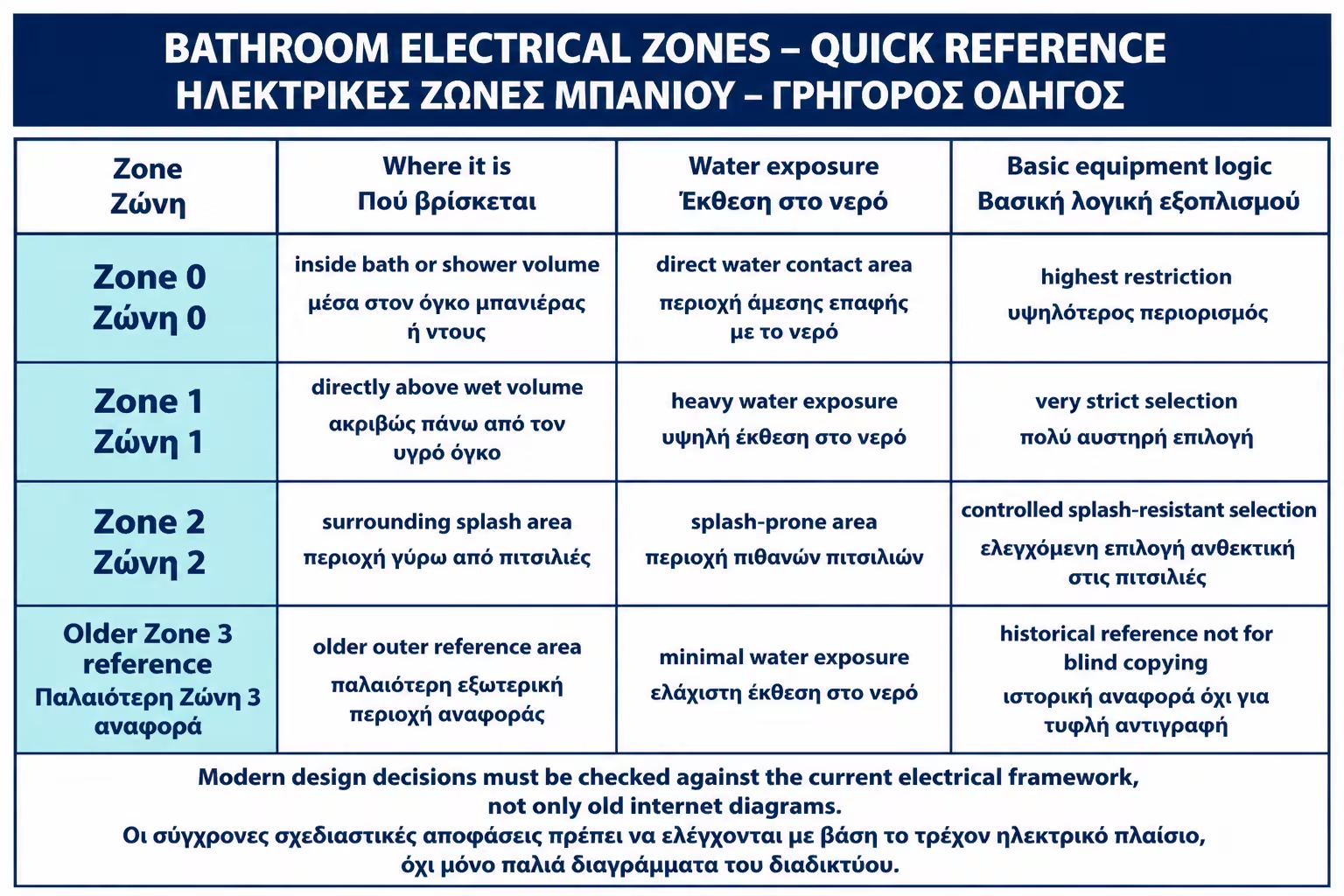
The table below is a practical summary for the owner. It does not replace an electrician and should not be used as the sole basis for an installation, but it helps clarify the logic.
| Area | Where it is in practice | What does it mean for electrical equipment |
|---|---|---|
| Zone 0 | Interior of a bathtub or shower | Extremely strict area. Only special equipment is considered, with suitable protection and very careful design |
| Zone 1 | Above the bathtub or shower, in the immediate area of use | Only equipment suitable for the zone is allowed, with the correct IP rating, protection and installation method |
| Zone 2 | Adjacent area around bathtub or shower | Extra care is needed with light fittings, appliances, mirrors and fans. Products are not chosen on appearance alone |
| Old Zone 3 | Area beyond Zone 2 under the older HD 384 framework | Useful as a historical reference, but in new projects the current ELOT 60364 logic and RCD protection must be checked |
| Outside the zones | Further away from the bath or shower | This does not mean "no rules". Proper earthing, RCD protection, suitable equipment and safe installation are still required |
The most important row is probably the last one. Many owners think that “outside the zones” means “anything goes”. It does not. The rules are simply different, not absent.
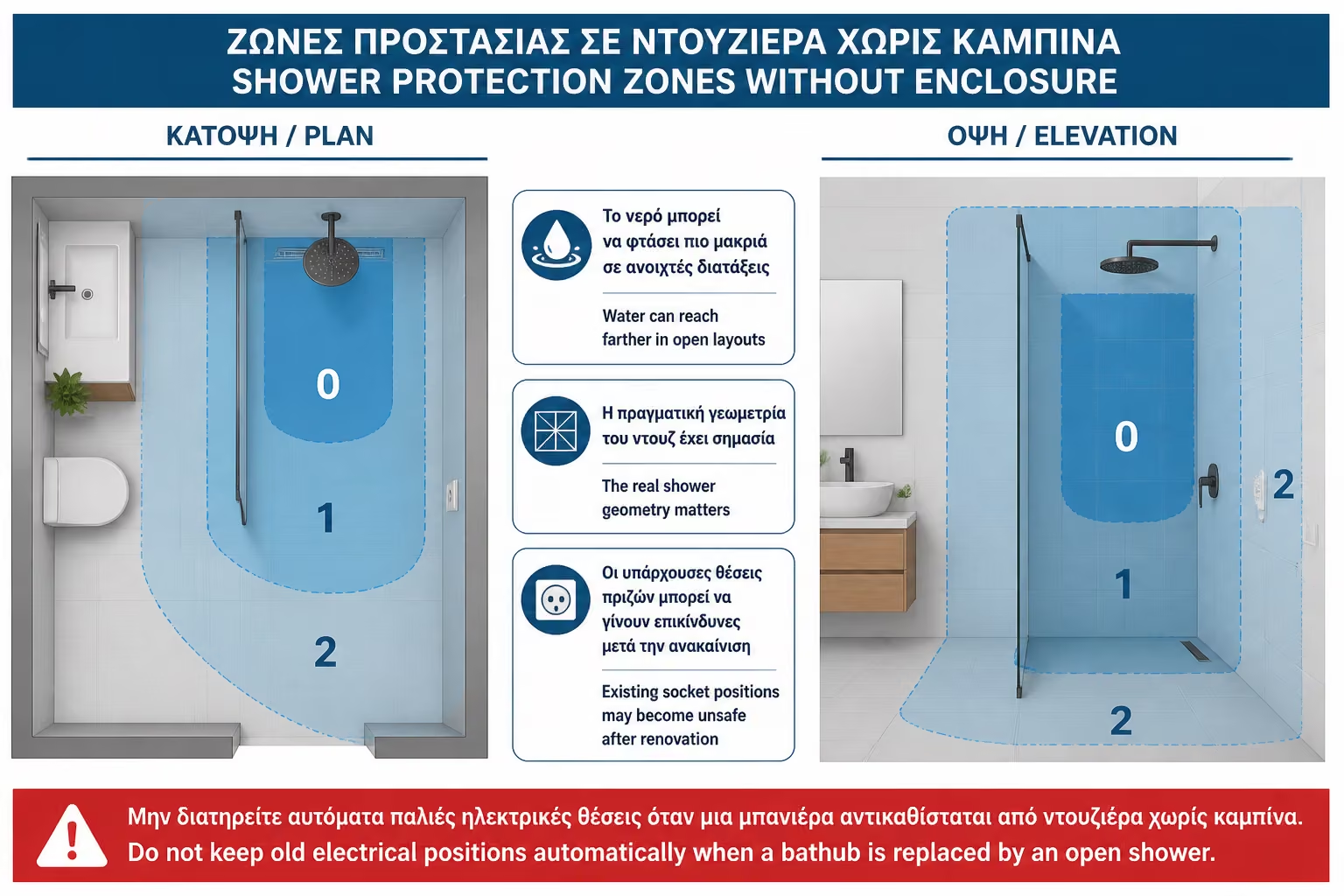
Walk-in showers have greatly changed the logic of modern bathrooms. They are beautiful, practical and give the feeling of a larger space. But electrically, they need special attention, because the water can move more freely than in a closed enclosure.
In a classic shower enclosure, fixed glazing limits splashes to some extent. In an open walk-in solution, the water can reach further, especially if the slope is not correct, if the shower head moves freely or if the user is bathing carelessly. This practically affects the choice of positions for sockets, lamps, towel rails and mirrors.
Also, in showers without a visible tray, the boundaries are not always as "clean" as in a bathtub. The electrician must assess the location of the fixed water outlet, floor configuration, dimensions, presence of glazing and use. It should not be copied from a bathtub or old shower design.
A common mistake is to remove the bathtub, put in a walk-in shower and leave the old socket or the old lamp in place. Changing the shower head can change the zone. So the electrical installation needs to be re-examined.
Many Greek bathrooms have a bathtub, but in everyday use they function as a shower. There is a mixer tap with a handheld shower, a curtain or a screen, and the user showers standing up. This is important because the water doesn't just stay inside the tub basin. It splatters walls, lamps, cupboards and nearby surfaces.
In such cases, the electrical assessment must take into account the actual use. If an outlet is next to the bathtub, it is not enough to say "the bathtub is low". We need to see that the user is showering standing up, that the handheld shower can be turned towards the socket, and that the area gets wet.
The same goes for wall lights above the bathtub, LED cabinets and electric towel rails near the spot. The use turns a seemingly "quiet" bathtub into an active shower area.
Therefore, when renovating, you must tell the electrician how the bathroom is actually used. Another bathtub for a rare bath and another bathtub that functions daily as a family shower.
Fixed partitions, enclosures and glazing can affect how exposed an area is to water, but the owner should not think to himself that "since there is glazing, we are fine". Whether a partition affects how it is rated depends on its location, height, whether it is fixed, whether it has openings, where the mixer is located and how the shower is used.
A fixed glazing may limit splashes towards an outlet, but if the outlet is still in an area affected by zoning or the glazing is not sufficiently protective, it is not enough. If an enclosure door opens to electrical equipment and water is dripping, this also needs to be considered.
The correct approach is to design the electrical installation based on the finished bathroom, not just the drawing on paper. Where is the fixed glass? Where does the door open? Where does the water fall? Where does the user stand? How far will splashes go in everyday use?
In small bathrooms, a glass can help, but it should not be used as a "patent" to insert a socket in a marginal position.
Light switches in old houses are often located inside the bathroom, next to the door or near the mirror. In new installations, the location of the switch should be considered based on the zones and the risk of contact with wet hands.
In many cases, the light switch is placed outside the bathroom or solutions are used that reduce the risk. If there is to be handling inside the bathroom, the electrician must assess the location, type of equipment and protection.
Attention is needed on mirror switches, touch controls, sensors and dimmers. Just because a mirror has a built-in touch button doesn't automatically mean it can be placed in any position. The device, power supply and zone must be evaluated together.
A practical mistake is placing a fan or heater switch next to the shower because it's "convenient there". In the bathroom, ease of use cannot trump safety.
The best time for proper electrical planning is before the walls are closed and before the tiles are installed. Then the correct circuits can be routed, electrical provisions can be moved, old positions can be corrected and the panel connection can be checked properly. After tiling, any change is more expensive, more difficult and often more improvised.
Before the renovation begins, the electrician must know the location of the bathtub or shower, whether there will be an enclosure, the position of the sink, mirror, furniture, washing machine, fan, towel rail and lighting. The electrician should also check the panel, RCD, earthing and existing circuits.
If the electrician comes after the tile is finished, the options are limited. Then the bad solutions appear: visible cables, ducts, rough connections, displaced sockets without the correct line or installation of equipment in the wrong place because "there is no other way".
In the bathroom, "no other way" usually means that the design was done late. Not that there wasn't a right solution.
Protection zones do not necessarily increase costs because they require expensive materials. They increase costs mainly when they have not been taken into account from the beginning. If the positions are designed properly before tiling, the cost difference can be reasonable. But if changes need to be made after completion, the costs add up quickly.
In the Greek market of 2026, a basic electrical intervention in a bathroom, such as moving or creating a few correct electrical provisions, can be included in the general electrical costs of the renovation. For a typical bathroom, simple electrical work can start from around €250–€600, when no major panel changes are required. A more comprehensive intervention with new lines, RCD, washing machine supplies, LED mirror, fan, lighting and grounding checks can range from around €600–€1,200 or more.
Prices depend on the area, access, floor, whether the bathroom is already gutted, whether new lines are required from the panel, whether materials, VAT, measurements, restorations and possible VAT are included. A very low bid may only cover “putting in a socket”, not proper planning according to the zones and protection requirements.
The economic approach is not to ignore the zones. It is to design them correctly from the beginning so that no corrections are needed later.
The first mistake is the outlet too close to the shower. It usually goes in because the mirror is there or because "there was no other wall". This is not a technical argument. If the position is not correct, the layout must be changed or another solution must be found.
The second mistake is the inappropriate light above the shower. A simple spotlight, a decorative lamp or an LED strip without proper protection should not enter a zone of increased risk.
The third mistake is the electric towel rail in a limit position. If the user can touch it from the shower or if it is in a wet area, the position should be re-examined.
The fourth mistake is using a power strip or extension cord in the bathroom. This is not a solution for a lack of sockets. It is an indication that the installation was not properly designed.
The fifth mistake is copying an old installation to a new renovation. Just because an outlet has been there for 30 years doesn't mean it has to go back in the same place after renovation.
Before anything is installed, run through the following questions first:
| Question | Yes / No |
|---|---|
| Has the exact location of the tub or shower been determined before the electricals are designed? | Yes / No |
| Has a licensed electrician checked if the spot is in Zone 0, 1, 2 or formerly Zone 3? | Yes / No |
| Is the outlet outside the danger zone and protected by an RCD? | Yes / No |
| Does the light fixture have an appropriate IP for the specific location? | Yes / No |
| Has the LED mirror or bathroom cabinet been tested as electrical equipment and not just furniture? | Yes / No |
| Is the electric towel rail in a location where it will not get wet or be touched by the shower? | Yes / No |
| Is the fan properly supplied and not accidentally connected by a nearby light fixture? | Yes / No |
| Is there a proper 30 mA RCD protecting the bathroom circuits? | Yes / No |
| Has earthing and equipotential protection been checked where required? | Yes / No |
| Have the electrical provisions been prepared before the tiles go in? | Yes / No |
If the answers are unclear, the project should not proceed based on assumptions. In the bathroom, a wrong position is not just an ergonomic mistake. It can become a safety issue.
If you keep only one thing from this guide, keep this: protection zones are not a theoretical drawing on paper. They are how we decide whether a socket, a light fitting, an LED mirror or an electrical appliance can be placed safely in the bathroom. Do not buy equipment or lock in positions before a licensed electrician has reviewed the layout. Start from the position of the bath or shower, define the zones, check the RCD, grounding and IP rating, and only then decide what goes where. The correct position is often more important than the product itself.
Zones 0, 1, 2 and the older Zone 3 are the basic safety map for bathroom electricals. They are not there to make renovation difficult, but to protect the user in a space where electricity and water are dangerously close. If we understand their logic, it becomes much easier to avoid wrong positions, inappropriate light fittings, dangerous sockets and improvised installations.
The most important change in today's approach is that we should not mechanically rely on old diagrams and simplifications. ELOT 60364 and Section 701 address the bathroom with more modern protection logic, where the zones are combined with a 30 mA RCD, proper grounding, appropriate IP, manufacturer's instructions and technical control. The old Zone 3 may still appear in older reports, but new projects must be assessed against the current framework.
For the owner, the practical direction is clear. Before tiles are installed, before an LED mirror is purchased, before the outlet is decided and before a light fixture is installed above the shower, electrical planning must be done. A beautiful bathroom without proper zones and protections is half a renovation. The right bathroom must be both functional and safe.
Return to category.
Go to categoryReturn to the central guide.
Go to guide