
Bathroom Lighting, Ventilation & Heating
Return to category.
Go to categoryThe bathroom fan is one of those devices that needs to run often enough, and long enough, to do its job properly. But when it is noisy, the usual problem begins: the owner switches it off too early, avoids the timer, does not let it run after the shower, or disables it entirely. The result is lingering humidity, fogged mirrors, odours, and gradual signs of mould.
Noise is not only a comfort issue. It directly affects how well the ventilation performs in real life. A fan that makes too much noise simply does not get used properly. It may have good airflow on paper, but in practice it runs less than it should because people find it irritating. In small apartments, in bathrooms next to bedrooms, or in homes where the bathroom is used early in the morning or late at night, that noise quickly becomes a daily problem.
In the technical specifications you will usually see a value in dB or dB(A). This is the noise level declared by the manufacturer. The lower it is, the quieter the fan is considered to be. But that number does not tell the whole story. A laboratory measurement is one thing; how the fan sounds in a small tiled bathroom with a false ceiling, ducting, grilles, and reverberation is another.
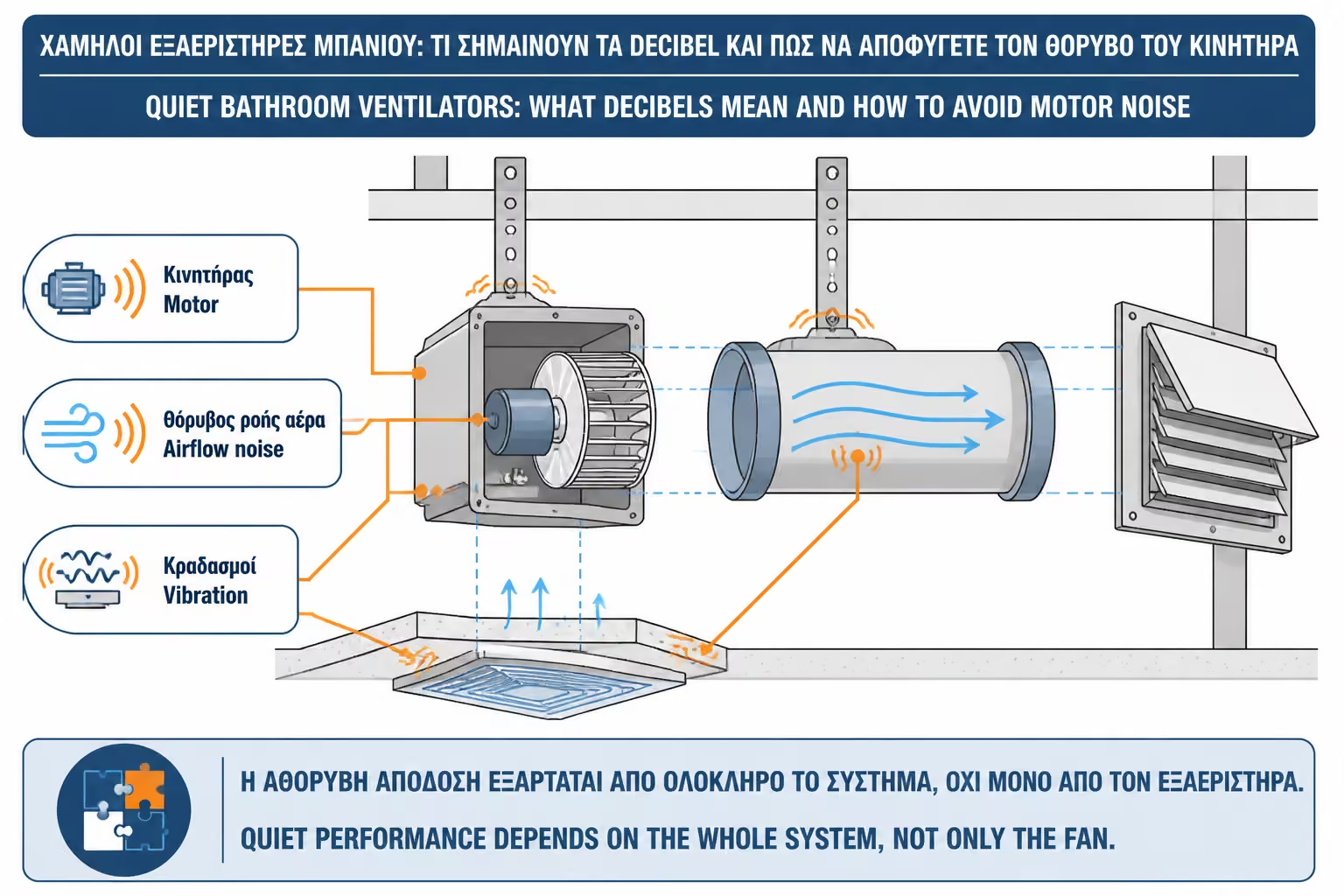
A truly quiet fan is not just one with a low dB rating on the box. It is one with the right airflow for the bathroom, the right motor type, the right duct diameter, a clear exhaust route, vibration-free support, and proper installation. In many cases, the annoying noise does not come from the motor alone. It comes from air being forced through a narrow duct, from a hissing grille, or from vibration being transmitted into the suspended ceiling.
In this guide we will see what decibels mean, what noise level is considered comfortable for a bathroom, why a fan can be louder than the manufacturer says, how axial, centrifugal and in-line fans differ in terms of noise and how to choose a solution that ventilates properly without making the bathroom sound like an engine room.
Bathroom fan noise is annoying because it occurs in a small, tight and often enclosed space. Tiles, mirror, glass cabinet and hard surfaces reflect sound. Thus, a noise that would go unnoticed in a large space can sound more intense in the bathroom.
In addition, the ventilator often operates in moments when we want peace. At night, after a shower, when the house is quiet, a noisy fan is much louder. If the bathroom is next to a bedroom, the noise may disturb others in the house. If there is a timer that keeps the fan on after the light goes out, the noise may continue after the user has already left the bathroom.
The result is practical: users start to avoid it. They turn off the light quickly, cancel the timer, or don't use the fan when taking a short shower. This is the exact opposite of what a bathroom needs. Proper ventilation should work well, especially after use.
So choosing a silent fan is not a luxury. It is a prerequisite for the system to work daily without disturbing.
Decibels, or dB, are a unit of sound level measurement. On ventilators you will usually see the dB(A) reading, which is a measurement approximated to how humans perceive sound. The lower the value, the quieter the ventilator is considered to be.
The important thing is that the dB scale is not linear in the way we perceive it every day. An increase from 20 dB to 30 dB does not mean "a little more". In practice, the sound becomes noticeably louder. That's why two ventilators that differ by only 8–10 dB can sound very different in the same bathroom.
For an owner to understand this practically, we can say that a fan around 20–25 dB(A) is considered very quiet, one around 30–35 dB(A) is usually acceptable for most bathrooms, while above 40 dB(A) can start to be annoying, especially if it is operated frequently or near a bedroom.
But we should not compare dB without looking at the supply. A very quiet fan with insufficient m³/h does not solve the humidity problem. Accordingly, a very powerful fan with high noise can be annoying. The right choice is a balance between performance and noise.
There is no single value that is right for every bathroom. The size of the room, the position of the fan, whether there is a false ceiling, whether the bathroom is next to a bedroom, and how often it runs all play a role. Still, there are practical ranges that help with selection.
| Noise level | Practical feel | Suitability for a bathroom |
|---|---|---|
| up to 20 dB(A) | Very quiet, almost unobtrusive | Ideal for bathrooms next to a bedroom |
| 20–30 dB(A) | Quiet operation | Very good choice for a master bathroom |
| 30–35 dB(A) | Audible, but usually acceptable | Good practical base for many bathrooms |
| 35–40 dB(A) | Perceptible noise | Acceptable only if use does not disturb |
| above 40 dB(A) | It can be tiring | It needs attention, especially with a timer or night use |
For a small guest WC, a 35–40 dB(A) fan may be tolerable because it works a bit. For a master bathroom with a shower and timer, it is better to aim for a lower level. For a bathroom next to a bedroom, the low noise level becomes a very important criterion.
A practical limit for comfortable living is to aim, where possible, for models below 30 dB(A) for basic use and even lower if the bathroom is close to a sleeping area. But you shouldn't buy the quietest fan if it doesn't have enough flow or if it can't overcome the resistance of the air duct.
The dB value declared by the manufacturer is obtained under specific measurement conditions. In the real bathroom, the conditions are different. The fan can be connected to a long duct, have corners, have a small external grill, be mounted on a thin suspended ceiling or transmit vibrations to the wall.
Sound can be amplified by air resistance. If the fan forces air through a narrow tube, the flow becomes noisier. If the grill has small openings, it may whistle. If the recoil clicks or squeaks, the user may think the motor is at fault when the part is at fault.
Noise can also be transmitted as vibration. A fan that is not properly secured, or that rests on a suspended ceiling without anti-vibration provision, can cause the entire system to hum. In such a case, changing the device does not always solve the problem if the installation remains the same.
That is why the system must be evaluated as a whole: fan, duct, grill, position, support and electrical control.
Fan noise is not always the same. It may sound like motor hum, rushing air, a whistling grille, creaking plastic, flap impact, or vibration in the ceiling. Each type of noise points to a different cause.
| Type of noise | Likely cause | Practical fix |
|---|---|---|
| Humming motor | Low quality motor or wear | Better model or replacement |
| Loud blowing | High air velocity in a narrow duct | Larger diameter or correct type |
| Whistle | Small or bad grille | Grill change / resistance reduction |
| Plastic creaking | Bad front or loose support | Correct placement / better product |
| Flap strike | Backdraft flap hitting in airflow | Better quality valve or adjustment |
| Vibration | Poor wall/ceiling support | Anti-vibration mounting |
| Transmitted noise | Duct carrying sound | Proper support and possible sound insulation |
A typical example is a fan that starts to "whistle" after a new external grille is installed. The owner thinks the fan itself is noisy, but in reality the grille has too little free area and the air is being forced through under pressure. The solution is not necessarily a new fan. It is the correct grille and the correct duct layout.
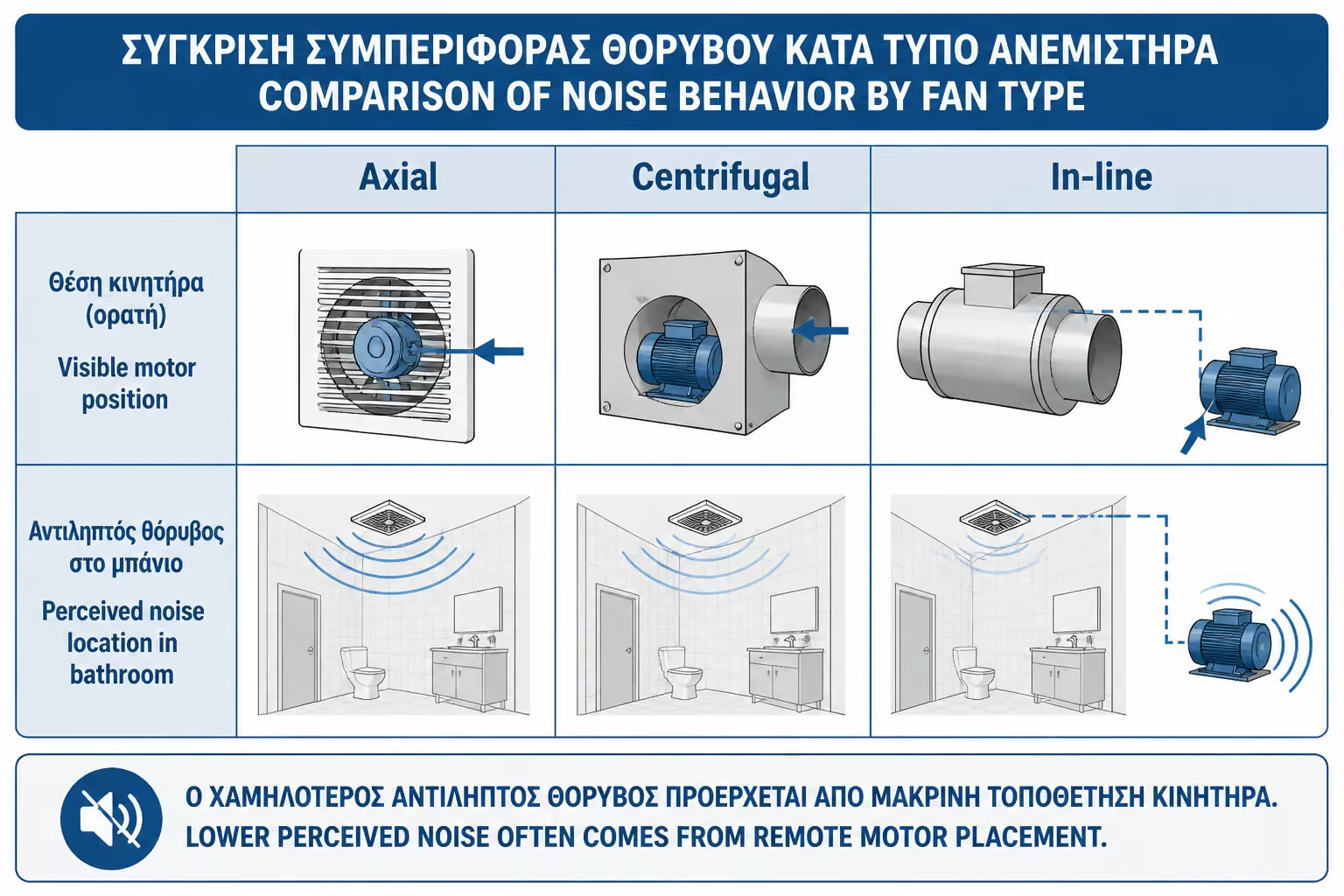
Axial fans are the most common in bathrooms. They are simple, economical and easy to install. On a short and straight route they can operate quite quietly, especially if a quality low-noise model is chosen.
The problem starts when the axial is placed in a difficult conduit. Because it is not ideal for high resistance, it can work under pressure. Then the noise increases and the actual throughput drops. The user hears the fan, but the moisture does not leave as much as it should.
In direct output to an external wall or light fixture, a quiet axial can be a very good choice. In a long duct with corners, trying to solve the problem with "stronger axial" often results in more noise and not necessarily better performance.
So the axial is quiet when it works where it should. When we put it in the wrong installation, it can become noisy and inefficient.
Centrifugal fans have a better ability to push air through resistive ducts. This makes them suitable for blind bathrooms, longer runs or installations with corners. In such cases, they may be more effective than an axial.
As for noise, the picture is more complex. A centrifugal can have a stronger motor and be louder if it is inside the bathroom. On the other hand, because it works more correctly against the resistance, it can perform better without "choking" like an improper axial. In a difficult installation, the right centrifugal can be a more reasonable solution even if on paper it is not the quietest.
The choice should be based on the installation. If the duct run is long, there is no point in choosing a very quiet axial fan that cannot pull enough air. A well-chosen centrifugal model with acceptable noise and proper performance is the better solution.
In bathrooms next to a bedroom, if centrifugal logic is needed but noise is a problem, it is worth considering an in-line solution so that the motor is removed from the space.
In-line ventilators are placed inside the air duct, usually in a false ceiling, loft or technical space. In the bathroom, only a suction grille is visible. This has a big noise advantage because the motor can be further away from the user's ear.
It doesn't mean that in-lines are always quiet. If the duct is bad, if the fan is too strong, if it is not properly supported, or if the grill is small, the noise may remain. But when designed correctly, in-line solutions can offer a very good balance of performance and comfort.
In a bathroom with a suspended ceiling, this solution is particularly good. The grill can be placed near the shower, while the motor can be placed in an accessible place for maintenance. With proper ducting, performance can be better and the noise in the bathroom lower than a wall fan.
The key is access. An in-line vent that is sealed inside a false ceiling without a hatch may be nice on day one, but problematic when it needs cleaning or replacement. Quiet design must also be maintainable.
In many cases, the main noise does not come from the motor but from the airflow itself. When air passes through a small duct at high speed, hits a sharp bend, or is forced through a small grille, it creates noise. That noise may sound like blowing, hissing, or air under pressure.
Duct diameter matters a lot. A powerful fan in a 100 mm duct can be noisier than a properly sized fan in a 125 mm or 150 mm duct because the air has to travel faster. In older bathrooms the diameter is often fixed, but in a renovation with a suspended ceiling it is worth reconsidering.
Bends matter too. A sharp corner immediately after the fan increases resistance and noise. A kinked flexible hose can make the system behave as if the duct were much smaller. A dirty backdraft flap can creak or knock.
Before you blame the fan, check the ductwork. A good motor on a bad duct system will still be troublesome.
Vibration noise is different from blowing. It is hum that passes through the wall, false ceiling or frame. It can be heard in the next room or create a low frequency that disturbs more than the dB indicates.
Poor support is a common cause. If the fan does not press properly, if the facade creaks, if the suspended ceiling is thin, or if the duct hangs without support, the vibrations are transferred. In in-line installations, the motor must be properly supported and not resting loosely on drywall or hanging from the ductwork.
In some cases anti-vibration gaskets, proper fastening, flexible joints or better support of the duct are needed. These are not visible in the product photo, but make a big difference to the final result.
A typical example is an in-line fan that is theoretically low noise, but was placed leaning against the false ceiling. When it works, the entire ceiling acts as a speaker. The solution is not another model, but proper support.
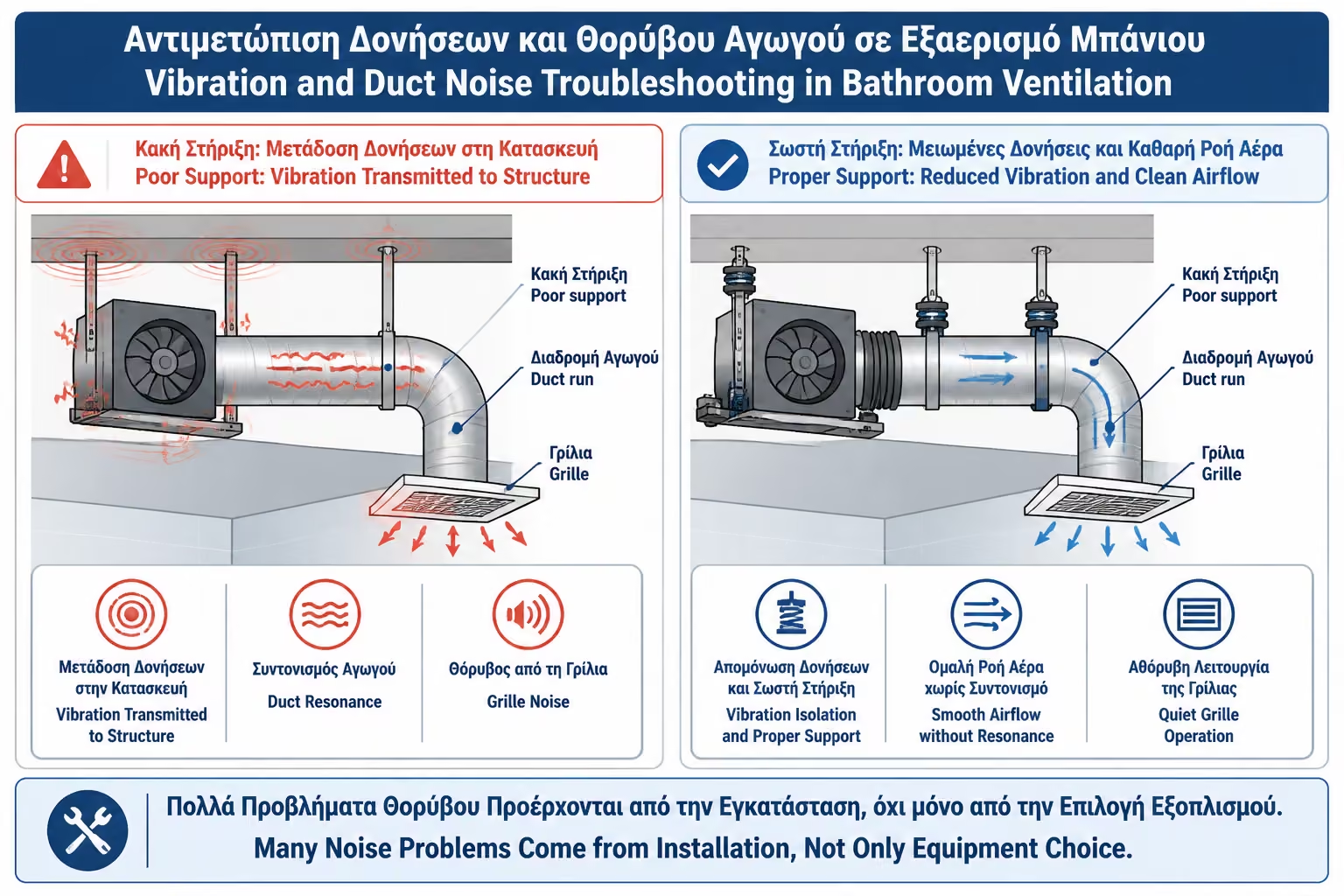
Backflow is necessary in many installations to prevent odors, cold air or air from a light fixture from returning. But if it is of poor quality or if it does not fit the flow of the fan, it can make noise. It may click when the fan starts or stops, crackle or pulsate from the wind.
The outer grille can also be noisy. If it has too little free surface, the air rushes through and can whistle. If it is dirty or has a sieve full of dust, it increases the resistance. If located in a windy location, it may make noises even when the fan is closed.
In small bathrooms, these small noises are particularly noticeable. The owner may have bought an expensive quiet model and end up being bothered by a cheap flap or a bad grille.
The correct selection of a silent fan should also include the system components. Not just the device.
The timer is very useful because it keeps the fan running after the shower. Thus it removes the moisture that remains in the room. But precisely because it works when the user has left the bathroom, the noise becomes more noticeable in the rest of the house.
If the fan is noisy, the timer will be annoying. The user will look for a way to reduce or cancel it. So, the more necessary the timer, the more important the low noise level.
In a bathroom next to a bedroom, a 40 dB(A) ventilator with a 15-minute timer can become a daily nuisance. A quieter one at 25–30 dB(A) can operate without anyone thinking about it. In such cases, it is worth paying a little more for lower noise.
Timing also matters. If the timer stays 30 minutes for no reason, it's annoying. If it only stays for 2 minutes, it is not aerating enough. The correct duration depends on the bath, use and humidity.
The humidity sensor turns on or keeps the fan running when the humidity is high. It is extremely useful in blind bathrooms and in areas with frequent showers. But if the fan is noisy, the sensor can become a source of irritation, because it will turn on often and maybe for a long time.
That is why models with a humidity sensor should ideally be low noise. The sensor makes sense when it allows the fan to work as needed without disturbing. If every activation is heard throughout the house, the function loses its value.
Care is also needed in the setting. If the humidity limit is very low, the fan can run almost continuously on humid days. If it is too high, it may lag. The best models allow adjustment of sensitivity and operating time.
A quiet fan with a correctly set humidity sensor is often a better solution than a very loud fan that only works when the user remembers.
In some installations, especially blind bathrooms with chronic dampness, continuous low duty ventilation with boost may be considered. That is, the fan runs continuously at a very low and quiet level and revs up when there is moisture or when the light comes on.
This logic can be more comfortable than a fan that suddenly turns on at high volume. Continuous low mode keeps the air more stable and reduces humidity spikes. If the motor is quality and very low noise, the user may not notice it.
But it doesn't fit everywhere. It requires proper device selection, low consumption, good setup and acceptance that the system will work longer. In simple small WC, it is usually overkill. In a blind master bathroom with frequent use, it might be worth it.
The point is not always to "never be heard". It is to be heard so little and so smoothly that it does not become annoying in everyday life.
When comparing two models, don't just look at dB. Look at the dB along with the m³/h flow. A 24 dB(A) ventilator with 80 m³/h and another 30 dB(A) with 150 m³/h are not directly comparable. The second one can be noisier but serve a larger or more demanding bathroom.
Also look at the guy. Axial, centrifugal or in-line? If the ride is rough, the low dB of a single axial may not matter because it won't perform. If the route is direct, you don't need to pay for a more complex system for no reason.
Check if the noise value is given at the same distance and under the same conditions. Manufacturers do not always present the data in the same way. Don't just rely on the word “silent” or “ultra quiet”. Ask specifically for dB(A), flow rate, diameter and if there are timer or humidistat functions.
Finally, look at the build quality. Good bearings, quality motor, correct front and solid construction reduce annoying sounds over time.
There are cases where the owner buys a silent ventilator, but the bathroom continues to have a problem. This occurs when the supply is insufficient, the duct has high resistance, there is no air intake or the vent is in the wrong position.
If the door closes tightly, the fan cannot draw enough air. If the conduit is clogged, the flow drops. If the vent is close to the door and away from the shower, it can draw fresh air from the crack and leave the water vapor in the background. If it doesn't have a timer, it stops too soon.
A very quiet fan that works a little and in the wrong position does not solve the humidity. Silence should not be bought at the expense of performance. The correct question is "quiet and sufficient", not just "quiet".
Therefore, before replacing a noisy fan, it is worth checking the entire installation. Maybe it needs duct cleaning, grill change, better return, or a different type of fan.
Prices depend on type, output, noise, motor quality, functions, diameter, installation and whether ducts, grilles, return or false ceiling are required. They are also affected by area, access, floor, existing installation, whether VAT is included and whether the offer is for appliance only or full installation.
| Category | Indicative range 2026 | What to watch out for |
|---|---|---|
| Simple axial fan | €25–€70 | Usually not the quietest solution |
| Axial low noise | €60–€150 | Good choice for simple routes |
| Silent with timer | 80–180€ | Very practical for a master bathroom |
| Silent with humidity sensor | 100–230€+ | Ideal for blind bathrooms, if set up correctly |
| Low noise centrifugal | 120–300€+ | For more difficult pipelines |
| Low noise in-line / mixed-flow | 120–350€+ | Good solution for false ceiling |
| Ducts, grilles, shock absorbers, recoil | 30–200€+ | They greatly affect the actual noise |
| Complete installation / conversion | 150–600€+ | Depending on access, conduit, electrical |
The low price may be enough in a small WC or simple replacement. In a master blind bathroom, however, a very cheap noisy ventilator is usually poor economy. If you don't use it enough, the bathroom will retain moisture.
The higher price is justified when it combines low noise, correct flow, timer or humidity sensor, suitable duct type and good installation. It is not justified only by a nice cap or the word “silent” on the packaging.
If the existing fan is bothering you, you don't always have to start with a replacement. First it is worth checking key points. Is the impeller clean? Does the faceplate have dust? Backlash hits? Is the outer grill clogged? Is the duct kinked? Is the device loose on the wall?
A cleaning can reduce the noise quite a bit if the problem is dust or impeller imbalance. Proper mounting can reduce vibration. Changing the grille can stop hissing. Backlash replacement can stop hits.
If the noise comes from the motor due to wear and tear, then replacement makes more sense. If the noise comes from a poor choice of type, for example axial on a long pipe, then replacing with the same type will simply repeat the problem.
Proper diagnosis before purchase saves money and frustration.
Mistakes in choosing a silent fan are often made because the owner focuses on a single number. He sees low dB and thinks he has found the best solution. But the bathroom needs a combination of quietness and efficiency.
| Error | What it causes in practice | A more correct approach |
|---|---|---|
| Select from dB only | Quiet but insufficient ventilation | Control dB together with m³/h |
| Very weak "silent" fan | The moisture remains | Correct supply for the space |
| Axial in long duct | Noise and low performance | Centrifugal or in-line |
| Ignore grid | Hissing or resistance | Suitable outlet grille |
| No anti-vibration support | Humming in the false ceiling | Proper support of motor and conductor |
| Timer in noisy model | Discomfort after use | Low noise with timer |
| Humidity sensor without adjustment | It works constantly or lags | Set limit and time |
| Closed space without air entry | The fan is pressed | Gap under door or blind |
| Buy only from the word “silent” | Misleading impression | Comparison of actual features |
| Lack of access to in-line motors | Difficult maintenance | Locker or technical access |
A typical example is an owner who buys a very quiet axial fan for a blind bathroom with a 4 meter duct. At first he is happy because the noise is low. But then he sees that the mirror remains cloudy and the corners retain moisture. The problem isn't that the vent is bad. It's that it's not right for that particular installation.
| Inquiry | Yes / No |
|---|---|
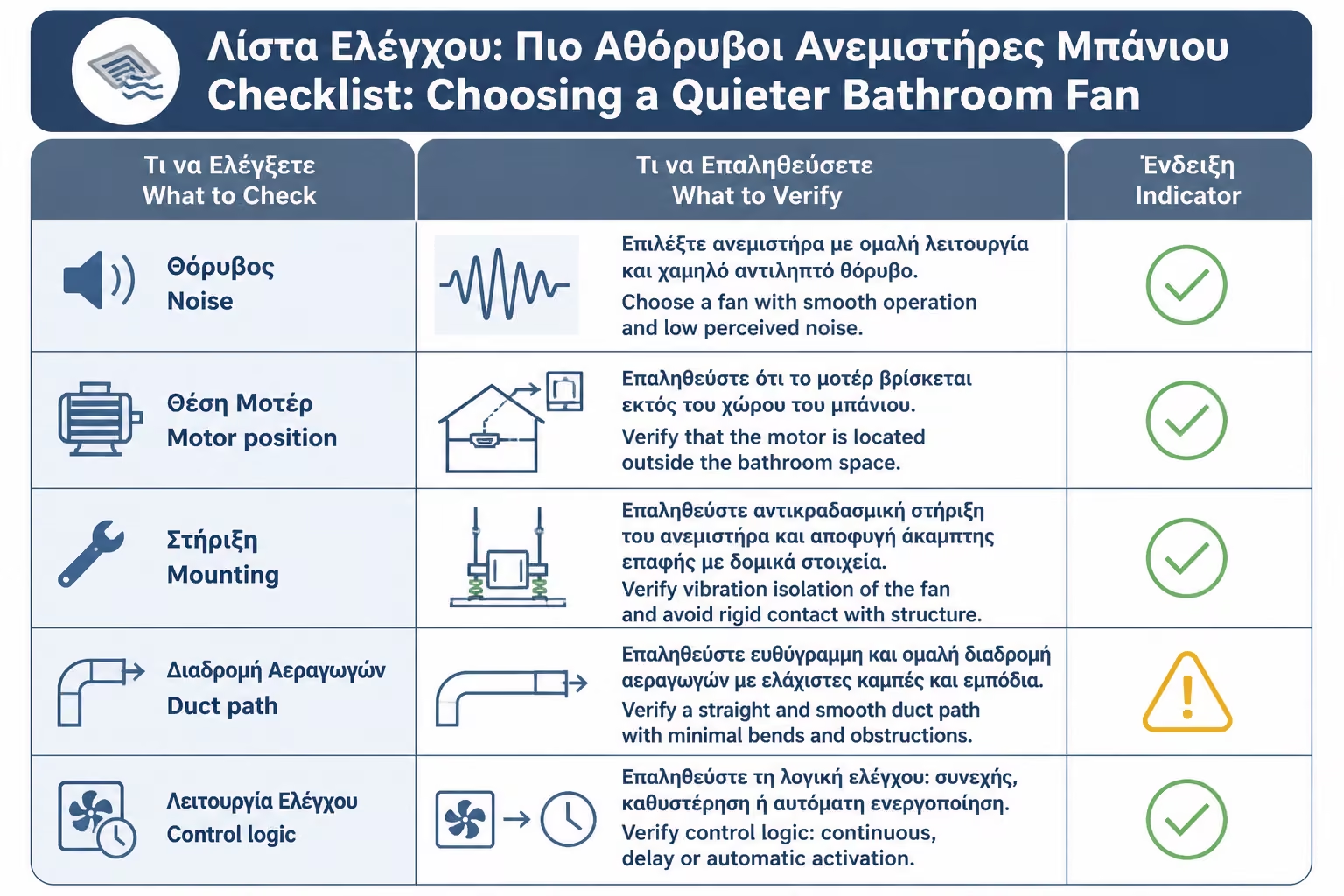
| Have you checked the noise level in dB(A)? | Yes / No |
| Is the flow m³/h sufficient for the volume of the bathroom? | Yes / No |
| Does the vent type match the duct length and angles? | Yes / No |
| Is the noise below 30–35 dB(A) for comfortable daily use? | Yes / No |
| Is the bathroom close to a bedroom and needs an even quieter solution? | Yes / No |
| Is there a timer so it continues after showering? | Yes / No |
| If there is a humidity sensor, is it set correctly? | Yes / No |
| Is there sufficient air intake through the door or other louver? | Yes / No |
| Does the grill and recoil create a whistling or knocking sound? | Yes / No |
| Is the conduit the correct diameter and not kinked? | Yes / No |
| If an in-line solution is chosen, is there access for maintenance? | Yes / No |
| Will the installation be done by a professional with an electrical safety check? | Yes / No |
| Does the offer state appliance, dB, m³/h, ducts, grilles, labour, VAT and incidentals? | Yes / No |
If you really want quiet ventilation, don't just buy the fan with the lowest dB. First see if it has enough flow for your bathroom and if its type fits the pipe. A quiet but weak fan does not solve the humidity. A strong but noisy one will not be used properly. The best solution is balance: low dB, correct m³/h, clean duct, good grill, anti-vibration support and a timer that can work without disturbing the house.
The noise of the bathroom fan is no small detail. It directly affects whether the ventilator will be used properly. If it bothers, the user will close it. If it closes early, the moisture will remain. And if the moisture stays, sooner or later blurs, smells, mold, damage to joints, silicones and furniture will appear.
The dBs in the specs are a useful guide, but should not be read on their own. For comfortable everyday use, it's a good idea to aim for low levels, ideally below 30–35 dB(A), especially in a master bathroom or near a bedroom. But the supply, fan type, ducting and installation are just as important.
The right solution is to treat ventilation as a system. If the ride is simple, a quality quiet axial may suffice. If the pipeline is long or difficult, consider centrifugal or in-line. If the noise is critical, move the motor away from the area where it is used and ensure proper support. So the fan will do what it should: it will work hard, make little noise and keep the bathroom dry and hygienic.
Return to category.
Go to categoryReturn to the central guide.
Go to guide