
Bathroom Lighting, Ventilation & Heating
Return to category.
Go to categoryBathroom ventilation has one basic problem: it often depends on the user's memory. Someone takes a hot shower, the bathroom fills with steam, the mirror fogs up, the walls "sweat" and the fan has to keep running for quite some time. In practice, however, the user exits, turns off the light, and the fan stops. Or doesn't open it at all, because it makes noise. Or quickly shuts him down, because he disturbs the night.
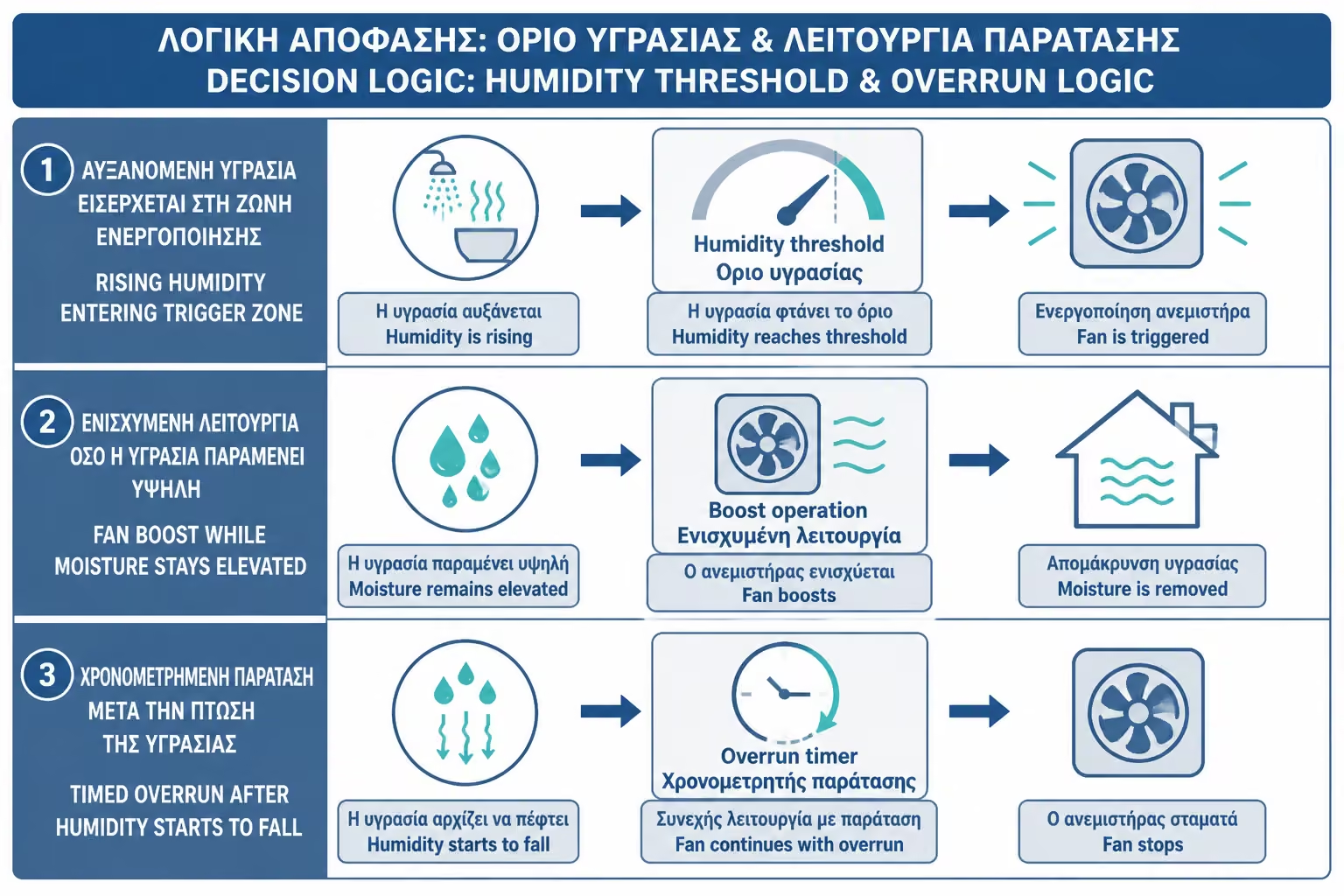
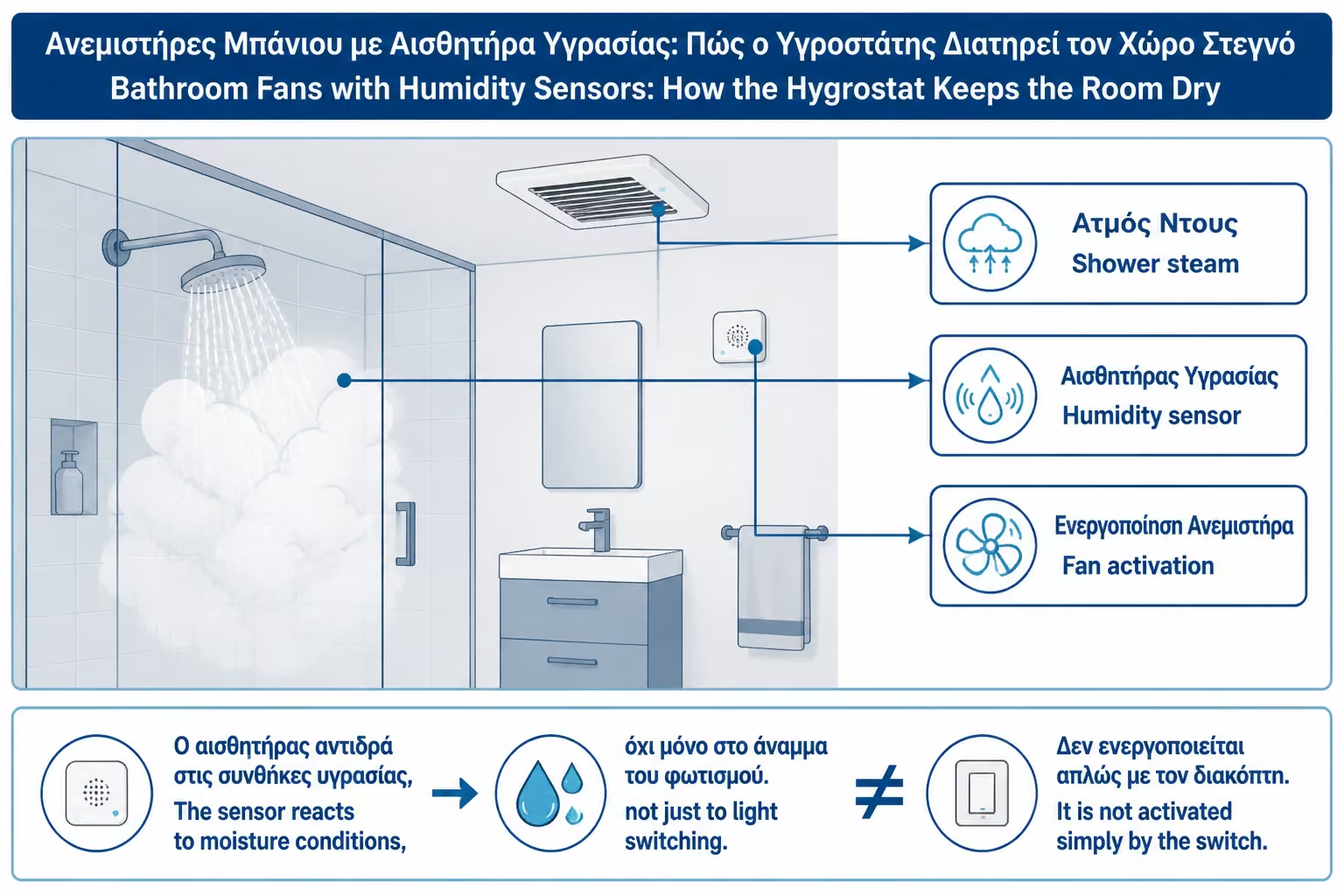
This is where the ventilators come in with a humidity sensor, i.e. with a hygrostat. It is one of the most practical automations for the bathroom, because they do not wait for the user to decide when the room should be ventilated. They sense the increase in humidity from the shower steam and turn on automatically or stay on until the humidity drops to more normal levels.
The idea is simple, but in practice it makes a big difference. A blind bathroom without a window, a small apartment bathroom, a bathroom used by several people, or an area where mold often appears in the corners can benefit greatly from a properly selected humidifier fan. It doesn't solve all problems by itself, but it reduces the risk of water vapor remaining in the room because someone forgot to ventilate.
But we have to make something clear from the beginning: the hygrostat is not a magic accessory. If the ventilator is small for the bathroom, if the duct is long and full of corners, if there is no air intake from the door, if the outlet is blocked or if the sensor is incorrectly set, the result will be mediocre. The "smart" ventilator must first be a proper ventilator.
In this guide we will see how the humidity sensor works, when it is really worth it, how it is adjusted, what relative humidity percentages mean, what mistakes are made most often, how much it costs in the Greek market in 2026 and what you should ask the electrician or technician before installation.
A hygrostat is a sensor that monitors the relative humidity of the air. When the humidity exceeds a predetermined threshold, it instructs the ventilator to operate. When the humidity drops back below a safer level, the fan stops or continues for a while longer, depending on the setting and model.
In practice, the sensor "sees" the sudden increase in humidity caused by the hot shower. No need to flip a switch. The fan turns on when the room needs it. This is especially useful in families, rental homes, Airbnbs, small windowless bathrooms and residences where users do not all have the same ventilation habit.
Relative humidity is measured in percentage. For example, when we say 60% relative humidity, we mean that the air contains 60% of the moisture it can hold at that temperature. After a hot shower, the rate can rise quickly. The hygrostat senses this increase and starts venting.
The owner does not need to know the exact physics of the phenomenon. He needs to understand the main thing: the hygrostat does not work with time, but with air condition. It doesn't light up because five minutes have passed. It lights up because the air is moist.
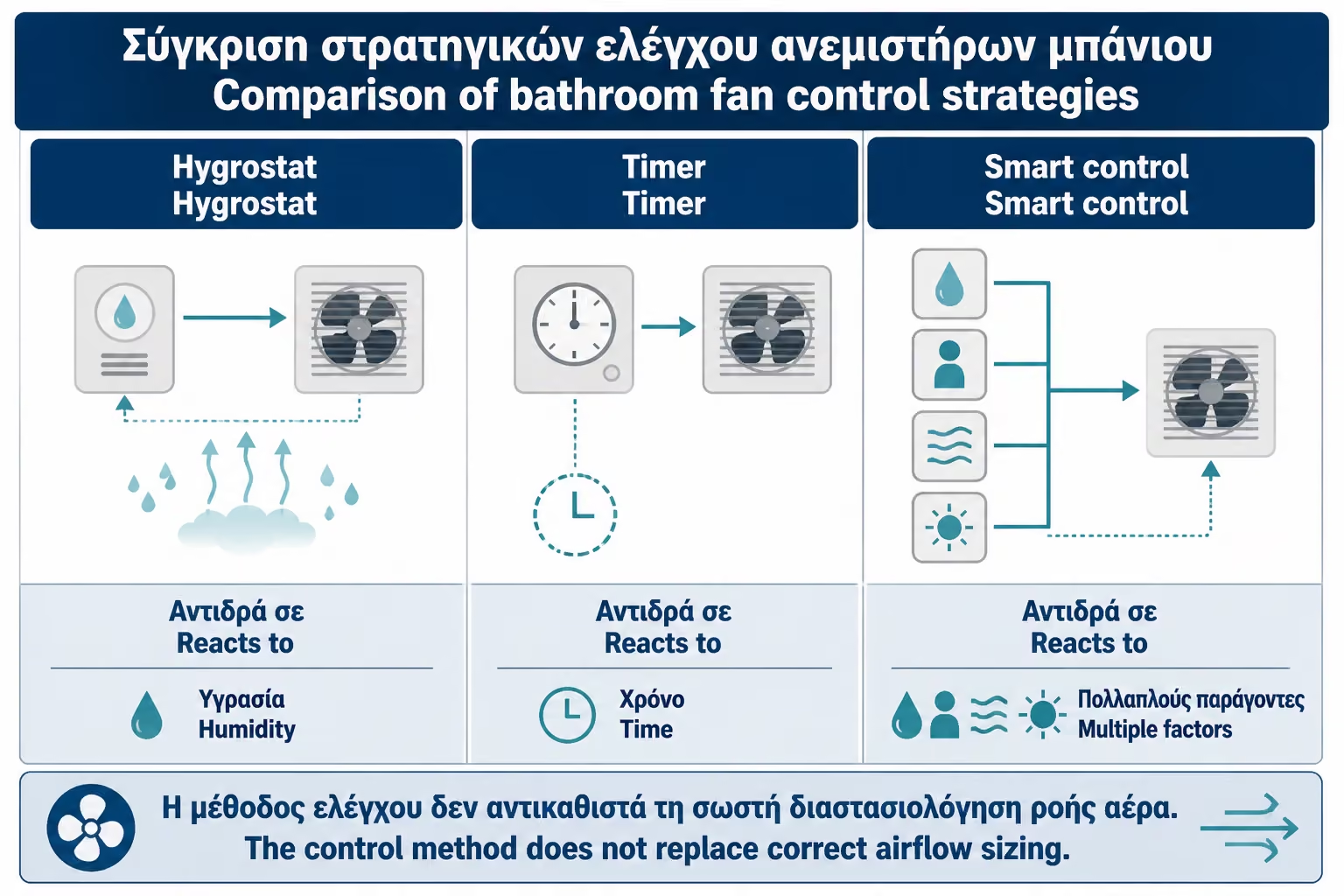
The simple switch depends on the human. If the user turns on the fan and lets it run long enough, all is well. If he closes it quickly, if he forgets it or if he doesn't open it at all, the humidity stays in the room.
The hygrostat removes this human error. If the bathroom fills with steam, the ventilator reacts. This is very important in bathrooms where users do not all have the same habits. In a family, someone may always turn on the fan, someone else never. The humidity sensor makes the operation more stable.
Compared to a simple timer, the hygrostat is more "intelligent". The timer works for a specific time, e.g. 10 or 15 minutes. This is helpful, but it doesn't know if the moisture is really gone. If someone took a short shower, maybe 15 minutes is enough or even a lot. If someone took a very hot shower in a blind bath, they might not be enough. The hygrostat adapts better to the actual situation.
The best solution in many bathrooms is the combination: humidity sensor together with timer or switch-off delay. So the fan is activated when needed and does not stop abruptly as soon as the humidity drops marginally.
The fan with a humidity sensor is worth more in bathrooms with a shower or bathtub, not so much in a simple WC. If the space does not produce a lot of water vapor, the humidification function may be unnecessary. In a guest WC, a simple ventilator with a switch or timer is usually sufficient.
Conversely, in a master bathroom, especially if it is blind, the hygrostat can be very useful. The same applies in small bathrooms without windows, in bathrooms with walk-in showers, in areas with poor natural ventilation or in homes where the mirror remains cloudy for a long time after the shower.
It's also worth it in homes where the ventilation needs to work without a constant reminder. In Airbnb, student houses, rental apartments or housing with many members, the dehumidifier protects the space from bad usage habits. It does not depend on whether each user knows or remembers what to do.
Not worth it though if the rest of the system is wrong. If the duct is clogged, if the fan is weak, if there is no air intake, or if the space has a real leakage problem, the humidistat will not save the day. It will light up, but it will not be able to remove moisture effectively.
The sensor does not see the vapor as the eye does. It does not recognize the water vapor cloud. It measures the humidity in the air. When we take a hot shower, the warm moist air rises and the relative humidity in the bathroom increases. The hygrostat registers this increase and activates the fan.
The simplest models operate with a fixed limit. For example, if the humidity exceeds 70%, they light up. When it drops below the threshold, they turn off after some time. More sophisticated models can also sense the sudden increase in humidity, i.e. the difference between before and after a shower, so they can work smarter in areas with already high ambient humidity.
This is important in Greece, because the humidity is not the same everywhere. A bathroom in an area with a dry climate has a different behavior and another in a seaside house, on the ground floor, in an old apartment building or in an area with high seasonal humidity. If the hygrostat is set too sensitively, it may come on frequently without a shower. If it is set too high, it may lag.
This is why regulation is critical. The sensor should react to the shower steam, not every little change in the weather.
Most models with a hygrostat allow a threshold setting, often in ranges such as 60%–90% relative humidity. There is no ideal price for every home. It depends on the climate, whether the bathroom is blind, the size of the room and the behavior of the users.
In many cases, a practical initial setting is around 60%–70%. If the fan turns on too often for no reason, the limit can be raised a bit. If it doesn't activate after showering or activates slowly, the threshold may be lowered. Correct setting is done by testing in actual use.
| Humidity setting | Practical behavior | When does it make sense? |
|---|---|---|
| 50%–60% | Very sensitive operation | Only if the bathroom has a severe problem and the environment is relatively dry |
| 60%–70% | Balanced initial setup | Good base for most bathrooms with showers |
| 70%–80% | More delayed activation | In areas with high general humidity |
| 80%+ | It burns mainly in strong steam | It can be slow for blind bathrooms |
The mistake is to leave the factory setting without testing. It may or may not fit. After installation, it is good to take a few showers and observe the behavior: when it lights up, how long it stays on, if the area dries out and if it bothers you.
The hygrostat is not "set and forget" from day one. Needs initial setup and minor fixes.
A common complaint is that the humidifier fan turns on by itself, even when no one has showered. That doesn't necessarily mean it's broken. It may simply be that the humidity in the room has risen due to weather, cooking, washing, moisture from other rooms or general atmospheric humidity.
If the bathroom is on the ground floor, in an old building, in a seaside area or in a house with a general moisture problem, the sensor may see high rates even without a shower. If it is set low, it will fire frequently.
In this case, the solution is not to disconnect the hygrostat. First the threshold needs to be raised a bit, check if there is proper ventilation, if the fan is actually pulling air and if there is a general moisture problem in the house. If the room has permanently high humidity, the ventilator simply detects it.
There are also more sophisticated sensors that react to a sudden increase in humidity instead of just a fixed limit. These can be more practical in areas where outdoor humidity is often high.
The opposite problem is that the fan is slow to turn on. The user takes a shower, the mirror fogs up, but the fan turns on later or not at all. This can happen if the humidity threshold is too high, if the sensor is in a position where it does not "see" moist air quickly, or if the bathroom has a flow that carries the steam away from the sensor.
The location of the sensor matters. If it is inside the device, and the device is too far from the shower or close to the door where drier air comes in, it may be slow to sense moisture. If the fan is in a suspended ceiling and the grill is in the right place, the behavior may be better.
Another point is the temperature. Relative humidity depends on air temperature. In some conditions, the room may appear full of steam but the sensor has not yet reached the limit. That is why adjustable models are preferable to models without options.
If the hygrostat is slow, it does not mean that the idea is wrong. It means it needs an adjustment, a better position or a better model.
The hygrostat decides when moisture is present. The timer decides how long the fan will continue to run. A combination of the two is often the best solution for a master bathroom.
After the shower, the moisture does not leave immediately. Even if the air starts to clear, the surfaces remain wet: tiles, floor, joints, towels, cabin, mirror. If the fan is stopped too early, moisture can rise again or remain on surfaces.
The timer keeps the fan running for a few more minutes. Typically, 10–15 minutes is a practical initial setting for several bathrooms, but in blind or very wet bathrooms it may take longer. If the fan is quiet, the longer operating time is not so annoying. If it's noisy, the user will want to close it.
The best automation is the one that doesn't bother you. If the hygrostat and the timer work correctly, the bathroom dries without the user thinking about switches.
In more modern systems, the fan is not just on/off. It can work continuously at a very low flow rate and rev up when the humidity increases. This logic is often called trickle ventilation with boost.
Continuous low mode keeps the space in a more stable state. Instead of the bathroom being completely closed and then the fan trying to suddenly remove a lot of moisture, there is a small constant air renewal. When there is a shower, the sensor gives a command to boost and the ventilator increases the flow.
This solution can be very good in blind bathrooms, in houses with chronic humidity or in very well insulated houses where the spaces are more "closed". But it wants low noise, low consumption, correct adjustment and acceptance that the fan will work more hours.
It is not necessary for every bathroom. In a simple WC or in a bathroom with a good window it can be an exaggeration. In a blind master bathroom though, especially if there are recurring signs of damp, it's worth considering.
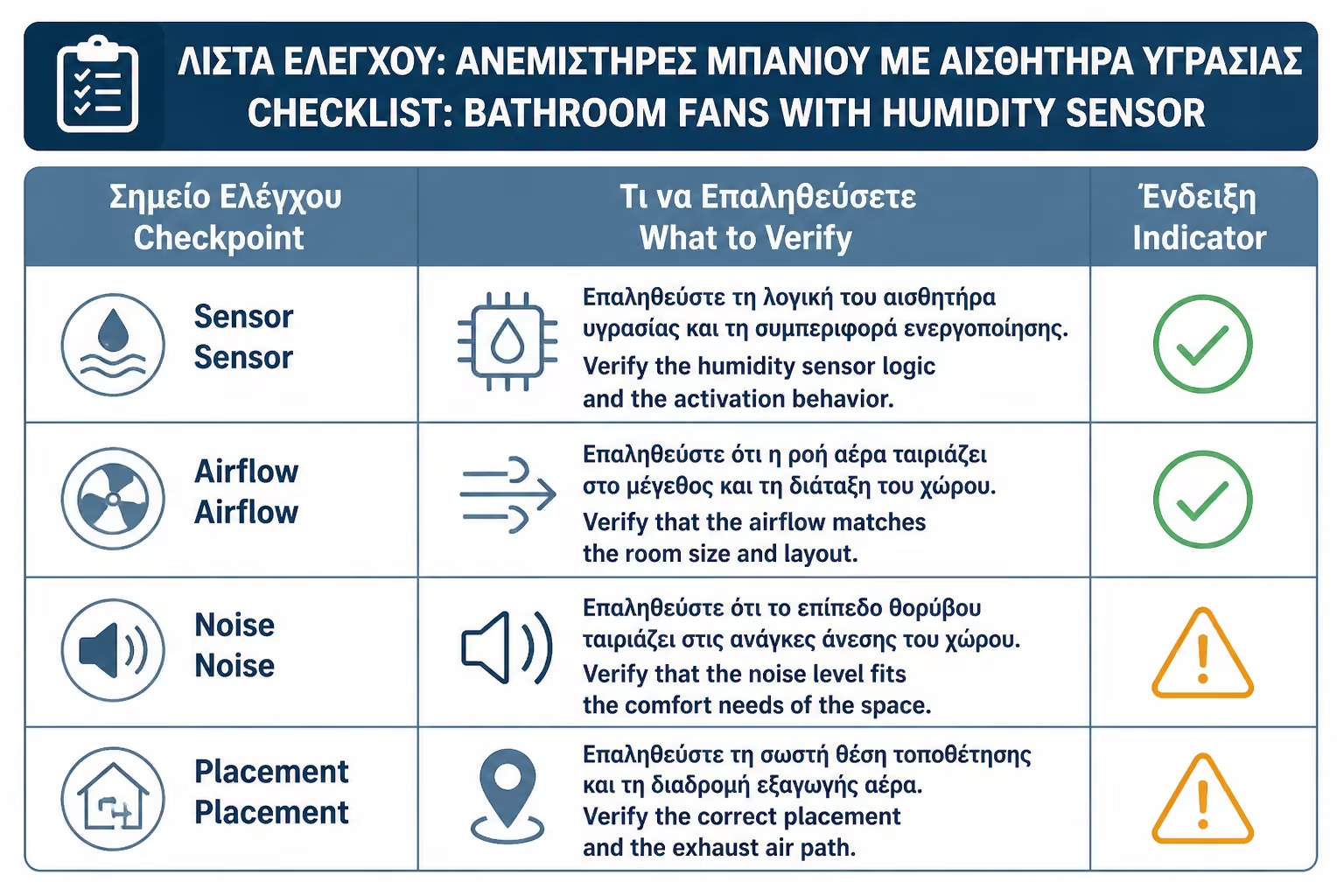
One of the biggest mistakes is to think that because the fan has a humidity sensor, we don't need to calculate the flow rate. This is wrong. The sensor decides when the fan will work. It doesn't magically increase his ability.
If the bathroom needs 120–150 m³/h and the fan is rated at 70 m³/h, the humidistat will just keep it open longer. It may help, but it won't be as effective as a properly sized vent. If the conductor has a high resistance, the actual output may be even lower.
Before buying a model with a hygrostat, the volume of the bathroom must be calculated and the duct examined. How many square meters is the space? What height? Is it blind? How long is the airway? Are there corners? Is axial, centrifugal or in-line the right type?
Automation is only useful when the mechanical basis is correct. First correct flow and path, then hygrostat.
The humidifier can turn on the fan at the perfect time, but if the air can't escape, the bathroom won't dry properly. The pipeline is often the weak point. Long pipe, many angles, small diameter, kinked spiral or clogged grill can greatly reduce the actual performance.
In such cases, the humidity sensor can make the fan run for a long time because the humidity is slow to drop. The owner may think that the sensor "doesn't go off", when in fact the bathroom is not ventilated enough.
If the humidistat vent stays on continuously after showering, four things need to be checked: the humidistat setting, the fan supply, the duct path, and the air intake through the door. If one of them is wrong, the automation will not work as it should.
In difficult installations, a centrifugal or in-line ventilator with a hygrostat may be a better solution than a simple axial with a sensor.
The hygrostat does not negate the need for air intake. For moist air to leave the bathroom, other air must be put in its place. Usually this is done from the gap under the door. If the bathroom is too sealed, the ventilator struggles.
A frequent scenario after a renovation is to put in a new door that closes better, with a smaller gap in the floor. The owner also installs a smart fan with a hygrostat, but the performance is not as expected. The fan turns on, sounds, but does not pull enough. The problem may be that it has nowhere to get air.
The solution may be a small gap under the door, a discreet transport louver or other air intake provision. This must be done with balance, because the bathroom door needs both privacy, sound reduction, and proper aesthetics.
Ventilation is always a circuit: air in, movement through the space, out. The hygrostat simply automates the output.
A fan with a hygrostat can run longer and more often than a simple fan. This is good for humidity, but it means noise matters even more. If the device is annoying, users will look for a way to turn it off or be annoyed every time it turns on by itself.
For a master bathroom, especially near a bedroom, it is worth choosing a low-noise model. A level below 30–35 dB(A) is usually more comfortable for everyday use, while even lower values are preferable when the bathroom is next to a sleeping area.
The noise doesn't just come from the device. It can come from a duct, grill, backfire, or vibration. If the hygrostat makes the fan run frequently, these little problems become more annoying.
Proper "smart" ventilation must be discreet. If the user listens to it constantly, it loses the sense of comfort it is supposed to provide.
On the market you will find simple ventilators with a hygrostat and more "smart" models with additional functions. A simple hygrometer with a timer is often sufficient for most bathrooms. Smart models may offer more settings, connection to an app, notifications or programs.
The question is whether you really need the extra features. For a typical blind bathroom, a reliable ventilator with proper flow, low noise, adjustable hygrostat and timer is much more important than a mobile app. Technology should solve a problem, not add complexity.
Smart models make sense when integrated into a total home system or when the owner wants monitoring and scenarios. For example, in a home with automation, the fan can work with humidity sensors, lighting and usage schedules. In a simple renovation, this may be overkill.
The main priority remains the same: to draw enough air, quietly, from the right position, for as long as needed.
In most bathroom ventilators, the humidity sensor is built into the device. This means that the position of the fan also affects how it "reads" the humidity. If the fan is too close to the door, it can be affected by the drier air coming in from the house. If it is near the shower, it perceives the increase in humidity more quickly.
In in-line systems, the suction grille may be located near the shower, but the sensor may be located on the motor or elsewhere, depending on the model. This needs to be checked. If the sensor is located away from moist air, it may lag.
There are also systems with a remote humidity sensor, but they are more complex. In simple dwellings, correct ventilator position and correct setting are usually sufficient. If the bathroom has a complicated floor plan or a long distance from the shower, you may need a more thought-out solution.
The sensor must "see" the moisture we want to remove. If it is placed in the wrong airflow, it will make the wrong decisions.
The hygrostat ventilator needs a proper electrical connection. Many models require a permanent power supply so that the sensor works even when the light is off. If they are wrongly connected to only the light switch, the auto function or timer may be lost.
This is a common mistake. The owner is purchasing a model with a humidistat, but the old setup only had one line that powered the old fan along with the light. If a permanent power supply or proper wiring is not provided, the new ventilator may not function as it should.
Installation must be done by a licensed electrician. The bathroom is a wet area and the location of the ventilator should be checked for zones, IP protection, leakage relay and general safety. The hygrostat is automation, but it remains an electrical device in a bathroom.
Before purchasing, ask an electrician to confirm what cables are included and what the specific model requires. This way you avoid buying a device that cannot be put to good use without additional consideration.
The hygrostat ventilator needs maintenance like any ventilator. The front, impeller, return and grille must be cleaned. If dust collects, the flow is reduced and the noise may increase.
The humidity sensor can also be affected by dust, salts, cleaning fumes or dirt, depending on the model and location. If the device starts to turn on strangely, won't turn off or lags excessively, it doesn't always mean that it's broken. May need cleaning, adjustment check or duct check.
In in-line systems, access to the motor and sensor is critical. If they are installed in a false ceiling without a hatch, maintenance becomes difficult. This is a big mistake in "hidden" installations.
Automation does not eliminate maintenance. On the other hand, because the fan runs frequently, it needs to be clean to perform properly.
The cost depends on the type of ventilator, the supply, the noise, the quality of the sensor, whether it has a timer, return, continuous operation, smart features and on the installation. It is also affected by area, floor, access, existing wiring, ducting, whether VAT is included and whether the offer is for appliance only or full installation.
| Category | Indicative range 2026 | What to watch out for |
|---|---|---|
| Simple axial with hygrostat | 70–150€ | Suitable for simple short exports |
| Silent axial with hygrostat and timer | 100–220€ | Good choice for a master bathroom |
| Centrifugal with hygrostat | 140–300€+ | For more difficult pipelines |
| In-line with humidity sensor / controller | 150–400€+ | He wants a false ceiling or technical space |
| Continuous operation with humidity boost | 180–450€+ | Useful in blind bathrooms with permanent humidity |
| Smart ventilator / automation | 180–500€+ | It's only worth it if the features are used |
| Additional electrical wiring | Wide variation | Permanent power supply, timer, switches |
| Ducts, grilles, return | 30–200€+ | They affect performance and noise |
The low price is reasonable in a simple installation with a short outlet. But if the bathroom is blind, has a long duct or is next to a bedroom, it is worth paying more attention to low noise, correct pressure and better sensor quality.
The higher price is justified when the device has real performance, low noise, adjustable hygrostat, timer, reliable motor and proper installation. It is not justified just because it says "smart" on the package.
Faults in hygrostat ventilators are usually not visible on the first day. They are visible in use: it turns on for no reason, does not turn on when it should, works continuously, makes noise or does not dry the bathroom.
| Error | What it causes in practice | A more correct approach |
|---|---|---|
| Only bought because it “has a hygrostat” | Insufficient supply or wrong type | First m³/h and pipeline, then automation |
| Incorrect humidity setting | Lights up continuously or slows down | Limit test and adjustment |
| No timer | It may stop early | Combination of hygrostat and overrun |
| Noisy model | The user disables it | Low dB for everyday use |
| Bad sensor position | It does not "see" the steam properly | Location near moisture flow |
| Long duct with single axial | He works a lot to no avail | Centrifugal or in-line |
| Door without air intake | The fan is not pulling properly | Door gap or blind |
| Incorrect electrical connection | Automatic mode is lost | Check wiring before purchase |
| Maintenance-free sensor | Erratic behavior | Cleaning and checking |
| Treat leakage as air humidity | The problem continues | Check for actual leakage or condensation |
A typical example is a blind bathroom where an economical axial fan with a hygrostat is installed in an old long duct. The sensor turns on correctly after the shower, but the fan runs for a long time and the bathroom remains wet. The owner blames the hygrostat, when the real problem is that the fan can't overcome the duct resistance.
| Inquiry | Yes / No |
|---|---|
| Does the bathroom have a shower or bathtub and does it produce a lot of steam? | Yes / No |
| Has the required flow rate been calculated in m³/h? | Yes / No |
| Does the vent type fit the duct? | Yes / No |
| Is the hygrostat adjustable? | Yes / No |
| Is there a timer or shutdown delay? | Yes / No |
| Is the noise acceptable for everyday use? | Yes / No |
| Is there adequate air intake under the door or through a louver? | Yes / No |
| Is the sensor in a location that quickly senses moisture? | Yes / No |
| Have the duct and outer grill been checked for resistance or clogging? | Yes / No |
| Is there a return for odors and air return? | Yes / No |
| Does the device have appropriate IP protection for its location? | Yes / No |
| Does the electrical connection properly support hygrostat and timer? | Yes / No |
| Is there access for cleaning and maintenance? | Yes / No |
| Does the quote include appliance, hygrostat, timer, pipes, labour, VAT and incidentals? | Yes / No |
If you want a fan with a humidity sensor, don't treat it like a gadget. The humidistat is only useful when the vent has the correct flow rate, correct type for the duct and enough air intake through the door. Choose a model with adjustable humidity limit, timer and low noise. After installation, do 2–3 tests with a real shower and set the threshold so that it turns on when there is steam, but does not idle all day. The goal is not to work all the time. It works exactly when the bathroom needs it.
A fan with a humidity sensor is one of the most essential automations that can go into a modern bathroom. It's not just a "smart" feature. It is practical protection against the most common cause of bathroom wear and tear: the moisture left after a shower.
In blind bathrooms, small bathrooms, family homes and areas with frequent use, the humidistat helps not to rely on the user's memory for ventilation. The fan senses the increase in humidity, activates when needed and continues until the air returns to better levels. This reduces haze, odors, condensation and the risk of mold.
The right choice, however, requires overall planning. m³/h must be calculated, the duct must be checked, air intake must be present, low noise must be selected, the sensor must be set correctly and the electrical installation must be done correctly. If these are ignored, the most "intelligent" fan can work for a long time without solving the problem.
The best solution is a fan that you don't think about. It turns on when it should, turns off when it should, does not disturb, does not make excessive noise and keeps the bathroom dry without daily intervention. This is the real role of the hygrostat: not to impress, but to quietly protect the space after every shower.
Return to category.
Go to categoryReturn to the central guide.
Go to guide