
Bathroom Lighting, Ventilation & Heating
Return to category.
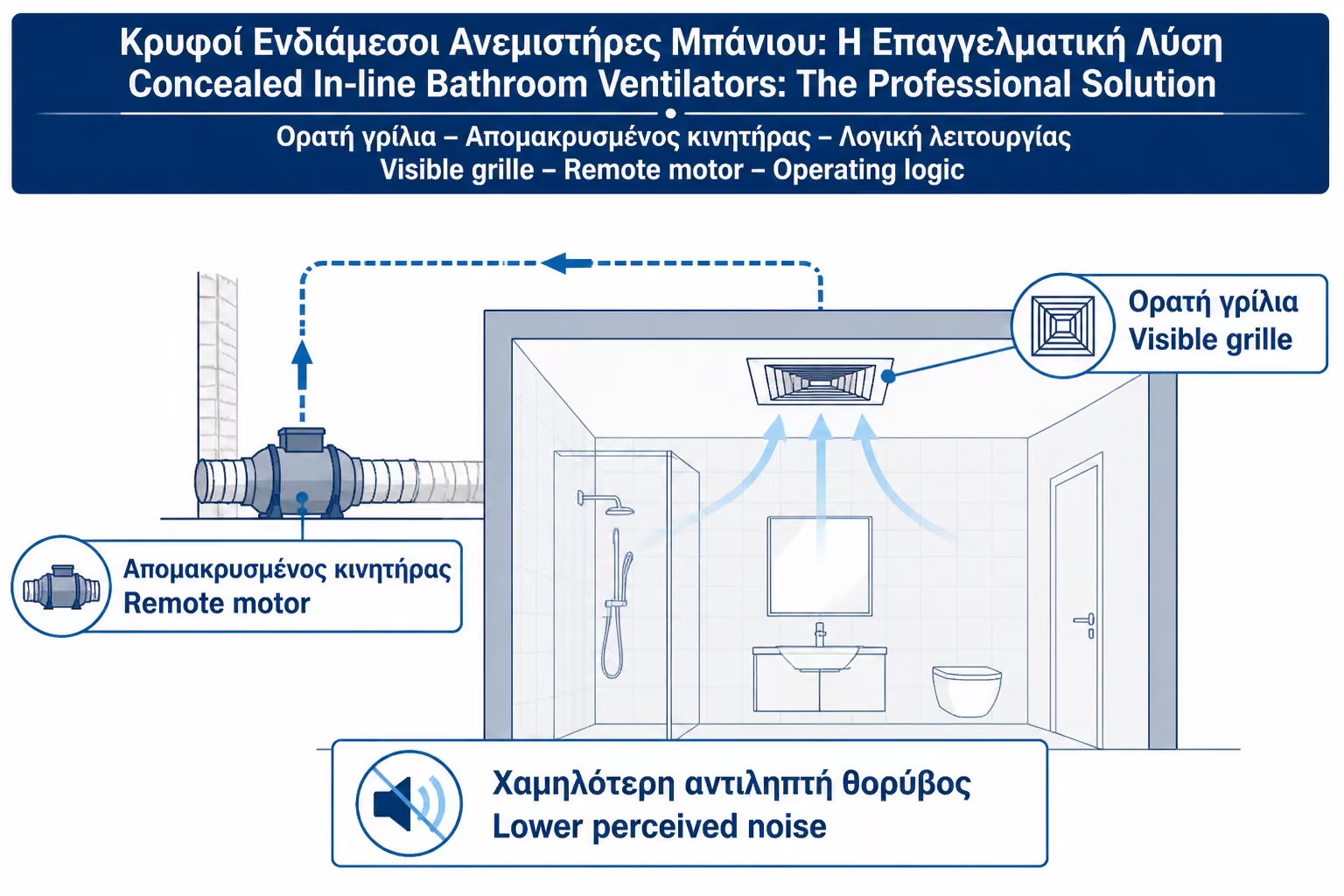
Go to categoryThe hidden in-line vent is the solution that is usually not seen in finished bathroom photos, but can make a huge difference in everyday use. Instead of seeing a plastic motor on the wall or ceiling, you only see a discreet suction grill. The actual motor is further away, in the air duct, false ceiling, loft, attic or some technical point.
This is also the reason why in-line ventilators are considered a more professional solution. They allow better placement of suction, greater flexibility in pipe routing and, when designed correctly, lower perceived noise in the bathroom. The motor does not need to be directly above the user's head or next to the mirror. It can be removed so that in the bathroom you can hear mainly the air flow and not the motor itself.
But we must correct from the beginning a frequent exaggeration: no ventilation system is truly "100% silent". Air moving through pipes, grilles and returns always produces some sound. What a properly designed in-line fan can achieve is much lower nuisance in the bathroom, because the motor is away from the area of use and the flow is designed more correctly. But if the vent is narrow, kinked, or full of corners, even the best in-line can sound and perform mediocre.
In Greek bathrooms, especially in blind bathrooms without windows, in bathrooms with suspended ceilings or in renovations where we want a clean design without obvious devices, the in-line solution can be excellent. The grill can be placed near the shower, where the steam is produced, while the motor can be hidden in an accessible place. This way the water vapors are removed more immediately and the bathroom dries more properly.
But the solution needs planning. It is not enough to buy a powerful in-line fan and "throw" it into the false ceiling. It needs a correct m³/h calculation, correct pipe diameter, as short and smooth a path as possible, few corners, access for maintenance, correct grill, return, timer or hygrostat where necessary, and electrical connection by a licensed electrician. In-line ventilation is a professional solution precisely because it treats ventilation as a system, not as a simple fan.
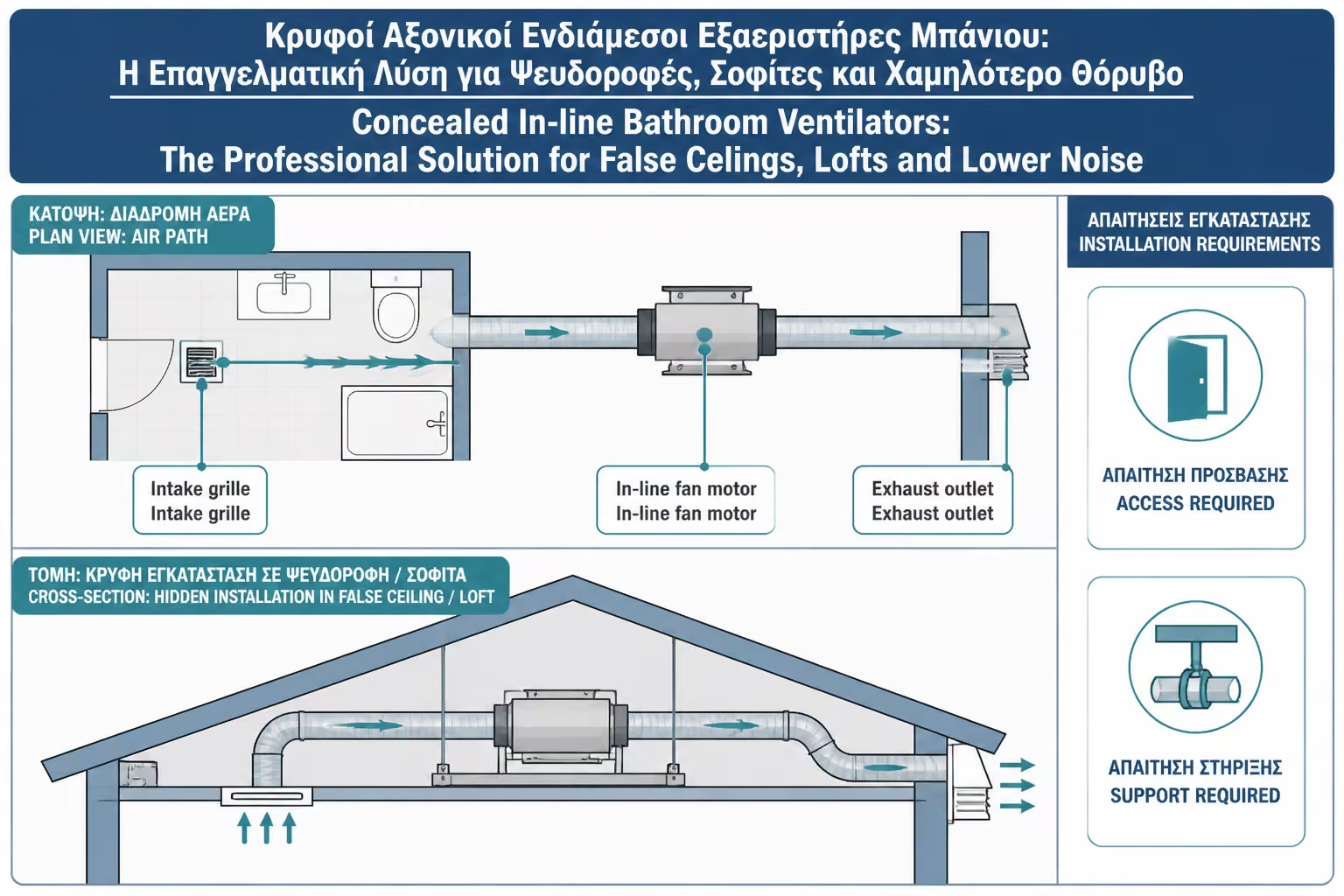
The in-line fan is a fan that is placed inside the air duct line. It is not necessarily located in the final grid of the bathroom. It may be further away, between the intake grille and the external outlet. In simple words, the bathroom "pulls" air from a grille, the air passes through a tube, passes through the in-line motor and is led out.
This differs from the classic wall-mounted axial fan, where the motor is located on the wall or ceiling of the bathroom. In in-line, the motor moves away from the space. This allows for a cleaner aesthetic and often lower noise in the bathroom.
There are several types of in-line fans. Some are simple in-line axials for short runs. Others are mixed-flow, that is, they combine elements of axial and centrifugal operation and perform better in ducts with moderate resistance. Others are more powerful centrifugal or special fans for longer runs. The right choice depends on the path, diameter, supply and resistance of the network.
In practice, for residential bathrooms, the most common in-line solutions are small or medium fans Φ100, Φ125 or Φ150, usually installed in a false ceiling, loft or technical space. The more demanding the bath and the longer the stroke, the more seriously the diameter and type should be considered.
In-line ventilation is considered more professional because it solves three problems at the same time: aesthetics, suction position and noise. Instead of being forced to put the fan where there is an old hole in the wall, you can put a discreet grille where it makes sense to draw air and place the motor in a more suitable place.
This is especially important in bathrooms with a walk-in shower or a large bathing area. Moisture is mainly produced in the shower. If the suction is close to it, the water vapor is removed before it spreads throughout the bathroom. With a classic wall fan, the location is often limited by where there is a wall to a light fixture. With in-line, the grille can be positioned more correctly.
The second difference is noise. When the motor is in the bathroom, the user can directly hear its operation. When the motor is moved to a loft or false ceiling, the noise is noticeably reduced in the room, as long as the installation is done correctly. It doesn't disappear completely, but it becomes more subtle.
The third difference is aesthetics. In a neat bathroom with recessed lighting, large tiles, minimal mirror and clean lines, an obvious plastic motor cover can spoil the image. With an in-line solution, only a small grille is visible, usually on the roof, which can be more subtly integrated into the design.
The phrase “100% silent” sounds nice, but technically it is not correct. Every ventilation system produces some sound. The motor has a mechanical noise. Air passing through pipes produces flow noise. Grilles can hiss if they are small. Kickbacks can hit. Conductors can carry vibrations.
What the in-line fan does is remove the main source of noise from the bathroom. If the motor is located in the loft or in a remote part of the false ceiling, the user does not hear it as directly. Inside the bathroom you hear mainly the flow from the grill, which can be very low if the network is correct.
But if the grille is too small, if the diameter is Φ100 while the flow rate is high, if the pipe makes many corners or if the fan is too strong for the cross-section, the noise can become annoying. You may not hear the motor, but you can hear the wind blowing.
So the right goal is not "zero noise". It is low and acceptable noise level in the bathroom. This requires proper design, not just a good product.
The in-line ventilator can be placed in a suspended ceiling, loft, attic, technical cabinet or other accessible point of the ventilation path. The key is to be outside the immediate wet zone, have a proper electrical installation, be well supported and have access for maintenance.
The false ceiling is the most common solution in bathroom renovation. A suction grill is placed in the bathroom, the pipe is passed through the false ceiling and the motor is placed in a place where it can be opened with a hatch. From there the air is directed to a light fixture or external outlet.
A loft is also a good solution when available. The motor is further away from the bathroom, has better access and can be maintained more easily. However, proper pipe routing and attention to condensation is needed, especially if the air duct passes through a colder area.
In single-family houses or top floors, it can be placed in an attic or technical space and exhaust the air towards a roof or external wall. There, the route needs special attention to thermal insulation, waterproofing and final finishing.
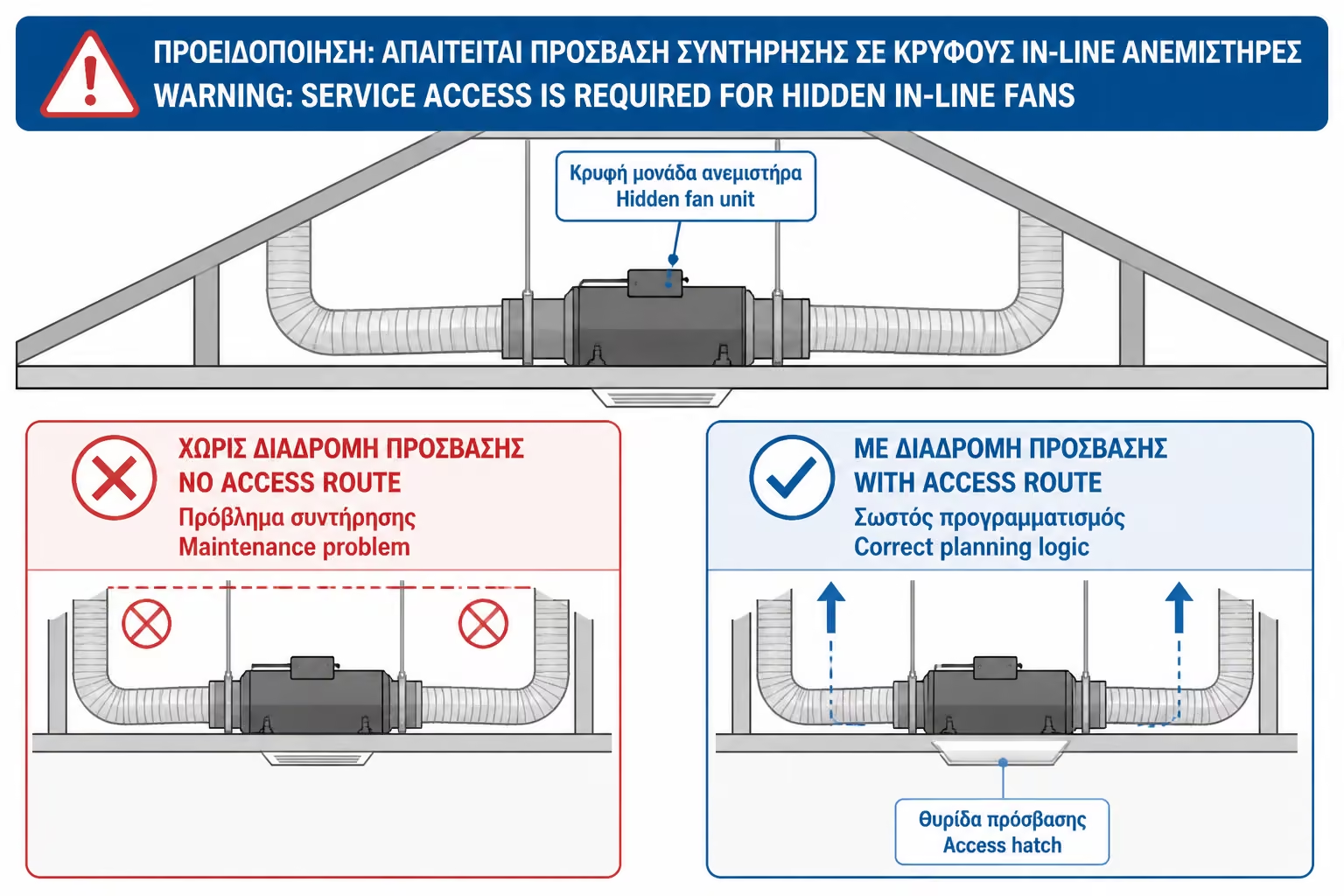
One of the biggest mistakes with in-line fans is that they are closed inside a suspended ceiling without access. On the first day everything seems perfect. The grille is discreet, the motor is not visible, the bathroom is clean. After a few years, when cleaning, checking, motor replacement or adjustment is needed, there is no way to get to the device without opening the drywall.
The in-line ventilator has a motor, impeller, electrical connection and many times a timer, controller or sensor. All of these may need maintenance. Dust, water vapour, lint from towels and dirt over time reduce performance. The return can get stuck. The pipe may need checking.
That is why an inspection box or access from a loft/closet/technical point must be provided. Access should not be theoretical. A technician must be able to actually open, view, clean and replace.
If someone suggests "lock it in and it won't break", it's a bad technical approach. Proper concealed ventilation is hidden from view, not inaccessible for maintenance.
In in-line ventilation, only the grille is usually visible inside the bathroom. This can be round, square, linear or a more subtle architectural grid. Its choice affects both aesthetics and performance.
The grille must have enough free cross-section to allow the air to pass without hissing. If it is too small or too "closed", the air passes at a higher speed and creates noise. The owner may have invested in a quiet in-line motor, but hear hiss from the grille.
The position of the grille is equally important. It should usually be placed high up, close to the source of moisture, i.e. the shower or bathtub, but with zone control and electrical safety. We don't want it to draw air right next to the door, because then a short-circuit is created: fresh air comes in through the door and leaves immediately without sweeping the bathroom.
In larger bathrooms, two suction grills can be provided, but this requires proper planning. If we just open two grids without calculating supply and resistance, it can draw more from one and less than the other.
The shower is usually the main source of steam. So a proper in-line installation often places the grill near the shower, ceiling, or false ceiling to draw the warm moist air that rises after the shower. This helps not to fill the whole bathroom with steam.
But the grill should not be placed randomly. If it goes inside the cabin or very close to a water zone, IP requirements and electrical zones must be considered. If we are only talking about a grille without a motor in place, things are often simpler than an electric fan in the shower, but the installation as a whole still needs to be checked.
In practice, a very good solution is for the grill to be located just outside or above the shower area, to the point where it draws water vapor without receiving direct splashes. If there is a walk-in shower, the location must take into account the glass, shower head, steam path and air intake through the door.
The correct location is not always the geometric center of the bathroom. It is the point that causes the air to pass through the wet zone to the exhaust.
In large bathrooms or in bathrooms with a separate shower zone and WC, a system with two suction grilles may make sense. For example, one near the shower for steam and one near the basin for smells. This gives more even ventilation, but only if the system is designed correctly.
The mistake is to think that two grilles automatically mean twice the performance. Air will follow the path of least resistance. If one grill is too close to the motor and the other is far away, the closer one may be drawing almost all the air. If not properly sized or adjusted, the second grille can be more decorative than functional.
In such systems, adjustable grids or proper branch design may be needed. The branches must be made with gentle angles, not with rough "T"s that create large losses. The motor must have enough flow and pressure for the entire network.
For most small bathrooms, one well-placed grille is better than two sketchy ones. The two grilles make sense in a larger or more complex bathroom, not as a mere impression of luxury.
In-line fans can have a larger flow than simple small wall fans. This is an advantage in blind bathrooms, longer ducts or large bathrooms. But oversupply is not always better.
If the fan is too powerful for the duct diameter, it can create flow noise. If the grill is small, it may whistle. If the door does not have enough air gap, the fan will work under pressure. If the bathroom is small, it can create a strong current and feel cold.
The correct flow is calculated based on the volume of the bathroom, the use, whether it is blind, the length of the pipe and the losses. For many bathrooms with showers, a practical logic is to start at 10–12 air changes per hour and adjust according to the installation. In a large or blind bathroom, a higher nominal flow may be needed because the duct has losses.
“Massive power” sounds impressive, but good ventilation is not a power struggle. It is the right combination of flow, pressure, diameter, noise and running time.
The big difference between good in-line or mixed-flow ventilators is that they can perform better in a pipe network. A simple axial fan may read 100 m³/h, but if it goes into a long duct with angles, the actual flow drops. A properly selected in-line can maintain better performance in such conditions.
This has to do with static pressure, i.e. the fan's ability to overcome network resistance. The owner does not need to read performance curves, but must understand the principle: the harder the ride, the more important the pressure capacity.
In a bathroom with a suspended ceiling, a grid above the shower, 3–5 meters of pipe and a final outlet to a light fixture, in-line is often more suitable than a simple wall-mounted axial. Not necessarily because it has “more m³/h” in the box, but because it can hold them better in the actual installation.
But if the exit is directly behind the wall, with a path of 20 cm, a simple axial may be enough. In-line is a professional solution when the installation needs it, not a mandatory option for every WC.
The in-line vent cannot fix a bad vent. If the tube is kinked, too narrow, full of corners or ends in a small grill, performance will drop and noise will increase. The motor may be better, but the air still struggles to get through.
Ideally, the main run should be a smooth hard pipe such as PVC or other suitable air duct, not a long bundled flexible aluminum pipe. Flex can be used in small connecting sections, but if you go all the way with flex that makes bellies and bends, much of the benefit is lost.
Diameter also matters. Φ100 may be sufficient for small bathrooms and small facilities. In more powerful in-line solutions, Φ125 or Φ150 may give better flow and lower noise, as long as there is room and proper final output.
The in-line ventilator is only as good as the network that accompanies it. If you pay for a good motor and connect it to a bad pipe, you didn't buy a professional solution. You bought an expensive motor in a cheap installation.
The noise of an in-line system has three main sources. The first is the motor. The second is the flow of air through grilles and pipes. The third is the vibrations transferred to the false ceiling, walls or ducts.
Removing the motor greatly reduces the first factor in the bathroom. But it does not mean that the second and third disappear. If the grille is small, the air may whistle. If the tube is narrow, a murmur is heard. If the motor rests on the plasterboard, the suspended ceiling can act as a speaker.
Correct installation requires good support of the motor, avoiding direct contact with sensitive surfaces, correct pipe diameter and a grill with enough free cross-section. In demanding cases, a soundproof air duct or anti-vibration connection can be used, but it is not always necessary.
The important thing is not to sell the in-line as "absolutely silent". It is quieter when properly designed. If it is sketchily designed, it can be disappointing.
An in-line fan can be combined with a timer, humidity sensor, separate switch or smart controller. The choice depends on the bathroom and the way of use.
The timer is a basic function for bathrooms with showers. The fan continues after the light goes out to remove water vapor. The hygrostat is even more useful in blind bathrooms, because it activates or keeps the fan open when the humidity is high. In more complex systems, there may be continuous low operation and boost when humidity increases.
In in-line solutions, the sensor can be located in the motor, in the duct or in a separate location, depending on the system. This matters. If the sensor does not "see" the moist air quickly, it may be delayed. In some cases, a remote humidity sensor in the bathroom or near the grill may be a more appropriate solution.
The electrical connection must be planned in advance. Timers and hygrostats often need a permanent power supply and a proper connection to a switch or controller. It is not a simple replacement of two cables.
Although the in-line motor can be located outside the bathroom or in the false ceiling, the installation still involves electrical equipment in a humid area. Grille position, motor position, wiring, switch, timer and sensors should be checked by a licensed electrician.
If the grill is located near a shower or bathtub, the zone must be evaluated. If the sensor or other electrical component is inside the bathroom, it must have adequate protection for its location. If the motor is located in a false ceiling, the electrical connection must be accessible and secure.
In old bathrooms, before a new system is installed, it is worth checking for leakage relays, proper earthing where required, proper line and proper isolation for maintenance. The in-line fan is a more serious installation than a simple wall fan, so it should not be connected casually.
The owner can choose the level of comfort and automation. Electrical safety must be confirmed by a professional.
The in-line fan is especially useful in blind bathrooms without windows, in bathrooms with false ceilings, in walk-in showers, in bathrooms next to bedrooms and in cases where the old wall fan does not work due to a long duct or poor location.
Also worth it when you want clean design. If the bathroom has a neat aesthetic, hidden lighting, minimal mirror and clean lines, the subtle grill is more elegant than an obvious motor on the wall. In more premium renovations, this plays an important role.
It is also a good solution when noise is critical. If the bathroom is next to a bedroom, or if the fan needs to work long enough after a shower with a timer, moving the motor out of the area of use can make everyday life much more comfortable.
It is not always worth it in a small WC with a direct outlet. There a good silent axial can be a simpler and more economical solution. In-line is a professional choice when the bathroom, duct or comfort requirements justify it.
There is no need for an in-line ventilator in every bathroom. If you have a small WC, direct exhaust to an external wall and little use, a simple quality axial with low noise may be enough. In-line will increase costs without providing substantial benefit.
Also avoid it if there is no way to access it for maintenance. An in-line enclosed in a suspended ceiling without a hatch is a bad installation. Better a simple visible solution that is easy to maintain than a "hidden" system that cannot be controlled.
Avoid it if it cannot be properly vented. If the available space causes the pipe to kink, get too short or make too many corners, the route must be solved first. In-line is not magic. If the air does not have a proper path, the motor will work under pressure.
Finally, don't overpay if the bathroom doesn't need it. A very loud in-line on a small network can make more streaming noise and feel exaggerated. The solution must be right, not just big.
Cost depends on diameter, flow rate, noise, motor type, whether there is a timer or hygrostat, pipe routing, false ceiling, grille, return, electrical connection and access for maintenance. It is also affected by area, floor, access, existing installation, whether VAT is included and whether the work is on a new renovation or a finished bathroom.
| Work / material | Indicative range 2026 | What affects the price? |
|---|---|---|
| Basic in-line Φ100 | 80–180€ | Supply, quality, noise |
| Mixed-flow in-line Φ125/Φ150 | 120–350€+ | Diameter, pressure, m³/h, brand |
| In-line low noise | 150–400€+ | Motor quality, support, construction |
| Timer / hygrostat / controller | 40–180€+ | Integrated or separate automation |
| Intake and exhaust grille | 20–120€+ | Design, cross-section, material |
| Pipes and fittings | 40–250€+ | Length, diameter, PVC or flex |
| Access door / false ceiling | Wide variation | Materials, location, finishes |
| Electrical installation | Wide variation | Wiring, switches, utilities |
| Full in-line installation | 250–900€+ | Complexity, access, network |
The low price may only be for the motor. It does not mean a complete solution. To work properly, it needs pipes, grills, supports, return, electrical connection and access. If these are not included in the offer, they will appear as extras.
The higher price is justified when there is a correct network design, quality motor, low noise, correct diameter, timer/humidist, maintenance box and clean final performance. It is not justified simply because the device is hidden in the false ceiling.
Faults in in-line ventilators are often hidden, because the system is not visible after completion. However, they appear in use: noise, weak suction, residual moisture, difficulty in maintenance or return of odors.
| Error | What it causes in practice | A more correct approach |
|---|---|---|
| Motor without access | Difficult to repair or replace | Locker or accessible technical point |
| Very small grille | Whistling and resistance | Grille with sufficient free cross-section |
| Long hose | Supply drop and noise | Smooth hard conduit where possible |
| Many 90° angles | Great resistance | Fewer and smoother changes of direction |
| Motor too strong | Flow noise and currents | Calculation of m³/h and pressure |
| Bad motor support | Vibrations in the suspended ceiling | Proper support / anti-vibration logic |
| Absence of return | Odors or cold air | Quality check valve |
| Extraction in a closed suspended ceiling | Hidden moisture | Exit to a suitable external point |
| Wrong grill position | It does not draw water vapor from the shower | Location near source of moisture |
| No air intake from door | Reduced performance | Slot or transport blind |
A typical example is a bathroom where an expensive in-line fan was installed in the false ceiling, but connected with a long hose that made two bellies and three corners. The motor was good, but the mains “suffocated” it. The owner was waiting for a quiet professional solution and finally he heard blowing while the moisture was slowly leaving. The problem wasn't the idea of in-line. It was the application.
| Inquiry | Yes / No |
|---|---|
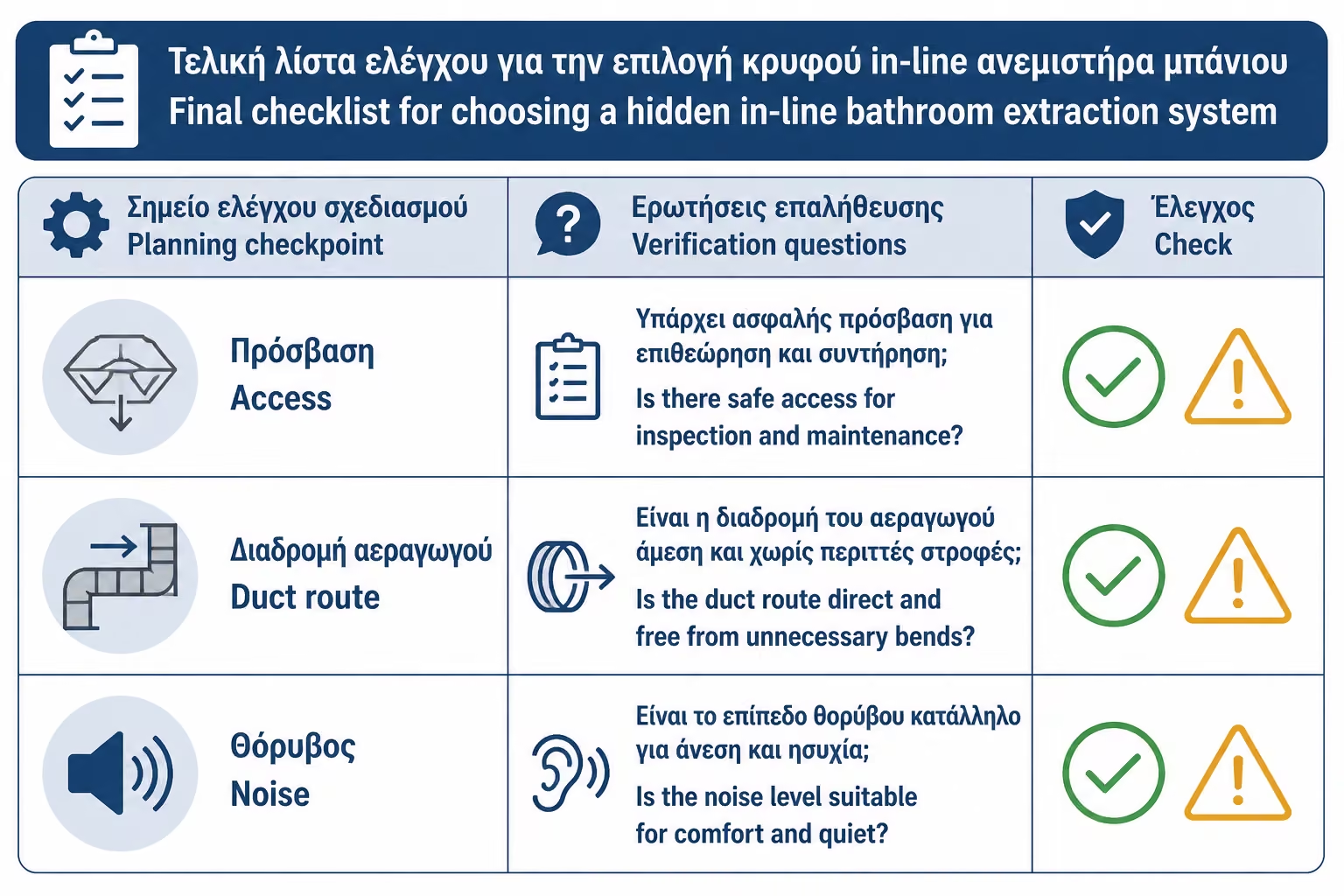
| Does the bathroom have a false ceiling, a loft or a technical room for the motor? | Yes / No |
| Is there actual access for engine maintenance? | Yes / No |
| Has the required flow rate been calculated in m³/h? | Yes / No |
| Does the in-line type fit the length and angles of the duct? | Yes / No |
| Is the pipe diameter sufficient for the supply? | Yes / No |
| Is the main run with a smooth tube and not a long kinked flex? | Yes / No |
| Is the suction grill near the source of moisture? | Yes / No |
| Is short-circuiting near the door avoided? | Yes / No |
| Is there an air intake under the door or through a blind? | Yes / No |
| Is there a return where appropriate? | Yes / No |
| Is the motor properly supported so that it does not transmit vibrations? | Yes / No |
| Is there a timer or humidistat for operation after the shower? | Yes / No |
| Has the electrical connection been checked by a licensed electrician? | Yes / No |
| Does the offer include motor, pipes, grills, door, electrical, labor, VAT and incidentals? | Yes / No |
If you want an in-line fan, don't buy it just because it promises high flow or quiet operation. The actual quality of the system is judged by the air path. Put the grill near the shower, keep the pipe as short and smooth as possible, avoid too many corners, give enough diameter and provide access to the motor. In-line can be extremely discreet in the bathroom, but not if you close it casually in a maintenance-free suspended ceiling. The professional result is not that nothing is visible; it is that it works properly for years.
The hidden in-line ventilator is one of the best solutions when we want serious ventilation, clean aesthetics and lower noise in the bathroom. It is particularly useful in blind bathrooms, in bathrooms with false ceilings, in walk-in showers, in areas next to bedrooms and in renovations where the position of the classic wall fan does not serve the air flow.
But it is not a magic solution. It's not really 100% quiet and doesn't perform properly if the vent is bad. It wants the right flow m³/h, right diameter, few corners, smooth network, grilles with sufficient cross-section, return, air intake from the door and access for maintenance. If all these are designed correctly, the result can be far superior to a simple wall fan.
The best time to decide on in-line ventilation is before the false ceilings are closed and before the electrical is completed. Then you can pass the pipes correctly, provide a window, place the grill in the right place and choose a timer or a hygrostat without any worries. After that, each change becomes more difficult and expensive.
If your bathroom has a simple, short outlet, you may not need an in-line. But if you have a blind bathroom, a long duct, a noise problem or you want a really clean design, it is worth considering seriously. Proper in-line venting doesn't look like much. But it shows in the fact that the mirror is fogging up, the shower is drying up and the bathroom is not holding moisture.
Return to category.
Go to categoryReturn to the central guide.
Go to guide