
Bathroom Lighting, Ventilation & Heating
Return to category.
Go to categoryThe bathroom fan is one of those appliances that many owners only remember when the problem starts. When the mirror fogs up for a long time, when the smell stays in the room, when black marks appear in the corners, when the ceiling "sweats" after every shower or when the joints start to darken. Until then, the ventilator is often treated as a small plastic component that simply goes into a hole in the wall.
In practice, though, proper ventilation is a key part of bathroom renovation. A bathroom can have expensive tiles, good waterproofing, quality taps, and the right lighting, but if water vapour is not removed properly, the space will deteriorate little by little. Moisture stays on the joints, the mirror, the ceiling, the furniture, and the silicone seals. The problems are not obvious in the first week. They show up after months of use.
The main mistake when buying a fan is that most people look only at the diameter or the price. "I have a 100 mm opening, so I will buy a 100 mm fan." That can work in a very simple bathroom with a short route to a shaft or external wall. But it does not work in every installation. An axial fan that blows almost directly outdoors is one thing, a centrifugal fan that has to push air through a longer or more difficult duct is another, and an in-line fan placed inside the ductwork or a suspended ceiling is something else again.
Choosing the type is not a question of "which one is best overall". It is a question of installation. How long is the air path? Does it have bends? Does it discharge into a shaft or through an external wall? Is there a suspended ceiling? How large is the bathroom? Does it have a window or is it blind? Do we want simple light-switch operation, time delay, a humidity sensor, or continuous low-speed operation? Those questions determine the right fan far more than the look of the front cover.
In this guide we will see the differences between axial, centrifugal and in-line fans, when each type is suitable, what air supply, static pressure, noise, pipe diameter, return and humidity sensor mean, what mistakes are often made in the Greek market and how to choose a solution that really works, not just "spinning the impeller".
The bathroom produces moisture very quickly. A hot shower of a few minutes fills the space with water vapor, especially when the bathroom is small, windowless or poorly ventilated. These water vapors must be removed. If they stay in the room, they condense on the coldest surfaces: mirror, tiles, ceiling, corners, metal elements, frames and furniture.
Condensation isn't just a nuisance. Over time, it creates conditions for mold, odors, deterioration of joints, silicones and wooden or MDF furniture. In bathrooms without windows, the situation is even more demanding, because there is no natural air renewal. The fan becomes the main means of moisture removal.
A common example is the blind apartment bathroom where the old fan only works when the light is on. The user takes a shower, gets out, turns off the light, and the ventilator stops just when it needs to continue working. The mirror remains cloudy, the ceiling retains moisture and the space dries slowly. There the problem is not only the power of the fan. It is also the mode of operation.
Proper ventilation needs three things: adequate air supply, proper exhaust path, and adequate run time. If one of the three is missing, the result will be mediocre, even if the ventilator looks “powerful” on the package.
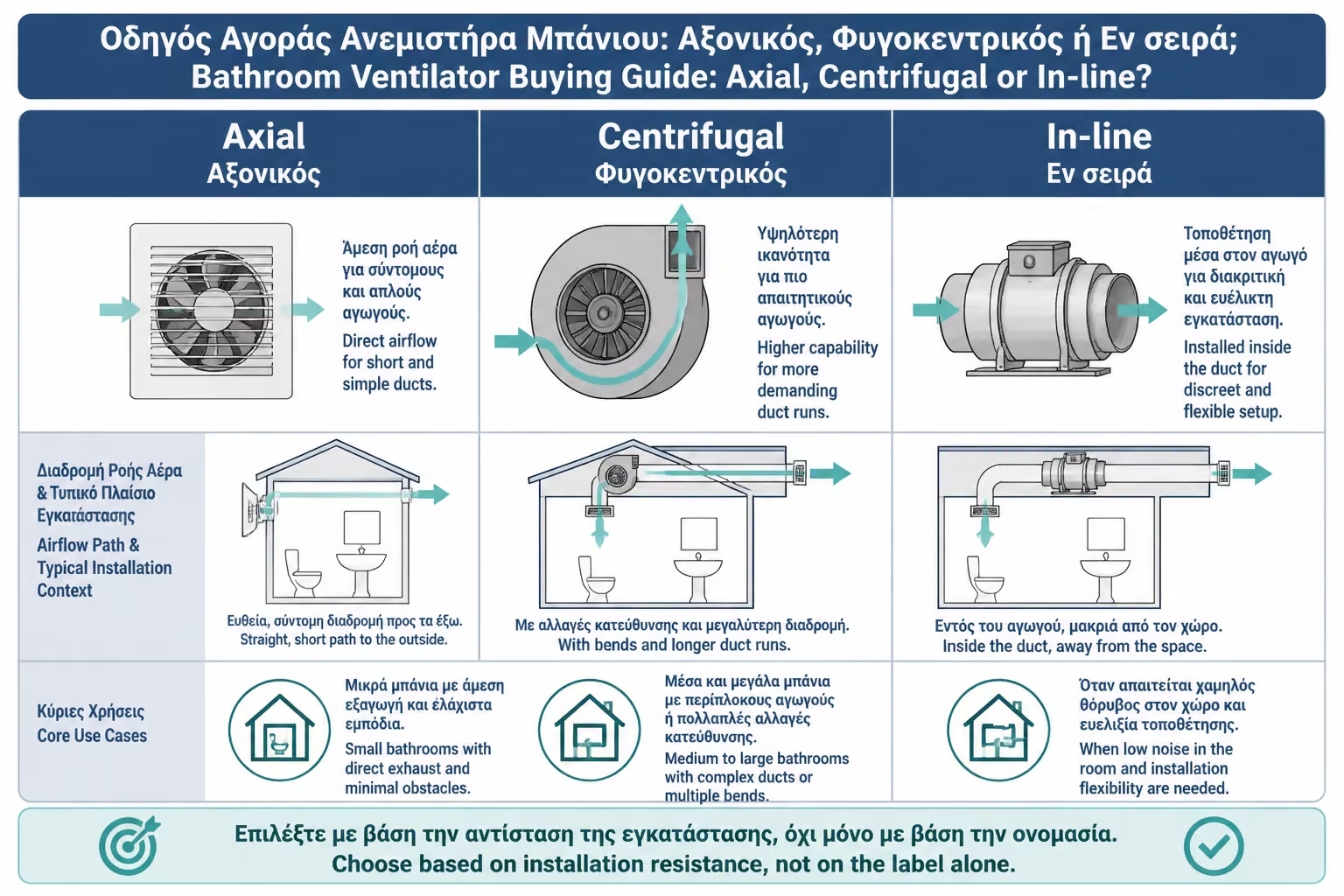
Bathroom fans are practically divided into three main categories: axial, centrifugal and in-line. There are also subcategories, such as mixed-flow in-line, continuous operation or low noise, but the basic selection starts from these three types.
| Fan type | Best application | Key advantage | Basic limitation |
|---|---|---|---|
| Axial | Short run, discharge almost straight outdoors | Economical, simple, easy | Loses performance in long duct runs or with many bends |
| Centrifugal | More difficult routes, more resistance | Better pressure, more stable performance | Usually more expensive and bulkier |
| In-line | Suspended ceiling or duct run with a remote motor | Good performance, possibility of lower noise in the room | Needs proper duct design and maintenance access |
The main difference lies in how the fan moves air and how well it can overcome duct resistance. Axial fans move air along their axis and are suited to short, simple runs. Centrifugal fans can develop more pressure, so they perform better when air has to pass through a more demanding duct system. In-line fans sit within the duct run itself and often offer more flexibility, especially when there is a suspended ceiling or when extraction has to happen away from the wall.
Simply put: we don't buy a fan based on the diameter alone. We buy it based on the bathroom and the air path.
The axial fan is the most common type in bathrooms. It is the classic small wall or ceiling fan that is placed on a wall, window, light fixture or near an external outlet. The air passes almost straight through the fan, from one side to the other.
It is simple, economical and easy to install. For a small WC or bathroom where the fan blows the air almost directly to an external wall or a very close light fixture, it may be perfectly adequate. That's why it remains the most popular choice.
Its downside is its limited resistance capability. If the air has to go through a long pipe, through many corners or through a narrow/dirty vent, the actual performance of the axial drops noticeably. Fan selection guides state that axial fans are mainly suitable for short and straight runs, and their efficiency decreases rapidly as the length and angles of the air duct increase.
A practical example: in a bathroom that has an external wall directly behind the ventilator, a good Φ100 axial can work just fine. In a blind bathroom venting in a 3-4 meter duct with two angles to the light fixture, the same fan may make noise but not produce enough air.
The axial fan is suitable when the exhaust path is simple. That is, when the air comes almost straight out or through a very small and straight duct. It is a good choice for small WCs, for bathrooms with an external wall, for old installations where there is already a Φ100 hole for the light fixture and for cases where the budget is limited but the route is not demanding.
In such cases, it is worth paying attention to details such as low noise, time delay, feedback and humidity sensor. A simple axial without a timer can be cheap, but if it turns off immediately with the light, it does not ventilate enough after the shower.
It does not fit well when the pipeline is long or complicated. It is also not suitable when there is a need for strong suction from a point far from the outlet. In these cases, the owner can buy a "stronger" axial fan, but the problem remains because the fan type is not suitable for the network resistance.
The practical advice is simple: if you see almost direct output to the outside, axial may be the right solution. If the air has to travel through pipes, corners and false ceilings, care is needed.
The centrifugal fan works differently. Air enters the center of the impeller and is ejected with greater pressure. This makes it more suitable for installations where there is resistance from ducts, corners or a longer run.
The great advantage of the centrifugal is that it can maintain better performance when the pipeline is not ideal. In technical comparisons it is stated that centrifugal fans are designed for applications that require higher static pressure and more stable performance when air must overcome resistance.
In the bathroom, this translates into a better choice for blind bathrooms with a longer vent, for installations where the exit is not close, and for situations where the simple axial "turns" but does not pull enough. A centrifugal can be more expensive, but on a rough ride it is often a better buy.
Its disadvantage is that it can be bulkier, more expensive and in some cases noisier if not chosen correctly. It also doesn't magically fix a bad install. If the duct is clogged, too narrow or ends in a bad outlet, even a centrifugal will struggle.
The centrifugal fan is suitable when the installation has a higher resistance than simple direct extraction. That is, when there is a pipe of several meters, when there are corners, when the bathroom is blind and the path to the light pipe or the external exit is not short, or when a simple axial does not work.
It is also suitable when more reliable performance is needed in a place with intense humidity. For example, in a small blind bathroom without a window, where a hot shower is taken every day, a centrifugal may be a more correct choice than an economical axial, if there is a duct with length and angles.
But noise must be considered. A stronger fan may remove moisture better, but if it makes too much noise, the owner will turn it off or avoid it. Thus the benefit is lost. The right choice is a balance between performance, pressure and noise.
In a renovation, the electrician or HVAC technician needs to see not only the location of the old fan but also where the duct goes. Many times the old ventilator was not "small". He was just the wrong guy for the ride.
The in-line ventilator is not necessarily placed on the bathroom wall. It enters the duct line, usually in a false ceiling, loft, attic, utility room, or elsewhere along the way. In the bathroom, only a suction grill can be seen, while the motor is further away.
This has two major advantages. First, it allows better positioning of the suction point. The grill can be placed near the shower or where it produces steam, while the motor is located elsewhere. Second, it can reduce the perceived noise inside the bathroom because the noise source is not located directly on the wall or ceiling of the room.
In-line ventilators are particularly useful when there is a false ceiling, when the bathroom is internal and the exhaust must be done through a duct, or when we want a cleaner aesthetic with only a discreet grille. Mixed-flow in-line fans often offer a good balance of flow and pressure for ducted installations, while purely axial in-line fans are more suitable for lower resistances.
The downside is that installation is more demanding. It needs proper conduit, support, access for maintenance, electrical supply, soundproofing where needed and proper exit. It's not a "put a fan in place of the old one" solution.
The in-line ventilator is suitable when there is room to place the motor outside the immediate bathroom area. This often happens when there is a false ceiling, loft or technical gap. It is a very good solution for new renovations, because it can be designed from scratch.
It is also suitable when we want the suction to be done from a specific point. For example, in a walk-in shower, the grill can be placed close to the steam production area, while the motor is further away. This way water vapor is removed more effectively before it fills the entire bathroom.
In large bathrooms or in bathrooms with many moisture points, a network with more than one grille can be provided if the fan and duct are designed correctly. But this is more complex and must be studied, not done casually with ramifications.
In-line is also a good choice when noise is an important issue. If the bathroom is next to a bedroom or if the owner is easily disturbed, removing the motor from the area can help. But the noise doesn't go away if the vent is bad or if the fan isn't supported properly.
Airflow indicates how much air the fan can move. It is usually reported in m³/h or l/s. The higher the flow rate, the more air can theoretically be removed. But the nominal supply is not always the actual supply in the installation.
In international residential guidance, intermittent bathroom extraction is often described with a minimum airflow of 15 l/s, that is about 54 m³/h, while continuous extraction can work with lower values in continuous operation. These figures are useful as a starting point, but the final choice must still be tailored to the size of the bathroom, how it is used, and the actual duct route.
For a small WC, a fan of 80–100 m³/h may be more than enough if the path is short. For a master bathroom with daily showers, especially if it is blind, a stronger solution or a better type of fan may be needed. But it is not right to always put the strongest. If the fan is too much, it can make noise, draw air from unwanted places or be annoying.
There must also be an air intake. The fan can't blow air if no new air is coming into the bathroom. If the door seals completely to the floor, performance drops. A gap under the door or other air intake provision is necessary for the system to function properly.
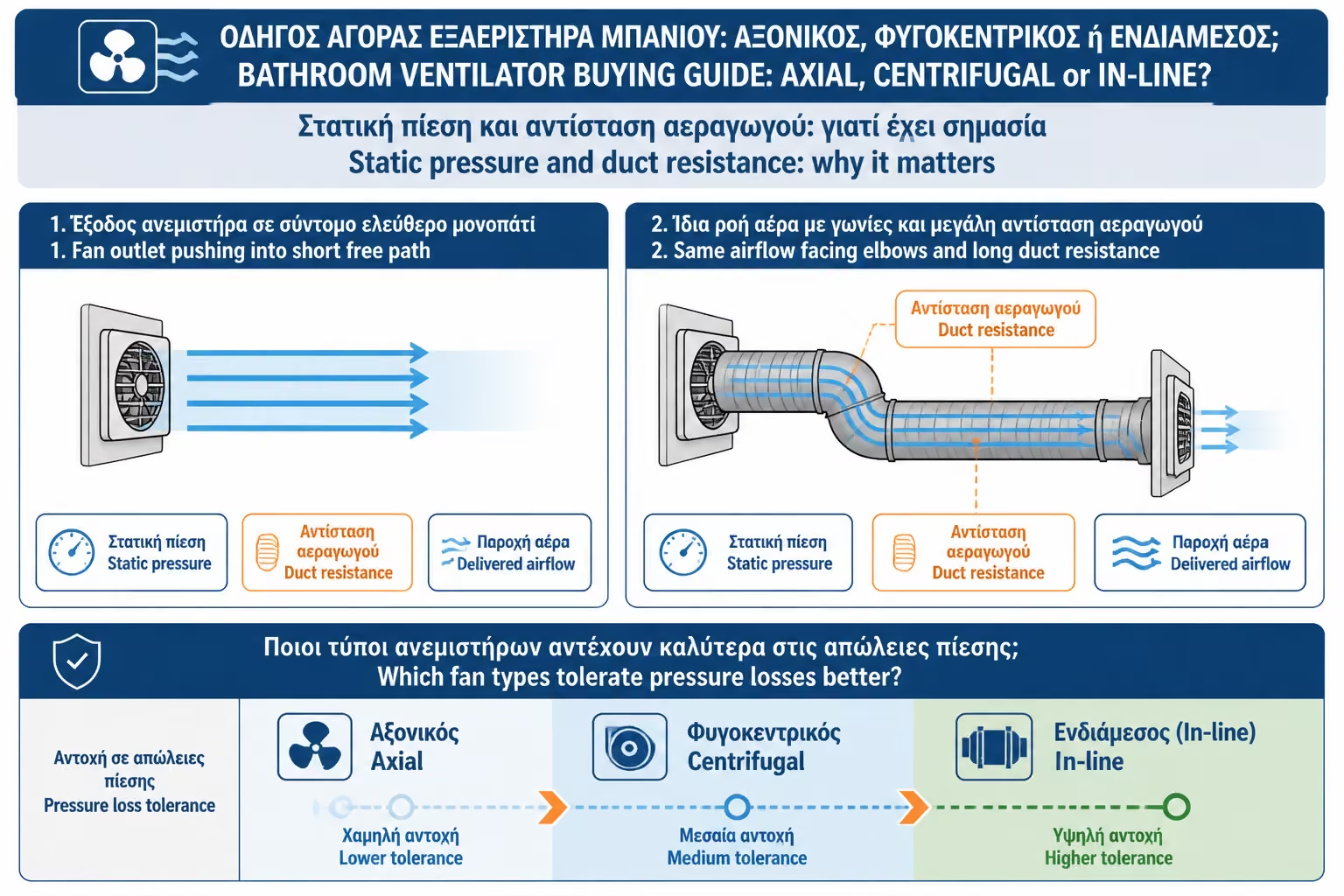
Static pressure is the technical characteristic that many homeowners overlook, but it explains why a fan works well in one bathroom and badly in another. Put simply, it shows how well the fan can overcome duct resistance.
If the duct is short and straight, resistance is low. If it is long, narrow, full of bends, or blocked by dirty grilles, resistance rises. Axial fans usually cope less well with pressure. Centrifugal fans, and many in-line or mixed-flow models, handle tougher runs much better. Technical ventilation sources consistently point out that centrifugal motors are generally better suited to long duct runs.
A practical example: two fans are both rated at 100 m³/h. The first is a simple axial model, the second is centrifugal. If you place them on a very short direct outlet, they may perform similarly. Put them on a 5 m duct run with two bends, though, and the centrifugal model will probably maintain much better real airflow.
That is why the right technician does not only ask, "How many cubic metres per hour does it produce?" They also ask, "What kind of duct run will it work on?"
Every meter of pipe and every angle reduces the fan's efficiency. The air rubs against the walls, changes direction, encounters grilles, returns and possible constrictions. All of this adds resistance.
A flexible spiral tube, if kinked or too long, can cut performance significantly. A smooth rigid conductor usually behaves better. A 90 degree angle right after the vent can reduce performance more than you might think. A clogged exterior grill can invalidate almost the entire system.
Fan sizing guides note that run length, number of fittings and angles affect how much air the duct can actually carry.
In practice, before you buy a fan, you need to know where the air is going. If you don't know, you're buying blind. In old apartment buildings, many times the ventilation duct is common, narrow, dirty or with a poor outlet. There the choice of fan must be made even more carefully.
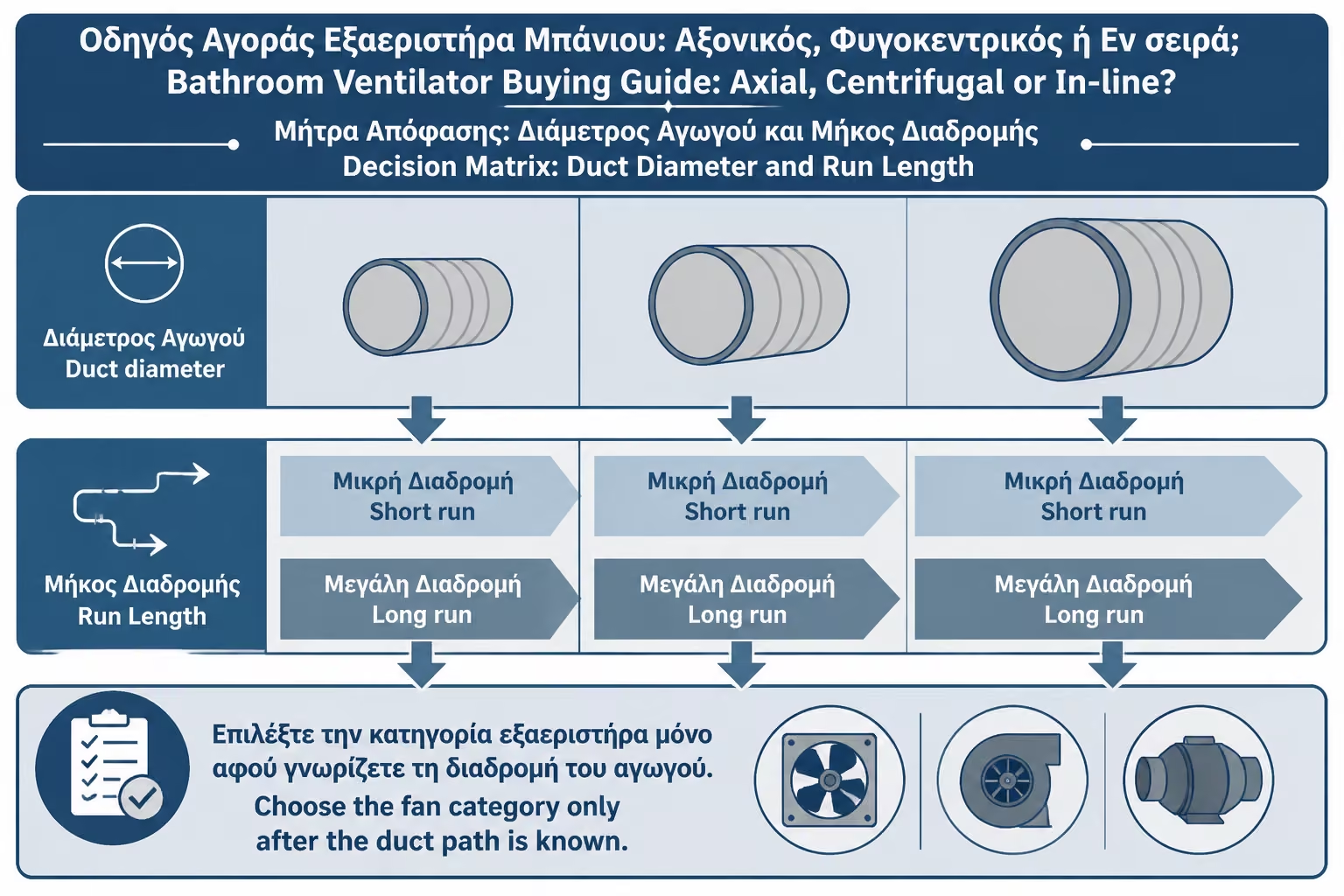
Most small bathroom ventilators are Φ100 because this is the most common diameter in older installations. For small WCs and simple routes, it may be sufficient. But as the flow and the route increases, the diameter of the pipe becomes more important.
A larger duct, such as Φ125 or Φ150, can carry more air with less resistance and often with lower noise if the system is properly designed. But it makes no sense to buy a Φ125 ventilator if the existing duct inside the wall is Φ100 and does not change. The actual cross-section of the narrowest point will limit the system.
In a renovation where false ceilings are opened and new routes are made, it is worth considering a larger diameter if the bathroom is demanding. In a simple replacement of an old fan, you usually stay with the existing diameter, unless there is a serious intervention.
Diameter should not be treated as a detail. A "loud" fan in a narrow, long and bad duct will make noise and perform less than it promises.
Noise is critical because it affects whether the ventilator will be used properly. If the fan makes an annoying noise, the owner will turn it off, avoid the timer or use it less. Then the moisture will stay in the bathroom.
Noise is reported in dB(A), but the numbers are not always easily compared because they depend on the measurement method and the distance. Nevertheless, the lower the price, the more comfortable the use. In buying guides, axial bathroom fans are often quoted in the range of around 35–45 dB(A), while more powerful centrifugals can be higher, although low-noise models are now available.
The in-line fan can help with noise because the motor is moved away from the bath. But if the duct carries vibrations, if the support is bad, or if the grill whistles, the noise remains. Correct installation is just as important as the model.
Practically, for a bathroom next to a bedroom, it is worth paying more attention to low noise, a timer of the right duration and perhaps an in-line solution. A cheap noisy fan may seem economical, but if you can't stand it, it's not doing its job.
How the ventilator works is almost as important as its type. A good fan that only runs for two minutes does not have time to remove moisture after a shower. A modest ventilator with a proper timer may perform better in practice.
The simple switch is the basic solution. The ventilator turns on together with the light or from a separate switch. It is an economical solution, but it depends on the user. If the user turns off the light immediately, the ventilation also stops.
The timer keeps the fan running for a few minutes after it is turned off. For a bathroom with a shower, this is very useful. The humidity sensor activates or keeps the fan running when the humidity rises. It is especially useful in blind bathrooms or in houses where users forget to open the ventilation.
There are also models with continuous low mode and boost when the humidity increases or when the light comes on. This logic is very good for bathrooms with a permanent moisture problem, but it needs the right choice, low noise and good installation.
The return is a small but important component. Prevents air from flowing back into the bathroom when the ventilator is not operating. In apartment buildings, skylights or common routes, it helps to reduce the return of smells, cold air or dust.
It's not always a perfect solution. If the light pipe is malfunctioning, if there is a common pipe with pressures from other compartments, or if the outlet is problematic, a more comprehensive check may be needed. However, return is a key element in many installations.
Care must be taken because backflow adds resistance. A weak axial can struggle even more if it has a hard flap or a bad grille. That is why it must be properly selected and maintained. If it gets stuck from dust or grease, it reduces performance.
A frequent complaint is "smells coming from the ventilator". The answer is not always a new fan. May need backflow, duct cleaning, better output or shared light duct control.
The ventilator is an electrical device in a wet room. So its location and its connection must be checked based on the safety zones of the bathroom, IP protection and the existing electrical installation. Not all models are suitable for every position.
If the ventilator is placed near or above a shower, the requirements are different from a location high on a wall away from water. The exact selection must be made by a licensed electrician. In areas with a bathtub or shower, special electrical installation requirements apply, such as those covered by ELOT HD 60364-7-701:2024 for areas with a shower or sprinkler.
There must also be proper leakage protection, proper wiring, proper grounding where required and secure connection. In older homes, replacing a fan is an opportunity to check if the installation is correct and if there is a leak relay.
The owner should not install a fan in a bathroom by himself, especially if it needs a new supply, connection to lighting, timer, sensor or installation near a wet zone. Just because the device is small doesn't mean the setup is trivial.
Even the right ventilator loses performance if not maintained. Dust collects on the faceplate, impeller, return and duct. Moisture can trap dirt. Insects or dirt on exterior grills reduce flow. After years, the fan may spin but not pull enough.
Basic maintenance is front and impeller cleaning, backflow check, outlet grill check and, where possible, duct check. In in-line systems, there must be access to the motor. If installed in a suspended ceiling without a hatch, maintenance becomes difficult or impossible.
A frequent mistake is to choose an in-line ventilator for low noise, but close it inside a suspended ceiling without access. When cleaning or replacement is required, the structure must be opened. This is not a correct installation.
Ventilation is a system that must be maintainable. If there is no access, the solution is half.
The cost depends on the type of ventilator, the supply, the noise, whether it has a timer or humidity sensor, the quality of construction, the diameter, whether it needs a new air duct, false ceiling, electrical supply or maintenance. It is also affected by area, floor, access, condition of existing installation, whether VAT is included and whether the offer is for appliance only or full installation.
| Selection | Indicative range 2026 | What affects the price? |
|---|---|---|
| Single axial Φ100 | €25–€70 | Supply, quality, noise |
| Axial with timer / low noise | €50–€130 | Timer, design, motor, dB |
| Axial with humidity sensor | 80–180€ | Settings, sensor quality |
| Bathroom centrifuge | 90–250€+ | Pressure, flow, noise, functions |
| In-line / mixed-flow ventilator | 80–300€+ | Diameter, flow, pressure, noise |
| Ducts, grilles, return | 20–150€+ | Length, materials, diameter |
| Electrical installation | Wide variation | Supplies, switches, timer, accessories |
| Complete installation with new duct | 150–600€+ | False ceiling, route, exit, access |
The low price may be right on a simple WC with a short outlet. However, it is not the right base for a blind bathroom with a long vent. There the economy in the ventilator type can lead to permanent humidity and ultimately higher repair costs.
The higher price is justified when there is low noise, better pressure, humidity sensor, quality motor, proper ducting, clean installation and maintainability. It is not justified simply because the cap is prettier.
The choice can be made easier if you start from the air route. If the fan vents almost directly to the outside, a good axial is usually enough. If there is a long duct or corners, consider centrifugal or in-line. If there is a suspended ceiling and you want lower noise, in-line can be a very good solution.
| Bathroom case | Most likely correct choice |
|---|---|
| Small WC with external wall | Axial |
| Small bathroom with a very short exit | Axial with timer |
| Blind bathroom with 2–4 m duct. | Centrifugal or good in-line |
| Long duct with corners | Centrifugal or mixed-flow in-line |
| Bathroom with false ceiling | In-line with suction grille |
| Bathroom next to bedroom | Low noise or in-line |
| Bathroom with strong humidity | Timer, humidity sensor or continuous low mode |
If you do not know the route of the duct, ask for an autopsy. Don't buy based on the old model alone. Many times the old ventilator was inadequate precisely because it was chosen without consideration of the path.
The right choice is not always the most powerful. It is the one that suits the resistance of the network, the noise you tolerate and the way you use the bathroom.
The errors in ventilation are visible after use. On the day of installation, all ventilators appear to be working. The real test is whether after a hot shower the mirror cleans quickly, the area dries, odors disappear and no moisture remains.
| Error | What it causes in practice | A more correct approach |
|---|---|---|
| Option only based on Φ100 | Wrong fan type for a demanding duct run | Length and angle control |
| Axial in long duct | Noise with little real output | Centrifugal or in-line |
| No timer after the shower | The moisture stays in the room | Timer or humidity sensor |
| Very noisy model | The user disables it | Low noise solution |
| Duct without air inlet | Reduced performance | Door crack or air supply |
| Bad return | Smells from a lamp | Proper valve and cleaning |
| In-line without access | Difficult maintenance | Locker or technical access |
| Export to wrong place | Return of moisture/odors | Correct final output |
| Inappropriate IP/location | Security issue | Check by an electrician |
| Ignore cleaning | Performance decline over time | Regular maintenance |
A typical example is a blind bathroom where only the face of the fan is changed with a “stronger” axial model, but the duct behind it has two corners and a long path. The noise increases, the real humidity does not go away and the owner thinks that "all the fans are useless". Actually, another type and better duct control was needed.
| Inquiry | Yes / No |
|---|---|
| Do you know if the air is coming straight out or through a duct? | Yes / No |
| Has the length of the duct been roughly measured? | Yes / No |
| Are there corners, bottlenecks or hose in the route? | Yes / No |
| Is the bathroom blind or does it have a window? | Yes / No |
| Is the fan supply sufficient for the size and use of the bathroom? | Yes / No |
| Does the fan type match the static pressure of the installation? | Yes / No |
| Is there a timer so it works after showering? | Yes / No |
| Need a humidity sensor? | Yes / No |
| Is the noise acceptable for everyday use? | Yes / No |
| Is there a return for odors and air returns? | Yes / No |
| Is there sufficient air intake from a door or other point? | Yes / No |
| Have the location and IP protection been checked by an electrician? | Yes / No |
| Will the in-line fan, if selected, be accessible for maintenance? | Yes / No |
| Does the quote include appliance, ducts, grilles, electrical, VAT and incidentals? | Yes / No |
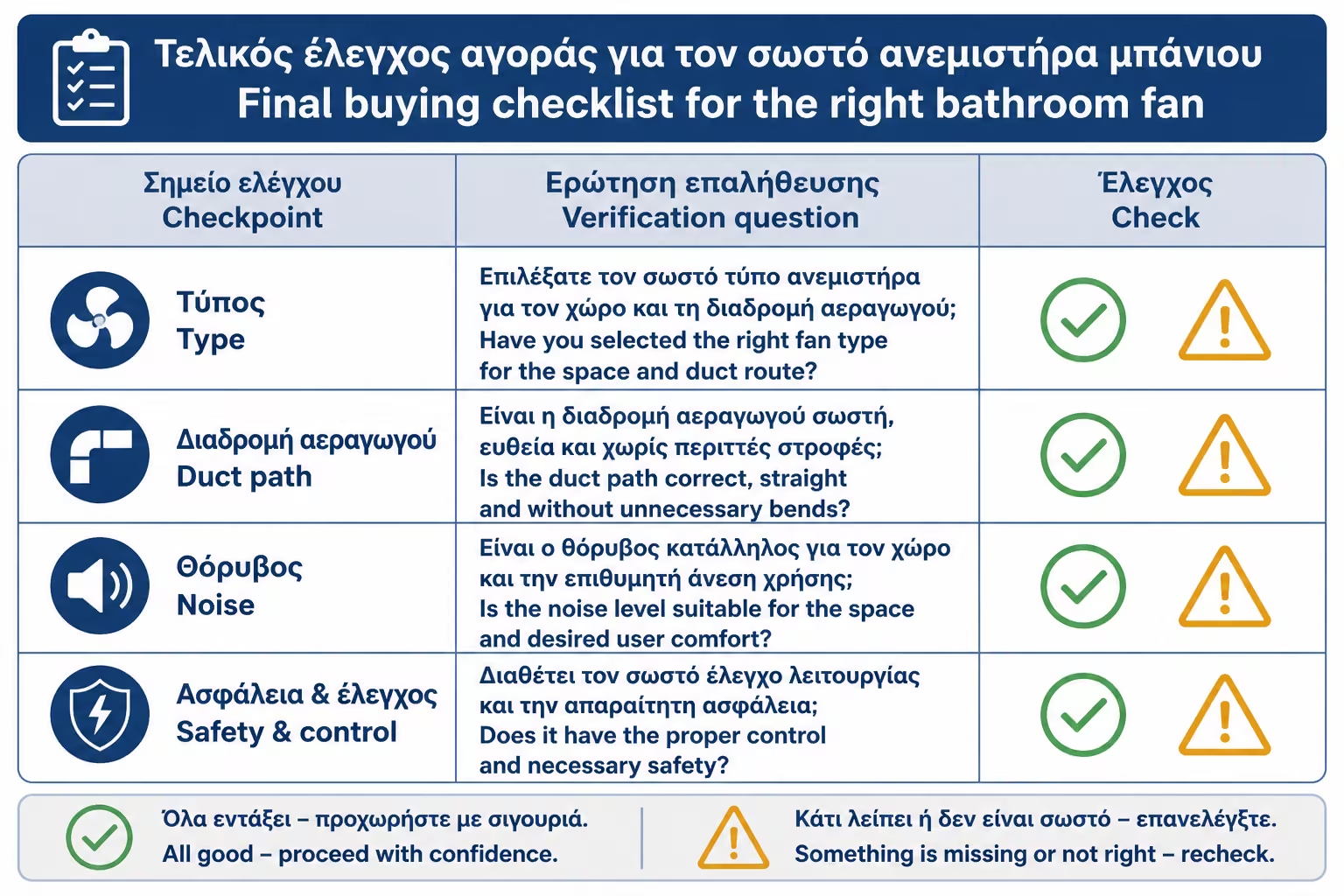
If you have to stick to one rule, stick to it: the right ventilator is not selected by the diameter of the hole, but by the air path. For direct output, a good axial may be sufficient. For a long duct, corners or blind bath, look at centrifugal or in-line. Don't just buy a "stronger" fan if you don't know the resistance of the duct. And don't forget a timer or humidity sensor: the ventilation should continue after the shower, not stop when the light goes out.
The bathroom fan is a small device, but it greatly affects the durability and hygiene of the space. It is not enough to put "something" in the place of the old one. A type that suits the installation must be chosen: axial for simple and short extractions, centrifugal for greater resistance, in-line for more elaborate networks, suspended ceilings and cases where we want better performance or lower noise in the bathroom.
Real performance doesn't just show up on paper. It depends on the air duct, angles, diameter, outlet, air inlet, return and operating time. A proper ventilator with a timer or moisture sensor can protect tiles, joints, furniture, mirrors and ceilings from permanent moisture. A wrong fan may just make noise without solving the problem.
The best decision is to do an autopsy before buying. See where the air goes, how far it travels, what obstacles it has and how the system will be maintained. If the renovation is still in the planning phase, this is the right time to provide for correct ducting, correct suction position, correct electrical connection and access for maintenance. So the ventilation will not be just a part on the wall, but a real bathroom protection system.
Return to category.
Go to categoryReturn to the central guide.
Go to guide