
Bathroom Lighting, Ventilation & Heating
Return to category.
Go to categoryThe bathroom fan is not just the device we see on the wall or ceiling. Behind the lid, behind the grill or inside the false ceiling there is something equally important: the air duct. It is the route that the moist air must follow to leave the bathroom and be led to a skylight, external wall, roof or other suitable outlet.
Very often, the ventilation problem is not that the fan is "weak". It is that the air does not have a good path. The ventilator may say 100 or 150 m³/h in the technical specifications, but if behind it there is a broken aluminum pipe, many bends, narrowings, a small grille and a long distance to the outlet, the real performance drops. The fan spins, it makes noise, but the mirror remains cloudy and the bathroom takes a long time to dry.
This is the "hidden" part of the ventilation. The owner sees the device and compares prices. But the technician must see the path of the air. How many meters of pipe are there? Is the tube smooth or corrugated? Does it have a lot of 90 degree angles? Is the aluminum tube stretched or gathered like an accordion? Is there a return? Is the end grill open enough? All this affects the actual supply much more than it seems at first.
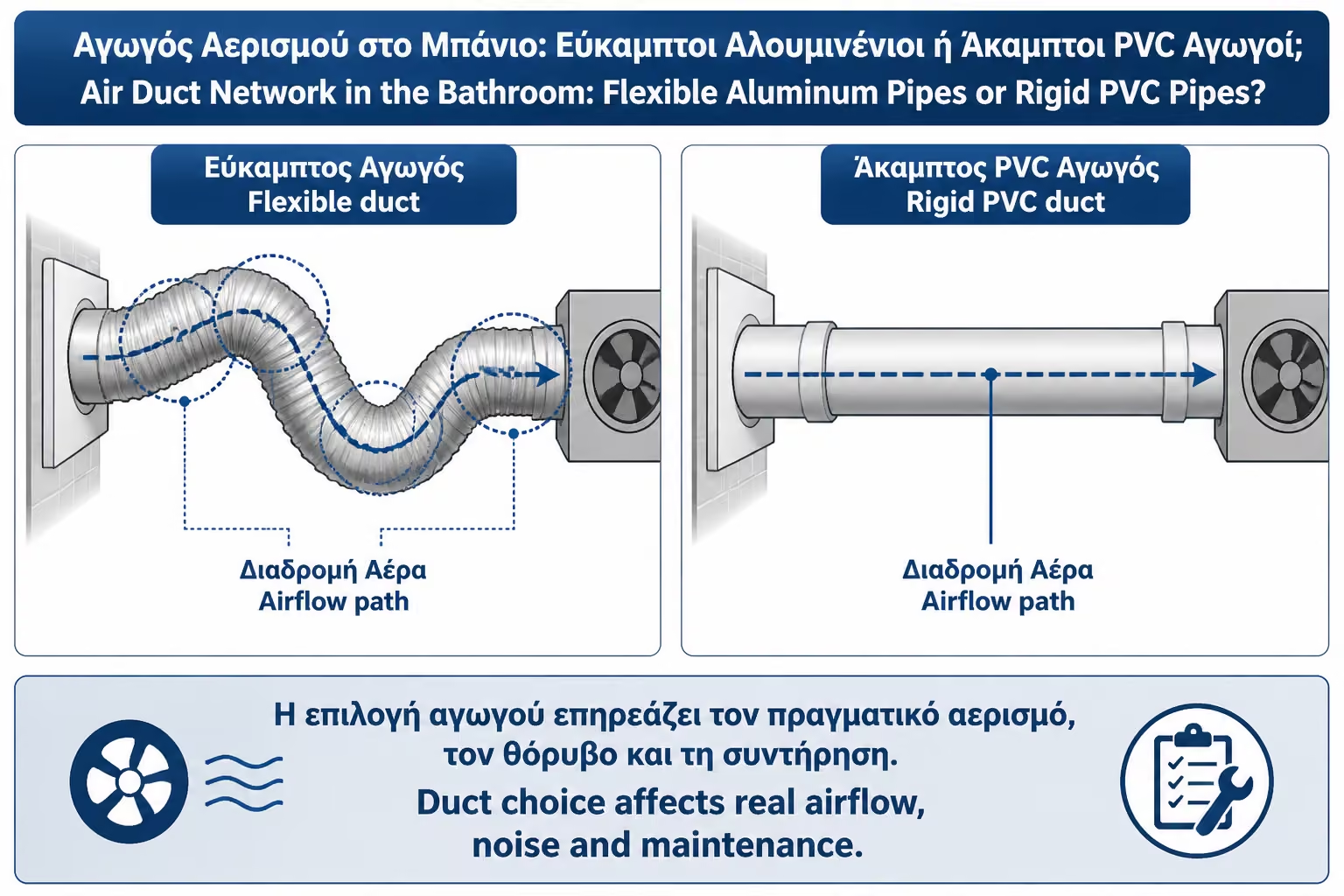
In practice, the two most common solutions are flexible pipes, usually aluminum tubing, and rigid pipes, usually PVC or other smooth plastic air ducts. Hoses are easy, fast and convenient on difficult routes. Rigid pipes are a cleaner and more efficient solution when properly installed. But there is no absolute answer that applies to every bathroom. There is a right choice per installation.
The main thing for the owner to remember is simple: air does not want obstacles. The shorter, straighter, smoother and of the correct diameter the path, the better the fan works. The more corners, kinks, constrictions and rough joints there are, the more the motor "chokes". This guide explains why this happens and how to avoid an installation that looks right but doesn't work.
The fan creates air flow. The vent determines how easily this flow will pass to the outlet. If the route is easy, the fan works more efficiently, with less noise and better real output. If the route is difficult, the fan works against resistance. Then the flow decreases, the noise increases and the bathroom dries more slowly.
This resistance is often called static pressure. The owner does not need to get into technical calculations, but he must understand the principle. Every meter of pipe, every corner, every constriction and every bad grille adds an obstacle to the flow. As the resistance increases, the actual efficiency of the fan drops. Technical ventilation guides point out that as the distance the air must travel through ducting increases, so does the resistance of the system.
This explains why the same ventilator can work well in one bathroom and poorly in another. If in the first it goes directly to an external wall and in the second it goes through 4 meters of pipe with two angles, it will not have the same actual flow. The same number is written on the box. But the installation is different.
A frequent practical example is the bathroom with false ceiling. The owner sees a beautiful grill on the roof and thinks everything is right. Above the drywall, however, there may be a hose that is bent, kinked, or too long. The result is that the fan makes noise without pulling enough.
Flexible aluminum pipes are popular because they are easy to install. They can go through tight spots, make small changes of direction, connect quickly to a fan or grill, and adapt to suspended ceilings where the path is not perfectly straight. For the installer they are convenient. For the owner, it is often a more economical solution.
In short runs, when the pipe is fully stretched and does not have many corners, it can work satisfactorily. For example, a 50–80 cm piece of hose connecting an in-line fan to a grille may be acceptable, especially if there are no kinks and the diameter is correct.
The problem occurs when the hose is used as an easy fix all the way. If it stays bunched up, if it does "bellies", if it turns sharply or if it is pressed into the false ceiling, it creates a lot of resistance. Corrugated inner surfaces increase air friction. Guides for exhaust fans state that flex duct ribbing increases static pressure because air gets trapped in the grooves and has trouble moving smoothly.
Simply put: aluminum tubing is convenient, but it's less forgiving of sloppiness than we think. If placed carelessly, it can negate much of the fan's performance.
Rigid PVC ducts or smooth rigid tubes have a more stable geometry and a smoother inner surface. This means air passes through with less friction than a kinked or corrugated hose. For this, where possible, hard vents are often considered a better solution for performance and noise.
Practically, a properly placed PVC pipe with gentle angles and a short length helps the ventilator work closer to its true capacity. The air doesn't encounter as many irregularities, there isn't as much turbulence, and the motor isn't under as much pressure. Technical ducting guides point out that rigid ducting solutions should be used wherever possible because they reduce resistance and bends in the system.
The downside is that hard tubes need better design. They are not "comfortable" like the flexible one. They want correct fittings, angles, supports, cuts, slopes where necessary and enough space inside the false ceiling or wall. If the route is very difficult or if there are obstacles, the installation may take longer.
In a complete renovation, however, it is worth considering the hard smooth air duct first and using flexible only where really necessary. This logic gives a more professional and efficient result.
There is no one answer for every bathroom. The flexible tube has a place in small, auxiliary connections or in places where absorption of small movements is needed. Hard pipe is preferred for the main route when proper installation is possible.
| Criterion | Flexible aluminum tube | Rigid PVC pipe |
|---|---|---|
| Installation | Quick and easy | It wants design and components |
| Air flow | Worse if it's wavy, bunched or creased | Better due to smooth inner surface |
| Angles | It turns easily, but with a lot of resistance | It wants special angles, more controlled flow |
| Noise | May be increased by turbulence | Usually quieter flow if designed properly |
| Maintenance | More difficult to clean if it collects dust/condensation | More stable and cleaner ride |
| Cost | Usually more economical in material/labor | May cost more in labor |
| When does it fit? | Small pieces, difficult joints, temporary or simple solutions | Main route, renovations, better performance |
If you are doing a simple fan replacement and there is already a small piece of hose in good condition, you may not need to change it. But if you are doing a complete renovation, putting in a new suspended ceiling or designing an in-line ventilator, it is worth designing a regular network with smooth pipes.
The rule of thumb is: flexible only as needed, rigid where possible.
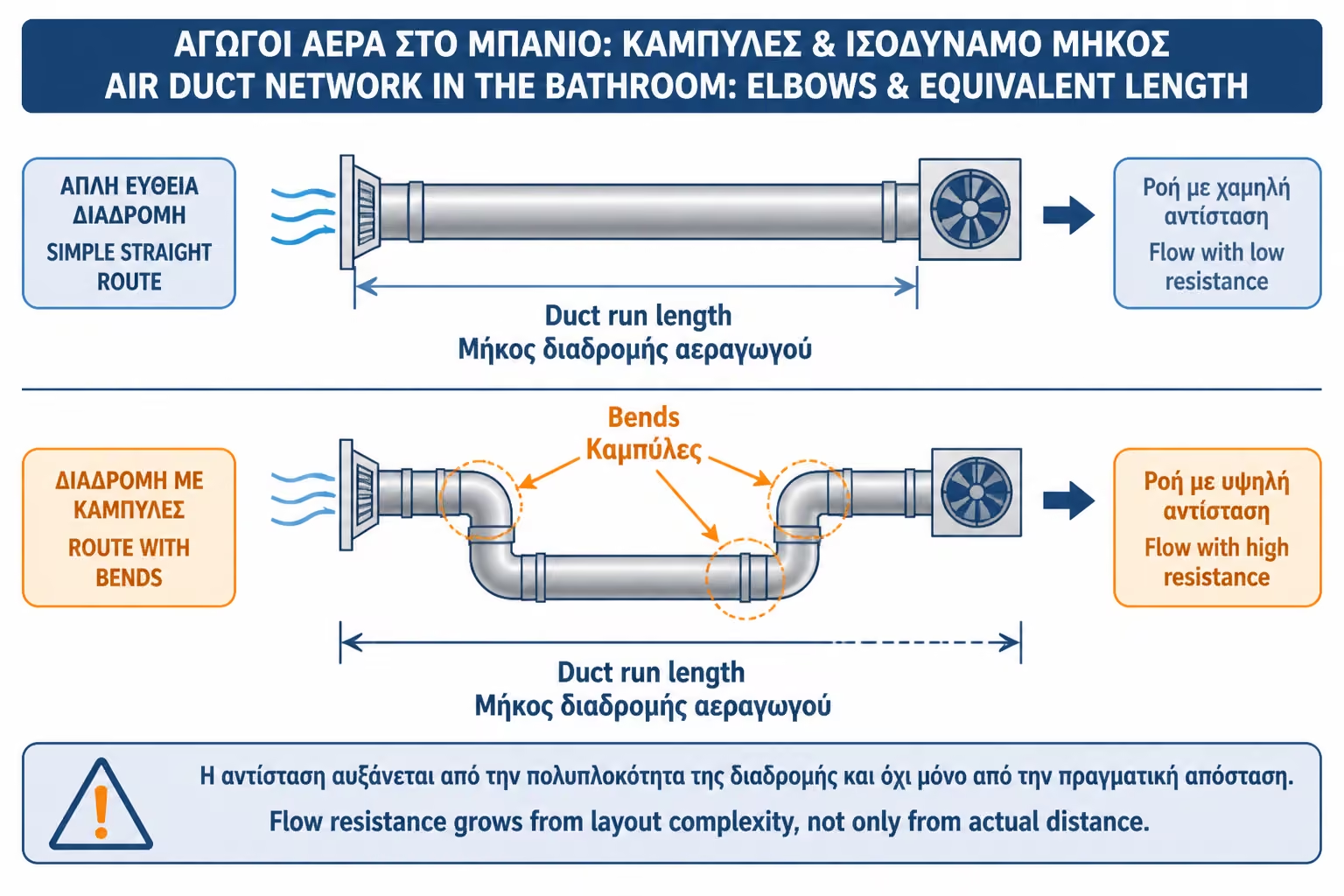
Each angle changes the direction of the wind. When air twists, it creates turbulence, pressure losses and drag. A 90 degree angle is not just "a little more pipe". It can act as a significant obstruction to flow, especially if it is right after the fan or if other corners follow.
45 degree angles are usually gentler than sharp 90 degree angles because the wind changes direction more smoothly. Duct design guides state that 90 degree angles create significant resistance to flow, while 45 degree angles are generally a more efficient solution when air needs to change direction.
In the bathroom, the difference can be seen in practice. A fan with a short straight path to the outside can perform well. If we add two sharp corners, a kinked hose and a small grille, the actual flow drops. The owner hears more noise, but sees less result.
A common mistake is to pass the air duct "as it suits" inside the suspended ceiling, with many small changes of direction to avoid spots, beams or pipes. Instead of making a clean path from the beginning, the pipe zigzags. This is a recipe for poor performance.
The farther the air has to travel, the more friction it encounters. Every meter of pipe adds resistance. This does not mean that a longer route cannot be taken. It means choosing the right type of fan, the right diameter and as clean a path as possible.
A simple axial fan can work well when venting almost directly to an exterior wall. But if the air has to go through 4–5 meters of pipe, especially with corners, the axial may not be enough. A centrifugal or in-line/mixed-flow ventilator is often needed there, which better withstands static pressure.
In bathroom fan selection guides it is stated that the length of the path, fittings and elbows affect how much air the duct can actually carry, while larger supplies may require a larger duct diameter.
Practically, if the exit is close, the choice is simpler. If the outlet is far, the vent should be designed like a small network, not like a random piece of pipe. In such cases, the rated m³/h flow rate of the ventilator is not sufficient. It should be checked if the device can perform on this route.
In the technical study of airways, the concept of equivalent length is often used. Simply put, a corner or fitting translates into extra "imaginary" meters of pipe because it creates resistance equivalent to some length of straight path.
The owner does not need to make exact calculations. But he needs to understand that 3 meters of pipe with two corners does not behave like 3 meters of straight path. They may behave like a much longer path in terms of resistance. If we add flexible corrugated pipe, the resistance increases even more.
A practical example: a 2m vent, smooth and straight, is a relatively easy route. A 2m duct with three tight bends, a kinked flex and a small grille can be much more difficult than a smooth 5m duct with gentle bends. The real problem is not just the measures. It's the way the air passes.
That is why in renovations the ventilation duct should not be designed last, "where there is room". It must be designed together with false ceiling, lighting, slopes and electrical.
Diameter directly affects performance and noise. The larger the diameter, the easier the air can pass through with less velocity and less resistance, as long as the ventilator and installation are compatible. The smaller the diameter, the more the flow is forced, especially at higher flows.
In old Greek bathrooms we often find Φ100, because it is the classic diameter of small ventilation fans. For a small WC or a small bathroom with a short path, it may be sufficient. For a larger bathroom, long vent or in-line system, it is worth considering Φ125 or Φ150 where possible.
The mistake is to put a powerful ventilator in a narrow network and expect miracles. If the fan has an output of Φ125 and we reduce it to Φ100 because "there is so much hole", we increase the resistance and the noise. Some manufacturers allow reductions under conditions, but in general diameter reduction requires caution and should not be done simply for convenience. Manufacturers of exhaust fans point out that using a reducer from a larger fan outlet to a smaller duct may seem like an easy solution, but it affects performance and must be evaluated on a system-by-system basis.
In a complete renovation, if it is possible to pass a larger diameter without excessive cost, it is usually worth considering. It's harder to fix afterwards.
The hose can work, but only when properly installed. The most common mistakes are that it stays bunched up, makes sharp turns, creases, is too long, or is casually connected with tapes and clamps without tightness.
When the hose is folded like an accordion, the inner surface becomes even more uneven. The air does not pass smoothly. When it goes belly up, it may collect condensation or dust. When it is crushed, the cross-section is reduced as if a constriction has entered. When the joints are not properly tightened, air can be lost inside the suspended ceiling.
A typical example is an in-line ventilator installed in a suspended ceiling, with 3 meters of flexible hose, of which 1 meter is redundant and collected. The owner thinks he has a possible solution, but the actual supply is falling. If the pipe was cut to the correct length, stretched and the main run was replaced with PVC, the same motor would perform better.
The hose must be used stretched, as short as possible and without sharp corners.
Rigid PVC pipe has better flow but is not automatically correct if placed incorrectly. If too many 90-degree angles are used, if the run is too long, if the joints are not tight, or if there is no support, problems can arise.
The joints must be correct and stable. Air must not escape through a false ceiling or loft. The route must be accessible where critical components such as in-line motors, return or cleaning points are located. The pipe must be supported so that it does not shake, squeak or transmit vibrations.
In horizontal runs in cold spaces, condensation may need to be considered. Humid warm bathroom air, when it passes through a cold duct, can create humidity inside. In such cases, pipe insulation or proper slope to a safe point may be required, depending on the route and construction.
Hard tube is a better base but needs professional application. It's not just "put PVC and we're done".
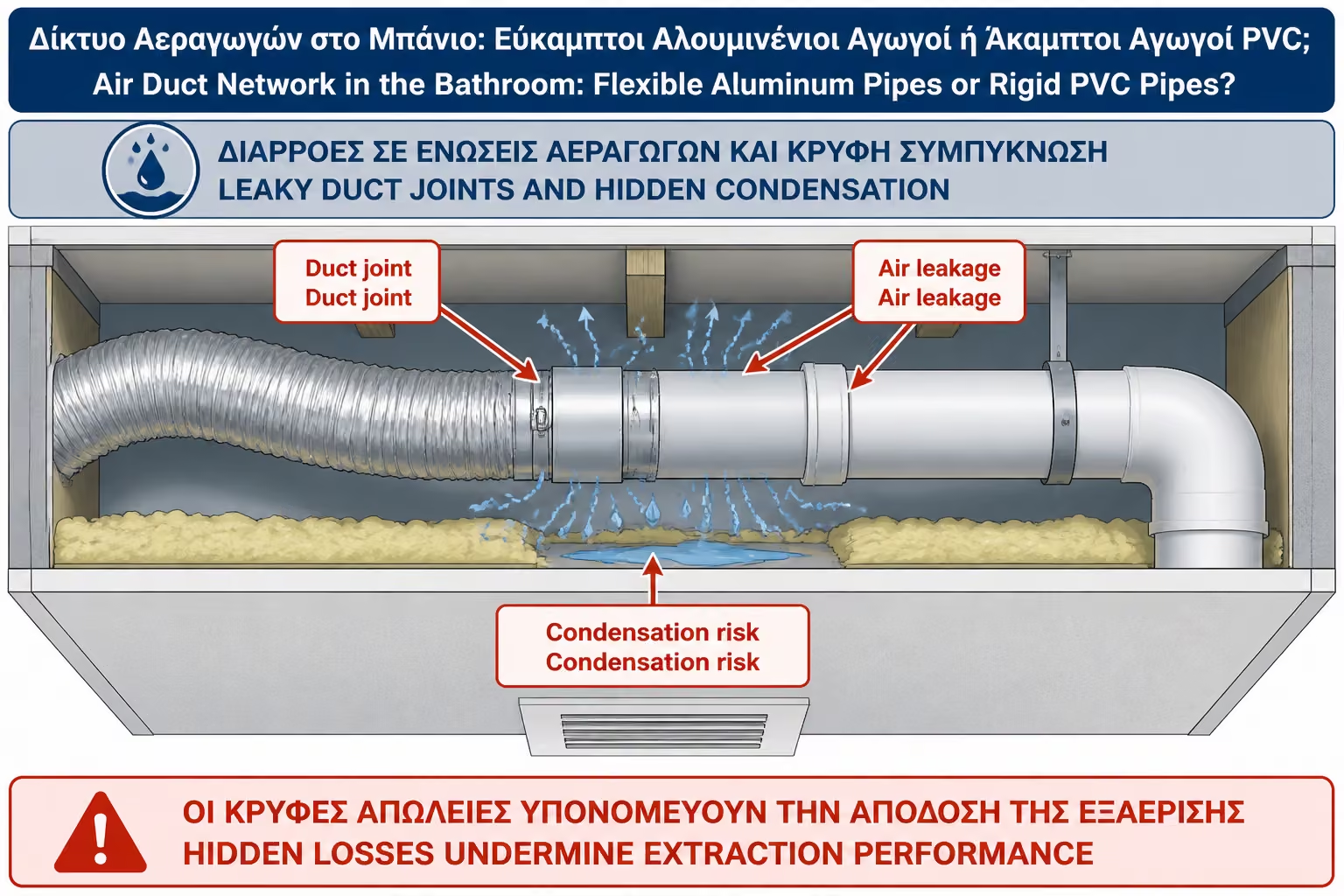
The air leaving the bathroom is warm and humid. If it passes through a cold pipe, especially in an attic, false ceiling near an outdoor area, roof or unheated void, water can condense inside the vent. If that water has nowhere to go, it can back up, drip off the grill, or stay inside the pipe.
This problem is more common on long runs and in poor positioning. A hose that makes a belly can hold water. An unsloped duct can collect condensation. An exit to a cold place without proper protection can create moisture.
The solution depends on the installation. Conduit insulation, proper slope, avoidance of bellies, better final outlet or shorter run may be needed. In some cases, the in-line vent must be placed where it does not create water traps.
A bathroom can have a proper vent and supply, but a bad vent that creates condensation. This is a hidden problem and often becomes apparent only after months.
The non-return valve prevents air from flowing back into the bathroom when the ventilator is not operating. It is very useful in skylights, windy outdoor exits and shared paths. But it adds resistance. If it is of poor quality or too hard, it can reduce the flow and create noise.
The final grille is also critical. It must protect against rain, insects and draft, but allow sufficient flow. A very dense screen or a grill with small openings can “choke” the system. A dirty grill can reduce performance even more.
On outdoor terminations, wind must also be considered. If the air hits the grill, it can create noise or returns. If the grill is in a bad spot, odors or moisture can get in behind.
The ventilation does not end at the fan. It ends at the exit. If the output is wrong, the whole system suffers.
If the duct has leaks, some of the air never reaches the outlet. Instead of going outside, it can end up in a false ceiling, loft, misplaced light fixture or masonry void. This not only reduces performance, but can create moisture in hidden places.
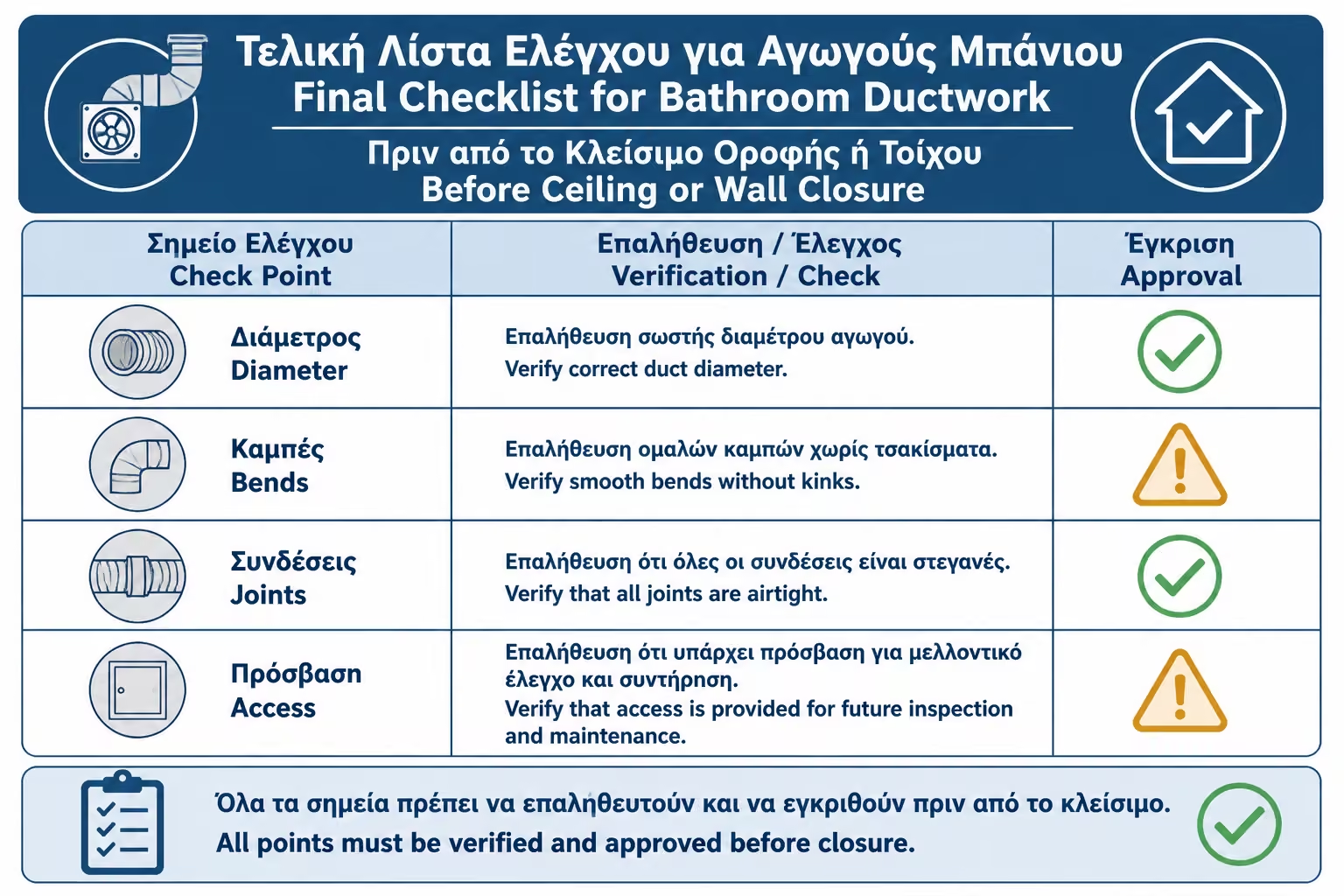
Joints must be properly buttoned, tightened and, where necessary, properly sealed. A rough tape that peels off after a while is not enough. Especially in suspended ceilings, where nothing is visible afterwards, the quality of the joints must be checked before the construction is closed.
A common mistake is to connect a hose to a nozzle without a proper clamp. Over time, from vibrations or temperature changes, the joint loosens. The fan continues to turn, but some of the moisture remains inside the suspended ceiling.
Before a false ceiling is closed, the vent must be tested. Check that it pulls, that there are no leaks and that the final outlet works.
Air duct can carry noise. The sound of the motor, wind noise and vibrations can pass through the pipe and be heard in the bathroom or next door. This is particularly important in in-line installations, where the motor is moved away from the bath to reduce noise.
If the conduit is too thin, poorly supported, or rests on drywall, it can transmit vibrations. If the air velocity is high due to a small diameter, a whistling sound may be heard. If the grills are small, they may hiss.
The solution may include correct diameter, better support, flexible anti-vibration sections, soundproof ducting in special cases or lower air velocity. Not everything is needed in every bathroom, but a bathroom next to a bedroom deserves attention.
The "silent" fan is not enough if the air duct network makes noise.
If the route is long or difficult, a simple wall-mounted axial fan may not be sufficient. In such cases, an in-line or mixed-flow ventilator in the duct may perform better. The motor is placed in the path, often in a false ceiling or technical point, and can be selected based on the resistance of the network.
The in-line is useful when we want the suction point to be close to the shower, but the outlet is far away. It is also useful when we want to reduce the noise in the bathroom by moving the motor further away. But it needs access for maintenance. If it closes inside a suspended ceiling without a window, the installation is problematic.
In a long airway, the in-line selection should be made along with diameter and stroke. It is not enough to put a more powerful motor in bad ducting. If the tube remains narrow, kinked or full of corners, performance and noise will remain problematic.
In-line is not a luxury solution. It is a technical solution when the route requires it.
Cost depends on length, diameter, pipe type, fittings, angles, grill, return, access, suspended ceiling, whether a new hole is needed and whether the work is being done on a new renovation or a finished bathroom. It is also affected by the area, the floor, whether VAT is included and whether the offer is for materials only or a complete installation.
| Work / material | Indicative range 2026 | What affects the price? |
|---|---|---|
| Flexible aluminum tube of short length | €10–€40 material | Diameter, quality, length |
| Hard PVC short path air duct | 20–80€ materials | Diameter, angles, fittings |
| New duct in suspended ceiling | 80–250€+ | Length, reach, supports |
| Larger diameter Φ125/Φ150 | Moderate cost increase | Space, grilles, compatibility |
| Back and outside grille | 15–80€+ | Quality, size, material |
| New hole in wall or outlet | 80–250€+ | Wall material, external access |
| In-line installation with network | 180–600€+ | Motor, ducts, door, suspended ceiling |
| Restorations / repairs | Wide variation | Tiles, plasterboards, plasters |
Low hose solutions are not necessarily wrong when the route is very short and simple. In a complete renovation, however, especially in a blind bathroom, it is often worth paying a little more for a proper smooth network, fewer corners and a better exit. The difference in daily performance can be greater than the difference in hardware.
The higher price is justified when it includes proper route design, quality materials, tight joints, access for maintenance and a clean exit. It is not justified simply because "a tube was inserted".
The goal is to make the route as easy on the air as possible. This means short length, correct diameter, few and gentle corners, smooth surfaces, tight joints and good final output.
In a complete renovation, plan the suction position first. Ideally close to the source of moisture, such as the shower, but respecting bathing zones and electrical safety. Then plan the route to the exit. If there is a suspended ceiling, do not let the air duct pass "as it pleases" at the end. Provide it together with lighting, cables and plumbing.
Avoid sharp corners immediately after the vent. Avoid reducing the diameter unnecessarily. Stretch the hoses. Support the hard conductors. Check the return. Do not exhaust air inside a closed false ceiling or loft. The air must be vented to a suitable external point.
A well designed network can make an average fan work better. A bad network can make a good fan fail.
Avoid flexible aluminum pipe as the primary solution when the run is long, when there are many corners, when the pipe will be hidden without access, or when you want low noise and stable performance. In these cases, hard smooth conductor is usually a better choice.
Also avoid him when he can't stretch. If there is no space inside the suspended ceiling and the pipe will be forced to bend, it is better to redesign the route. A kinked hose can reduce the cross-section so much as to invalidate the system.
It can be used on small connecting sections, for example from grille to hard duct or from in-line fan to vent, as long as it is properly stretched and supported. But it should not be used as a shortcut to avoid proper planning.
A hose is a tool, not an excuse for a bad ride.
Duct errors are often invisible because they are hidden behind false ceilings and grills. They are only visible from the result: noise, humidity, odors and low performance.
| Error | What it causes in practice | A more correct approach |
|---|---|---|
| Collected hose | Great resistance and noise | Stretched tube to the correct length |
| Many 90° angles | Supply drop | Fewer and gentler corners |
| Diameter reduction | Increased speed and noise | Maintain correct diameter |
| Extraction to suspended ceiling | Hidden moisture and mold | Exit to a suitable external point |
| Rough associations | Air losses | Clamps and proper sealing |
| Small outer grill | Whistling and resistance | Grille with sufficient free cross-section |
| Backlash that sticks | Reduced flow or noise | Quality valve and cleaning |
| Pipe without support | Vibration and noise | Proper support and anti-vibration logic |
| Extra long network with axial fan | Insufficient actual performance | Centrifugal or in-line |
| No access for maintenance | Difficult repair | Box or accessible point |
A typical example is a bathroom where a silent fan with a timer was installed, but behind it there was an old hose that made two bellies and a sharp corner. The fan was good. The network was bad. The result was noise and poor performance. By replacing the track with smooth PVC and fewer corners, the same device could perform much better.
| Inquiry | Yes / No |
|---|---|
| Is the airway path as short as possible? | Yes / No |
| Have unnecessary corners and sharp curves been avoided? | Yes / No |
| Does the pipe diameter match the vent? | Yes / No |
| Is diameter reduction avoided for no technical reason? | Yes / No |
| If there is a hose, is it fully stretched and not kinked? | Yes / No |
| Can the main run be done with a smooth hard tube? | Yes / No |
| Are the joints properly tightened and tight? | Yes / No |
| Is there a check valve where needed? | Yes / No |
| Does the final grille have sufficient free cross-section? | Yes / No |
| Does the air end up in a suitable external point and not in a closed space? | Yes / No |
| Is condensation predicted on cold runs? | Yes / No |
| Is there access to in-line motors or critical components? | Yes / No |
| Was the system tested before the suspended ceiling was closed? | Yes / No |
| Does the quote describe pipes, angles, grilles, returns, labour, VAT and incidentals? | Yes / No |
If you have to stick to one rule about vent pipes, stick to it: the vent doesn't perform according to its box, but according to the vent you give it. Short, straight and smooth path means better flow and less noise. Long hose, many bends, small diameter and rough connections mean that the motor "chokes". In a full rebuild, prefer hard smooth pipe for the main run and use flexible only in small, properly stretched sections. The ventilation network is hidden, but determines the entire performance.
Ductwork is the invisible part of bathroom ventilation, but it's often what makes the biggest difference. A good vent can fail if connected to a bad pipe. A modest fan can perform better if it has a short, clean and properly dimensioned path.
Flexible aluminum pipes are useful when the run is short, when ease of connection is needed, or when there is no other practical solution. But they must be taut, short and without wrinkles. Rigid PVC or smooth ducts are usually a better choice for the main route, especially in renovations where the network can be designed from scratch.
Many angles, long length, diameter reductions, poor grills and rough joints increase drag. This means less actual m³/h, more noise and slower bathroom drying. If the bathroom is blind or chronically damp, the correct ventilation is not a detail. It is a key technical element of the renovation.
The best time to solve the issue is before the false ceilings and walls are closed. Then you can choose correct diameter, clean path, fewer corners, correct outlet and access for maintenance. Then everything becomes more difficult and more expensive. The vent is visible from the cap, but works inside the tube.
Return to category.
Go to categoryReturn to the central guide.
Go to guide