
Bathroom Lighting, Ventilation & Heating
Return to category.
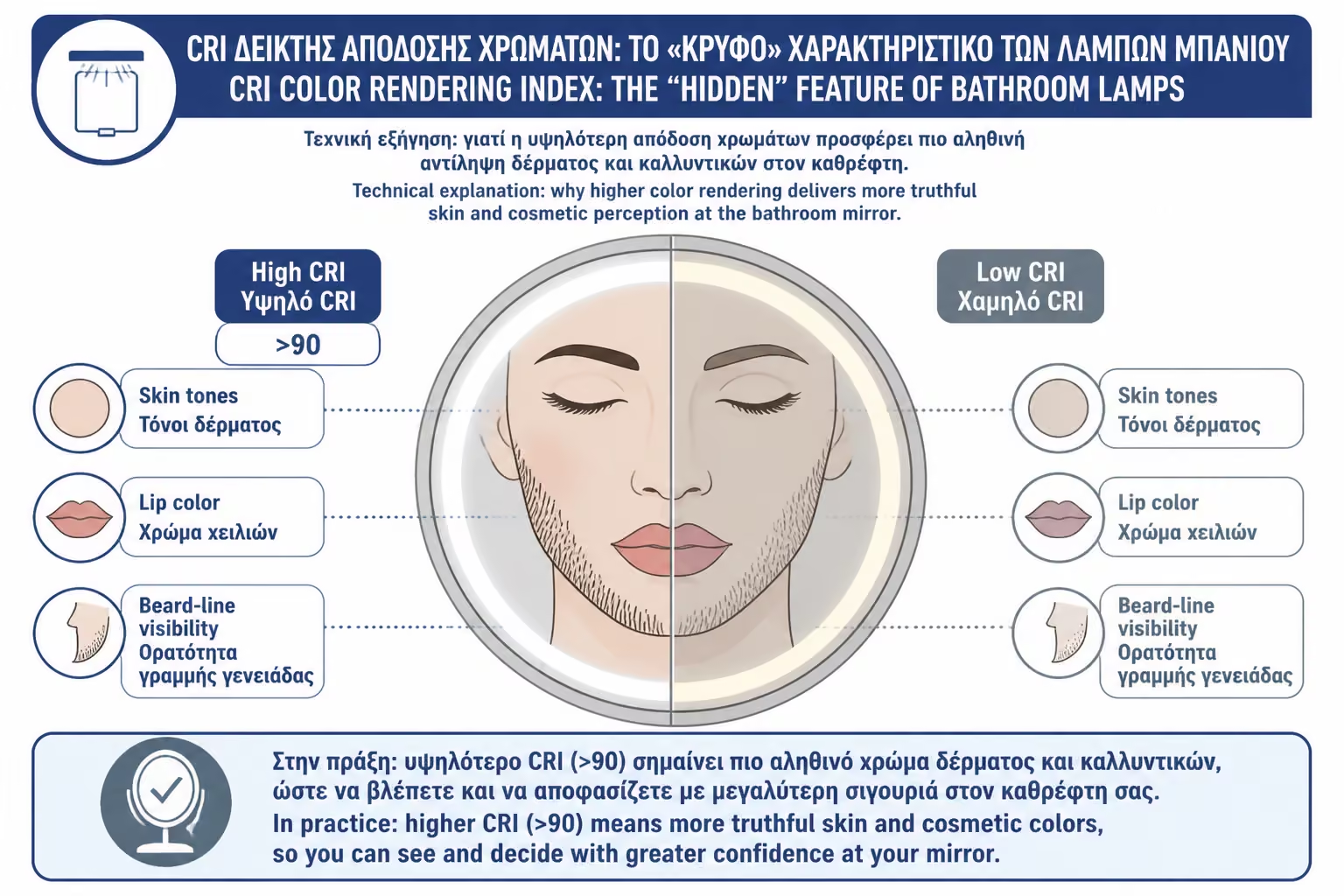
Go to categoryWhen a homeowner chooses bathroom lighting, they usually look at three things: design, watts or lumens, and color temperature, meaning whether the light is warm, neutral, or cool. Much less often it looks at the CRI index. And yet, this number can explain why two LEDs with the same intensity and color temperature look completely different on the face, tiles and bathroom materials.
The problem becomes particularly apparent in the mirror. A mirror can have a neutral light of 4000K, appear quite bright and yet the skin looks dull, the makeup unnatural or the colors not read correctly. The user can leave the house and see in natural light that the foundation, blush or aftershave doesn't look like they did in the bathroom. Kelvins are not the only ones to blame. Very often the low color rendering of the lighting is to blame.
CRI, from Color Rendering Index, shows how naturally a light source renders colors relative to an ideal or natural reference. Simply put, it doesn't tell us whether the light is warm or cool. It tells us how correctly the colors look under that light. This is critical in spaces where color matters. And the bathroom is just such a space.
In the bathroom we see our face up close, choose makeup shades, shave, check the skin, see the details of the tiles and judge whether the space looks clean and natural. An LED with a low CRI can make all of this more difficult, even if it is "bright enough". Therefore, for the mirror and basic lighting of a master bathroom, a very good practical choice is an LED with a CRI above 90.
It does not mean that every light with a CRI of 80 is useless or dangerous. In ancillary spaces it may be acceptable. But in the mirror, especially when the bathroom is used for make-up, shaving and daily grooming, CRI > 90 is not a luxury. It is one of the features that make the light look really quality in practice.
The CRI describes the ability of a light source to render colors naturally. The scale theoretically goes up to 100. The closer a light source is to 100, the more faithfully it renders colors relative to an ideal reference.
This does not mean that CRI is the only indicator of light quality, but it is a very useful practical guide. If an LED has a CRI of 80, it can satisfactorily illuminate a corridor, a warehouse or a utility area. However, if the same LED is placed in the bathroom mirror, it can make the skin look flatter, less natural, or slightly distort the shades.
The difference is not always immediately visible in the store. There the lights often look all "white" and "loud". But it shows in everyday use, when the user is trying to see details in the face or when the tiles don't show in the bathroom as they did in the sample.
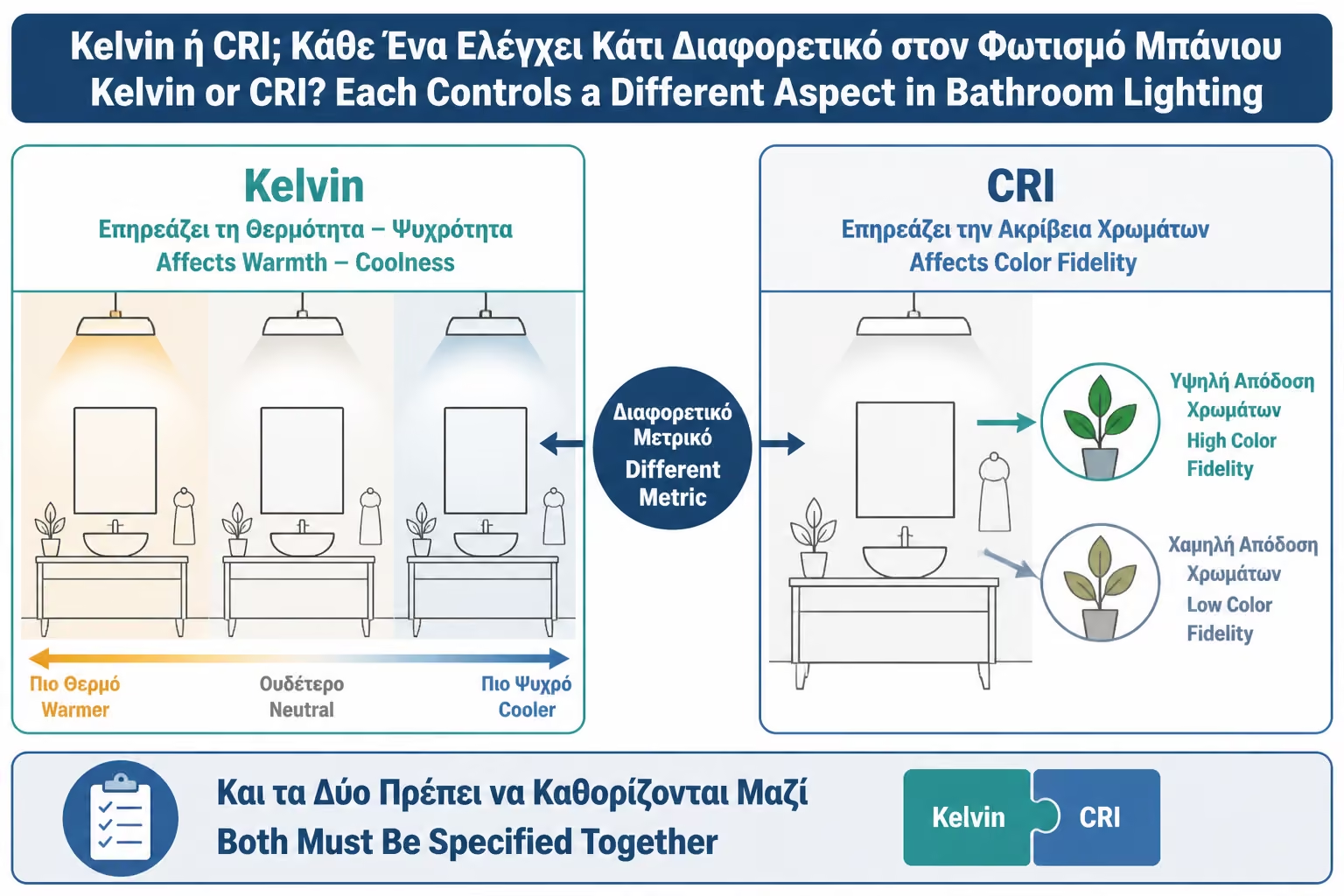
An important point is that CRI is not the same as Kelvin. One LED may be 4000K and have a CRI of 80, while another LED may also be 4000K but have a CRI of 95. Both will have a similar light “temperature” but will not render colors as naturally. This is the point that is often missed in budget lighting options.
The bathroom is a space where light is not only used to see where we are walking. It is used to evaluate details. Face, skin, hair, makeup colors, tile shades and surface clarity all depend on the quality of light.
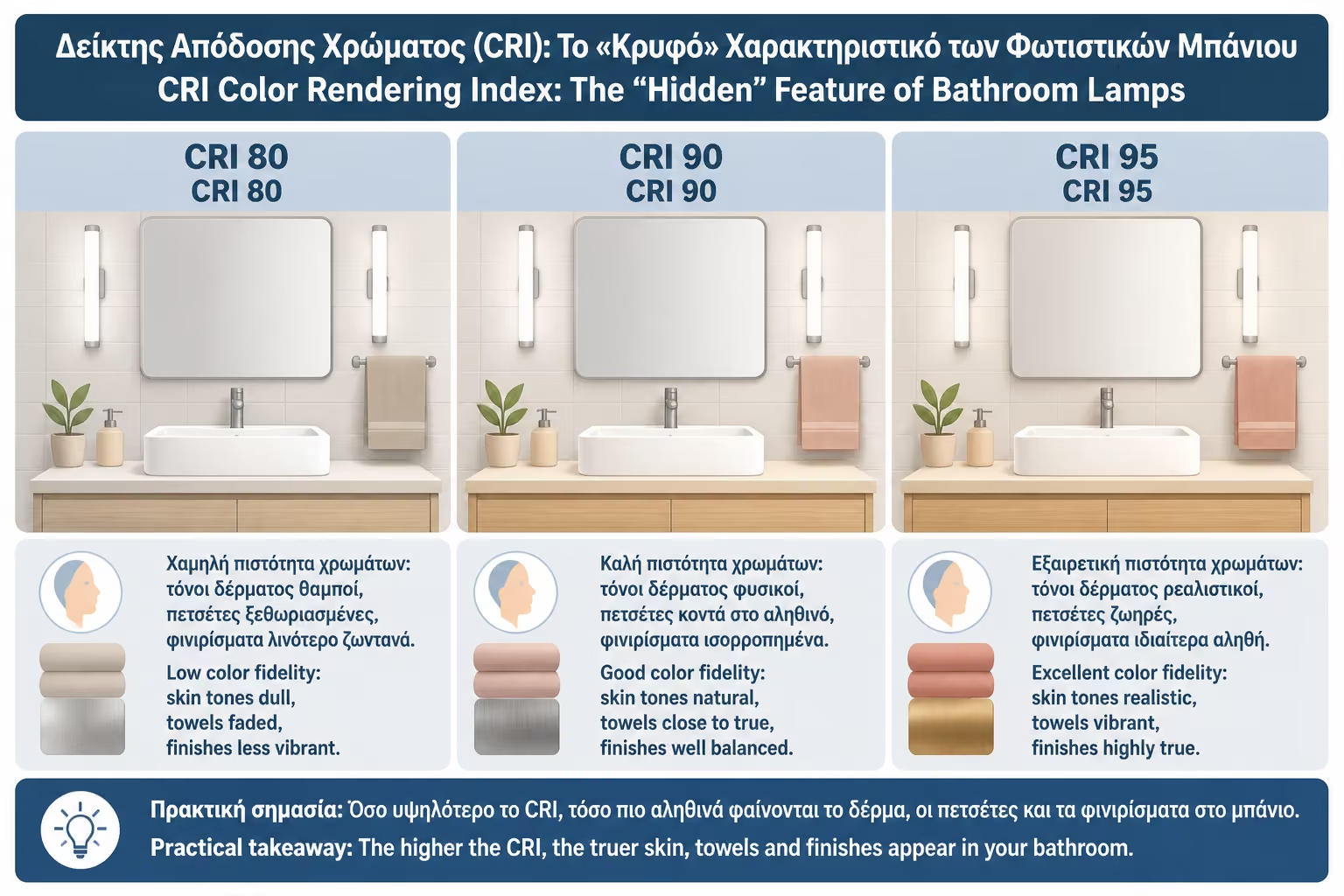
A bathroom with a low CRI may appear bright but not natural. White tile can look a little gray or cold. Beige tile can lose its warmth. Grays can take on strange shades. Skin may appear duller or duller than it actually is.
The problem becomes more pronounced in the mirror. There the user expects to see an image as close as possible to reality. If the light doesn't render the colors right, makeup can look right in the bathroom and different outside. When shaving, small bumps or contour details may not be clearly visible. In skin care, image can be deceiving.
That is why the CRI in the bathroom is not a "technical detail for electricians". It is a feature that directly affects everyday life. A lamp can be cheap, powerful and beautiful, but if it has poor color rendering, the user will know it every day without necessarily knowing why.
In the market we often find lamps and LEDs with a CRI of around 80. It is a very common value for general use and in many cases it can be acceptable. But in the bathroom, especially on the mirror, CRI 80 is often not the best choice.
CRI 90 and above is considered much more suitable for spaces where faithful color rendering is important. In the bathroom this translates into more natural looking skin, better perception of make-up, a more correct image of the tiles and a more pleasant overall feeling of lighting.
| CRI | Practical picture | Suitability for bathing |
|---|---|---|
| CRI < 80 | Possible color distortion, poorer image | Best avoided in basic bathroom lighting |
| CRI 80–89 | Acceptable for general use, not ideal for mirror | It can be used in auxiliary places |
| CRI 90–94 | Much better color naturalness | Very good choice for mirror and master bathroom |
| CRI 95+ | Even more accurate performance | Ideal for demanding use, makeup, premium lighting |
The difference between CRI 80 and CRI 90 is not always spectacular at first glance, especially if we are only looking at a white wall. But it is seen in more complex colors: in the leather, in the wood, in the beige and gray tiles, in the shadows of the face and in the colors of the make-up.
A practical example: two LED mirrors might both read 4000K. One has a CRI of 80 and the other a CRI of 92. The former may appear “strong” but make the face flatter. The second one may not look more impressive in the photo, but in everyday use it looks much more natural.
Makeup is one of the most demanding uses of lighting in the home. It doesn't just need enough light. It needs light that renders the shades correctly. Foundation, concealer, blush, bronzer and eyeshadow are all based on slight color differences. If the light alters them, the result may look different outside the bathroom.
With a low CRI, the user may not clearly see the differences between pink, beige, yellow or neutral undertones. The face may appear more even in the bath than it actually is. Thus, makeup is applied based on an image that is not entirely reliable.
With CRI > 90, the light renders skin and products more naturally. This does not mean that the result will be perfect in every condition, because other elements such as light direction, Kelvin and shadows also affect. But the risk of the user seeing a "fake" image in the mirror is significantly reduced.
Therefore, if the bathroom mirror is used for make-up, CRI should be included in the main selection criteria, along with color temperature and the right lighting position. A 4000K LED with a CRI > 90 is usually a much better base than a random cool LED that just looks strong.
In shaving, the user needs cleanliness and detail. He wants to see contours, redness, shadows, areas that need attention, and skin texture. Here color rendering plays an important role, even if it is not as obvious as in makeup.
A light with a low CRI can make the face appear flatter. Small color differences in the skin are not well distinguished. If it is combined with the wrong lighting direction, for example light only from above, the result becomes even more difficult: there are also shadows and reduced color fidelity.
With a higher CRI, the face looks more natural and details become more distinct. This is especially helpful for daily shaving, beard grooming, line correction or post-shave irritation control.
No need to turn the bathroom into a professional lighting studio. But the mirror needs to have light that does not distort. For this, CRI > 90 in mirror illumination is a practical and not an excessive specification.
CRI is not just about the face. It also concerns the materials of the space. In a bathroom renovation, the owner often invests time and money in choosing tiles, joints, furniture, countertops, faucets and decorative details. If the lighting has poor color rendering, this can all look less correct than it is.
Beige and earth tiles can look dull. Grays can appear cold or “dead”. Natural textures such as wood, stone or marble can lose depth. Even white is not always the same under different CRI. It may look less clean or take on an unwanted tint.
A typical example is the bathroom where the owner chooses an expensive tile with fine water, but lights it with cheap, low-quality LEDs. The tile is not highlighted. Waters look flatter, color loses intensity and the space does not have the effect you expected. It's not the tile's fault. It's the light's fault that doesn't render it right.
Conversely, good lighting with a CRI > 90 can highlight even simpler materials. It doesn't make a budget tile luxurious, but it helps it look clean and natural. In a small space like the bathroom, this is of great importance.
Many owners feel that if they choose 4000K, they have solved the issue of light quality. 4000K is indeed a very good temperature for the mirror and master bath, but it is not enough by itself. It also needs good color rendering.
Kelvins tell whether light appears warm, neutral, or cool. CRI tells how natural colors look within that temperature. So two LEDs at 4000K may have a different result because they have a different CRI. One can be pure and natural. The other may look flat and poor.
The right choice for the mirror is not just “4000K”. It is “4000K with high CRI, good diffusion and correct light direction”. If one of them is missing, the result may not be ideal.
| Feature | What does it show? | Because it matters |
|---|---|---|
| Kelvin | Whether the light is warm, neutral or cool | It affects the feeling of space |
| CRI | How correctly the colors are rendered | Affects face, makeup, tiles |
| Lumens | How much light the source produces | It affects the amount of lighting |
| Diffusion | How soft or hard the light is | Affects shadows and glare |
| Direction | Where does the light come from? | It affects usability on the mirror |
This is also the reason why a "powerful LED" is not necessarily a good LED. Lighting quality is a combination of characteristics, not a single number.
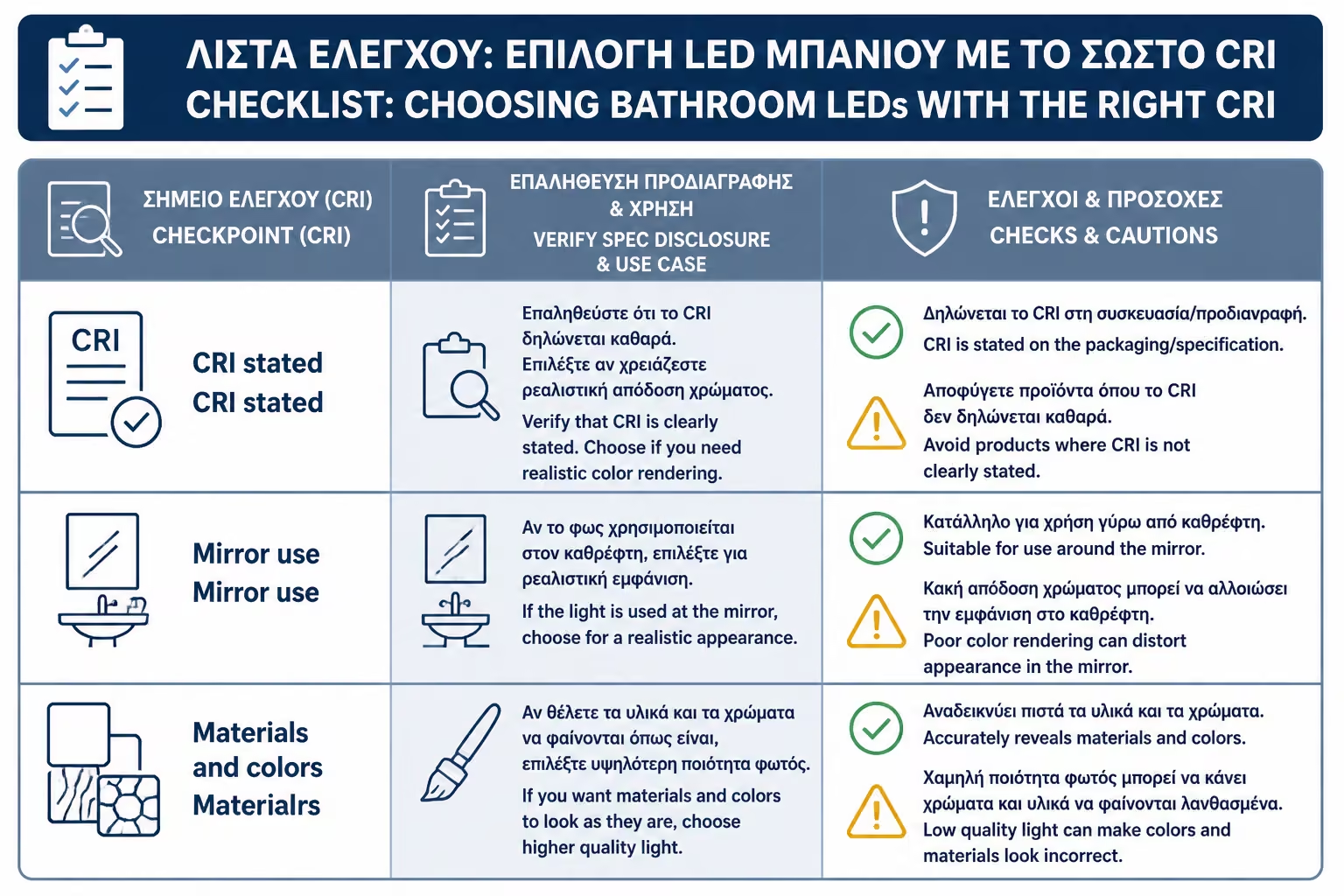
In many budget fixtures, especially in name-brand products or products sold primarily on price, the CRI is either not listed at all or is generally listed. The consumer sees watts, lumens, Kelvin and maybe IP protection, but not color rendering.
This is not to say that every financial product is bad. But it means that the owner does not have a complete picture. If a light is intended for a warehouse or hallway, he may not be so concerned. But if it is intended for the bathroom mirror, the absence of CRI information should make him more cautious.
The reason CRI is often "hidden" is simple: higher color rendering LEDs usually cost more. It's not always a huge difference, but it's there. A product that competes only on the lowest price may use LEDs that are bright enough, but do not render colors as naturally.
In practice, the question to be asked of the supplier is simple: "What CRI does the fixture or mirror have?" If the answer is no, the owner must decide if they care about color accuracy. For the master bathroom mirror, it usually has to be interesting.
LED mirrors have become a staple in bathroom renovations, but not all of them are suitable for true face lighting. Many give a beautiful image to the photo, but do not provide information about the quality of light.
Before buying an LED mirror, you need to check if the lighting is frontlit, backlit or a combination. Backlit lighting mainly illuminates the wall behind the mirror and is more atmospheric. The frontlit light comes out towards the user and is more practical for makeup and shaving. If the mirror is only backlit, even if it has a good CRI, it may not give enough light to the face.
CRI is particularly important in frontlit mirrors, because there the light is used directly for the face. A frontlit mirror at 4000K with a CRI > 90 is clearly a more reliable choice for a master bathroom than a mirror with an unknown CRI and strong cold light.
Attention is also needed for mirrors with adjustable color temperature. Just because they change from 3000K to 4000K or 6500K doesn't mean they have high color rendering. Kelvin change does not replace CRI. A mirror can have many settings but mediocre light quality.
General bathroom lighting doesn't always require the same level of color accuracy as a mirror, but that doesn't mean it should be ignored. If the general lighting has a low CRI, the whole space can look less natural.
In a master bathroom, especially if it has neat tiling and materials, it is also good practice for general lighting to have a CRI of at least 80–90, with a preference for higher quality when the budget allows. If the mirror has a CRI > 90 but the ceiling spots have a low CRI, there may be a difference in the image depending on which light is on.
Ideally, the mirror should have the highest CRI priority, but also the general lighting should not be too low quality. Especially in small bathrooms, where the lights mix easily, the differences are more pronounced.
In guest WCs, where use is shorter and color accuracy less critical, it can be a more economical option. But even there, a better lighting makes the space look more qualitative.
Hidden lighting in the bathroom usually has another role. It is not used for makeup or shaving, but for atmosphere, depth and low light. So CRI is not always as critical as it is on the mirror.
If an LED strip goes under hanging furniture, behind a mirror or inside a niche as a decorative element, more emphasis can be placed on color temperature, diffusion, moisture protection and uniformity. However, if the hidden lighting brings out a tile, stone or wooden surface, the CRI is still useful. A material with a nice texture may look poorer under low quality LED strip.
A common mistake is to place very economical LED strip in a prominent place, such as a shower niche with a decorative tile. On the first day she looks impressive. But then the owner notices that the color of the tile looks different or that the light is uneven. It's not just the tension that's to blame. The quality of the LED is also to blame.
For ambient lighting you don't always need a CRI of 95. But when the lighting highlights materials or is visible every day, it's best not to go for the cheapest non-spec film.
The CRI gives an overall picture, but it doesn't always tell the whole story. A particularly important point for the skin is the performance of red shades. In more technical specifications you may come across the R9 indicator, which is associated with bright red.
Why does this matter in the bathroom? Because skin is not just "beige". It has pink, red, slightly yellow or neutral undertones. If the light doesn't render red tones well, the face can look dull, lifeless or different than in natural light.
In the everyday market, the owner does not necessarily need to request a detailed technical report for each lamp. But in an expensive LED mirror or lighting intended for make-up, it is useful to have a high color rendering index and, if available, a good R9 rendering.
This is one point where very cheap products usually fall short. They may have an acceptable general CRI, but render moderately specific hues that are critical to the face. For the common owner, the rule of thumb remains: in the mirror, we're looking for high-quality LEDs, not just strong light.
The ideal is to see the lamp or mirror up close. In practice, however, many purchases are made from e-shops. In this case, specifications become even more important. Don't settle for just product photos. Photos of fixtures are often edited or taken in conditions that do not show actual performance.
Ask or search for specific information: Kelvin, CRI, lumen, lighting type, if it is frontlit or backlit, if it is dimmable, if it has IP protection for bathroom and what warranty is provided. If it's LED strip, ask for details about the strip, not just the profile.
A simple hands-on check, if you're in a physical store, is to look under the product light at your hand, a piece of white paper, and an object with a red or beige hue. If the skin looks dull or the white takes on an odd hue, the light may not be ideal for a mirror.
It's not a scientific measurement, but it helps. Even better, if you're choosing tiles and lighting together, see a sample tile under similar lighting. This way you avoid the disappointment of the bathroom looking different from the showroom.
CRI affects cost, but not always too much. In the Greek market of 2026, the difference between a simple LED lamp and a quality lamp with CRI > 90 can be small or significant, depending on the product, brand, power, design and application.
For simple spot or bathroom downlights, choosing a higher CRI can raise the price, but usually not to the extent that it dramatically changes a renovation budget. For LED mirrors, the difference can be greater, because it is combined with build quality, anti-glare function, touch control, dimmer and better electronics. For custom LED strips, cost is affected by strip quality, profile, power supply, IP protection and installation work.
| Selection | Indicative picture of costs | When is CRI > 90 worth it |
|---|---|---|
| Bulbs / just LEDs | Small to moderate price difference | When they illuminate a mirror or key space |
| Bathroom spot / downlights | Moderate difference per piece | In the main bathroom and careful materials |
| LED mirror | Greater variance | Almost always, if used for makeup |
| LED hidden lighting tape | Depends on movie, profile and driver | When highlighting a tile or exposed surface |
| Custom lighting | Higher total cost | In demanding or premium bathrooms |
Prices depend on region, supplier, whether VAT is included, quantity, access, electrical installation and whether the quote is for materials only or materials plus labour. As with any technical choice, the higher price is justified when it corresponds to real quality, not just a commercial description.
The practical advice is simple: if you have to keep costs down, don't cut from the mirror lighting first. There CRI > 90 has more value than in a secondary hidden light.
Although CRI > 90 is a great choice for the mirror and master bathroom, there is no need to obsess over every light fixture in the room. There are cases where a good CRI of 80–89 may be sufficient, especially if the fixture does not affect the face or underlying materials.
In a small guest WC, where the mirror is used for a short time, it may not be necessary to pay for top color performance. In a dim night light under the furniture, CRI is not as critical as safety, correct intensity and pleasant color temperature. In an ambient lighting that is rarely turned on, absolute color accuracy is not always a priority.
The point is to prioritize correctly. First we prioritize the mirror. Then to the general lighting of the master bathroom. Then to the lighting that highlights materials. Finally come the purely auxiliary or decorative light sources.
So the budget is used more intelligently. Not everything has to be premium. It needs the critical points to be correct.
CRI is a feature that is often not discussed at all in a simple bathroom renovation. This leads to options that seem logical at first, but are frustrating to use.
| Error | What it causes in practice | A more correct approach |
|---|---|---|
| Selection based on Kelvin only | The light has correct hue but poor color rendering | Control and CRI, especially on the mirror |
| Buy LED mirror without specifications | Unknown light quality | Ask for CRI, Kelvin and lighting type |
| Choice of very cheap LED strip in a prominent place | Materials appear poor or damaged | Quality tape, correct profile and driver |
| CRI > 90 only on the mirror but very poor general lighting | Inconsistency in the image of the space | Balanced quality in key lights |
| Emphasis on brightness only | Strong but unnatural light | Combination of lumens, CRI, diffusion and position |
| Buy from product photo | Actual performance is not shown | Spec check or try it in person |
| Ignorance of R9 in demanding use | Skin looks dull | High quality LED for makeup |
The most dangerous mistake is to assume that "all LEDs are approximately the same". Is not. Two fixtures can have the same wattage, same Kelvin and similar price, but completely different light quality. CRI is one way to distinguish this difference before the purchase is made.
Before approving bathroom fixtures, ask for specific answers. You don't need to talk in overly technical terms. You just have to ask the right questions.
Ask what CRI the mirror and general lighting fixtures have. Ask what the color temperature is in Kelvin. Ask if the light is suitable for a bathroom, what IP protection it has, if it is dimmable and if the driver or power supply is reliable and accessible for maintenance where needed.
For an LED mirror, ask to know if the lighting is frontlit or backlit, if it has an anti-glare function, if it has touch control, if it remembers the last setting and if the characteristics of the light are clearly stated. If the mirror is intended for make-up, explicitly ask for high color rendering.
The electrician must check for safe installation, supplies, humidity zones, compatibility with switches or dimmers and proper wiring. The supplier must provide clear specifications. The owner must know what he is buying and why.
| Inquiry | Yes / No |
|---|---|
| Is the CRI listed on the fixtures or the mirror? | Yes / No |
| Does the mirror lighting have a CRI > 90? | Yes / No |
| Is the color temperature suitable for use, usually around 4000K on the mirror? | Yes / No |
| Has a distinction been made between Kelvin and CRI? | Yes / No |
| Does the mirror shine towards the face and not just towards the wall? | Yes / No |
| Is there good diffusion to avoid harsh shadows? | Yes / No |
| Have the tiles or material samples been tested under similar light? | Yes / No |
| Is the LED strip, if any, of sufficient quality and correct profile? | Yes / No |
| Are the fixtures suitable for use in a bathroom and humidity? | Yes / No |
| Has the IP protection been checked based on the mounting position? | Yes / No |
| Does the offer state whether it includes lighting, power supplies, labour, VAT and incidentals? | Yes / No |
| Has the electrician confirmed the correct and secure connection? | Yes / No |
If the bathroom mirror is used daily for makeup, shaving or grooming, don't buy LED just because it says 4000K or because it looks powerful. Ask for CRI > 90. Kelvins determine the hue of the light, but CRI determines how natural the colors appear. A good LED on the mirror should combine neutral temperature, high color rendering, correct diffusion and safe installation. If you have to save, save on secondary decorative lights, not the light you look at your face every morning.
CRI is one of the most important yet most overlooked features in bathroom lighting. It's not always visible in the product photo and not always mentioned in the simple descriptions, but it directly affects how the face, makeup, shaving, tiles and materials of the space look.
For the master bathroom mirror, especially when used daily, the LED option with CRI > 90 is a practical and essential upgrade. It is not enough that the light is strong. It must be reliable. It must show colors naturally, not distort the skin and work with the right color temperature and lighting position.
The best result is obtained when lighting is treated as a system. Kelvin for feel, CRI for color naturalness, lumens for light quantity, diffusion for comfort and proper installation for safety. When these are combined correctly, the bathroom doesn't just look brighter. It looks more natural, cleaner and more properly designed.
Return to category.
Go to categoryReturn to the central guide.
Go to guide