
Bathroom Lighting, Ventilation & Heating
Return to category.
Go to categoryThe mirror is probably the most demanding lighting point in the bathroom. There we don't just want the space to be "seen". We want to see the face correctly. We want clarity, balance, correct color rendering and as few shadows as possible. For shaving, make-up, contact lenses, skin care or just daily preparation, mirror lighting directly affects comfort and the final result.
The common mistake is that the mirror is treated as a decorative element. A beautiful lighted mirror or a lamp above the sink is selected and we consider the matter solved. But in practice, many times the user stands in front of the mirror and sees a shadow under the eyes, a strong shadow on the nose, dark areas under the chin or a distorted sense of skin color. The bathroom may seem bright, but the face may not be properly lit.
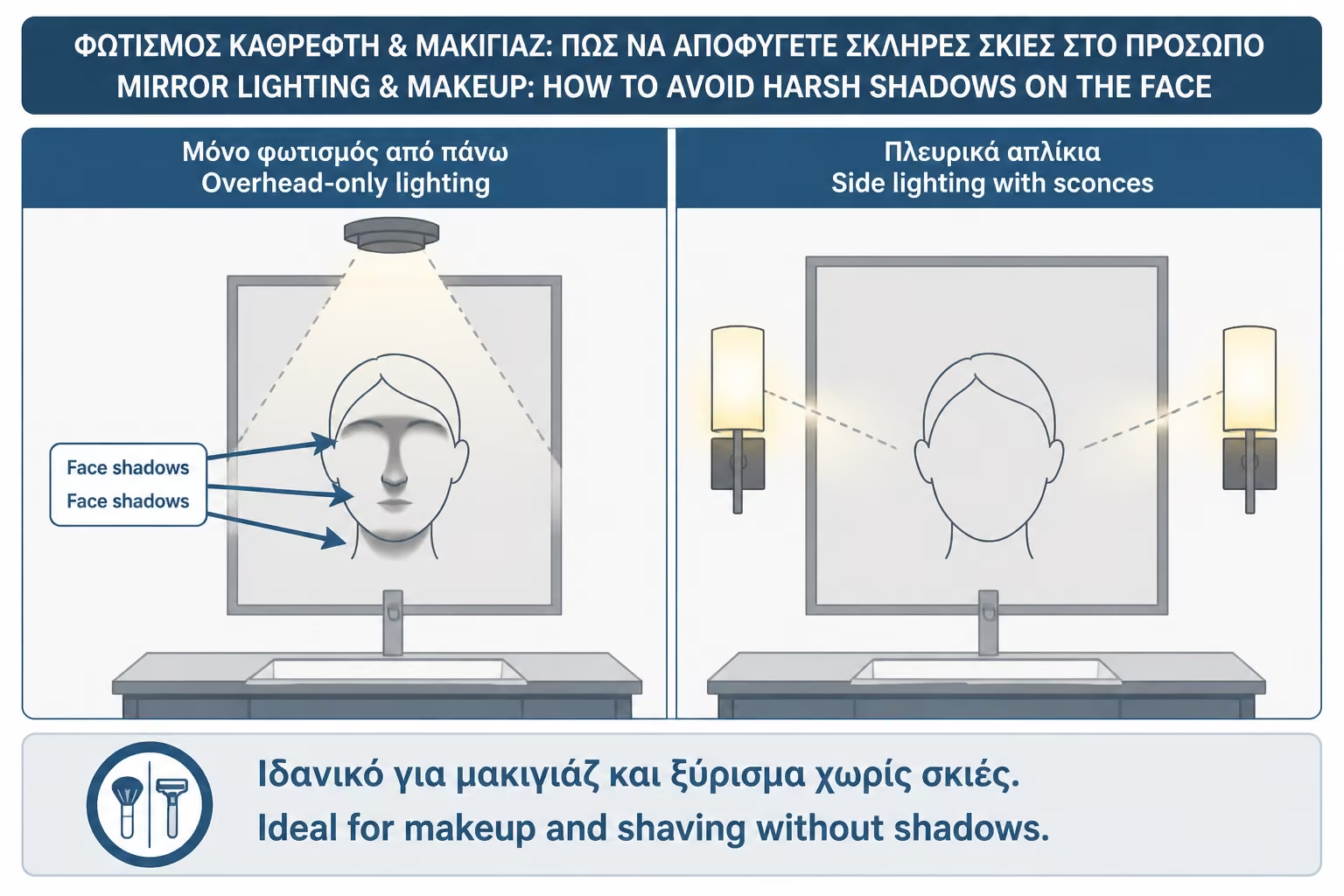
This is mainly because the light is coming from the wrong direction. When the main lighting is only on the ceiling or only above the mirror, it falls on the face from above. The effect is similar to standing under a powerful spotlight: illuminated, but not flatteringly or functionally. Shadows become harsh and detail is lost exactly where we need it.
The right mirror lighting doesn't necessarily need to cost too much. It takes proper logic. The light should come from the front and as evenly as possible towards the face. That's why sconces to the right and left of the mirror, or a quality mirror with real front lighting, usually work better than a strong overhead light alone. The point is not to put more light, but to put it in the right place.
In this guide we'll see what good mirror lighting means in practice, why harsh shadows are created, which lights really help with make-up and daily care, what you should pay attention to before the electrical supplies are made and how to avoid options that look impressive in the photo, but disappoint in everyday use.
The general lighting of the bathroom has a key role: to illuminate the space as a whole. We want to see the floor, the shower, the furniture, the sanitary ware and the surfaces. The mirror lighting, however, has another role. It doesn't light up the space. It illuminates man.
This difference is crucial. A bathroom can have very good ceiling lighting and yet the mirror does not work properly. The reason is that the user usually stands between the light source and the mirror. If the light is coming from the ceiling, much of it falls above or behind the head, creating shadows on the face.
Consider a small apartment bathroom, where there is a light fixture in the center of the ceiling and a mirror above the sink. When the user approaches the mirror, their body cuts off some of the light. The forehead may be brightly lit, but the eyes and the area below the nose remain darker. For a quick hand wash this doesn't bother. For makeup or shaving, however, it becomes a daily problem.
Proper mirror lighting should be designed as task lighting. Just as a kitchen counter needs its own light to see what we are doing, so the mirror needs its own light to see the face clearly. The central light is not enough, no matter how powerful it is.
Harsh shadows are created when light comes from a bright, small, or misplaced source. On the face they are mainly seen under the eyes, on the sides of the nose, under the cheekbones and under the chin. It's not just a matter of aesthetics. It's a matter of accuracy.
In makeup, harsh shadows can lead to a misjudgment of color and intensity. Foundation can look more even than it is, blush brighter or duller, and eyeshadows different from how they will look in natural light. When shaving, the shadow under the chin or in the contours of the face can make accuracy difficult. In skin care, minor redness, blemishes or dry spots may not show clearly.
The problem becomes more pronounced when the luminaire has a narrow beam or when the LED is very "bare", without proper diffusion. A strong spot above the mirror can cast a lot of light, but in a way that creates harsh contrasts. The user feels that the bathroom is bright, but cannot physically see their face.
That is why the solution is not to simply increase the lumens. More light from the wrong spot can make shadows even more intense. The right solution is softer, more diffused and more forward light.
Light from above is practical for general lighting, but problematic for the face. When the source is above the mirror or on the ceiling, the light falls vertically or at a sharp angle. The forehead and nose are illuminated more, while the hollows of the face remain in shadow.
This is why many bathrooms look "properly lit" when we look at them empty, but not when we use them. The photo of the space can look good because the wall, sink and tiles are illuminated. But the user in front of the mirror sees something else: shadow under the eyes, deeper lines on the face and a harsher image than the real one.
A lamp above the mirror is not always wrong. It can work in small WCs, utility bathrooms or when it has very good diffusion and is complemented by other light sources. But as a single source for makeup or daily care, it's rarely the best choice.
The main problem is direction. The face needs light coming towards it, not light falling on it. The more forward and balanced the light is, the more natural the result becomes.
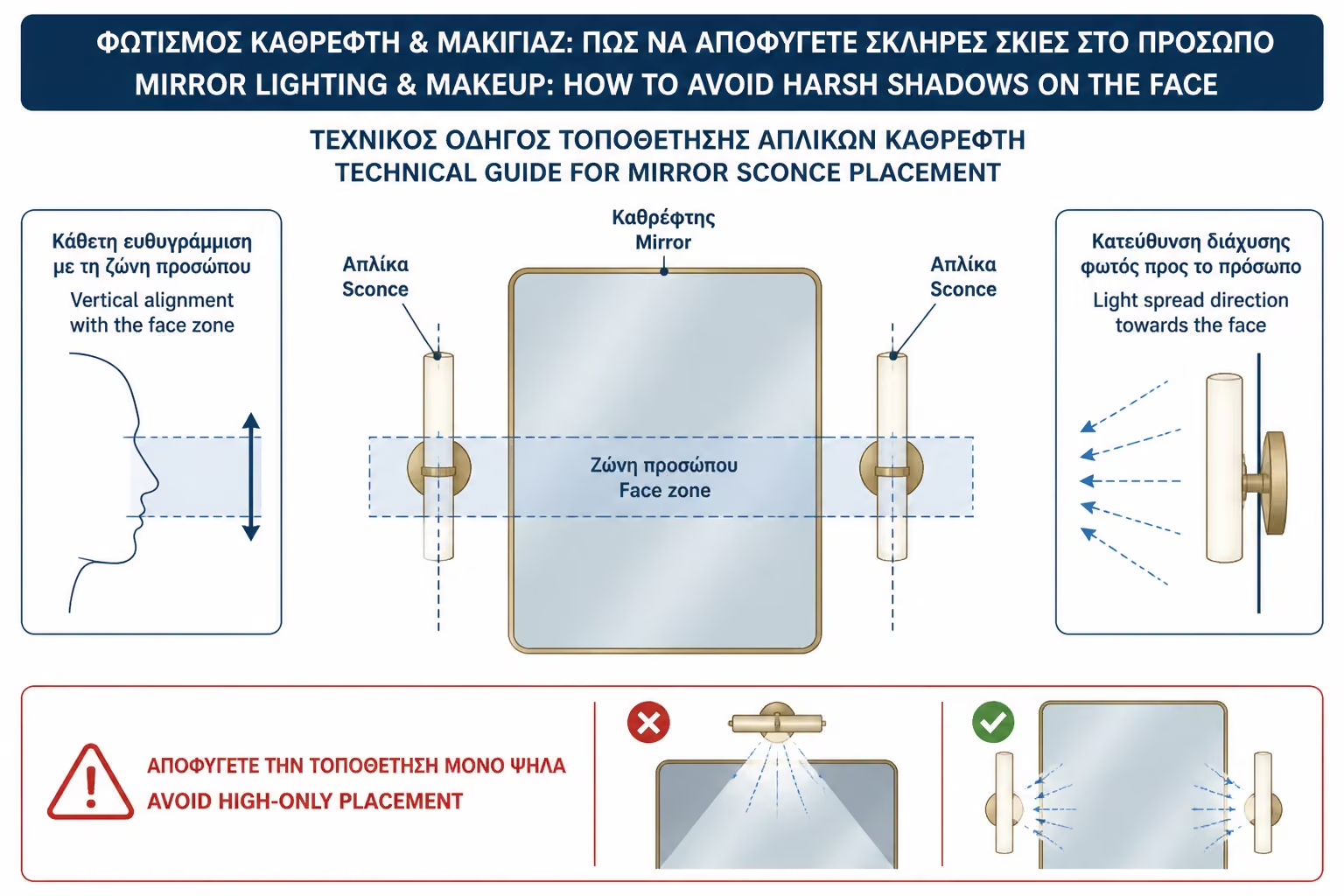
Sconces to the right and left of the mirror are considered one of the most correct solutions for facial lighting, because they bring the light closer to the user's height and distribute it more evenly. Instead of light falling from above, it comes from the front and from both sides, reducing harsh shadows.
The ideal logic is that the light sources are approximately at the height of the face. It doesn't have to be exactly the same height for every user, but too high or too low should be avoided. In a family bathroom, where people of different heights use the mirror, a middle position is usually chosen which practically serves most people.
Vertical sconces are particularly effective, because they give light at a greater height and not just at a small point. They can illuminate the face more evenly from the forehead to the chin. Small, very decorative sconces can be beautiful, but if they have a narrow beam or low brightness, they do not solve the problem.
A typical example: in a bathroom with an 80 cm mirror, two thin vertical sconces on the sides can give a much better face image than an expensive ceiling light. The owner can spend less on "impressive" general lighting and more on the correct position of the mirror. This is more apparent in daily use.
The correct position of the sconces depends on the height of the mirror, the width of the furniture, the available width on the wall and the height of the users. There is no absolute dimension that fits every bathroom. But there is a practical principle: sconces should illuminate the face, not the wall, not the ceiling, not just the top of the head.
Typically, side sconces are placed to the right and left of the mirror, with their center at or slightly above eye level. If they are vertical and long enough, they are more forgiving of small deviations, because they spread the light over a larger surface. If they are small and pointy, their location should be much more careful.
The distance from the mirror also matters. If the sconces are inserted too far, the light can be too wide and lost in the space. If they get too close to or behind the plane of the face, they can create reflections or unevenness. In narrow bathrooms, where the mirror takes up almost the entire width of the wall, side sconces may not fit. There, another solution is needed, such as lighting integrated into the mirror or a light with very good diffusion on the top.
Before the electrical supplies are made, the width of the mirror must be decided. This is critical. If the waits come out first and then a mirror of a different dimension is bought, the sconces may be in the wrong place. The result will either look ugly or require maintenance on a finished wall.
Not all bathrooms have the space for sconces on the right and left. In many Greek apartments, the wall of the sink is narrow, the mirror is located near a corner, or there is a cabinet, window, column, or restriction from plumbing and electrical waits. In these cases, the solution is not to abandon proper lighting, but to choose the best possible alternative.
A quality lighted mirror can work well as long as its light is forward and not just peripheral to the wall. There are mirrors that mainly create a decorative halo behind the glass or around the perimeter. These give a nice atmosphere, but they don't necessarily illuminate the face properly. For make-up you need a mirror that emits enough light towards the user, with uniform diffusion.
Another solution is a horizontal lamp above the mirror, but with careful selection. It should have a wide spread, not a narrow beam. Don't be too high. Do not "hit" only the forehead. If the lamp is long and soft, it can work quite well, especially in smaller bathrooms. It's not as ideal as the two side light sources, but it's much better than a simple spot on top.
In more demanding cases, an illuminated mirror can be combined with soft general lighting, so that there is not much contrast between the face and the rest of the bathroom. Balance is important. If the face is brightly lit but the surrounding area is dark, the effect can be tiring.
Illuminated mirrors have become extremely popular, and with good reason. They give a clear image, reduce the need for separate lamps and often offer functions such as an anti-glare surface, touch switch or color temperature change. But they are not all the same.
The first thing that needs to be clarified is whether the mirror illuminates towards the user or towards the wall. The lighting towards the wall creates a beautiful atmosphere, but it is not enough for makeup. Forward lighting, with light zones on the mirror surface, is more practical for the face. Even better are mirrors that have a diffused, even light without bright LED dots showing through.
A frequent mistake is choosing a mirror only from an e-shop photo. In the photo the mirror looks impressive, but it is not always clear how much light it emits and in which direction. The owner installs it, turns on the light, and finds that the result is more “hotel atmosphere” and less actual makeup lighting.
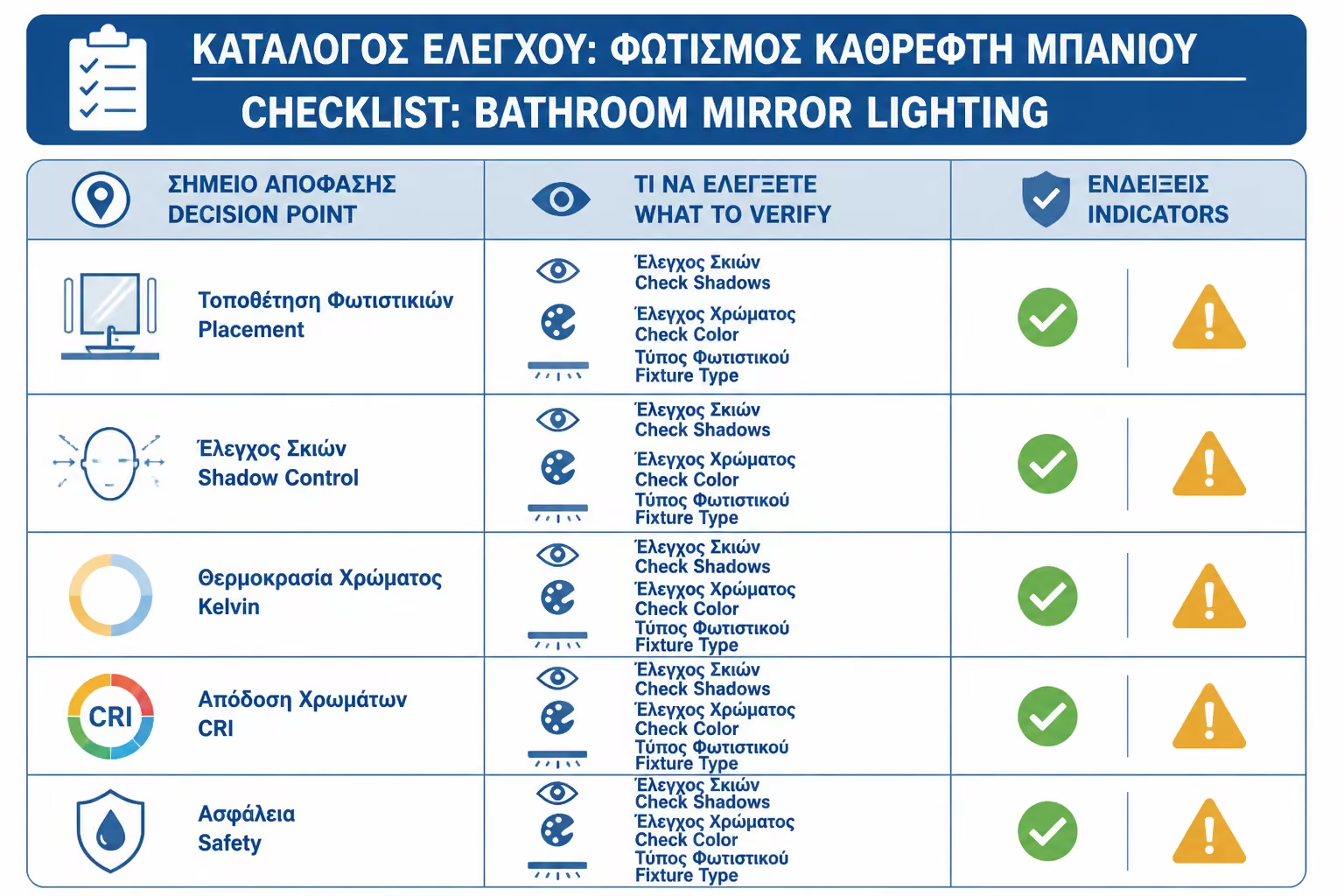
If the mirror is the main source of work lighting, specifications such as brightness, color temperature, CRI, diffusion quality, anti-glare function and connection method must be checked. If these are not clear, it is better to consider the mirror as supplementary and provide additional lighting.
For make-up and daily care, the color temperature should be as natural and stable as possible. Too much warm light can make skin look more yellow or paler than it is. Too much cold light can harden the features and make the bathroom look like a business or doctor's office.
In practice, for a main house bathroom, neutral options around 3500K–4000K usually work well. 3000K is warmer and more pleasant, but in some cases it may not be as accurate for makeup. 4000K gives a clearer picture and often helps more with grooming, without necessarily becoming cold, as long as the fixtures are of good quality.
Accidental mixing of different temperatures should also be avoided. If the mirror has 6500K and the ceiling 3000K, the face will be illuminated with cold light while the room will have a warm atmosphere. This creates visual inconsistency and can affect color perception. If a temperature-adjustable mirror is chosen, it is useful to have a fixed setting for daily use rather than constantly changing it for no reason.
For guest WCs, where no make-up or detailed grooming is done, warmer light may be preferred for ambiance. For a master bathroom, however, the functionality of the mirror should come first.
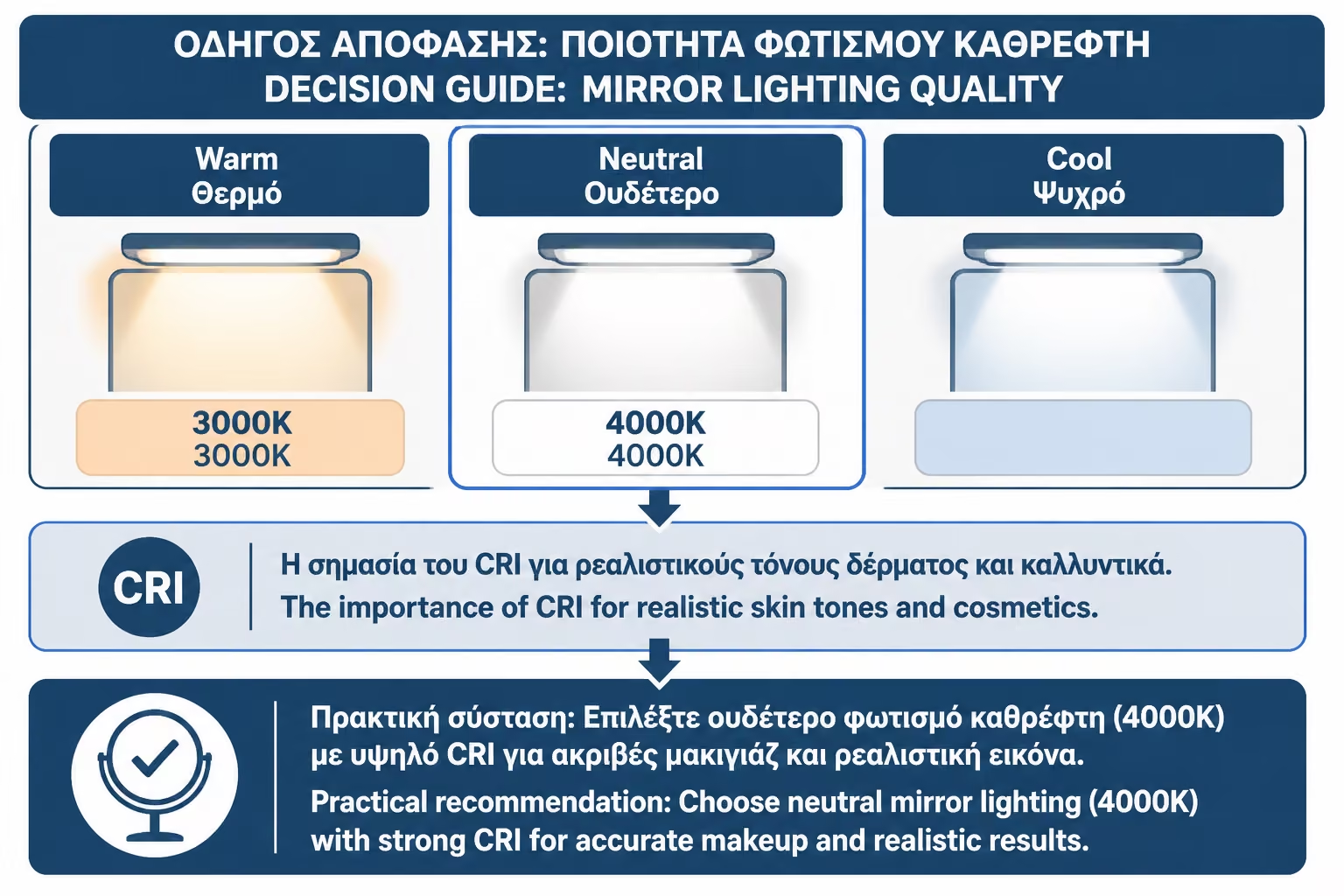
One point that is often overlooked is the color rendering index, known as CRI. Simply put, it shows how naturally a light renders colors. For makeup, this is of great importance. If the light doesn't render the colors well, the skin, foundation, lipstick or shadows may look different than in natural light.
In a simple corridor, CRI may not be of much concern to the owner. In the bathroom mirror, however, it makes a difference. A cheap LED can be powerful, but give "dead" or unnatural looking colors. The user sees enough light, but not a correct image.
For makeup use, it is worth looking for lamps with a high color rendering. We don't always need to go into overly expensive solutions, but it's good to avoid anonymous fixtures without clear specifications. When the supplier cannot provide basic information on color temperature, CRI and brightness, the choice becomes more a matter of luck than design.
This is a typical point where the cheap solution may seem acceptable at first, but annoys every day. It doesn't necessarily break down. She just doesn't do her job right.
Mirror illumination should be sufficient for clear detail, but not so bright as to be dazzling. Excessive brightness at a short distance from the face can be tiring, especially if the lamp does not diffuse well. The eye doesn't just want intensity. He wants comfort.
The correct brightness depends on the size of the mirror, the color of the tiles, the distance of the user from the mirror and the rest of the lighting in the bathroom. A bathroom with white or light colored tiles reflects more light. A bathroom with dark, matte tiles absorbs more and needs better study.
In practice, it is better to have a choice. If the mirror is used both for make-up and casual evening use, a dimmable system or a dimmable mirror can be very practical. But the dimmers must be compatible with the LEDs and correctly provided for in the installation. Not all fixtures work with all dimmers.
A mistake we often see is choosing too much light on the mirror without diffusion. The user turns on the light and feels that it "hits him in the eye". This is not proper makeup lighting. It's just bright light. The goal is clean, soft and even light on the face.
In the bathroom there are many reflective surfaces: mirror, shiny tiles, glass cabinet, chrome faucets, shiny counter or sink. If the lighting is placed at the wrong angle, it can create annoying reflections.
Glossy surfaces are not a problem in themselves. The problem is when light hits them in a way that bounces straight back into the eye. A light above the mirror can be reflected on the mirror or on a glossy tile behind the sink. A ceiling spot can "hit" the glass cabin and create annoying glare points.
For this the mirror lighting must be tested mentally based on the user's position. Where will he stand? Where will he look? What surface is opposite? If the bathroom has high gloss tiles behind the sink, you may need more diffused light rather than small, bright sources.
On matte surfaces, reflections are reduced, but light is absorbed more. So a higher light output may be needed. Every choice of material also affects the lighting. That is why planning should not be done in isolation.
The type of mirror greatly affects the lighting. A simple rectangular mirror usually leaves room for side sconces. A round mirror can be very beautiful, but it often makes it difficult to place sconces correctly, especially on a narrow wall. A mirrored cabinet has depth, so sconces must be chosen so that they do not clash visually or practically with the body of the cabinet.
In a mirror-cabinet, built-in lighting can be practical, but needs control. Many such products have an overhead or under-cabinet light, more for use than perfect face lighting. If the bathroom is used daily for make-up, additional lighting may be needed.
Large wall mirrors pose another challenge. If they take up the entire width above the sink, there is no room for side sconces. There, lighting can be integrated into the mirror or a horizontal light with very good diffusion can be used. In more elaborate solutions, a light zone can be drawn within the plane of the mirror itself.
The important thing is not to first choose the mirror only based on the image and then look for the lighting "somehow". Mirror and lighting must be decided together.
In bathroom renovation, the order of decisions is very important. Mirror lighting should not be decided after the tiles have been completed. By then we should already know where the facilities will be, at what height, how many switches will be needed and what type of mirror will be included.
The correct order is to first decide the layout of the bathroom: sink position, furniture, mirror, cabinets and possible sockets. Then the lighting logic must be chosen: side sconces, illuminated mirror, light above the mirror or a combination. Then the electrician comes to leave supplies in the right places.
If the order is reversed, the problems begin. The electrician leaves one outlet above the mirror, but then the owner chooses two sconces. Or facilities are left right and left, but in the end a very large mirror is bought that covers them. Or a mirror with a built-in switch is selected, but no proper permanent supply is provided behind it.
These are not rare scenarios. They often occur when lighting is treated as a final decorative detail. In fact, it is a technical decision from the beginning of the project.
Mirror lighting is located in an area where current, humidity, water vapor and often water coexist around the sink. That is why the installation must be done by a licensed electrician and the lamps must be suitable for use in a bathroom.
It is not enough for a lamp to be beautiful or economical. It must be suitable for its location, have correct protection, correct connections and be installed in accordance with current electrical installation rules. The exact requirement depends on the position of the fixture in relation to the sink, shower, bathtub and the humidity zones. No arbitrary generalization should be made.
Particular attention is needed in lighting fixtures very close to the sink, in mirrors with built-in power, in shaver sockets or in combinations of mirror, anti-glare function and LED. The owner does not need to know all the technical details, but should ask the electrician to confirm that the choice is safe and suitable.
In older homes, before adding new facilities, it is a good idea to check the existing installation. If there are old lines, rough joints or inadequate protections, the renovation is an opportunity to fix them. Lighting is an aesthetic issue, but electricity in the bathroom is a safety issue.
The cost depends on whether we are talking only about the purchase of lighting or also about electrical work, repairs, new supplies, switches, dimmers, LED mirrors or special construction. It is also affected by area, access, floor, condition of existing facility, whether prices include VAT and whether the quote is for materials only or materials plus labour.
For a typical residential bathroom, mirror lighting can be done relatively cheaply if there is already a supply and a simple but quality light fixture is chosen. But if two new sconces, switch changes, tiling or a higher quality lighted mirror are needed, the cost goes up.
| Selection | Indicative range 2026 | What to watch out for |
|---|---|---|
| Simple lamp above a mirror | €30–€120 | Diffusion, length, IP protection |
| Side sconces | 40–180€ / pc. | Height, light beam, build quality |
| Quality vertical sconces | 80–250€ / pc. | Uniformity, CRI, design, protection |
| Illuminated mirror | 120–450€+ | If it illuminates in front or only around the perimeter |
| Mirror with anti-glare function | 180–600€+ | Dimensions, LED quality, warranty |
| New electrical supplies | Wide variation | Digging, tiling, errands, access |
| Dimmer or smart control | Additional cost | LED compatibility and installation |
A low price is not necessarily bad, especially in a small WC or simple use. But if the mirror is a basic point of daily care, it is not worth making a choice based only on the lowest cost. A lamp that doesn't illuminate the face properly will be annoying every day, even if it was cheap on the market.
On the other hand, the most expensive solution is not always needed. Two well-placed, simple but quality sconces can do better than a striking LED decorative mirror that doesn't have enough brightness. Correct placement and correct diffusion are often more important than price.
Many mistakes in mirror lighting are not visible on the day of installation. They are visible afterwards, when the bathroom is used normally. The owner may be excited by the first image, but then find that the light is tiring, creates shadows or is insufficient for makeup.
| Error | What it causes in practice | A more correct solution |
|---|---|---|
| Light only from the ceiling | Shadows on the face | Separate mirror lighting |
| A small lamp above the mirror | Light only in the forehead, shadow in the eyes | Side sconces or diffused front light |
| Illuminated mirror for ambiance only | Nice effect, insufficient makeup light | Brightness and light direction control |
| Very cold light | Hard skin image | Neutral temperature 3500K–4000K |
| Low CRI | Incorrect color rendering | Selection of lamps with good color rendering |
| Provisions without a mirror selected | Wrong positions, errands | Mirror and lighting decision before the electrical ones |
| All lights in one switch | No flexibility | Separate switch for mirror |
The most expensive mistake is not always the most obvious. It could be a wrong supply behind the mirror, a light fixture that doesn't change easily, or a mirror that covers the waits. These are difficult to fix when the bath is finished.
When you get a quote for a bathroom renovation, lighting is often described in general terms: “mirror light”, “LED mirror”, “sockets”, “electrical”. These descriptions are not always enough. It should be clear what exactly is included.
The owner should ask for clarification: who supplies the lighting? Is placement included? Are there separate provisions for sconces? Are switches included? Does the mirror have its own switch or does it connect to a wall switch? Are the fixtures suitable for a bathroom? Is there a place for a power outlet near the mirror, where it is allowed and with the right specifications?
Also, it must be clarified whether the offer includes contingent consideration. If the wall is already tiled and needs to be routed, the cost is not the same as a pre-tiling installation. In a new renovation, changes are easier as long as the walls are open. After completion, each change becomes more difficult.
A good offer is not necessarily the most detailed in technical terms, but it should answer the practical questions. Where will the light come in? How will it light up? What does it illuminate? Is it safe? Can it be maintained? Does it fit the mirror to be selected?
| Inquiry | Yes / No |
|---|---|
| Has the mirror type and size been decided on first? | Yes / No |
| Is the light coming from the front and not just from above? | Yes / No |
| Is it possible for sconces on the right and left? | Yes / No |
| If sconces won't fit, has a truly functional lighted mirror been chosen? | Yes / No |
| Does the mirror illuminate the face and not just the wall behind it? | Yes / No |
| Has an appropriate color temperature been selected for daily care? | Yes / No |
| Has the color rendering of the luminaire been checked? | Yes / No |
| Is the light diffused and does not dazzle the user? | Yes / No |
| Are the fixtures suitable for bathrooms and wet environments? | Yes / No |
| Are proper utilities provided prior to tiling? | Yes / No |
| Does the mirror lighting come on independently of the general lighting? | Yes / No |
| Does the offer make it clear what is included in fixtures, labour, supplies and VAT? | Yes / No |
If the mirror is used daily for makeup, shaving or grooming, don't just rely on the ceiling light and don't choose a mirror light just because it looks good. The crucial thing is the direction of the light. We want light from the front, ideally to the right and left of the face, with good diffusion and correct color rendering. Before the electrical supplies are passed, decide on mirror, height, width and type of lighting. After tiling, any correction becomes more difficult and more expensive.
Proper mirror lighting is not a luxury. It's a matter of everyday comfort and practicality. A bathroom can be beautiful, clean and modern, but if the mirror casts shadows on the face, its use will always be problematic. Makeup, shaving and grooming need light that renders the face correctly, not just a bright light somewhere in the room.
The basic principle is simple: the light must come from the front. Sconces to the right and left of the mirror are often the most balanced solution, because they reduce shadows and illuminate the face more naturally. When they do not fit, careful selection of a lighted mirror or light fixture with good diffusion is needed. Light alone from above can be practical as a supplement, but it is rarely the ideal base solution for makeup.
The best decision is to design the mirror lighting from the beginning of the renovation, along with the mirror, furniture, fixtures and switches. This avoids shadows, temporary solutions, wrong waits and extra tasks. In the end, good lighting is not only visible in the bathroom photo. It is seen every morning when the user stands in front of the mirror and sees clearly, naturally and comfortably.
Return to category.
Go to categoryReturn to the central guide.
Go to guide