
Bathroom Lighting, Ventilation & Heating
Return to category.
Go to categoryThe bathroom is one of the few spaces in the house that must serve completely different needs within the same day. In the morning we want clear, strong and functional light. We want to shave, paint, see the face clearly, check details and start the day without half-dark corners. At night, however, the same bright light can become tiring, abrupt and almost annoying.
This is where the dimmer really changes the use of the bathroom. It doesn't just add a "luxury". It gives control. It allows the same space to operate with a different intensity in the morning, a different intensity in the evening and a different intensity in night use. A bathroom that with a simple switch is either fully lit or dark, with a dimmer can acquire intermediate states that make everyday life much more comfortable.
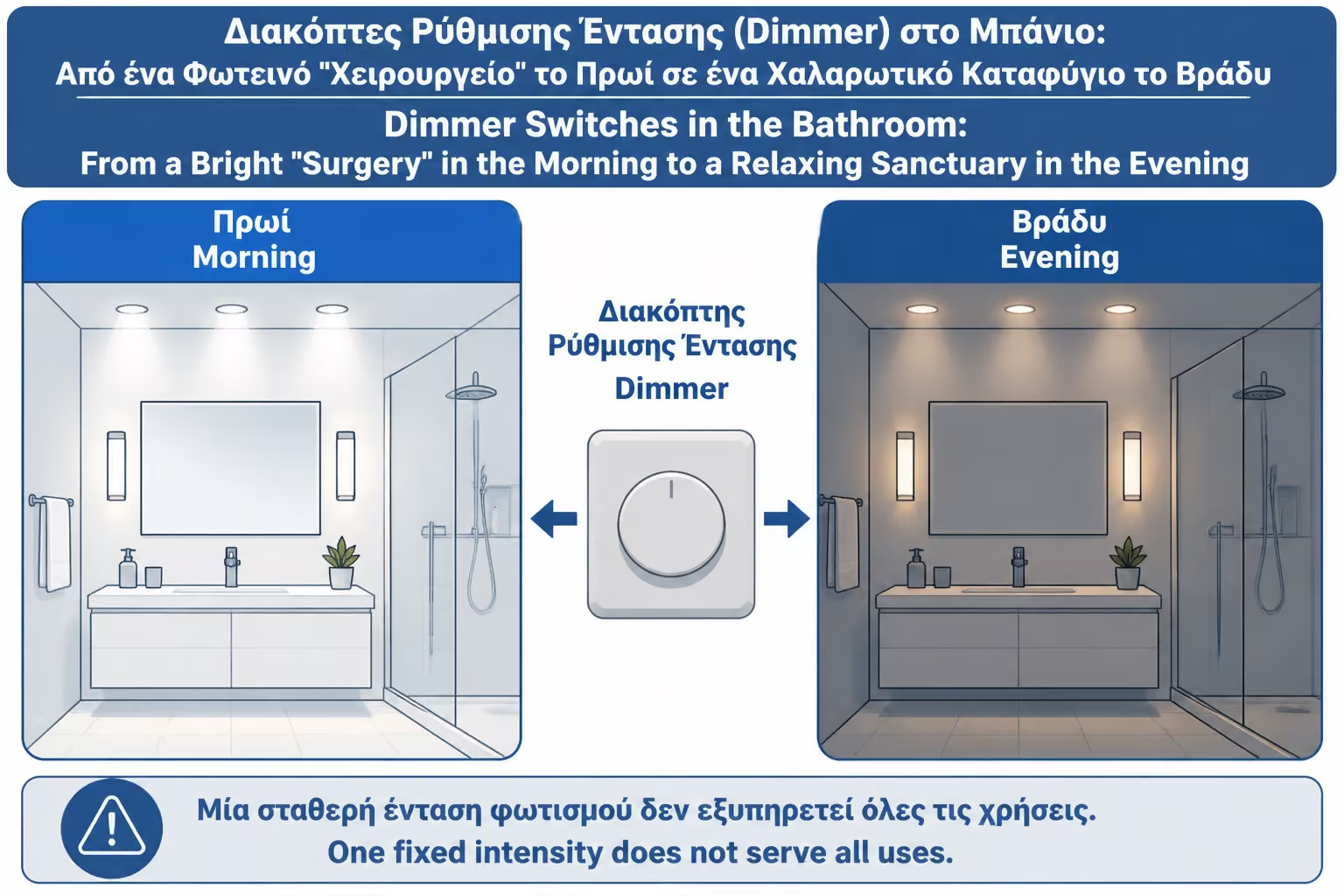
The picture is simple: in the morning, the general lighting and the mirror work at high intensity, so that the bathroom is clean, bright and practical. At night, the same light can descend lower, so that the space does not resemble a "surgery". In a leisurely shower, an evening grooming routine or a nighttime visit to the WC, low light makes a big difference.
But the dimmer in the bathroom is not just a switch that replaces the old one. Especially with LEDs, compatibility is needed. Not all lamps are dimmable. Not all bulbs work with all switches. Not all drivers are suitable for volume adjustment. If the wrong choice is made, flickering, buzzing, limited dimming range or lights that do not turn on and off correctly can occur. Even LED manufacturers emphasize that the compatibility of LED lamps, dimmers and electronic drivers must be checked by product and system.
In the bathroom there is another level of attention: electrical safety. Spaces with a bathtub or shower are subject to special requirements for low-voltage electrical installations, as reflected in ELOT HD 60364-7-701:2024 for spaces containing a shower or sprinkler. This does not mean that the owner must become an electrician. But it does mean that dimmers, lights, drivers, humidity zones and protections must be checked by a licensed professional before installation.
A dimmer is a mechanism that allows you to adjust the intensity of the lighting. Instead of the light being only "on" or "off", it can operate at intermediate levels. This sounds simple, but in practice it completely changes the feel of the space.
In a bathroom without a dimmer, the user has one basic choice: full volume or darkness. If the light is strong, it is practical in the morning but harsh in the evening. If the light is softer, it is pleasant for relaxing but insufficient for mirroring, cleaning or shaving. The dimmer solves this dilemma, because it allows the same light fixture to be adapted to use.
The important thing is to understand that a dimmer is not a substitute for proper lighting design. If the mirror is lit incorrectly, the dimmer will not correct the shadows. If the light fixture is unsuitable for a bathroom, the dimming setting does not make it safe. If the LED has poor color rendering, lowering the intensity does not make it quality.
The dimmer is a control tool. It works best when it is preceded by proper planning: suitable fixtures, correct positions, correct color temperature, good diffusion and safe installation.
In the morning, the bathroom is a work space. The mirror must illuminate the face properly. General lighting must allow clear visibility. Light should help detail, not blur. In this usage, low light means fatigue, makeup mistakes, difficulty shaving and dark spots.
At night, however, the need changes. After a long day, too much light can be harsh. Especially if the bathroom has white glossy tiles, LED mirror, many spots or cold light, the full intensity can make the space hard. The user does not always want "maximum visibility". He wants peace.
There is also night use. There strong light is often an exaggeration. If one gets up at 3 in the morning and turns on the central light at full intensity, the eye is immediately disturbed. A low light or a dimmable circuit can make a visit to the WC much smoother.
This is the real reason why a dimmer makes sense in the bathroom. Not because it is "modern", but because the space has different roles during the day.
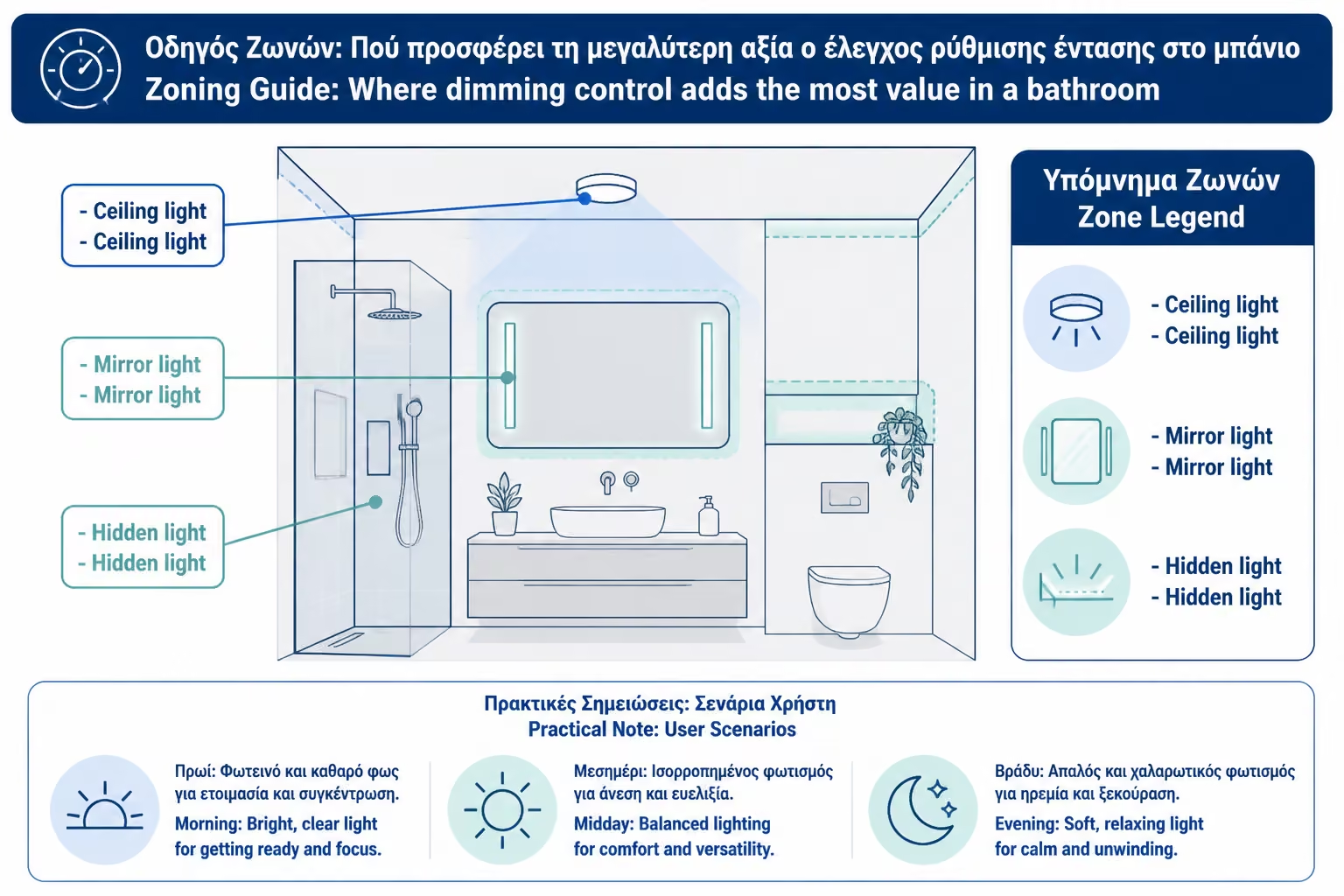
Not every bathroom light needs to have a dimmer. In many cases, dimming is mainly worth in specific circuits: general lighting, hidden lighting or an ambient lighting level. Mirror lighting needs a more careful approach, because it often has to maintain a constant quality and intensity for makeup or shaving.
In general lighting, the dimmer is practical because it changes the whole feel of the space. A bathroom with three ceiling spots can operate at 100% in the morning and at 40% or 50% in the evening. So there is no need for a second system for each use.
In concealed lighting, the dimmer is even more valuable. An LED strip under hanging furniture or behind a mirror can be impressive at full intensity, but at low intensity it becomes ideal for night or relaxing lighting. There the dimmer helps to keep the hidden lighting from looking excessive.
In the mirror, dimming can be useful, but it should not sacrifice practicality. For make-up and shaving you need enough intensity, correct color rendering and stable light. If the dimmer causes flicker or changes the image quality, it is better to have a separate fixed work light and dimming on the other levels.
In the morning, the bathroom must function cleanly. This does not mean that it should be overlit. It means that the lighting must be sufficient, uniform and properly directed. A dimmer allows to find the point where the space is bright without becoming harsh.
In a bathroom with general ceiling lighting and an LED mirror, the morning scenario might be: general lighting at 80–100%, mirror at 100% and hidden lighting off or low. So the space works practically without being loaded with unnecessary effects.
This is especially useful in bathrooms with lots of white or shiny materials. Full intensity on all lights can create strong reflections. With a dimmer, the general lighting can be dimmed a bit, while the mirror remains strong where needed.
A frequent mistake is to try to achieve an atmosphere by putting in lower power lights from the beginning. But then in the morning there is not enough space. The dimmer provides a better solution: we put in the right lighting and adjust it according to use.
At night, the bathroom can become a small place to unwind. It doesn't have to be a luxurious master bathroom to have that feeling. Even a small bathroom can appear calmer when the light is properly dimmed.
In this scenario, general lighting may drop to 30–50%, the mirror may be turned off or run low, and hidden lighting may take over the atmosphere. If there is an LED under the furniture, behind the mirror or in a niche, the low intensity creates depth without tiring.
Color temperature also plays a role. A hidden lighting at 3000K with a dimmer can give a much more relaxing feeling than a cold white LED. If the bathroom is only 4000K, dimming can still help, but the warmer ambient level gives a stronger sense of calm.
The evening scenario is where the dimmer shows its value the most. The same space that is functional and bright in the morning can become calm in the evening without changing any material.
Night use is one of the most practical applications of dimming. In many homes, the bathroom is lit at night with the same strong light used in the morning. This is awkward and abrupt. A low light level can solve the problem.
The best solution is often a separate low light: under hanging furniture, in a low spot, behind a mirror or in a hidden line. If this is dimmable, it can be set so low as to give only the necessary visibility. It doesn't need to light up the whole bathroom like daylight.
A motion sensor can be combined with low light, but it needs proper setting. If it lights up too brightly or stays on for a long time, it's annoying. If it turns on with a delay, it is not practical. If it is placed in the wrong place, it can be activated unnecessarily.
For simple homes, a dimmed light switch may be more reliable than an overly complex system. The best solution is not always the "smartest". It is the one that works daily without any disturbance.
The most common problem with dimmable LEDs is flicker, known as flicker. It can appear at low intensities, when turning on, when turning off, or in a certain setting range. Sometimes it is accompanied by a hum in the switch, driver or light fixture.
The problem does not necessarily mean that the lamp is broken. It often means that the LED, driver and dimmer are not compatible with each other. LEDs don't behave like old incandescent bulbs. They need proper electronic control.
There are different types of dimming, such as leading edge, trailing edge, 0–10V, DALI, PWM or smart control systems, depending on the application. The owner does not need to know all the technical details. But he must know that "dimmable LED" does not mean "works with any dimmer".
A practical example: the owner buys beautiful LED spots that say dimmable and replaces the simple switch with a dimmer. In medium intensity everything looks good, but in low light the spots flicker. The problem may be the type of dimmer, the minimum load, the driver or the quality of the LEDs. If the system as a whole had been chosen from the beginning, it would have been avoided.
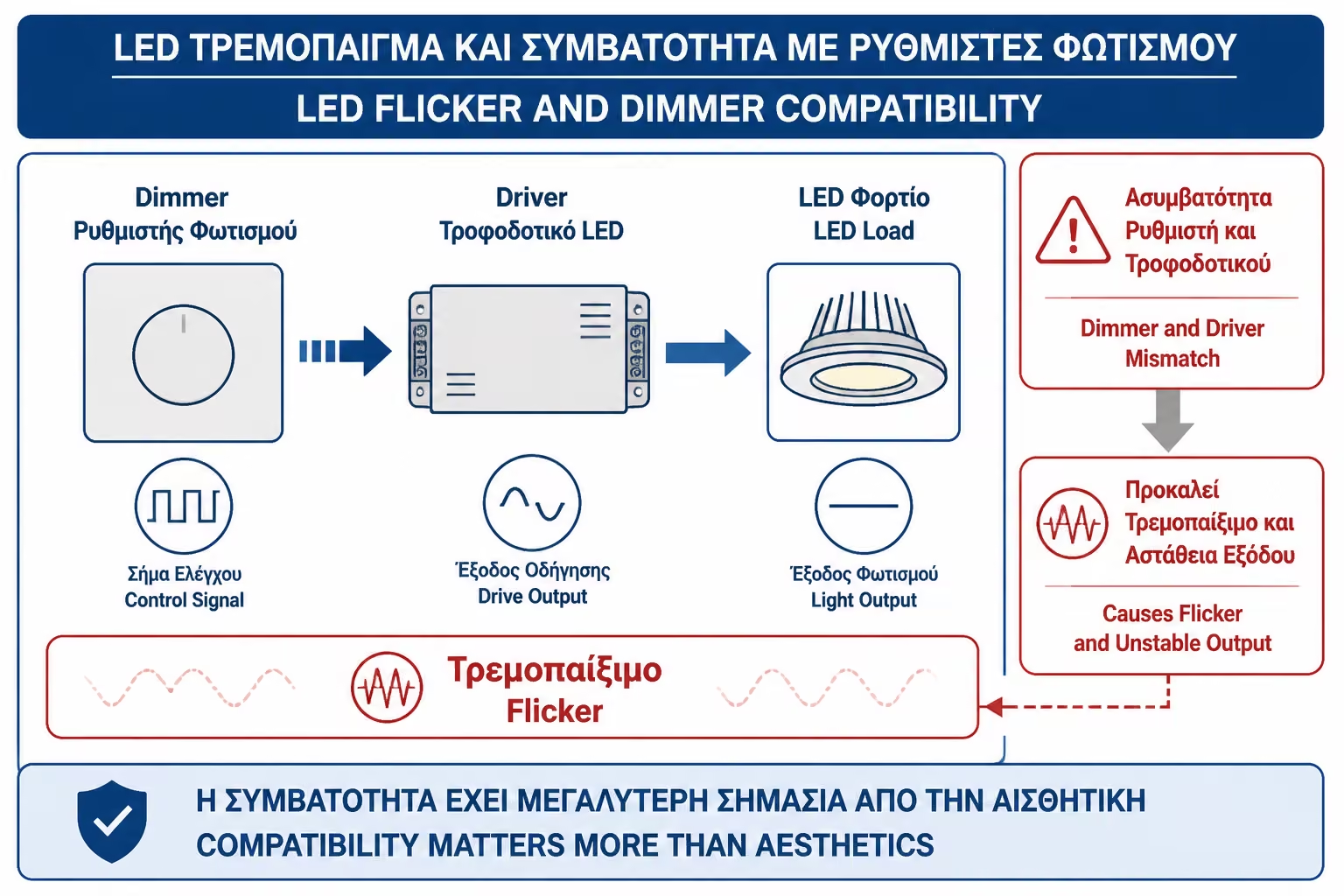
The terms leading edge and trailing edge refer to ways in which a dimmer adjusts the supply to the fixture. In the past, many dimmers were designed for incandescent or halogen lamps. With LEDs, things became more demanding, because each lamp can have a different driver or electronic circuit.
In practice, many modern LEDs work best with trailing edge dimmers, but this is not an absolute rule. Manufacturer compatibility should always be checked. Some lamps require a specific dimmer. Others have their own driver and accept a specific type of control. Others do not dim at all, even if the owner assumes "all LEDs are dimmable".
In LED strips, the situation is even more specific. They need a dimmable driver or a suitable controller. If the strip is connected to a simple power supply and then dimming is attempted from the wrong point, it may not function properly or exhibit flickering.
The owner should ask the electrician and the supplier to confirm the whole: lamp, driver, dimmer, load and control method. No buying separate parts because they "will fit".
General ceiling lighting is one of the most logical places for a dimmer. In a typical bathroom with spot or downlights, the intensity setting can give a lot of flexibility. In the morning it works fully, in the evening it turns down, and for simple use it can stay at an intermediate level.
The important thing is that the ceiling lights are dimmable and the dimmer matches the total load. If there are multiple spots, the total power and compatibility must be calculated. If there are integrated LED downlights, their driver must be checked. If they are replaceable LED bulbs, the bulbs must be dimmable and suitable for the particular dimmer.
In bathrooms with suspended ceilings, access must also be provided where there are drivers or connections. Dimming is not just the switch on the wall. It's the whole system behind the clean ceiling image.
A dimmable ceiling circuit is of great value when the general lighting is quite strong. If the lighting is already marginally low, the dimmer will not offer much. First there must be sufficient lighting, then dimming.
Mirror lighting is a more sensitive case. On the one hand, a dimmable mirror light can be very practical, because it allows bright light for makeup and lower light for evening use. On the other hand, the mirror is a working point and quality should not be sacrificed.
For make-up, shaving and grooming, mirror lighting must have the right intensity, neutral color temperature, high CRI and flicker-free stability. If the dimmer flickers or changes the feel of the light too much, it's best to use the mirror at full volume and dim other lights.
Many LED mirrors have a built-in dimmer or touch adjustment. This can be very useful, but it needs to be checked how it connects. Will it be permanently powered and controlled by touch? Will it open from a wall switch? Does it remember the last setting? Is it combined with an anti-glare function? These details affect daily use.
Ideally, the mirror lighting should have its own circuit or at least its own control. So the user is not obliged to light the whole bathroom at full intensity just to use the mirror.
Concealed lighting is probably the best spot for a dimmer in the bathroom. LED under hanging furniture, behind a mirror, in a false ceiling or in a niche can completely change the feeling when the intensity is adjusted.
At full volume, a hidden light can look impressive but also a bit over the top. At low volume, it becomes much more atmospheric. This is especially true for the floating effect under furniture. If the intensity is high, dust, drops and reflections are visible on the floor. If it is lowered, the light becomes more elegant.
In LED strips, however, dimming requires a proper driver or controller. It is not enough to fit a classic dimmer into the wall. A system must be selected that cooperates with the tape, operating voltage, power and control mode.
Also, hidden lighting must have a separate circuit. If it is tied to general lighting, its value is lost. At night we often only want the hidden lighting, not all the lights together.
Today there are two main logics: the classic dimmer switch on the wall and smart dimming via app, wireless switch, Zigbee/Wi-Fi system or central automation. Both solutions have their place, but they do not suit all bathrooms.
The classic dimmer is direct and easy to understand. You turn or press the switch and adjust the light. No mobile, app or login needed. In a daily use bathroom, this is a big advantage.
Smart dimming allows scenarios: morning, evening, night, cleaning, relaxing. It can be combined with sensors, schedules or voice control. It is more flexible, but needs better design, compatible devices and reliability. In a space like the bathroom, where use is fast and practical, the solution must work without delays.
A mistake is to install a smart system just because it is modern. If the user ends up always turning on the same light from the wall, the system remains unused. On the other hand, in a master bathroom or a bathroom with many levels of lighting, smart scenarios can be of real value.
The best choice depends on lifestyle. For many owners, a good dimmer on the general lighting and a separate switch for the hidden lighting is more useful than a complex smart ecosystem.
Many confuse dimming with changing color temperature. The dimmer reduces the intensity of the light. It doesn't necessarily change whether the light is warm or neutral. If an LED is 4000K, it remains 4000K even when dimmed, unless it is a special warm dim or tunable white system.
Warm dim systems mimic the behavior of the old incandescent lamp: as the intensity is lowered, the light becomes warmer. This can be very pleasant for atmospheric spaces. In the bathroom, however, it is not always ideal for the mirror, because when we want precision in make-up or shaving we need stable, neutral light.
Tunable white systems allow a Kelvin change, for example from 3000K to 4000K or 5000K. These can provide very flexible scenarios, but are more complex and expensive. They want compatible LEDs, controllers and proper handling.
For most bathrooms, a practical solution is simple: neutral and strong light on the mirror, dimmable general lighting, and warmer dimmable hidden light for ambiance. Not everything needs to change Kelvin for the space to function properly.
The dimmer reduces the intensity, but does not improve the quality of the light. If an LED has a low CRI, colors will be rendered mediocre at both low and high intensity. If the light is poorly diffused, the shadows don't disappear because we turned it down. If the LED is flickering, low volume may make the problem more obvious.
That is why the choice of dimmer must be accompanied by the choice of quality LEDs. In the mirror, especially, it is worth asking for LEDs with a high CRI, usually above 90, and a correct color temperature. In general lighting, we want fixtures that dim smoothly without noise or flicker. In hidden lighting, we want uniformity and stability.
A bathroom with cheap LEDs and a bad dimmer can look worse than a bathroom without a dimmer but with proper lighting. Dimming highlights the quality of the system. If the system is mediocre, the problems show.
The correct approach is to buy the package as a system: lamp, lamp or LED module, driver, dimmer and control method. No random combinations.
The dimmer switch should be placed in a location suitable for a bathroom, according to the zones and rating of the installation. It is not correct to carry switches or controllers where it is aesthetically convenient without considering safety.
In many bathrooms, switches are located outside or in the entryway, away from the shower and bathtub. In other cases there may be internal switches, but this should be done based on applicable requirements, IP protection where appropriate and electrician control. Just because a dimmer looks like a simple switch doesn't mean it can go anywhere.
Wireless or smart controls also need attention. If they are in the bathroom, they must be suitable for their location. If it is a battery, a battery change must be provided. If it is a touch panel, suitability in a wet environment must be checked.
The bathroom is not a place to experiment with general purpose electrical equipment. Safety comes before design.
The dimmer is worth more when the bathroom has multiple uses and good basic lighting. In a main bathroom, in a master bathroom, in a bathroom with hidden lighting or in a space where the owner wants a morning and evening scenario, the difference is big.
It is also worth it in bathrooms with many spots. If the lighting is strong, the dimmer allows it to not always be at 100%. This helps with comfort and can also reduce consumption when the LED is operating at a lower intensity, as long as the system is suitable. Lighting sources also point out that incompatible combinations of LEDs, drivers and dimmers can cause flicker, hum or limited adjustment range, so the benefit only exists when the components are chosen correctly.
In a small guest WC, the dimmer may be less necessary. If there is only one lamp and the use is short, a simple switch and a correct choice of intensity may be sufficient. In a very budget renovation, it may be worth more money to invest in good mirror lighting and secure installation than a dimmer.
Dimmer is not necessary everywhere. But it is excellent when there is a reason to change the atmosphere of the space.
There are cases where the dimmer can create more problems than it solves. If the fixtures selected are not dimmable, if the supplier does not give clear specifications, or if the electrician cannot confirm compatibility, it is better not to do a rough installation.
If the bathroom only has one inexpensive ceiling light, maybe adding a dimmer isn't worth it. If the light is already low, there is nothing essential to adjust. If the electrical installation is old and untested, the priority is safety, not atmosphere.
Also, in low quality mirror fixtures, dimming can make flicker more apparent. In cheap LED strips, discontinuities or tinting may appear at low intensity. In such cases, the solution is not necessarily to remove the dimmer, but to choose a better system.
Correct dimming requires correct components. If there is no budget for them, better a simple, reliable on/off with good lighting than a problematic dimmable circuit.
The cost depends on whether we are talking about a simple dimmer switch, compatibility with LEDs, changing lamps, dimmable drivers, smart control, new facilities or a complete lighting scenario. It is also affected by the area, the electrician, the condition of the existing installation, whether the work is being done on a new renovation or a finished bathroom, whether VAT is included and whether any allowances are required.
| Selection | Indicative range 2026 | What affects the price? |
|---|---|---|
| Simple LED-compatible dimmer | €25–€80 | Quality, type of dimming, brand |
| Better dimmer / electronic mechanism | 60–150€+ | Compatibility, stability, range of adjustment |
| Dimmable driver for LED strip | 30–120€+ | Power, control type, quality |
| Smart dimmer or controller | 50–200€+ | Protocol, implementation, compatibility |
| Replacement of non-dimmable lamps | Wide variation | Spot, mirror, LED strips, drivers |
| Electrician job | Wide variation | Access, benefits, control, discretion |
| Complete bathroom lighting scenario | 150–600€+ | Lots of circuits, smart, dimmers, drivers |
The lowest solution is not always wrong, but it must be compatible. A cheap dimmer that causes flicker is not economical. On the contrary, a properly selected dimmer can make even a simple lighting function more qualitatively.
The higher price is justified when it includes reliable components, compatibility testing, safe installation, correct placement and maintainability. It is not justified just because the word “smart” is on the package.
Errors with dimmers are usually seen after installation, when the user starts adjusting the volume. Then there are flickers, hums, unstable ignition or disappointing adjustment range.
| Error | What it causes in practice | A more correct approach |
|---|---|---|
| Dimmer on non-dimmable LED | Flicker, crashes, poor operation | Choice of dimmable lights |
| Incompatible dimmer and driver | Humming, flickering, limited range | Compatibility check before purchase |
| All lights in one dimmer | No correct usage zone | Separate circuits per role |
| Dimmer on mirror without CRI/flicker control | Bad face image | Quality work lighting |
| Driver without access | Difficult repair | Accessible maintenance point |
| Smart system without a practical switch | Daily suffering | Simple operation first, smart later |
| Placing a switch in the wrong position | A matter of safety or practicality | Zone testing by an electrician |
| Very low intensity as a unique scenario | Insufficient use lighting | Full volume for work, low for atmosphere |
A typical example is the bathroom where all the lights—spot, mirror and hidden lighting—are connected to a dimmer. The owner lowers the volume for atmosphere, but the mirror becomes inadequate. He brings her up for makeup, but the hidden lighting becomes too much. The problem is not the dimmer. It is that the circuits were not separated correctly.
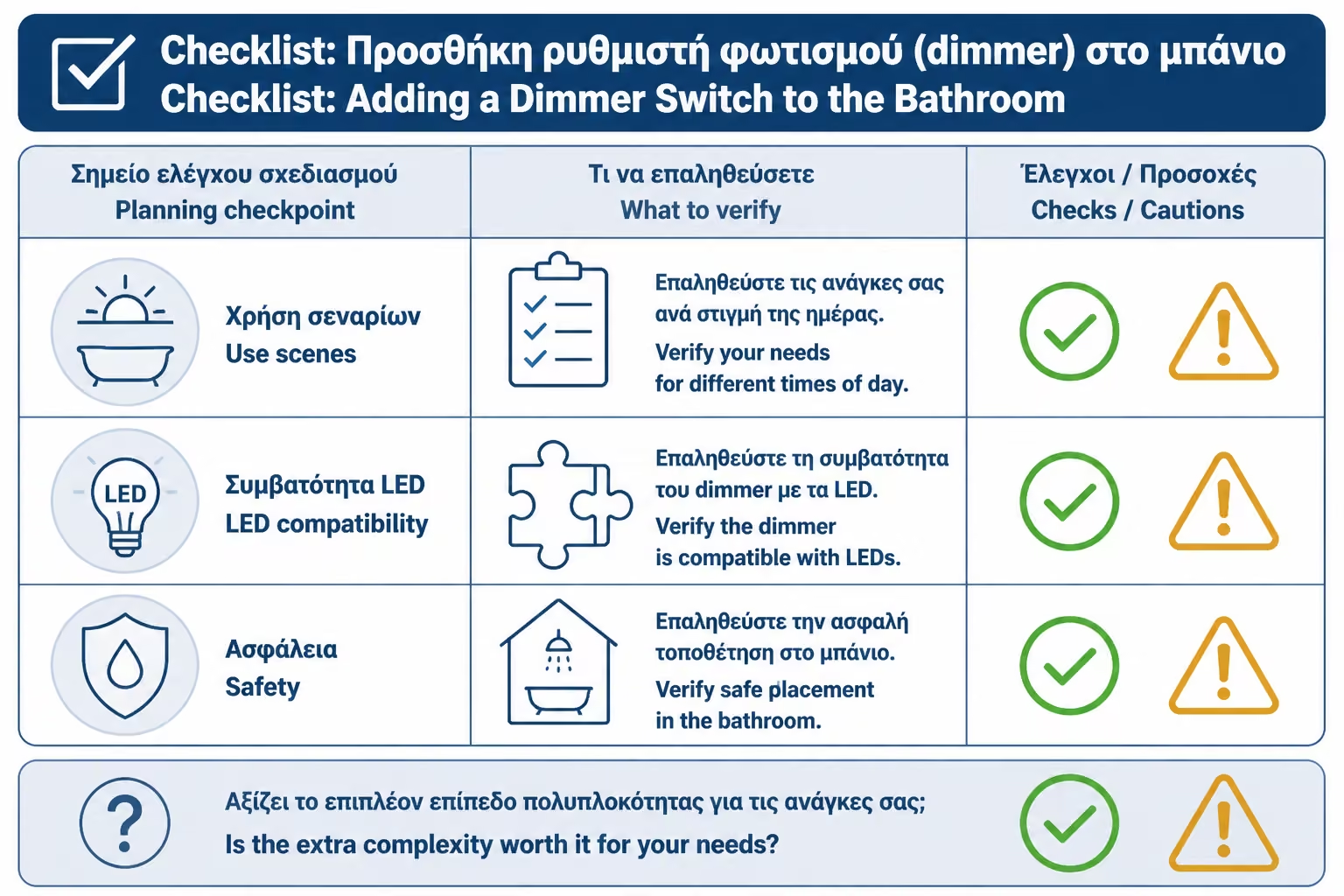
| Inquiry | Yes / No |
|---|---|
| Are the lights you want to adjust really dimmable? | Yes / No |
| Is the dimmer compatible with the LED or driver type? | Yes / No |
| Has the minimum and maximum load of the dimmer been checked? | Yes / No |
| Are general lighting and mirror lighting on separate circuits? | Yes / No |
| Does the recessed lighting have its own control or dimmer? | Yes / No |
| Is there a morning lighting scenario with enough intensity? | Yes / No |
| Is there a low scenario for evening or night? | Yes / No |
| Does the mirror light flicker at low intensities? | Yes / No |
| Is the driver, if any, accessible for maintenance? | Yes / No |
| Is the switch or controller in a safe and suitable location for a bathroom? | Yes / No |
| Has the electrical installation been checked by a licensed electrician? | Yes / No |
| Does the quote include dimmers, drivers, fixtures, labour, VAT and possible wiring changes? | Yes / No |
If you want a dimmer in the bathroom, don't look at it as simply changing a switch. See it as part of the overall lighting design. Divide the lights into roles: mirror for precision, general lighting for clarity, hidden lighting for ambiance. Put dimmers where they really change the experience, especially general and hidden lighting. And before you buy anything, ask your electrician to confirm that the LED, driver and dimmer are compatible. Good dimming is invisible: it doesn't flicker, it doesn't hum, it doesn't disturb and it just makes the bathroom adapt to the moment.
Dimmer switches can transform the bathroom more than meets the eye. They don't change the tiles, the sanitary ware or the furniture, but they change the way we experience the space. In the morning they provide clear, strong light for practical use. At night they allow for a more calm, relaxing atmosphere. At night they avoid the sudden lighting that is tiring.
But success depends on the right application. The LEDs must be dimmable, the drivers compatible, the switches suitable, the circuits properly separated and the installation safe for a bathroom. If these are ignored, the dimmer can bring flicker, hum, instability and technical inconvenience.
The best solution is to plan the dimming from the beginning of the renovation. Not at the end, when lamps, mirrors and LED strips have already been purchased. With the right design, the bathroom can have three faces: bright and functional in the morning, calm and atmospheric in the evening, low and discreet at night. This is the real gain of a good dimmer.
Return to category.
Go to categoryReturn to the central guide.
Go to guide