
Bathroom Lighting, Ventilation & Heating
Return to category.
Go to categoryColor temperature is one of the details that many owners only notice when it's too late. They choose tiles, furniture, mirror, batteries, shower and lamps, but when it comes time to buy LEDs, they suddenly see options like 3000K, 4000K or 6500K and don't know what they mean in practice. The result is often a bathroom that has the right materials, but the wrong sense of light.
A bathroom with too much cold light can look clean in the shop window, but in the home resemble a doctor's office or a warehouse. The face in the mirror appears harder, shadows become more intense and skin colors are not rendered naturally. On the other hand, a very warm light may be pleasant for relaxing, but not ideal for makeup, shaving or detailed grooming.
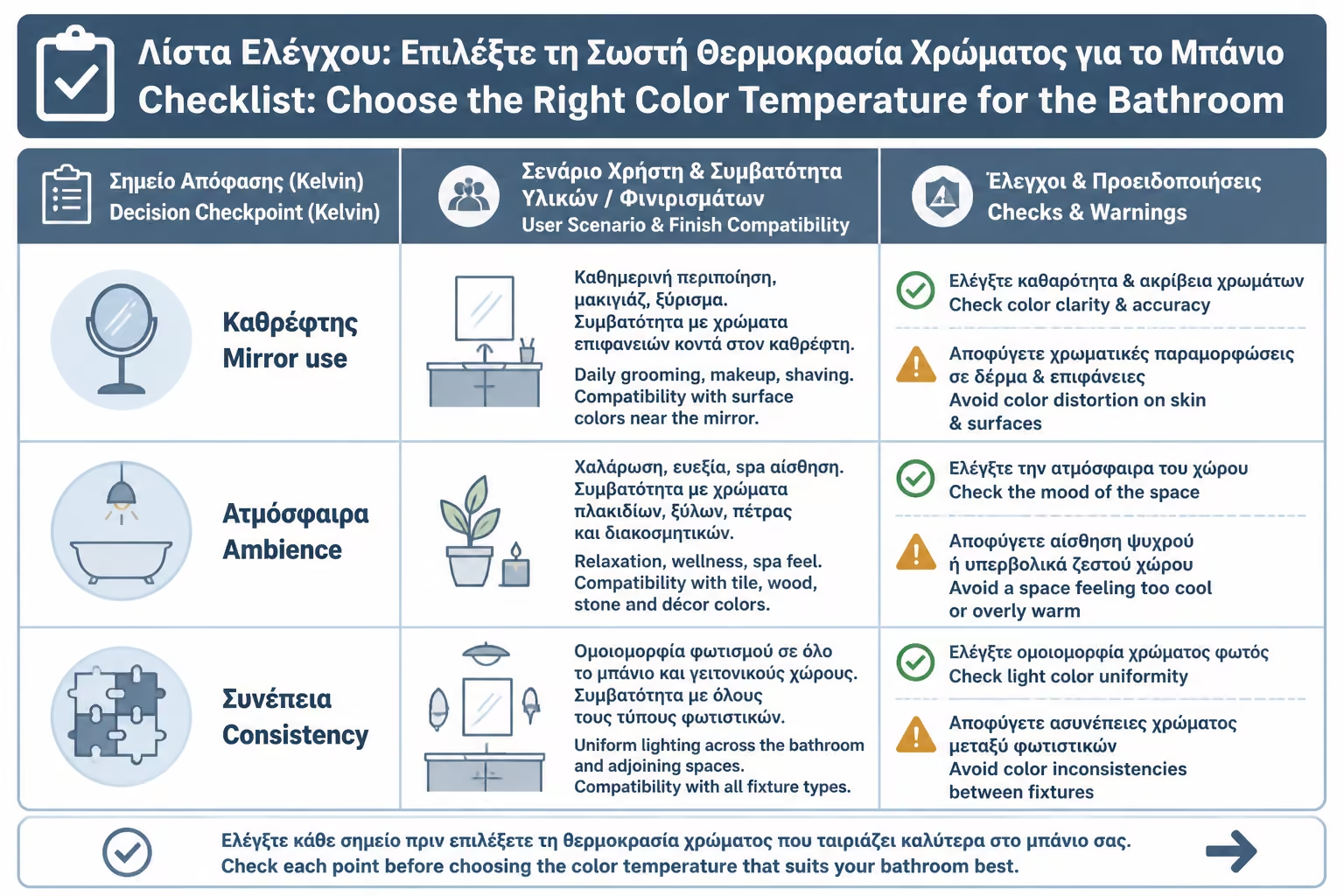
In the bathroom, light has to do two different jobs. It must create a pleasant space, but also accurately render the face, materials and colors. This is why color temperature is not just a matter of taste. It is a practical decision that affects daily use.
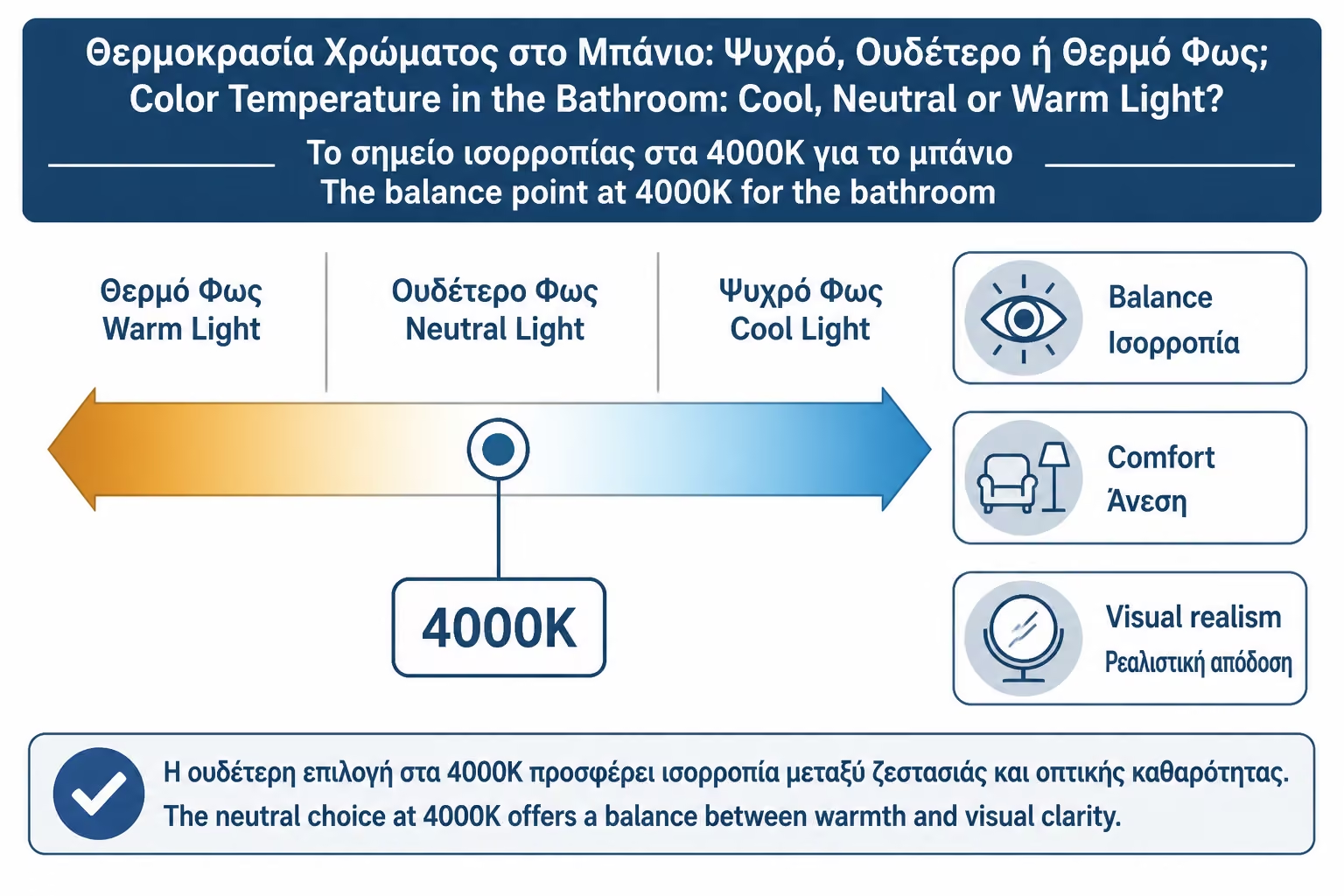
In practice, for the main bathroom of a residence, a very safe and balanced choice is usually neutral white around 4000K. It is not so hot that it yellows the image, nor so cold that it becomes hard. For the mirror, especially when used for makeup or shaving, 4000K often work better than very warm or very cool LEDs.
This is not to say that 4000K is always the only correct answer. A guest WC, a spa-style bathroom or atmospheric recessed lighting can benefit from warmer light. The important thing is to know what light we put, where we put it and what we expect it to do.
Color temperature, measured in Kelvin, describes the visual sensation of light. It has nothing to do with whether the lamp heats up more or less. It has to do with whether the light appears warm, neutral or cool to the eye.
The lower the Kelvin value, the warmer and more yellowish the light appears. The higher it is, the more white or blue-cool it appears. An LED at 2700K is more like the old warm incandescent bulb. An LED at 4000K gives a cleaner and more neutral feel. An LED at 6000K or 6500K gives a very cool, bright white light.
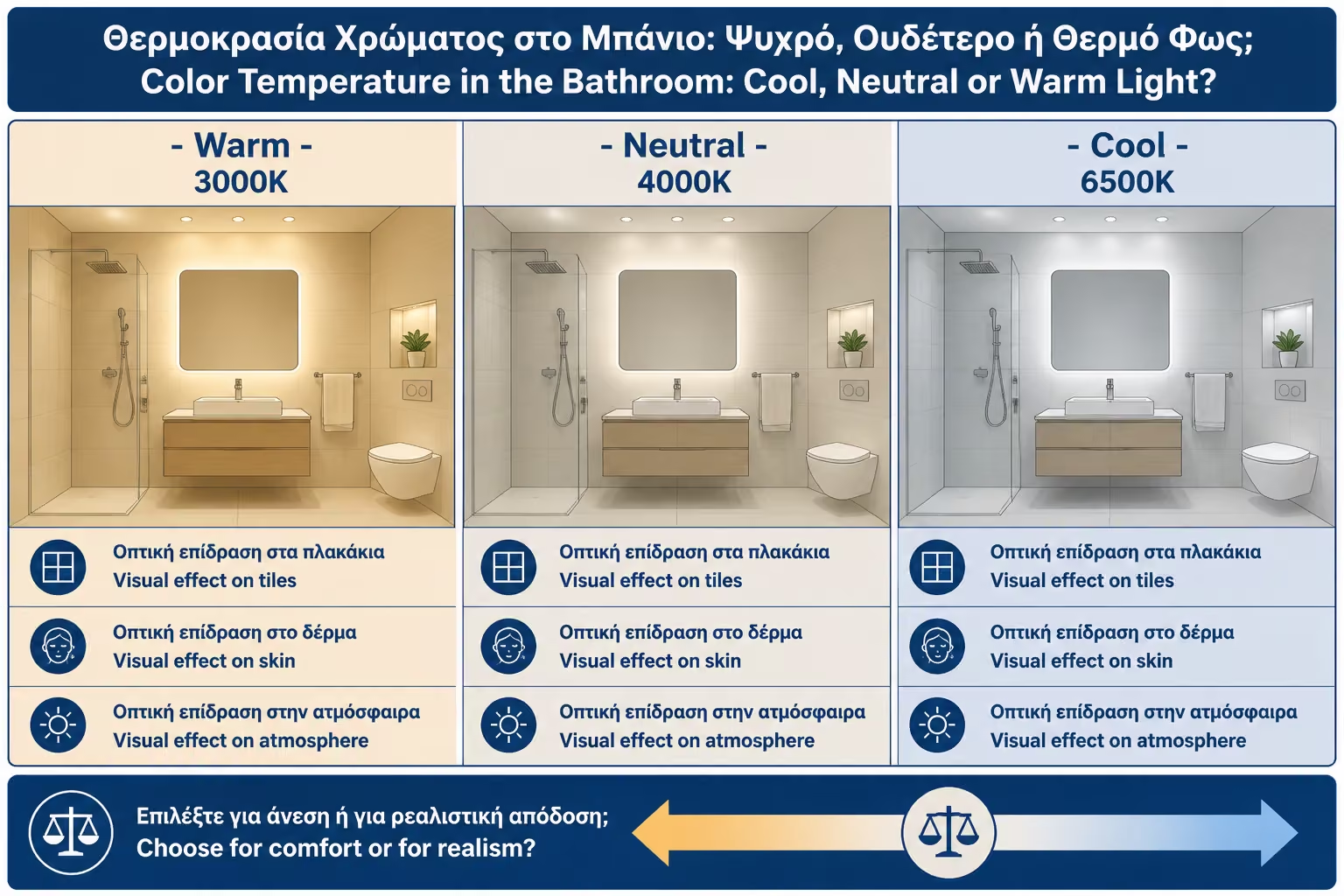
In the bathroom, this difference is immediately apparent. The same tile can look more beige below 3000K, more natural below 4000K, and more bluish below 6500K. The same face can appear "warmer" in low Kelvin, clearer in neutral light, and harsher in very cold light.
That is why the color temperature must be decided before buying the LED lamps and mirrors. It's not a detail that's always easily fixed afterwards. In many LED fixtures, the temperature is constant. If the wrong choice is made, the fix may mean changing the fixture, not just changing the bulb.
You will usually find three main categories of light on the market. Warm light, which is around 2700K–3000K. Neutral light, which hovers around 3500K–4000K. And cool light, which usually starts at 5000K and goes up to 6000K or 6500K.
No category is inherently "good" or "bad". What matters is whether the light suits the use. The problem starts when a color temperature is chosen because it "looks stronger" or because "that's what people use in bathrooms", without considering what the space actually needs.
| Temperature | Feel | Where it fits best |
|---|---|---|
| 2700K–3000K | Warm, relaxed, more yellowish | Guest WC, ambient lighting, spa feeling |
| 3500K–4000K | Neutral, clean, more natural | Master bathroom, mirror, makeup, shaving |
| 5000K–6500K | Cold, intense, more blue-white | Special uses, utility spaces, not usually ideal for a home |
In the Greek market, we still often see very cool LEDs in bathrooms because they create the impression that they "light more". In practice, what the eye reads as intensity does not always mean better lighting quality. A cool LED can look powerful while making the space feel uninviting and the face look unnatural.
4000K sits in the neutral spectrum and therefore works very well in many residential bathrooms. It gives a clean, bright effect without the yellowness of overly warm light or the harshness of overly cool light. It is a practical balance between comfort and functionality.
For mirror use especially, 4000K is often the safest choice. During make-up and shaving, we want to see the face clearly, but not under light that distorts colours or deepens shadows. Neutral light usually makes skin look more natural than very warm or very cool options.
A practical example: in a bathroom with white tiles, gray furniture and an LED mirror, 6500K can make the space look very cold and "blue". The same bathroom at 3000K may look warmer, but the white tile loses its purity. At 4000K, a more balanced image is usually achieved: clarity without exaggeration.
This is why 4000K is often recommended for master bathrooms. Not because it is fashionable, but because it serves the everyday uses of the space well.
The warm light around 3000K gives a more relaxed, friendly and atmospheric feeling. It is well suited to spaces where the bathroom is not primarily used for detailed work on the mirror, but for comfort, tranquility or an aesthetic effect.
In a guest WC, for example, 3000K can be a great choice. The space is used shortly, the mirror does not usually require precision makeup and the point is to look pleasant and welcoming. The same applies to a hidden lighting under hanging furniture or in niches, where the light acts more as an atmosphere than as a main source of work.
3000K also suits bathrooms with natural textures, beige tiles, wood shades, stone or a more spa aesthetic. There cold light can spoil the style, while warm light supports the feeling of relaxation.
The problem occurs when 3000K is used as the only mirror lighting in a bathroom where makeup is done. The face may appear warmer or "softer" than it actually is, and colors may not be read accurately. Therefore, in such use, the warm light can remain in the ambient lighting, but the mirror has a more neutral temperature.
Very cold light has been associated in the minds of many owners with cleanliness. In shops, workshops, warehouses and some professional areas, it gives a strong sense of brightness. In the residential bathroom, however, it often creates aesthetic and comfort problems.
An LED at 6500K can make white tiles look cold, skin duller and shadows on faces harsher. If combined with shiny surfaces, chrome faucets and white sanitary ware, the effect can become tiring, especially at night.
Cold light is not always wrong. It can have a place in special professional uses or in auxiliary spaces where maximum visual clarity is required. But in the bathroom of a residence, and especially the mirror, it is rarely the most balanced choice.
A common mistake is to choose cold light because it "looks stronger". The owner turns on the lamp in the shop and is impressed. At home, however, in a small bathroom, the same light can be too much. The sense of brightness should not be confused with the quality of lighting.
Makeup requires realistic facial rendering. It is not enough to have enough light. The light must correctly show the color of the skin, the shades of the products and the intensity of the lines. If the color temperature is wrong, makeup can look different in the bathroom and different when the wearer steps out into natural light.
Very warm light can make skin appear more "golden" or softer. This can lead to product application exaggeration because the user does not accurately see the differences. Too cold light, on the other hand, can make skin look paler or harsher, leading to wrong shade choices.
For this, a mirror used for make-up should have a neutral light, usually close to 4000K, with good diffusion and high color rendering. Color temperature is only one part of the equation. Equally important are the CRI index, the direction of the light and the avoidance of shadows.
A very practical scenario is for the mirror to be 4000K, while the hidden bathroom lighting is 3000K. So when precision is needed, the mirror is used. When relaxation is needed, the warmest mood lighting comes on.
When shaving, the user needs a clear image of the outline, shadows and small details of the face. If the light is too warm, it can hide certain contrasts. If it's too cool, it can overemphasize lines and make the face look harsher than it is.
Neutral light around 4000K offers a good balance. Gives clarity without excessive harshness. Combined with the right lighting position, ideally from the front and not just from above, it helps the user to see accurately without tiring.
A frequent problem occurs in bathrooms with a light only on the ceiling and a very cold temperature. The space appears brightly lit, but the face has shadows from the nose and chin. The user tries to get closer to the mirror, but then it cuts off even more light. The solution is not necessarily cooler or stronger light. It is more correct temperature and better direction of lighting.
For shaving, as for make-up, the mirror should be treated as a workplace. Light should aid accuracy, not just look “powerful”.
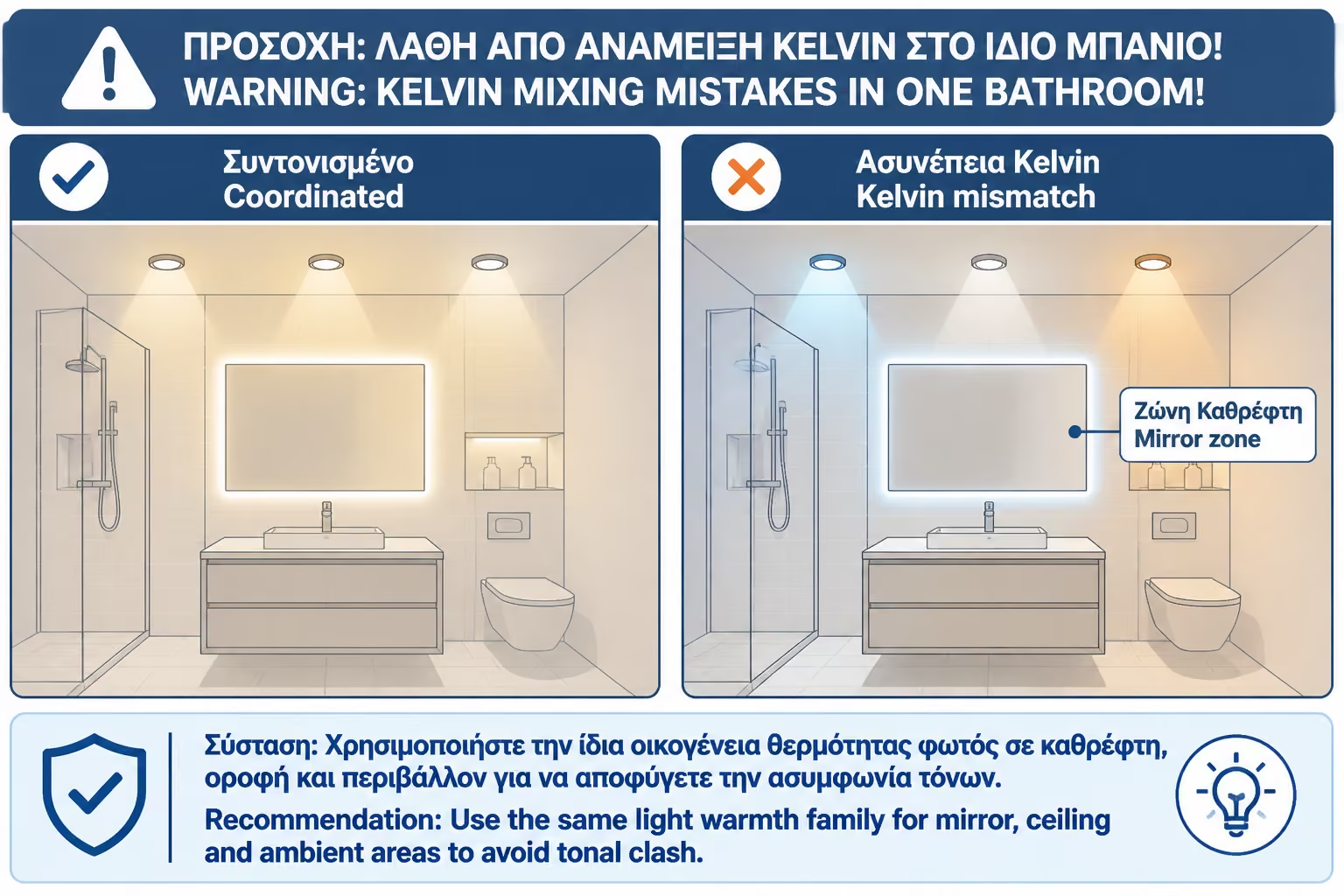
One of the most common mistakes is mixing different color temperatures without a design. The mirror can have 6500K, the ceiling spots 4000K and the LED strip in the alcove 3000K. Each fixture on its own may look acceptable, but all together create visual inconsistency.
The eye perceives this difference immediately, even if the owner does not know how to describe it. The space looks "confused". One spot appears blue, another yellow, and the third neutral. The tiles change color depending on the light that hits them and the mirror shows a different image from the rest of the room.
It doesn't mean that all the lights have to be exactly the same temperature. There can be a conscious separation. For example, 4000K in the mirror and 3000K in hidden lighting is a reasonable choice, because each light has a different role. The mistake is mixing temperatures at random because each product was purchased separately.
Before buying, it is good to decide on a basic scenario: what Kelvin will the general lighting have, what Kelvin will the mirror have and what Kelvin will the ambient lighting have. This small decision prevents many aesthetic problems.
The answer depends on how the bathroom is used. If the space is small and all the lights are often on together, it is usually best to have the temperatures close together. For example, general lighting and a mirror at 4000K give a clear and uniform image.
But if there is separate hidden lighting, it can be warmer. A light under the furniture, behind the mirror or in a niche does not always have to render the face realistically. It can work as night or mood lighting. There 3000K is often more pleasant.
The important thing is that they don't all light up together and look disjointed. If the mirror is 4000K and the hidden light is 3000K, the difference can work fine when there are separate switches. But if everything is turned on with a switch, the mix can look less neat.
In more modern bathrooms, the separation into scenarios is very useful. Morning scenario: general lighting and mirror at 4000K. Evening scenario: only hidden lighting at 3000K. Cleaning: full lighting. So the color temperature is not just chosen as a number, but as part of everyday use.
Bathroom materials change the way light is seen. A white glossy tile reflects a lot of light and can make a cool LED look even harsher. A matte beige tile absorbs more light and can look very pleasing at 3000K, but perhaps less clear in the mirror.
Gray tiles are particularly sensitive to color temperature. In very cold light they can appear blue or lifeless. With very warm light, they may turn brown or beige. 4000K often keeps them closer to their true image.
Wooden furniture and natural textures are usually flattered by a little warmer light. But if the same space is used for make-up, the functionality of the mirror should not be sacrificed. In such cases, the space can have warmer ambient lighting, but the mirror remains neutral.
A good practical test is to see a sample tile under different Kelvins before making a final selection. The same tile that looks perfect in the store under certain lighting may look different in your bathroom. Lighting doesn't just highlight materials. It transforms them.
Many people confuse color temperature with brightness. They say "I want strong light, so I'll put cold". This is technically wrong. Brightness is mostly related to lumens and light spread, not whether the LED is 3000K or 6500K.
A 3000K fixture can be very bright. A 6500K fixture may be insufficient. The feeling that cold light is "stronger" comes from the fact that the eye perceives it more strongly, not necessarily because it illuminates better.
In the bathroom this is of great importance. If you need more light on the mirror, don't just turn up the Kelvin. Check light output, direction, diffusion and placement. A proper 4000K fixture with good diffusion can be much more practical than a cold LED that glares and casts shadows.
The right question is not "how white should the light be?". It is "how much light do I need, at what point and with what quality?".
Color temperature tells whether the light is warm, neutral or cool. But it doesn't say how correctly it renders the colors. This is shown by the color rendering index, known as CRI. For the bathroom, and especially for the mirror, it is of great importance.
Two fixtures may both be 4000K, but render the face very differently. One can make skin look natural and clean, while the other can make it look flat, dull or unnatural. The difference is not due to Kelvin, but to the quality of the LED and the color rendering.
For make-up, shaving and daily care, it is worth choosing LED lamps and mirrors with good color rendering. When a product does not mention such information at all, it does not necessarily mean that it is unsuitable, but the owner has less information about the actual light quality.
A common example is the cheap LED mirror that has adjustable 3000K/4000K/6500K, but low LED quality. The user changes the color temperature, but the image remains mediocre. This shows that Kelvins are important, but not the only purchase criteria.
Many LED mirrors and bathroom lights now offer the ability to change the color temperature. The user can choose warm, neutral or cool light. This feature can be handy as long as it's used correctly.
In a master bathroom, the arrangement can help because the space has different uses. In the morning 4000K can be selected for a clear picture. At night 3000K can be selected for a calmer feel. If there is also a volume control, the control becomes even more useful.
The problem is when temperature regulation is used as a commercial argument, but the lamp itself is of low quality. A product with many functions is not necessarily better than a simple, quality 4000K constant light. In everyday use, most owners end up using one or two settings rather than all of them.
Also, the mode of operation must be checked. Some fixtures change Kelvin from the switch with continuous presses. Others have touch control. Some remember the last setting and others revert to a preset. These details affect everyday comfort more than it seems at first.
The Kelvin option must be adapted to the type of bathroom. A small guest WC, a main family bathroom and a large bathroom with a spa feel do not have the same needs.
| Bathroom type | Suggested lighting logic | Comment |
|---|---|---|
| Guest WC | 3000K or 3500K | Priority in atmosphere |
| Master bathroom | 4000K in mirror and general lighting | Balance of cleanliness and comfort |
| Bath with make-up/shave daily | 4000K with good CRI | Priority on realistic face image |
| Spa aesthetics | 3000K in ambient lighting, 4000K in the mirror | Separation of function and relaxation |
| Bathroom with dark materials | 3500K–4000K, with sufficient lumens | Dark materials absorb light |
| Bathroom with white glossy tiles | Avoid very cold light | 6500K can get hard |
In practice, a safe solution for most master bathrooms is 4000K in mirror and main lighting, with possibly 3000K in mood lighting. So the space remains practical without losing its comfort.
Color temperature alone does not necessarily increase cost. A 3000K, 4000K or 6500K fixture may have a similar price if all other characteristics are the same. What usually drives up the cost is the LED quality, color rendering, Kelvin adjustability, dimmer, IP protection, design and product reliability.
In the Greek market of 2026, a simple LED bathroom lighting can be economical, but as long as features such as adjustable temperature, high CRI, dimmable function, anti-fog on a mirror or smart operation are added, the price goes up. This is not necessarily a bad thing, as long as the features are actually used.
| Selection | Indicative cost impact | When is it worth it? |
|---|---|---|
| Fixed 4000K | Usually an economical and practical solution | Master bathroom, general lighting, mirror |
| Adjustable Kelvin | Moderate cost increase | When we want morning and evening use |
| High CRI | It may increase the price | Makeup, shaving, realistic color rendering |
| Dimmable LED | Additional cost of lamp/switch | Comfort and different scenarios |
| Smart control | Greater variance | When integrated into an overall system |
Cheapest is not always wrong. For an auxiliary space it may be enough. But in the master bathroom mirror, the light quality deserves more attention. It is a point that is used every day and any wrong choice quickly becomes annoying.
Errors in Kelvin are not always visible in the store. They are visible when the bathroom is completed and the user experiences the space morning, noon and night. Then it becomes clear whether the light is comfortable, practical or tiring.
| Error | What it causes in practice | A more correct approach |
|---|---|---|
| Choose 6500K because it “seems strong” | Hard, cold bathroom image | Lumen control and neutral light selection |
| 3000K as a unique light for makeup | Possible alteration of shades | 4000K on the mirror |
| Otherwise Kelvin without design | Confused image of space | Single logic or conscious separation |
| Luminaire without known temperature | Unforeseen result | Check specifications before purchase |
| Emphasis on Kelvins only | Ignore CRI, Lumens and Diffusion | Overall light quality rating |
| All lights in one switch | No adjustment to use | Separate circuits or scripts |
| Buy LED mirror without control | Wrong color or insufficient lighting | Mirror selection before electrical ones |
A typical example is the bathroom with LED mirror at 6500K and hidden lighting at 3000K. The owner thought it would have both "clear light" and a "warm atmosphere". In practice, when they are lit together, the space looks divided: the mirror becomes confused and the alcove turns yellow. If the two lights had different switches and a clear role, the effect could work much better.
Before buying LED lamps or mirrors, ask for specific information. Don't settle for "it's white light" or "it's strong". These descriptions are not enough for correct selection.
Ask what the color temperature is in Kelvin, if the fixture is fixed or adjustable, what brightness it has, if there is CRI information, if it is suitable for a bathroom, if it is dimmable and if its function is compatible with the switch or system to be installed.
Especially on LED mirrors, it must be clarified whether the lighting is backlit, frontlit or a combination, and what temperature each function has. There are mirrors that change temperature, but there are also mirrors where the back and front lighting have a specific, fixed shade.
The electrician must also check the suitability of the installation, IP protection where required, supplies, switches and compatibility with dimmers or smart functions. The owner can decide the feel he wants. Technical safety and proper connection must be done by a professional.
| Inquiry | Yes / No |
|---|---|
| Have you decided whether the bathroom mainly needs functionality or atmosphere? | Yes / No |
| Will the mirror be used for makeup or shaving? | Yes / No |
| Has a neutral light, usually around 4000K, been chosen for the mirror? | Yes / No |
| Has too cold light been avoided as a basic housing option? | Yes / No |
| Can ambient lighting be warmer without messing with the mirror? | Yes / No |
| Do all fixtures have a known color temperature? | Yes / No |
| Has the color rendering been checked, especially on the mirror? | Yes / No |
| Are Kelvin, Lumen and Diffusion correctly combined? | Yes / No |
| Are there separate switches for general, mirror and hidden lighting? | Yes / No |
| Have you checked how the tiles look under the selected light? | Yes / No |
| Does the LED mirror have a compatible function with the electrical installation? | Yes / No |
| Does the quote clearly state fixtures, color temperature, labour, VAT and any dimmers? | Yes / No |
If you have to keep a rule of thumb, keep it: for the master bathroom mirror, especially when doing make-up or shaving, prefer neutral light around 4000K with good color rendering and proper diffusion. Don't go for 6500K because it "looks stronger" and don't rely on too warm a light if you need color accuracy. If you want atmosphere, put a warmer light in the recessed lighting or in a separate scenario, not as a single task light on the mirror.
The color temperature in the bathroom affects much more than the first impression. It affects how the tiles look, how comfortable the space is, whether the mirror reflects the face correctly and whether the bathroom works well at different times of the day.
For most master bathrooms, neutral light around 4000K is a safe and practical choice. It gives a clear image, helps with make-up and shaving and avoids the excesses of very warm or very cold light. It doesn't mean the 3000K doesn't have a place. Instead, it can be great for mood lighting, a guest WC or evening use. 6500K, however, needs a lot of attention in homes, because it often makes the bathroom harder than it needs to be.
The correct solution is not to pick a Kelvin number at random. It is to divide the lighting by role: mirror for precision, general lighting for clarity, hidden lighting for comfort. When these are designed from scratch, the bathroom looks better, functions better and avoids the trap of "bright but wrong" light.
Return to category.
Go to categoryReturn to the central guide.
Go to guide