
Bathroom Lighting, Ventilation & Heating
Return to category.
Go to categoryThe lighting in the bathroom is one of those parts of the renovation that is often dealt with late, almost at the end. First the tiles, the sanitary ware, the shower, the furniture, the mirror are chosen and when the time comes for the electrician, the owner usually says: "Put a light on the ceiling and something above the mirror". The result may be technically functional, but in day-to-day use it quickly becomes apparent that something is missing.
A bathroom with the wrong lighting can look smaller, colder and more boring than it really is. It may have expensive tiles, quality sanitary ware and beautiful furniture, but the mirror casts shadows on the face, the shower remains semi-dark and at night the light is so strong that it disturbs. On the other hand, a modest bathroom can be significantly upgraded when the lighting is planned correctly from the beginning.
The right bathroom lighting is not a lamp. It's a combination. General lighting is needed to illuminate the space as a whole, task lighting for the mirror and daily care, and ambient or hidden lighting for comfort, depth and more pleasant use. These are the three basic levels of lighting used in modern interior design.
In practice, the problem is not only aesthetic. It is also functional. If the lighting of the mirror is wrong, shaving, makeup or facial care are done in shadows. If the general lighting is insufficient, the bathroom looks hazy and makes cleaning difficult. If there is no softer lighting for the night, every visit to the WC is made with a sharp, strong light that is tiring.
This guide explains how to correctly combine the three levels of lighting in the bathroom, what mistakes are most often made, what should be foreseen before running electrical lines and when a "nice idea" from a photo can create a problem in practice.
The bathroom is a small space, but it is used in many different ways. In the morning it needs clean, bright, functional light. In the evening it needs a calmer atmosphere. The mirror needs precision. The shower needs safety and visibility. In the WC, especially at night, it needs low light without glare.
A single ceiling light cannot properly meet all these needs. If it's too strong, it becomes tiresome. If it is lower, it is not enough for the mirror. If it is in the center of the bathroom, it usually creates a shadow on the face, because the user is standing between the lamp and the mirror. So, while the area looks lit, the area that really needs precision remains problematic.
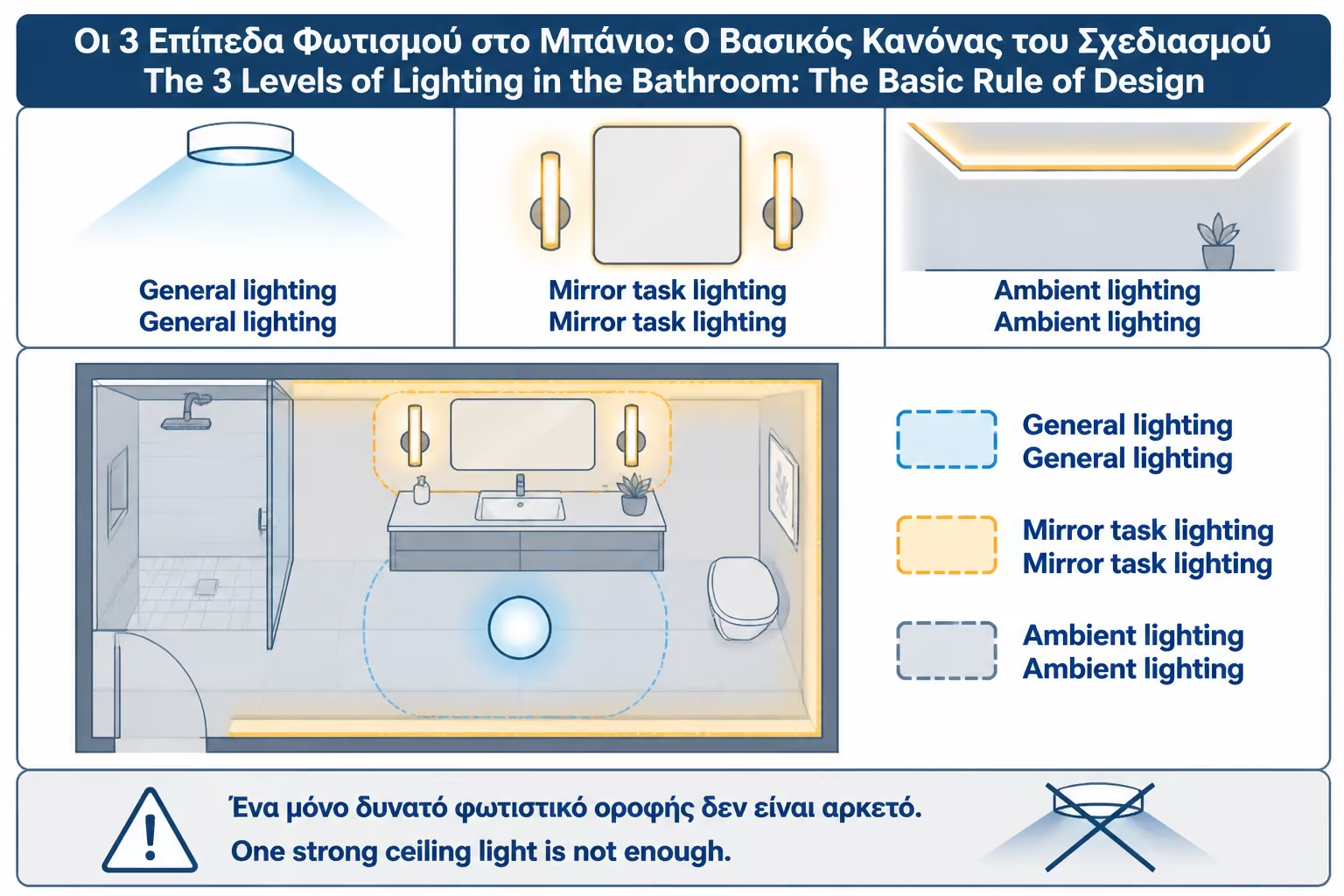
Layered lighting solves exactly this issue. It does not try to make one fitting do everything. Instead, it divides the role of lighting into three categories:
| Lighting level | Role | Typical use |
|---|---|---|
| General lighting | Lights the bathroom as a whole | Ceiling, centrally or with spots |
| Work lighting | Correctly illuminates the face and precise movements | Mirror, washbasin |
| Ambient / hidden lighting | Creates comfort, depth and low lighting | Niches, under furniture, false ceilings, shelves |
The difference becomes obvious in everyday use. A bathroom with three lighting layers can be brightly lit for cleaning, practical at the mirror, and calm for a relaxing evening shower. It changes not only the appearance of the space, but also the way it is used.
General lighting is the basis. It is the light that someone turns on when they enter the bathroom and want to see the space clearly. It usually comes from a ceiling light, recessed spot, surface downlights or linear lighting in a false ceiling.
In small bathrooms, a properly selected ceiling light can satisfactorily cover the space. In larger or more elongated bathrooms, however, a single point of light often creates unevenness: it brightly illuminates the center, but leaves the shower, basin or furniture area darker. There, most small mistakes are seen after the project has been delivered, when the owner begins to use the bathroom normally.
A practical example is the classic apartment bathroom with a length of approximately 2.50–3.00 meters and a width of 1.50–1.80 meters. If a single lamp is placed in the center, the mirror area can be lit from behind or from above, while the shower in the background looks darker. Conversely, two or three well-spaced lighting spots can give a much more even effect without necessarily increasing the cost too much.
General lighting should be designed based on the geometry of the space, not simply based on "where the cable used to be". In a bathroom renovation, especially when changing the position of the furniture or the shower, it is worth re-designing the position of the lighting.
The choice of lighting is not only a matter of taste. It affects light diffusion, ease of maintenance, moisture resistance and the final style of the bathroom.
The ceiling lamp is the simplest and often the most economical solution. In small bathrooms without a false ceiling, a good LED ceiling light with the right brightness and proper protection can work very well. The mistake is to choose too small or too decorative a ceiling lamp that does not illuminate enough. A beautiful lamp that gives off a little light does not solve the practical problem.
Spots give a more modern image and better distribution, as long as they are placed correctly. They shouldn't be randomly "in a row" because that's how it looks good in the design. Consideration must be given to where the user is standing, where the mirror is, if there is a glass cabinet, if the tile is very shiny, and if the light beam creates reflections.
Linear lighting, either in a false ceiling or as a surface light, can give a more architectural effect. It is particularly suitable for modern bathrooms, long narrow spaces or cases where we want a more uniform light line. But attention needs to be paid to the quality of the profile, the diffuser and the LED strip, because cheap solutions may show "dots", turn yellow or have unevenness.
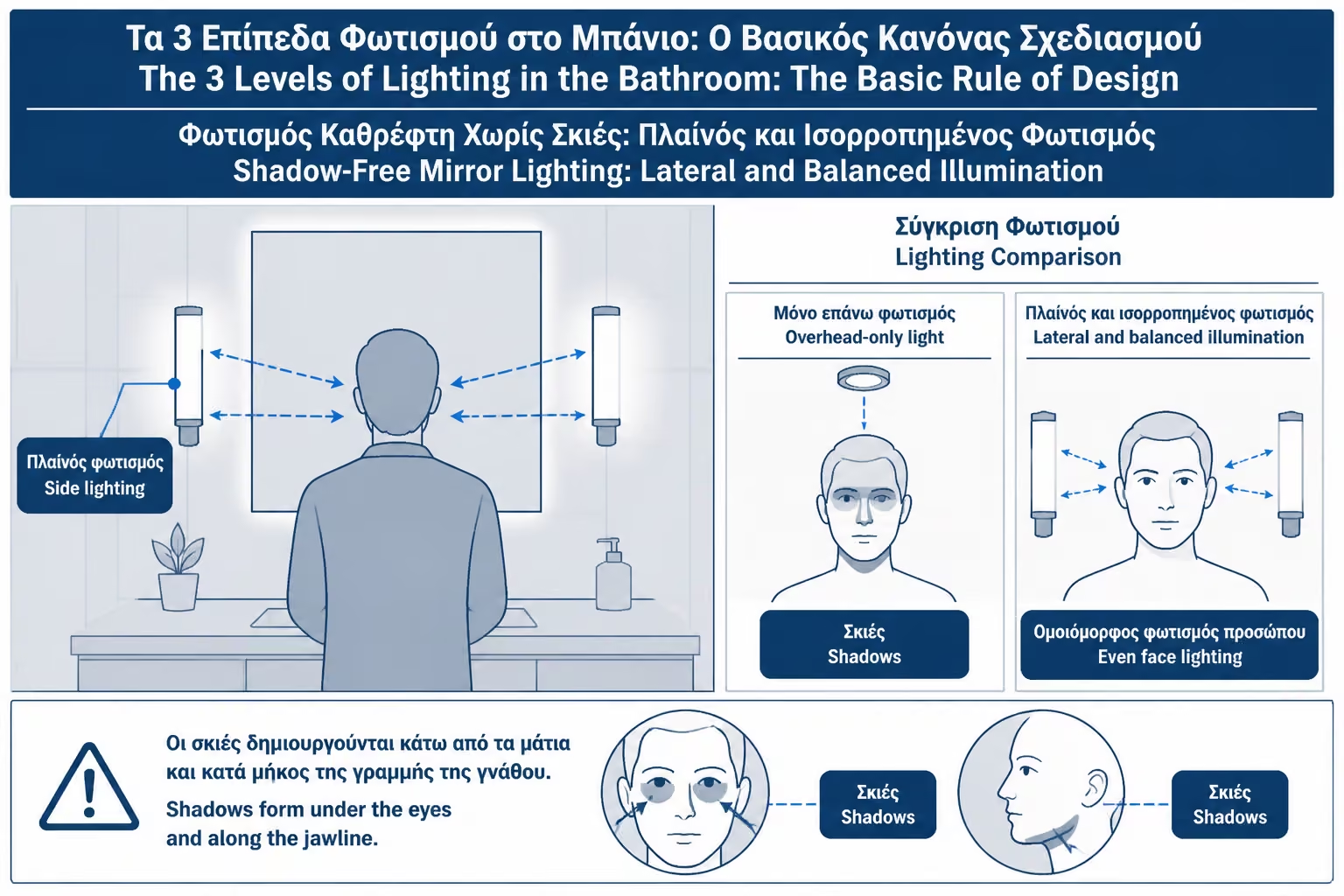
Mirror lighting is perhaps the most misunderstood point in the bathroom. Many owners find that a lighted mirror or a light above the mirror is sufficient. In practice, the point is not just to illuminate the mirror, but to properly illuminate the face of the person standing in front of it.
The common mistake is that the light only comes from above. When the light source is above the head or too high above the mirror, shadows are created under the eyes, nose and chin. The result is tiring for shaving, makeup or contact lenses. The user sees his face, but not in a clear and balanced way.
The best logic is for the lighting to come as evenly as possible from the front and, ideally, from both sides of the face. For this, vertical sconces to the right and left of the mirror are often a more correct solution than a single lamp above. When there is no room for side lights, a quality mirror with integrated perimeter or front lighting can give a good result, as long as it has enough brightness and correct diffusion.
An owner may buy a very nice lighted mirror and be disappointed because its light is mostly decorative. Many mirrors with LED surrounds create a nice effect on the wall, but they do not illuminate the face sufficiently. That doesn't mean it's a bad choice. It means we need to know if the mirror is acting as actual task lighting or just as an atmospheric element.
Shadows on the mirror are not always corrected with a stronger bulb. A change of position or type of lighting is often needed. If the light is coming from the wrong angle, the stronger it is, the more intense the shadows can become.
Ideally, the light source should be at about the height of the face or spread evenly around the mirror. In a bathroom where the mirror is 80–100 cm wide, two thin vertical sconces on the sides can give a great effect. In a smaller WC where there is no width, a mirror with good front lighting or a horizontal light above the mirror can be chosen, but with a wide spread and not a narrow downward beam.
The color of the surrounding surfaces is also important. A bathroom with dark tiles, black furniture and matte surfaces absorbs more light. The same light fixture that looks sufficient in a white bathroom may look weak in a dark bathroom. That is why the lighting should not be chosen independently of the materials.
In practice, a good rule of thumb is this: if the mirror is a staple of everyday use, don't treat it like a decoration. It's a job. Just as you wouldn't light a kitchen counter just from behind, you shouldn't just light the face from the ceiling either.
Color temperature greatly affects the feel of the bathroom. It is measured in Kelvin and describes whether the light appears warmer, neutral or cooler. In practice, most owners perceive it as a "yellowish", "natural" or "cool-white" light.
For residential bathrooms, neutral temperatures around 3000K–4000K usually work well. 3000K gives a warmer and more restful feeling, while 4000K is more clean and functional. Very cool light, such as 6000K or 6500K, can make the bathroom look harsh, hospital or cheap, especially when combined with glossy white tiles.
There is no one right answer for all bathrooms. In a small guest WC with warm tones, 3000K may be more pleasant. In a master bathroom where the mirror is used daily for grooming, 3500K–4000K may be more practical. The important thing is not to randomly mix different temperatures in the same field of view. A ceiling light at 6500K and a mirror at 3000K are inconsistent and tiring.
Practically, before buying the lamps, it is good to decide the overall feel of the bathroom. If the goal is spa, relaxation and warm style, the light must support it. If purity, functionality and morning use are what you're looking for, a slightly more neutral approach is needed.
In the past, most people chose bulbs based on wattage. In LEDs, this is not enough. What matters most are the lumens, i.e. the luminous flux, as well as how the light is diffused in the space. A low-quality LED may consume little, but have poor output, poor dissipation, or annoying glare.
In a small bathroom, too much brightness can be just as annoying as a lack of light. If all the lights turn on together from one switch and are too bright, the bathroom becomes harsh, especially at night. That is why it is preferable to have separate circuits: one for the general lighting, another for the mirror and another for the hidden or dim lighting.
A practical example: in a 5 m2 bathroom, the general lighting may be sufficient for cleaning and daily use, but the mirror needs additional lighting of its own. If the owner tries to cover both with very strong ceiling spots, they will likely have bright overhead light but poor face lighting. The solution is not "more light everywhere", but the right light in the right place.
Ambient lighting is not just a luxury for large bathrooms. When designed correctly, it can improve everyday comfort even in small spaces. It does not replace general lighting or task lighting. It completes the experience of the space.
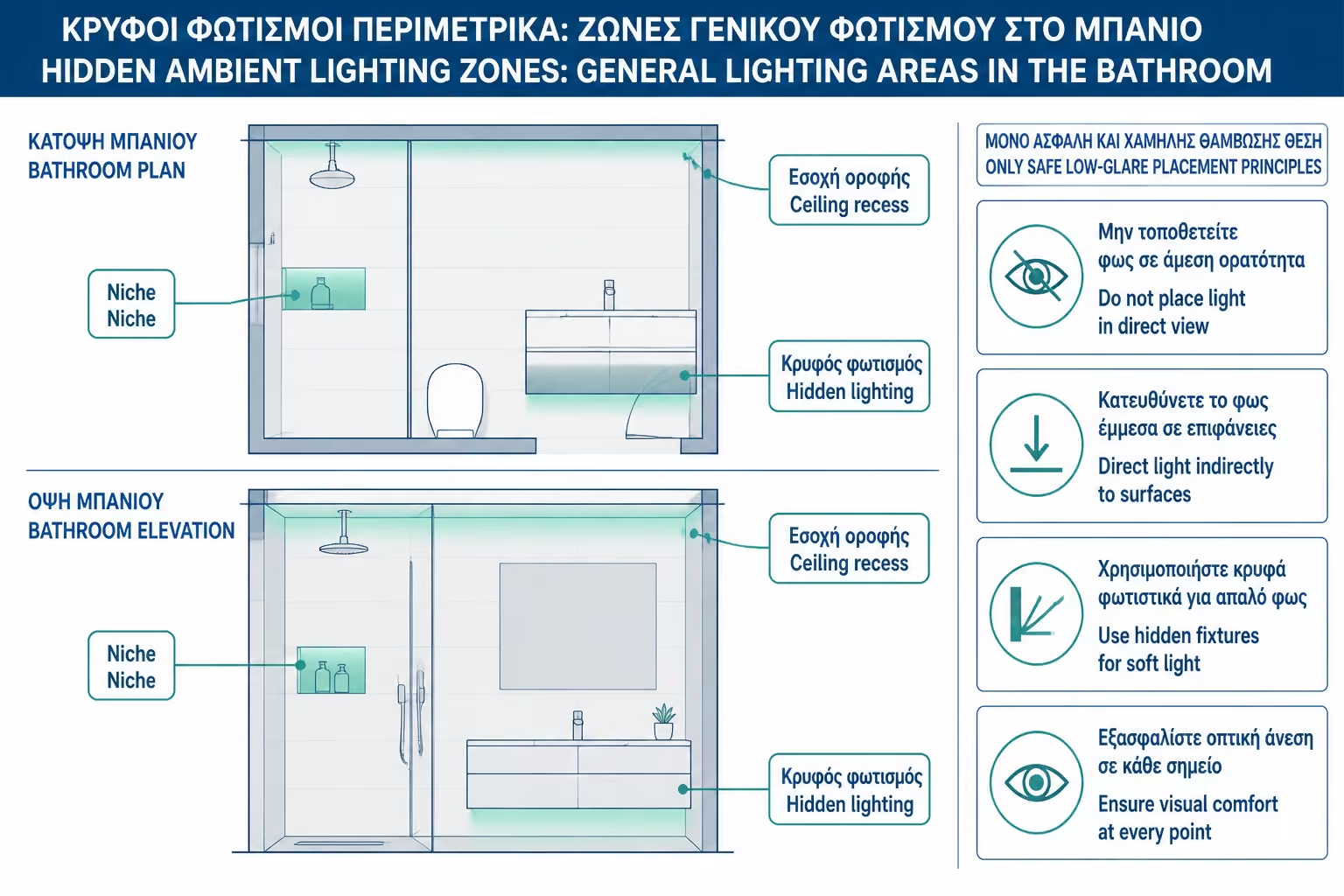
It can be placed under hanging bathroom furniture, inside a shower niche, around a false ceiling, behind a mirror or in a low spot near the floor. The point is not to "fill" the bathroom with LED strips, but to create points of light that give depth and practicality.
A hanging piece of furniture with low lighting underneath can work very well as night lighting. The user enters the bathroom without turning on the central light and sees enough to move about safely. If it is combined with a motion sensor, the result is particularly practical. However, the right choice of materials and protection is needed, because the bathroom has water vapor, cleaning agents and frequent humidity.
Concealed lighting should be used with restraint. When it appears everywhere, it loses its value and can make the bathroom feel more like a showroom than a home. One or two well-designed locations are usually enough.
The shower is a place where lighting needs special attention. On the one hand, it needs good visibility. On the other hand, it is an area with increased humidity, possible contact with water and stricter requirements for the selection of lighting and electrical installation.
In-shower alcoves are popular in modern renovations. When properly lit, they highlight the tile and make the space look neater. But here the mistake can be costly. A simple LED strip without proper protection, without a correct profile and without a correct power supply location can present damage, oxidation or maintenance problems.
In the suspended ceiling, hidden lighting can give a nice diffusion, especially when the bathroom is high and allows such a construction. But access where needed, proper heat dissipation for the LED strips and a clean electrical installation must be provided. LED strips are not "put a strip and we're done". They want the right power supply, the right length, the right cable cross-section and a quality profile.
In small bathrooms, the excessive use of false ceilings and bright lines can visually lower the space. If the clear height is already limited, it may be better to choose surface lights with good aesthetics instead of heavy construction.
In the bathroom, the lighting is not only chosen based on appearance. Moisture, water vapor and proximity to water require attention to electrical safety. Luminaires must be suitable for the location where they will be installed and installation must be done by a licensed electrician.
The degree of protection IP shows the protection of a light against dust and water. It does not mean that every lamp with a "nice design" is suitable for a bathroom. Special attention is needed near the shower, above the bathtub, in alcoves and in places where there may be direct contact with water or strong water vapors.
It is not correct to give a general rule without checking the specific installation. Another light fixture in the center of a ceiling away from the shower and another spot directly above the bathing area. Also, another bathroom with a cabin that limits the water and another open walk-in shower where the water vapors and splashes spread more.
The owner does not need to become an electrician. But he needs to clearly ask the professional to confirm that the fixtures, lines, connections and switches are suitable for their location. In a bathroom renovation, electrical safety is not a point for experimentation or improvised solutions.
One of the most useful things that can be provided in a bathroom is the separation of lights on different switches. There is no point in having three levels of lighting if they all light up together. The user should be able to choose according to the moment.
In a well-designed bathroom, the general lighting can have its own switch, the mirror its own and the recessed lighting its own. In more elaborate installations, a dimmer, motion sensor or smart control can be provided. Not everything is needed in every project. But they need to be decided before the walls and false ceilings are closed.
A common mistake is for the owner to remember the hidden lighting when the tiles have already been installed. Then the solution becomes either sketchy or more expensive. It may require an external channel, rip out, drill into finished surfaces, or compromise with wireless solutions that don't have the same clarity.
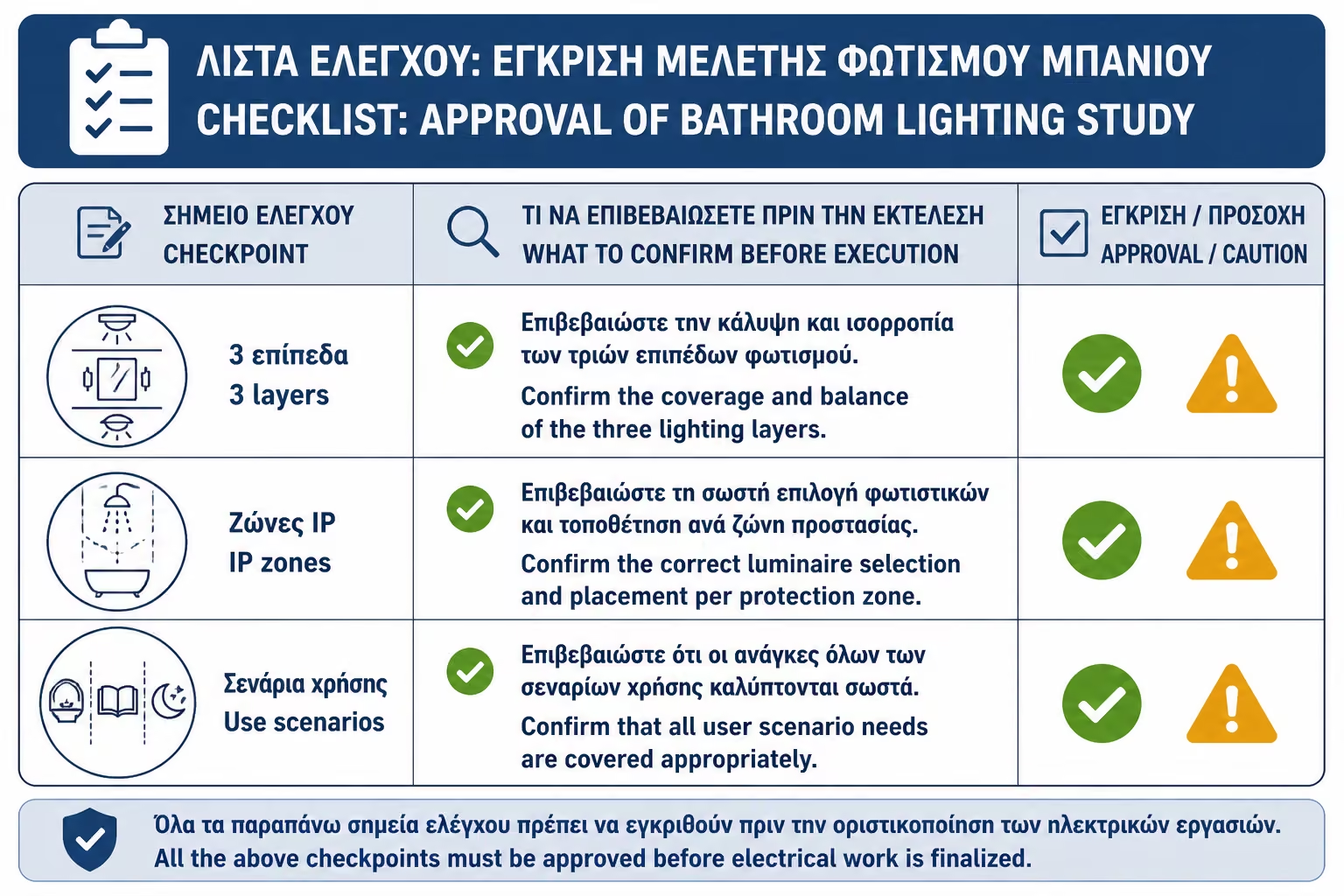
Use cases help a lot in planning. Before deciding on the switches, it is good to answer practical questions: which light will one turn on in the morning? What light will he use for the mirror? Need low light at night? Want lighting in the shower? Will the mirror have an anti-glare function or its own switch? These decisions seem small, but they determine everyday comfort.
Errors in lighting are not always visible in the drawing. They are visible when the space is used. A bathroom can be beautifully photographed, but uncomfortable in everyday life. That is why practical thinking is needed and not just aesthetic inspiration.
| Error | What it causes in practice | A more correct approach |
|---|---|---|
| A single light in the center | Shadows in the mirror, dark corners | Combination of general and task lighting |
| Light only above the mirror | Shadows on the face | Side or uniform front lighting |
| Very cold light | A harsh, unwelcoming image | Neutral or warm temperature depending on use |
| All lights in one switch | No flexibility, annoying at night | Separate circuits |
| Cheap wet spot LED strip | Damage, unevenness, oxidations | Proper protection, profile and power |
| Buy lighting after the tiles | Limited options, extra tasks | Design before power lines |
A typical example is the mirror with built-in LED that is bought because it “looks modern”. If its light is dim and mostly peripheral to the wall, the bathroom will look nice when it's empty, but the user will need additional lighting to see their face properly. The problem is not the mirror. It's that he was assigned the wrong role.
In small bathrooms, the right lighting does not mean many lamps. It means proper targeting. A bathroom 3–4 sq.m. it can work very well with a quality general lighting and proper mirror lighting. If there is a possibility for low hidden lighting under the furniture, even better, but it is not always necessary.
The mistake in small bathrooms is overloading. Many spots, strong LED lines, illuminated alcoves, LED mirror and decorative sconces can make the space look more confusing. Lighting should serve the space, not overwhelm it.
In a small guest WC, for example, a beautiful mirror lighting and a discreet ceiling light may suffice. If the WC is not used for shaving or make-up, task lighting does not need to be as demanding as in the main bathroom. Instead, emphasis can be placed on atmosphere.
In the master bathroom, however, even if it is small, the mirror should be treated seriously. Daily precision movements are made there. A "beautiful but dark" bathroom gets tiring very quickly.
In larger bathrooms, lighting should be planned in zones. Another need is the sink, another the shower, another the bathtub, another the basin space and another potential storage or counter area. If the general lighting is treated uniformly, there may be areas that are overlit and areas that are dark.
In such cases, the three levels of illumination become even more important. The general lighting should give uniformity, the mirror should be accurate and the ambient lighting should highlight the materials without becoming excessive. Especially in bathrooms with natural materials, stone, wood textures or large tiles, lighting can enhance or detract from the effect.
Balance is critical. A large bathroom with many bright lines may look impressive at first glance, but tiresome in daily use. Conversely, a bathroom with properly divided lighting scenarios can change its character depending on the time: clean and bright in the morning, calm and relaxing in the evening.
The cost of lighting in a bathroom renovation depends on whether we are talking only about the purchase of lighting or also about new electrical lines, false ceiling, hidden lighting, power supplies, dimmers, sensors and installation work. It is also affected by area, floor, access, condition of existing electrical installation, whether prices include VAT and whether the quote is for labor only or materials plus labour.
For a typical residential bathroom, basic lighting can remain relatively economical with a good ceiling lamp or a few proper lighting points and a practical mirror. But when false ceilings, hidden LED strips, multiple circuits and special lighting are added, the cost goes up.
| Task / choice | Indicative range 2026 | What affects the price? |
|---|---|---|
| Simple LED ceiling light for bathroom | €25–€80 | Quality, IP protection, design |
| Better ceiling light or bathroom downlight | €60–€180 | Performance, materials, brand, protection |
| Illuminated mirror | 120–450€+ | Dimensions, anti-glare function, LED quality |
| Side mirror sconces | 40–180€ / pc. | Design, quality, protection |
| LED strip with profile and power supply | 80–250€+ per application | Length, Profile, Power, IP, Placement |
| Additional electrical lines / switches | Wide variation | Excavation, maintenance, access, existing installation |
| False ceiling for lighting | Depending on the sq.m. and detail | Height, materials, spots, hidden lines |
In a simple bathroom renovation, lighting can be moved to reasonable levels if the choices are clean and practical. In a more complete solution with three levels of lighting, a quality mirror, separate switches and hidden lighting, the cost can increase significantly, but it usually makes a real difference in everyday use.
Low price is not necessarily bad. A small bathroom may not need expensive solutions. But a very cheap offer should be checked: does it include suitable lighting for the bathroom? Does it include power supplies and profiles for LEDs? Does it include chores? Does it include VAT? Does it provide separate switches or just connect all the lights together?
Lighting must be decided before the walls are closed, before the false ceilings are completed and before the tiles are placed in the critical areas. Then, each change costs more and often leads to compromises.
The owner must know early on the position of the furniture, the width and height of the mirror, whether there will be sconces, whether the mirror will have built-in lighting, whether there will be a niche in the shower, whether there will be a false ceiling and how many switches are needed. These are not decorative details. They are electrical decisions.
A common problem occurs when the mirror is changed at the last minute. The electrician has left a supply above the mirror, but in the end a round mirror with side sconces is chosen. Then the facilities are not in the right place. Or an illuminated mirror with its own touch switch is selected, but the supply behind it is not properly provided. These mistakes are resolved, but usually with extra time, effort and aesthetic compromises.
The right design does not necessarily mean an expensive project. It means that decisions are made in the right order.
The owner can choose the style, aesthetics, color temperature and level of comfort he wants. It can also request specific usage scenarios: strong light for cleaning, good light on the mirror, low light for night. But he must not improvise on electrical connections, lighting near water, power supplies, moisture zones or interventions in the existing installation.
The licensed electrician must check the safety, suitability of the fixtures, lines, protections, switches and compliance with the applicable electrical installation rules. In bathrooms with old installations, it is worth a closer inspection, because many homes have old wiring, inadequate grounding or sloppy interventions from previous years.
The decorator, engineer or experienced renovation technician can help with the placement: where the light should fall, where it will cast a shadow, how the tile will stand out, if the suspended ceiling makes sense and if the idea that looks good in a photo fits the particular bathroom.
The best result comes when aesthetics and technique are agreed upon before the project begins.
| Inquiry | Yes / No |
|---|---|
| Is separate general lighting provided for the entire bathroom? | Yes / No |
| Does the mirror properly illuminate the face and not just the wall? | Yes / No |
| Is there an avoidance of strong shadows from only ceiling light? | Yes / No |
| Has the color temperature for all fixtures been decided? | Yes / No |
| Are the fixtures suitable for use in bathrooms and wet environments? | Yes / No |
| Has appropriate IP protection been checked per location? | Yes / No |
| Are there separate switches for general, mirror and hidden lighting? | Yes / No |
| Is there provision for an illuminated mirror or sconces? | Yes / No |
| If there is an LED strip, is the correct profile and power supply provided? | Yes / No |
| Is there access for maintenance where needed? | Yes / No |
| Has it been checked whether the false ceiling reduces the height too much? | Yes / No |
| Does the offer clarify whether it includes lighting, labour, incidentals and VAT? | Yes / No |
If you have to keep one thing, keep it this: don't plan the bathroom lighting after the tiles are finished. Lighting requires decisions from the beginning, because it affects supplies, switches, mirrors, suspended ceilings and security. A strong ceiling light is not enough. You need proper general lighting, clear face lighting in the mirror and, where it makes sense, a soft low light for comfort. The crucial thing is not to put a lot of lights in, but to put the right light in the right place.
Lighting in the bathroom is not a detail that is left for the end. It is a key part of the functionality, safety and final feel of the space. A bathroom can have expensive materials and still look wrong if the lighting creates shadows, a cold atmosphere or dark spots.
The three levels of illumination help organize thinking properly. The general lighting gives a clear picture of the space. The task lighting makes the mirror really useful. Ambient or hidden lighting adds comfort, depth and a better everyday experience, as long as it is not used excessively or casually.
The best decision for the owner is not to choose lighting fixtures only from photos. He needs to think about how he uses the bathroom every day, which areas need real light, which areas need calm, and which option is safe for a wet environment. With the right design from the start, lighting can dramatically change a bathroom without necessarily skyrocketing the cost of the renovation.
Return to category.
Go to categoryReturn to the central guide.
Go to guide