
Bathroom Lighting, Ventilation & Heating
Return to category.
Go to categoryThe bathroom fan should not be chosen at random. It is not enough to look at the diameter of the old hole, pick up a "powerful" fan off the shelf and assume that the problem is solved. The real question is more specific: how much air does the fan need to remove from that particular bathroom, within a reasonable amount of time, so that water vapor and odors are removed?
This is usually expressed in m³/h, i.e. cubic meters of air per hour. Many people call it “absorbing power”, but technically it is not power. It is an air supply. It shows how much air volume can pass through the fan in one hour, under ideal or specific measurement conditions. The higher the flow rate, the more air it can theoretically remove.
"Theoretically" is very important. A fan may say 100 m³/h on the box, but if it goes into a long, narrow, dirty or full of corners duct, the actual delivery to the bathroom can be noticeably less. That is why the cubic calculation is necessary, but it is not the only purchase criterion. It must be combined with the fan type, air path, noise, operating time and fresh air intake.
For a typical residential bathroom, the practical logic is to first calculate the volume of the space: square meters times clear height. Then we decide how many times per hour we want the air to change. This is called ACH, from Air Changes per Hour. For bathrooms, several practical guides mention about 10–15 air changes per hour as a common rationale for water vapor removal, while in normative approaches we also find minimum flows such as 15 l/s, i.e. about 54 m³/h, for intermittent extraction in a bathroom with shower or bathtub.
The important thing for the owner is not to stop at just one number. If the bathroom is small, blind, windowless, with daily hot showers and a long vent, a more careful choice is needed than a small WC with a direct exit to the outer wall. The correct calculation is not a mathematical trick. It's the first filter to not buy a fan that looks good on paper but fails in practice.
m³/h means cubic meters per hour. If a ventilator states a flow rate of 100 m³/h, this means that it can, under the manufacturer's test conditions, move up to 100 cubic meters of air in one hour. It does not mean that your bathroom will clean immediately in every case. It means that this is the rated air carrying capacity.
In practice, the manufacturer's supply is often for “free air” or low resistance conditions. That is, the fan works without a large duct, without many corners, without constrictions and without clogged grills. If the fan is placed in a real bathroom with a 3m pipe, two corners and an external louver, the actual performance drops.
This is why two ventilators with the same m³/h may behave differently. A single axial and a centrifugal may report similar throughput, but over a long pipeline the centrifugal will often hold its performance better. The provision is therefore not read by itself. It is read together with static pressure and fan type.
For the owner, m³/h is the number that helps us make the first calculation. It tells us roughly what size fan we need. Then we have to check if this type can perform in this installation.
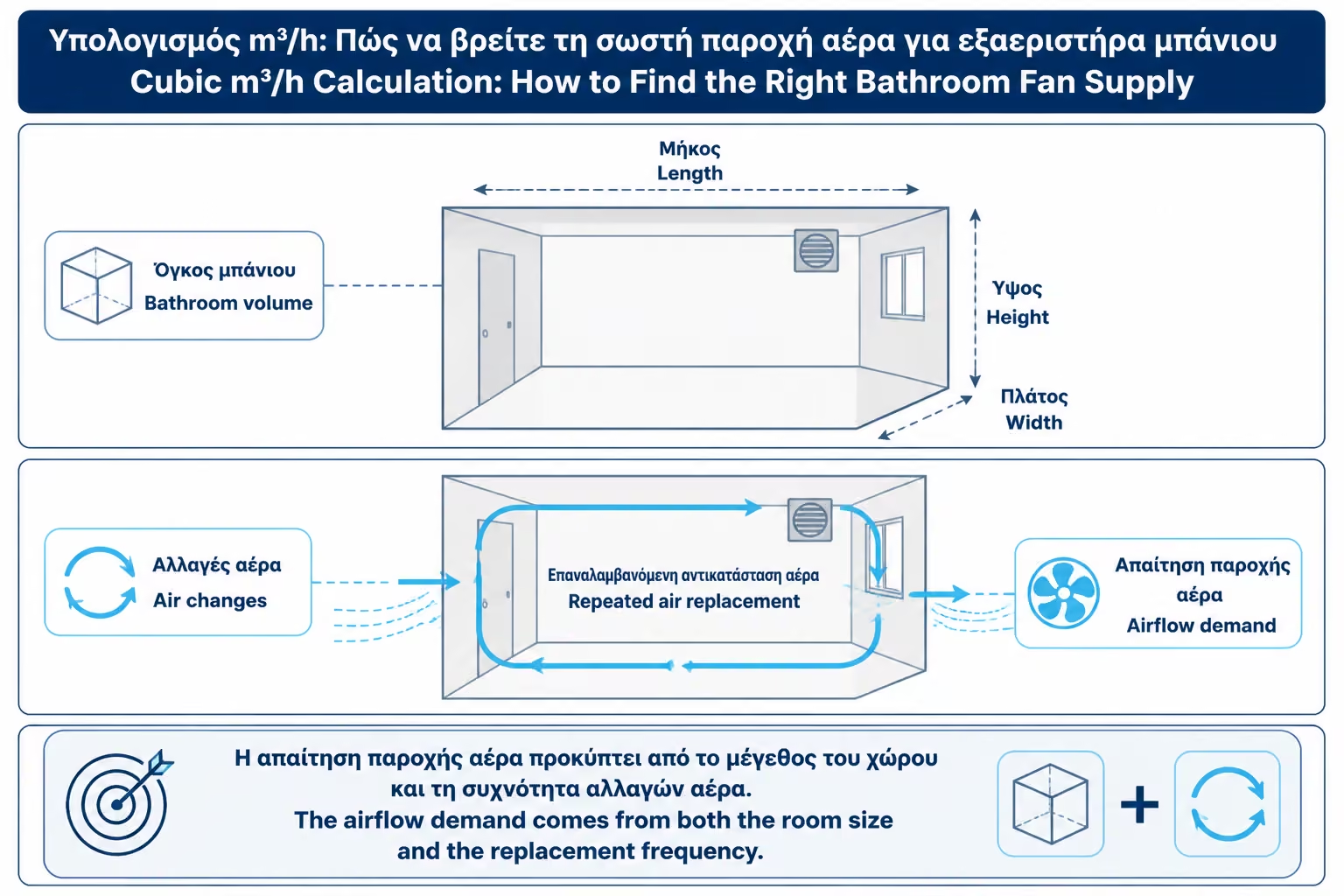
The volume of the bathroom is calculated very simply:
Bathroom volume = length × width × height
If you already have the square footage, then:
Bathroom volume = square meters x net height
For example, a bathroom of 5 sq.m. with a net height of 2.70 m. has volume:
5 × 2.70 = 13.5 m³
This means that the air inside the bathroom is about 13.5 cubic meters. If we want the air to change 10 times an hour, we theoretically need:
13.5 × 10 = 135 m³/h
If we want 12 air changes per hour:
13.5 × 12 = 162 m³/h
This is the basic calculation. It's still not the ultimate fan option, but it gives us an order of magnitude. It shows us that a bathroom of 5 sq.m. with a daily shower should not always be treated with a very small fan just because the hole is Φ100.
Air changes per hour show how many times the air in a room is theoretically replaced in one hour. If a bathroom has a volume of 10 m³ and the ventilator removes 100 m³/h, then theoretically the air changes 10 times per hour.
The calculation is:
Required flow m³/h = bath volume × air changes per hour
In bathrooms, the usual practical logic is to work with about 10–15 air changes per hour, depending on use, size and whether there is a window. Some construction guides state that bathrooms need about 11–15 air changes per hour to effectively remove water vapor.
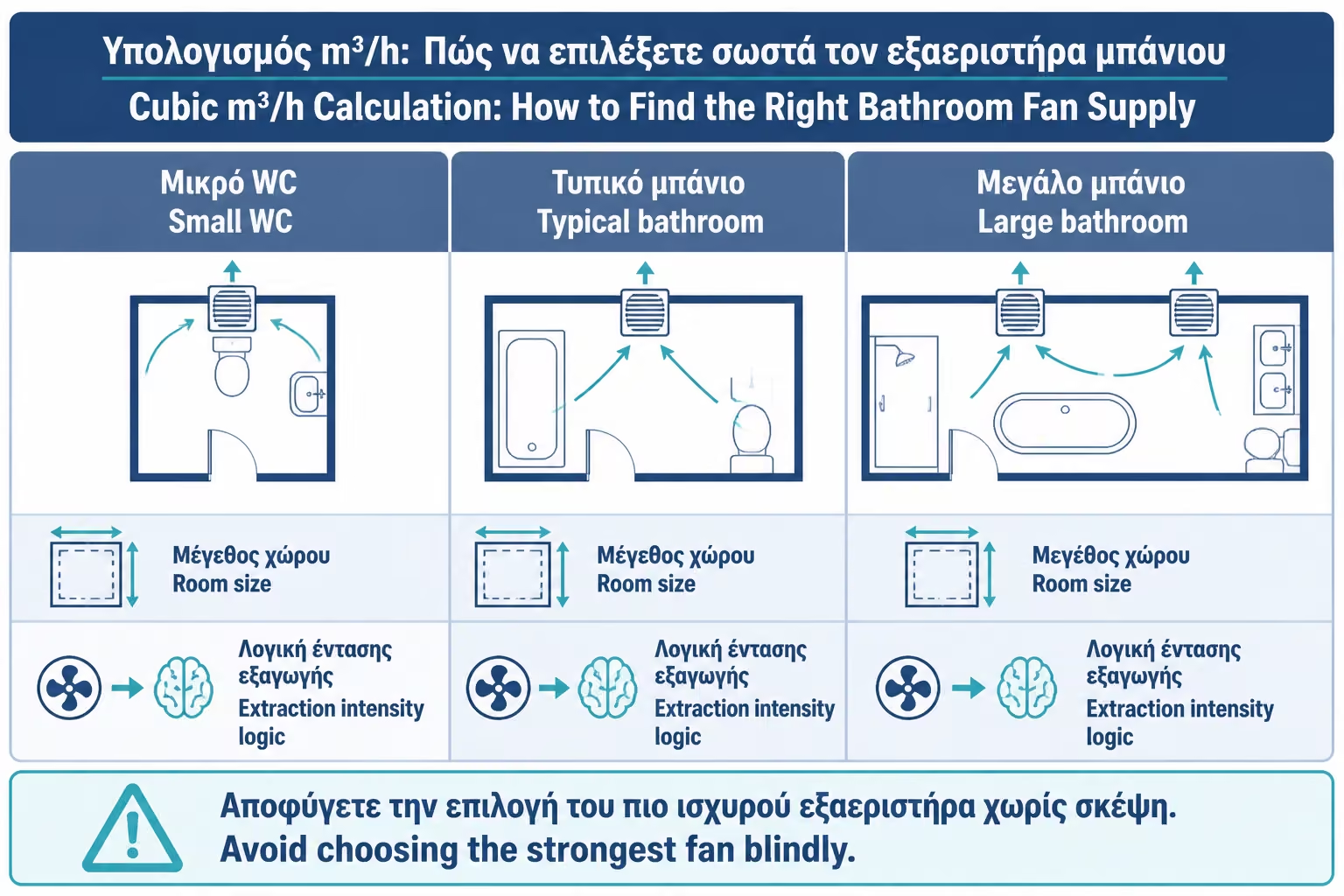
We don't always have to chase the highest number. A small WC without a shower does not have the same requirement as a blind master bathroom where hot showers are taken every day. If we put too powerful a fan in a small space, we may have noise, discomfort and useless consumption. If we apply too little, moisture will remain.
The right choice is balance: enough air changes to let water vapor escape, but not an excessive supply for no reason.
To make it easier, the panel below shows indicative requirements based on square footage, assuming a height of 2.70 m and 10–12 air changes per hour. The prices are practical and need to be adjusted if the bathroom is blind, has a long duct or heavy use.
| Bathroom size | Volume with a height of 2.70 m. | Provision for 10 ACH | Provision for 12 ACH |
|---|---|---|---|
| 3 sq.m. | 8.1 m³ | 81 m³/h | 97 m³/h |
| 4 sq.m. | 10.8 m³ | 108 m³/h | 130 m³/h |
| 5 sq.m. | 13.5 m³ | 135 m³/h | 162 m³/h |
| 6 sq.m. | 16.2 m³ | 162 m³/h | 194 m³/h |
| 8 sq.m. | 21.6 m³ | 216 m³/h | 259 m³/h |
| 10 sq.m. | 27 m³ | 270 m³/h | 324 m³/h |
The table shows something that often surprises owners: the theoretical supplies for quick air renewal are often larger than the very small models typically installed in old bathrooms. This does not mean that every bathroom of 5 sq.m. definitely needs 160 m³/h in practice. It means that a 60 m³/h fan might be marginal, especially if there is a shower and a blind space.
Also, regulatory minimum amenities and practical comfort requirements are not always the same thing. A minimum requirement may prevent complete failure, but in actual steam use we may want a higher output or a longer run time.
In several international regulatory guides, a minimum intermittent exhaust of 15 l/s, i.e. approximately 54 m³/h, is specified for bathrooms with a bath or shower. Some instructions also mention overrun, i.e. operation for a few minutes after the light goes out, especially when there is no opening window.
This value is useful as a minimum basis, but it does not mean that it is always enough for comfortable and fast removal of moisture in every Greek bathroom. A small WC may be fine with a supply close to these levels. A master blind bathroom with a hot shower, long hose and poor ventilation may need more.
In the market, many Φ100 models give about 80–100 m³/h in nominal flow. This often covers small bathrooms with a single track. But when the going gets rough, the actual supply drops. So a fan that on paper is above the minimum may actually underperform.
It is safe practice not to select a fan exactly at the theoretical limit. We keep a reasonable margin, especially in blind bathrooms, ducts with corners or heavy use.
Let's take a small WC of 2 sq.m. without shower, with a height of 2.70 m. The volume is:
2 × 2.70 = 5.4 m³
If we want 8–10 air changes per hour, the theoretical flow rate is:
5.4 × 8 = 43 m³/h
or
5.4 × 10 = 54 m³/h
In such a WC, a simple axial fan with a nominal flow of 70–90 m³/h may be more than enough, as long as the path is short and the outlet is correct. No need for an overly powerful model. Noise, feedback and proper operation are more important.
If the WC is blind and used frequently, a timer can help, but there is not the same production of water vapor as in a bathroom with a shower. So the calculation should not be done with the same strictness.
This is a good example where exaggeration is not needed. A very powerful fan in a small WC can be noisy and annoying without providing any real benefit.
A standard bathroom of 5 sq.m. with a height of 2.70 m has volume:
5 × 2.70 = 13.5 m³
If we want 10 air changes per hour:
13.5 × 10 = 135 m³/h
If we want 12 air changes per hour:
13.5 × 12 = 162 m³/h
If the bathroom has a window, a short exhaust path and the fan runs long after the shower, a model around 100–120 m³/h can also perform well. But if the bathroom is blind and the duct has corners, then the choice should be made more carefully. A better fan type or higher rated flow may be needed to achieve satisfactory real-world performance.
This shows why "I have Φ100, so I get a simple Φ100" is not always correct. Many Φ100 models are around 80–100 m³/h. On a single route they may be acceptable. On a difficult route they may not be enough.
For a typical master bathroom, good practice is to look not only at m³/h but also whether the fan is axial, centrifugal or in-line, whether it has a timer, whether it has a humidity sensor and whether the duct allows for actual flow.
A bathroom of 8 sq.m. with a height of 2.80 m has volume:
8 × 2.80 = 22.4 m³
For 10 air changes per hour:
22.4 × 10 = 224 m³/h
For 12 air changes per hour:
22.4 × 12 = 269 m³/h
Here a simple small fan Φ100 is usually insufficient, especially if there is a walk-in shower, a free-standing bathtub, a blind floor plan or a long ventilation duct. A larger diameter, in-line solution, more suction points or more careful network design may be needed.
In large bathrooms, an exhaust point in a random position is not always enough. If the shower is at one end and the vent is at the other, the water vapor may spread throughout the space before being removed. In such cases, an intake grill near the shower with an in-line fan may be better than a wall-mounted fan away from the moisture source.
The large bathroom needs an air flow study, not just a higher number of m³/h.
The easy thinking is: since I want the humidity to go away quickly, I'll get the most powerful fan. It's not always right. An excessively powerful fan can make more noise, draw air from unwanted places, create drafts, disturb use and eventually be turned off by users.
Also, if the duct is narrow or has a lot of resistance, the "strongest" fan will not necessarily perform accordingly. It may just work with more noise against a bad conductor. The right solution might be a larger diameter, fewer corners or a different type of fan, not just more m³/h in the package.
There is also the issue of comfort. In a small bathroom, too much flow can draw strong air under the door and create a cold feeling, especially in winter. If the bathroom has a radiator or towel rail, excessive ventilation can remove warm air faster than necessary.
The right choice is sufficient, not excessive. We want the fan to work efficiently and quietly, for a long time, without becoming annoying.
The m³/h calculation is based on the volume of the bathroom. But the pipeline determines how many of these m³/h will actually pass through. If the conductor is bad, performance drops.
A short, smooth, straight pipe with the correct diameter helps a lot. A long hose, tucked into a suspended ceiling, with two corners and a small external grill, can significantly reduce the flow. Every corner, every constriction and every dirty blind adds resistance.
This is where the calculation should become more practical. If the panel shows that you need around 120 m³/h and the duct is almost direct, a 120–140 m³/h model may be sufficient. But if the ductwork is difficult, you may need a larger rated fan or a different type, such as centrifugal or in-line.
Manufacturers' values should be read in conjunction with pressure/flow technical charts when installation is demanding. For a simple owner, this means that on a difficult route a technician must enter the selection, not just buy from an e-shop.
The fan cannot remove air if no other air can get in its place. If the bathroom door closes tightly, the fan will struggle. It will create vacuum, make more noise and draw less air.
The simplest solution is to leave a small gap under the door. In many bathrooms, 1–1.5 cm can help significantly, depending on the overall setup. Another option is a discreet louvre in the door or at a low point, if aesthetics and acoustic privacy allow it.
A common renovation mistake is to install a new tightly sealed door, a new rubber seal, a new threshold, and at the same time a small fan. The bathroom becomes more "sealed", so the fan performs worse. The owner then assumes the fan is to blame.
Airflow needs a path: air must enter from somewhere, pass through the bathroom, and leave through the exhaust point. If one part of that path is missing, the m³/h calculation will not hold up in practice.
Even the right ventilator takes time. The water vapor does not all leave when the shower ends. After use, surfaces remain wet, towels retain moisture, the floor evaporates water and the air continues to have increased humidity.
That is why a timer or overrun function is so useful. It keeps the fan running for 10, 15, or more minutes after the light goes out or after use. Guidance for bathrooms without an opening window often mentions an overrun of around 15 minutes for intermittent ventilation.
In practice, a bathroom with a moderate fan but proper overrun may dry better than a bathroom with a strong fan that shuts off immediately. Uptime is part of performance.
The humidity sensor is even better in some cases because it's not just based on time. If the humidity remains high, the ventilator continues. This is useful in blind bathrooms, families with multiple showers, or areas where users forget to leave the vent open.
The humidity sensor, or humidistat, activates the fan when the relative humidity rises above a set threshold. It is especially useful in blind bathrooms and in spaces where water vapour is the main problem. The user does not need to remember to switch the fan on. The system responds to the actual air conditions.
But it is not a panacea. If set too low, it can work continuously, especially in areas with high seasonal humidity. If set too high, it may activate slowly. If the sensor is of poor quality, it may be unstable.
In bathrooms with frequent use, a fan with humidity sensor and timer is a very practical solution. In a small WC without a shower, it may be unnecessary. There, a simple switch or timer for smells is enough.
The important thing is not to buy the sensor as a "smart feature" for its own sake. It is worth it when there is a real water-vapour problem to solve.
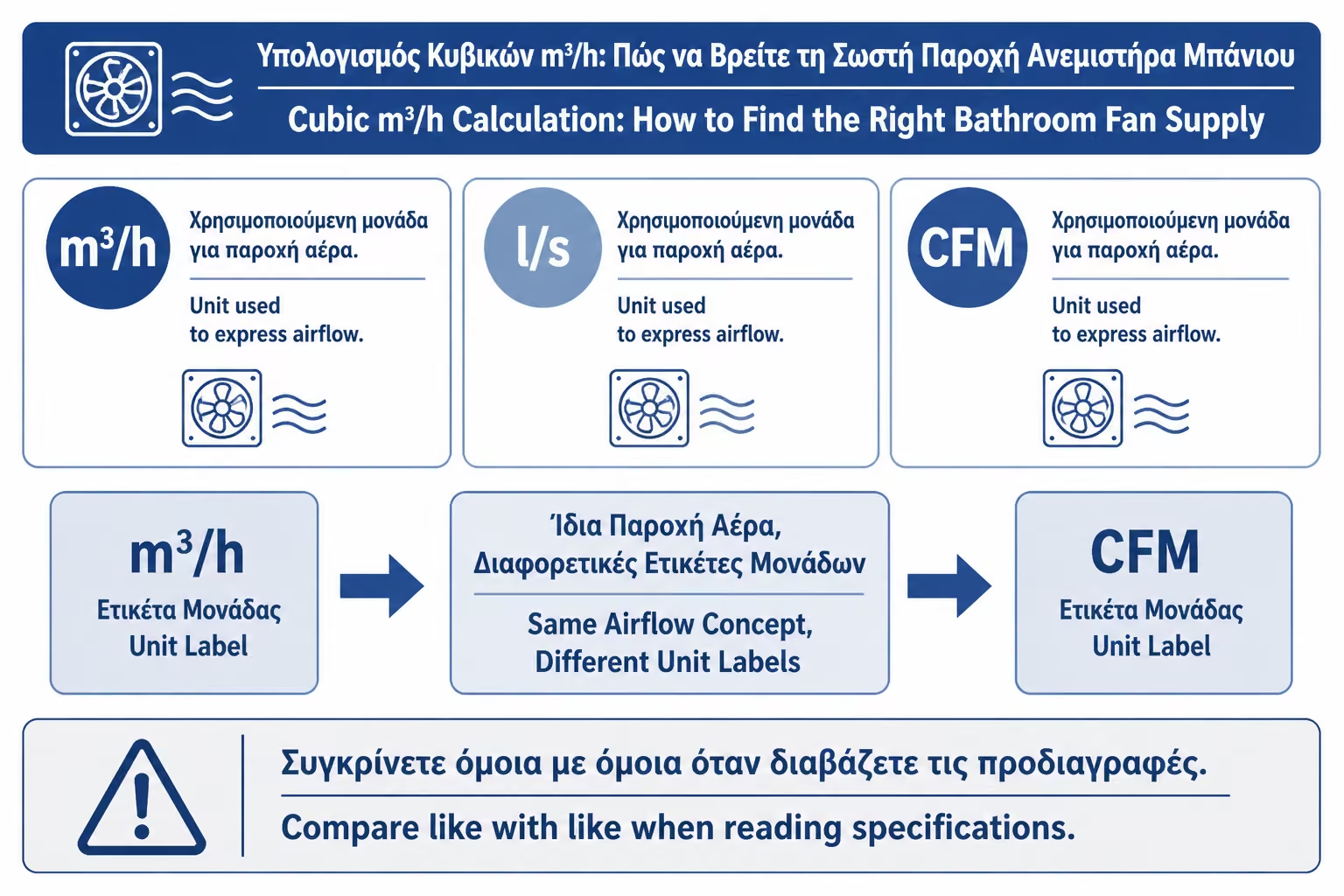
In the technical specifications you may see different units: m³/h, l/s or CFM. In Europe we often meet m³/h and l/s. In American articles and products you will see CFM, which is cubic feet per minute.
The main conversions are:
| From | In | Practical conversion |
|---|---|---|
| l/s to m³/h | We multiply × 3.6 | 15 l/s = 54 m³/h |
| m³/h to l/s | We divide ÷ 3.6 | 108 m³/h = 30 l/s |
| CFM to m³/h | We multiply by approximately × 1.7 | 50 CFM ≈ 85 m³/h |
| m³/h to CFM | We divide approximately ÷ 1.7 | 100 m³/h ≈ 59 CFM |
This helps when comparing products or guides. For example, the often cited American practice of 50 CFM for a bathroom corresponds to approximately 85 m³/h. If you see a European minimum of 15 l/s, this corresponds to 54 m³/h. It's not exactly the same calculation logic in all countries, but the conversions help to understand the order of magnitude.
For the Greek market, you will usually read m³/h. So it is good to do your calculation in cubic meters per hour.
Sometimes calculating with 10–12 ACH gives a large number, especially in large bathrooms. This doesn't mean you have to put a huge fan on the wall. It means you have to design the system better.
In a large bathroom, you may need an in-line fan with a larger duct diameter. Extraction may need to be positioned closer to the shower. A longer run time may work better than excessive peak airflow. Better air intake under the door may also be needed. In some cases, a combination of natural and mechanical ventilation is the right solution.
In some cases, continuous low boost operation is more comfortable than a very loud fan that suddenly comes on. This is especially true in blind bathrooms with a permanent moisture problem. Continuous low air renewal can keep the room more stable, while boost helps after the shower.
So the calculation is not a final buy order. It is an indication that a proper ventilation strategy should be chosen.
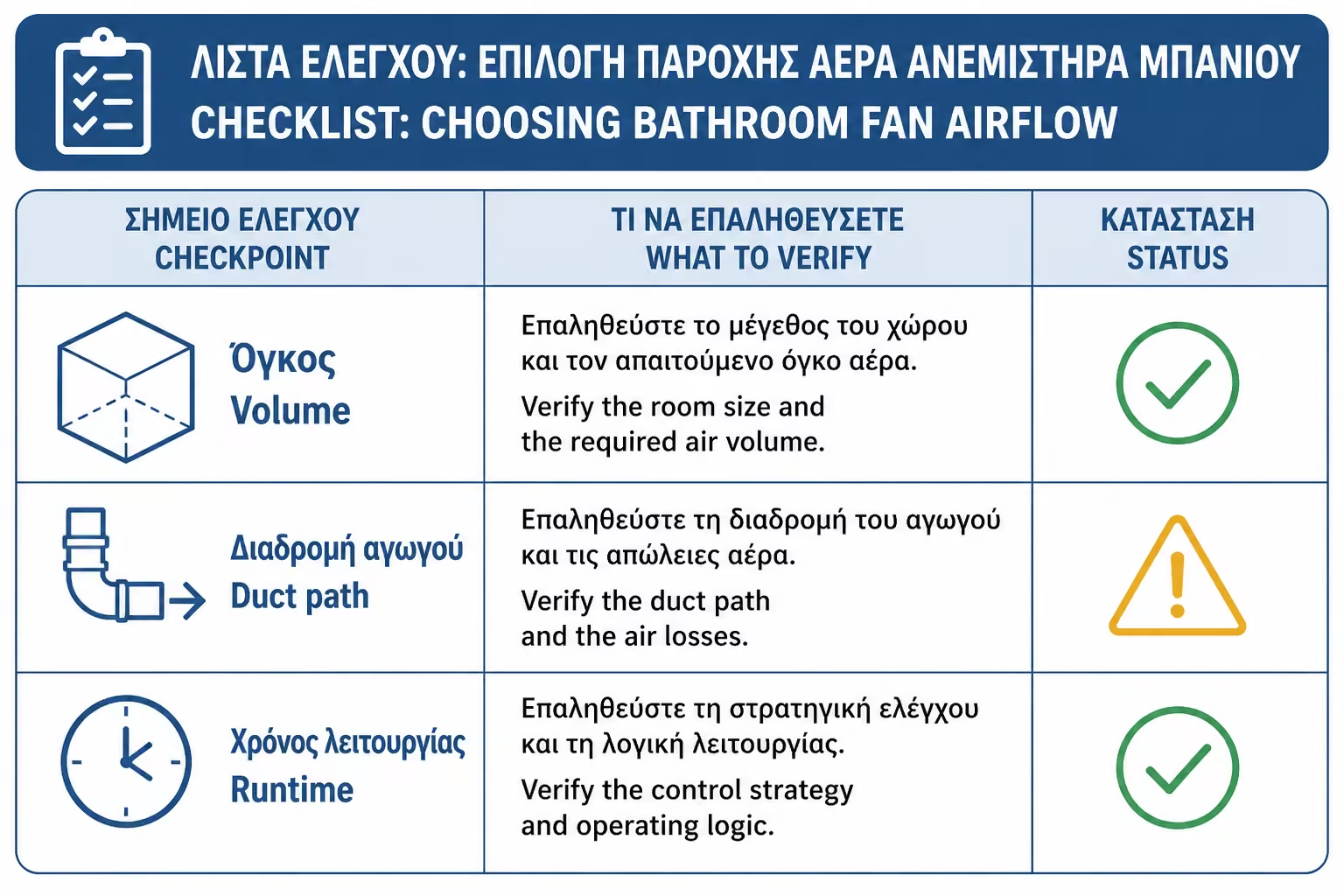
When looking at a model, don't just look at the m³/h output. See the connection diameter, the noise in dB(A), if it has a timer, humidity sensor, backflow, IP protection, consumption, motor type and suitability for the mounting method.
If the installation is ducted, look for information on performance under resistance or on suitable duct length. More technical models include performance curves showing how airflow drops as static pressure increases. The average owner does not need to analyse them personally, but the technician should take them into account in demanding installations.
Also check whether the model is suitable for wall mounting, ceiling mounting, or both. Check whether it includes a backdraft damper, whether it requires a specific mounting position, whether it supports a timer or has one built in, and whether cleaning access is straightforward.
A good ventilator is not just the one with the highest number of m³/h. It is the one that suits the bathroom, the duct and the way of use.
The table below gives practical guidance. It does not replace an autopsy, but it helps to avoid the most wrong choices.
| Space type | Indicative supply / logic | Possible type |
|---|---|---|
| Small WC 2–3 sq.m. no shower | 50–80 m³/h | Axial |
| Small bathroom 3–4 sq.m. with simple output | 80–120 m³/h | Axial with timer |
| Standard bathroom 4–6 sq.m. with a shower | 100–160 m³/h | Good axial or centrifugal, depending on pipeline |
| Blind bathroom 4–6 sq.m. with duct | 130–200 m³/h nominal or correct pressure | Centrifugal or in-line |
| Large bathroom 7–10 sq.m. | 180–300 m³/h, depending on use | In-line / mixed-flow or designed system |
| Bathroom with long drain | Not only m³/h, pressure control | Centrifugal or in-line |
| Bathroom next to bedroom | Low noise, correct overrun | Low-noise or in-line |
Ranges are indicative. Whether to select the lower or upper value depends on the usage. A bathroom that is used once a day does not have the same need as a family bathroom where four people shower in a row. A bathroom with a window does not have the same requirement as a blind bathroom without natural ventilation.
The right choice results from a combination of calculation and actual autopsy.
As the flow, quality, pressure and functions increase, the cost usually increases. But the relationship is not linear. A more expensive ventilator is not necessarily better for every bathroom, and a cheap one is not always wrong. The correct value depends on the installation.
| Category | Indicative range 2026 | Comment |
|---|---|---|
| Simple small axial 70–100 m³/h | €25–€70 | For simple short exports |
| Axial with timer 80–120 m³/h | €50–€130 | Good basic solution for small bathrooms |
| Axial with humidity sensor | 80–180€ | Useful in blind or frequently used bathrooms |
| Centrifugal 100–200 m³/h | 90–250€+ | For more difficult pipelines |
| In-line / mixed-flow 150–300 m³/h | 100–350€+ | For suspended ceilings, longer runs, lower noise |
| New duct / grilles / return | 40–250€+ | Depends on length and access |
| Full installation with electrician | Wide variation | Supplies, timer, sensor, accessories |
Prices depend on area, floor, access, existing installation, pipe diameter, VAT and whether the offer is for product only or complete installation. A higher price is justified when it includes the right type of fan, low noise, sensor, proper IP protection, correct conduit and clean electrical installation.
The low price can be perfectly reasonable in a small WC with a direct outlet. But it is often a mistake in a blind bathroom with moisture, where an inadequate choice will lead to mold, damage and ultimately higher costs.
The calculation is simple, but errors in interpretation are frequent. Many owners correctly calculate the volume, but then ignore the duct. Others only look at the m³/h and buy a very noisy model. Others choose a small fan because "the bathroom is small", without considering that it is blind and heavily used.
| Error | What happens in practice | A more correct approach |
|---|---|---|
| Calculation with quadratics only | Height and volume are unknown | Calculation m² x height |
| Selection based on m³/h only | The duct is ignored | Check fan length, angles and type |
| Buy the most powerful model | Noise and disturbance | Adequate but not excessive supply |
| Ignore timer | Moisture remains after the shower | Overrun 10–15+ minutes |
| Zero air intake | The fan is "choking" | Door crack or other air entry |
| Axial in long duct | Low real performance | Centrifugal or in-line |
| Small diameter in large flow | Noise and losses | Correct pipe diameter |
| Ignore noise | The user disables it | Low dB and correct position |
| No return | Smells from a lamp | Check valve |
| No maintenance | Performance decline over time | Clean the impeller and grille |
A typical example is a 4 sq.m. bathroom where the calculation shows roughly 110–130 m³/h, but the owner buys a basic 120 m³/h axial fan and installs it on a 4 m duct with two bends. On paper the airflow looks correct. In practice, the fan may deliver far less. The solution was not simply "more m³/h", but the right fan type and a better route.
| Inquiry | Yes / No |
|---|---|
| Have you calculated the volume of the bathroom in m³? | Yes / No |
| Have you decided how many air changes per hour you need? | Yes / No |
| Does the bathroom have a shower or is it just a WC? | Yes / No |
| Is the bathroom blind or does it have a window? | Yes / No |
| Have you checked the length of the vent? | Yes / No |
| Are there many corners or constrictions in the duct? | Yes / No |
| Does the fan's rated flow have room for losses? | Yes / No |
| Does the fan type match the duct resistance? | Yes / No |
| Is there enough air intake from the door or other point? | Yes / No |
| Is there a timer or humidity sensor for after-shower operation? | Yes / No |
| Is the noise acceptable for everyday use? | Yes / No |
| Is there a return for odors and air return? | Yes / No |
| Have the location and electrical installation been checked by a professional? | Yes / No |
| Does the quote include vent, ducting, grilles, labour, VAT and incidentals? | Yes / No |
If you want to calculate the ventilator correctly, start from the volume of the bathroom: square meters by height. Then multiply by 10–12 air changes per hour for a practical initial estimate. But don't just buy from this number. If the duct is long, has corners, or the bathroom is blind, add clearance and consider a centrifugal or in-line vent. And don't forget the simplest: the ventilator must continue after the shower and have somewhere to draw fresh air. Without a timer and no air flow, even the correct m³/h will not work as you expect.
Calculating m³/h is the first step toward proper bathroom ventilation. No complicated maths are required. You measure the floor area, multiply it by the clear height, and find the room volume. Then you multiply that by the number of air changes per hour that suits the bathroom's use. For most bathrooms with showers, a practical starting point is around 10–12 ACH, with adjustments case by case.
But that number is not the final answer. Real performance depends on the duct route, diameter, bends, fan type, backdraft protection, air intake, and run time. A fan with the correct m³/h on paper can still fail if it is installed in the wrong duct setup. By contrast, a well-designed system with the right fan type, timer, and airflow path can keep the bathroom dry and hygienic for years.
The best approach is to use the calculation as a guide, not as an absolute recipe. For a simple WC or a small bathroom with a short outlet, a good axial fan may be enough. For a blind bathroom, a long duct run, or heavy daily use, a more serious solution is needed, often centrifugal or in-line. Proper ventilation is not judged by how fast the impeller spins. It is judged by whether the mirror clears, the surfaces dry, and the moisture does not linger in the room.
Return to category.
Go to categoryReturn to the central guide.
Go to guide