
Bathroom Lighting, Ventilation & Heating
Return to category.
Go to categoryThe bathroom is the place where the heating must be accurate. It doesn't necessarily have to be hot all day. But it needs to be warm at the right time: when you wake up, when you get in the shower, when you get out wet, when the towels are drying. That's exactly where smart Wi-Fi thermostats and programmable controllers make sense.
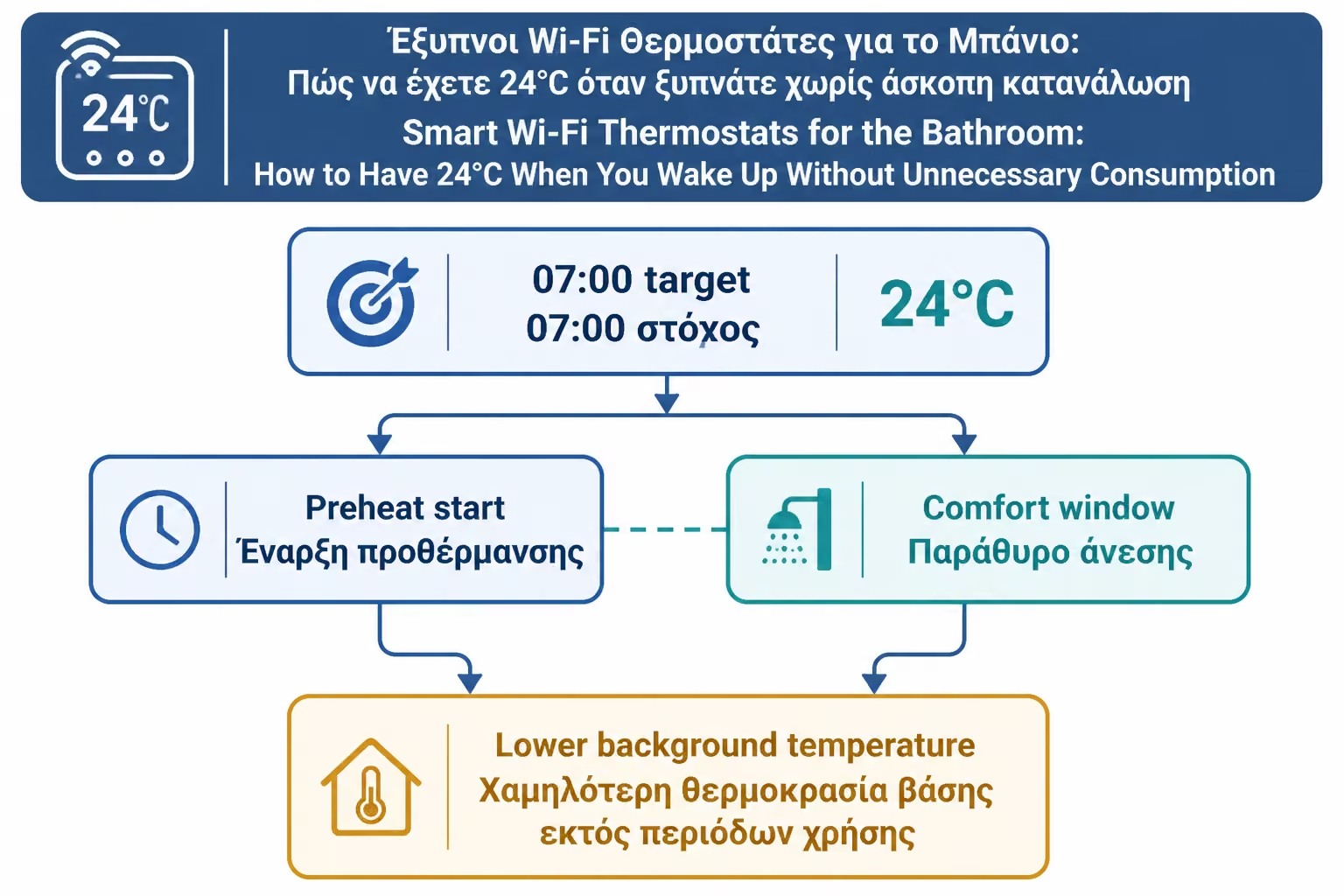
The idea is simple: instead of manually turning on the electric underfloor or the towel rail and hoping it will heat up, you set a schedule. For example, if you wake up at 07:00, the bathroom can start heating up at 06:15 or 06:30, so that at 07:00 it is already comfortable. Then the system drops to a lower temperature or shuts down, instead of consuming power unnecessarily until noon.
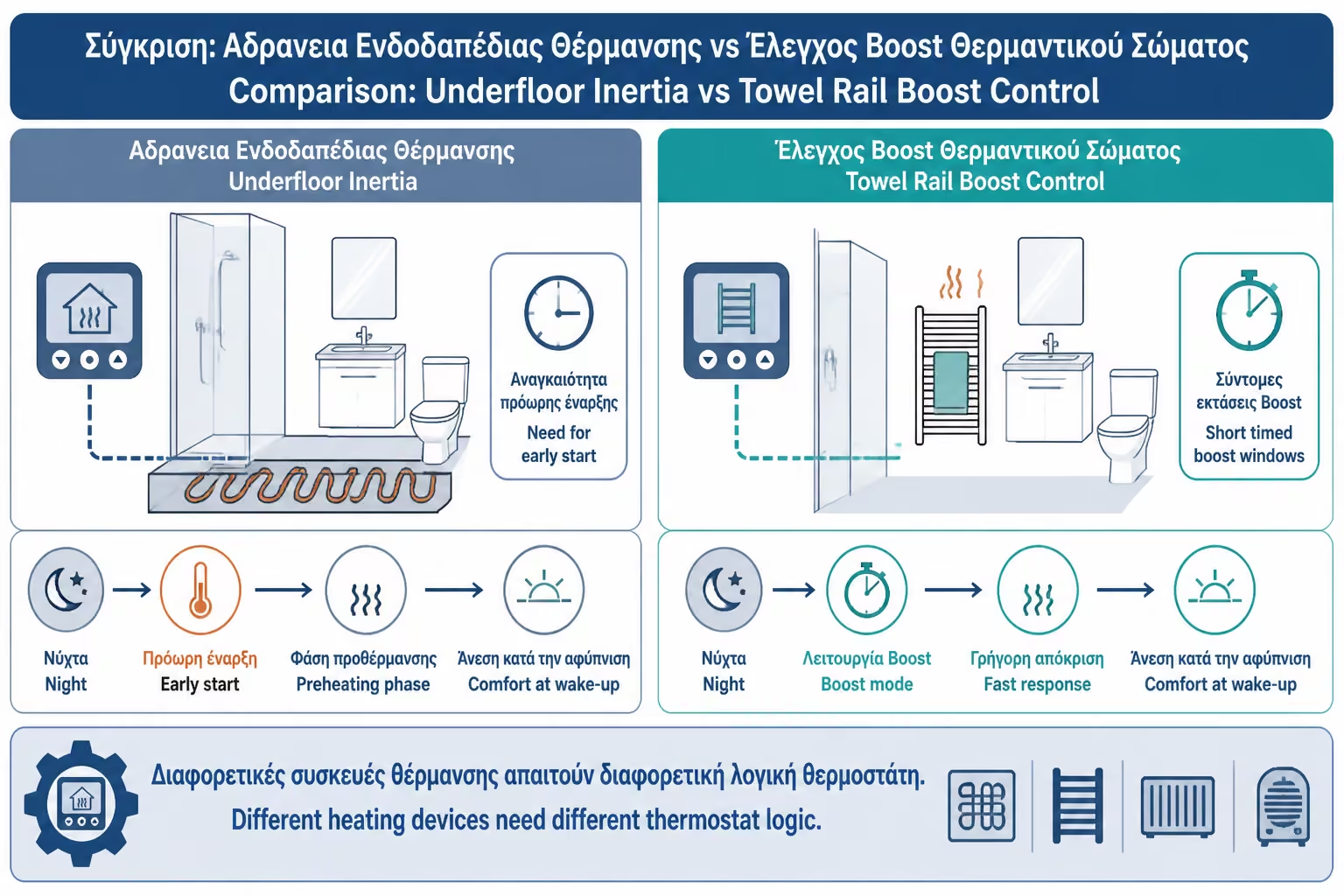
The critical point is that not all systems behave the same. Electric underlay has inertia: the tile and the adhesive/mortar underneath must first be heated. So it needs a warm-up. The electric towel rail, on the other hand, works more like a “boost”: it can be turned on for 30–60 minutes to heat and dry towels, without having to keep the whole bathroom at 24°C all day.
A Wi-Fi thermostat does not save electricity by itself. It saves when used to reduce unnecessary operating hours, avoid excessive temperatures, apply a schedule by day and adapt heating to your routine. Modern underfloor thermostats can work with a floor sensor and/or room sensor, activating the heating to maintain the selected setpoint.
In the bathroom, there is also the matter of safety. The thermostat, the control and the electrical connection do not fit where it is convenient. For bathroom installations, construction instructions state that the thermostat should be placed outside zones 0, 1 and 2 or, if this is not possible, in an adjacent room, controlling the bathroom with a floor sensor. So smart control must also be smartly installed.
The Wi-Fi thermostat is the controller that commands the heating to turn on or off, based on temperature, schedule and settings from a mobile app. It can control electric underfloor heating, electric towel rail, heating panel or other compatible electrical load, depending on its specifications.
In an electric subfloor, the thermostat is usually connected to a floor sensor. The sensor is located inside the floor, between the heating cables, and measures the temperature of the tile or mass around the system. This is critical, because the comfort in the bathroom depends not only on the air but also on how warm the floor is.
In an electric towel rail, the control can be integrated in the resistor, with a thermostat and boost mode, or external, as long as the product and the installation allow it. Many modern resistors have Comfort, Stand-by, program and Boost 2h functions, i.e. switching on for a certain time and returning to a previous function.
The main value of Wi-Fi is not that it "turns on from the mobile". It is that it can implement schedule, avoid forgotten devices, adapt to different days and give control without going to the switch every time.
Unlike a living room or an office, the bathroom has short usage peaks. You want high comfort for 30–60 minutes, not necessarily 24°C from 00:00 to 23:59. If you keep an electric underfloor or towel rail constantly on "so it's ready", you're paying for a lot of useless hours.
Smart heating is schedule based. Higher temperature during use hours, lower maintenance temperature or complete off when not needed. If the bathroom is used morning and night, you create two "windows" of comfort. If you wake up later on the weekend, the schedule changes.
This is especially important in electrical solutions. A 600W system that stays on for 8 hours consumes up to 4.8 kWh. If it works for a targeted 2 hours, the maximum consumption drops to 1.2 kWh. With a thermostat it can be even lower because it doesn't run at full power all the time.
The goal is not to freeze the bathroom. The goal is to not heat up when not in use.
The electric subfloor does not heat up like an air heater. First the cable heats up, then the glue or self-levelling, then the tile, and finally you feel a warm floor and a more comfortable space. This takes time. If you schedule it to start at 07:00, probably at 07:00 the floor will just start rising.
That is why underfloor thermostats must be adjusted with preheating. For a small bathroom with an electric heating mat under tiles, preheating can be 30–60 minutes, depending on power, insulation, layer thickness and starting temperature. On heavier systems or frozen floors, it may take longer.
The floor sensor is crucial. You don't just want the air to say 24°C while the tile is cold, nor the floor to overheat because the air is slow to rise. The right thermostat can use a floor sensor, a room sensor or a combination, depending on the function and the product. In-floor thermostat guides explain that floor and room sensors are used to monitor the temperature and turn the system on or off at the selected setpoint.
The correct setting for underfloor heating is "predict when I need heat", not "turn on when I'm cold".
The electric towel rail has a different logic. It doesn't always need to keep the bath at 24°C. Often her role is to warm and dry towels. This is best done with boost: short operation for a certain time before or after the shower.
For example, you can set the towel rail to turn on at 06:30 and off at 08:00. Or to activate for 2 hours after the evening bath to dry the towels. Many smart or electronic towel rail controllers offer comfort mode, standby/antifreeze, weekly programs and 2h boost.
Boost is important because the towel rail can consume 300–800W or more. If it is forgotten all day, the consumption goes up. If it works targeted, it offers the comfort you want with much less hours.
The towel rail should not be casually controlled with a common smart plug in the bathroom. If you want smart control, choose a compatible controller or thermostat for a wet room, installed by an electrician and according to the manufacturer's instructions.
Let's say you want the bath at 24°C at 07:00. The correct setting is not the same for every system.
For an electric underfloor, you start as a trial run. You set the program to go up in comfort mode at 06:15 or 06:30 and check if at 07:00 the floor and the air have reached the desired sensation. If not, you start earlier. If so and there is time to spare, you are a little late. Then you set return to eco or off at 08:00.
For an electric towel rail, you can schedule boost at 06:30–08:00 or 06:45–08:15, depending on how quickly it heats up. If the goal is mainly a dry/warm towel, the entire bathroom does not necessarily need to reach 24°C.
For a combination of underfloor and towel rail, the best logic is: underfloor starts earlier for floor thermal comfort, towel rail activates closer to use time for towels. So you don't overload one device to do the work of the other.
| System | Target time | Possible launch | Operation |
|---|---|---|---|
| Electric underfloor | 07:00 | 06:00–06:30 | Floor heating |
| Electric towel rail | 07:00 | 06:30–06:45 | Towel boost |
| Infrared panel/mirror | 07:00 | 06:45–06:55 | Instant radiant comfort |
| Wall-mounted air heater | 07:00 | 06:50–06:55 | Fast air heating |
Times are indicative. Your own bathroom needs to be "trained" with 3-5 day trials.
Smart thermostats often have different modes. Comfort is the temperature of use, e.g. 23–24°C in the bathroom. Eco is a lower temperature, e.g. 17–19°C, so that the space does not freeze but does not consume too much. Away is for absence, where the system is down or off. Frost or Antifreeze keeps a minimum protection temperature, useful in cottages or very cold areas.
In the bathroom, you don't always need an eco temperature all day, especially if we are talking about an electric underfloor in a small space. It may be beneficial to turn it completely off between uses. But if the bathroom gets very cold and mouldy, a low level of maintenance can help the surfaces not reach too low temperatures.
For a towel rail, standby or antifreeze only makes sense if the product supports it and if there is a need. Usually the practical mode is program + boost.
The main thing is not to use only manual mode. Underfloor control guides state that the manual maintains the temperature you set until you change it, so it can result in continuous operation if you forget.
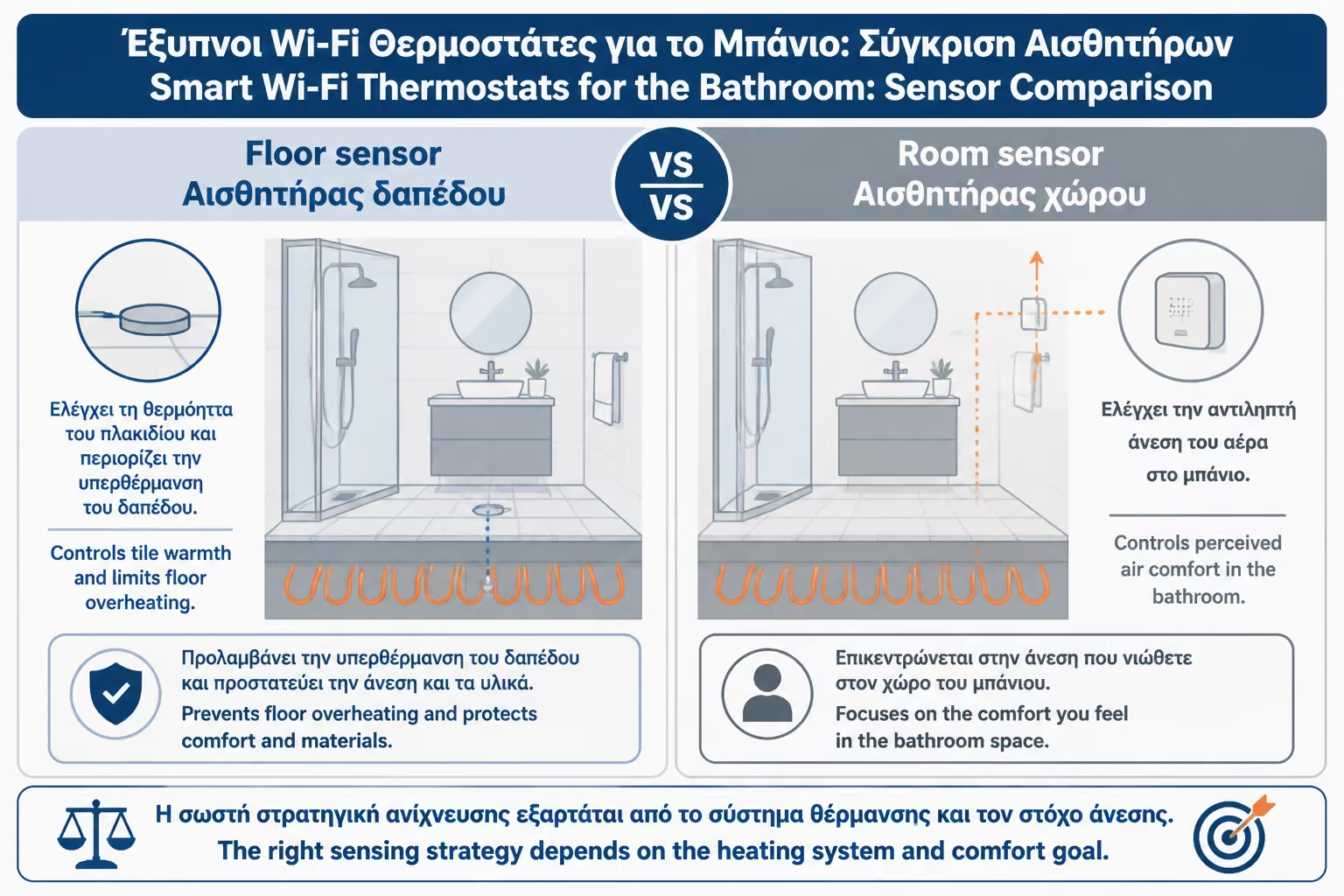
The room sensor measures the air. The floor sensor measures the floor. In the bathroom, both make sense, but for different reasons. The air tells us if the room is at 24°C. The floor tells us if the tile is comfortable and safe.
For electric subflooring under tiles, the floor sensor is essential. It protects against overheating, gives more precise comfort control, and helps the thermostat not rely solely on rapidly changing air from a door opening, shower or fan.
The room sensor can be affected by steam, drafts, door, window or hot towel. If the thermostat is outside the bathroom, it cannot measure the bathroom air correctly. In such cases, floor sensor control is even more important.
For an electric towel rail, it often measures body/resistance temperature or operates on a preset schedule. There the concept of "24°C room" is less direct, unless there is a separate room thermostat.
The thermostat should not fit where it is convenient. The bathroom has safety belts due to the shower/tub. In the installation instructions for an electric underfloor thermostat, it is stated that for bathroom installations the thermostat must be placed outside Zones 0, 1 and 2, or if this is not possible, in an adjacent room with control via a floor sensor.
This is of practical importance. If you put a touch thermostat next to the shower, it can be inconvenient and dangerous. If you put it inside where it receives water vapor or splashes, the service life may be shortened or the requirements may be violated. If you put it outside the bathroom, you need a proper floor sensor and maybe not a room sensor.
Installation must be done by a licensed electrician. The thermostat controls an electrical load, often 300–2,000W, in a humid environment. It's not just a gadget.
Wi-Fi does not mean wireless power. Power passes through an electrical circuit. This must be correct.
The mobile app is useful when you actually use the right features. The most important is the weekly schedule. You set different times for weekdays and weekends. Then comes remote control: if you come home early, you can turn on the bathroom from your phone. If you leave and forgot it on, you can switch it off remotely.
Other useful features are energy monitoring, open-window detection, adaptive start and notifications. Adaptive start, where available, learns how early the heating should begin in order to reach the target temperature at the desired time. This is especially useful with underfloor heating.
Not all "smart" functions are necessary. If you don't want cloud, accounts and apps, a good programmable thermostat without Wi-Fi can do 80% of the job. Wi-Fi adds convenience and remote control, not necessarily better heating per se.
The worst case scenario is to buy a smart thermostat and leave it permanently on manual at 24°C. Then it's not smart. It's an expensive switch.
Adaptive start or early start is one of the most useful functions for underfloors. Instead of saying “turn on at 06:30”, you say “I want 24°C at 07:00”. The thermostat learns how quickly the bathroom heats up and starts earlier or later to meet the target.
This solves the idle problem. In January it may take 60 minutes. In October, 25 minutes may be enough. If the program is fixed without adjustment, it will either be slow to heat or start too early and burn unnecessarily.
Not all thermostats have this function. If you have an electric subfloor and want comfort with economy, it's worth looking for. If you're only controlling a towel rail, adaptive start is less critical; boost is more important there.
For the best result, do not constantly change the program during the first few days. Let the thermostat "learn" the behavior of the space.
Some smart thermostats allow geofencing: when you leave the house, the heating goes down; when you come back, it goes up. This is useful for general heating, but in the bathroom it needs attention. The bathroom doesn't just need to heat up when you get home. It needs to be warmed up before specific use.
If you shower every morning, the fixed schedule is more reliable than geofencing. If your routine changes a lot, mobile remote control helps. You can turn on the bathroom before you leave the gym or before you get home from work.
Geofencing should not turn on an electric towel rail every time you approach the house unless you are going to take a shower. This will increase consumption. Better scenarios are: manual boost from app, specific routines or "Shower in 30 minutes" button.
Smart heating must follow usage, not just location.
Savings occur when operating hours are reduced. Let's take a 600W electric underfloor. If it stays on for 8 hours, the maximum consumption is 4.8 kWh. At €0.25/kWh, that's €1.20 per day. If it works for 2 hours with a program, it is up to 1.2 kWh, that is €0.30. The difference can be big.
| Device | Power | Runtime | Consumption | Cost at €0.25/kWh |
|---|---|---|---|---|
| Underfloor | 600W | 8 hours | 4.8 kWh | €1.20 |
| Underfloor | 600W | 2 hours | 1.2 kWh | €0.30 |
| Towel rack | 500W | 6 hours | 3.0 kWh | €0.75 |
| Boost towel rack | 500W | 1.5 hours | 0.75 kWh | €0.19 |
| Infrared mirror | 600W | 1 hour | 0.6 kWh | €0.15 |
In practice, the thermostat may cycle, so the actual consumption may be less than the maximum. But the calculation shows the logic: savings are a matter of hours and setpoints.
A Wi-Fi thermostat that cuts 4–6 wasted hours a day can pay for itself relatively quickly. A Wi-Fi thermostat that just keeps the bathroom always warm does not save.
24°C is a comfortable bathing temperature for many, especially when they get out of the shower. But it doesn't have to be a constant temperature. It can be the comfort setpoint for 30–60 minutes. The rest of the day can drop to 18–20°C or close, depending on insulation, humidity and use.
For electric underfloor heating, it is sometimes more practical to set floor temperature instead of air. For example, a 27–29°C floor may feel comfortable, even if the air is slightly lower. Exact values depend on tile, system and manufacturer's instructions.
Don't chase too high setpoints. Every extra degree increases consumption and can make the bath too hot. In a small space with water vapor, overheating without ventilation is not a solution.
The correct setting is the one that gives you comfort during use and low consumption during idle hours.
A good schedule for a worker who wakes up at 07:00 might be:
| Time | Underfloor | Towel rack |
|---|---|---|
| 06:15 | Comfort / warm-up | Off |
| 06:40 | Comfort | Boost |
| 07:00 | 24°C target | Hot towel |
| 08:00 | Eco or Off | Off |
| 19:30 | Comfort if there is an evening shower | Boost if needed |
| 21:00 | Eco or Off | Off |
For a family, larger windows may be needed, e.g. 06:00–08:30 and 20:00–22:00. For a holiday home, there may be frost mode and remote activation before arrival.
For a bathroom with mold or very cold surfaces, you may need a low maintenance temperature instead of full off, especially in winter. But this must be weighed against cost and ventilation.
The program must be live. The first setup is not always the final one. After a week, you see what works and fix it.
Heating without ventilation can make the bathroom more comfortable, but it does not remove water vapor. If you heat the air and don't remove it, the moisture remains. When it cools, it will condense on cold surfaces. So the smart thermostat must work together with smart or proper ventilation.
Ideally, the ventilator has a timer or a hygrostat. After the shower it continues to work until the humidity drops. Heating keeps surfaces warmer and ventilation removes water from the air. This is the right combination.
You can create a practical scenario: at 06:15 the subfloor starts, at 07:00 it is used, after the shower the fan continues for 15–30 minutes, while the towel rail stays on boost to dry towels. If the ventilator has a humidity sensor, even better.
The smart bathroom is not only a thermostat on the mobile phone. It is coordination of heating, ventilation and use.
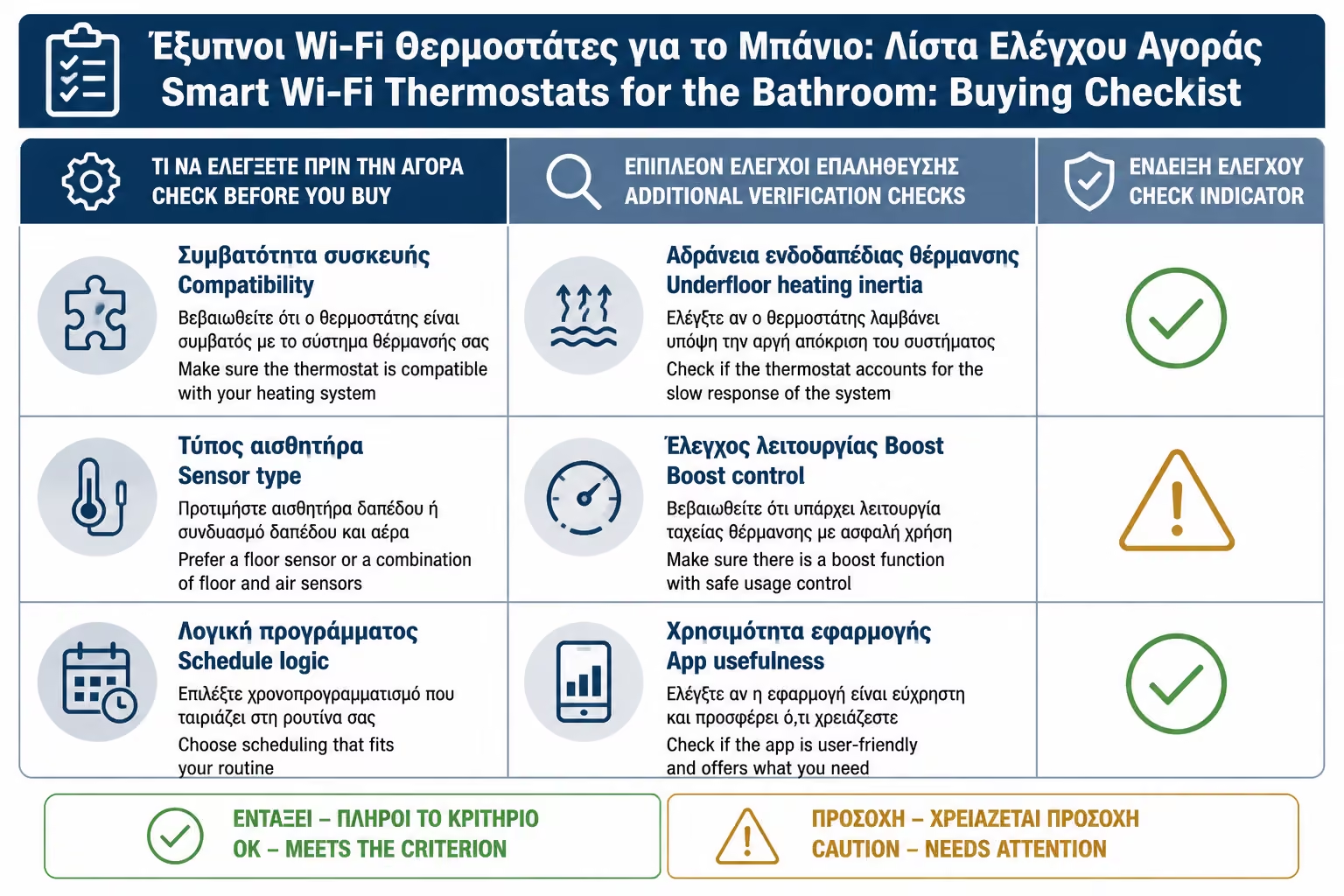
Before you buy, you need to know what you want to check. An electric underfloor thermostat has a specific maximum load, e.g. 16A on many models, floor sensor connection and output to the heating mat. It does not mean that it is suitable for a towel rail or air heater.
The electric towel rail can have its own controller. Connecting it to an external thermostat may void functions or warranty. If it has built-in boost, maybe you don't need an external Wi-Fi thermostat but a smart controller compatible with the resistance.
Smart plugs are not a general solution for the bathroom. Many do not have an appropriate IP, are not intended for wet zones and are not correct for a constant heating load in a bathroom. The safe solution is a permanent installation and a suitable controller.
Always check: maximum power, type of load, IP/installation location, sensors, warranty and manufacturer's instructions.
The cost depends on whether we are talking about a simple programmable thermostat, a Wi-Fi model, a smart thermostat with an app, a towel rail controller or a complete new electrical line. In renovation, the forecast is more economical. In a finished bathroom, some finishing touches may be needed.
| Product / work | Indicative range 2026 | Comment |
|---|---|---|
| Simple programmable underfloor thermostat | 40–100€ | No Wi-Fi |
| Wi-Fi underfloor thermostat | 80–250€+ | By brand/app/functions |
| Spare floor sensor | €10–€40 | It must be compatible |
| Smart towel rail controller | 50–180€+ | Per resistor/functions |
| Thermostat electrical installation | 80–250€+ | Per supply and position |
| New line/panel protection | 150–400€+ | If there is no forecast |
| Complete smart bathroom upgrade | 200–700€+ | Thermostat, connection, settings |
Don't just buy a thermostat from the app. Look at load, sensor compatibility, warranty, ability to manually operate if Wi-Fi drops, and support.
Installation must be calculated together with the product. A cheap thermostat that requires difficult wiring may cost more than a better one that fits into the existing installation.
| Error | What it causes in practice | A more correct approach |
|---|---|---|
| Manual mode at 24°C all day | Useless consumption | Comfort/eco program |
| In-floor start at the time of use | Cold floor | Warm-up/adaptive start |
| Smart plug in bathroom | Risk/incompatibility | Permanent suitable controller |
| Thermostat in wrong zone | Electrical hazard | Out of zone or neighboring room |
| No floor sensor | Bad tile control | Floor sensor in a tube |
| Towel rack without timer | It is forgotten on | Boost mode |
| Very high temperature hunting | Higher bill | 23–24°C only when needed |
| Ignoring ventilation | Moisture and mold | Timer/ventilator hygrostat |
| Purchase without load control | Thermostat overload | Watt/Ampere control |
| App/cloud dependency only | Misuse if Wi-Fi drops | Local handling too |
The most frequent mistake is to buy a Wi-Fi thermostat for "economy", but it remains permanently active. Economy doesn't come from Wi-Fi. It comes from the right program.
| Control | Yes / No |
|---|---|
| Will it check subfloors, a towel rail or another body? | Yes / No |
| Is the load in Watts/Amperes within specifications? | Yes / No |
| Is there a floor sensor for sub-floors? | Yes / No |
| Will the thermostat be placed outside the bathroom zones? | Yes / No |
| If he enters outside the bathroom, can he check with a floor sensor? | Yes / No |
| Is there a schedule per day and hour? | Yes / No |
| Is there a boost mode for a towel rail? | Yes / No |
| Is there local handling if Wi-Fi doesn't work? | Yes / No |
| Is the app supported and has clear settings? | Yes / No |
| Will the installation be done by a licensed electrician? | Yes / No |
| Is there a leakage relay and proper grounding? | Yes / No |
| Does the bathroom ventilation work in parallel? | Yes / No |
| Have you calculated the cost per operating hour? | Yes / No |
To have a bath at 24°C at 07:00, don't just put "on at 07:00". The subfloor needs preheating, so it starts earlier or uses adaptive start. The towel rail needs a boost, not permanent operation all day. Set comfort only during the hours of use and eco/off the rest. And remember: the thermostat controls the heat, not the humidity. To keep the bathroom from getting moldy, the fan should run after showering as long as necessary.
Wi-Fi smart thermostats are very useful in the bathroom when implemented correctly. They can make the electric subfloor start on time so the floor is warm when you wake up. They can activate the electric towel rail in boost only when needed. They can lower the temperature or turn off when the bathroom is not in use.
Savings do not occur because the thermostat is "smart". It occurs because unnecessary operating hours are reduced and excessive setpoints are avoided. A bathroom doesn't need 24°C all day. It needs 24°C at the right time. This is what makes the program, adaptive start and boost really useful.
The underfloor and the towel rack have a different logic. The first requires prediction and a floor sensor. The second requires short, targeted operation. If you set them the same way, you will lose either comfort or energy.
Finally, safety comes first. The thermostat and electrical connections must be properly installed in relation to the bathroom zones, with proper protection and by a licensed electrician. Wi-Fi makes control more comfortable, but does not change the rules of the bathroom as a wet space.
Return to category.
Go to categoryReturn to the central guide.
Go to guide