
Bathroom Lighting, Ventilation & Heating
Return to category.
Go to categoryThe mirror is one of the most basic elements of the bathroom. We use it every morning, after the shower, for shaving, for make-up, for daily care. However, it is also one of the first surfaces that "betray" the humidity of the room: it immediately fogs up, fills with drops and often remains dull for a while, especially in a small or blind bathroom with poor ventilation.
Heated mirrors are designed to address exactly this problem. With a thin heating pad behind the mirror surface, they raise the glass temperature slightly so water vapor does not condense as easily. In the simplest models, the goal is demisting. In more advanced models, the mirror can also function as an infrared heating panel, directly warming the user and the surfaces in front of it.
The idea is attractive: one object, two functions. Clear reflection after the shower and at the same time heating the bathroom without a towel rail or visible body. In small bathrooms where every centimeter of wall counts, an infrared mirror can be very practical. It is placed where there would be a mirror anyway and adds heating without "loading" the space.
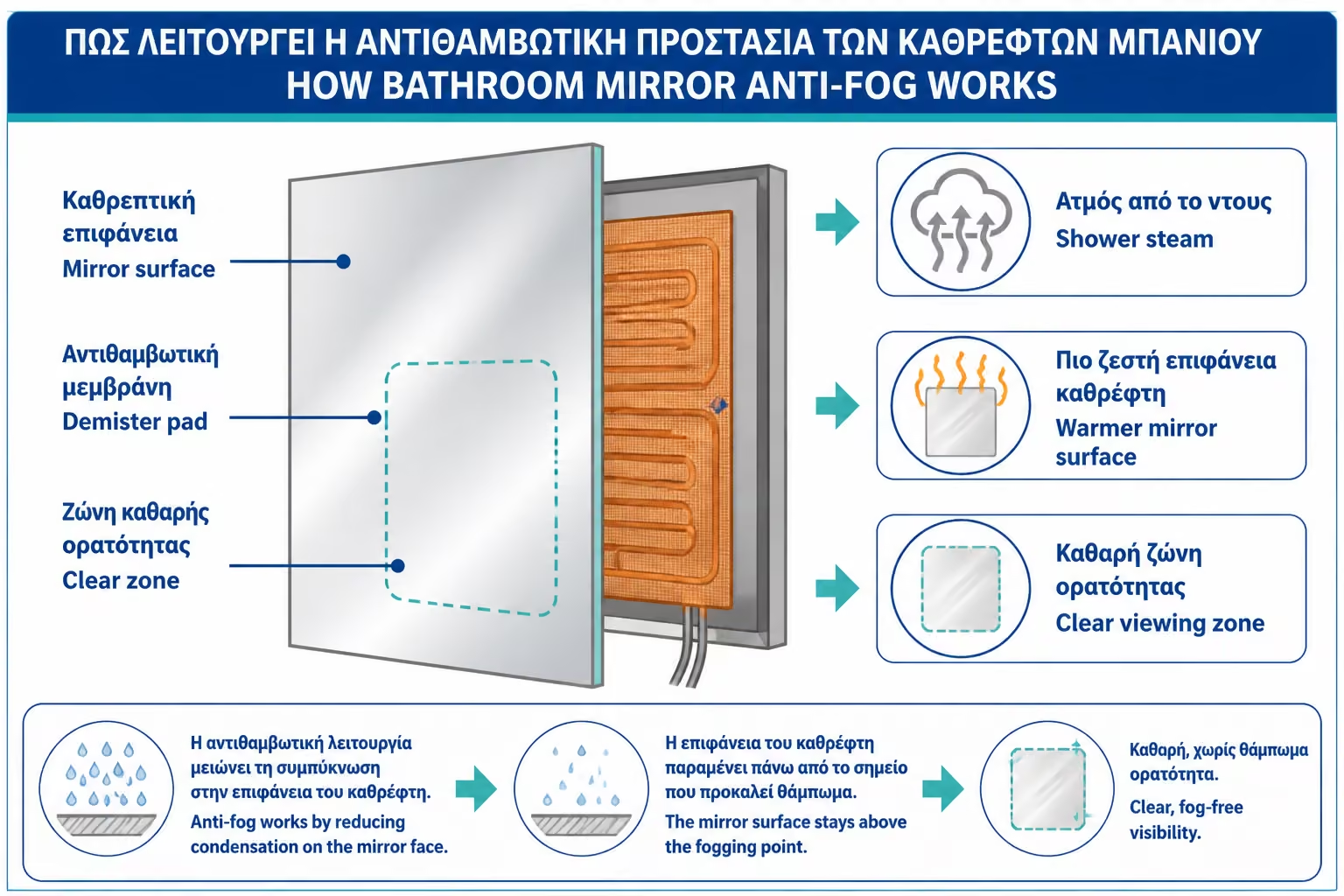
But we need to correct a common overstatement: no mirror is 100% anti-dazzle in all conditions. A good demister can keep the heated mirror area clean as long as it's turned on in time, has the right power, and the bathroom isn't extremely saturated with water vapor. However, if you take a very hot shower in a small blind bathroom without ventilation, it may dull the unheated periphery, the edges, or delay the demisting. Demister pads work by heating the glass above the dew point so that water vapor does not become droplets on the surface.
The same applies to space heating. A small mirror with demister pad 20–60W is not a bathroom heater. A large 400–800W infrared mirror can make a substantial contribution or act as the main electric heater in a small bathroom if it has the right power, location and control. Infrared heating mainly heats people and surfaces that are in direct "visual" contact with the radiation, not first the air like a classic heater.
There are many terms used in the market and they are often confused. A simple demister pad heated mirror has a small heating film behind the glass. Its purpose is to heat the surface of the mirror so that it does not fog up easily. It is usually activated together with the LED lighting or with a separate touch button.
An infrared heating mirror, by contrast, is essentially an infrared heating panel with a reflective mirror surface. It does not just have a small demister pad. It has enough power to act as a heater. It can be 300W, 500W, 700W or more, depending on the size and model. Manufacturers of infrared mirror heaters describe these panels as products that can heat the room while also staying clearer than an ordinary cold mirror in use.
There are also LED mirrors with demister and lighting, which give comfort in daily use but are not designed to heat up the bathroom. Such a mirror can be great for shaving after a shower, but if the bathroom is freezing, it will not replace a towel rail or heating panel.
| Mirror type | Main function | Typical power | Can it heat a bathroom? |
|---|---|---|---|
| Simple mirror | Reflection | 0W | No |
| Mirror with demister pad | Demisting | About 20–100W | Not really |
| LED mirror with demister | Lighting + demisting | Medium, by model | Usually not |
| Infrared mirror heater | Heating + mirror | 300–900W+ | Yes, if dimensioned correctly |
| Mirror with small anti-fog film | Local opacification | Low | No |
The first question before buying is therefore simple: do you want a mirror that will not fog or a mirror that will also act as a heater? They are different categories.
Fog occurs when the warm moist shower air hits cooler glass. The surface of the mirror is below the dew point and the water vapor condenses into tiny droplets. These drops scatter the light and the mirror appears cloudy.
The demister pad solves the problem by locally heating the back side of the mirror. The glass becomes slightly warmer and water vapor has difficulty condensing on the surface. According to buying guides for demister mirrors, the heating element is usually activated by a switch, touch sensor or together with the mirror lighting, so that it begins to warm the surface before or during the shower.
The important thing is that anti-fog works best when activated before the space fills with water vapor. If you turn on the demister after the mirror is already heavily fogged, it will take time for the surface to heat up and the droplets to evaporate. If you turn it on 5–10 minutes earlier or together with the light before showering, the effect is much better.
The function is local. If the pad only covers the center of the mirror, the center zone may remain clear and the edges may be blurred. This does not mean that the product is damaged. It means that the heated part is smaller than the whole surface.
The phrase "100% non-fogging" is commercially attractive, but technically dangerous. Fog depends on mirror temperature, relative humidity, shower duration, ventilation, bathroom size, whether the demister has been turned on in time and how much surface area the heating pad covers.
In a well-ventilated bathroom, a properly sized demister mirror can remain practically clean for most of use. In a small blind bathroom without ventilation, with a very hot shower and a closed door, the conditions are much more extreme. There may be haze around the periphery or it may take longer to clear.
Also, some mirrors have a demister pad smaller than the overall glass. This is for cost, consumption and manufacturing reasons. If the user expects the entire 120x80 cm mirror to stay perfectly clean, but the pad only covers 50x40 cm, they will be disappointed.
The right promise is: drastically reduces or prevents fogging in the heated zone, when used correctly. Not "100% always, in the whole bathroom, in every condition".
A mirror can only work as a primary heater if it is a real infrared heating mirror with enough power for the bathroom. That is, we are not only looking at the dimensions of the mirror, but the Watts. If the bathroom needs 600–800W and the mirror is an 80W demister, we are not talking about heating. If the mirror is a 600W infrared panel, then it starts to make sense as a heater.
Infrared heating does not heat the air first. It warms people and surfaces it "sees". This means that the position of the mirror is critical. If it is facing the user, it can provide an immediate sensation of heat. If it is sideways, behind a door or blocked by furniture, the efficiency as heating is reduced.
For a small bathroom of 3–4 m², a 400–600W infrared mirror can make sense. For a larger or colder bathroom of 6–8 m², more power or a second heat source may be needed. It is not enough to say "it is infrared, so it heats". The wattage still has to be calculated.
If there is already a towel rail or underfloor, the infrared mirror can function as a supplement. If it will be the only heating, a much stricter selection is needed.
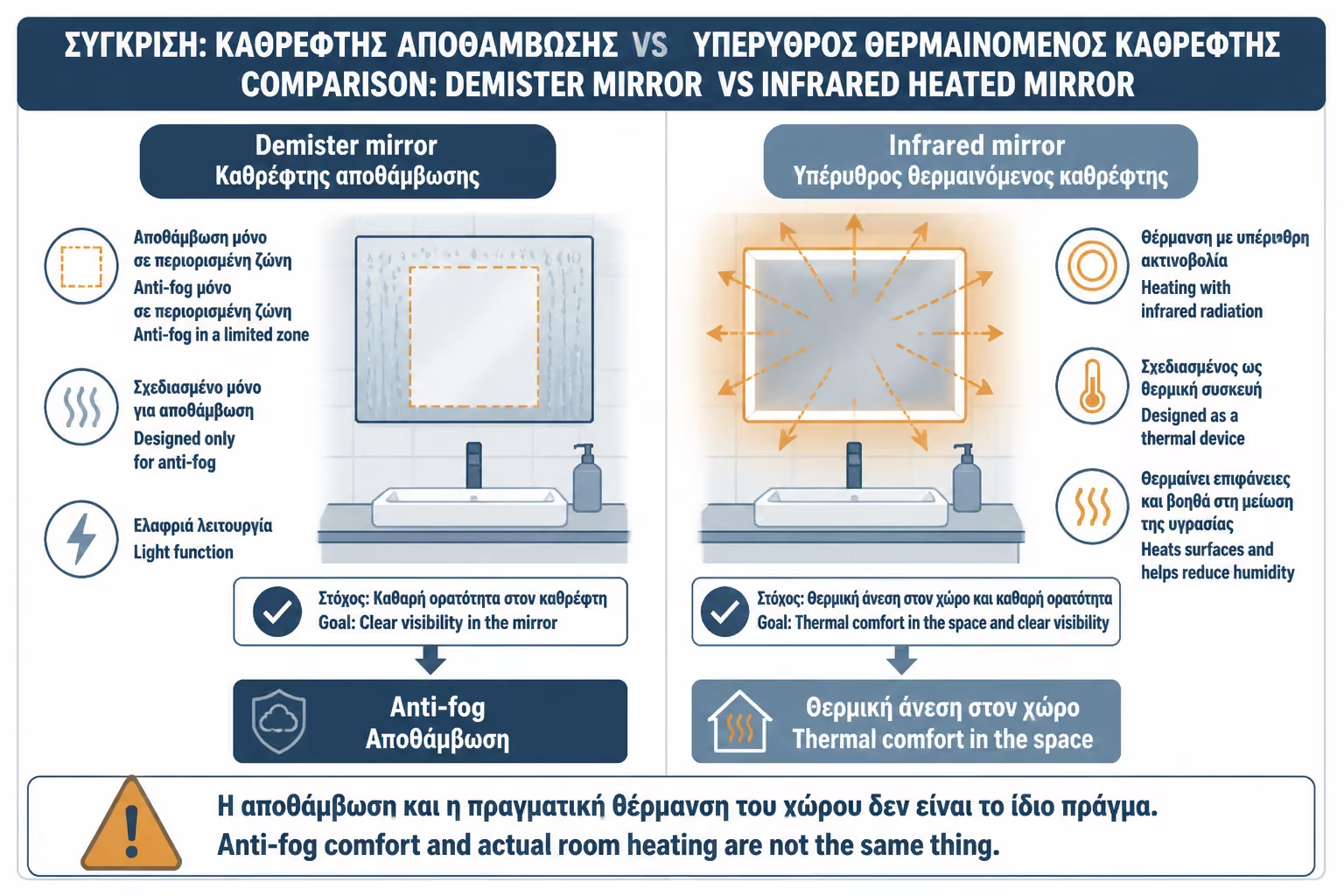
The difference is best seen if we look at the purpose. The demister pad heats the mirror. The infrared mirror heater also heats the space/user. The first is visibility comfort. The second is a heating installation.
| Criterion | Demister mirror | Infrared mirror heater |
|---|---|---|
| Main objective | Do not fog up the mirror | To heat the space and the user |
| Power | Low | Medium to high |
| Consumption | Small | Analogous to the heating Watts |
| Anti-glare | In the heated zone | Usually very good when it works |
| Bathroom heating | Not really | Yes, if it has the right power |
| Place | Usually together with a mirror/LED | As a bathroom heater |
| Control | Switch/touch/light circuit | Thermostat, timer, smart control |
If the supplier presents a simple LED mirror with a demister as a "heated bathroom mirror", ask for the watts and the purpose of operation. If there is not enough thermal power for the space, it is not a main heater.
Conversely, if you buy an infrared mirror heater, don't treat it like a simple mirror. It is an electric heater and must have proper installation, IP rating, thermostat and safe location.
Demisting does not need many watts. Space heating does. As a practical starting point for small bathrooms, you can begin around 80–120W/m² for a well-insulated space and 120–150W/m² for a colder bathroom, as with other electric heaters. If the bathroom is 4 m², the requirement may be around 400–600W, depending on insulation, the window and the number of external walls.
| Bathroom size | Additional heating | Possible main heating |
|---|---|---|
| 2–3 sq.m. WC | 200–300W | 300–450W |
| 3–4 sq.m. bathroom | 300–500W | 450–600W |
| 5 sq.m. bathroom | 400–600W | 600–750W |
| 6–7 sq.m. bathroom | 500–800W | 750–1,000W+ |
| Cold bathroom with window | +15% to +30% | Needs proper calculation |
If the mirror only has a 40W demister pad, it does not go into this panel as heating. 40W keeps a section of glass warm, not the room. If it has infrared heating 600W, then it is compared to the thermal loads of the bathroom.
The final choice should be made based on the actual bathroom. A small interior bathroom without a window needs less power than a bathroom with an exterior wall and old framing.
Operating costs depend on wattage. A 40W demister pad that runs for 30 minutes consumes just 0.02 kWh. At €0.25/kWh, this is around €0.005. In other words, daily demisting costs almost nothing.
A 600W infrared mirror heater operating for 2 hours consumes 1.2 kWh. At €0.25/kWh, it costs around €0.30. If it works every day for 2 hours, the monthly cost can reach around €9. If it runs 4 hours, it doubles.
| Device | Power | Runtime | Consumption | Cost at €0.25/kWh |
|---|---|---|---|---|
| Small demister | 40W | 30 minutes | 0.02 kWh | €0.005 |
| Big demister | 100W | 1 hour | 0.10 kWh | €0.025 |
| Infrared mirror | 400W | 1 hour | 0.40 kWh | €0.10 |
| Infrared mirror | 600W | 2 hours | 1.20 kWh | €0.30 |
| Infrared mirror | 800W | 2 hours | 1.60 kWh | €0.40 |
The bottom line is simple: demisting costs very little. Heating cost rises in direct proportion to wattage. Savings come from timers, thermostatic control and sensible use, not just because the mirror is marketed as "smart".
It is worth it when the bathroom is small or medium, when you want a clean design without an additional heating element, when the mirror wall has the right position for infrared radiation and when there is a safe electrical installation. In such cases, the infrared mirror can provide both a clear mirror and a feeling of warmth.
It is also worth it in bathrooms that are used briefly but often. For example, morning shower, shaving, makeup, quick use. A programmed mirror can be turned on before use and turned off afterwards, without heating the whole house.
Not worth as much if the mirror is in a bad position for heating. If the user is standing sideways or far away, if the mirror is small or if there is furniture that blocks the radiation, the heating will not be ideal.
It is not worth it as the only solution if the bathroom has large leaks, external walls, mold, poor ventilation and a need for drying towels. There you need a combination with a towel rack, fan or other heating.
Not a good idea when you expect the mirror to dissolve the bathroom moisture. The heated mirror may not fog, but the water in the air remains. If a fan is not working, water vapor will go to the ceiling, windows, corners, silicones and joints.
Not a good idea when the location is too close to a shower or direct splash point, no proper IP and no zone control. The mirror is an electrical device. It doesn't fit where it's convenient just because "it's for the bathroom".
Not a good idea if you want mostly dry towels. The infrared mirror heats surfaces it sees, but does not replace the towel rack. Towels need hanging, air circulation and heat on them.
It is also not a good idea if your budget is limited and the bathroom does not have the basics: good ventilation, waterproofing, safe electrical. Mirror heating is a comfort upgrade, not a replacement of basic infrastructure.
The heated mirror is an electrical device in a wet area. So bathroom zones, IP rating and connection method must be checked. The bathroom is no ordinary room: it has a shower, a bathtub, steam, wet hands and possible splashes.
In Greece, the reference for electrical installations in areas with a shower or sprinkler is ELOT HD 60364-7-701:2024, which concerns requirements for special installations or areas containing a shower or sprinkler. Also, there is a relevant amendment of ELOT HD 60364-7-701:2024/A11:2024 with date of issue 06/12/2024.
In practical terms, it should be checked if the mirror is out-of-band or in an area that requires a specific IP. The mirror, demister, LED lighting, touch button, infrared element and power supply must be suitable for the position. It is not enough that only one part of the system has an IP.
Installation must be done by a licensed electrician. Especially in a high power infrared mirror, we are not talking about a simple accessory. We are talking about an electrical heating device that must be properly powered and protected.
Most heated bathroom mirrors should be treated as permanent electrical installations, not devices that plug into a random outlet. They are often connected to the lighting circuit, especially when the demister works together with LED lighting, or have a separate supply/switch. Guides for demister mirrors state that many pads connect to the lighting circuit and are activated by light, but the electrical connection must be done by a professional due to bathroom regulations.
For infrared mirror heaters, the situation is even more demanding. If it has a power of 500–800W, it is not just a small demister. It needs proper line, protection, handling and possibly a separate thermostat. It should not be casually connected to an existing circuit without load control.
The control must be in a safe position. If it is a touch button on the mirror, it must be allowed for the zone and IP. If it is a wall thermostat, it must be placed outside the wet zone. If it is a smart control, there must again be a safe electrical installation.
Exposed plug strips, adapters and loose extension cables have no place in a bathroom.
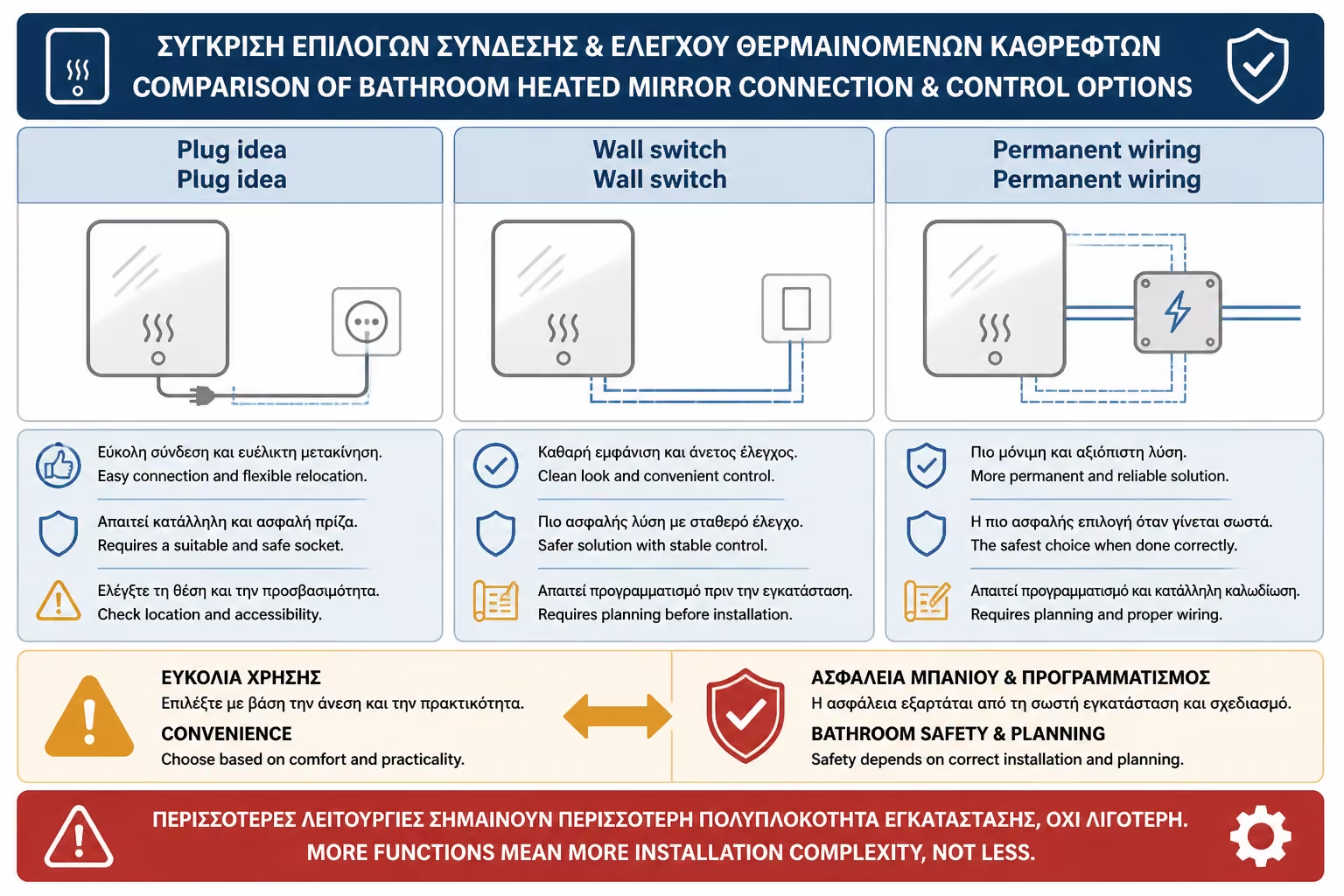
Modern bathroom mirrors often incorporate LED lighting, demister, Bluetooth speaker, meter, touch sensor, shaver socket and sometimes heating. The more functions, the more electrical components go into wet space.
This is not bad in itself. But it is a reason for a more careful purchase. It needs a reliable manufacturer, clear IP, manual, warranty, access for maintenance and proper installation. A cheap "smart" mirror without adequate certification can cause more problems than a simple good mirror with a separate demister.
There must also be logic in how it is controlled. If the demister always turns on with the LEDs, it may run unnecessarily when you only step into the bathroom briefly. If the infrared heater is activated by the same button as the light, it may heat for no reason. Ideally, demisting and space heating should have separate control or a smart timer.
The more "intelligent" the mirror, the more important the correct selection and installation.
A heated mirror does one thing: it keeps the glass warmer so that steam doesn't easily condense on it. The fan does something else: it removes moist air from the bathroom. Both are needed.
If the mirror does not fog up, an illusion can be created that the bathroom "does not have moisture". This is wrong. Water vapor may simply go to other cold surfaces: window, ceiling, corners, silicones, behind furniture. Mirror fogging is not an indicator that the area is drying properly.
In a proper bathroom, the demister offers comfort of use and the ventilation protects the space. The fan should run during and after the shower, ideally with a timer or a hygrostat. The door must allow air to enter. Surfaces must be dry.
The mirror that doesn't fog up is nice. A bath that dries is healthy. It's not the same thing.
For simple demister, the consumption is small, but the timer is still useful. No need to leave it on for hours after use. For infrared mirror heater, control is essential. Without a thermostat or timer, a 600–800W appliance can run unnecessarily and increase the bill.
Best control depends on usage. If you just want a clean mirror after showering, hooking up with lighting and an off delay can be handy. If you want space heating, you need a thermostat or program. If the bathroom is used every morning at the same time, scheduling is ideal.
For infrared mirrors, it is good to have a separate heating and lighting function. You don't want 700W turning on every time you just need light for two minutes.
Smart control is only useful if you use it. A simple reliable timer is often enough.
The heated mirror can reduce condensation on the glass. This does not mean that it prevents mold in the entire bathroom. If moisture remains in the space, mold can appear elsewhere. If there is a leak, poor ventilation or a thermal bridge, the mirror does not solve the cause.
An infrared mirror can help a little more than a simple demister, because it also heats surfaces in front of it. If the cold wall or zone around the sink warms up, the chance of condensation there is reduced. But again, the moisture must be removed.
If the bathroom has black mold on the ceiling, silicones or joints, first cleaning, cause diagnosis, ventilation and waterproofing where necessary. Then the heated mirror can be a comfort and anti-fog upgrade.
Don't buy a demister to get rid of mold. Buy it so you can see clearly in the mirror.
The cost depends on size, glass quality, LED lighting, demister, infrared heating, IP rating, design, smart functions and installation. Simple demister mirrors are more affordable. Infrared mirror heaters are clearly more expensive because they are also heaters.
| Product / work | Indicative range 2026 | Comment |
|---|---|---|
| Simple demister pad for existing mirror | 20–60€ | It needs an electrical connection |
| LED mirror with demister | 120–400€+ | By size/quality |
| Large LED mirror with demister & extras | 300–800€+ | Bluetooth, meter, sensors |
| Infrared mirror heater 300–500W | 300–700€+ | Small/medium sized bathroom |
| Infrared mirror heater 600–900W+ | €600–€1,200+ | More severe heating |
| Electrical installation/connection | 80–300€+ | Per supply, zones, table |
| Thermostat/timer/smart control | 50–200€+ | If not included |
In a finished bathroom, fixtures or new plumbing may be needed, so the installation goes up. In renovation, it is much easier to foresee cable, location, switch and fuse before tiles are laid.
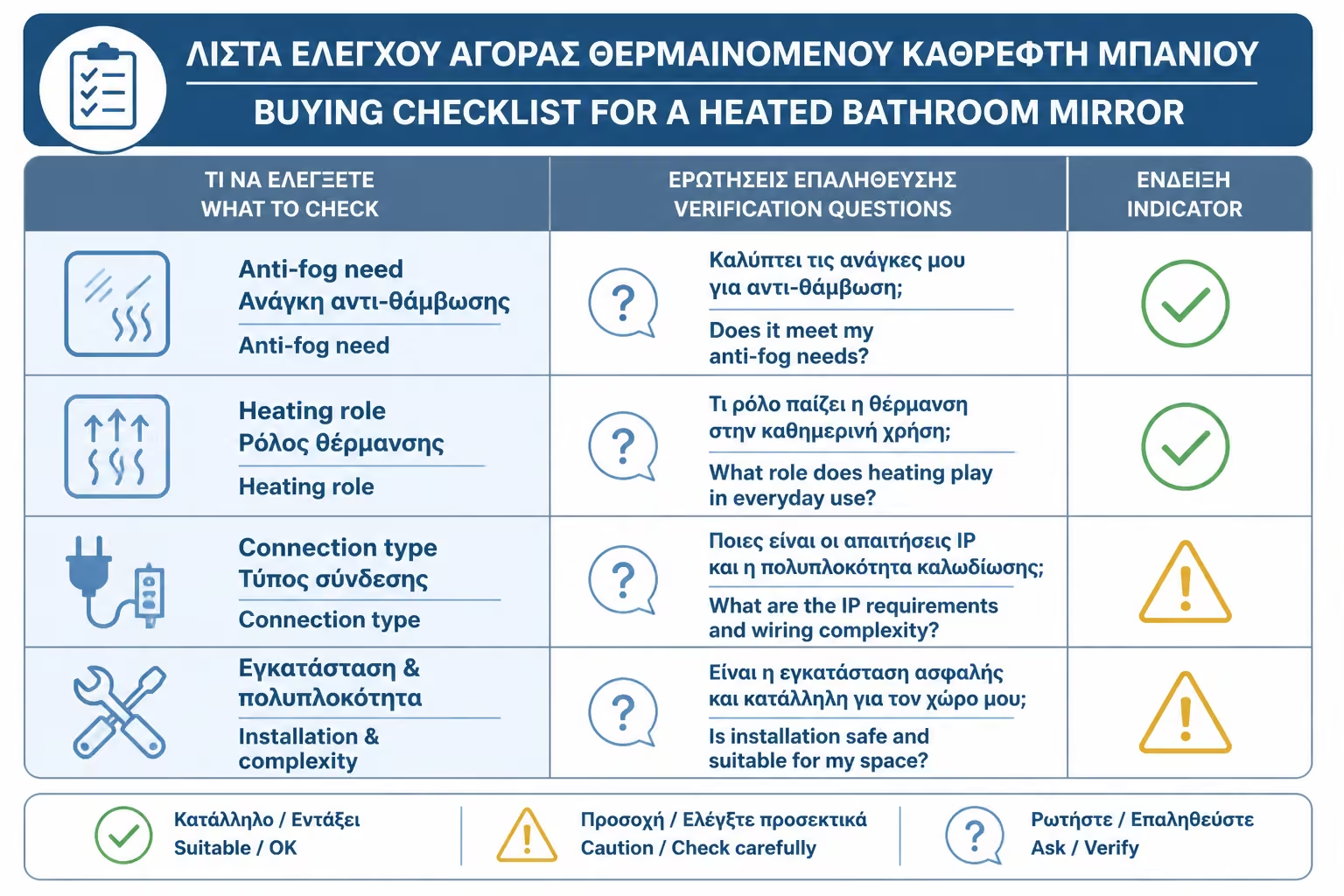
The quote should make it clear what you are buying: demister mirror or infrared heater mirror? How many watts does it have? What IP rating? Does it include a thermostat? How does it connect? Does it have a warranty?
| Error | What it causes in practice | A more correct approach |
|---|---|---|
| Faith in “100% anti-fog” | Disappointment in extreme steam | Demister and ventilation surface control |
| Confusion of demister with space heating | Cold bath | Watt control |
| Infrared mirror without power calculation | Insufficient heating | Calculation of W/m² |
| Bad mirror position for radiation | It does not heat the user | Position with eye contact |
| Connection without an electrician | Danger in wet area | Permanent secure installation |
| Ignore IP rating | Unsuitable product | IP per zone |
| Heating together with light without control | Useless consumption | Separate timer/thermostat |
| Buying lots of low quality extras | Faults/difficulty service | Quality and guarantee |
| Use as a mold solution | The moisture remains | Ventilation and cause diagnosis |
| Mirror without service access | Difficult repair | Schedule maintenance |
The most common mistake is for the owner to read "heated mirror" and think that it will heat the bathroom. If the device only has a small demister, it will heat the glass, not the room.
| Control | Yes / No |
|---|---|
| Do you only want anti-fogging or also space heating? | Yes / No |
| Do you know the Watts of the demister or the infrared heater? | Yes / No |
| Does the heated zone cover enough of the mirror? | Yes / No |
| Will the mirror turn on before the shower or only after? | Yes / No |
| If it is infrared, has it been calculated whether it is sufficient for the bathroom? | Yes / No |
| Does the position of the mirror "see" the user? | Yes / No |
| Does it have an appropriate IP rating for the position? | Yes / No |
| Will the installation be done by a licensed electrician? | Yes / No |
| Is there a leakage relay and correct supply? | Yes / No |
| Is the bathroom fan working properly? | Yes / No |
| Do the heating and lighting have a reasonable control/timer? | Yes / No |
| Is there a possibility of service or replacement if it breaks? | Yes / No |
Don't buy a heated mirror just because it says “heated.” Ask first: how many watts does it have, and what exactly does it heat? If it's a 40W demister, it is mainly an anti-fog solution. If it is a 600W infrared mirror, it is a heater and should be sized as one. And don't trust “100% anti-fog” claims blindly. A mirror stays clear when the heated zone has time to warm up and the ventilation is working. If the bathroom fills with steam and is not ventilated, the moisture will simply move elsewhere: to the ceiling, the silicone joints, and the corners.
Heated mirrors are a very practical bathroom upgrade. A simple demister mirror largely solves the everyday problem of a foggy mirror, especially when activated before or during the shower. An infrared heated mirror can go a step further, also acting as a discreet heater that warms the wearer and the surfaces in front of it.
The difference between the two categories is the wattage and the purpose. Low power usually means anti-fogging. Higher power can mean real space heating, but only if the device is sized correctly for the bathroom. An infrared mirror can be an excellent 2-in-1 solution in a small bathroom, but it should not be bought without a power calculation, the right location, and proper electrical planning.
Anti-glare should not be presented as absolute. The right heated mirror can keep the heated surface clean, but performance depends on steam, ventilation, preheat and pad size. "Never fogs, all over, in all conditions" is an exaggeration.
Finally, the heated mirror does not replace the ventilator. It can keep the glass clean, but it doesn't remove moisture from the air. A mold-free bathroom always requires a combination of: proper ventilation, heating, dry surfaces and safe electrical installation. Then the mirror becomes a real comfort upgrade, not just an expensive gadget.
Return to category.
Go to categoryReturn to the central guide.
Go to guide