
Bathroom Lighting, Ventilation & Heating
Return to category.
Go to categoryThe towel rack in the bathroom is often bought as an accessory. We choose it because it is beautiful, because it fits into the available wall, because it matches the batteries or because it promises hot towels. But if we want it to work as a main heating body, that is, to really heat the air in the bathroom and not just dry a towel, then it must be calculated correctly.
The question is not "which towel rail will fit?". It is "how much heat does the bath lose and how much does the body have to replace?". A small indoor WC without an external wall has very different needs than a 6 sq.m. bathroom. with window, external masonry and ceiling under a roof. If you put the same body in both, one may be enough, the other will just warm the towels while the room stays cold.
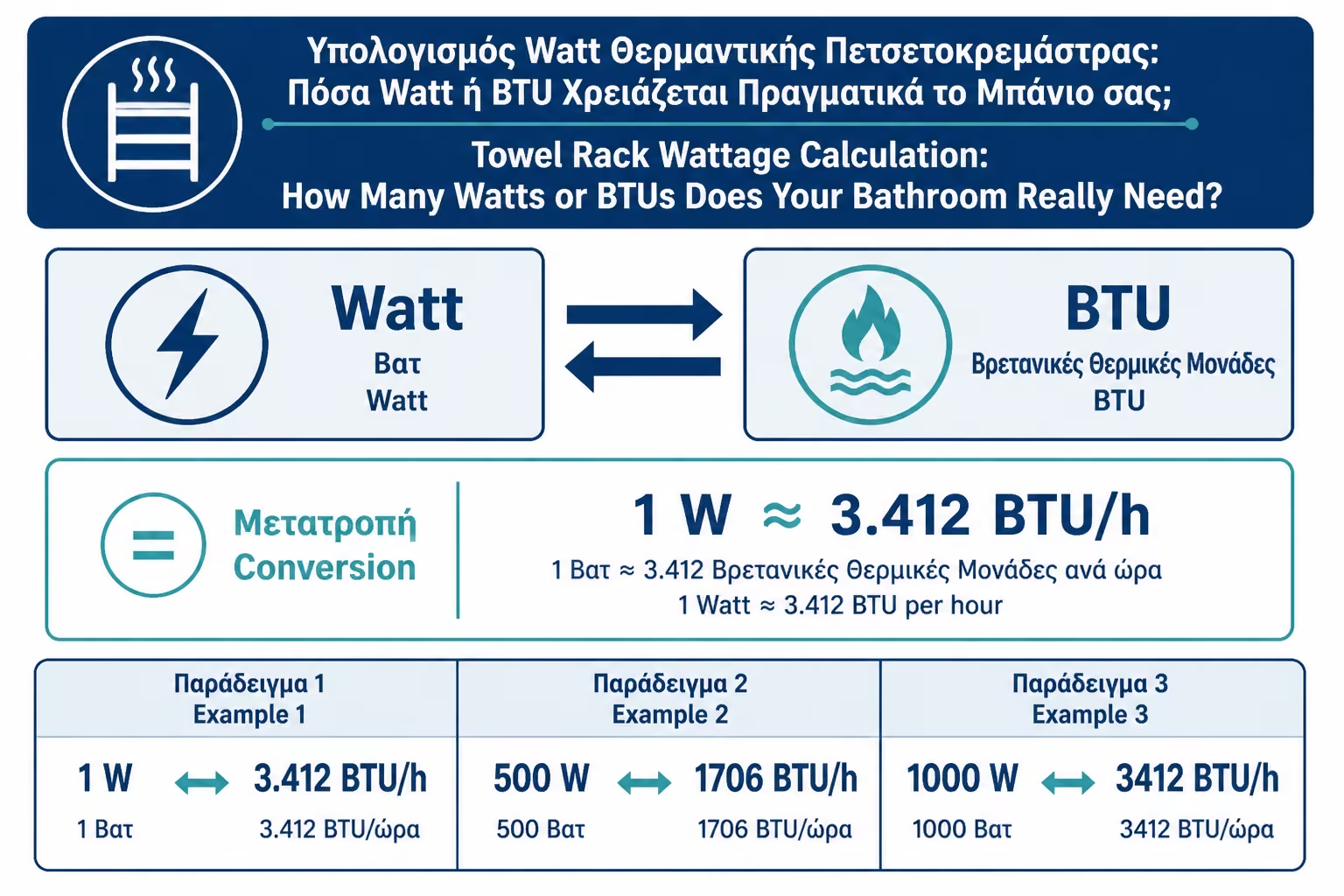
In the technical characteristics you will see two units: Watt and BTU/h. In Europe we often use Watts, while in many guides and calculators you will see BTU. The conversion is simple: 1 Watt corresponds to approximately 3,412 BTU/h. So a 500W body delivers approximately 1,706 BTU/h, while a 1,000W body delivers approximately 3,412 BTU/h.
But the crucial thing is not only the unit. It is the conditions in which performance is measured. A hydraulic towel rail can give specific performance at ΔT50, i.e. when the average body water temperature is 50°C above the room temperature. Stelrad explains that Delta T is the difference between the average water temperature inside the body and the room temperature; for example, if the room is 20°C and the average water temperature is 70°C, we have ΔT50.
This is of huge importance in heat pump homes. An element that delivers 800W in a high temperature boiler system may deliver much less when the heat pump is working with 35–45°C water. If you don't take this into account, you will buy a towel rail that looks adequate on paper, but in practice is lukewarm and insufficient for space heating.
This guide shows a practical way to calculate for homeowners: how to find the Watts or BTUs your bathroom needs, when to add margin, how to adjust the calculation for exterior walls and windows, and when a mechanical calculation is needed instead of a simple formula.
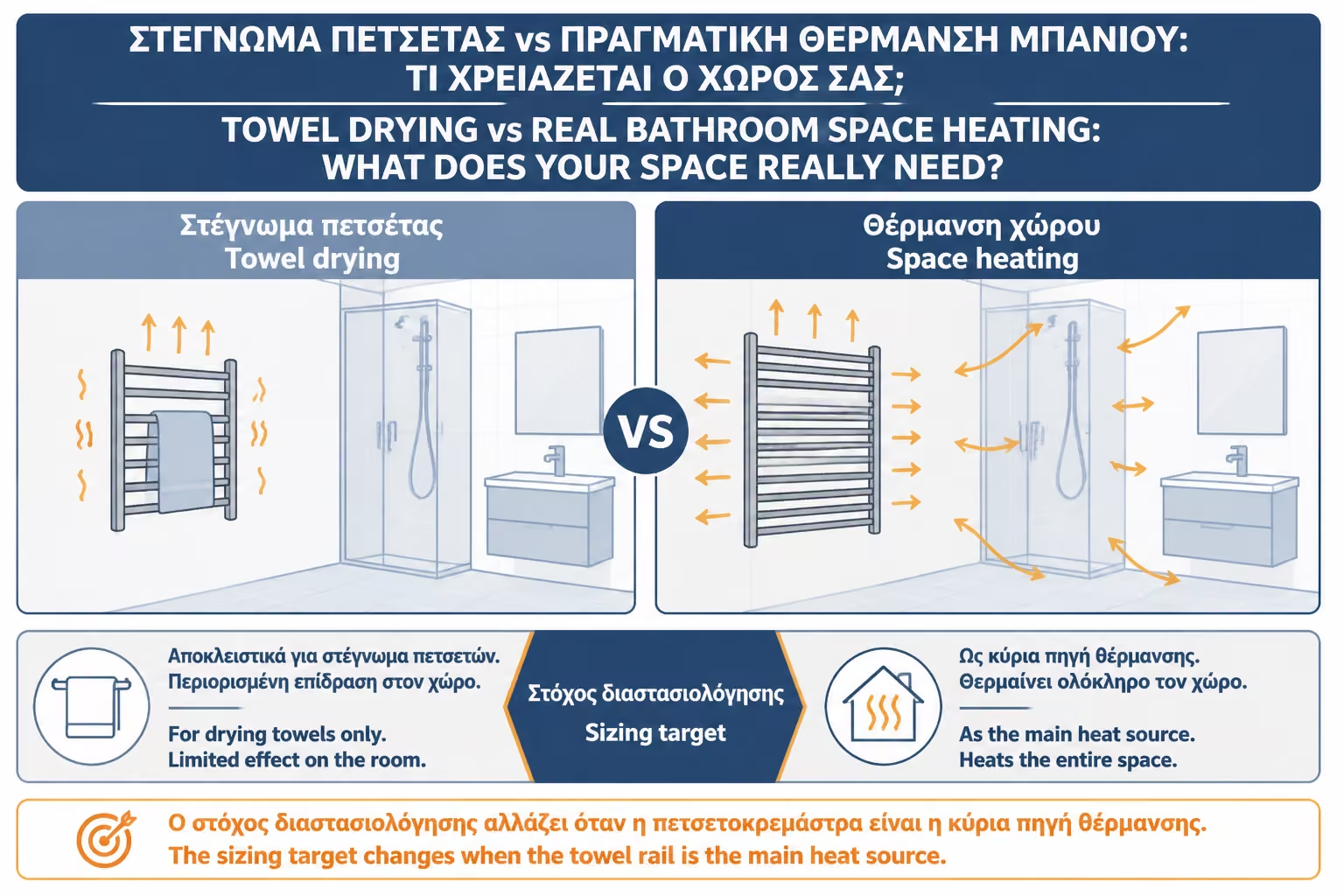
The first question is whether you want the towel rail to dry towels or to heat the entire bathroom. If the room already has underfloor heating or another radiator, the towel rack can be complementary. In this case, the size is chosen more based on towels and use.
However, if the towel rail will be the only heating element, then it must cover the thermal losses of the bathroom. That is, it must be able to keep the room at a comfortable temperature, usually around 22–24°C for bathing, even when it is cold outside. If it is not enough, the bathroom will remain frozen, the surfaces will sweat and mold will find an opportunity.
A frequent mistake is to say "I installed a towel rail, so I have heating". A small 300W towel rail may be enough for two towels, but not for a 6 m2 bathroom. with an external wall. If you even fill it with towels, much of the heat does not go into the room but is trapped in the fabrics.
The correct calculation starts with the role of the device. If it is a main body, it is counted as a normal radiator.
Watts indicate thermal power. When we say that a body delivers 600W, it means that it can give off 600 Joules of heat per second under the specific measurement conditions. BTU/h is another unit of thermal power, common in English guides and calculators.
The conversion is:
Watts × 3.412 = BTU/hr
and vice versa:
BTU/h ÷ 3.412 = Watts
| Power in Watts | About BTU/hr |
|---|---|
| 300W | 1,024 BTU/hr |
| 400W | 1,365 BTU/hr |
| 500W | 1,706 BTU/hr |
| 600W | 2,047 BTU/hr |
| 800W | 2,730 BTU/h |
| 1,000W | 3,412 BTU/hr |
| 1,200W | 4,094 BTU/hr |
The conversion helps when one store gives Watts and another BTU. But you have to compare same conditions. For electric towel rails, Watts are more straightforward because the electrical resistance is almost all converted to heat in the room. For plumbing, Watts depend on water temperature and ΔT.
So when comparing hydraulic towel rails, look at which ΔT the performance is given. If one body says 800W in ΔT50 and the other 800W in different conditions, it is not a direct comparison.
For a first estimate, many heating guides use a per square meter rule. For bathrooms, a practical baseline is around 100W/m² for an average space with relatively good insulation, while colder or poorly insulated bathrooms may need 120–150W/m². Electric bath heater manufacturers' guides often quote the 100W/m² rule as a general basis for sizing.
The simple formula is:
Required Watts = square meters × 100 to 150W/m²
| Bathroom size | Moderate insulation, 100W/m² | Cold/outdoor bathroom, 130W/m² | Very demanding, 150W/m² |
|---|---|---|---|
| 3 sq.m. | 300W | 390W | 450W |
| 4 sq.m. | 400W | 520W | 600W |
| 5 sq.m. | 500W | 650W | 750W |
| 6 sq.m. | 600W | 780W | 900W |
| 8 sq.m. | 800W | 1,040W | 1,200W |
| 10 sq.m. | 1,000W | 1,300W | 1,500W |
This method is easy and useful for a first impression. It does not replace an accurate heat loss calculation, but protects you from too small choices. If you have a bathroom of 6 sq.m. and you look at the 300W towel rail as a single body, the panel immediately shows that it is probably insufficient.
For a small indoor WC, the lower price may be sufficient. For bathroom with shower, external wall and window, move towards the higher prices.
A more technical but still practical approach is to calculate the volume of the bathroom and the temperature difference we want to cover. Many radiator calculators use room volume, temperature difference and loss factors. In simplified form, Stelrad's guide to towel radiator sizing states the formula BTU = bathroom volume in m³ × temperature difference in °C × 60 to estimate requirements.
The logic is:
BTU/h ≈ Space volume × ΔT × 60
where:
Example: bathroom 5 sq.m. with a height of 2.70 m. it has a volume of 13.5 m³. If we want 22°C and calculate a difference of 20°C, then:
13.5 × 20 × 60 = 16,200 BTU/h
This number seems too high for a typical small bathroom because simplified factors vary by calculator and are often adjusted to imperial/room factors or more complex parameters. That's why online calculators are best when they take into account insulation, windows, exterior walls and space type, rather than blindly using a generic formula.
In practice, for the owner, the W/m² method is simpler for a first estimate, while for the final selection of the main body it is advisable to use a calculator or a professional calculation.
The bathroom does not have the same thermal requirement as a bedroom. We usually want a higher comfort temperature because we get out of the shower wet. It also has materials that feel cold: tiles, glass, mirrors, porcelain, metal fittings. If the air is 20°C but the surfaces are cold, the sensation remains unpleasant.
In addition, the bathroom is humid. The heat helps reduce condensation and dry the towels. So the towel rack should not only be calculated to "not get cold", but also to help dry the space.
Small bathrooms have another paradox: because they are small, many people put too small a body. But if the small bathroom has an external wall and a window, the losses per square meter can be high. So a 3–4 sq.m. bathroom may need 400–600W, not 150W.
If you want the towel rail to act as the main heater, leave some margin. It is better to have a slightly larger unit with a thermostat that can be adjusted than a very small one that runs constantly and still cannot keep up.
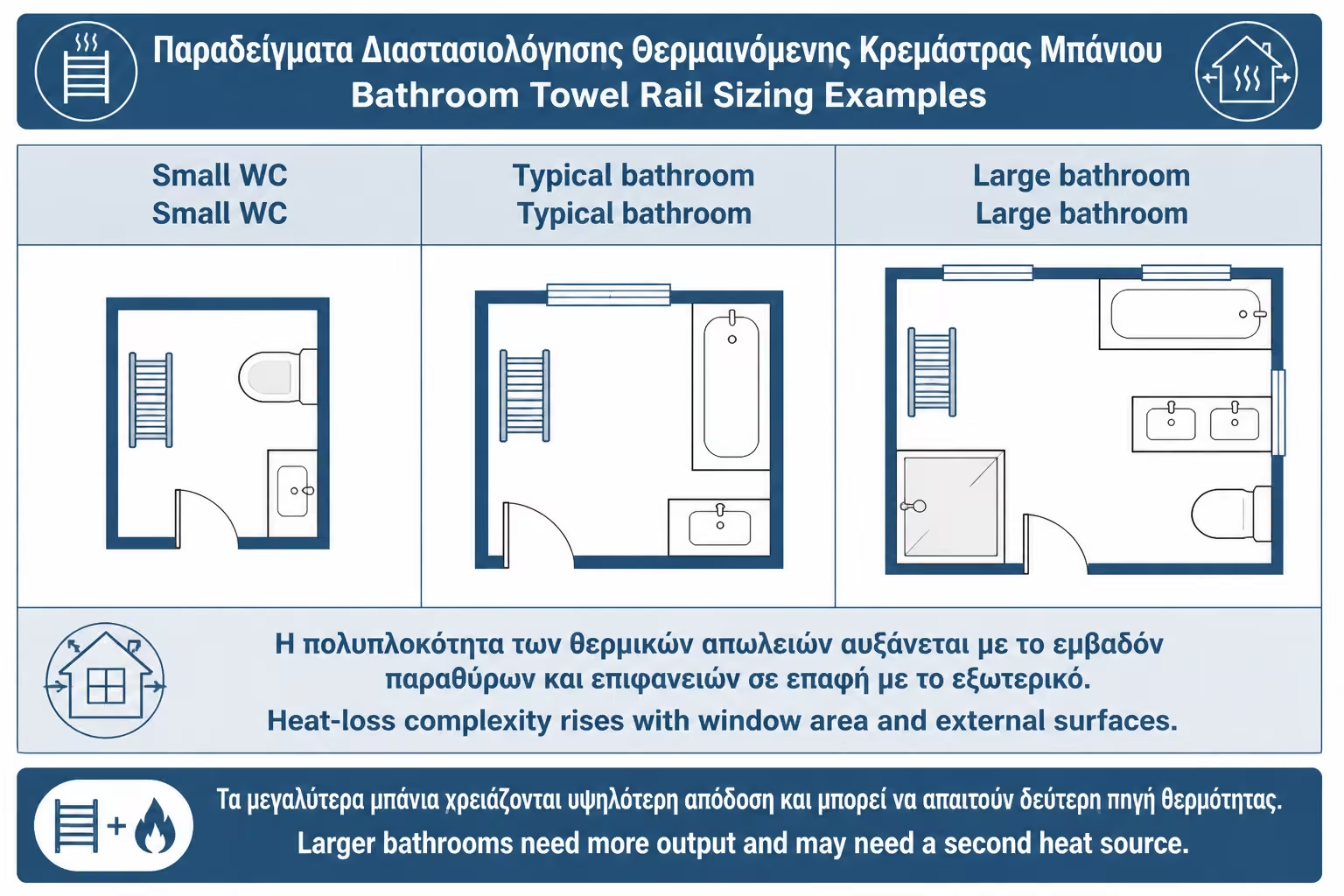
A small WC without a shower, around 2.5 sq.m. with a height of 2.70 m, has limited heating needs. It does not generate heavy steam, it does not have wet towels after a shower, and it usually only needs basic comfort. If it is internal, without an exterior wall, about 250–350W may be enough.
However, if it has an exterior wall or a small window to a shaft, the requirement may increase. In that case, a small electric towel rail or a small 300–400W heater might make sense. If there is no real need for towel drying, perhaps a towel rail is not even the most practical solution; a small radiator or simply spillover heat from a neighboring space may be enough.
The common mistake in a WC is to install an oversized unit for no reason, especially if it runs electrically without a timer. In that case, the extra size only increases consumption without offering any meaningful benefit.
For WC without shower, we calculate more conservatively. For a bathroom with a shower, the whole picture changes.
A typical bathroom of 4–5 sq.m. with a shower is the most common case. As a simple rule, we need about 400–500W in good conditions, 520–650W in a colder or outdoor bathroom and up to 600–750W if the losses are significant.
If the bathroom has a window, exterior wall, or frequent mold, I wouldn't choose the lower limit. I would look for a towel rail that gives at least 600–700W in actual operating conditions. If it's electric, those watts are relatively straightforward. If it is hydraulic, we need to see at what water temperature it gives this performance.
In a gas or oil boiler system, a unit rated at 600–700W at ΔT50 may be sufficient, depending on the losses. In a heat pump system, the same unit may deliver less, so a larger size or an electric boost may be needed.
If the towel rail is filled with two large towels, leave room. Towels reduce the heat radiated/transferred into the space.
In a 7-8 m2 bathroom, the towel rack as a single unit becomes a more demanding task. Based on 100W/m² we are talking about 700–800W. If there are exterior walls, a window, poor insulation or a roof, 900–1,200W or more may be needed. This is already large for a classic small towel rail.
In such bathrooms, you often need either a large towel rail, or a second unit, or underfloor heating, or a combination. A thin design towel rack can be beautiful but not enough. If the bathroom has a walk-in shower, a lot of humidity and large cold surfaces, the heating must be more serious.
For a heat pump, a large bathroom and a towel rack as the main body is a combination that needs an engineer. Oversizing, fan-assisted body or supplemental electrical operation may be needed.
In a large bathroom, don't expect a "typical" 500W towel rail to do the main heating job. It will dry towels, but the space will remain cold.
The simple formula is only the starting point. Then we adjust for the real conditions. If the bathroom is internal, without an exterior wall, with good insulation and light use, you can stay close to 100W/m². If it has an exterior wall, a window, a roof above, or a history of mold, you should go higher.
| Condition | Suggested fix |
|---|---|
| Indoor bathroom without external wall | Base 100W/m² |
| An outer wall | +10% to +15% |
| Window or old frame | +10% to +20% |
| Ceiling under roof / cold room | +15% to +25% |
| Poor insulation / old house | +20% to +40% |
| Bathroom with mold history | Do not select a lower limit |
| Low temperature heat pump | Performance control at low ΔT |
| Many towels on the body | Add margin |
Example: bathroom 5 sq.m. based on 100W/m² gives 500W. If it has an exterior wall and window, you can easily go up to 650–750W. If it's under a roof and old, it may take even longer.
If you are between two sizes, it is usually safer to choose the larger one as long as it has a thermostat or some form of control. A slightly larger unit can be turned down. A very small one cannot deliver heat it simply does not have.
The output of hydronic units is usually given at a specific ΔT. If a unit is rated at 800W at ΔT50, that means it delivers 800W when the average water temperature is 50°C above the room temperature. For a 20°C room, that implies an average water temperature of around 70°C. That suits a traditional boiler, but not always a heat pump.
If the system runs at 45°C water and the room is 22°C, the ΔT is much lower. The unit's output drops significantly. That is why a towel rail in a heat pump system can feel lukewarm. It is not "broken"; it is simply working at a lower thermal regime.
Serious manufacturers publish correction factors for different ΔT values. Ask the supplier or engineer for the output at the ΔT that matches your system. Do not rely only on the big headline figure.
For electric towel rails, this issue does not exist in the same way: a 600W resistor gives about 600W of heat. For plumbing, water decides.
In a heat pump, the goal is to operate the system with as low an inlet temperature as possible, because this increases efficiency. If we try to run the pump at a high temperature just to heat a small towel rail, we may reduce the efficiency of the whole system.
So the correct solution is different: larger body surface, low temperature towel rail, combination with underfloor or dual fuel boost. Guides to heat pump towel rails state that because heat pumps often operate at lower temperatures than boiler systems, a larger body or specially designed towel rail is required to compensate for the lower temperature.
If you have a heat pump, ask for three numbers: supply temperature, return temperature and desired bath temperature. With these the actual ΔT can be calculated. Then a body is selected that delivers the required Watts at this ΔT.
In many cases, the best practical solution is dual fuel: the pump gives gentle basic heating and the electric heater gives a short boost for towels and comfort.
In an electric towel rail, the wattage of the element is essentially the heat that ends up in the room. If the element is 500W, the device gives off about 500W of heat at full operation. So the calculation is simpler than in the hydronic case.
The issue is operating cost and control. If you need 700W to heat the bathroom and you install a 700W electric model, it will heat the space but consume 0.7 kWh per hour at full operation. With a timer, it can run only when needed. With a thermostat, it can cycle and reduce consumption. Without control, it can waste energy.
To be used as the main heating, the electric towel rail must have enough power and not just be small "for towels". If you put 300W in a bathroom that needs 700W, it will be economical because it doesn't consume much, but it won't heat the room.
The electric option is ideal for autonomy, but it must be supported by proper electrical installation, suitable IP protection, an RCD, and a timer. It should not be installed with an improvised plug or socket.
When the towel rail is empty, it emits heat into the room. When it is full of towels, much of the heat is used to dry the fabrics. This is desirable, but means that less heat reaches the air and bathroom surfaces directly.
If you use the towel rack as the main body, you need to consider that in real life it will have towels. If the family hangs 3–4 large towels on it, the body should have room. Otherwise it will always be covered and the space will remain cold.
The solution is right size and right use. Towels should be spread out and not folded in multiple layers. If there is space, choose a towel rail with enough bars and height. If there is no space, you may need a second heating source for the bathroom air.
The towel rail is not an unlimited heater. When we use it as a spreader, the space efficiency is reduced.
A second heater is needed when the bathroom is large, when it has significant losses, when the towel rack must be small due to space, when there are many towels or when the heating system is at a low temperature and the body cannot perform sufficiently.
The second source can be underfloor heating, a small radiator, a fan coil suitable for a bathroom, an electrical panel with suitable protection or another permanent solution. It must not be a portable fan heater. The bathroom requires a permanent and secure installation.
In renovation, it is much better to foresee the second source from the beginning. After tiles, changes cost more. If the calculation shows that you need 1,000W, and the towel rail that doesn't have a capacity is 500W, don't ignore it. You will pay for it in a cold bath and humidity.
If the bathroom has a history of mold, prefer adequate heating and ventilation rather than a marginal solution "so as not to spoil the design".
Online BTU calculators are useful, but must be filled out correctly. Good calculators take into account room size, height, windows, exterior walls, room type and insulation. BestHeating says that a BTU calculator gives a useful guide to the BTU/Watt level a space needs, but for an accurate calculation it's best to consult a professional.
When using a calculator, don't put in "standard" answers if your bathroom is special. If it has an old window, state it. If it has two exterior walls, state it. If it's under a roof, take that into account. If it's small but frozen, don't pick the lower limit.
After the result, check the unit. If the calculator gives BTU/h, convert to Watts. If the body is performing at ΔT50 and you have a heat pump, don't compare it directly. Ask for correction.
The calculator is a beginning, not a final study. For main heating in a renovation, especially with a heat pump, an engineer's opinion is worthwhile.
More power usually means a larger and more expensive unit. In electric towel rails, it also means higher maximum consumption when running at full output. But a small unit that runs constantly and still does not heat properly is not necessarily more economical. A slightly larger model with a thermostat can warm the space faster and then cycle.
In hydronic systems, a larger unit means a larger heat-emitting surface. This is especially useful with heat pumps, because lower water temperatures require larger emitters for the same output. The extra purchase cost may be reasonable if it allows the system to run at a lower temperature with better efficiency.
| Decision | Direct cost | Long term effect |
|---|---|---|
| Small body | Lower market | Possible insufficient heating |
| Correctly dimensioned body | Average cost | Comfort and less moisture |
| Larger body with thermostat | Higher market | Better margin and control |
| Small body + lots of electric use | Seemingly economical | It can work continuously |
| Dual fuel with correct timer | Higher installation | Flexibility and targeted consumption |
The right strength is an investment in comfort and moisture prevention. Exaggeration is not necessary, but under-dimensioning is one of the most common and annoying mistakes.
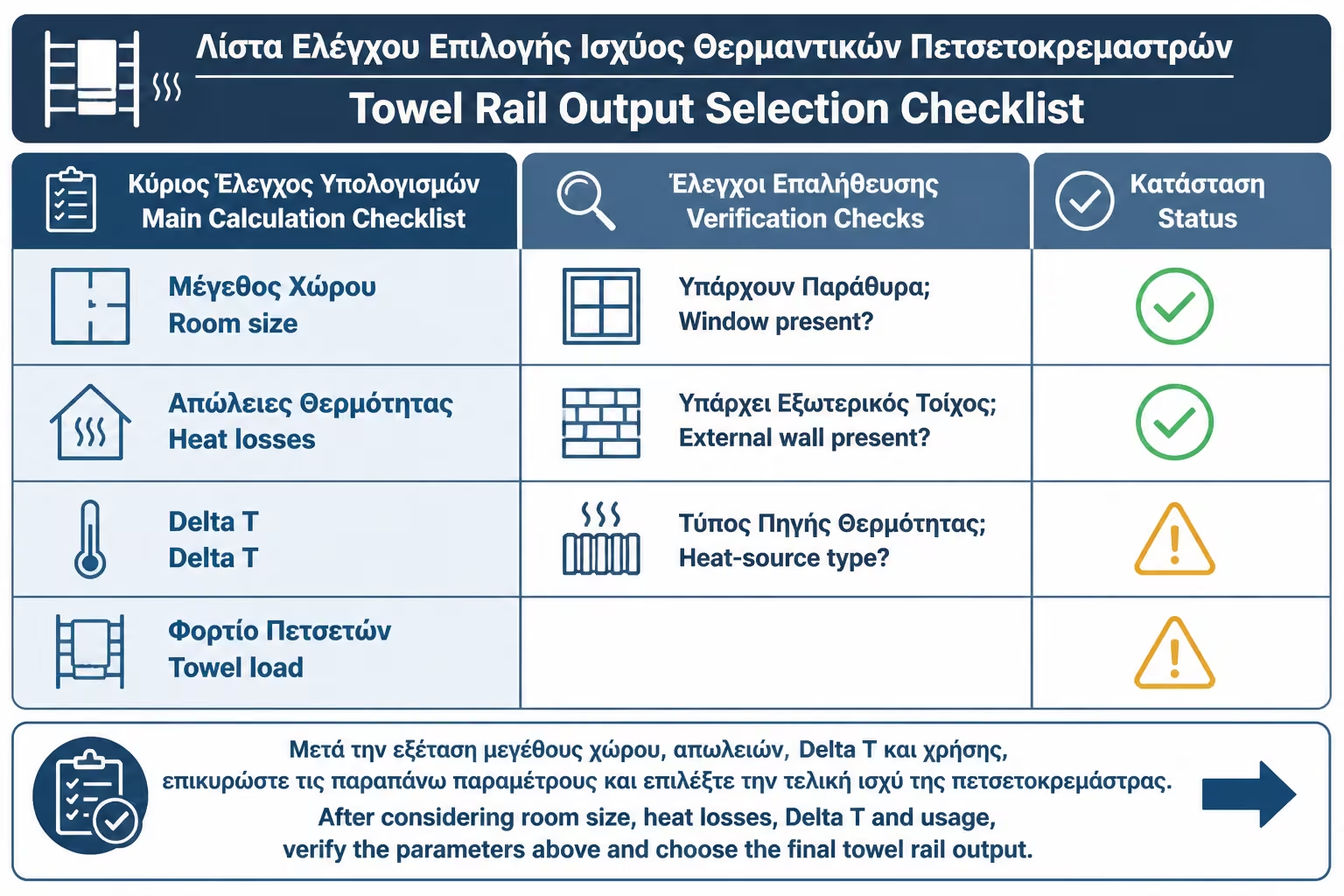
First measure the square footage of the bathroom. Second, choose a W/m² base: 100W/m² for good conditions, 120–130W/m² for average, 150W/m² for cold or demanding bathroom. Third, add corrections for window, exterior walls, roof, or poor insulation. Fourth, check the heating system: boiler, heat pump or electric. Fifth, choose a body that delivers the required watts in real-world conditions.
Example: 5 m2 bathroom, one external wall and window. Base 120W/m²: 5 × 120 = 600W. We add about 15–20% for window/external wall: we reach about 700–750W. If you have a boiler, you are looking for a hydraulic towel rail that performs around the ΔT of the system. If you have an electric one, you're looking at 700–750W with a timer. If you have a heat pump, you are asking for low water temperature performance or considering a larger body/dual fuel.
If the bathroom already has underfloor heating, the towel rack can be smaller and work mainly for towels. If it is the only body, do not remove margin.
This method is not a complete study, but it gives you a much better basis than "I like this design".
Miscalculations lead to cold baths and frustration. The towel rail looks installed, but it doesn't do what you expect.
| Error | What does it cause? | A more correct approach |
|---|---|---|
| Selection based on wall dimensions only | Insufficient power | Watt/BTU calculation |
| Ignore external wall | Cold surfaces | Add margin |
| Ignore window | Condensation on glass | More power or better frame |
| BTU comparison without conversion | Wrong choice | 1W = 3,412 BTU/h |
| Ignore ΔT | Overestimation of hydraulic efficiency | Control at real water temperature |
| Heat pump with small towel rail | Cool operation | Larger body or dual fuel |
| Towels on a borderline body | The space does not heat up | Add margin |
| Electric without timer | Useless consumption | Thermostat/timer |
| Too little power for "economy" | Cold bath | Correct power with control |
| No vent connection | Moisture remains | Heating + ventilation together |
The most common mistake is to buy a small designer towel rail for a large bathroom and then assume that "towel rails don't heat up". The truth is that this particular one did not have the required power.
| Control | Yes / No |
|---|---|
| Have you measured the actual square meters? of the bathroom? | Yes / No |
| Have you calculated a W/m² basis? | Yes / No |
| Have you added margin for exterior walls/window? | Yes / No |
| Will the towel rail be the main body or complementary? | Yes / No |
| Have you converted Watt ↔ BTU/h correctly? | Yes / No |
| Is hydraulic body performance given at the correct ΔT? | Yes / No |
| If you have a heat pump, has the low temperature performance been tested? | Yes / No |
| Is there enough surface for the family's towels? | Yes / No |
| If it's electric, does it have a timer and thermostat? | Yes / No |
| Is the electrical installation safe for bathing? | Yes / No |
| Does the mounting position allow for good performance in space? | Yes / No |
| Is the bathroom ventilation working properly? | Yes / No |
| Does the quote list body, power, ΔT, valves, resistance, labor and VAT? | Yes / No |
If the towel rail will be the only heater in the bathroom, don't count it as an accessory. Start at 100W/m² for good conditions and go up to 130–150W/m² when there is a window, exterior wall, roof or mold history. If you have a heat pump, don't rely on catalog performance in ΔT50; ask for performance at your system water temperature. And always consider that in real life the towel rack will have towels on it, so room is needed.
Power calculation is what separates a towel rail that just looks pretty from one that actually heats up the bathroom. If the goal is only to dry towels, the requirements are less. However, if the towel rail will function as the main heating body, it must cover the losses of the space in Watts or BTU/h.
The simplest practical basis is 100W/m² for a well-insulated bathroom and 120–150W/m² for more demanding spaces. Then we add allowance for external walls, windows, roofs, poor insulation and damp history. For BTUs, remember that 1W is about 3,412 BTU/h. For hydraulics, we always look at ΔT, because performance changes dramatically with water temperature.
On a gas or oil boiler, a properly sized hydraulic towel rail can be very efficient. In a heat pump, more attention is needed, a larger surface area or a dual fuel solution. In an electric towel rail, Watts are clearer, but the timer and thermostat are necessary to avoid unnecessary consumption.
The right power is not a luxury. It's what keeps the bathroom warm, reduces condensation, dries towels and helps keep mold from forming. If calculated correctly from the beginning, the towel rack becomes a real radiator. If it's miscalculated, you're left with a beautiful but inadequate fixture on the wall.
Return to category.
Go to categoryReturn to the central guide.
Go to guide