
Bathroom Waterproofing & Moisture Protection
Return to category.
Go to categorySpreadable cementitious sealants are among the most common materials one will encounter in a bathroom renovation, especially when it comes to a built-in shower, tile floor, shower walls, or areas with frequent moisture. For many craftsmen they are the "standard" of the market, because they work well with classic building substrates, such as cement mortar, plaster, concrete and tile adhesives.
But the fact that a material is common does not mean that it is always applied correctly. In practice, many problems do not come from choosing a cementitious sealant, but from mixing it wrong, applying it too thinly, running it over a dusty substrate, not taping corners, or not adhering to the times between coats. The hardware may be correct, but the system may fail due to implementation.
The key distinction that the owner needs to understand is between 1-component cementitious materials and 2-component cementitious materials. The former usually come as a powder and are mixed with water. The latter consist of a powder and a liquid component, usually a resin or polymer emulsion, which improves elasticity, adhesion and the ability of the material to follow micro-movements. This difference is not merely commercial. It is of real importance in showers, corners, floors and areas where water and small movements stress the waterproofing layer every day.
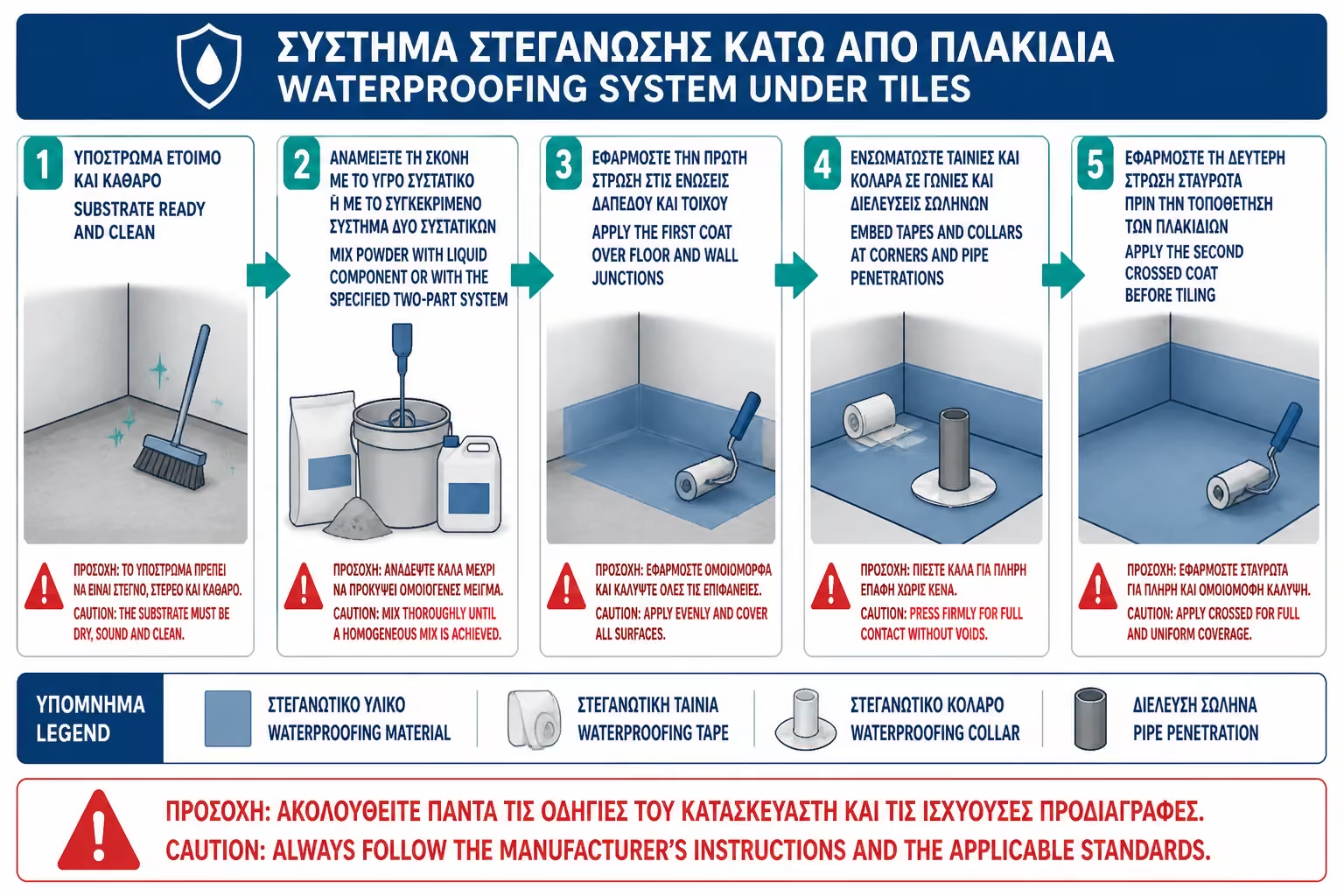
In a bathroom, waterproofing should not be treated as "a coat of insulation before the tiles". It is a technical stage in a specific order: proper substrate, primer where needed, proper mixing, application in two layers, reinforcement in corners and joints, curing time and then paving with compatible adhesive. If any of these are omitted, even a good cement may not give the result we expect.
This guide explains what spreadable cements are, how 1- and 2-parts differ, how they should be mixed and applied, where a 2-part solution excels, and what a homeowner should check before sealing under tiles.
Spreadable cementitious materials are sealing materials based on cement, special additives and, depending on the type, polymer or resinous components. They are applied in liquid or pasty form to the substrate and, after curing, create a protective layer that prevents or significantly reduces water penetration.
In the bathroom they are mainly used under tiles. This is important: it is not usually a finished decorative surface, such as a clear varnish or a transparent resin. The cementitious creates the waterproofing base and on top follows tile adhesive and tile.
They are usually applied with a brush, roller or spatula, depending on the product, the surface and the requested thickness. In most correct applications two layers go in, not one. The first layer covers and "bonds" with the substrate, while the second completes the sealing continuity. Tapes or special pieces are used in corners, floor-wall joints, pipes and siphons.
Their great value is that they match the building logic of the bathroom. They adhere well to cement mortars and plasters, can accept tiles on top and are a familiar solution for the Greek market. But quality is not only in the bag or container. It is mainly in preparation and implementation.
1-component cements usually come as a dry bagged powder. On the construction site they are mixed with water, according to the ratio given by the manufacturer. After mixing, a spreadable mortar is created, which is applied to the substrate.
Their advantage is simplicity. They are relatively easy to use, less expensive than many 2-component systems and suitable for several applications where the substrate is stable and the elasticity requirements are not excessive. They can be used on bathroom walls, in less demanding wet zones and in some cases under tiles, as long as the system is suitable for use.
However, 1-components usually have less elasticity than 2-components. This does not mean that they are "bad". It means they should be used where movements, stresses and daily wet stress are compatible with their capabilities. A simple bathroom wall may be sufficient. In a demanding walk-in shower with a linear spout, many angles and possible micro-movements, a more flexible system may be needed.
The biggest pitfall in 1 component is the wrong water ratio. If more water is added to "spread more easily", the material can be weakened. If there is less, it may not be worked properly and may not create an even layer. Mixing should not be done by eye.
2-component cementitious materials consist of two parts: a dry cementitious powder component and a liquid component, usually a polymer or resin emulsion. Instead of just mixing the powder with water, it mixes with this special liquid. This creates a more improved, more elastic and more technically demanding waterproofing mortar.
The presence of the liquid component significantly improves the behavior of the material. The final layer usually has better adhesion, greater elasticity and better ability to follow micro-movements than a simple 1-component cement. This is particularly important in bathrooms, because corners, joints, piping, siphons and shower surfaces are not stationary and "dead" spots. They accept temperature changes, humidity, contractions, expansions and small construction movements.
The 2 components are not necessary for every square meter of the bathroom, but in demanding zones they have a serious advantage. In a built-in shower, on a walk-in floor, in corners, in areas around a faucet or on walls with daily direct contact with water, the extra elasticity can make a difference.
Their disadvantage is that they require more care in mixing and application. The consistency cannot be easily "fixed" by randomly adding water. The two components must be mixed as intended, worked within the pot life of the mixture and applied to the correct thickness.
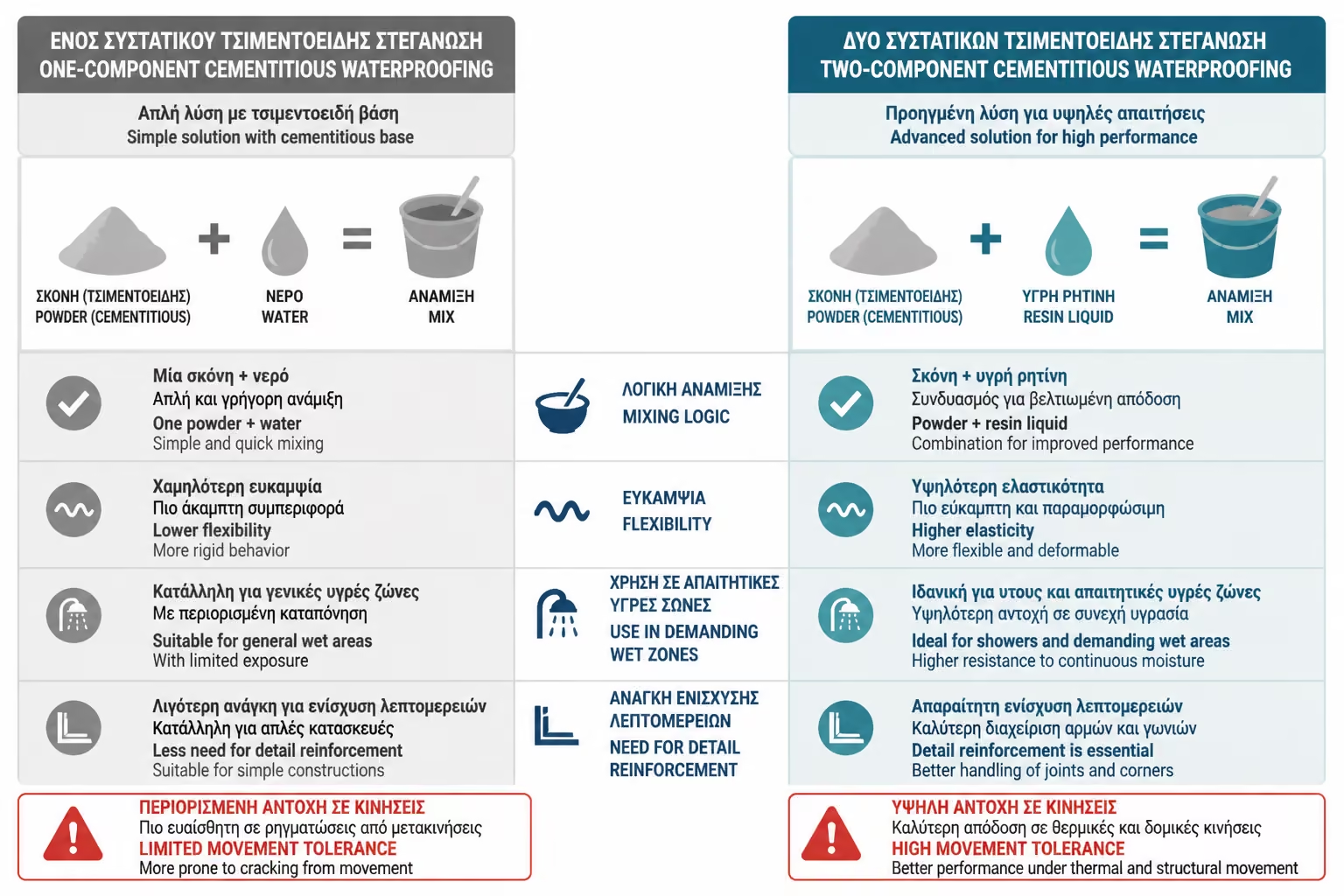
The word "elasticity" is often heard in sealing materials, but it is not always easy for the owner to understand why it matters. In a bathroom, surfaces are not completely stationary. Cement mortar can have small contractions, corners can work differently from the floor, pipes can create small changes, while hot and cold water cause temperature changes.
In a rigid sealant, these micro-movements can over time create capillary cracks or weaknesses, especially at corners and joints. A more resilient cementitious system can better follow these small changes, reducing the risk of failure.
This is not to say that elasticity solves everything. If there is a large crack, a loose substrate, bad cement or the wrong siphon, no elastic material will save the structure. But on a properly prepared substrate, elasticity is a significant advantage, particularly in shower zones.
A practical example is the floor-wall connection in a walk-in shower. There, two levels meet, receive water daily and may have small movements. If a rigid application is used without tape, the site is vulnerable. If 2-component rubber cement is used along with sealing tape, the system has a much better chance of lasting.
Cementitious materials are mainly used under tiles, on floors and walls that receive moisture. The most demanding use is the floor of the shower, especially when it is built and not a prefabricated base. There the material has to cooperate with the creases, the siphon, the corners and the tile adhesive.
On shower walls, concrete is also a common choice. The waterproofing should rise to a practical height, usually at least about 2 meters in the zone receiving water. Around batteries and supplies there should be a special seal, not just a hardware passage.
In shampoo recesses, built-in shelves, seats or parapets, concrete blocks can be used, but need special attention in the corners. These structures have many small internal edges where water can remain. There the sealing must be continuous and reinforced.
On a floor outside the shower, the need depends on the layout. In small bathrooms with a walk-in shower without steps, it often makes sense to waterproof most or all of the floor. In more enclosed cabins, wet zone protection may be sufficient.
Before any cementitious material is applied, the substrate must be suitable. This means stable, clean, dust free, no loose spots, no oils, paint, old adhesives coming off, or moisture beyond the system's allowable limits. If the base is bad, the hardware cannot work properly.
In new cement mortar, basic curing must be completed according to the materials instructions. If the cement mortar is still too wet and gets closed under waterproofing and tiles, problems can arise. On old substrate, loose plasters must be removed, cracks repaired and surfaces thoroughly cleaned.
Primer is not always necessary on every product and substrate, but when the system calls for it, it should not be omitted. It helps regulate absorbency and improve adhesion. A very absorbent substrate can "pull" water from the material quickly. A very smooth substrate can make adhesion difficult.
In practice, good fit can be seen before the bag is opened. If the technician does not clean, inspect and prepare the base, the most expensive sealant will not perform as it should.
In 1-component cementitious materials, the powder is mixed with clean water in the ratio specified by the manufacturer. This ratio must be observed. Adding more water to make the material easier to apply is a common construction site mistake. It can reduce strength, change adhesion and create a layer that does not meet product specifications.
Mixing should be done with a mechanical mixer at low speed to create a homogeneous mixture without lumps. Usually the material needs a few minutes of rest and then a brief re-mixing, depending on the instructions. This helps to properly hydrate the ingredients and give the mixture proper workability.
No more should be mixed than can be applied within the life of the material. If the material begins to "pull" in the bucket, it should not be revived with additional water. This spoils the recommendation. Better smaller batches and proper application than a big bucket worked in haste.
A practical control is the texture: the material must spread without running too much and without dragging like dry mortar. If it looks like watery paint or hard plaster, something is wrong with the mixing or ratio.
In 2-component cementitious materials, the process must be even more careful. Usually the liquid component is first put into a clean container and then the powder is gradually added with continuous mixing. The goal is to create a homogeneous paste, without lumps and without insoluble points.
The liquid component is not just "water with something in it". It is a key part of the system. Therefore, it should not be replaced or diluted arbitrarily with water, unless expressly permitted by the manufacturer. If the powder-resin ratio is altered, the final material may lose elasticity, adhesion or strength.
And here you need a low-speed mixer. Too high revs can trap air in the mixture, which doesn't help the sealing layer. After the first mixing, several products require a short waiting time and a second mixing. The technician must follow the instructions and not work "as he likes".
The 2 components have a specific working time. When the mixture begins to set, it should not be re-mixed with water or additional liquid. This is especially important on hot days or in poorly ventilated bathrooms where time may be limited.
The brush is a very common tool for spreadable cements, especially in corners, details, rough substrates and places where we want the material to be "worked" into the surface. With the brush, the technician can press the material into small irregularities, cover corners and better control difficult spots.
On cement mortars, plasters and surfaces with little roughness, the brush helps with the first layer. The material does not just sit on the surface, it is worked on. This can improve contact and reduce small gaps.
The brush is also useful around siphons, supplies, tapes and corners. That's where precision is needed. A large surface can be covered more quickly with a roller, but a brush allows better control over the details.
The downside is that it requires experience not to leave too thin or too thick spots. If the technician "overflows" the material with the brush to cover a larger area, the final thickness may be insufficient. The brush should not be used for economy of material, but for correct application.
The roll is practical for larger and relatively flat surfaces, such as shower walls or floors with clean geometry. It allows faster application and can give an even layer, as long as the material has the appropriate fluidity and the roll is suitable for the product.
But the roller is not ideal for all details. In corners, around pipes, in the siphon and in bands, it is usually necessary to brush first or in parallel. If the technician only rolls the entire shower and doesn't work on the joints, there may be weak spots left.
Another issue is thickness. With the roller, especially if the material is diluted more than it should be, a very thin layer can be created that looks visually full but does not have the required consumption. Visual coverage does not always mean technical coverage.
Properly applied, the roller can be used for the large fields and the brush for the details. This combination is often more practical than using one tool alone.
Many cementitious systems provide for two layers. The first layer creates the base and covers the substrate. The second completes the thickness, closes small imperfections and improves the continuity of the sealing. "One good hand" is not the same as two correct coats.
The second coat is often applied after the first coat has set or dried to the product's specifications. In several applications, it is applied cross-wise, i.e. in a different direction, in order to better cover micro-gaps. This helps especially on surfaces with small irregularities.
If a single layer is applied too thick, it may crack or not cure properly. If too thin a layer is applied, there is not enough material to create a reliable seal. The correct consumption per square meter is a key criterion.
The owner can simply ask: "How many hands will be passed and how long will we wait before the tiles?" If the answer is "one pass is enough", it needs to be confirmed that this is actually allowed by the specific product and the specific use.
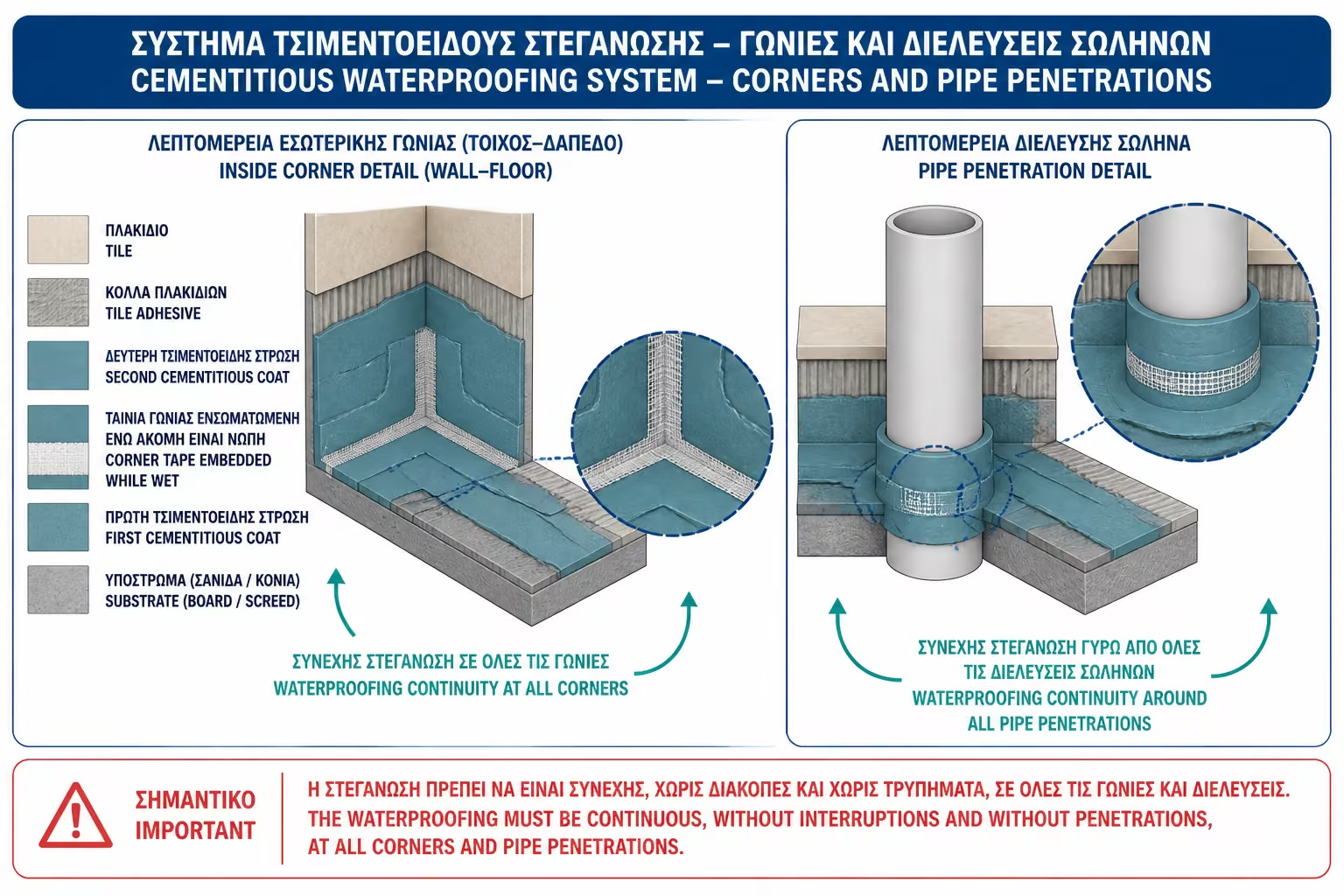
Cementitious sealants should not be applied alone to critical joints. In floor-wall corners, in vertical corners, around pipes, siphons and level changes, sealing tapes or special pieces are needed. These are incorporated into the first layer and covered with the second, depending on the system.
The tapes give elasticity and continuity in places where the material itself can be strained. They are particularly important in showers, because there the corners receive direct water. Omitting them is one of the most common mistakes in rough applications.
Around battery supplies, cuffs or special seals are needed. It is not enough to put cement around the hole. The pipe, rosette and opening in the tile constitute a break in the waterproofing and must be treated as such.
In the siphon, especially in the linear, the connection to the seal is critical. If the siphon has a flange or intended connection surface, the cementitious material must be properly integrated into it. If there is no such provision, the risk increases and there must be a technical solution, not improvisation.
Haste is one of the biggest enemies of sealing. Each cement has specific times between coats and before tiling. These times depend on the product, application thickness, temperature, humidity and room ventilation.
Just because the surface looks dry doesn't mean it's fully cured. If the tiles are glued too soon, moisture can be trapped or adhesion can be affected. If the second coat is applied before the first is ready, weak spots may occur.
In a bathroom that needs to be delivered quickly, there is often pressure to get crews moving. But in the sealing this pressure can lead to failure. The correct order and times of application must be provided in the schedule.
The owner can request that product times be met. He doesn't need to know them inside out, but he must avoid the logic of "it passed in the morning, we stick tiles in the afternoon" if this is not allowed by the system.
After the waterproofing comes the tile adhesive. The adhesive must be compatible with the cementitious system and suitable for the tile to be used. Not all adhesives are the same, especially when it comes to large tiles, porcelain, shower floors or wet stress surfaces.
If the sealant is too smooth, improperly cured or dusty, the adhesive may not adhere properly. If the wrong adhesive is used on a rubber seal, separations may occur. That is why it is good to treat the system as a whole: sealant, glue, grout and sealants.
In shower floors, the grout must also be suitable for a wet zone. It does not replace sealing, but affects maintenance and wear. In demanding cases, better quality or even epoxy grout can be considered, if the workshop has experience.
Proper waterproofing doesn't end when the screed dries. It is complete when all subsequent materials work properly with it.
Cement mistakes are often simple, but serious. Something doesn't have to go spectacularly wrong for there to be a problem. Small deviations at each stage add up.
| Error | Possible consequence | Correct approach |
|---|---|---|
| Too much water in mixing 1 component | Weak layer, reduced adhesion | Compliance with manufacturer's ratio |
| Dilution of 2 components with water without instruction | Loss of elasticity and technical properties | Use the liquid component as directed |
| Application on dusty substrate | Detachment or poor adhesion | Cleaning and priming where necessary |
| One thin layer instead of two | Insufficient sealing | Apply in required layers and consume |
| No corner tapes | Cracks and small leaks | Incorporation of sealing tapes |
| Hasty paving | Entrapped moisture or adhesion failure | Compliance with drying times |
| Bad siphon connection | Leakage at the most critical point | Use of flange, collar or special detail |
| Using the wrong glue over the insulation | Detachment of tiles | Compatible adhesive for the system |
A typical example is a shower where 2-component cement was applied, but without strips in the corners. The owner paid for "good hardware", but the system was left weak at the most critical point. The problem was not the class of material, but the omission of detail.
The cost depends on the surface, the product, whether it is 1 or 2 component, the need for primer, tapes, cuffs, gaskets, the condition of the substrate, the area, the floor, access, whether VAT is included and whether the price is for materials only or materials with labour.
1-component cementitious materials are usually more economical as a material. 2-components have a higher cost, but offer better elasticity and often better behavior in demanding zones. The difference in the total cost of a bathroom is not always great, especially if we are talking about limited square footage in the shower zone.
In a complete bathroom renovation in Greece in 2026, where a typical bathroom of about 5 sq.m. can be indicatively around €3,200–€5,500 for a simple to medium solution and €6,000–€7,500+ for more demanding options, proper cementitious waterproofing is a small but critical part of the overall budget. Economy at this stage is rarely worth it, especially in the shower.
| Selection | Financial picture | When is it justified? |
|---|---|---|
| 1 component cementitious | More economical and simple | Less demanding zones, fixed substrates, walls |
| 2-component cementitious | Higher material costs | Showers, floors, corners, small movements, demanding use |
| Ribbons and cuffs | Small additional cost | Necessities in corners, supplies and joints |
| Primer | Low to moderate cost | Where requested by the substrate or system |
| Proper application work | It affects more than it seems | Critical to the final result |
A bid that is low because it omits films, second coat or proper preparation is not really economical. It is incomplete.
The owner doesn't need to know material chemistry, but needs to ask for specific answers. First, which material to use: 1-component or 2-component? Why is this chosen? Is it suitable for showering or just general wetness? How many layers will it be applied?
He should also ask about the preparation. Will the substrate be cleaned? Does it need a primer? Has the cement mortar dried? Are there any soft spots? These are not details. It is the basis of adhesion.
Then he must ask about the crucial details: Will tapes be inserted in the corners? What will happen around the siphon? How will the battery supplies be sealed? How high will the waterproofing go up the walls?
Finally, he must ask to see the stage before the tiles go in. There you will see the layers, the bands and the connection to the critical points. After paving, this will all be covered.
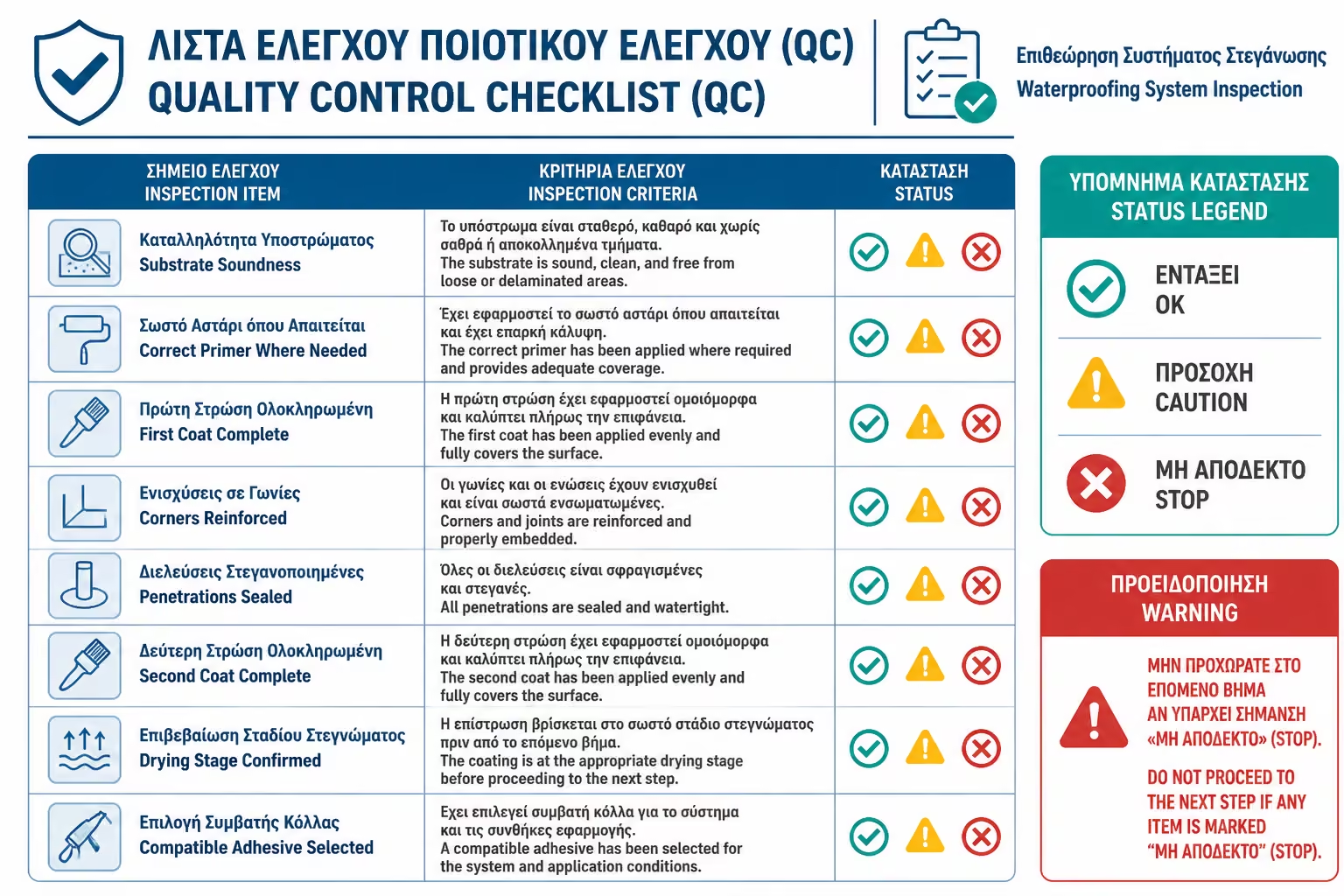
Before the cementitious waterproofing is closed under the tiles, it is worth doing a hands-on check. This helps the owner identify gaps before they become expensive problems.
| Inquiry | Yes / No |
|---|---|
| Has a suitable cementitious material been selected for the particular use? | Yes / No |
| Do we know if it is 1 or 2 component and why it was chosen? | Yes / No |
| Is the substrate clean, firm and free of loose spots? | Yes / No |
| Has primer been applied where required? | Yes / No |
| Was the mixing done with the right proportion and not "by eye"? | Yes / No |
| Was the material applied in two coats or as prescribed by the system? | Yes / No |
| Has the required consumption per square meter been met? | Yes / No |
| Are the corners taped? | Yes / No |
| Are there cuffs or special pieces around water supplies? | Yes / No |
| Is the siphon connected to the waterproofing layer? | Yes / No |
| Have drying times been met prior to tiling? | Yes / No |
| Is the tile adhesive compatible with the waterproofing? | Yes / No |
| Does the offer mention materials, labour, VAT and technical stages? | Yes / No |
If several answers are "I don't know", it does not necessarily mean that the work is bad. But it means that it has not been tested enough before it is covered. And in waterproofing, this is always a risk.
> If you have to keep only one thing, keep it this: cementitious sealant is not a “just go over it and be done with it”. It is an application system. In the shower, especially on the floor, corners and around the faucet, prefer a 2-component elastic system when the demands are high, but don't stop at the name of the material alone. Ask for proper mixing, two coats, tapes in the corners, special connection to the siphon and adherence to times. The elasticity of the 2-component helps, but is not a substitute for proper fit.
Spreadable cementitious materials are rightly one of the most common waterproofing materials on the Greek market. They are compatible with most building substrates, work well under tiles and can provide reliable protection in bathrooms and showers. But their success does not depend only on the product. It depends on choosing the right type and the quality of application.
1-component are simpler and more economical, suitable for less demanding zones or fixed substrates. The 2 components, with the resinous liquid component, are superior in elasticity and are usually preferable in areas with greater stress, such as shower floors, walk-in structures, corners and places where there are micro-movements. Their difference is of practical importance, not just theoretical.
On the other hand, no cementitious material should be applied lightly. The correct mix ratio, clean substrate, primer where needed, two coats, corner tapes, siphon connection and drying times are what turn the material into a true waterproofing.
For the owner, the best protection is not to dwell on the phrase "we will put concrete". He must ask which, why, how, in how many layers and in what detail. A properly applied cementitious system can protect the bathroom for years. A poorly passed material, even if it is of good quality, can hide under the tiles and reveal its mistakes much later.
Return to category.
Go to categoryReturn to the central guide.
Go to guide