
Bathroom Waterproofing & Moisture Protection
Return to category.
Go to categoryIn bathroom waterproofing, many owners pay attention to the basic insulation material: whether to put cementitious, liquid membrane, fleece, polyurethane or some other system. This makes sense, because waterproofing is the layer that protects the construction from water. But there is a second critical stage that is often underestimated: the tile adhesive that will press onto the seal.
The glue is not just "the material that holds the tile". It is the connecting link between two different layers: below is the waterproofing, which is often elastic, smooth, non-absorbent or with limited absorbency; above is the tile, often porcelain, large, heavy and almost non-absorbent. If the adhesive isn't right, the system can fail not because water got through the insulation, but because the tile didn't stick to it properly.
This is especially important in showers and modern bathrooms. The surfaces accept water, temperature changes, cleaning agents, micro-movements, expansions and contractions and daily use. The adhesive must be able to hold the tile on a demanding substrate and at the same time absorb small deformations without cracking or peeling. That is why in such applications we talk about improved and deformable adhesives, such as C2TE S1 or, in more demanding cases, S2.
These codes are not meaningless commercial jargon. They come from the European tile adhesive classification. EN 12004 is used to classify ceramic tile adhesives, with basic categories such as C for cementitious adhesives, D for dispersions and R for resinous, while additional indications denote improved properties, reduced slip, extended open time and deformability.
In practice, if proper waterproofing has been done and then simple glue is used, a weak link is created. It's like building a good base and then attaching the final cladding to a material not designed for such conditions. This guide explains what waterproofing and adhesive compatibility means, why plain adhesive should not be used over waterproofing systems, what C2TE S1 and S2 classes mean and what the owner should check before tiling.
When gluing tile onto simple absorbent plaster or cement mortar, the adhesive has a relatively familiar base. The substrate is mineral and usually has some absorbency. But when waterproofing has preceded, the surface changes. It can be smoother, tighter, more elastic or less absorbent. This means that the glue does not work in the same conditions.
A cementitious sealant, an acrylic membrane, a polyurethane membrane or a fleece membrane have different surface behavior. Some material offers mechanical adhesion, others require a specific adhesive, others require a special primer or a specific waiting time before paving. If random glue is used, it may not develop the required adhesion.
Also, waterproofing often has elasticity. This is good because it helps to absorb micro-movements. But if the glue on top is too stiff, it may not cooperate with this elasticity. The result can be cracks in the joint, delamination of tiles or local voids under the cladding.
In a shower, this problem becomes more serious. Water, temperature changes and daily use test the interface between the adhesive and the sealant. If there is an incompatibility there, the bathroom can fail without necessarily "piercing" the waterproofing.
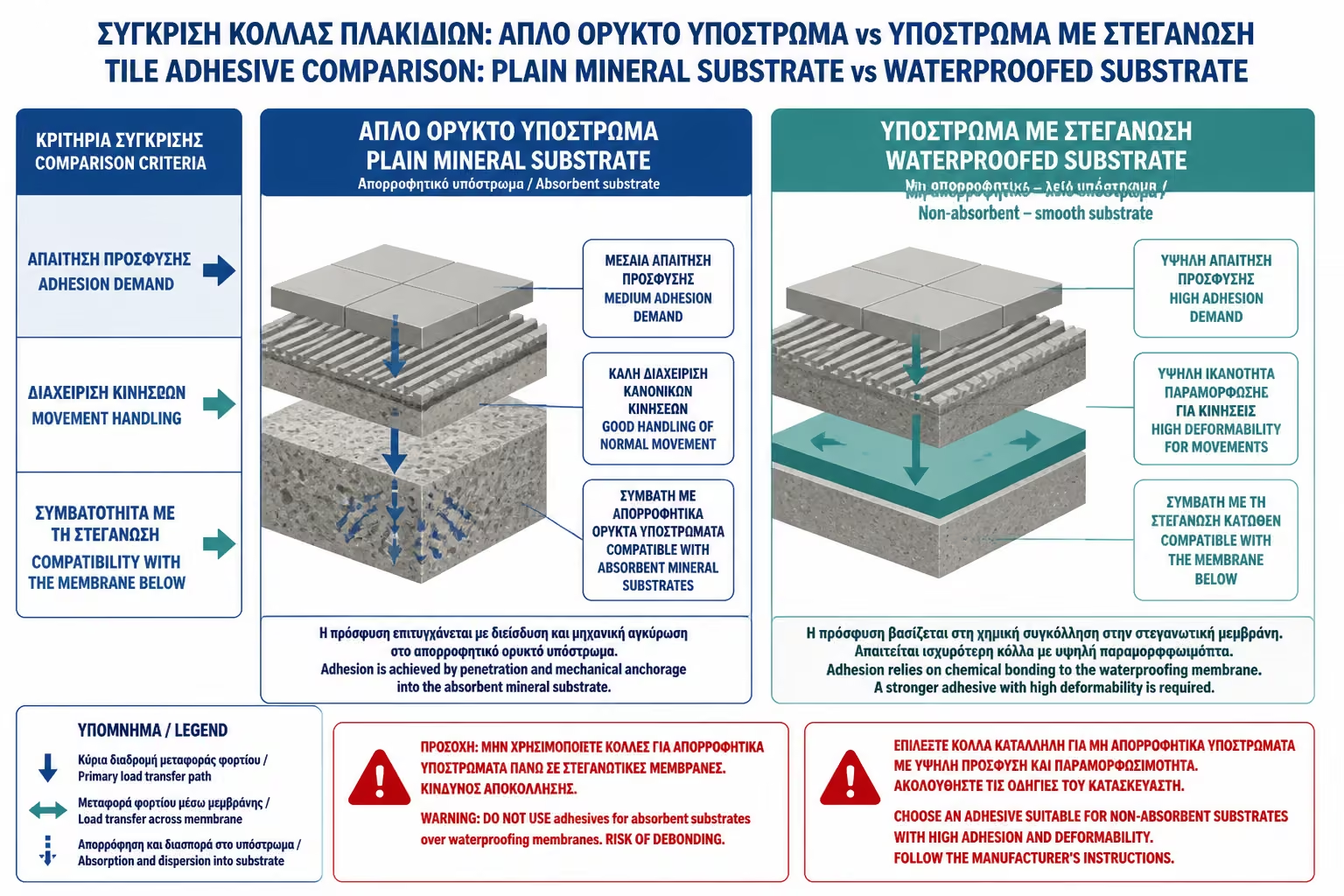
By the term "simple adhesive" we usually mean a basic cementitious tile adhesive intended for simple interior applications, on absorbent substrates and with less demanding conventional tiles. It can be suitable for a simple wall, for small ceramic tiles or for surfaces without much stress. But it is not suitable for every application.
On waterproofing, especially in a shower, simple glue can have three main problems. First, it may not have enough grip on a closed or rubbery surface. Second, it may not have enough deformability to follow micro-movements. Third, it may not work with porcelain or large tiles that have low absorbency and are heavier.
The fact that an adhesive "grips" when we apply it does not mean that it will withstand use. Many failures occur later, when the bath starts working: hot water, cold water, cleaning agents, moisture, small movements, pressure loads and contractions. Then it can be seen if the glue was really suitable.
That's why you shouldn't choose a glue based only on the price or the general phrase "it's a good glue". Its category and its compatibility with the waterproofing system and the tile must be considered.
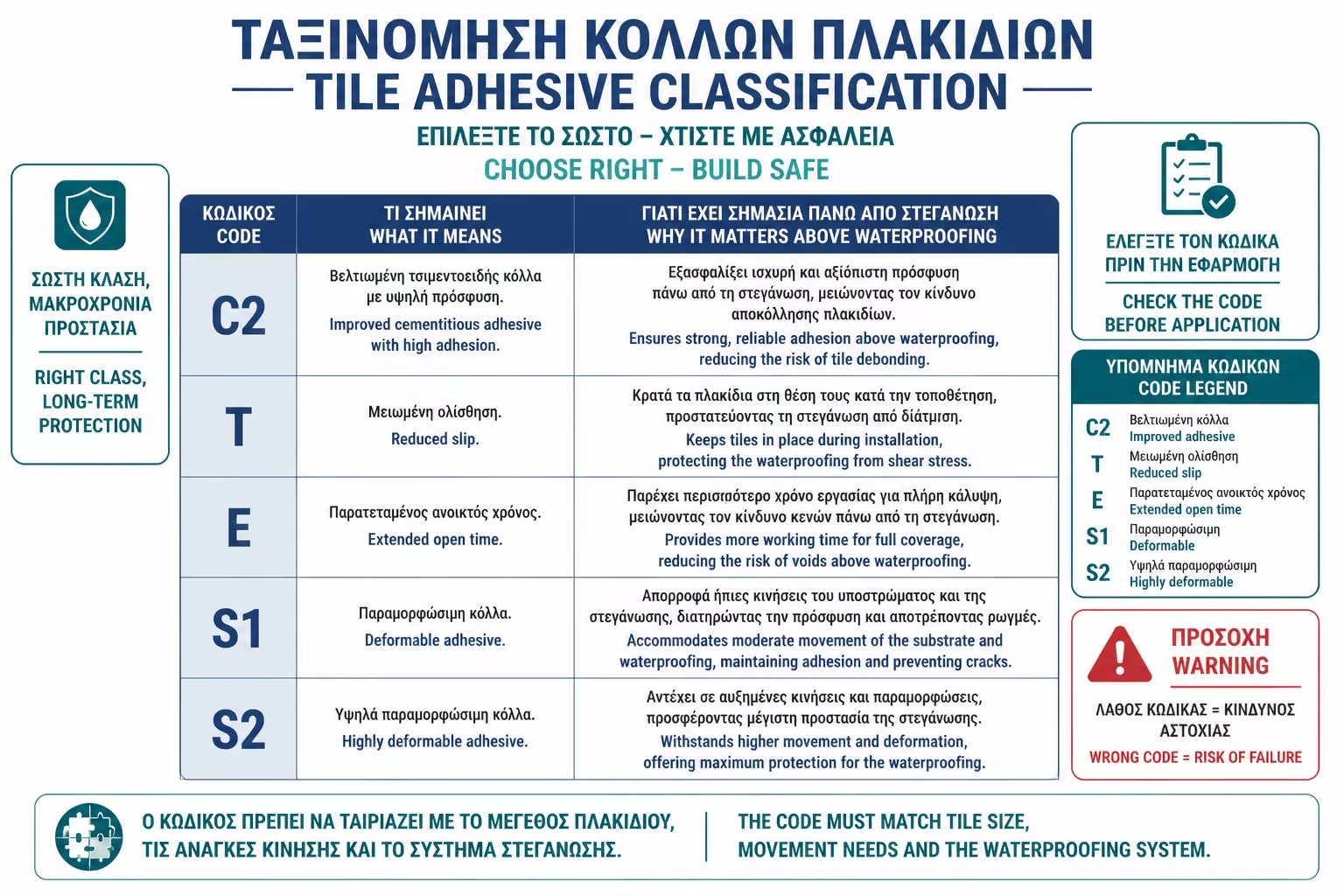
The marking of the glue gives information about its properties. “C” stands for cementitious adhesive. “2” indicates improved performance over the base category. “T” stands for reduced slip, useful on walls so that tiles do not slide down during application. “E” stands for extended open time, meaning more room to work before the adhesive loses its ability to adhere to the surface.
The “S” mark is particularly important on moisture-insulated surfaces. It states deformability, i.e. the ability of the hardened adhesive to be deformed by stresses between the tile and the substrate without losing adhesion or damaging the finished surface. This concept is related to deformation tests, while category S1 refers to deformable adhesive and S2 to highly deformable adhesive.
In practice, a C2TE S1 adhesive is an improved cementitious adhesive, with reduced slip, extended open time and deformability. An S2 has even greater deformation capacity and is used in more demanding conditions. The S1 and S2 distinction is usually linked to the transverse deformation capacity: S1 for deformation of about 2.5–5 mm and S2 for more than 5 mm, according to the relevant classifications used in the market.
For the owner, there is no need to memorize all the letters. It needs to hold that over waterproofing, especially in a shower, we want improved and deformable glue, not simple basic glue.
In a bathroom, tile, adhesive, waterproofing and underlay do not all behave in the same way. Waterproofing can be elastic. The tile can be very stiff. The substrate may have micro-movements. Water and temperature create contractions and expansions. The glue is in the middle and has to manage these differences.
If the glue is too stiff, the stresses are transferred to specific points. Joints may open, cracks may appear, or the tile may detach. If the glue is deformable, it can absorb small changes and maintain adhesion.
This is especially important on large tiles. The larger the tile, the more surface area it acts as a rigid slab. Small movements in the substrate cannot be easily "lost" in the many joints, as it would be with small tiles. So the glue should help more.
It is also important on wooden substrates, dry construction, underfloor heating, walk-in showers, large surfaces, outdoor areas and generally in any application where there is movement. In the shower room, even if there is no underfloor heating, the temperature changes from hot water and daily humidity are enough to make deformability significant.
There is no one-size-fits-all adhesive for all waterproofing systems. Another behavior is a cementitious spreadable, another liquid polyurethane membrane, another acrylic membrane and another fleece membrane. The adhesive must be compatible with the surface on which it will be glued.
In cementitious waterproofing, most good elastic cementitious adhesives can work as long as the system allows and the drying times are observed. In fleece membranes, adhesion is primarily through the fleece and the adhesive, so an adhesive must be used that the system specifies or allows. In polyurethane or acrylic liquid films, the surface may be more closed or more elastic, so compatibility is even more critical.
The mistake is to first choose the glue based on the habit of the board and then try to use it on any insulator. The correct order is the reverse: the waterproofing system is selected, then the adhesive compatible with it, the tile and the use.
The owner can ask for a simple technical confirmation: "Is the adhesive to be used suitable for the particular sealant?" This question often catches big misses.
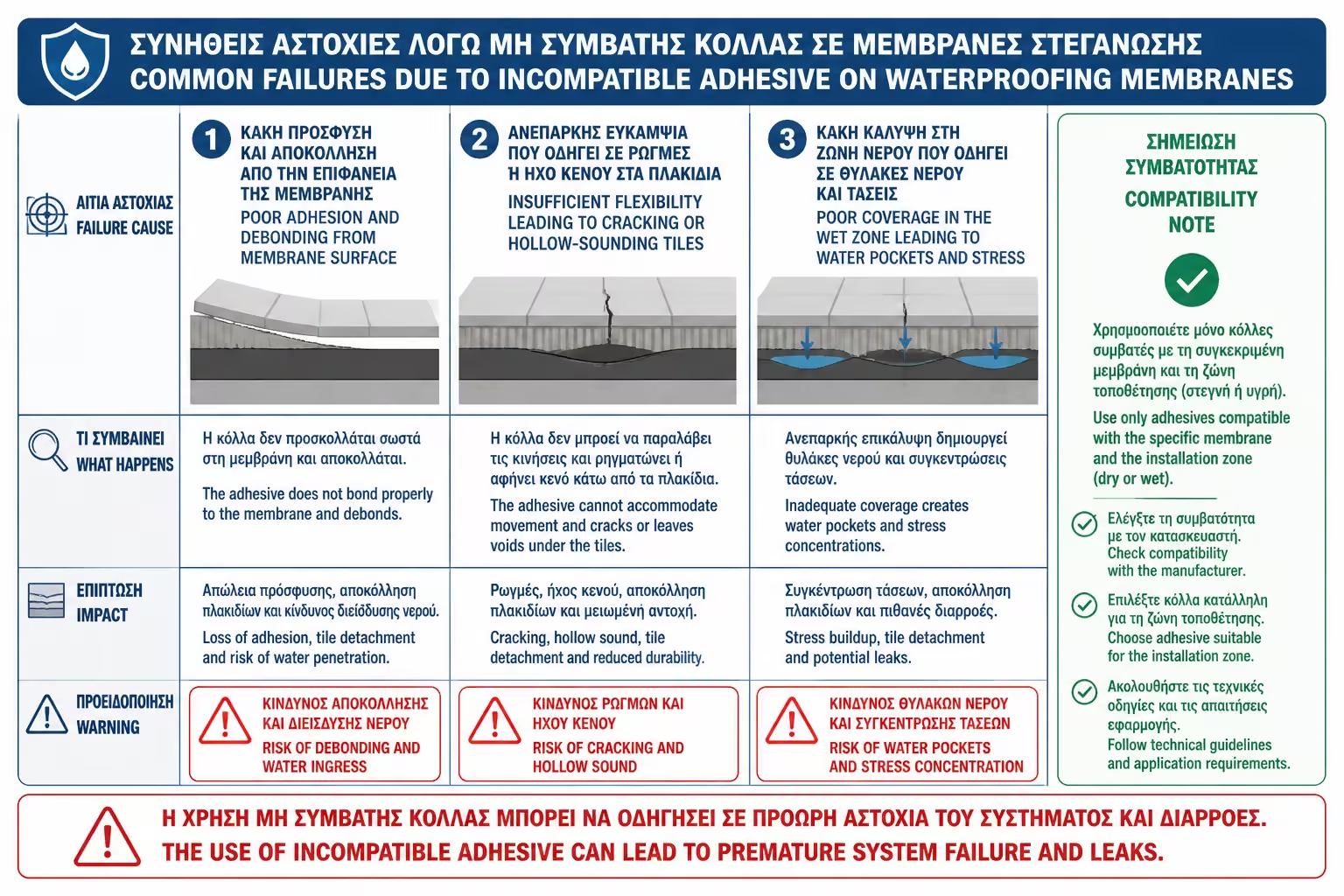
The wrong adhesive can cause tile delamination, hollow spots, joint cracks, water seepage under the finished surface and general weakening of the system. The problem may not be immediately apparent. The tile can be glued, look stable and the bathroom delivered normally. Failure occurs later when the system begins to stress.
In a shower floor, the gaps under the tile are particularly dangerous. They can hold water, make noises, strain joints and lead to localized detachment. If the tile is large and the glue is not spread properly, the problem becomes even more intense.
On walls, insufficient adhesion can appear as tile peeling, small cracks or a "hollow" sound. If it is a large porcelain tile on waterproofing, the glue must have high adhesion and proper workability. "It holds because it didn't fall" is not a technical criterion.
In the corners and near the siphon, the wrong glue can cooperate poorly with the movements of the waterproofing. Those are precisely the points where the water tests the construction the most. If the adhesive fails, the repair may require tile removal and rebuilding.
Class C2 indicates an improved cementitious adhesive compared to the basic class C1. In practice, when we are talking about porcelain tiles, large tiles, wet areas, damp-proofed surfaces or more demanding substrates, the C2 option is usually the reasonable minimum basis.
This does not mean that every C2 glue is automatically suitable for everything. A C2 without S1 or S2 may have improved grip, but not the deformability we want in movements or rubber seals. That is why in many demanding applications it is not enough to ask for "C2". We want C2TE S1 or S2, depending on difficulty.
T helps on walls, because it reduces the sliding of the tile. E helps with practical application by giving a longer open time, useful on large tiles or in situations where the craftsman needs more time. But the S indicator is the one that particularly concerns the system's ability to handle movements.
For a simple tiling on a kitchen wall, a basic adhesive may be sufficient. For a shower over waterproofing, the logic changes. There the glue should not be the cheapest part of the construction.
S1 adhesive is usually the practical choice for many demanding bathroom applications: floors and walls above waterproofing, porcelain tiles, medium to large sizes, walk-in showers and interior surfaces that receive moisture. It offers deformability and better behavior in small movements.
S2 glue is used when the requirements are even higher. For example, in very large tiles or slabs, in substrates with greater movements, in wooden floors or OSB where a special system has been designed, in underfloor heating with large temperature changes, in outdoor spaces or on surfaces where deformability is a critical factor. S2 is highly deformable and can handle higher stresses than S1.
S2 does not always have to be selected. It is more expensive and often more specialized. If the substrate is stable, the waterproofing conventional and the tile reasonably sized, a good C2TE S1 may be sufficient. But if there are many risk conditions together, S2 should be seriously considered.
The right choice should be made based on the system. Substrate, waterproofing, tile size, temperature changes and use. Not based on cost alone.
Modern bathrooms often use large porcelain tiles. These have low absorbency and a large surface area. This makes them beautiful and practical to clean, but more demanding to glue. The glue must have very good adhesion and cover the back side properly.
Above waterproofing, the problem doubles: below we have a closed or elastic surface, above we have a closed porcelain tile. The moisture of the glue is not readily absorbed on either side. If the adhesive is not suitable or if the tile is not pressed properly, gaps may be left or proper curing may be delayed.
On large tiles, a double application of adhesive is often required: both on the substrate and on the back side of the tile. This helps achieve better coverage and reduce gaps. In a shower floor, voids are undesirable because they can hold water or create failures.
Choosing C2TE S1 or S2 in such applications is not an exaggeration. It is a technical necessity resulting from the low absorbency, the size and the moisture-insulated base.
In fleece films, the adhesive must work with the fleece and mechanically integrate into its fibers. If the system specifies a specific type of adhesive, it must be followed. The wrong glue may not bond properly to the fleece or not have the deformability required.
In cementitious waterproofing, the surface is closer to the logic of paving, but remains a waterproofing layer. It needs a high-adhesion adhesive and, in showers, a deformable category. It should not be considered a simple plaster.
In acrylic or polyurethane films, compatibility is even more important. The surface can be more elastic and more closed. Some products require a specific primer or specific adhesive. If the wrong glue is applied, it can peel off the film, even if the film itself is flawless.
That is why in a serious project there must be a chain of compatibility: substrate, primer, waterproofing, glue, tile, joint. If one link doesn't fit, the whole system is at risk.
Before glue is applied, the waterproofing must be cured as required by the system. If the adhesive is applied over uncured waterproofing, adhesion problems, trapped moisture or chemical incompatibility may occur. This is particularly important in liquid membranes and polyurethane systems.
Rushing to the construction site is a frequent problem. The insulation is laid in the morning and in the afternoon the slab wants to start so as not to waste a day. This can only be allowed if the product allows it. Otherwise, it's a risk.
Drying time depends on temperature, humidity, ventilation, thickness of application and type of material. In closed bathrooms without windows, times may be longer. Just because a surface looks dry doesn't always mean it's ready for glue.
The right quote and schedule should include these times. Waterproofing and glue should not be "squeezed" in time because delivery is pressing.
The category of glue is important, but it is not enough by itself. The application of the adhesive must ensure proper coverage under the tile. In wet zones, especially shower floors, we don't want gaps. Gaps can hold water, create weak spots and make the tile sound hollow.
The glue must be combed with a suitable spatula, depending on the size of the tile. The tile must be pressed properly so that the glue lines are compressed and full contact is made. On large tiles, double coating is often necessary.
On walls, the reduced slip of category T helps keep the tiles from slipping. On floors, proper coverage is more critical. In showers with slopes, the tile must be careful not to create bellies with the adhesive and not to cancel the flow.
An expensive C2TE S1 adhesive, if applied with gaps, will not perform as it should. The material class and the technical application must go hand in hand.
Sometimes there is the logic that "we'll put good grout and good silicone, so it won't be a problem". This is wrong. Grout and silicone play an important role, but they do not correct poor tile adhesion.
Grout protects the finished surface and affects maintenance, but does not hold the tile in place. Silicone in the corners and joints gives elasticity, but cannot stabilize tiles that are not properly adhered to the waterproofing.
If the adhesive peels off, water can seep under the tile and move into gaps. Waterproofing can prevent damage to the substrate, but the finished cladding will have a problem: hollow tiles, cracks, blackened joints or breaks.
Proper logic is layer by layer. Each material must do its job. Waterproofing protects. The glue holds and absorbs stresses. The grout completes the surface. Silicone manages the elastic compounds. None of these should make up for the failure of the previous one.
The mistakes are usually simple, but serious. They are often done out of habit: "we always put this glue". But the moisture-insulated surface is not always like simple plaster or simple cement mortar.
| Error | Possible consequence | Correct approach |
|---|---|---|
| Simple glue on waterproofing | Debonding or poor adhesion | C2TE S1 or S2 depending on the application |
| Adhesive without S1/S2 in elastic membrane | Cracks or detachment from micro movements | Deformable adhesive |
| Wrong glue on a polyurethane system | Incompatibility and detachment | System approved glue |
| Paving before the insulation dries | Trapped moisture, poor adhesion | Observance of maturation times |
| Large tiles without double coating | Gaps under tiles | Full coverage and proper spatula |
| Use the same glue everywhere | Underestimation of different zones | Other requirement in shower, wall, floor, OSB |
| Ignoring manufacturer's instructions | Loss of system compatibility | Control of technical brochures |
A real example is a shower where good waterproofing was done, but large porcelain tiles were glued with cheap simple glue. In delivery everything looked right. After a few months, some tiles started to sound hollow. The insulation had not necessarily failed. The end liner had failed to bond to the waterproofed substrate.
C2TE S1 or S2 glue costs more than a simple glue. But in the total cost of a bathroom, the difference is usually small compared to the risk it reduces. Adhesive is one of those materials that can't be seen, but holds the entire finish in place.
In the Greece of 2026, a typical bathroom of about 5 sq.m. it can be indicatively around €3,200–5,500 for a simple to medium renovation, while more demanding solutions with a walk-in shower, linear siphon, full waterproofing, large tiles and a custom glass cabin can reach around €6,000–7,500 or more. Within this framework, the cost difference between simple glue and a suitable elastic adhesive is much less than the cost of peeling or re-installing tiles.
| Choice of glue | Financial picture | When is it justified? |
|---|---|---|
| Simple glue | Lower cost | Only in simple, undemanding applications where the substrate allows |
| C2TE | Middle solution | Better grip, reduced slippage, extended open time |
| C2TE S1 | Higher cost but reasonable base for showers | Waterproofing, porcelain tiles, large tiles, bathroom floors/walls |
| C2TE S2 | More accurate and more specialized | Large dimensions, movements, OSB/timber with system, sub-floors, high stress |
The glue economy is one of the most wrong economies. If the tile peels off, not only is new glue paid for. They pay for rip-outs, new materials, time, hassle and potential damage to the seal.
A proper quotation should not simply state “tiling”. It must state the type of glue to be used, especially when waterproofing is involved. For example, it must be stated whether C2TE S1 or S2 is to be used, whether the adhesive is suitable for the particular tile and whether it is compatible with the waterproofing system.
If there are large tiles, the installation technique should be mentioned, such as double coating where required. If there is a shower floor, it must be clear that the adhesive is suitable for a wet zone and for application over waterproofing. If there is a wooden substrate, decoupling membrane or underfloor heating, the requirement must be even more specific.
The offer must also separate materials, labor and VAT. A low bid that uses simple glue may look better, but it doesn't compare to a bid that includes proper deformable glue and a proper fit.
The glue is too important to be vague. If the quote only says “tile adhesive”, critical information is missing.
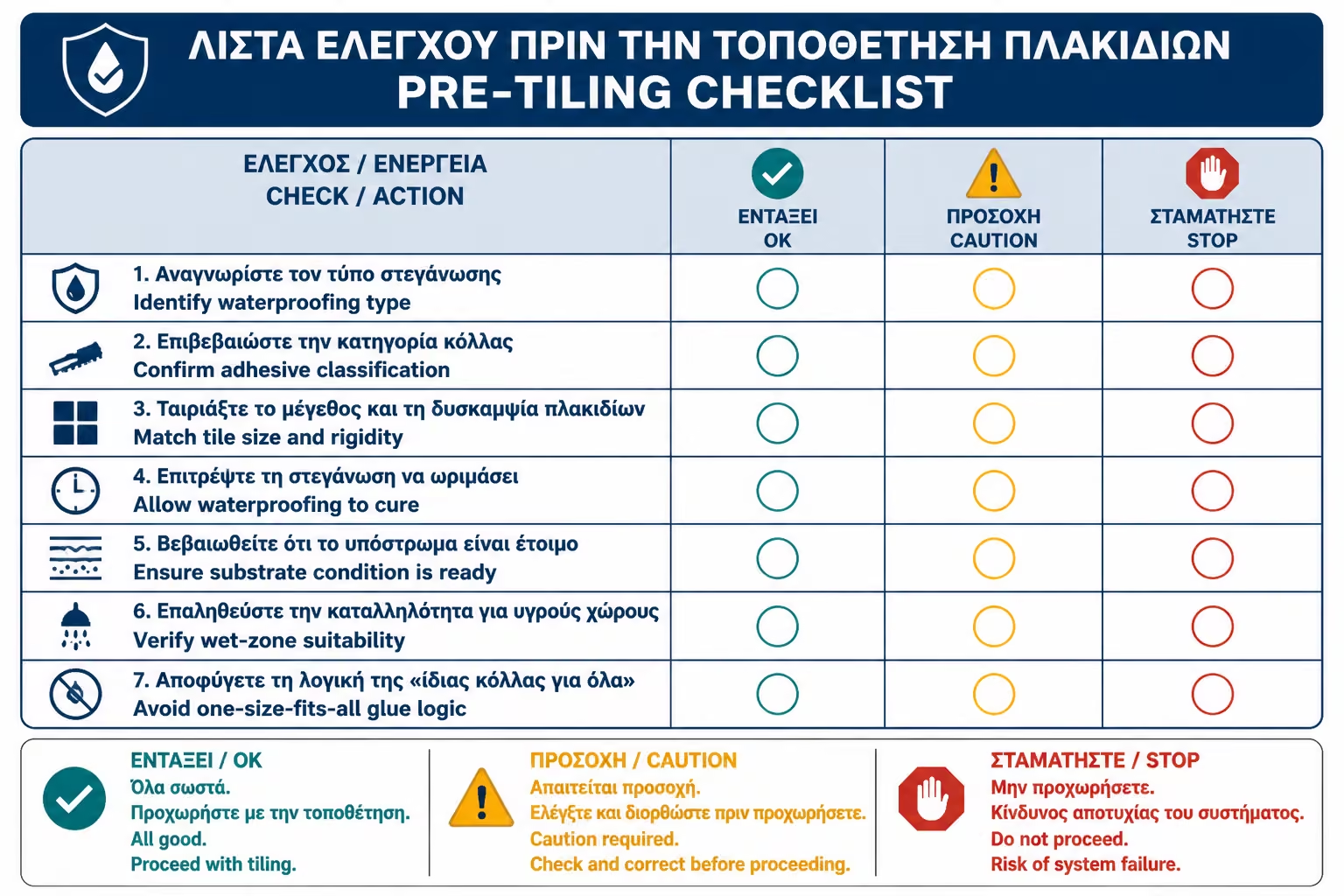
Before paving begins, first ask what adhesive will be used. Not just brand, but category. Is it C2TE? Is it S1 or S2? Is it suitable for this particular sealant? Is it suitable for the tiles you have chosen?
Also ask if the waterproofing has dried sufficiently. Proper adhesive on wet or immature film may fail. Ask if the system has been checked for compatibility. If the materials are from different companies, at least ask for a technical rationale or application instruction.
If the tiles are large, ask if it will be double coated. If it is a shower floor, ask how to ensure full coverage without gaps. If there is a walk-in with folds, ask how to avoid spoiling the slopes with too much glue.
A serious technician will not be bothered by these questions. It's part of the job right.
| Inquiry | Yes / No |
|---|---|
| Has the waterproofing dried/cured according to instructions? | Yes / No |
| Is the glue compatible with the specific waterproofing system? | Yes / No |
| Is the adhesive at least C2 for demanding application? | Yes / No |
| Is there an S1 or S2 indication where deformability is required? | Yes / No |
| Is the adhesive suitable for porcelain or large tiles? | Yes / No |
| On a wall, is there reduced slip T where needed? | Yes / No |
| Is there sufficient open time E for proper application? | Yes / No |
| Is double coating provided on large tiles? | Yes / No |
| In the shower floor, will gaps under the tiles be avoided? | Yes / No |
| Won't the glue be used to correct misalignments? | Yes / No |
| Are the grout and silicones compatible with wet zone use? | Yes / No |
| Does the offer clearly state the type of glue, materials, labor and VAT? | Yes / No |
If the answer to most is "I don't know", paving should not be started in a hurry. The adhesive is the layer that will hold the entire finish lining over the waterproofing.
> If you have to keep only one thing, keep this: we don't put "whatever glue we have" on top of waterproofing. The sealed surface is a more demanding substrate and needs an adhesive with high adhesion and deformability. For showers, large porcelain and walk-in applications, the C2TE S1 is often the logical base, while the S2 should be considered in even more demanding cases. The right adhesive is not a luxury; it is the link that holds the tile to the insulation.
Waterproofing and tile adhesive must be treated as a single system. It is not enough to make a proper waterproofing if the final lining is then glued with simple or incompatible glue. The tile must remain firmly bonded to a surface that is often elastic, closed and less absorbent than a simple substrate.
The C2TE S1 and S2 categories exist precisely to describe improved properties that matter in practice: grip, reduced slippage, open time and deformability. In a shower, these are not technical details about the bag of glue. It's the difference between a pavers that lasts and one that may peel off when daily use begins.
The owner must request that the adhesive be listed in the quote and check its compatibility with the waterproofing system. It must also pay attention to application: correct time after waterproofing, correct spatula, full coverage and double application where necessary. The best glue won't save a sloppy fit, but the right fit shouldn't be based on the wrong glue.
In a bathroom, all the hidden layers work together. Substrate, primer, waterproofing, glue, tile, grout and silicones. If the weakest link is the glue, the problem may appear much later, when the bathroom has already been delivered. That's why choosing the right super-elastic glue is not an exaggeration. It is part of technically correct sealing.
Return to category.
Go to categoryReturn to the central guide.
Go to guide