
Bathroom Surface Materials & Finishes
Return to category.
Go to categoryModern vinyl flooring has greatly changed the face of bathroom remodeling. Where in the past the flooring options were almost always tile, mosaic, marble or laminate, today we are seeing more and more LVT and SPC flooring in residential, rental, Airbnb, small bathrooms, WCs and utility spaces. The reason is simple: they give the look of wood, stone, cement or a modern floor, without the cold feeling of tile and without the sensitivity of real wood to moisture.
Their big advantage is comfort. A vinyl floor is warmer to the touch than a ceramic or porcelain tile. It does not have the same hard and cold feeling, which is immediately noticeable in a bathroom, especially in winter. In small apartments, houses without underfloor heating or bathrooms that are used every day, this difference in feel can be very important.
The second big promise is water resistance. Most modern LVT and SPC products are made of materials that do not swell like wood or laminate when in contact with water. That is why they are often advertised as waterproof and suitable for bathrooms and kitchens. Indeed, the vinyl or SPC core material itself can be waterproof. But in the bathroom we have to make a very important distinction: one thing is "the product does not absorb water" and another is "the entire installation is completely watertight like a basin". SPC installation guides for bathrooms emphasize that, even when the material is 100% waterproof, wet areas require perimeter sealing with elastic silicone to prevent water from reaching the substrate.
The third advantage is speed. Click-system floors can be installed quickly, often and by a careful DIY user, as long as the space is simple and the substrate is correct. LVT adhesives require more technical precision, but give a more stable and professional feel, especially in small wet spaces. This combination — waterproof core, hot press, thin thickness and fast application — explains why LVT and SPC have become so popular.
But it is not a solution without conditions. If they are placed on a crooked floor, on old tiles with large "teeth", in a place with a bad slope, in a shower or in a bathroom where water stagnates, problems may appear. Vinyl may not absorb water, but water can seep through perimeter gaps, through joints, under the floor or around the sink and create moisture in the substrate. So proper planning remains essential.
In this guide we will see what LVT and SPC floors are, what is the difference between click and glue, when they are suitable for a bathroom, when they are not, what "100% waterproof" really means, how they go over old tiles, what to look for in underlay, sealing and anti-slip, and when it is worth choosing them instead of tile.
LVT stands for Luxury Vinyl Tile. It is vinyl flooring in the form of tiles or planks, imitating wood, stone, cement, terrazzo or other materials. It consists of PVC/vinyl layers, a decorative film and a protective wear layer. The wear layer is critical, because it affects resistance to wear, scratches and everyday use.
LVT can be glued or click. Glued LVT is applied with a special adhesive on a very well prepared substrate. Click LVT snaps together with a mechanical system and is installed as a floating floor, i.e. it does not stick to the substrate. Both solutions can be used in residences, but have different requirements.
The great advantage of LVT is that it is thin, warm to the touch and very versatile aesthetically. A good wood effect LVT can give the feeling of a wooden floor without the fear of moisture of real wood. A stone look LVT can give a calmer surface than a cold tile. For bathrooms that want a more livable, warm image, it is an interesting solution.
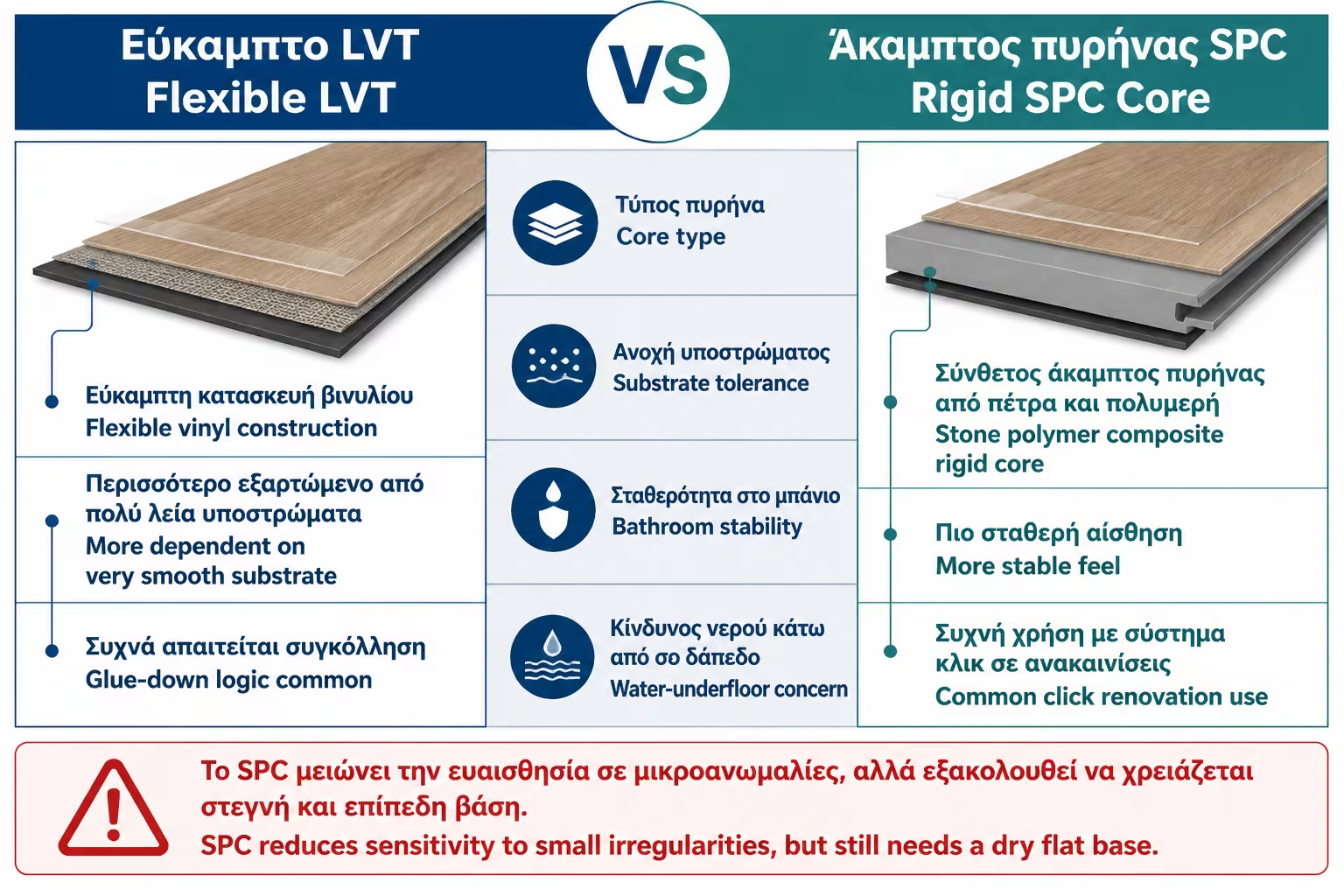
SPC stands for Stone Plastic Composite or Stone Polymer Composite, depending on the manufacturer. It is a rigid core vinyl floor, meaning it has a more rigid core than a simple flexible LVT. Its core usually contains a mixture of limestone dust and plastic polymers, which makes it stable, durable and less susceptible to small irregularities than a very thin glued vinyl.
SPC is often released in click form. It has a built-in or suggested underlay, snaps together like a floating floor and is quick to install. It is popular in renovations because it has a thin thickness, good strength, often a waterproof core and a wide variety of designs. In guides for SPC installation it is stated that the floor must be placed on a dry, clean and flat base, paying attention to the deviations of the substrate so as not to create problems with the click system.
In the bathroom, SPC has an advantage because the rigid core gives a more stable feel and usually holds up well to moisture. But as a floating floor, it needs perimeter expansion gaps, proper sealing in wet areas and care so that water does not enter from below.
The material itself, in most good LVT/SPC series, is waterproof or practically non-absorbent. It doesn't swell like wood core laminate and it doesn't rot like wood. This is a real advantage. In a bathroom, where there is water and steam, it is very important.
But we must avoid oversimplification. When a manufacturer says “waterproof flooring”, they are usually referring to the product, not necessarily the entire installation. If water falls on the board, the material will not absorb it. But if water gets around the perimeter, under the basin, around pipes or through a bad joint, it can get trapped under the floor and create moisture in the subfloor.
This is the point that the owner must understand. LVT/SPC is waterproof as a material. The bathroom does not automatically become watertight just because we installed a waterproof floor. For wet areas, floating SPC installation guides state that the perimeter should be sealed with permanently elastic silicone, but not "locked" the floating floor in a way that prevents its expansion.
So the correct phrase is not "I put LVT and I don't care about water". The correct phrase is "put suitable waterproof LVT/SPC, with proper placement and sealing, so that water does not reach the substrate".
One of the key sensory benefits of LVT/SPC is thermal sensation. The tile is hard, dense and cold to the touch, especially in bathrooms without underfloor heating. Vinyl has a "softer" and warmer feel because its material does not draw heat from the sole in the same way.
This does not mean that it heats the space. It means it's more comfortable when you're walking barefoot. In a bathroom that is used morning and night, this sensation is of great importance. Especially in children's bathrooms, small WCs or houses where we don't want bath mats everywhere, LVT/SPC makes the space friendlier.
There is also the issue of acoustics. Vinyl floors usually sound softer than tiles. Click SPC, if it has a built-in substrate or the right underlay, can reduce the "cold" and hard feeling. However, if it is placed on a bad base or with an unsuitable substrate, it can sound hollow or make clicking noises. So here too the substrate plays a role.
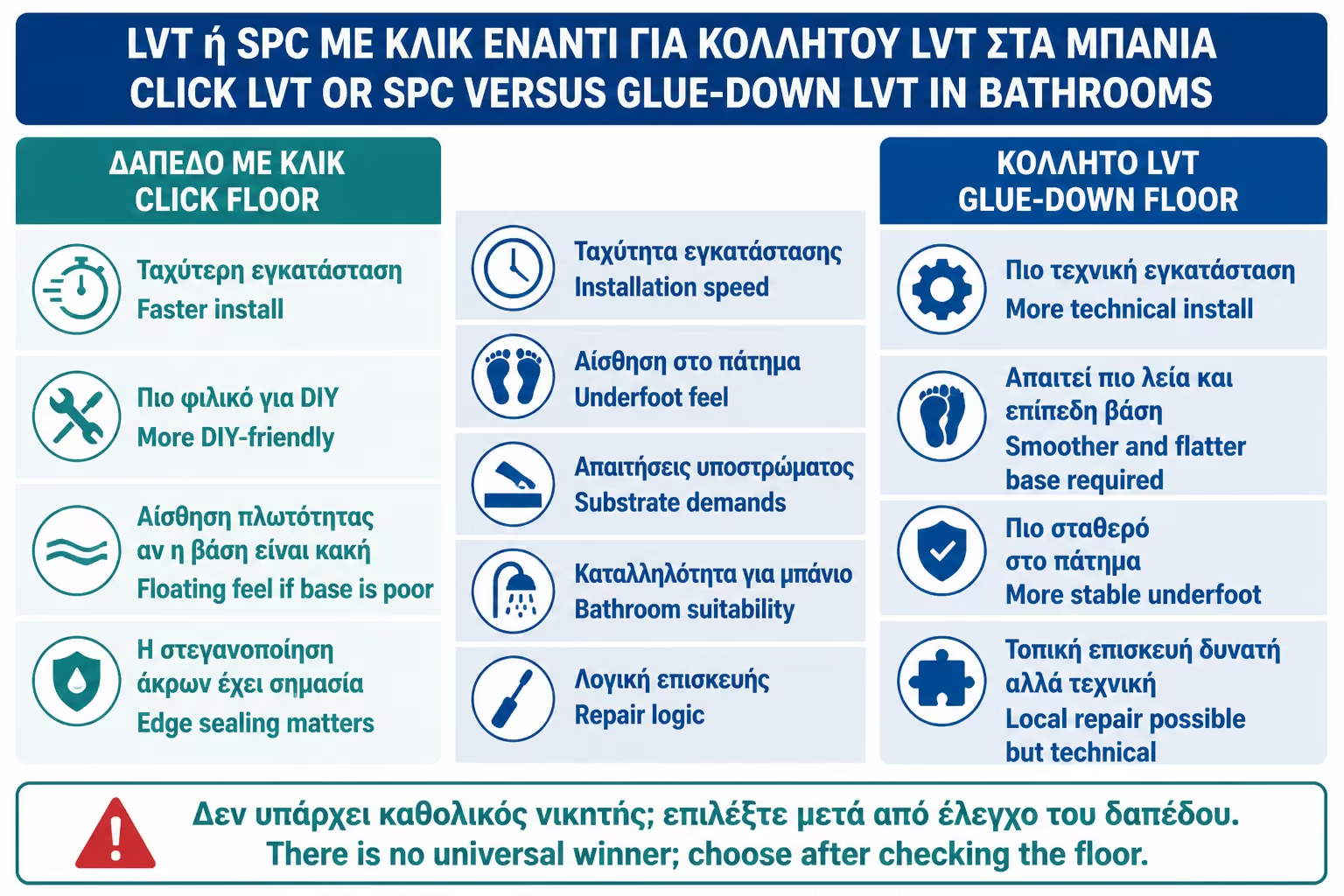
The click-system is more DIY-friendly. The boards snap together and the floor "floats" on the substrate. No glue is needed over the entire surface and installation is faster. It is a good solution for simple rooms, toilets, small bathrooms without many difficult details and renovations where we want a quick application.
Glued LVT is a more professional solution in areas where we want absolute stability. It sticks to the entire surface, does not "play", does not have the same need for expansion perimeter gaps as a floating floor and is often preferred in small wet areas, commercial applications or places with more stress. But much better substrate preparation is needed, because any irregularity can be seen on the final surface.
For a bathroom, many technicians prefer glued LVT when the base can be properly prepared, because the fully glued floor has less movement. On the other hand, SPC click is very popular due to its convenience and rigid core. The choice should be made based on space, not just convenience.
Use the table below as a quick reference for the key points of this section.
| Criterion | Click LVT/SPC | Adhesive LVT |
|---|---|---|
| Place | Faster, more DIY-friendly | More technical, requires glue and a better base |
| Sensation to pressure | It can have a more floaty/hollow feel if the base is not good | More solid and professional feel |
| Substrate | It wants a flat base, but rigid SPC forgives small imperfections better | It needs a very smooth and flat base |
| Bathroom | Conditionally suitable, with perimeter sealing | Often a more stable solution for small wet spaces |
| DIY | Easier for experienced owner | Better than a pro |
| Repair | It can be difficult if boards need to be loosened | Local replacement is possible, but requires technique |
| Labor cost | Usually lower | Usually higher due to preparation |
| Water hazard below | Needs attention to edges and sealing | Smaller if welding and joints are correct |
There is no one option that is always best. Click is faster and friendlier. Sticky is more demanding but often more stable. For a master bathroom with heavy use, the decision should be made after checking the floor.
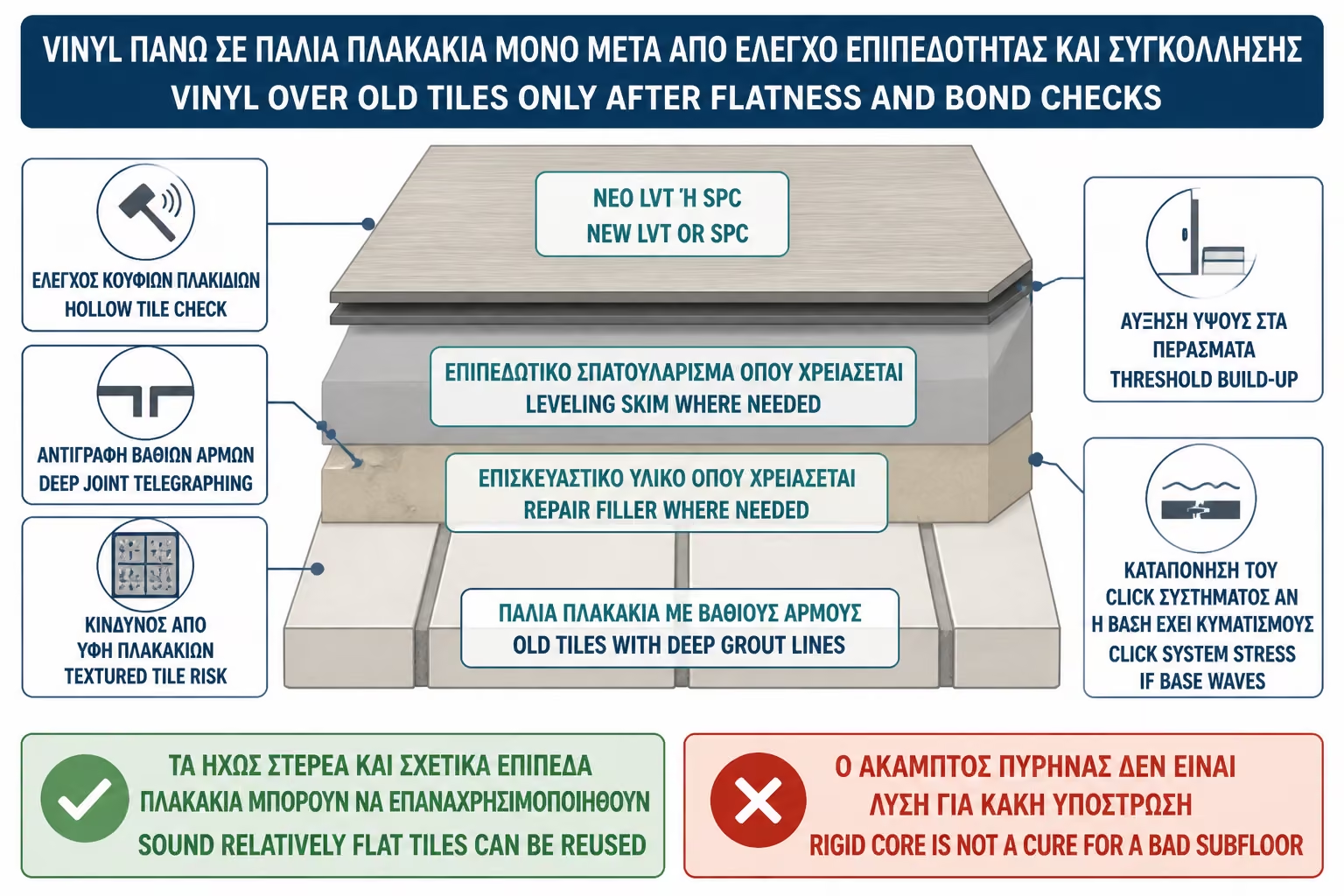
Yes, in many cases they can, and this is one of the main reasons they are chosen for renovations. But the old tiles must be firm, clean, without hollow spots and with acceptable flatness. If there are broken tiles, large "teeth", deep joints or pronounced irregularities, they must be corrected.
In click SPC, the rigid core can go over relatively small irregularities, but it doesn't mean it can go over undulating or problematic floors. If the joints of the old tiles are too deep or the tiles have a strong texture, a sense of irregularity or pressure can be created in the click system over time. In glued LVT, irregularities are even easier to see. Leveling with a suitable self-levelling material or a thin layer of preparation is usually required.
A practical example: if you have an old bathroom with small 20x20 tiles and a relatively flat surface, a good SPC click can be applied with little preparation, as long as there are no hollow spots. However, if you have old embossed tiles with deep joints or cracks, "putting them over" is not the right solution without preparation.
In LVT/SPC, the base is decisive. The floor may be waterproof, but if there is moisture, unevenness or movement underneath, the result will not be correct. The base must be dry, clean, stable and flat. SPC installation guides state that the substrate must be dry, clean and flat, and that dips or bumps must be corrected when they exceed the manufacturer's allowable tolerances.
In a bathroom, it must also be checked for old moisture. If there is a leak or trapped moisture under the old tiles, the new floor will hide it, not solve it. This can create odors, mold or substrate problems. LVT/SPC should not be used as a "cover" over a problem.
The same goes for gradients. LVT/SPC are not flow forming materials. If the bathroom has a floor that holds water, the new floor will also hold water. If there are strong slopes towards the floor siphon, it must be examined whether the click system can work properly. Floating floors prefer flat surfaces, not floors with complex slopes such as showers.
Great care is needed here. LVT/SPC can be great for a bathroom floor, but they are obviously not suitable for the floor inside the shower itself. The shower has continuous water flow, soap, gradients to the siphon and bare foot. The click system is not designed to work as a shower liner with a siphon in the center, unless the manufacturer expressly provides such an application and a special system is in place.
In a bathroom where there is a separate shower cubicle and the LVT/SPC goes outside it, the solution can be very good. But if we are talking about a walk-in wet room where the same floor continues inside the shower area, a very strict technical evaluation is needed. Usually tile, tread, resin or special wet room systems are preferred there.
For the owner, the rule of thumb is simple: another bathroom floor, another shower floor. Do not assume that because SPC is waterproof it can go where water falls from the shower every day, unless the manufacturer specifically says so and the installation system supports it.
In floating click floors, a perimeter expansion gap is left. This is necessary so that the floor can move slightly. In a bathroom, however, this gap is also a possible entrance of water to the substrate. That is why wet area instructions often call for perimeter sealing with permanently elastic silicone or other compatible sealant, without hindering the operation of the floating floor.
This means that edge detail is critical. Around the basin, under the furniture, in the doorway, at the meeting with the shower and around pipes, there must be a proper seal. If water gets under the floor, it may not damage the board, but it can damage the subfloor or create odors.
Silicone should not be accidental. It needs elastic, suitable for bathing, compatible with the material and applied to a clean surface. Bad silicones are among the most common weak points in quick renovations.
LVT/SPC floors can have different surfaces. Some have a textured wood texture, some are smooth, some have a matte finish and some have a glossier surface. In the bathroom, non-slip is a key criterion. Water, soap and bare feet can make even a seemingly safe floor more slippery.
Before choosing, ask for technical specifications. If there is an R-rating or other slip resistance classification, evaluate it. Don't just rely on the floor having a "textured feel". In a bathroom with children or the elderly, the choice should be more conservative.
Also, avoid very shiny surfaces in the bathroom. They may look impressive, but they look easier on the water and may be less practical. A matte or slightly textured LVT/SPC is usually a safer choice.
In a proper renovation, the basin is often removed so that the new floor can go cleanly underneath, or a proper cut and seal can be made. If we try to cut around the basin without removal, the result can look rough and create hard to clean spots.
In a click floor, we must be careful not to "lock" the floating floor with heavy fixed elements in a way that prevents the normal movement of the system. Each manufacturer's instructions vary, but in general, floating floors should not be anchored uncontrollably. In glued LVT, the logic is different because the floor is fully bonded to the base.
Around basins, pipes and furniture, sealing is essential. This point receives water from mopping, splashes and possible small leaks. A bad cut around the basin can become a source of moisture under the floor.
SPC/LVT clicks are among the most DIY-friendly flooring solutions, but that doesn't mean every bathroom is suitable for a beginner. A simple rectangular WC with a flat floor, without many pipes and without a shower, may be possible for a careful owner. A bathroom with a basin, cabin, thresholds, piping, many cuts and the need for a waterproof perimeter seal is more demanding.
The hard part of DIY isn't always the fastening of the boards. It's the details: proper scoring, correct cuts around curves, maintaining expansion gaps, perimeter sealing, thresholds, joints with other floors and a clean fit around the basin. If these are done sloppily, the floor can look cheap or create water problems.
Glued LVT is less DIY-friendly. It needs a perfectly prepared base, the right adhesive, the right open time, roller pressure and precision. For a bath, it is better to have it done by a professional.
Use the table below as a quick reference for the key points of this section.
| Advantage | What it means in practice |
|---|---|
| Waterproof material | LVT/SPC itself does not swell easily with water |
| Hot press | More comfortable than tile, especially barefoot |
| Quick installation | Ideal for renovations with little disturbance |
| Small thickness | It can go over old floors with less height issues |
| Wide variety of designs | Wood, stone, cement, terrazzo, monochrome |
| DIY possibility | The click system is more accessible to owners |
| Disadvantage | What it means in practice |
|---|---|
| It does not waterproof the bathroom by itself | Water can seep through edges and joints |
| It needs a flat base | Irregularities and deep joints of old tiles create problems |
| Be careful in the shower | It is obviously not suitable for a wet room or shower floor |
| Water hazard below | The material holds up, the substrate maybe not |
| Floating feeling on click floors | If the base is not good, it may sound or move |
| Restrictions on heavy fixed elements | Floating floors should not be mistakenly trapped |
The table shows the bottom line: LVT/SPC are extremely practical, but not “no rules”.
In the Greek market of 2026, LVT and SPC floors have a wide price range. Economical ranges can start from around €15–25/sq.m. as a material, while better series with a larger wear layer, better click system, more natural texture and better quality printing often move around €25–45/sq.m. Premium products, special collections, increased anti-slip or very realistic wood/stone textures can cost more.
Installing click SPC/LVT is usually cheaper than installing tiles, especially if the substrate is ready. It can move indicatively around €8–15/sq.m. for simple applications, but in small bathrooms with many cuts, basins, pipes, thresholds and seals it can be priced as a total project. Glued LVT can have a higher cost due to adhesive and base preparation.
Additions must also be calculated: underlay if required, self-leveling material, grout for old tile joints, silicones, trim profiles, thresholds, basin removal/replacement and possible plumbing work. A very cheap offer often does not include these points.
As with tiles, additional material is needed. For simple LVT/SPC installation, around 5–10% fire is usually estimated. In a small bathroom with lots of cuts around basins, pipes and corners, 10% is safer. If the design has a strong direction, such as wood effect boards, we must also pay attention to the direction.
The boxes have specific square. We don't buy exactly 4.6 m2, we buy boxes. It is good to save some boards for future repair. If the order, click profile or shade is changed, the same product may not be found later.
In LVT/SPC, future replacement can be more difficult than it seems. In a click floor, to change a board in the middle, often part of the floor has to be removed. So parts help, but local repair needs a technician.
LVT/SPC is a better choice when we want quick renovation, warmer pressing, less dust, small thickness and friendlier feeling than tile. It is ideal for WCs, bathrooms without a wet room arrangement, floors outside the shower zone, rentals, Airbnb and residences where we want to avoid stripping.
The tile remains a better choice when we have a floor that gets wet systematically, a shower with slopes, high waterproofing requirements, a need for a very long life or areas with hard use and frequent cleaning with strong products. Also, the tile is a safer choice when we want to pass the same material inside the shower.
It is not a matter of "which is better in general". It's a matter of usage. An LVT/SPC can be great for flooring a bathroom with a walk-in shower. But it may be a bad idea for a wet room where the entire floor receives water.
The first mistake is the belief that "waterproof product" means "no need to seal". In the bathroom, edges and joins are critical.
The second mistake is mounting on a bad substrate. If the old tiles are hollow, crooked or with deep joints, they need to be fixed first.
The third mistake is the use of a click floor in a shower or wet room without the express approval of the manufacturer. This is a risk.
The fourth mistake is poor cutting around the basin and piping. These spots are visible and water can pass through.
The fifth mistake is choosing a cheap product with a small wear layer in a daily use bathroom. The floor may look nice at first, but it wears out faster.
Use the table below as a quick reference for the key points of this section.
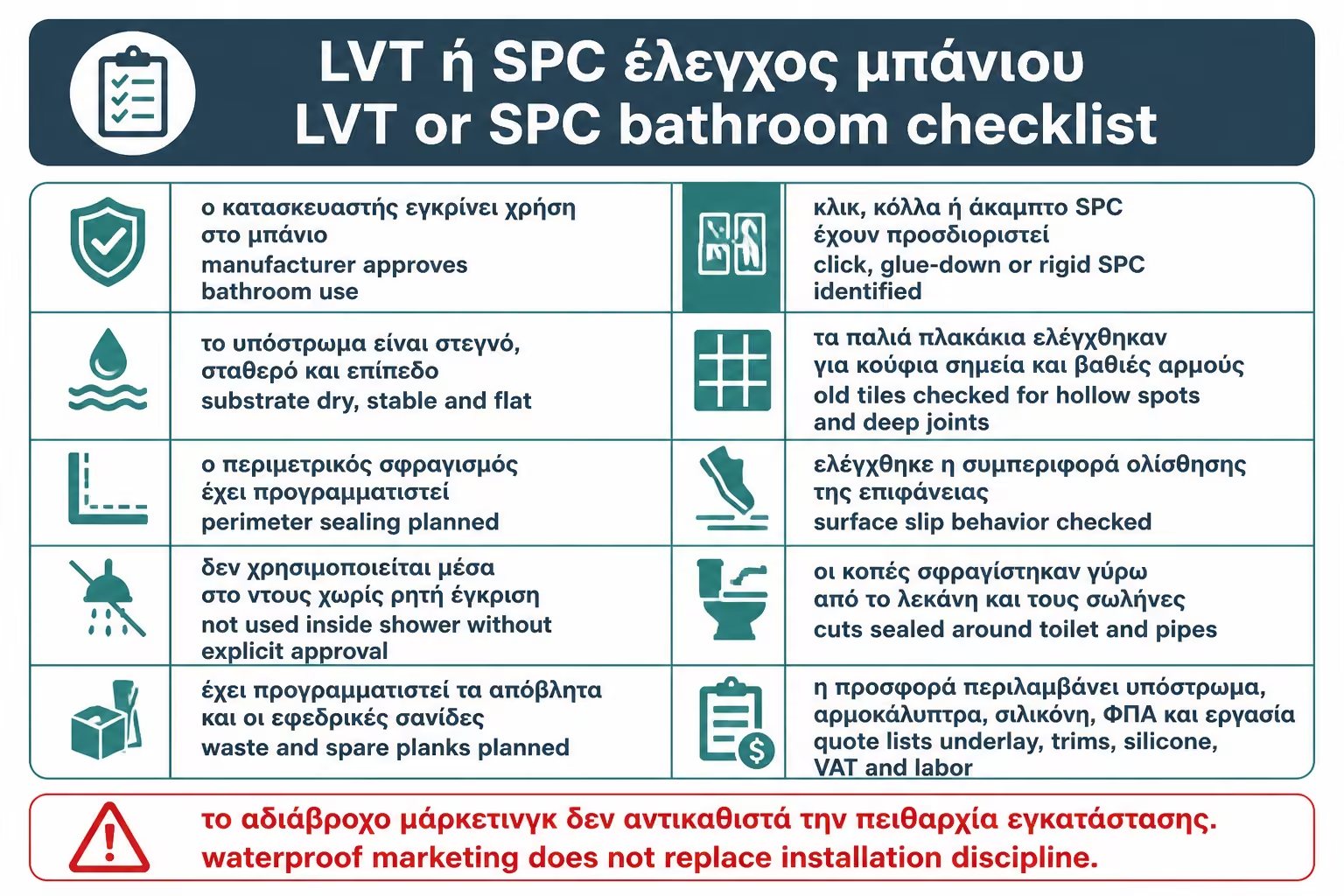
| Question | Yes / No |
|---|---|
| Is the product suitable for bathing according to the manufacturer? | Yes / No |
| Do you know if it is click, glued LVT or rigid SPC? | Yes / No |
| Is the substrate dry, firm and level? | Yes / No |
| If going over old tiles, have hollow spots and deep joints been checked? | Yes / No |
| Is perimeter sealing provided for a wet area? | Yes / No |
| Has the slip resistance of the surface been tested? | Yes / No |
| Will it not be placed inside the shower without the express approval of the manufacturer? | Yes / No |
| Are proper cuts and seals provided around basin and piping? | Yes / No |
| Estimated 5–10% fire and some spare parts? | Yes / No |
| Does the quote include material, underlay, profile, silicones, VAT and labour? | Yes / No |
If there are many unclear answers, don't proceed just because the product says “waterproof”. In the bathroom, the installation is just as important as the material.
If you want LVT or SPC in the bathroom, keep the basic distinction: the product may be 100% waterproof as a material, but the installation is not automatically 100% watertight. Ask for a product suitable for the bathroom, check the substrate, seal the perimeter properly and avoid placing in the shower unless expressly permitted by the manufacturer. For a bathroom with a walk-in shower, SPC/LVT can be a great, warm and quick solution. For wet room or shower floor, another technical seriousness is needed.
Modern LVT and SPC floors are one of the most practical solutions for a quick bathroom renovation. They are warm to the touch, more comfortable than tile, available in many finishes and can be installed quickly, often even over old tiles. For WCs, small bathrooms, floors outside the shower zone and homes where we want low noise, they can be an excellent choice.
But the word "waterproof" needs a correct interpretation. LVT or SPC itself may not absorb water, but water should not seep under the floor. That is why the substrate, the perimeter sealing, the cuts around the basin and piping, the anti-slip properties and the adherence to the manufacturer's instructions count. The floor may be DIY-friendly, but the bathroom as a wet space does not forgive sloppy details.
The best use of LVT/SPC in the bathroom is as a quick, comfortable and beautiful floor covering in areas that do not function as a single shower. If you want to cover up old tiles and instantly change the feel of the space, it's seriously worth considering. But if you want a solution for a floor that accepts continuous water, slopes and a siphon, you have to move with stricter specifications or choose another system.
Return to category.
Go to categoryReturn to the central guide.
Go to guide