
Bathroom Surface Materials & Finishes
Return to category.
Go to categoryAnti-slip is one of those technical features that many owners pay attention to only after a problem has arisen. At the tile show, attention usually falls on color, dimension, whether the tile is granite, whether it looks like marble or cement, and of course, price. But in the bathroom, in the kitchen, on the balcony and especially in the shower, the most beautiful tile can turn out to be the wrong choice if it slips when wet.
The problem is exacerbated because the terms R9, R10, R11, R12 are often used as mere trade labels. The customer hears "it's non-slip" and thinks it's safe for every use. In reality, however, the R index does not generally mean “bathroom non-slip”. It comes from a specific test, in specific conditions, and mainly concerns surfaces on which someone walks with shoes. For areas where we walk barefoot and there is water, such as showers, changing rooms or swimming pool environments, there is another classification: categories A, B and C for wet areas with bare feet. These tests are now integrated into the European framework EN 16165, which gathers methods for evaluating the slipperiness of pedestrian surfaces.
That is why the question "what is the mandatory index for the bathroom?" needs attention For a private residential bathroom in Greece, there is no simple general rule like "the law requires R10" or "the shower must be R11" that is automatically applied in every case. But there are technical specifications, European test standards, safety requirements in public/business areas and practical selection rules that a serious technician should not ignore.
In practice, for a typical residential bathroom floor, a reasonable safe base is to look at at least R10, not R9, especially if the floor gets wet frequently. For the shower area, particularly in walk-in showers, built-in showers or floors sloping towards a linear drain, R11 is often preferred and, even better, barefoot class A/B/C should also be checked, with a practical preference for B or C depending on water exposure, slope and use. It's not an exaggeration. It's a matter of real conditions: bare feet, soap, water, an incline and a small space where a slip can become a serious accident.
This guide explains in simple but technically correct terms what the R9, R10 and R11 indicators mean, where they are used, where they are misunderstood, what to look for before buying tiles and how to avoid the common mistake: choosing a tile that is “non-slip” on paper, but unsuitable for the actual use of your bathroom.
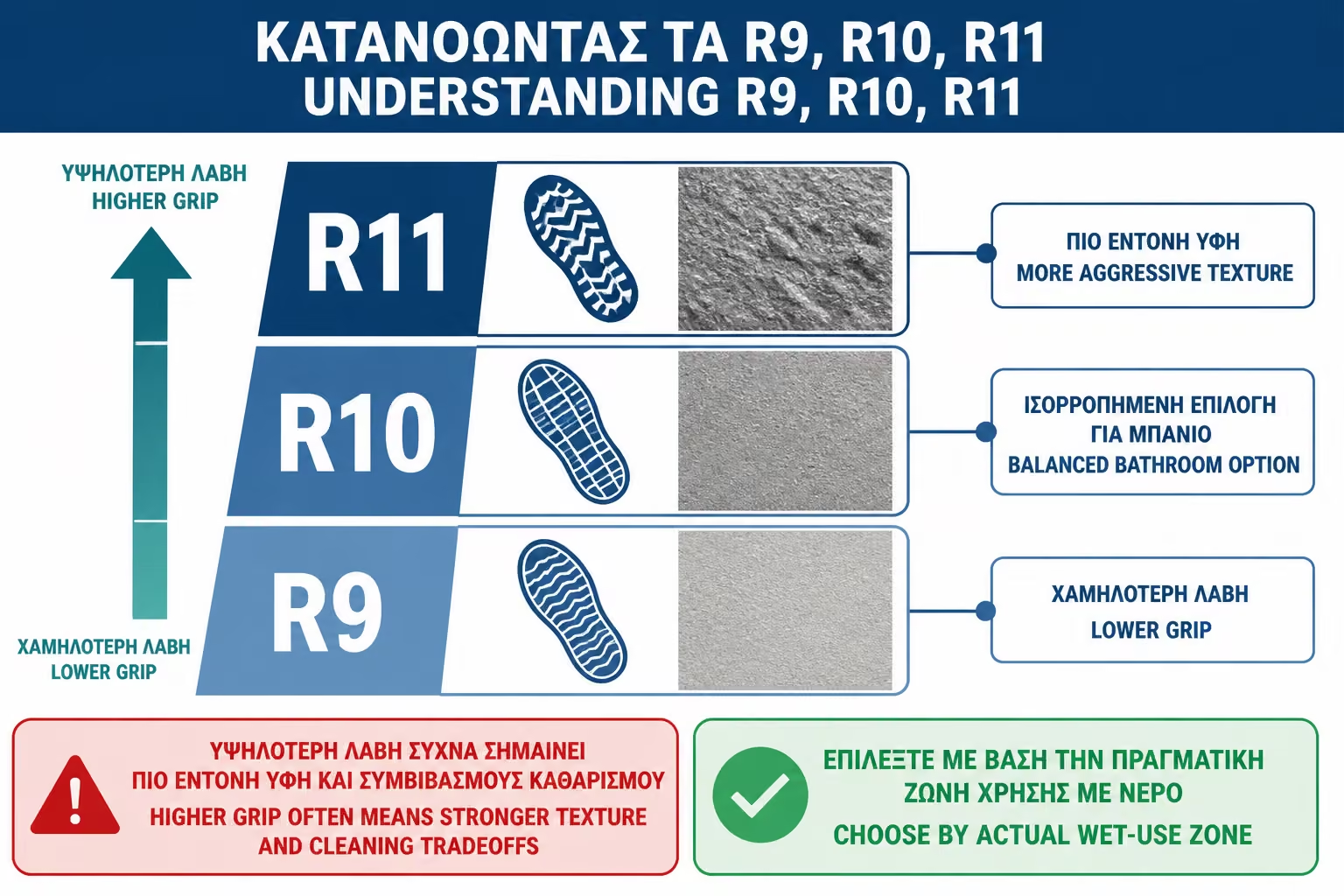
R-Indices are anti-slip classification derived from an inclined ramp test. In the classic German DIN 51130 method, a tester walks on a ramped surface, wearing special footwear, while the surface is lubricated with oil. The ramp gradually increases in slope and the point at which the slide begins determines the R class. The scale goes from R9 to R13, with R9 being the lowest class in this classification and R13 the highest.
Simply put, the higher the number after R, the greater the surface's resistance to sliding in that particular test. This, however, does not mean that the higher the R the better for every space. An R12 or R13 can be too rough for an indoor bathroom, difficult to clean and unpleasant to bare feet. Accordingly, an R9 may be sufficient for a dry interior, but insufficient for a bathroom floor that gets wet every day.
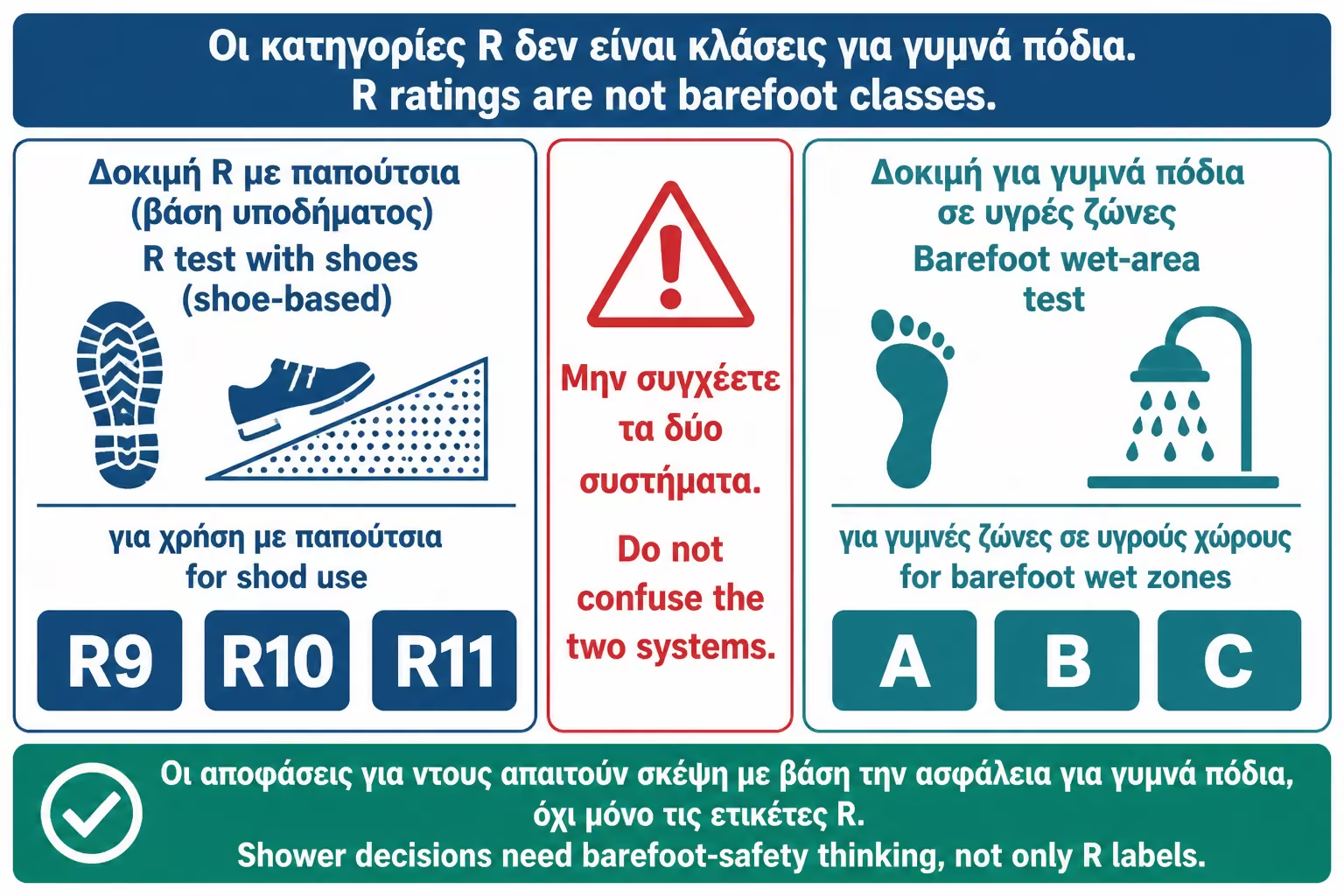
The critical point is that the R test is mostly about walking in shoes. This means that it is very useful for kitchens, corridors, business areas, entrances, balconies and generally surfaces where we usually step on shoes. In the bathroom, however, especially in the shower, the use is different. We often walk there barefoot, with soap and water. So the R index helps, but it doesn't tell the whole story.
R indices correspond to angle range in the ramp test. They usually present as follows:
Before you review the table, keep the following points in mind:
| Indicator | Indicative slip angle | Practical interpretation |
|---|---|---|
| R9 | about 6°–10° | Low slip resistance for dry indoor spaces |
| R10 | about 10°–19° | Moderate slip resistance, often suitable for indoor spaces that may occasionally get wet |
| R11 | about 19°–27° | Increased slip resistance, often preferred for wet zones, outdoor floors and more demanding applications |
| R12 | about 27°–35° | High anti-slip for areas with intense moisture, grease or safety requirements |
| R13 | above about 35° | Very high slip resistance for special professional/industrial applications |
The above ranges are the practical basis that the tile market works with when referring to R-ratings. The German DIN 51130 method uses the ramp test and classifies surfaces into categories R9–R13 depending on the angle at which sliding begins.
For the owner, the translation is simpler. R9 is the minimum level of this scale and should not be considered a safe choice for areas that get wet regularly. R10 is a common choice for bathroom floors, kitchens and interiors where water may be present, but not continuous wet use. R11 is a safer choice for showers, balconies, external stairs, entrances and areas where water is frequent or a slope increases the risk.
R9 sounds “anti-slip” because it has an R index. But in practice it is the lowest class of this classification. This means that it may be suitable for dry interiors, but it is not the choice one would recommend as a base for a bathroom floor that gets wet frequently.
A glossy or slightly satin R9 tile can look very beautiful in a modern bathroom. In the first days the owner may be completely satisfied. The problem occurs in use: when stepping out of the shower with wet feet, when there is soap on the floor, when a child runs into the bathroom, or when an elderly person steps on a wet spot without slippers.
In a dry guest WC, where there is no shower and the floor rarely gets wet, an R9 may be acceptable as long as the tile itself is suitable for flooring. In a master bathroom, however, especially if there's a tub or shower without a full-water enclosure, the R9 is usually a riskier choice.
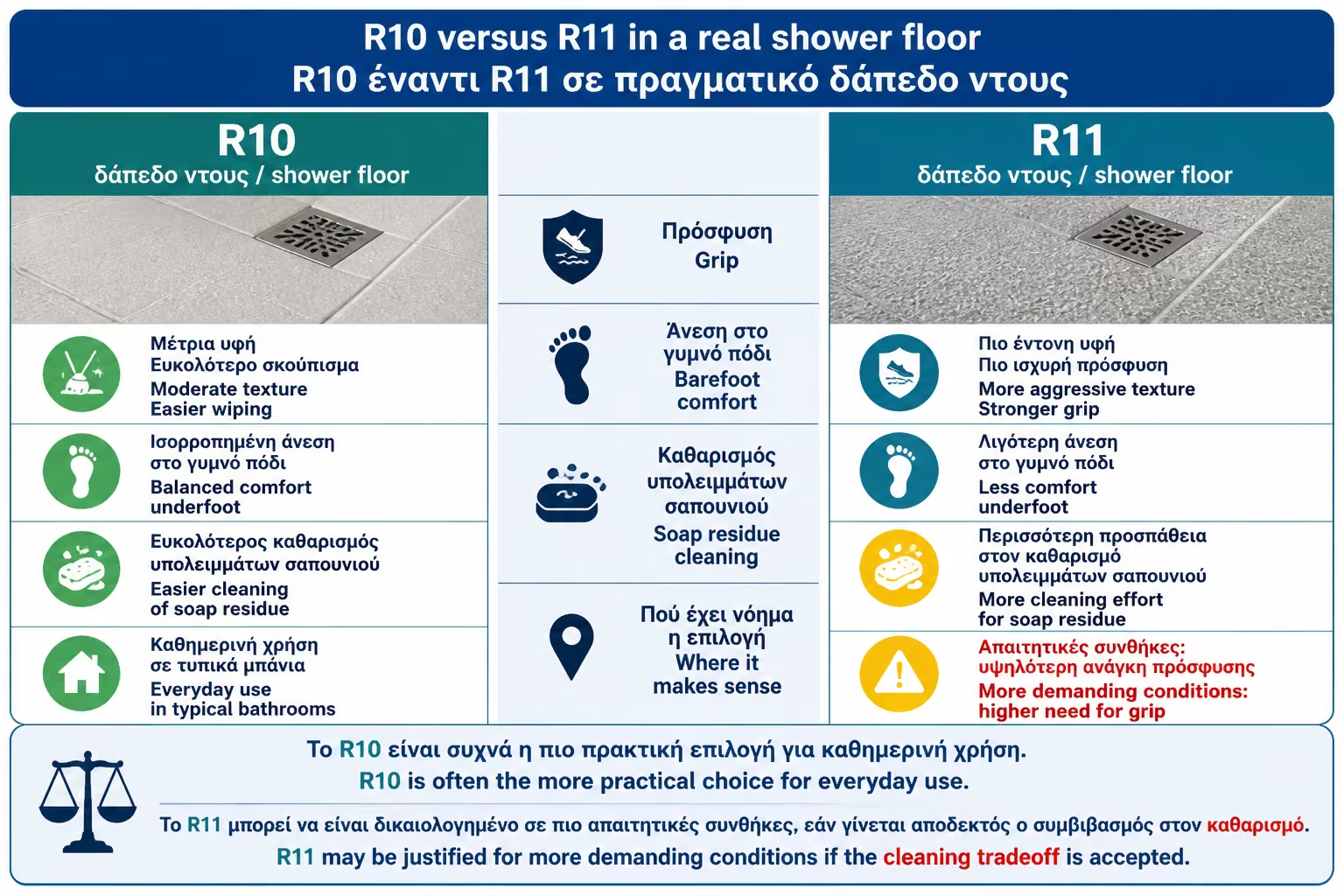
For the floor of a typical residential bathroom, R10 is often the most balanced choice. It gives better slip resistance than R9 without necessarily becoming rough or difficult to clean. It is a reasonable base for floors where water may be present, but there is no continuous flow of water across the surface.
This is not to say that every R10 is the same. The feel of the surface, the microtexture, whether it is matte or embossed, the dimension of the tile and the joint play a big role. Two tiles with the same R10 index may have different behavior on bare feet or cleaning. A slightly embossed R10 can be very practical, while a more "closed" satin R10 can be easier to clean but less safe in soapy water.
In a bathroom with children, the elderly or a person with reduced mobility, it is worth thinking more conservatively. That's where the R10 might be the minimum starting point, but not always the final answer. If the shower is integral with the rest of the floor or if there is a walk-in design, the shower area must be considered separately.
R11 offers increased slip resistance and is often used in areas where water is more frequent or use is more demanding. For outdoor floors, balconies, patios, outdoor stairs and entrances, R11 is often a safer choice than R10, especially if the area gets wet from rain or is frequently washed.
In the shower, the R11 is also a practical choice, particularly when talking about a built-in shower with a tiled floor. There we have a bare foot, water, soap, a slope to a drain and a small surface where the user turns or steps at different angles. If a linear drain is added, the slopes must be properly designed so that the water can escape without creating dangerous points.
The R11, of course, isn't always comfortable or easy to clean. The stronger the texture, the longer it can hold soaps, salts and dirt. In areas with hard water, such as many areas of Greece, this is quickly apparent. That is why the choice should not be made only on the basis of the number. We must also look at the texture, color, cleaning method and use.
The bathroom is a special case because we don't always walk in shoes. The classic R classification, as used in the DIN 51130 test, concerns surfaces where the tester wears footwear. For wet areas where people walk barefoot, there is a separate approach with categories A, B and C, derived from the DIN 51097 method and now linked to the European framework EN 16165.
This is of enormous practical importance. A tile may have a good R-rating for use with shoes, but not ideal for a bare foot in a soapy water. Conversely, a material may be designed for wet barefoot areas and give a better sense of safety in the shower.
Categories A, B and C are used for areas where there is wet use with bare feet. Class A is the lowest, B more demanding and C the highest. On a practical level, for simple wet zones A or B may be requested, while for more demanding zones with water, slopes or a pool environment, C is a safer category. For a residential shower, it's wise to not just look at the R, but also ask for a barefoot wet area rating when the manufacturer has one.
Here a clear answer without exaggerations is needed. For an ordinary private residential bathroom in Greece, there is no single, simple and universal rule that says "the bathroom floor must be R10" or "the shower must be R11" in every case. R indices are technical test classifications, not in themselves a general Greek law for every private bathroom.
This does not mean that the owner can ignore the anti-slip. It means that it should be seen as a technical safety requirement and not just a formal compliance. In public spaces, commercial buildings, hotels, healthcare facilities, communal facilities, swimming pools or accessible WCs, there may be specific project specifications, design requirements, safety regulations or insurance requirements. There the index should not be chosen casually, but defined by an engineer or competent designer.
For residence, practical recommendation is more useful than a false certainty:
Before you review the table, keep the following points in mind:
| Space | Practical minimum recommendation | Best choice when there is frequent water |
|---|---|---|
| Dry WC without shower | R9 may be acceptable if the tile is floor | R10 for greater safety |
| Standard bathroom floor | R10 as a logical basis | R10 with a good matte/satin texture or R11 if it gets wet often |
| Area outside shower/tub | At least R10 | R10–R11 depending on use |
| Built-in tiled shower | R11 as a safer practical option | R11 together with suitable barefoot category B or C |
| Walk-in shower / wet area without clear separation | R11 | R11 and barefoot control B/C |
| Outside balcony or staircase | R10–R11 depending on exposure | R11 or higher where there is rain, slope or increased risk |
So, if a clear practical direction for the owner is to be given: do not choose R9 for a master bathroom floor that gets wet frequently. Consider R10 as a reasonable base for flooring and R11 as a preferred choice for tiled showers, walk-in solutions and areas with constant water contact. For the shower, ask for additional information on barefoot wet classification, not just R-rating.
Anti-slip is usually achieved by micro-roughness or textured surface. This texture helps the foot or shoe to "grip" better, but at the same time it can hold salts, soaps, dirt and cleaning residues. This is especially noticeable in showers and outdoor areas.
A homeowner may choose a very rough tile for the shower, believing that this will provide maximum safety. After a few months, however, you may find that the tile whitens from salts, retains soaps and needs more frequent scrubbing. If the color is dark, the salts are even more visible.
This does not mean that we should avoid non-slip tiles. It means we have to find a balance. In a family bathroom, a good R10 on the main floor and a neat R11 or barefoot suitable tile in the shower may be a better solution than putting a very rough surface everywhere. Safety must be combined with maintenance.
Yes, it does affect her, but not in the way many think. The R index refers to the surface of the tile, but in the real floor there are also joints. Joints create small breaks in the surface and can aid adhesion, especially in small dimensions or mosaics.
That is why we often see smaller tiles or mosaics on shower floors. It's not just an aesthetic choice. They help create proper slopes to the drain and offer more joint lines. In a built-in shower with a central spout, a large tile can make the slopes very difficult. If it is installed incorrectly, it can create spots where water pools.
On the other hand, very small tiles have more joints, so more maintenance. They want good grout, proper application and cleaning. The choice should be made based on the shower system, trap location, slopes and use, not just whether the tile is R10 or R11.
In general, the glossier and smoother a surface is, the more care is needed in areas with water. A glossy tile may be great on a bathroom wall, but not the best choice for a floor. In the exhibition, the glossy floor looks luxurious and bright. At home, however, with water, soap and footprints, it can become practically difficult.
Matte and satin tiles are usually more balanced for bathroom floors. Not all of them are slip resistant, but they offer a better base than a very shiny material. Embossed tiles give a greater sense of grip, but require more cleaning.
For walls, slipperiness is not a major issue. A glossy or smooth surface can be used there without the same risk. That is why many times the correct solution is a different tile on the wall and a different one on the floor, even if they belong to the same series. Many companies offer the same aesthetic in a wall version and in a non-slip floor version.
In bathrooms used by the elderly, small children or people with limited mobility, anti-slip should be treated as a key safety feature. A slip in such a space is not a simple nuisance. It can lead to serious injury.
In these cases, it makes no sense to look for the absolute minimum that "passes". We must choose more conservatively. The bathroom floor should start at R10 with a really practical texture, while the shower should be seriously considered with R11 and a suitable barefoot classification. Correct slopes, stable cabin or partition, handrails where necessary and avoidance of sharp height differences must also be provided.
A common mistake is to emphasize only the tile and ignore the rest. If the shower is at the wrong angle, if the water is leaking out, if there is not a sufficient entry opening or if the bath mat slides on the floor, then even a good tile is not enough.
R-Indices are very important outdoors. On a balcony, roof, yard or outdoor staircase, the tile receives rain, dust, mud, leaves, sun and temperature changes. Here the R10 may be sufficient on a sheltered balcony with little exposure, but on a staircase, ramp or bare floor, the R11 is often a wiser choice.
The subject of inclination is critical. A floor with a slight slope that holds water becomes more dangerous than a floor that dries quickly. If there are steps, the edge of the step must be properly shaped. It is not enough that the tile says R11 on the box. The detail of placement can determine safety.
In outdoor areas we must also pay attention to maintenance. Very rough surfaces can hold dirt and greens. If the area is not cleaned often or has shade and moisture, the slipperiness can be increased by biological residues, not by the tile itself. That is, a good tile can become dangerous if it remains dirty or if it holds water.
In the bathroom and especially in the shower, slopes are just as important as the tile. If the water does not drain properly, the surface stays wet longer. The more water remains on the floor, the greater the risk of slipping, even with a good non-slip tile.
In a walk-in shower, for example, the owner may choose R11 tile but have the wrong slope for the linear spout. The result is water that goes out towards the bathroom or pools at the edges. There the problem is not solved only with a better tile. It needs proper floor design, drain in the right place, correct height difference and careful placement.
The same applies to balconies. If the floor has a "belly" and holds water, the tile will be tested daily. Anti-slip reduces the risk, but does not correct construction failures.
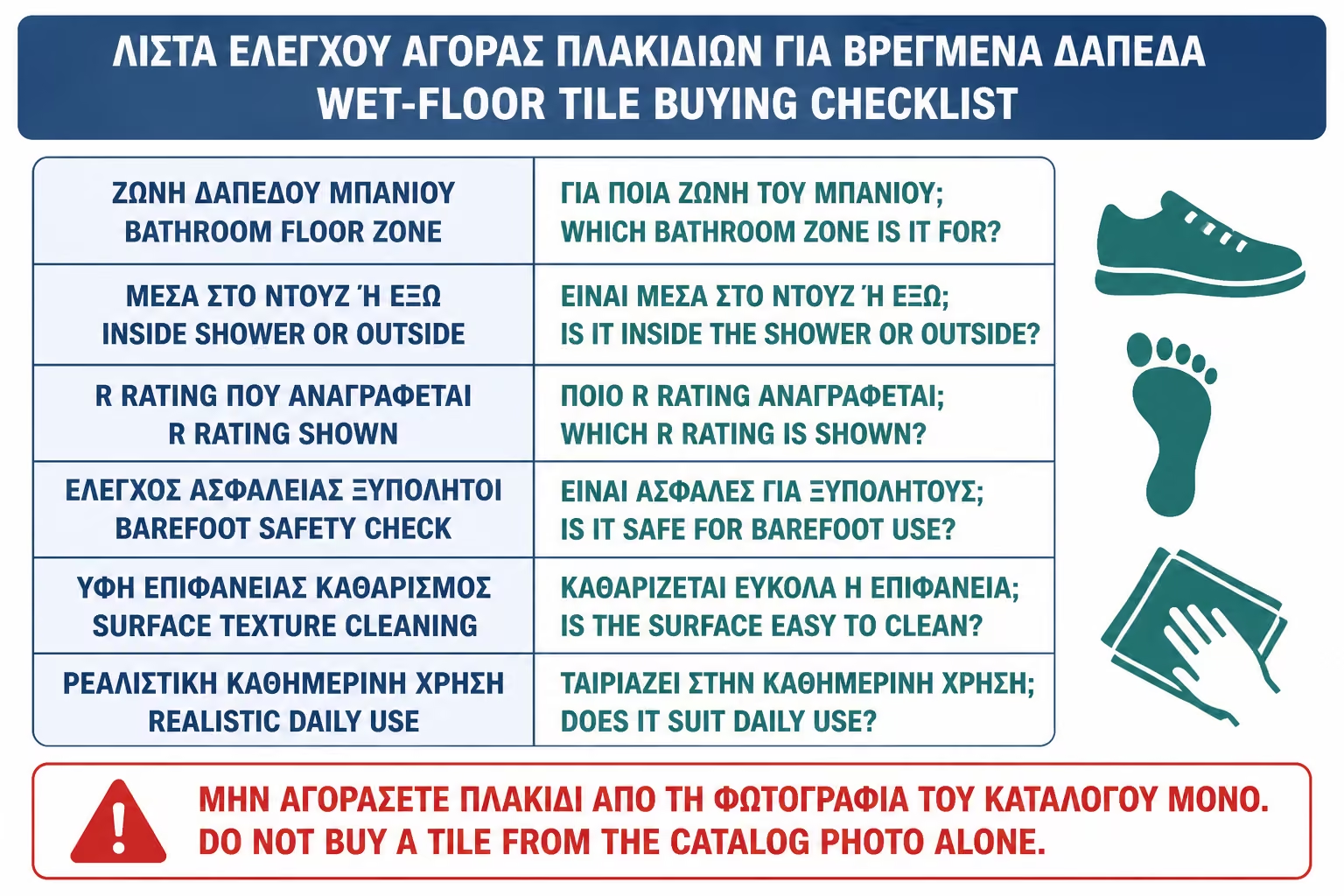
When choosing tiles for a bathroom floor or shower, don't stop at the phrase "it's non-slip". Ask for a specific index. Ask if the R is for a shoe test, if there is an A/B/C barefoot classification, if the tile is suitable for flooring, if it is recommended for a shower and if there is a technical brochure.
In serious selection, especially for projects with safety requirements, it is advisable to request a technical product data sheet or test certificate. There is no need for the owner to become a materials engineer. But it needs not to rely only on verbal assurance.
In practice, the key questions are:
These questions often catch the wrong market. If the supplier cannot answer clearly, it does not necessarily mean that the product is bad. But it does mean that it needs more testing before it goes into the bathroom.
Slip resistance can affect the price, but it is not always the main factor. Dimension, brand, whether it is porcelain, surface, country of origin, availability and series play a big role. In the Greece of 2026, a simple bathroom floor with decent R10 porcelain can be found at reasonable mid-range prices, without necessarily needing a premium option.
For a practical picture, budget and medium floor tiles can range from around €15–35/m², while special series, large dimensions, branded anti-slip porcelain or special textures can go quite a bit higher. Installation costs depend on the dimensions, cuts, substrate, slopes and whether it is a simple floor or a shower.
In the works, a simple laying on an easy surface can be found in low offers from around €6–8/m2, but a more realistic basis for typical proper residential work is often around €10–15/m2. In shower, large dimensions, many cuts, linear drain, slopes or difficult substrate, the price can go up. This makes sense when the work requires more precision.
The important thing is not to save a few euros on the tile and create a permanent security problem. In a small bathroom, the cost difference between an inappropriate R9 and a correct R10 or R11 can be small in the overall renovation budget, but large in use.
The first mistake is choosing based on appearance. The owner sees a glossy tile, likes the luxury it gives and chooses it for a bathroom floor. But in everyday life, when water falls, the surface becomes more dangerous.
The second mistake is the generic phrase “non-slip” without an index. Many products are marketed as anti-slip, but not all have the same behavior. Another R9, another R10, another R11, and another barefoot B or C.
The third mistake is to use the same tile everywhere without technical control. It can be nice to continue the same pattern from the wall to the floor to the shower, but it's not always right. The wall does not have the same requirements as the floor. The shower does not have the same requirements as the rest of the bathroom.
The fourth mistake is to ignore cleaning. A tile that is too rough can be safe but tedious to maintain. If not cleaned properly, it can retain soaps and salts, and eventually lose some of its practical behavior.
Before you review the table, keep the following points in mind:
| Question | Yes / No |
|---|---|
| Have you confirmed that the tile is suitable for flooring? | Yes / No |
| Do you know the actual R-Index and not just that it is “anti-skid”? | Yes / No |
| For a master bathroom floor have you avoided R9 as a base choice? | Yes / No |
| For a tiled shower have you considered R11 or a suitable barefoot classification? | Yes / No |
| Have you asked if there is an A/B/C class for barefoot use? | Yes / No |
| Has it been checked whether the texture is easily cleaned from salts and soaps? | Yes / No |
| Has the craftsman seen the tile before purchase, especially if it is going into a shower? | Yes / No |
| Have the slopes to the drain been studied? | Yes / No |
| Have you avoided a very shiny surface in a wet zone? | Yes / No |
| Is there a technical brochure or clear specification from the supplier? | Yes / No |
If the answers are unclear, it is best to delay the purchase until they are clear. The tile is not an object that is easily changed after installation. A mistake in anti-slip will be experienced daily.
If you have to keep only one thing, keep this: in the bathroom don't just ask "is it non-slip?". Ask “what R-value is it, is it suitable for flooring, and is it rated for bare feet in a wet area?”. For a typical bathroom floor, R10 is a reasonable practical base. For a built-in shower or walk-in solution, look seriously at R11 and, where available, barefoot class B or C. And don't forget: even the right tile won't save you wrong slopes, poor drainage or sloppy installation.
Slip resistance indicators R9, R10 and R11 are a useful tool, but must be interpreted correctly. R9 is not “safe for all” because it has an R index. It is the lowest category of this classification and is mainly suitable for dry indoor spaces. R10 is a practical base for residential bathroom floors, while R11 is a more suitable choice for showers, walk-in solutions, outdoor spaces and areas with frequent water.
The most important thing is not to look at slip resistance in isolation. Actual safety depends on the tile, texture, slopes, faucet, cleaning, use of the space and who will be using the bathroom. In areas with children, the elderly or people with reduced mobility, the choice must be made even more carefully.
For private residences in Greece, do not look for a simplified "mandatory" answer that applies to all. Ask for technical data, choose based on actual use and avoid excessively smooth surfaces in wet zones. A properly chosen tile is not only a matter of appearance. It's a matter of everyday safety.
Return to category.
Go to categoryReturn to the central guide.
Go to guide