
Bathroom Surface Materials & Finishes
Return to category.
Go to categoryWhen a homeowner walks into a tile showroom, they often hear two terms used almost as if they mean the same thing: "ceramic" and "porcelain tile." In practice, however, they are not the same thing. And this difference is not only about price or appearance. It concerns how much water the material absorbs, how much it withstands wear and tear, whether it is suitable for flooring, whether it can be used outdoors, how difficult it is to cut and what requirements it has for installation.
The problem is that in the market the terms are often used loosely. Someone says "granite" meaning any hard floor tile, another says "ceramic" just meaning something more economical, while in several cases the customer chooses based on the design only. A buyer may choose a beautiful wall tile and imagine it will work just as well on the floor, or choose a glossy porcelain for a bathroom without thinking about slip resistance.
The right choice is not always "get a porcelain tile because it's better". This is an oversimplification. Porcelain does have very low absorbency and high density, but it is not always the most practical or economical choice for every surface. On a bathroom wall, for example, a good ceramic tile can be perfectly adequate, lighter, easier to cut and more economical. In a heavy-use floor, on a balcony or in a ground floor shop, porcelain tiles usually have a clear technical advantage.
What the owner must understand is that the tile is not only evaluated as a decorative material. It is a technical surface. We step on it, wet it, clean it with chemicals, hit it with objects, expose it to water vapor, temperature changes and daily stress. That's why the choice should be made based on use, not just on the basis of shade or fashion.
In this guide we will see what porcelain really means, why it has almost zero absorbency, where it excels over standard ceramic tiles, where it is not necessarily needed, what to look out for on floors and walls, and what mistakes lead to unnecessary costs or poor application.
The term "ceramic tile" is general. It describes tiles made from clay materials, minerals and other natural ingredients, which are shaped, dried and fired in an oven. Depending on the composition, the firing temperature, the pressure during production and the type of surface, different classes of tiles result.
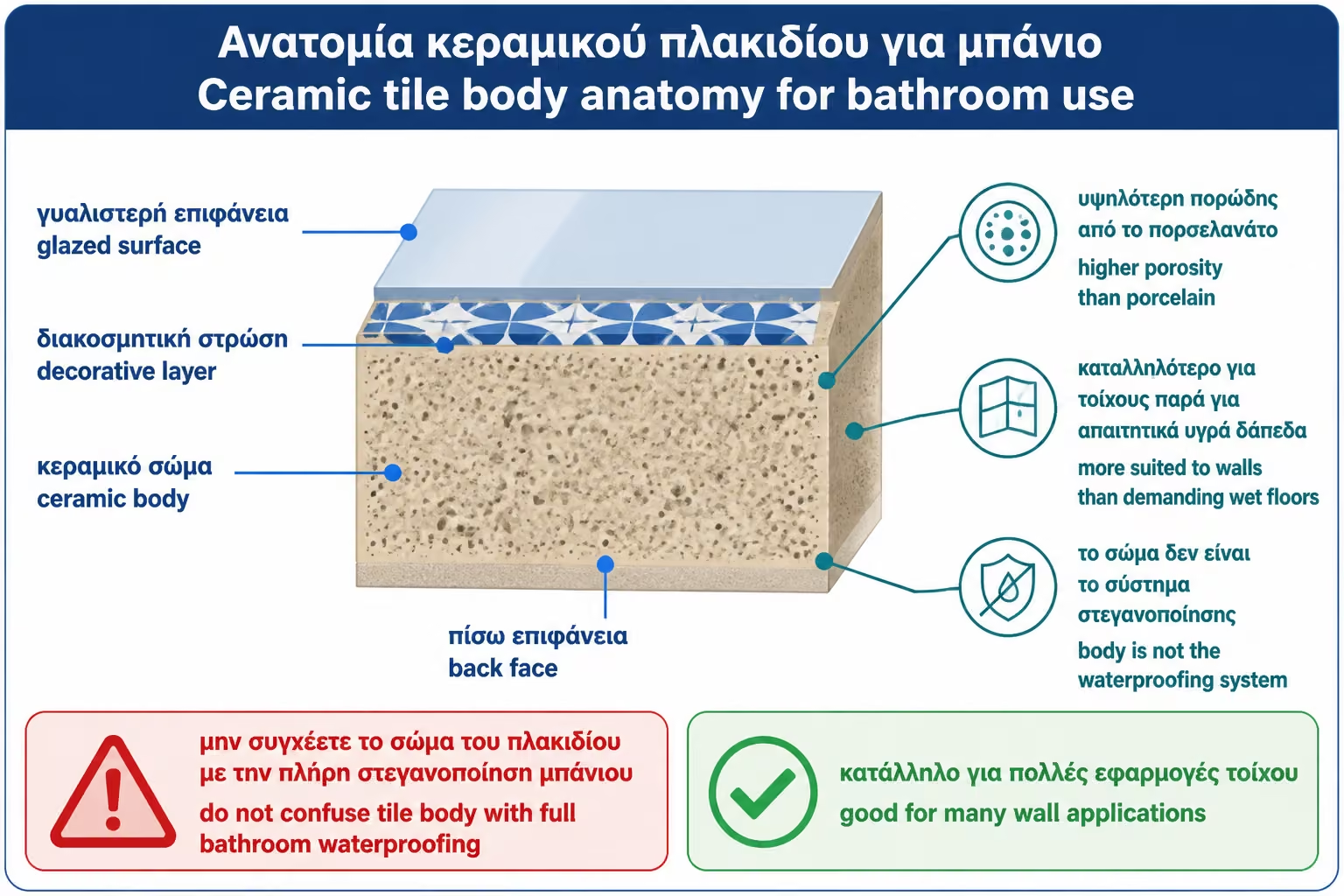
In the everyday market, when someone says "ceramic", they usually mean a more traditional tile, often glazed, used mainly on walls or light-use indoor floors. These tiles usually have a more porous body than porcelain. That is, their inner material can absorb more water if exposed directly, especially from the back or edges.
This does not mean that they are "bad" tiles. A good ceramic wall tile can perform well in a bathroom for many years, as long as it is installed correctly and the surface remains protected from glazing. The problem starts when it is used in a place it was not designed for. A wall tile should not be treated like a floor tile because it just "looks solid" in the hand.
A typical example is the small WC where the owner wants a single design on the wall and floor. If the tile is only for a wall, it may look beautiful vertically, but not have the required mechanical strength or non-slip resistance for a floor. The result may not be seen in the first week. It will show later, with scratches, polishes, wear or breaks in corners.
In the Greek market, the term "granitoplakaki" is still widely used, but technically we are talking about porcelain tile. It is not natural granite cut from stone. It is a high-density industrial ceramic product, made with selected raw materials, strong compression, and high-temperature firing.
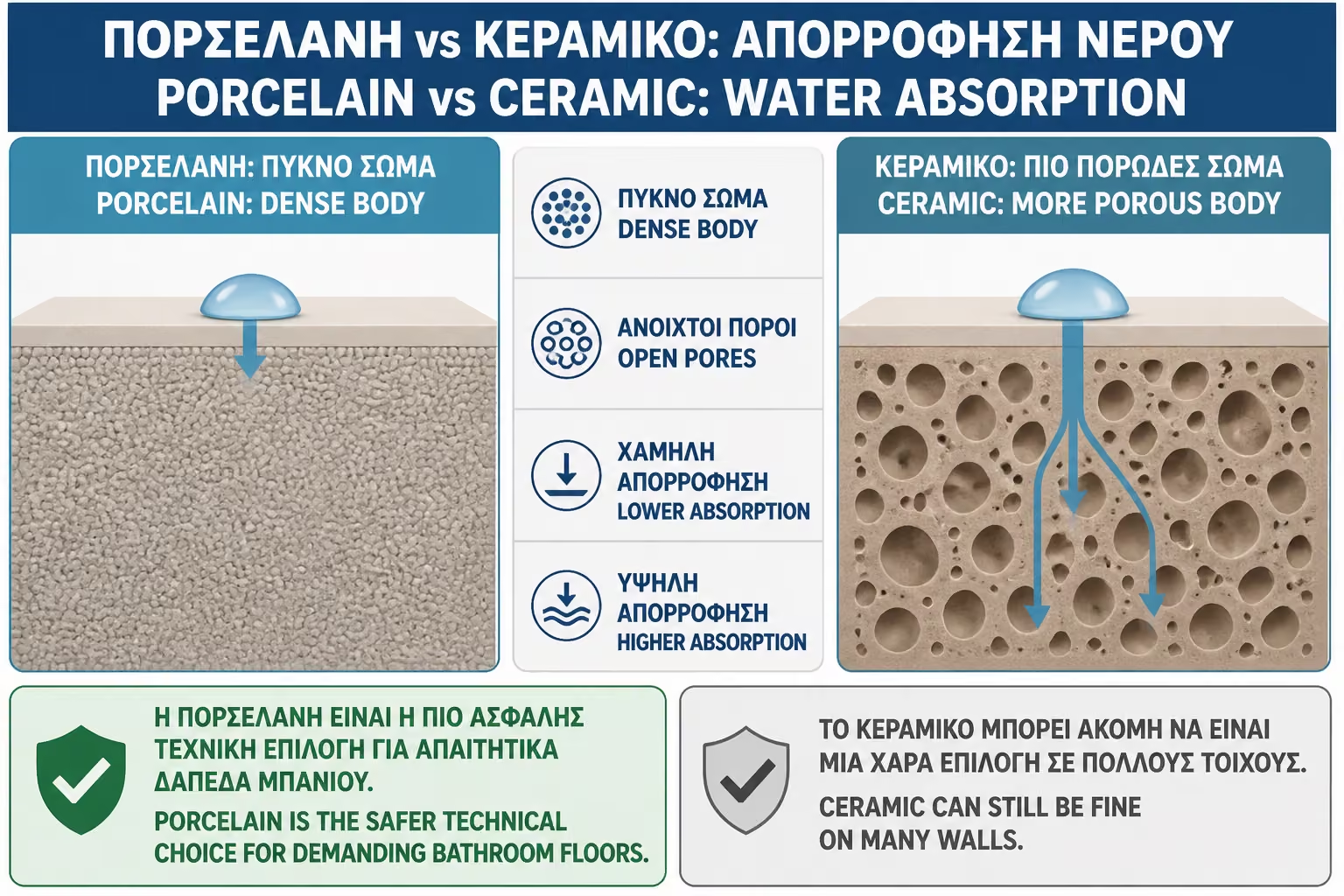
The big difference is in the body of the tile. Porcelain is more compact, less porous and much more difficult to absorb water. According to the international classification, dry pressed porcelain tiles are usually included in the BIa group, i.e. tiles with a water absorption of up to 0.5%. Accordingly, American standard ANSI A137.1 defines porcelain as ceramic tile with an absorbency of 0.5% or less when tested by the corresponding ASTM C373 method.
That 0.5% is very important. It does not mean that the tile is "magically waterproof" throughout the system. It means that the body of the tile itself absorbs minimal water. Water, however, can still get through joints, bad silicone, incorrect slopes, cracks or insufficient waterproofing under the tiles. That is why it is wrong to say that "I installed porcelain, so there is no need for waterproofing". The tile is only one part of the system.
Porcelain can be glazed, full body, through body, matte, glossy, non-slip, imitating marble, cement, stone or wood. Not all porcelain has the same surface resistance, nor are all ceramics the same. That is why the choice must be based on the technical characteristics of the specific product and not only on the "porcelain" label.
The low absorbency of porcelain results from its production method. The raw materials are ground very finely, pressed strongly and fired at high temperatures so that the body of the tile becomes very dense. During firing, the material vitrifies to a significant extent. Simply put, the pores are reduced and water has a hard time getting inside.
In more porous ceramic tiles, the body has a greater ability to absorb. If such a tile is cut and we see its edge, it often looks more "earthy", lighter in color and more absorbent. In contrast, a porcelain has a more solid feel and usually weighs more per square meter.
This is of practical importance in areas with water. In a bathroom, water doesn't always stay on the surface. It can pool around the drain, seep into joints, seep into cuts around piping, or remain under a mat. The more porous the tile, the more important it is to properly protect the surface, edges and substrate.
Outdoors, absorbency becomes even more critical. A tile that attracts water can suffer more from cycles of moisture, frost, sun and temperature changes. In Greece the frost is not the same in all areas, but in mountainous villages, northern Greece, yards, roofs and balconies that "hold" water, the option of low absorbency is much safer.
One of the most common mistakes is to confuse the absorbency of the tile with the sealing of the space. Porcelain absorbs minimal water, but this does not mean that the bathroom is watertight. Watertightness depends on the entire system: substrate, slopes, joints, adhesives, silicones, waterproofing, drains and joint details.
A homeowner can choose expensive porcelain tile for a walk-in shower and feel like they've solved the water problem. But if there is no proper waterproofing under the tiles, if the corners have plain cement adhesive without elastic tape, or if the drain is not properly connected to the waterproofing system, water can find a way. It won't go through the tile. It will go through the weak points of the system.
This is critical in apartment building bathrooms. The damage from a bad shower isn't always limited to your own bathroom. It can appear as dampness in the ceiling of the lower apartment, swollen plaster in the next room or mold behind furniture. The tile is not a waterproofing membrane. It is a finished surface.
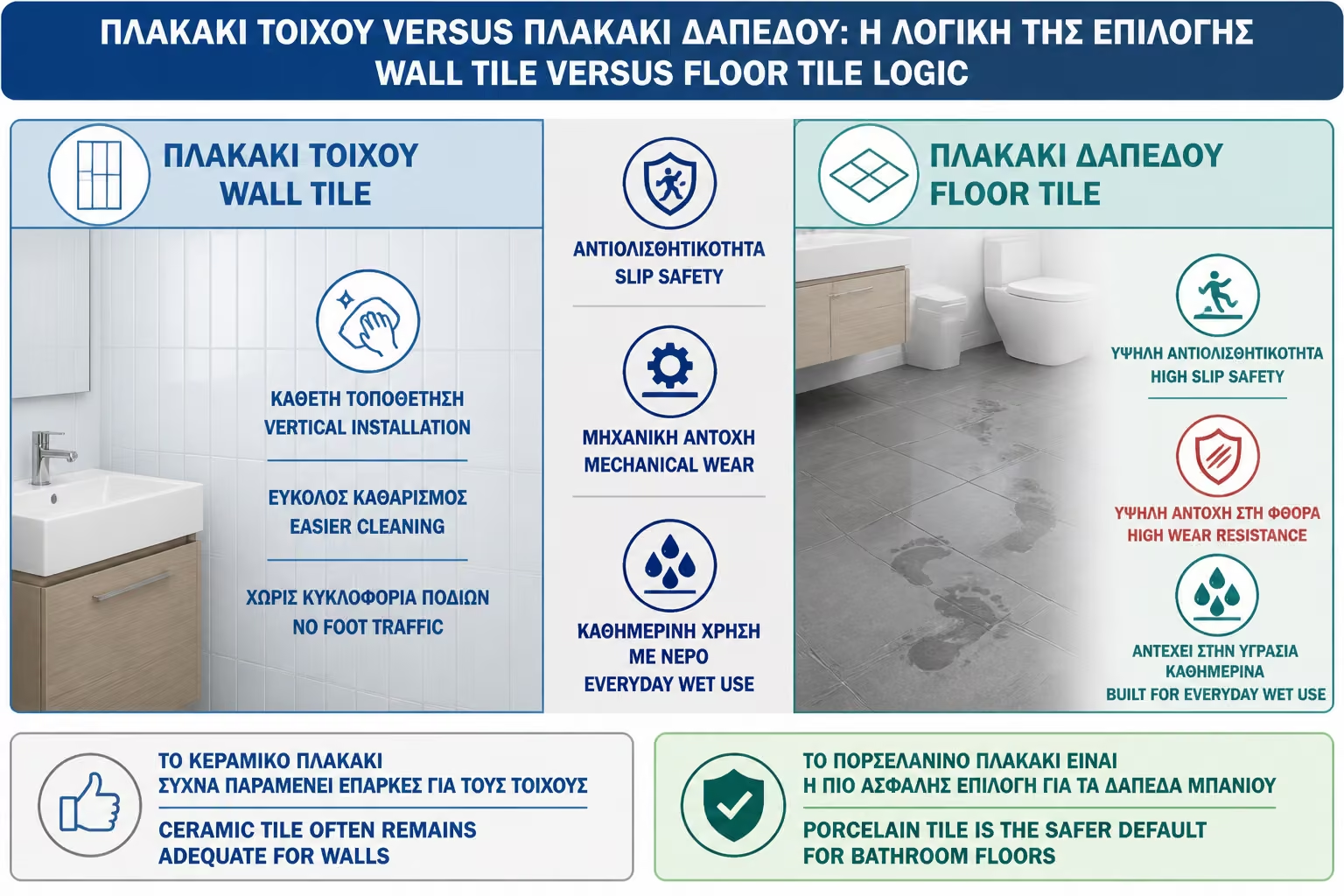
The floor is stressed much more than the wall. Shoes, sand, chairs, children's toys, pets, mops, bumps and daily use create wear and tear that is not present on a vertical surface. That is why a tile that is suitable for a wall is not necessarily suitable for a floor.
Porcelain tiles usually have better mechanical strength and greater density. This makes them a very good choice for residential floors, kitchens, hallways, bathrooms, commercial areas and outdoor floors. But we must also look at the surface. A porcelain glaze may be hard, but optically scratches more easily or slips when wet. A matte or slightly embossed porcelain may be more practical for everyday use.
On the walls, the picture changes. There is not the same strain there. A good ceramic wall tile can provide an excellent aesthetic result with lower weight and lower cost. It is also easier to cut, which helps in bathrooms with many fittings, corners, recesses, hanging sanitary ware and special details.
The porcelain tile excels mainly where the use is demanding. On floors with daily traffic, in kitchens where water and oil fall, in bathrooms with frequent use, in house entrances, on balconies, terraces and yards, the low absorbency and durability of porcelain give a clear advantage.
In a kitchen, for example, the floor receives stains, dropped objects, cleaners and constant mopping. A good matte or satin porcelain tile can be a much safer choice than a standard ceramic tile. In a residential hallway, where shoes come in from outside, wear resistance is more important than on a bathroom wall.
Outdoors, porcelain is usually the best base of choice, but not just any porcelain. We want proper slip resistance, proper slopes, outdoor glue, proper joints and allowance for expansion and contraction. A great tile can fail if it is placed on a bad substrate or if there are no proper slopes for the water to run off.
Ceramic tile should not be underestimated. On bathroom, kitchen, WC, laundry room walls or interior linings, it can be a very reasonable choice. It is often cheaper, lighter and easier to process. In renovations where there is a lot of cutting around piping, sockets, switches, cabinets and alcoves, this can reduce time and difficulty.
A ceramic wall tile can also give a more "warm" and decorative feeling, with a wide variety of colors, textures and small dimensions. In areas that are not stepped on and do not receive mechanical stress, it is not always necessary to pay for porcelain.
The mistake is to choose ceramic only because it is cheaper, without looking at the use. Another tile for wall above the sink and another tile for shower floor. Another tile for kitchen backsplash and another for entry floor. Economy makes sense when it doesn't sacrifice convenience.
On the bathroom floor, porcelain is usually the safest choice. The bathroom has water, water vapour, cleaning agents, places with frequent pressure and an increased risk of slipping. Low absorbency is an advantage, but the surface plays an equally important role.
For a bathroom floor, especially near a shower, it is advisable to avoid very shiny surfaces. They may look impressive on display, but with soap and water they become more demanding to use. A matte, satin or slightly textured tile is often more practical.
Special attention is needed on large tiles. A 60×120 tile can look luxurious, but in a small bathroom with a floor drain and many slopes it can be difficult to install. If the slopes do not "come out" correctly, water may remain in places or many ugly cuts may be needed. In such cases, a smaller dimension or a different design in the shower zone may give a better result.
On bathroom walls, the answer is no. You don't always need porcelain. If the wall is not subject to direct mechanical stress, a good ceramic wall tile may be fully sufficient. This is especially true in areas outside the shower, behind the sink or around the basin.
Porcelain on the wall makes sense when we want a single material with the floor, large dimensions, special aesthetics, increased durability or use in an area with a lot of water. But it also has requirements. It is heavier, more difficult to cut and needs proper glue and installation technique. In large slabs, the flatness of the wall becomes critical. If the wall is crooked, the large tile will not "forgive" easily.
A common mistake is to choose large porcelain for an old bathroom without checking the substrate. The owner sees an impressive photo with large slabs, but in the real bathroom there are old plasters, bellies, non-rectangular corners and pipes that create technical difficulties. There the cost is not only the tile. It is the preparation needed to be placed correctly.
In the kitchen and hallway, durability is of great importance. The kitchen is a work space, not just a display space. Objects fall, there is grease, moisture, cleaning agents and frequent stepping. The corridor and entrance receive shoes, dust, sand and minor impacts.
In these areas, a good porcelain floor is usually preferable. If there is a single floor in the kitchen, living room and hallway, porcelain can give a uniform look and great durability. But you need to pay attention to the texture. Very shiny surfaces show footprints, water and lines more easily from cleaning. Highly textured surfaces, on the other hand, can hold dirt if they are not suitable for indoor use.
In the living room, the choice depends more on aesthetics and overall use. If the house has children, pets or direct access to a garden, practicality counts more. If it's a soft-use apartment, there are more options. Here again, however, the quality of the product, the correct placement and the choice of joint affect the final result.
For balconies, patios, terraces and outdoor stairs, porcelain is usually the right tile class. But the choice should not stop at the word "porcelain". The outdoor space requires a non-slip surface, resistance to temperature changes, correct glue, elastic joints and above all correct slopes.
A big mistake is to install an exterior tile on a problematic substrate, without a waterproofing check. On a roof, for example, the tile cannot save a bad insulation. If there is trapped moisture, cracks or insufficient slopes, sooner or later problems will appear: peeling, broken joints, standing water or dampness at the lower level.
On outdoor stairs and ramps, slip resistance is more important than good looks. A tile that looks "clean" and minimal on display can become dangerous in the rain. Technical characteristics should be requested there and not simply rely on the feeling of the hand.
Before you review the table, keep the following points in mind:
| Criterion | porcelain tile / Porcelain | Ceramic tile |
|---|---|---|
| Water absorption | Very low, usually up to 0.5% for porcelain | Usually higher, depending on category |
| Suitable for flooring | Very good, as long as it has the right surface and specifications | Only if it is a floor tile, not a simple wall tile |
| Suitability for wall | Good, but heavier and harder to cut | Very good for interior walls |
| Outdoor space | Usually preferable, with proper anti-slip | It needs a lot of attention and a proper category |
| Cutting and piercing | More difficult, requires good tools | Easier to edit |
| Material cost | Usually higher | Usually cheaper |
| Installation cost | It can be increased due to hardness and large dimensions | Usually simpler placement |
| Ideal use | Floors, bathrooms, kitchens, exteriors, heavy use | Walls, cladding, soft use, economical solutions |
The table helps to show the basic direction, but is not a substitute for checking the specific product. There are excellent porcelain and medium porcelain. There are also good ceramics and very weak ceramics. The label is a starting point, not a full technical assessment.
In the Greek market of 2026, prices fluctuate widely. A simple ceramic wall tile can start at low prices per square meter, while a good porcelain floor with a contemporary design, large dimension or special surface can cost significantly more. Final prices depend on brand, dimension, origin, quality, availability, design and quantity.
For a practical picture, in ordinary residences one can find ceramic wall tiles from around €10–25/sq.m. for economical and medium options, while floor porcelain often ranges from 15–35€/sq.m. for simple to good choices. Large dimensions, marble imitations, rectified edges, special textures or branded ranges can go much higher.
On the job, simple tiling on an easy surface can start at low bids of around €6–8/m2, but a more realistic base for typical proper residential work is often around €10–15/m2. For large tiles, lots of cuts, difficult substrates, small bathrooms with lots of details, sloped showers or outdoor areas, the cost can go up.
It must always be clarified whether the price is for labor only or includes adhesives, grouts, primers, transport, stripping, maintenance, VAT and substrate preparation. A seemingly low price can be honest if it involves simple work on a clean surface. But it can be misleading if it doesn't include key ingredients or if it leaves out difficult details.
Large tiles have become very popular, especially in bathrooms and open spaces. They give fewer joints, a clearer image and a more modern aesthetic. But technically they are more demanding. It is not enough to buy a 60x120 or 120x120 tile and expect it to be installed like a small tile.
As the dimension increases, the flatness of the substrate becomes more important. Small irregularities that do not appear strongly on a 25×40 tile, on a large tile can create "teeth", gaps or poor contact with the adhesive. Also the cuts are more difficult, the transfers more demanding and the possibility of breakage greater.
In small bathrooms, large tiles need careful study before purchase. If the dimensions of the space lead to a lot of narrow strips, odd cuts or bad corner meetings, the expensive material may not show as in the photo. There a good craftsman or engineer will look in advance at the markings, heights, slopes and cut points.
Many porcelain tiles are available with rectified edges, i.e. cut more precisely after firing, to allow a finer and more uniform joint. This gives a more modern effect, but requires more correct placement. The thin joint does not forgive crooked walls, dimensional differences or bad engraving.
Some owners ask for "no visible joint at all". This is practically not a correct requirement. The joint is needed. It allows micro-movements, covers tolerances, protects edges and helps the system function. Too narrow or no joint can create problems, especially on large surfaces or in areas with temperature changes.
The choice of joint color also greatly affects the result. An open joint in a kitchen floor can get dirty more easily. A very dark joint on a light tile can accentuate any imperfection. The right choice is not only aesthetic; it is also a matter of maintenance.
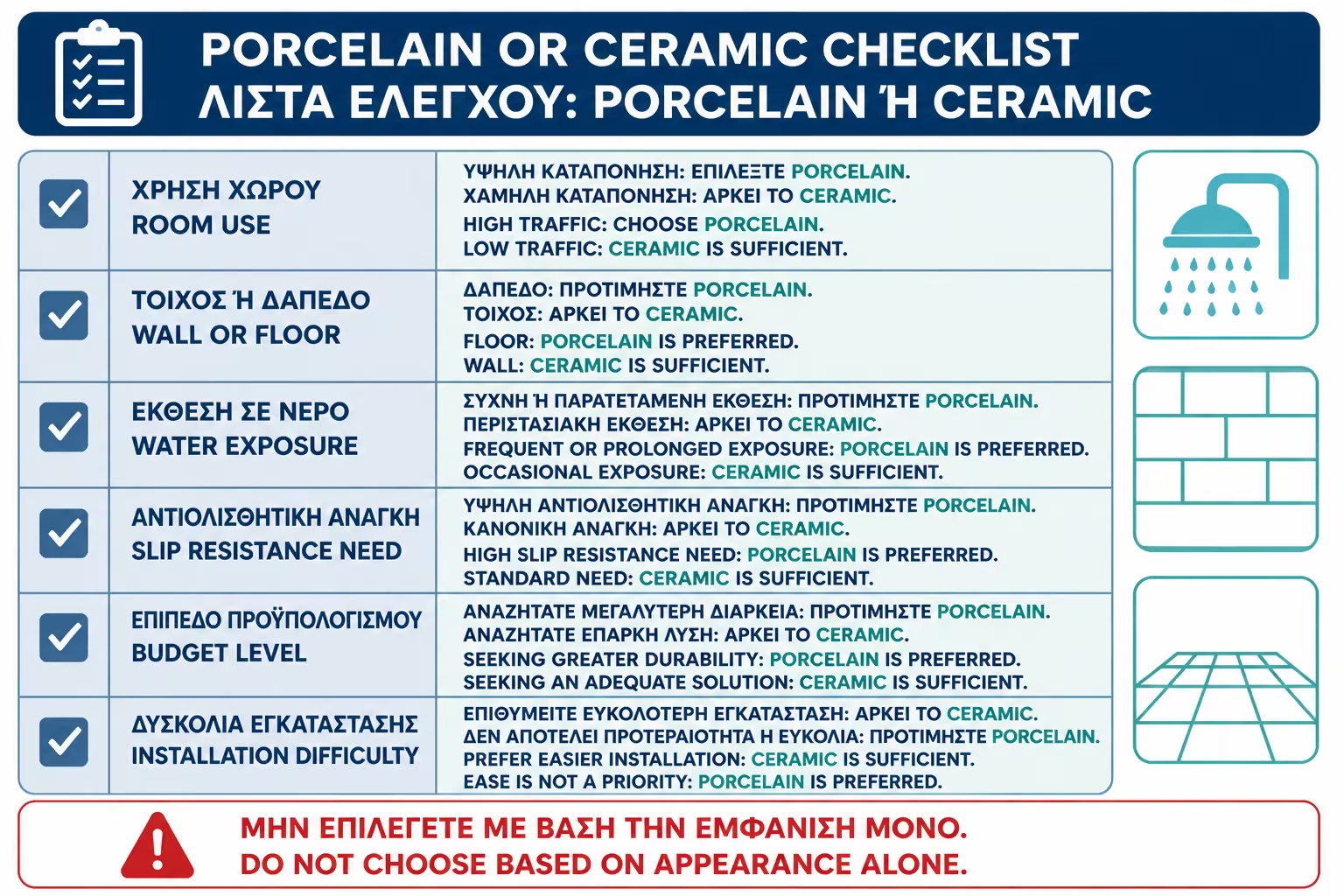
The most common mistake is to choose based on appearance alone. The owner sees a tile on display, under nice lighting, on a clean surface, and imagines it the same at home. But the house has other conditions: natural light, smaller surfaces, water vapor, dust, daily use and placement restrictions.
Second mistake is using wall tile on floor. It can be done out of ignorance or because there is an offer in some plan. If the product is not suitable for pressing, the economy can be lost very quickly.
A third mistake is choosing a very shiny surface in a bathroom or outdoor area. The result can be impressive in photography, but practically difficult and potentially dangerous when wet.
A fourth mistake is not accounting for waste. With tiles, especially large formats or patterns that need to line up, an extra allowance is always needed. That allowance increases when there are many cuts, diagonal layouts, or a likely future need for replacements.
Before buying tiles, it is not enough to ask "how much is a square". You need to ask for the basic specifications and explain where the hardware will be placed. A WC wall has other requirements, others a bathroom floor, others a balcony and others an external staircase.
It is good to know if the tile is suitable for the floor or only for the wall, if it is porcelain, if it has an anti-slip category for the area you are interested in, if it is rectified, which glue is recommended, if there are special pieces available and if the series will continue to exist for future replacement.
In practice, a proper selection is best made when the owner, supplier and craftsman work together. The supplier knows the product, the craftsman knows the application and the owner knows the use of the space. When one of the three is missing, the possibility of error increases.
Before you review the table, keep the following points in mind:
| Question | Yes / No |
|---|---|
| Do you know if the tile is for floor, wall or both? | Yes / No |
| Has the absorbency or grade of the tile been checked? | Yes / No |
| For a bathroom or outdoor area has the anti-slip been tested? | Yes / No |
| Has the craftsman seen the size and dimension before purchase? | Yes / No |
| Has it been calculated for cuts and future replacement? | Yes / No |
| Do you know if the price includes VAT, glue, grout and application materials? | Yes / No |
| Has the flatness of the substrate been checked? | Yes / No |
| Is waterproofing provided where necessary in a bathroom? | Yes / No |
| For large tiles, has a proper layout and cutting plan been prepared? | Yes / No |
| Have you kept a few extra pieces for future repair? | Yes / No |
If the answer to most of the questions is “no”, it is better not to rush to buy. Tile is not a material that changes easily after installation. A mistake in selection has been seen for years.
If you have to stick to one key takeaway, stick to this: don't choose a tile based on the photo or price per square foot alone. For floors, bathrooms and outdoors, look first at usage, absorbency, slip resistance and quality of installation. Porcelain is an excellent choice when strength and low absorbency are needed, but it is no substitute for proper sealing, proper slopes, and good installation. For walls and lighter uses, a good ceramic can be a more reasonable and economical solution. The best option is not always the most expensive; it is the one that technically fits the space.
The difference between porcelain and ceramic tiles is not just commercial. It's a technique. Porcelain has very low absorbency, greater density and usually better behavior in floors, wet areas and exterior applications. That is why it is often the safest choice for bathrooms, kitchens, corridors, balconies and areas with heavy use.
On the other hand, ceramic tiles remain very useful and practical, especially for walls and interior cladding. There is no reason why one should always pay more for porcelain when the use does not require it. The right decision results from the combination of space, use, substrate, aesthetics, budget and technical requirements.
The biggest mistake is to treat the tile as a simple decoration. In practice, it is a construction material with specific strengths and limitations. A beautiful tile can fail if it goes into the wrong space or is installed carelessly. On the contrary, a reasonable and properly selected material can give a durable, clean and practical result for many years.
Before you decide, ask for technical data, talk to the craftsman before the purchase and see the space as it really is: with its slopes, its humidity, its cuts, its use and its difficulties. There you can see which option is really worth it.
Return to category.
Go to categoryReturn to the central guide.
Go to guide