
Bathroom Surface Materials & Finishes
Return to category.
Go to categoryIn tiling there is an oft-repeated misunderstanding: many people think that the "good glue" is simply the one that sticks the strongest. In practice, however, glue should not only stick. It must also cooperate with the substrate, the tile, the temperature, the humidity and the small movements of the structure. This is precisely the field where the elastic adhesives S1 and S2 come into play.
In an old bathroom with small ceramic tiles on solid cement mortar, the requirements were relatively simple. Today, however, things have changed. We install large 60×120 granite tiles, slabs that reach slab dimensions, tiles over old tiles, underfloor heating, plasterboard in bathrooms, cement boards, waterproofing membranes and fine renovation systems. All this creates movements, stresses and differences in behavior between the tile and the substrate.
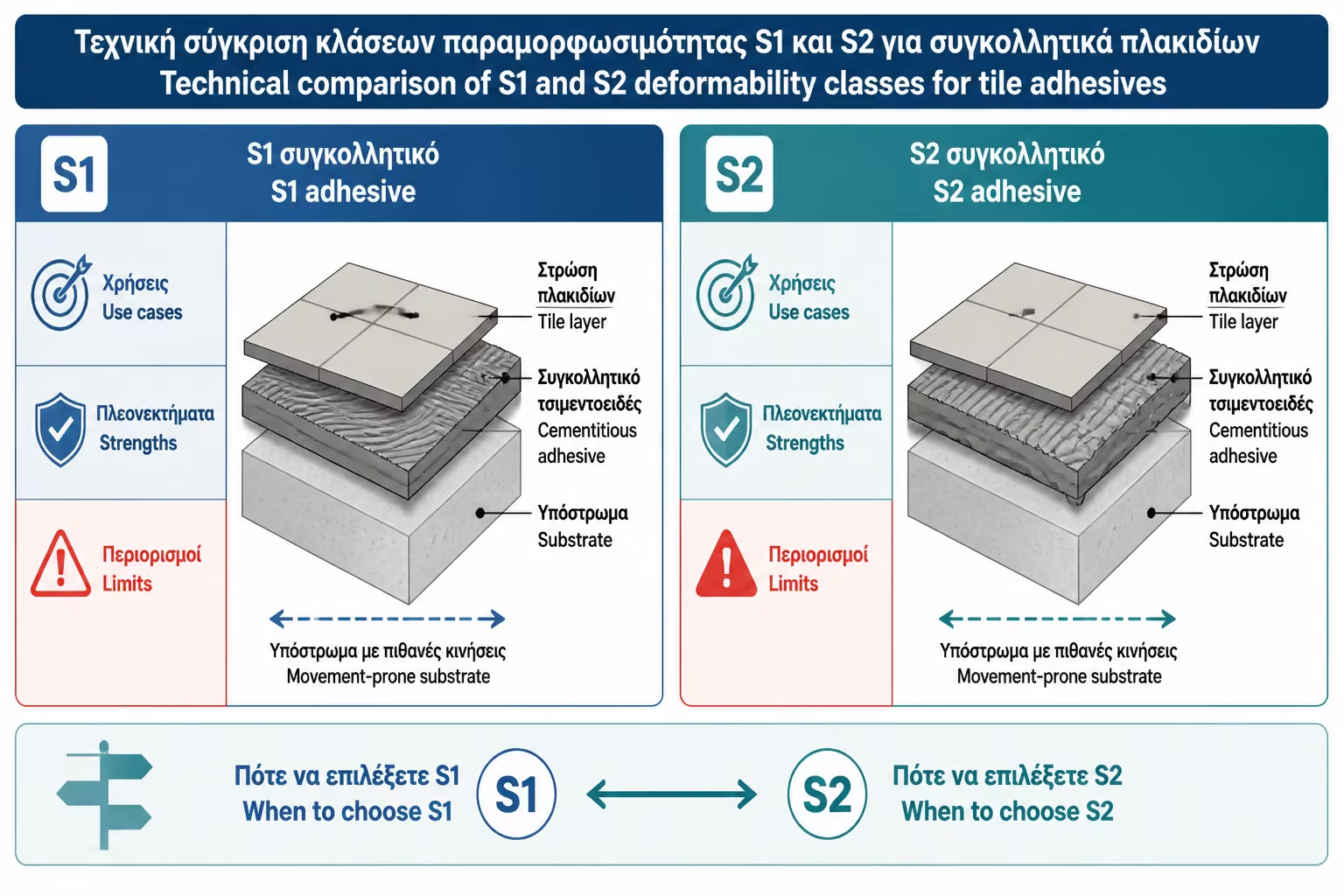
Elastic or deformable adhesive does not mean that the adhesive is "soft" or that the tile will move. It means that the adhesive has the ability to absorb small deformations without losing adhesion and without breaking like a rigid layer. According to technical classifications based on European standards, class S1 characterizes deformable adhesive with transverse deformation of about 2.5 to 5 mm, while S2 characterizes highly deformable adhesive with deformation above 5 mm.
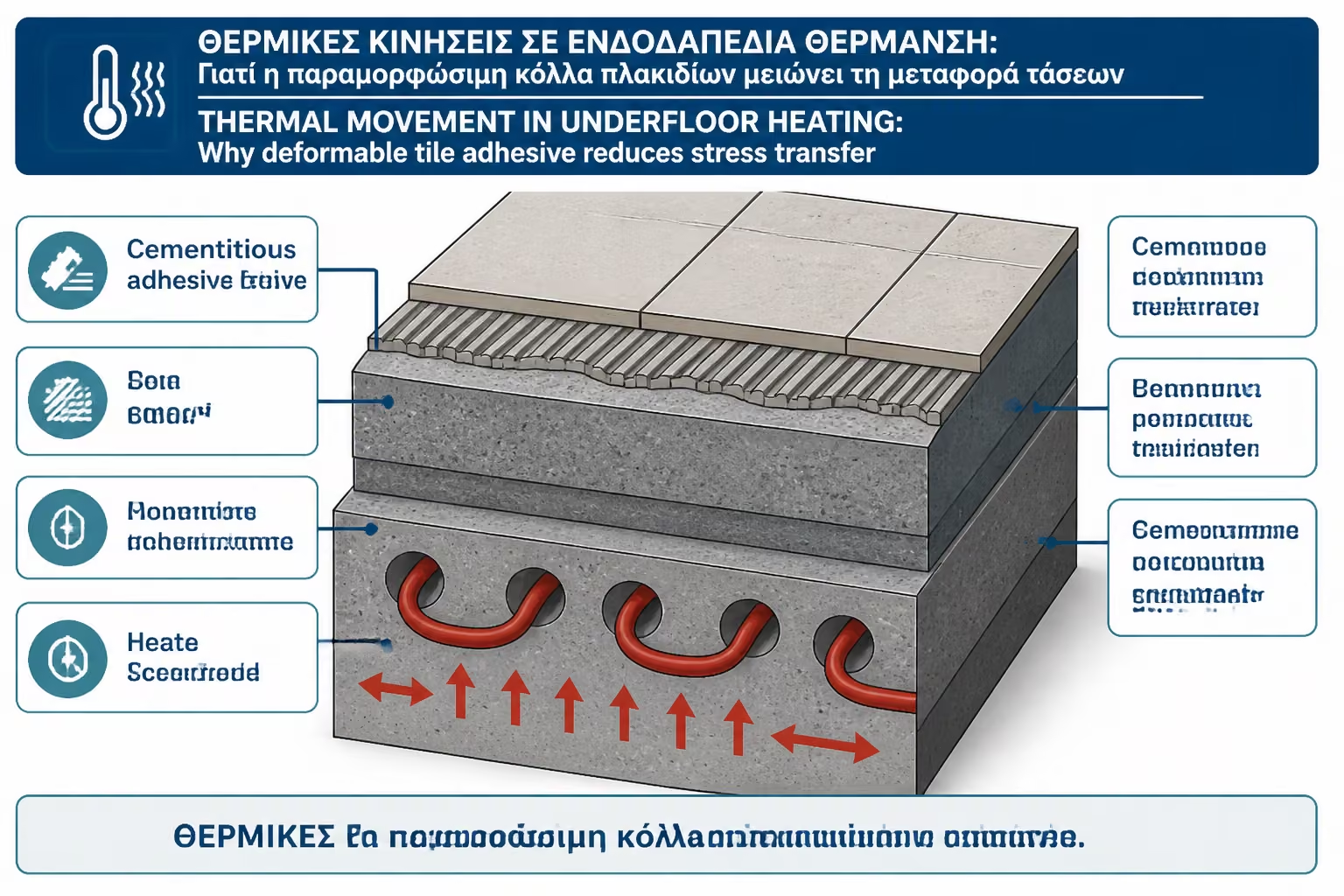
This feature is particularly important in underfloor heating, where the floor heats and cools repeatedly, in plasterboards or cement boards that behave differently from solid concrete, and in large tiles or slabs where stresses are transferred over a larger surface area. Sika, in an adhesive selection guide, states that the S1/S2 categories relate to the degree of transverse deformation, with S1 referring to deformable products and S2 highly deformable products.
The critical point is that S1 or S2 glue is not a "magic fuse". It does not fix a loose substrate, it does not replace expansion joints, it does not straighten a crooked floor, it does not waterproof and it does not save a wrong installation. But it is a necessary part of the right system when the application has movements or tendencies. And in modern bathrooms, these cases are much more common than we think.
The term "elastic adhesive" is used a lot in the market, but technically it is more correct to talk about deformable adhesive. Glue does not act like rubber. It is not a soft mass that allows the tile to move uncontrollably. It is a cementitious material modified with polymers, so that it can withstand small deformations.
These small distortions result from the use of the space. When a floor is heated by underfloor heating, it expands very little. When it gets cold, it contracts. When a large tile experiences a temperature difference between its surface and its back, stresses develop. When a drywall has micro-movements, the adhesive must follow them to some extent.
A stiff adhesive may have good initial adhesion but not be forgiving of these movements. If the substrate and the tile "work" differently, the stress will go somewhere: the joint, the adhesive, the tile or the substrate. The deformable adhesive acts as a micro-motion absorption zone.
S1 is the category most often encountered in demanding domestic applications. It is a deformable adhesive and covers many situations: underfloor heating, bathrooms, large dimensions, exterior floors, tile on tile, some applications on plasterboard or cement board and general substrates with small movements.
S2 is more specialized. It is a highly deformable adhesive and is used when the demands are greater: very large slabs, more unstable substrates, special facades, wooden or light substrates where allowed by the system, special thermal stresses or applications where the tile/system manufacturer explicitly requests S2.
The difference is not "S2 is always better so I put S2 everywhere". S2 is a more specialized product, usually more expensive and not necessary in simple applications. The right question is: how much deformability does the project need? In many bathrooms with modern porcelain tiles, a C2TE S1 is very often the logical choice. On slabs or very demanding surfaces, S2 may be needed.
Underfloor heating creates repeated heating and cooling cycles. The floor rises in temperature, then falls, rises again, falls again. These changes are small but continuous. Tile, adhesive, grout and substrate do not always expand in the same way.
If the adhesive is too stiff, thermal movements can lead to delamination, cracking of the joints or "ringing" of tiles. Large tiles make the effect more pronounced, because a large slab has fewer joints to absorb movements. That is why in underfloor heating S1 glue is usually considered the safe base, while for more demanding cases S2 is considered.
But elastic glue is not enough. Underfloor heating requires proper substrate curing, heating initiation protocol, expansion joints, appropriate grout and correct tile selection. If we suddenly turn on the heating on a new floor or if there are no expansion joints, even good glue can be subjected to excessive stresses.
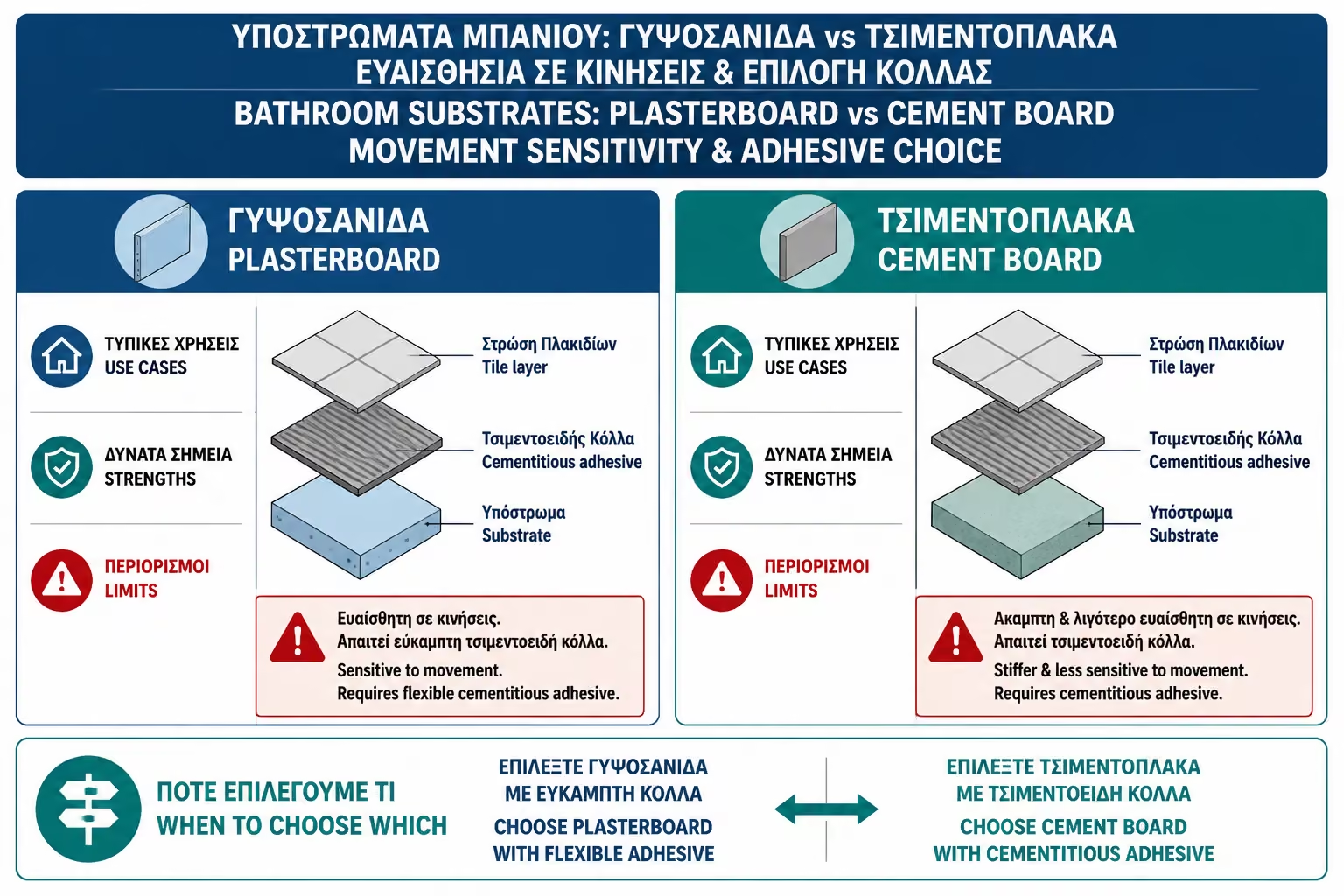
Gypsum boards, gypsum boards and cement boards are lightweight building systems. They do not have the same rigidity as a solid brick or concrete wall. They can have small movements, especially if the frame is not dense enough, if the board is not properly supported or if it is loaded with large tiles.
In a bathroom, the problem becomes more complex because there is also moisture. The board must be suitable for a wet area, have proper waterproofing where required and be able to support the weight of the tile. S1 glue helps to absorb small movements, but does not make a bad plasterboard suitable for heavy tiles.
On a plasterboard wall with large tiles, the choice of adhesive must be made together with the board system. How much weight per square meter does the manufacturer allow? What primer is needed? Is there a waterproof membrane? What type of glue is compatible? S1 is often necessary, but it is not the only answer.
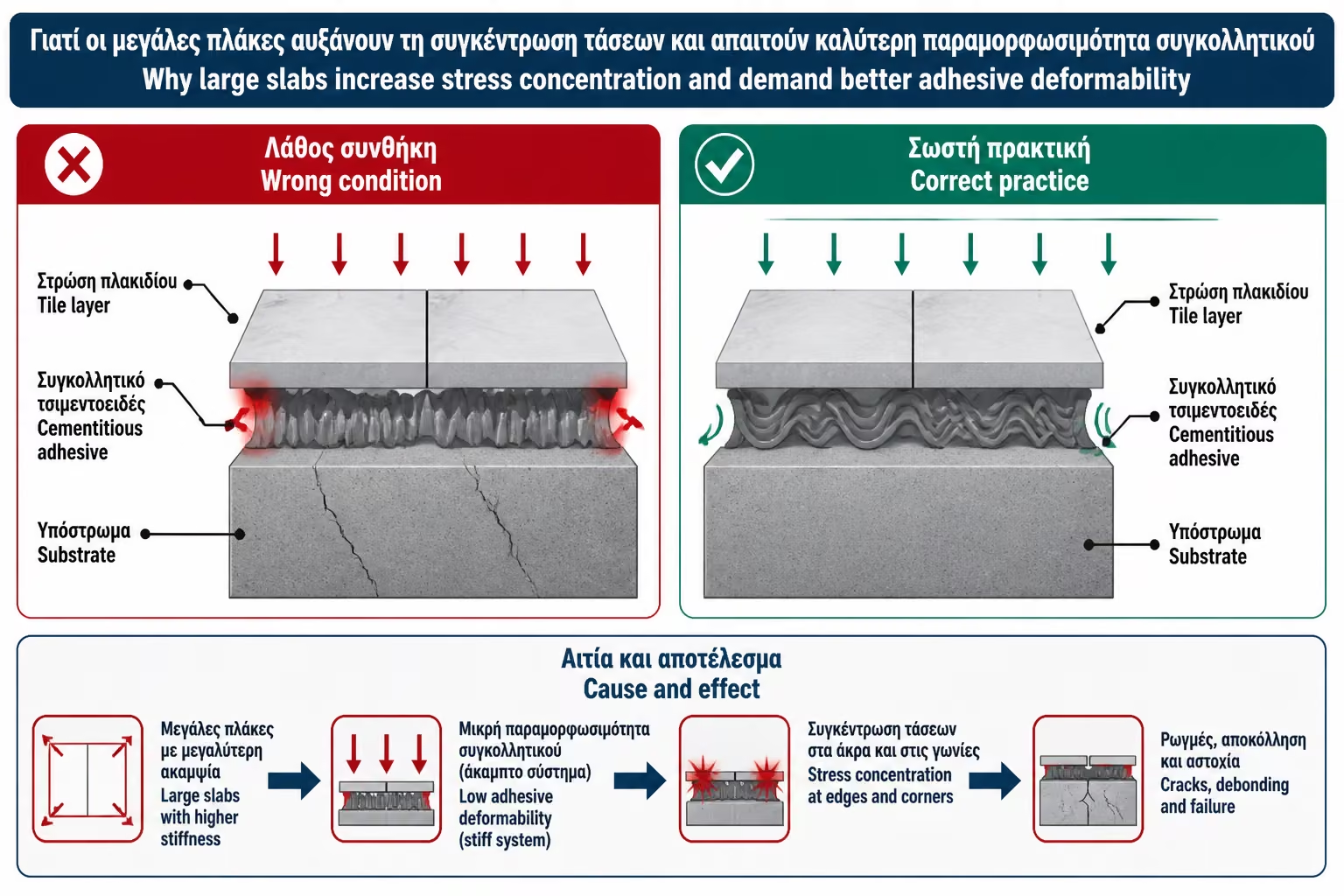
Large tiles and slabs are impressive, but technically demanding. As the dimension increases, the number of joints per surface decreases. Joints act as small movement absorbing zones. When we have few joints and large plates, the stresses are transferred more to the adhesive and the substrate.
In addition, a slab has a large contact surface. If there are gaps underneath, if the adhesive is not spread properly, or if the substrate is not flat, the tile can be stressed and crack or peel off. For such applications manufacturers often recommend improved high performance adhesives, usually C2TE S1 or S2, depending on dimension, thickness, substrate and space.
Sika, in a tiling systems technical brochure, mentions C2TE S1 series of adhesives for applications in ceramic tiles, thin dense porcelain slabs, underfloor heating and old tiles in interior applications, showing exactly the field where deformability is linked to demanding modern tiles.
The C2TE S1 code is perhaps one of the most useful in modern tiling. C2 indicates improved cementitious adhesive. T indicates reduced slip, useful on walls. E stands for extended open time, i.e. more working comfort. S1 denotes deformability.
In a bathroom with granite tiles, large tiles, walls, humidity and possible micro-movements, this category is very practical. It's not overly specialized like an S2, but it gives more security than a simple C1 or C2. That is why many craftsmen use it as a "good base" for demanding domestic applications.
This does not mean that every project needs C2TE S1. A small ceramic tile on a simple interior dry wall may not need such an adhesive. But in a bathroom with porcelain and modern dimensions, the choice of simple glue to save a few euros is usually bad economy.
S2 enters the conversation when movements or trends are larger. This can happen on very large slabs, on substrates that are more sensitive to deformation, on demanding facades, on special decoupling systems, on wooden substrates where the manufacturer allows it, or in applications where the technical sheet of the tile requires a highly deformable adhesive.
For a typical bathroom renovation, S2 is not always necessary. However, if we are talking about very large thin plates on a wall, for surfaces with underfloor heating and large formats, or for a substrate that is not solid, then it is worth considering. The decision should be made technically, not commercially.
S2 is more expensive, but in a project with large slabs the cost of the glue is small compared to the cost of the slab, transport, cutting and failure. If a slab breaks or peels off, the damage is far greater than the price difference of the glue.
One of the most dangerous mistakes is thinking: "I put S1, so I don't need expansion joints". Error. Elastic adhesive absorbs micro-movements within the system, but construction joints, perimeter joints and expansion joints must be maintained or properly designed.
In floors with underfloor heating, outdoor spaces, large surfaces or substrate changes, expansion joints are part of the system. If they are covered with tile and glue, stresses will build up and cracks may appear. S1 helps but does not negate the natural behavior of the materials.
In a bathroom, the surfaces are smaller, but the perimeter joints remain important. At corners, at the wall-floor junction, around showers and at material changes, elastic sealants should be used where provided, not hard grout everywhere.
In a bathroom, especially in the shower, the waterproofing is done under the tiles with suitable systems: cementitious sealants, membranes, corner strips, cuffs around pipes and proper detailing on the siphon. The adhesive, even if it is S1 or S2, is not a waterproofing film.
Deformable adhesive may work better with waterproofing underlayment and movement, but won't stop water from getting through if there are gaps, cracks or bad corners. If the bathroom needs waterproofing, it must be done before installing tiles.
This is especially important on slabs in the shower. Because we have fewer joints, many believe there is less risk. In fact, the large plate reduces the joints, but the few joints, siphon and corners remain critical. The glue has to be right, but the seal has to be there.
An S1 or S2 adhesive can absorb small movements, but cannot save a loose substrate. If the plaster is weak, if the cement mortar rubs off, if the old tiles are hollow, if the plasterboard does not have the correct framework or if the floor has large irregularities, the glue will stick to a problematic base.
The substrate must be firm, clean, dry, level and suitable for the weight of the tile. Dust, oil, old adhesives that do not hold, loose materials and moisture must have been removed. If the base is non-absorbent, such as old tiles, a special adhesion primer is needed. If it is very absorbent, it may need a fixing primer.
S1 is part of the solution, not an excuse to skip preparation.
Use the table below as a quick reference for the key points of this section.
| Application | Usual choice | Comment |
|---|---|---|
| Small ceramic tile on plain interior wall | S1 is not always necessary | C1/C2 may be sufficient, depending on substrate |
| Granite tile in bathroom | C2TE S1 often a safe choice | Especially on floors, walls and wet zones |
| Underfloor heating | S1 as a base, S2 in special cases | Expansion joints are also needed |
| Plasterboard / bathroom cement board | S1, depending on system | The correct board and waterproofing is paramount |
| Large tiles 60×120 | C2TE S1 | Full coverage and flat substrate |
| Slabs / very large slabs | S1 or S2, often based on manufacturer's instructions | It depends on dimension, thickness, substrate |
| Tile on tile | C2TE S1 + primer | Non-absorbent substrate |
| Outdoor area / balcony | C2TE S1 or more special system | Temperatures, water, expansions |
The table gives practical direction, but the final choice should always be confirmed by the adhesive's technical leaflet and the tile's instructions.
Use the table below as a quick reference for the key points of this section.
| Wrong expectation | Reality |
|---|---|
| "I put S1 and I don't need expansion joints" | Expansion joints remain necessary where provided |
| "I put S2 and I don't care about the substrate" | The substrate must be stable and suitable |
| "Elastic glue seals the shower" | Sealing is a separate system |
| “S1 levels the floor” | Flatness is corrected before gluing |
| "The more elastic the better for everything" | The choice must fit the application |
| "If the glue is expensive, you don't need proper technique" | Application remains decisive |
This distinction is critical, because many failures are not due to "bad glue", but to a wrong expectation of the glue.
On large tiles and slabs, the elastic adhesive must be applied properly. It is not enough to have the S1 code on the bag. You need the right spatula, the right direction of combing, pressure of the plate, possible double application and control of coverage.
Double coating means that adhesive is applied to both the substrate and the back of the tile. This helps achieve full contact, especially on large porcelain tiles. If gaps are left, the plate may crack under load or sound hollow.
Elasticity helps with movement, but gaps are a separate problem. A slab without proper coverage is at risk even with the best adhesive.
Before laying tiles over underfloor heating, the substrate must be cured. We must not close moisture inside the system. A thermal cycle is usually required in accordance with the system instructions to check the installation and complete the basic expansions before final lining.
The heating must not work strongly during installation. After installation, do not raise the temperature suddenly. Glue and grout take time. If the heating is turned on quickly and strongly, stresses or dehydration of the glue may occur.
S1 glue is important, but must be accompanied by a proper work protocol. Heat is a technical factor, not just comfort of use.
In plasterboard and cement board, the weight of the tile is of great importance. Large wall slabs are not allowed in every system. The board manufacturer gives load limits and frame requirements. If these are not observed, the best glue cannot save the construction.
Before choosing a bathroom plasterboard tile, the following must be checked: board type, thickness, frame, profile spacing, waterproofing, allowable weight per square meter and compatible adhesive. In a wet zone, such as a shower, a suitable waterproofing system is required.
S1 glue makes sense because it helps with micro-movements, but it shouldn't be used to "legitimize" a wrong descent.
In the Greek market of 2026, elastic S1 and S2 adhesives cost more than simple C1 or basic C2 adhesives. The difference may seem significant per bag, but in the total cost of a bathroom it is usually small compared to the tiles, worktops, faucets, waterproofing and sanitary ware.
For a typical bathroom, choosing a better adhesive can add a small percentage to the overall cost, but significantly reduce the risk. In large slabs, the adhesive is an even smaller percentage relative to the value of the material. If a slab peels or cracks, the cost of repair is far greater than the difference between simple and proper glue.
S2 is more expensive and not needed in every project. Must be requested when required by the application. S1, however, in bathrooms with granite tiles, sub-floors or large formats, is often a very reasonable investment.
A proper tile quote should not just say “tile adhesive”. It must state the class of the adhesive: for example C2TE S1, the brand or product, whether a primer is needed, the substrate to which it will be applied and whether there is a special requirement due to sub-flooring, plasterboard, old tiles or slabs.
It must also mention substrate preparation. Will it be primed? Will it be waterproofed? Will hollow old tiles be inspected? Will double coating be used? Will expansion joints be maintained? These are more important than just saying “rubber glue”.
If the craftsman cannot explain why he chooses S1 or S2, the offer is unclear. The owner does not need to become a chemist, but he must know that the choice was made for a specific reason.
The first mistake is to use simple glue on underfloor heating or large porcelain tiles for reasons of economy.
The second mistake is to consider S1 a panacea. If the base is loose or dirty, the glue will not work properly.
The third mistake is the omission of expansion joints. The elastic adhesive does not eliminate the movements of the structure.
The fourth mistake is the wrong use of S2 in projects where it is not needed, simply because "it is the best". The right product is the one that fits the application.
The fifth mistake is insufficient coverage behind large tiles. Elasticity does not fix gaps.
Use the table below as a quick reference for the key points of this section.
| Question | Yes / No |
|---|---|
| Is there underfloor heating? | Yes / No |
| Is the tile large format or slab? | Yes / No |
| Is the substrate drywall, cement board, or other lightweight system? | Yes / No |
| Is new tile going over old tile? | Yes / No |
| Are there thermal changes or outdoor space? | Yes / No |
| Has it been checked if the chip manufacturer asks for S1 or S2? | Yes / No |
| Has it been tested for compatibility with sealing? | Yes / No |
| Are expansion joints and perimeter joints provided for? | Yes / No |
| Will there be full glue coverage and double coating where needed? | Yes / No |
| Does the offer list a specific product and category code? | Yes / No |
If several answers are “yes”, then you probably need at least S1 glue. If there are very large slabs or a particularly demanding substrate, S2 should be considered.
In a modern bathroom, especially with granite tiles, underfloor heating, plasterboard or slabs, elastic adhesive is not a luxury. It's technical security. For most demanding home applications, a properly selected C2TE S1 is often the logical base. S2 comes in when we have larger movements, very large plates or special substrates. But no S1 or S2 is a substitute for proper underlayment, expansion joints, waterproofing and full adhesive coverage behind the tile.
S1 and S2 elastic adhesives exist because modern tile installations are no longer simple. Large porcelain tiles, slabs, underfloor heating, plasterboards and renovations on old substrates create micro-movements and trends. If the adhesive is too stiff, these stresses can lead to delamination, cracks or hollow tiles.
The S1 offers enough deformability for many demanding home applications. S2 offers even greater deformability for special and more difficult cases. Their selection must be made based on the tile, substrate, dimension, heating, use and manufacturers' instructions. We do not choose "the most expensive" glue. We choose the appropriate glue.
For the owner, the practical conclusion is simple: if your bathroom has underfloor heating, plasterboard, old tiles as a substrate or large slabs, ask for the adhesive category to be written in the offer. The phrase "we will put good glue" is not enough. You want a specific product, a specific category and a specific application technique. There it is judged whether the tile will stay in place for years.
Return to category.
Go to categoryReturn to the central guide.
Go to guide