
Bathroom Surface Materials & Finishes
Return to category.
Go to categoryTile adhesive is one of the materials that the owner rarely pays attention to. Usually the discussion revolves around the design of the tile, the color of the joint, the dimension, the finish and the installation price. But the glue is the material that holds the whole system in place. If chosen incorrectly, even the best tile can peel, rattle, crack or create problems in a bathroom, floor, wall or outdoor space.
On glue bags we often see codes like C1, C2, C2TE, C2TES1, C2FT, S1, S2. To many they seem like technical details that concern only the board. In practice, however, these codes are a very useful way to understand whether the adhesive is simple or improved, whether it slides on the wall, whether it has a longer working time, whether it is quick-setting or whether it has elasticity for difficult substrates.
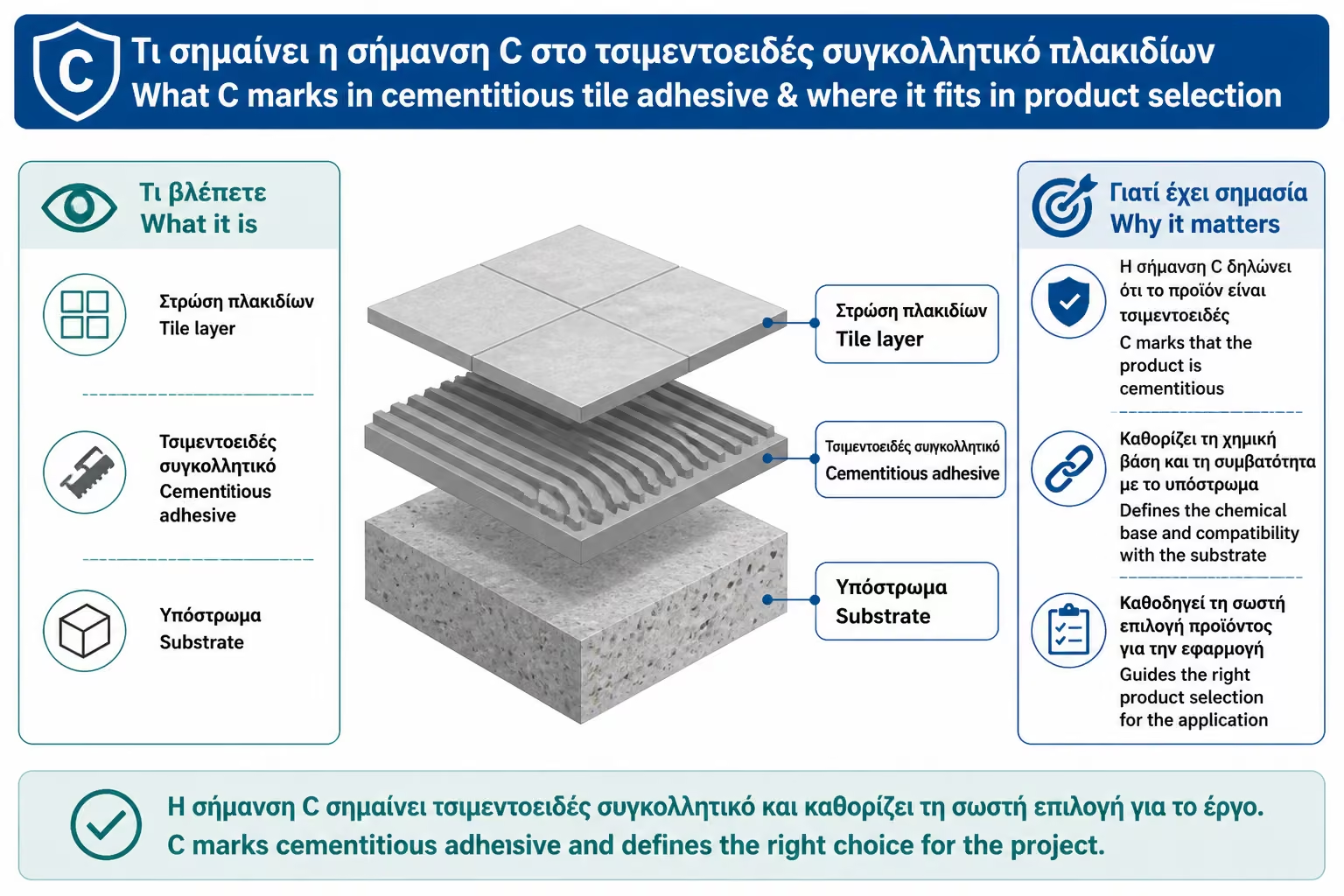
The basic European classification for ceramic tile adhesives is based on EN 12004. According to manufacturers' guides, C indicates cementitious powder adhesive, Class 1 corresponds to normal adhesive with minimum requirements, Class 2 to improved adhesive with additional requirements, T to reduced slip, E to extended open time and F to fast setting adhesive.
This means that a C2TE glue is not just a “good glue” with a brand name. It is a cementitious adhesive with improved adhesion, with reduced slippage and longer working time. If S1 is added, we are talking about a deformable or elastic adhesive, useful for substrates that receive thermal changes, underfloor heating or greater stresses. Mapei typically explains that a code like C2TE S1 stands for cement-based adhesive with improved adhesion, non-slip behavior, extended open time and deformability.
The important thing is that the glue is not selected only on the basis of the tile. It is selected based on the tile, substrate, dimension, space, use and conditions. Another glue is needed for a small absorbent ceramic tile on an interior wall, another 60×120 granite tile in a bathroom, another tile on an old tile, another underfloor heating and another outside balcony with sun, cold and expansions.
The adhesive is the intermediate layer that connects the tile to the substrate. It must hold the weight of the tile, withstand moisture, cooperate with expansions, fill the back of the tile properly, and maintain adhesion for years. The more demanding the tile or substrate, the more important the right choice becomes.
In the past, most tiles were smaller, more absorbent and ceramic. The classic cementitious adhesive could work satisfactorily in many applications, especially on fixed plaster or cement mortar. Today, however, we use much more porcelain / granite tiles, large formats, thin tiles, rectified tiles, floors with underfloor heating, renovations on old tiles and waterproofing systems in the bathroom. All this raises the demands.
The problem of the wrong glue is not always visible in the first week. It can appear months or years later: tiles that rattle, corners that lift, cracks in joints, peeling walls, water finding voids under the tile or tiles that are not in full contact with the adhesive. That is why glue is not a point for blind economy.
C stands for cementitious adhesive. It is the most common type of tile adhesive. It circulates in powder form and is mixed with water or other suitable liquid, depending on the product. Most of the adhesives we buy in a bag for ceramic and granite tiles are of this category.
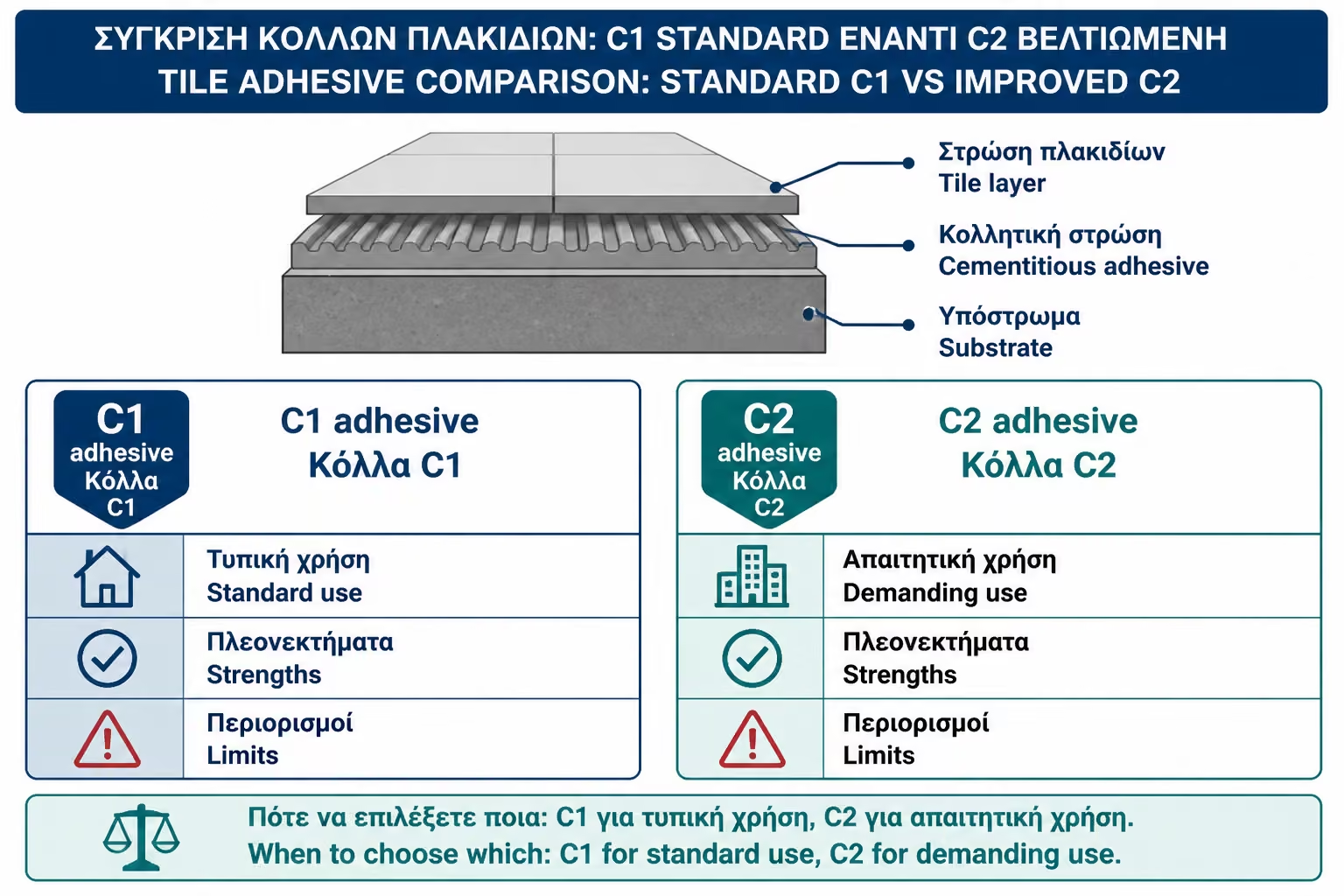
C alone does not tell us whether the glue is plain or enhanced. This is what numbers 1 and 2 say. A C1 is normal cementitious adhesive. A C2 is an improved cementitious adhesive. Additional characters, such as T, E, F, S1, describe additional properties.
There are other adhesive families, such as dispersion adhesives or reaction resin adhesives, but in the Greek residential market, when we talk about bathroom tiles, floors and walls, the main discussion is almost always around the C1/C2 cementitious adhesives.
C1 is the basic grade of cementitious adhesive. It is suitable for simple applications with small or medium ceramic tiles, on stable, absorbent substrates, usually in indoor spaces without particular stresses. It is the most economical class and can work properly when the conditions are really simple.
The problem is that many of today's applications are not simple. The granite tile has very low absorbency. Large tiles have greater coverage requirements. Bathrooms are damp. Old tiles are a non-absorbent substrate. Balconies accept thermal changes. There a C1 can be a marginal or wrong choice.
So C1 is not a "bad glue". It is an adhesive for specific core applications. If used where it should, it can be enough. If it is used because it is cheaper on a demanding project, then the economy is false.
C2 is an improved cementitious adhesive with better adhesion characteristics than C1. It is used in more and more demanding applications: granite tiles, larger dimensions, floors with greater stress, outdoor areas, bathrooms, kitchens and substrates where we want greater safety. According to Sika, Class 2 corresponds to improved adhesives with additional criteria compared to the normal category.
For most modern residential projects, especially when it comes to porcelain / granite tiles, C2 is usually the safest base of choice. It does not mean that every C2 does for everything. It means we start from improved traction and then look to see if we need T, E, S1 or another property.
In practice, if the owner does not know what to ask for, a reasonable question to the craftsman is: "Why do we choose C1 and not C2?". If the answer is "because it's cheaper", it's not enough. If the answer is "because we have small absorbent ceramic on a dry interior wall", then it might make sense.
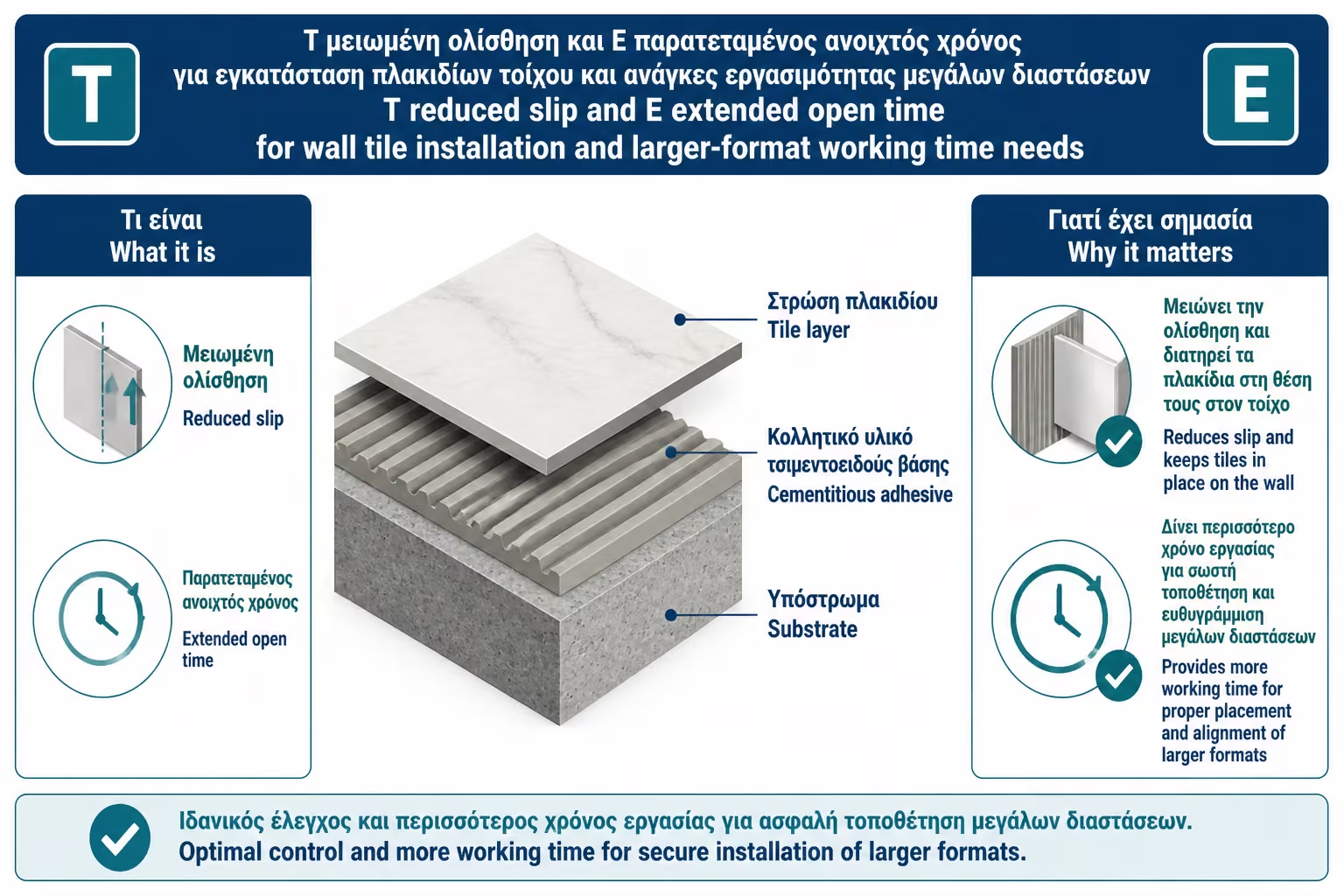
T stands for reduced slip or thixotropic behavior. Practically, the glue helps to keep the tile from sliding down after being placed on a vertical surface. This is especially important on walls, especially with larger or heavier tiles.
If you are putting wall tiles in the bathroom, the T is very useful. On a wall with large tiles, the tile should remain where the craftsman placed it until the adhesive sets. If the glue does not have reduced slip, the craftsman has more difficulty, more supports are needed and the risk of displacement increases.
`T` does not mean proper technique is no longer needed. It does not replace spacers, leveling systems, alignment or proper support where required. It simply means the adhesive has improved slip resistance on the wall.
E stands for extended open time, i.e. a longer time during which the adhesive remains active on the surface and can accept tile. This is very useful in hot weather, on absorbent substrates, on large surfaces, or when the craftsman needs more time for accurate placement.
Without sufficient open time, the adhesive can "peel" to the surface before the tile is installed. Then the tile doesn't stick properly, even if it looks like it's stepping on the glue. This is a common problem in summer applications, in drafts, or when too much adhesive is spread before the tiles are installed.
E is useful in large formats, in places where positioning requires precision and in applications where we don't want the craftsman to rush. A C2TE adhesive is a frequent and practical choice in many modern projects because it combines improved adhesion, reduced slippage and longer working time.
The F stands for fast setting. These adhesives are used when space must be delivered quickly or when conditions require a short waiting time. They can be useful in commercial spaces, renovations, small bathrooms that need to be used quickly or applications at lower temperatures, depending on the product.
However, fast coagulation is not always an advantage. It gives less working time. The craftsman must be organized, mix smaller quantities and work with precision. For a large format tile or a difficult design, a fast-setting glue can be difficult if there is no experience.
So we don't choose F because we "want to finish faster" in general. We choose it when there is a real need and when the craftsman knows how to work with the specific product.
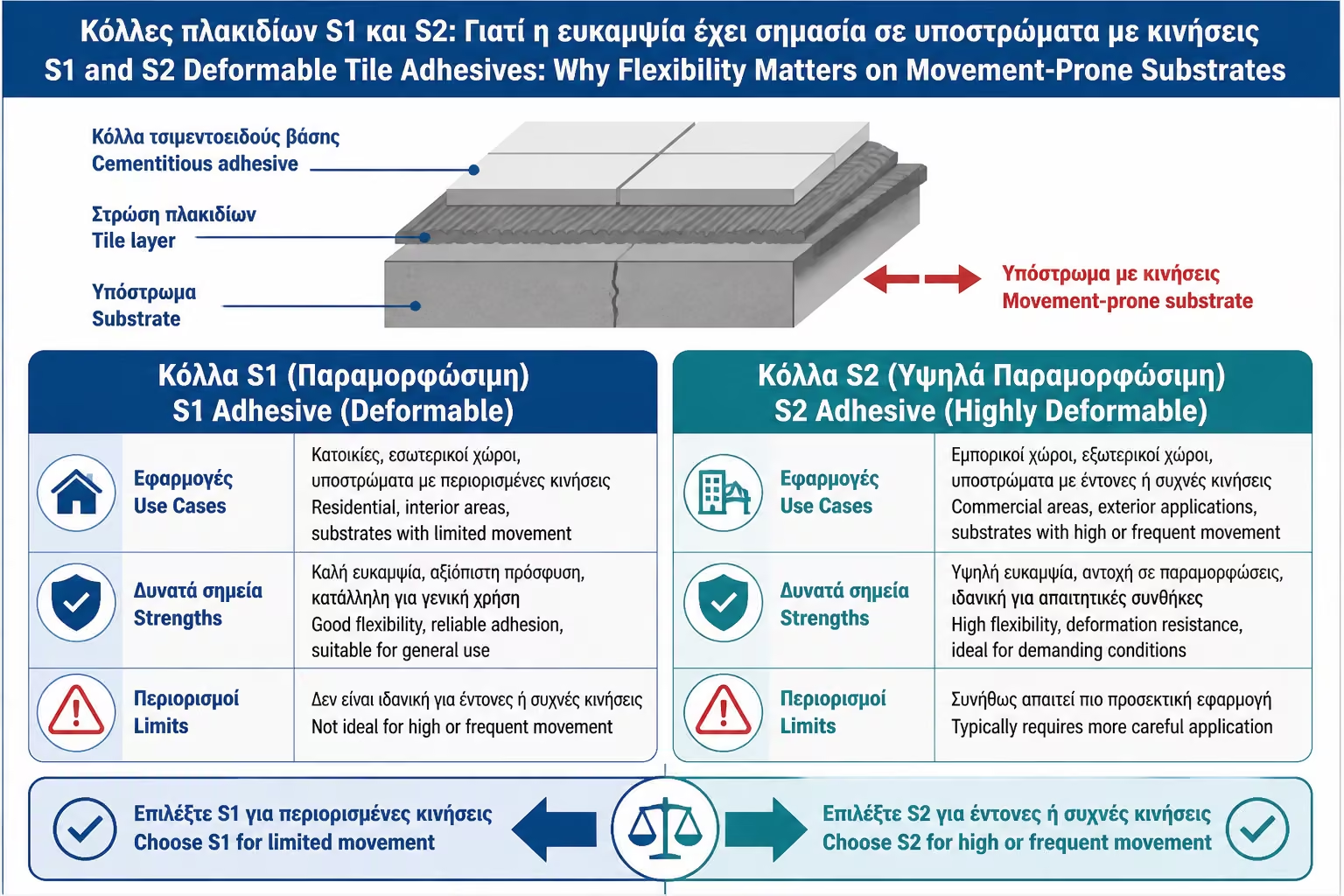
Although our topic starts with C1, C2, T and E, in practice we have to talk about S1 and S2 as well. These codes indicate deformability, i.e. the ability of the adhesive to withstand small movements and stresses without losing its function. S1 is a deformable adhesive, while S2 has even greater deformability.
S1 adhesives are useful in underfloor heating, outdoor areas, large tiles, substrates with thermal changes, balconies, roofs, plasterboards of suitable construction and generally where there is movement. Sika, in product C2TE S1, mentions use in applications such as heated floors, swimming pools, facades and industrial floors, i.e. in more demanding conditions.
S2 is an even more special choice, for very demanding applications, thin plates, large formats or substrates with increased distortion. It is not needed everywhere, but when it is, simple glue is not economical.
Ceramic tiles, especially the more classic wall tiles, are more absorbent than porcelain / granite tiles. This means they work more easily with simpler cementitious adhesives in basic applications. A small ceramic tile on an interior wall can be installed with a simpler adhesive, as long as the substrate is correct.
The granite tile has very low absorbency. It doesn't "pull" the glue the same way. It is more demanding on grip, especially when it is large, heavy or placed on the floor, bathroom or outdoor area. Therefore, for porcelain / granite tiles, C2 is usually the right starting point. For large formats or difficult conditions, we look at C2TE S1 or a similar category.
A common mistake is to choose an expensive granite tile and use an economical glue "to keep the cost down". The cost difference of glue in a bathroom is small compared to the cost of tiles, labor and possible failure. The adhesive must follow the requirement of the tile.
The glue is not selected only from the tile. It is also selected by the substrate. The plaster behaves differently, the cement mortar another, the concrete another, the plasterboard another, the old tile another, the waterproofing membrane another and the underfloor heating another.
On an absorbent and stable substrate, the glue works more easily. A non-absorbent substrate, such as old tiles, requires a special primer or adhesive suitable for such an application. In bathroom plasterboard, the board must be suitable, properly sealed and an adhesive compatible with the system must be used. In waterproofing materials, the compatibility of the adhesive with the membrane or cementitious sealant must be checked.
The substrate must also be clean, dry, stable and level. The best adhesive won't save loose plaster, dust, oils, moisture or old tiles that sound hollow. The choice of glue is important, but it is not a substitute for preparation.
Placing a new tile on top of an old tile is demanding because the substrate is smooth and non-absorbent. Here we usually need improved C2 adhesive, often C2TE or C2TES1 depending on the new tile, and special adhesion primer for non-absorbent substrates. A simple C1 is not enough because "the old tile is hard".
Old tiles are checked first. If they are hollow, detached or broken, they are not a good foundation. Then they are cleaned, degreased and primed. Only then does the glue come in. If the new tile is large or porcelain, the adhesive requirement increases.
Tile-over-tile is one of those situations where the choice of adhesive and primer should be a system, not a random combination of products. Better to use products of the same family or at least compatible products with technical brochures that allow this application.
The older the tile, the more important the correct adhesive and full coverage become. A large tile 60×120, 80×80 or larger does not forgive gaps underneath. If they are left empty, it can break under load, sound hollow, or cause problems in the corners.
For large format porcelain, we usually choose C2TE, often S1, especially if the substrate has movements, if there is underfloor heating or if the space is outside. It takes the right trowel, the right combing direction, the pressure of the tile, and often a double coat — glue on both the substrate and the back of the tile.
Glue should not be used as a leveling material. If the floor is crooked, it is corrected first. Applying thick layers of adhesive to "carry" the tile is bad practice, unless the product is specifically suited for that thickness and the application is done correctly.
In the bathroom, the glue must withstand moisture, thermal changes and daily use. For modern tiled bathroom walls and floors, C2TE is often a safe choice. In a shower, especially with porcelain or large dimensions, the choice can go to C2TE S1, depending on the substrate and the sealing system.
We need to make one thing clear: tile adhesive is not waterproofing. Even if it is good, it does not replace waterproofing in a shower. Waterproofing is done with suitable systems under the tiles, and the adhesive must be compatible with them. If the substrate gets water, the glue is not the material that will save the construction.
In the shower, full adhesive-to-tile contact is important to avoid gaps where water can collect. Slopes, siphoning and sealing are equally critical.
In underfloor heating, the floor receives thermal changes. The tile, adhesive and substrate expand and contract. That's where we need deformable glue, usually S1, and proper expansion joints. The glue must be able to cooperate with the movements, not act as a rigid layer that cracks.
Outdoors, we have sun, cold, water, frost in some areas, expansions and temperature differences. Here also C2 and often S1 is a safer choice. An adhesive suitable for external use must be used and there must be a proper slope so that water does not pool.
The choice of glue on a balcony or roof is not the same as in an interior room. If the wrong glue is put in, temperature and humidity cycles will show the problem.
Use the table below as a quick reference for the key points of this section.
| Code | What does it mean? | Where does it help? |
|---|---|---|
| C | Cementitious adhesive | The most common category for tiles |
| C1 | Normal grip | Simple indoor applications with small/medium sized ceramics |
| C2 | Improved grip | Granite tiles, bathrooms, floors, more demanding applications |
| T | Reduced slippage | Walls, large or heavy tiles |
| E | Extended open time | Large formats, heat, more comfortable work |
| F | Fast coagulation | Quick repairs or immediate site delivery |
| S1 | Deformable / elastic | Indoor, outdoor, large tiles |
| S2 | Highly deformable | Very demanding applications, large slabs |
The table is a practical reading guide. It does not replace the technical brochure, but it helps not to choose glue blindly.
Use the table below as a quick reference for the key points of this section.
| Application | Usual safe option | Comment |
|---|---|---|
| Small ceramic tile in interior dry wall | C1 or C1T | If the substrate is absorbent and stable |
| Ceramic bathroom tile | C2 or C2TE | Better security due to moisture and use |
| Granite floor tile | C2TE | Low absorbency, better adhesion |
| Large porcelain 60×120 | C2TE S1 | Full coverage, double coat where needed |
| Tile on old tile | C2TE or C2TE S1 + primer | The substrate is non-absorbent |
| Underfloor heating | C2TE S1 | Thermal movements |
| Balcony / outdoor floor | C2TE S1 | Water, sun, temperature changes |
| Natural stone sensitive to stains | Special glue for stone | Beware of discoloration and moisture |
The above options are practical directions. The final choice should always be confirmed by the technical brochure of the adhesive and the instructions of the tile manufacturer.
Adhesive consumption depends on the dimension of the tile, the flatness of the substrate, the tooth of the trowel and the application technique. Small tiles need a smaller spatula. Larger tiles need a larger tooth and often a double coat.
A common mistake is to use a small spatula on a large tile. The tile appears to be glued, but there are gaps underneath. These voids are heard later, fill water in wet spaces or lead to cracking under load. The problem is not only the glue but also its application.
Correct combing of the glue, pressure of the tile and checking coverage are all part of the job. In demanding applications, the craftsman should occasionally lift a tile to check that the adhesive is properly covering the back side.
The first mistake is choosing based on price alone. The difference between plain and improved glue is small compared to the cost of failure.
The second mistake is to use C1 on a large granite tile or on an old tile. These applications usually require better grip.
The third mistake is the omission of a primer on a non-absorbent substrate. The adhesive does not hold properly on a shiny old tile without an adhesion system.
The fourth mistake is to think that S1 means "the best glue for everything". It's useful when there's a need for deformability, but it doesn't correct a bad base or wrong fit.
The fifth mistake is not reading the technical brochure. The commercial description on the bag is not enough. We want EN 12004 class, suitable substrates, application thicknesses, open time and restrictions.
Use the table below as a quick reference for the key points of this section.
| Question | Yes / No |
|---|---|
| Do you know if the tile is ceramic or porcelain? | Yes / No |
| Do you know the dimension and weight of the tile? | Yes / No |
| Is the substrate absorbent or non-absorbent? | Yes / No |
| Is the application on a wall, floor, bathroom, shower or outdoor area? | Yes / No |
| Need a reduced T slip for a wall? | Yes / No |
| Need extended open time E? | Yes / No |
| Is there underfloor heating or thermal changes that require S1? | Yes / No |
| If it goes over an old tile, is a special adhesion primer provided? | Yes / No |
| Has the adhesive's data sheet been checked? | Yes / No |
| Is the adhesive compatible with waterproofing or underlayment where applicable? | Yes / No |
If most of the answers are "no", the choice of glue is risky. Before the material is bought, we need to know exactly what we are gluing, where and on what.
If you want a simple rule of thumb, keep this: C1 only for simple applications, C2 as a safe base for most modern tiles, C2TE for better work on walls and larger tiles, and C2TE S1 when there are movements, subfloors, exteriors, large formats or demanding substrates. But no code saves a bad base. Before the glue, we check the substrate, cleanliness, absorbency, primer and flatness. The adhesive is part of a system, not a single product.
Codes on tile adhesives are not a bureaucratic detail. It's a practical way to understand what the material is capable of. C1 denotes normal cementitious adhesive for simple applications. C2 indicates improved adhesion and is usually more suitable for modern granite tiles, bathrooms and more demanding spaces. T helps on walls because it reduces sliding. E gives more working time. S1 adds deformability for movements, temperature changes and more difficult applications.
The right choice is not made with one word. It is done by a combination of factors: type of tile, size, space, substrate, humidity, temperatures, old tile, underfloor heating and application technique. A good adhesive on the wrong substrate can fail. A proper glue with a poor application too. That is why the choice must be combined with proper preparation and an experienced craftsman.
If in doubt, ask the craftsman or supplier to show you the EN 12004 class on the bag and explain why this adhesive is suitable for the particular tile and substrate. The answer "we always put this" is not enough. In bathroom remodeling, the right material is what's chosen for the job, not what's just in stock.
Return to category.
Go to categoryReturn to the central guide.
Go to guide