
Bathroom Surface Materials & Finishes
Return to category.
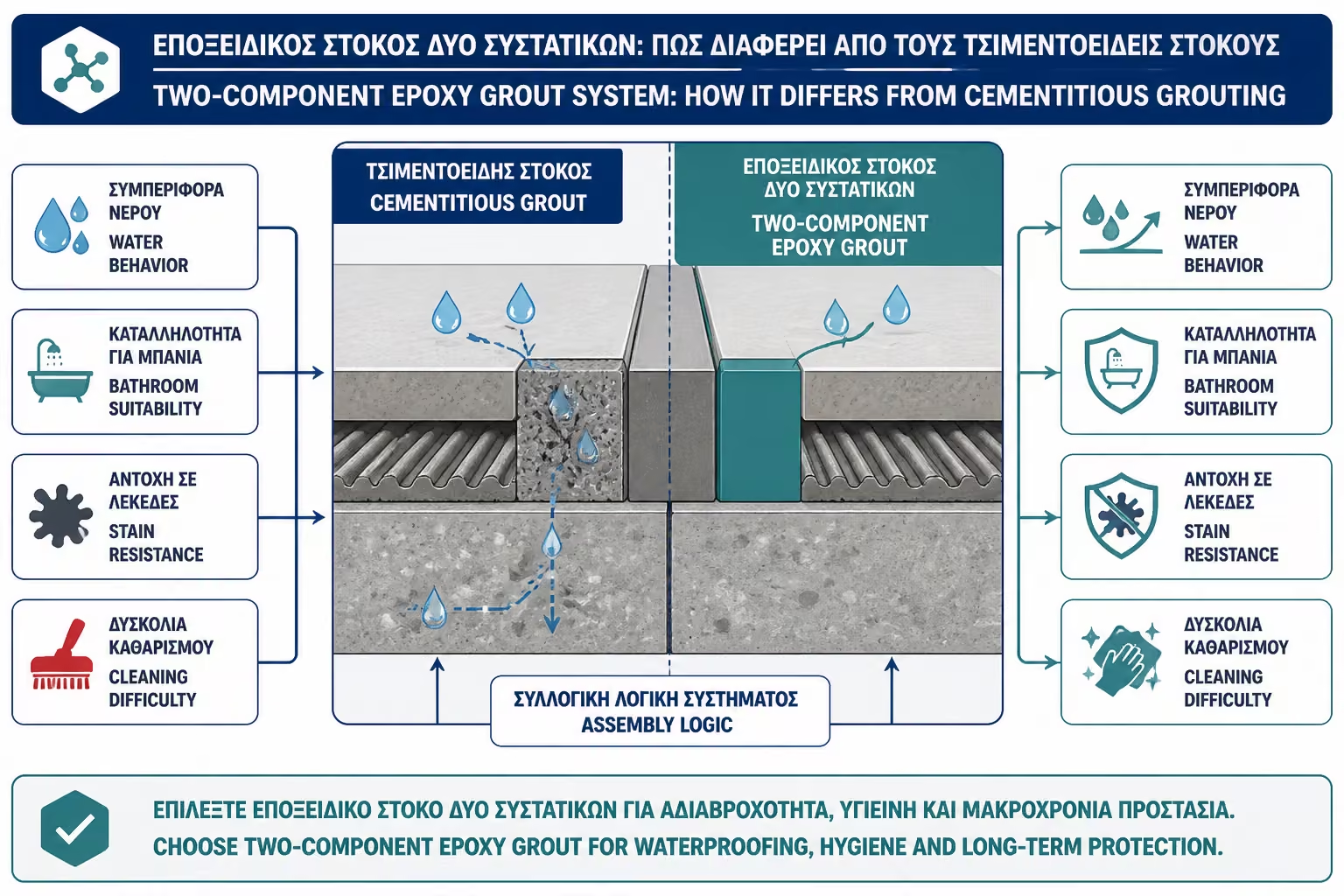
Go to categoryEpoxy grout is the solution that is usually heard when the owner wants "the best grout" for a bathroom, shower, mosaic, kitchen counter, pool or area with heavy use. Unlike classic cementitious grout, epoxy is not based on cement and water. It is a two-component resin product, usually resin and hardener, that are mixed before application and harden through a chemical reaction.
Its main advantage is that it creates a much denser, non-absorbent and durable joint. It does not behave like a porous cementitious mortar. That is why it is used in places where we want high resistance to water, stains, cleaners, soaps, oils, chemicals and frequent use. According to a LATICRETE guide, epoxy grouts are non-porous compared to cementitious grouts, which makes them highly resistant to stains, chemicals and moisture.
But here we must correct three exaggerations that are often heard. First, epoxy grout has extremely low absorption and very high water resistance, but the tile system does not automatically become a "watertight bath" just because we changed the grout. The shower is sealed under the tiles, with membranes, cementitious sealants, corner tapes and correct detailing on the siphon. Second, epoxy grout is very stain resistant, but that doesn't mean it never gets dirty or needs cleaning. Third, products with antimicrobial protection can limit the growth of mold that causes surface stains, but no joint can save a bathroom with poor ventilation, stagnant water and soaps that stay on the surface for days.
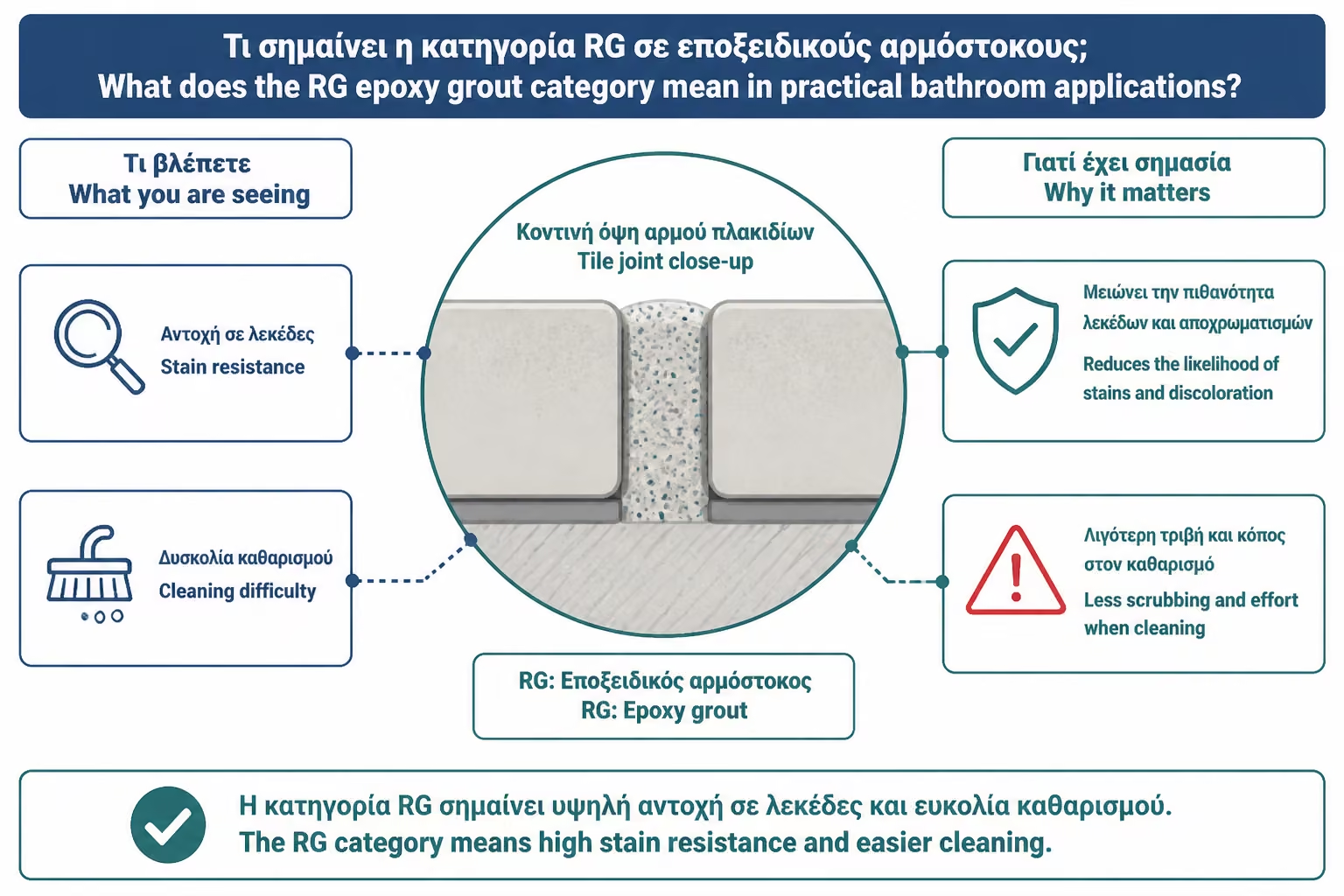
In the European classification of grouts, epoxies belong to the RG category, i.e. reaction-resin grouts. The EN 13888 standard distinguishes CG cementitious grouts from RG resin grouts, which are based on synthetic resins and harden through a chemical reaction. This means that it is not just "best cementitious". It's another technology.
In this guide we'll look at what 2-component epoxy grouts are, why they're so bath-resistant, where they're really worth it, what their drawbacks are, how to apply them correctly, what mistakes to avoid and when it makes sense to choose them over a good CG2 WA cementitious grout.
Epoxy grout is a two-component resinous material. The first component is usually epoxy resin with colored paste or aggregate, and the second is the hardener. When they are mixed, a chemical reaction starts that leads to hardening of the material. It doesn't just dry out because water evaporates. It ripens chemically.
This difference explains many of its advantages. Cementitious grout has a porous structure and can absorb moisture or dirt. Epoxy creates a much more closed and non-porous surface. It does not require a sealer, unlike many cementitious joints. LATICRETE's technical brochure for epoxy grout states that it does not require sealing and offers uniform color, durability and stain protection.
In practice, the epoxy joint looks more "plasticized" and dense. It is more difficult to stain with soaps, cosmetics, oils, cleaners or hard water. This does not make it invisible in maintenance, but it makes it much more durable than a simple cement joint.
The bathroom is one of the most difficult places for grout. The joint receives water, steam, soap, shampoo, shower gels, salts, cleaners, rubbing and frequent temperature changes. In the shower, especially, the joint can get wet every day and stay wet for a long time.
Epoxy grout excels because it does not readily absorb these materials. It does not "water" like a conventional cement joint. This means less tanning, less stain absorption and easier cleaning. Mapei, in a practical guide to epoxy grout application, states that epoxy grouts have extremely low water absorption, are more stain resistant and are less likely to favor mold growth.
This makes it a very good choice for showers, tiled floors, small joints that we want to stay clean, dark joints that we don't want to whiten, counters, kitchens, commercial WCs and high hygiene areas. It's not necessary everywhere, but where maintenance and durability are a priority, it's seriously worth it.
Epoxy grout has extremely low water absorption and practically works as a non-porous joint. In technical brochures of RG products we see very low water absorption values. For example, epoxy grout class EN 13888 RG reports water absorption after 240 minutes ≤ 0.1 g. This explains why in the everyday market it is often described as "waterproof".
But we must be precise. The joint may have extremely high water resistance, but the showerhead is not sealed by the joint alone. Water can get through corners, silicones, siphons, cracks, bad joints, supply holes or the wrong substrate. If there is no proper waterproofing under the tiles, the epoxy joint does not replace this work.
The correct phrase is: epoxy grout is extremely water-resistant and very low-absorbing, but it is not a complete bathroom waterproofing system on its own. For the owner, this means choosing it for a durable joint and easy cleaning, not to skip the waterproofing under the tiles.
Epoxy grout has very high stain resistance. This is one of its great advantages. Coffee, soaps, shower gels, body oils, make-up, hair dyes and cleaners are much less likely to be absorbed than a cement joint. Also, because it is non-porous, it is easier to clean.
But the phrase "never stains" is an exaggeration. If strongly pigmented materials, paints, metallic residues, permanent salts or aggressive cleaners are left on the surface, surface deterioration or dullness may occur. Maximum stain resistance is achieved after the product has fully cured. LATICRETE's technical guide states that maximum stain resistance is achieved after 7 days at 21°C.
So the epoxy joint is much more stain-resistant than the cement-based one, but not an excuse to give up cleaning. In the bathroom, soaps and salts should be removed. The difference is that they do not penetrate the joint as easily.
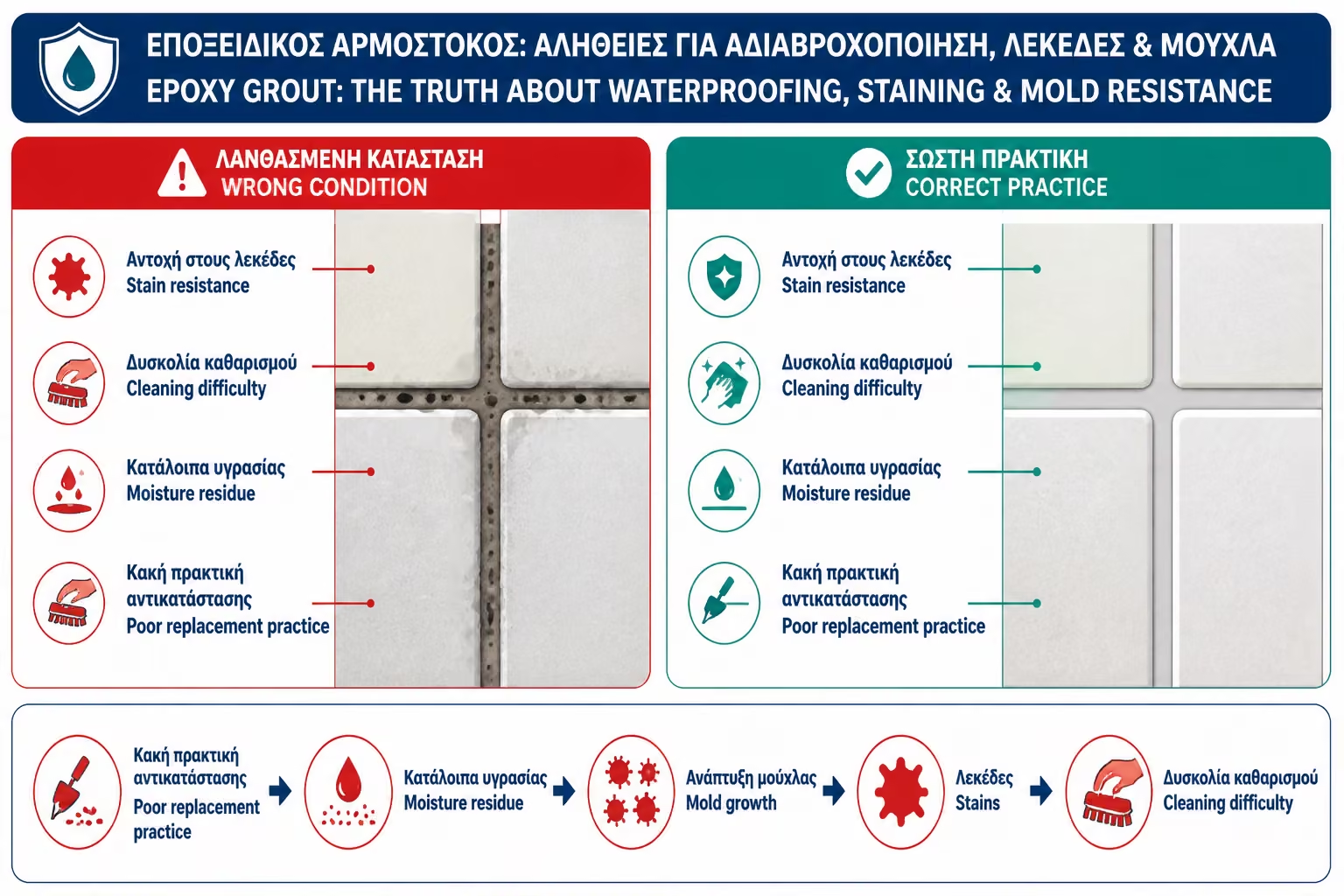
Epoxy grout does not provide the same porous environment that a cementitious grout does. This greatly reduces the chance of dirt and mold settling inside the joint. Some products also have special antimicrobial protection. For example, LATICRETE's technical brochure states that the epoxy grout product has antimicrobial product protection to combat the development of stain-causing mold and mildew. Accordingly, products such as Kerapoxy Easy Design are listed with BioBlock® technology and a bacteriostatic agent.
But mold does not only grow "inside" the joint. It can develop on surface film of soaps, on silicones, in corners, in places with poor ventilation or in joints that are constantly wet. If a bathroom has poor air circulation, stagnant water and dirty surfaces, even epoxy grout can show surface contaminants.
The correct wording is that epoxy grout is much less conducive to mold growth than cement grout and is much easier to clean. It does not mean that the bathroom does not need ventilation or cleaning.
RG stands for reaction resin grout. It is the category of resinous grouts. Unlike CG cementitious joints, RGs are based on synthetic resins and harden through a chemical reaction. EN 13888 separates these categories and sets performance requirements for ceramic tile grouts.
For the owner, `RG` is a sign that he is not simply buying a "reinforced cementitious" grout. He is buying a different chemistry, with different performance, a different application method and a different cost level. RG grouts are intended for applications where high resistance to water, chemicals, stains and abrasion is required.
If a quote says "epoxy joint", ask for the product and its category. Ideally it should appear to be suitable for the joint dimensions and type of tile. A general description is not enough.
The first advantage is very low absorption. This reduces stains, tans and soap absorption. The second is chemical resistance. Epoxy holds up better to many cleaners and chemicals than a classic cement joint. The third is color fastness. It does not show "white spots" from rashes as easily, because it does not act as a porous cement-like material.
The fourth advantage is that no sealer is needed. A good cement joint may need sealing or water repellent technology for better performance. Epoxy is already non-porous as a system. Technical brochures of epoxy grouts explicitly state that they do not need sealing.
The fifth advantage is resistance to intense use. In tiled shower floors where there is a lot of jointing, epoxy can greatly reduce future maintenance. There it shows its value more than on a large wall with large tiles and minimal joints.
The first drawback is the cost. Epoxy grout is more expensive as a material and often more expensive to labor. It is not a product that spreads as easily as a simple cement. It needs experience, organization and proper cleaning.
The second disadvantage is the working time. Once the two ingredients are mixed, time is limited. The material begins to react. If the craftsman is slow, the material hardens in the container or on the surface and becomes difficult to clean. LATICRETE's epoxy grout, for example, reports a working time of around 80 minutes at 21°C, which shows how important temperature and organization are.
The third disadvantage is haze, that is, the surface film that can remain on the tile if it is not cleaned properly. On glossy, textured, porous or natural tiles, this can become a serious problem. Epoxy grout should be cleaned at the right time with the right sponges and cleaners, not the next day haphazardly.
Epoxy grout is especially valuable on shower floors, especially with mosaics, small tiles or pebbles where there is a large volume of grout. There the cement joint will have a large contact surface with water and soaps. Epoxy greatly reduces future absorption and browning.
It's also worth it on shower walls with a dark joint, on white tiles where we want a clean image for years, in heavily used family bathrooms, in rentals/Airbnbs where we want lower maintenance, and in areas where cleaning needs to be quick and efficient.
It is not always necessary on all bathroom walls. If you have large 60x120 tiles on a wall out of direct rain, with minimal joints, a good CG2 WA may be sufficient. But if we are talking about a shower for daily use, epoxy seriously enters the comparison.
In a simple WC without a shower, epoxy grout can be technically excellent but economically excessive. In a bathroom wall that does not accept water, its value may not always justify the cost. In very small joints of large tiles, the total joint area is small, so the benefit is reduced.
Also, on very porous natural stone, epoxy grout can stain or haze if not properly tested and protected. Not all materials are compatible without preparation. A sample test is always needed, especially on marble, travertine, pumice stone, pebbles or textured surfaces.
So epoxy is not "put it everywhere and I'm done". It is a premium choice that must suit the tile, the space and the craftsman.
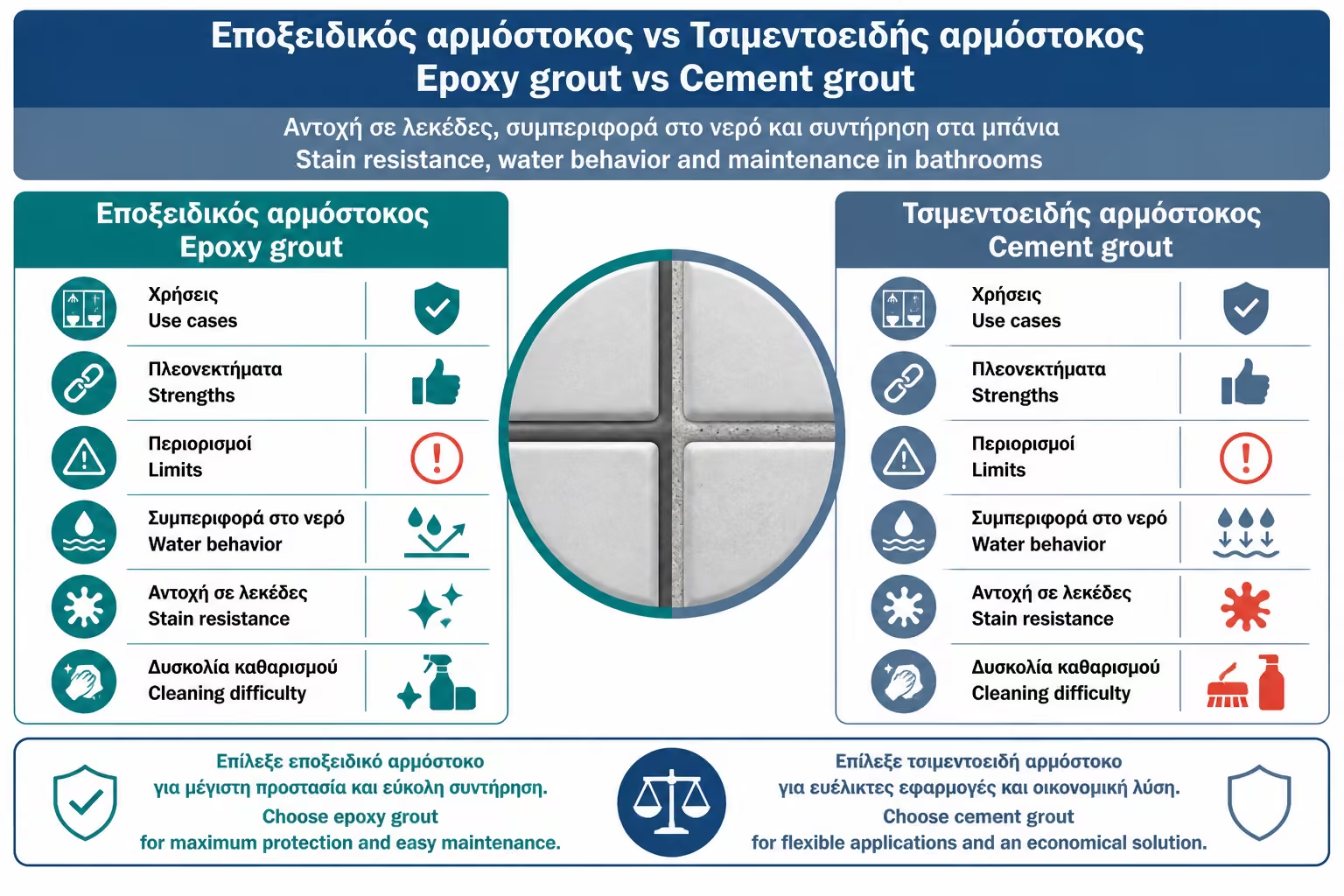
Use the table below as a quick reference for the key points of this section.
| Criterion | Cementitious grout | Epoxy grout |
|---|---|---|
| Hardware base | Cement, aggregates, additives | Resin and hardener |
| Category | CG1 / CG2 / CG2 WA | RG |
| Absorption of water | Exists, reduced to CG2 W/WA | Very low |
| Stain resistance | Good to average, depending on the product | Very high |
| Chemical resistance | Limited to epoxy | High |
| Application | Easier and familiar | More demanding |
| Cleaning during application | More forgiving | It must be done immediately and correctly |
| Sealer | Sometimes it helps | You usually don't need to |
| Cost | Lower | Higher |
| Ideal use | Typical bathrooms, walls, floors | Showers, mosaics, heavy use, stains |
The table shows that epoxy is technically superior in strength, but more demanding and expensive.
Before applying epoxy grout, the joints must be clean, dry and of the correct depth. They must not have adhesive residues, dust, water or foreign bodies. If the joints are filled to the top with glue, the grout will not have sufficient depth and may not work properly.
The tile adhesive must be sufficiently cured. We do not hastily grout on wet glue or on a substrate that retains moisture. Especially on large porcelain tiles, the moisture in the glue can be slow to leave. The manufacturer's times must be observed.
Before application, sensitive surfaces must be protected. On natural stone, embossed tiles or matt porous surfaces, a test is carried out. If the epoxy leaves a film and is not thoroughly cleaned, repair is difficult.
Epoxy grout does not mix "by eye". The two ingredients must be mixed in the ratio given by the manufacturer. We do not add water to make it easier. We do not arbitrarily divide packages if we cannot measure accurately. An incorrect ratio can result in material that does not cure properly, remains sticky or loses strength.
Mixing should be done well, until a homogeneous material is obtained. The walls and bottom of the container must be cleaned during mixing so that no loose material remains. Transfer to a second clean container and second mixing is recommended in many systems, especially in demanding applications, to reduce the risk of undermixing at the ends.
Temperature greatly affects working time. In a warm place, the epoxy hardens faster. In a cold place, it works more slowly but it can be difficult to spread. The application must be planned based on the conditions.
Epoxy grout is applied with a hard rubber spatula or a special grouting spatula, pressing the material diagonally into the joints so that they are completely filled. There should be no gaps, bubbles or empty zones. The excess is removed as much as possible from the surface with the spatula, before washing begins.
On walls, the non-slip of the product is important. Many modern epoxy grouts have non-sag formulas so they work better on vertical surfaces. LATICRETE mentions, for example, improved non-sag formula for walls and floors in an epoxy grout product.
The craftsman should not spread a huge area if he cannot clean it in time. Epoxy grouting is done in sections. The organization is basic: application, first cleanse, second cleanse, haze control.
The first cleaning is the most critical stage. It is done while the epoxy is still fresh, with a suitable sponge, water and, where the product provides, a special cleaner or pad. The goal is to shape the joint and remove the excess from the tile without draining the joint.
The sponge should be rinsed frequently and the water changed. If we just move the epoxy film from one point to another, it will remain haze. On embossed tiles, cleaning must be even more careful, because the resin can get into the textures.
Excessive water should not be used if the product does not allow it. Not all epoxies work the same way. We follow the technical brochure, not general habits of cement joints.
After the first cleaning, a second pass follows, usually with clean water or a special cleaner, depending on the product. The second cleaning removes the thin film that may remain on the tile. This should be done at the right time. If done too early, the joint may fail. If done too late, the film hardens and is difficult to remove.
After drying, the craftsman should check the surface from a side angle of light. Epoxy haze is often seen when light falls obliquely. If detected early, it is much easier to remove. If it remains for the next day or more, it may require special epoxy residue remover and more work.
On glossy tiles, haze appears as a blur. On matte tiles it can be more insidious. On embossed tiles it can stay in the texture. This is why sample testing is important.
Epoxy grout takes time to develop full strength. It can be surface hard in a few hours, but full chemical and stain resistance performance takes longer. As mentioned, LATICRETE technical guide gives maximum stain resistance after 7 days at 21°C.
This means that the shower should not be used prematurely. Manufacturer gives waiting time for light traffic, cleaning, water exposure and chemical stress. These times must be observed. If the shower is used too soon, the joint may not have developed full strength.
In professional projects or Airbnb, the time pressure is great. But rushing into an epoxy joint can ruin an expensive material. Site delivery must be scheduled on a product-by-product basis.
Use the table below as a quick reference for the key points of this section.
| Space / application | Epoxy grout | Comment |
|---|---|---|
| Tiled shower floor | Very good choice | Large joint surface, frequent water |
| Shower walls | Very good choice | Easy to clean, less tan |
| Bathroom for daily use | Good to premium option | Ideal if we want low maintenance |
| WC without shower | Often an exaggeration | Good cementitious CG2 WA may suffice |
| Kitchen / counter / backsplash | Very good choice | Resistance to stains and cleaners |
| Natural porous stone | With care | It wants testing and possible protection |
| Embossed tiles | With care | Risk of haze on textures |
| Pools/spa | Often an ideal choice | Depending on product and system |
Epoxy is worth more where use is heavy and the joint is actually exposed to water or stains.
In the Greek market of 2026, epoxy grout is clearly more expensive than cementitious grout. The price of the material can be many times that of a good CG2 WA, and the labor costs more due to difficulty, time and the need for proper cleaning. On small surfaces, such as a shower floor, the total additional cost can be reasonable. In an entire bathroom with many walls, the difference grows.
Realistically, the smartest use is often selective: epoxy in high stress zones such as shower floor, shower walls, tiles or countertops, and good cementitious CG2 WA on softer surfaces. This puts technical value where it's needed without needlessly driving up costs.
Risk must also be calculated. A poorly applied epoxy can leave a haze and require difficult cleanup. So it is not enough to buy expensive hardware. You must also pay a craftsman who knows it.
The first mistake is the wrong mixing of the two ingredients. If the ratio is not correct, the material may not harden properly.
The second mistake is the application on a very large surface without the possibility of immediate cleaning. Epoxy is not as forgiving of delays as a cementitious.
The third mistake is applying to textured or porous tiles without testing. Haze can remain on the texture and is difficult to remove.
The fourth mistake is premature use of the shower. Full endurance takes time.
The fifth mistake is the belief that the epoxy joint replaces the waterproofing. It doesn't replace it.
Use the table below as a quick reference for the key points of this section.
| Question | Yes / No |
|---|---|
| Is the product RG class according to EN 13888? | Yes / No |
| Does the handyman have experience with epoxy grouts? | Yes / No |
| Has a tile sample been tested, especially if it is matte, textured or natural stone? | Yes / No |
| Are the joints clean, dry and at the correct depth? | Yes / No |
| Is the tile adhesive sufficiently cured? | Yes / No |
| Are there proper sponges, pads and cleaners for epoxy haze? | Yes / No |
| Is work planned on small areas per stage? | Yes / No |
| Is there a curing time before using the shower? | Yes / No |
| Is there normal waterproofing under the shower tiles? | Yes / No |
| Does the quote say a specific product and not just "epoxy joint"? | Yes / No |
If the answers are unclear, take your time. Epoxy grout is a great material, but the quality shows in the application.
Epoxy grout is probably the best choice for joints that get wet every day, especially in shower floors, tiles and high-use bathrooms. But don't choose it with the logic "put epoxy and I'm done". It needs proper mixing, quick and careful cleaning, haze control and curing time. And most importantly, it does not replace the waterproofing under the tiles. If the shower is not properly waterproofed, the best grout will only delay the problem, not solve it.
2-component epoxy grouts are a premium solution for bathrooms, showers and demanding applications. Compared to cementitious ones, they offer much lower absorption, higher stain resistance, better behavior towards chemicals and cleaners, and much easier long-term cleaning. For shower floors, tiles and heavy use, the difference can be dramatic.
At the same time, they must be approached realistically. It doesn't mean they never get dirty, it doesn't mean they don't need cleaning, it doesn't mean they eliminate mold from a poorly ventilated bathroom, and it doesn't mean they seal an uninsulated shower. It's an extremely durable joint, not a magic fix for wrong construction.
The right choice is to use it where its value can be seen: in the shower, on mosaics, in places with water, stains and intense cleaning. If applied by an experienced craftsman, with correct preparation and correct times, it can keep the image of the bathroom clean and stable for many years. If applied haphazardly, it can become an expensive problem. In epoxies, the material is top notch, but the application is half the battle.
Return to category.
Go to categoryReturn to the central guide.
Go to guide