
Bathroom Surface Materials & Finishes
Return to category.
Go to categoryPressed cement mortar inside the shower is one of the most striking solutions in a modern bathroom. It creates a seamless image, without tile joints or visual breaks, with a natural, handmade texture that fits perfectly in minimal, Cycladic and boutique interiors. A walk-in shower finished in microcement on both walls and floor can feel like a single architectural shell, much calmer and more refined than a conventional tiled shower.
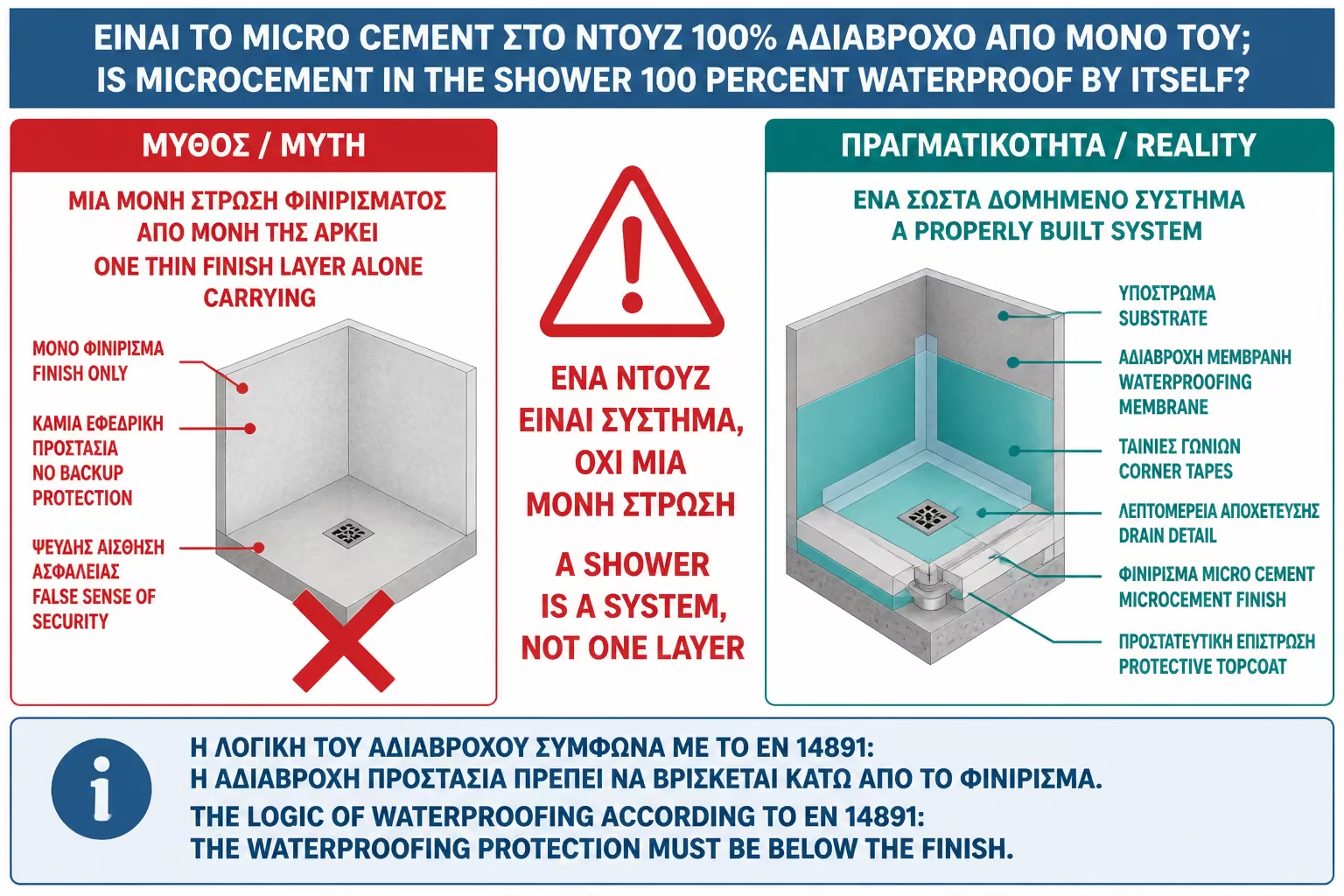
But the main question is not whether it looks beautiful. It is whether it can perform. And here the answer has to be clear: shower microcement can be made highly water resistant, but it should never be presented as "100% waterproof" on its own. The final result depends on the whole system: substrate, waterproofing, corners, drain, falls, microcement coats, reinforcement where needed and the final protective varnish. The microcement itself is part of the solution, not the only line of defense.
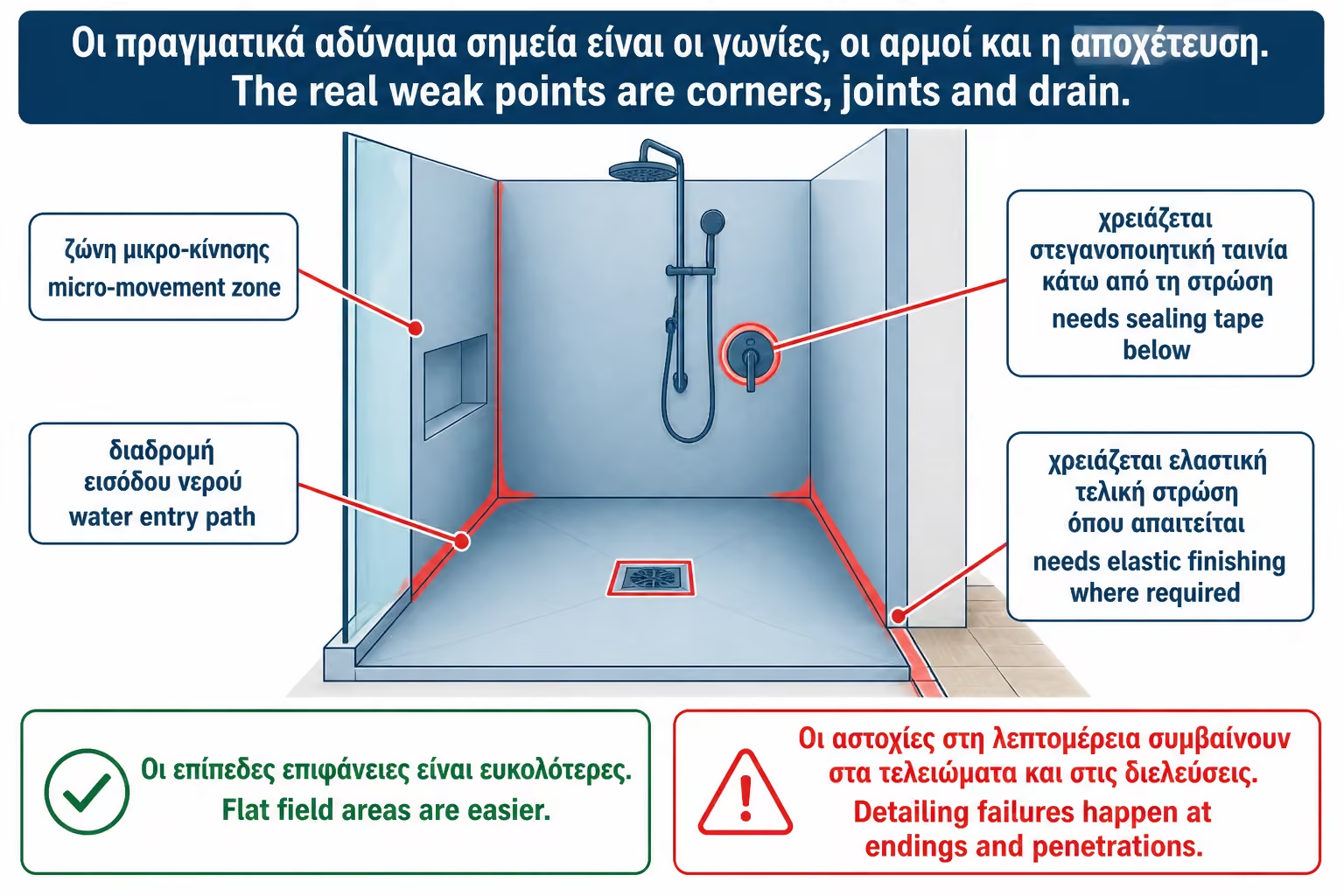
This is the main misunderstanding in the market. The owner hears "a seamless finish means no water can get through" and assumes the issue is solved. In reality, even a surface without tile joints still has critical points: wall-to-floor junctions, the drain, corners, pipe penetrations, connections to glass, edge details and possible micro-movements in the substrate. If those are not handled properly, water will find a path.
Serious builders and applicators treat microcement as a multi-stage system, not just a decorative layer. Surface preparation, correct coats, waterproofing and final protective are all critical steps. Technical application guides emphasize that microcement is not a product that is simply spread, but a complete system that must be applied step by step to avoid problems and future failures.
In this guide, we will look at what a "waterproof" microcement shower really means, the difference between water resistance and full waterproofing, why 2-component polyurethane varnishes matter so much, how to avoid cracking, what to ask your installer and when microcement in the shower is the right choice, or when tile is the safer route.
The most honest answer is: not by itself. It can work as a highly durable, water-resistant finish when it is part of a proper system, but it should not be treated as a magic film that solves everything on its own. Pressed cement mortar, or microcement, is a thin finishing layer. Real protection in a shower has to come from the layers and details below it and above it.
In practice, the shower should have waterproofing below the finished surface. That may be a suitable membrane, a cementitious waterproofing layer, a resin system or another certified solution, depending on the project and the manufacturer. In European waterproofing practice, EN 14891 covers wet-applied waterproofing products used under ceramic finishes, such as cementitious, dispersion and resin coatings. Even though microcement is not tile, the principle is the same: the finish should not be the only defense against water.
If someone tells you "there is no need for waterproofing because the microcement itself is waterproof", that should worry you. A proper shower is not based on one layer. It is based on a system. Microcement can be very durable, but if the substrate cracks, if the sealer fails, if there is a mistake around the drain, or if the corners are not reinforced and sealed properly, the finish alone is not enough.
In bathroom renovations, the words "waterproof," "sealed" and "water-resistant" are often used as if they mean the same thing. They do not. And that confusion creates the wrong expectations from the start.
Water resistance means that a material withstands contact with water without being easily damaged. Waterproofing the surface means that with the appropriate varnishes or sealers the absorption is drastically reduced and the final layer is protected. Waterproofing means that the system prevents water from passing into the structure behind or under the lining.
A microcement surface may be water-resistant and well sealed, but if there is no proper waterproofing at the corners and around the drain, the shower can still fail. Likewise, a very good sealer can protect the finish from stains and moisture, but it cannot correct substrate cracks or poor falls that leave water standing.
In practical terms, the owner should not be asking, "Is the microcement waterproof?" but rather, "What is the complete waterproofing and protection system for this shower?" That is the right question.
The walls of a bathroom outside the shower receive mainly water vapor and occasional splashes. The bathroom floor receives water and pressure. The shower, however, receives continuous and direct contact with water, hot-cold, shampoo, soaps, salts, cleaners, bare feet and mechanical stress.
On the shower floor there is also the issue of falls. If water does not drain properly to the outlet, it stays on the microcement. The longer it stays, the more the sealer is stressed, the more limescale builds up and the greater the chance of dulling or wear. A seamless finish may look perfect, but it cannot hide a bad drainage design.
A practical example: in a walk-in shower with a linear drain, if the fall is correct and water leaves quickly, the surface is under much less stress. But if the fall is insufficient or there are small depressions, water will remain on the floor. That is not necessarily a failure of the microcement itself. It is a problem of the base or the construction detail.
Microcement is a thin finish. It is not a material that corrects loose substrates, hollow tiles, movement, moisture or cracks. If the substrate has a problem, that problem may later appear in the finished surface as cracking, lifting, peeling or general deterioration.
In new construction, the base must be firm, mature, dry and properly shaped. When renovating over old tiles, it must be checked whether the old tiles are well glued. If there are hollow spots, it is not enough to cover them. They must be fixed or removed. Stepping over hollow tiles is like painting over a peeling wall.
The substrate must also be level where needed and formed with the correct falls toward the drain. We should not try to create those falls with microcement alone. The geometry has to be solved in the base. Microcement follows the surface; it is not a construction tool for correcting major geometric errors.
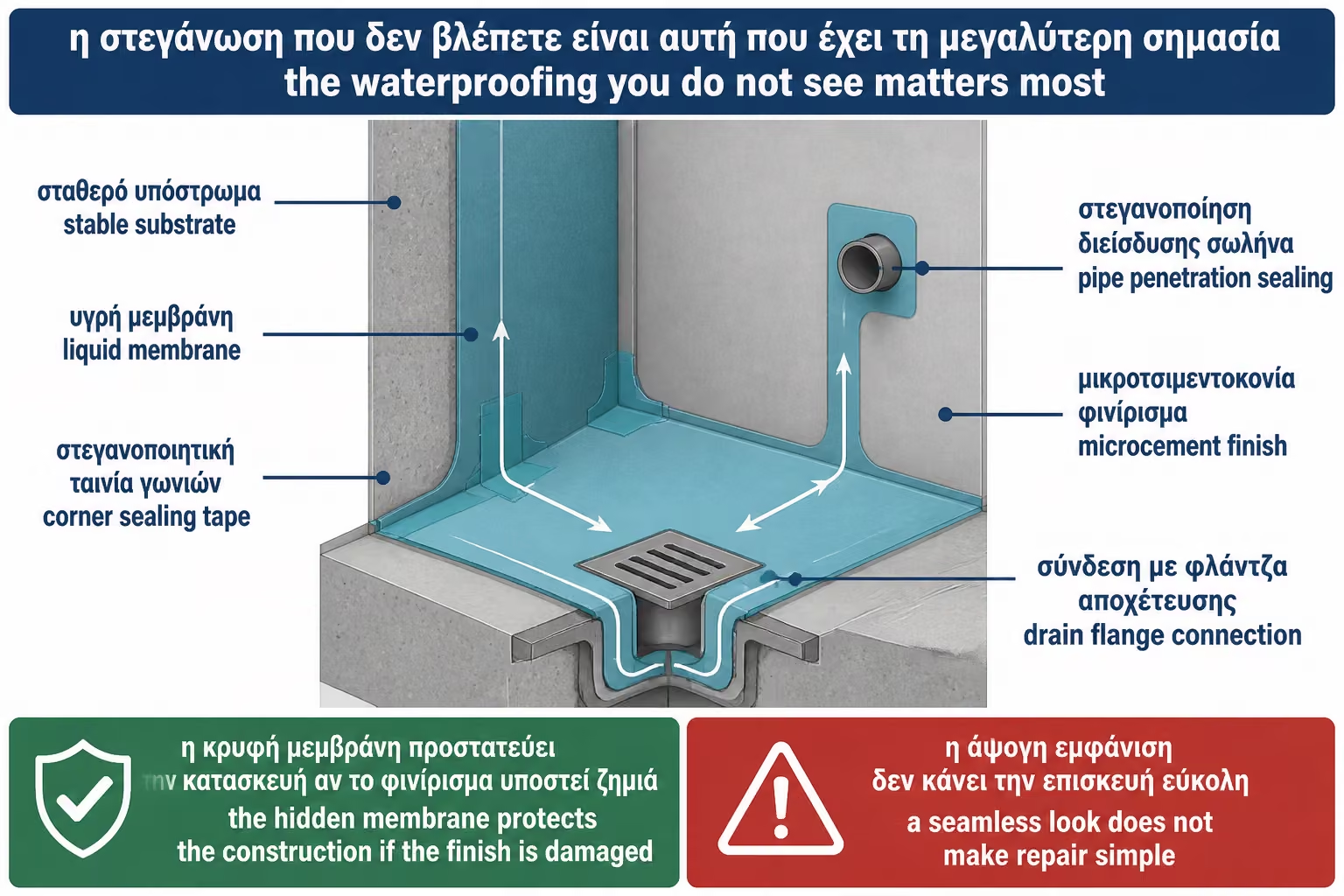
In the shower, the most important stage is the one that never appears in the final photo. Before the microcement goes on, there must be proper waterproofing at the walls, floor, corners, drain and pipe penetrations. That hidden layer is what protects the construction if the finish is ever damaged or if a small failure appears later.
Wet-area systems usually include a membrane, waterproofing tapes at the corners, special treatment around penetrations and drains, and full continuity of the waterproofing layer. In wet-room specifications, the membrane is typically used together with compatible tapes at joints, perimeter terminations, fittings and pipe penetrations before the final finish is applied.
With microcement this matters even more because the final image is continuous. If there is a mistake, repair is not as simple as changing one tile. Local or even full reapplication may be necessary, and a truly invisible repair is not always possible.
Flat surfaces are the easy part. Difficult points are corners, wall-floor junctions, siphons, facilities and encounters with other materials. There, micro-movements, stresses and water entry points are created.
In the corners of the shower we should not rely only on the rigidity of the treadle. It needs proper sealing tape under the system and proper rubber finishing where required. The same is true around the linear siphon. The connection of the end surface with the siphon must be technically correct, not just beautiful.
One of the most common problems with built-in showers is that water finds its way not from the middle of the surface, but from the ends. A small failure in the connection to the siphon or in a corner can cause moisture behind the lining. The press should not be used to "cover up" such details. They must be properly designed.
The final varnish or sealer is the surface that will come into daily contact with water, soaps, cleaners and feet. For a shower, simple guards are not enough. A high-quality 2-component polyurethane varnish or other equivalent professional topcoat suitable for wet areas is usually required, depending on the system.
2K polyurethane products consist of a base and hardener. After mixing, they create a more durable protective layer than simple one-component products. Microcement manufacturers report that two-component polyurethane varnishes are used to protect and preserve the microcement, offering resistance to wear, abrasion, scratches, chemicals, dirt and yellowing, depending on the product.
This does not mean that any 2K varnish is suitable for a shower. It must be compatible with the specific microcement system, suitable for wet areas, correctly applied in the required layers and allowed to dry for the proper amount of time. If the varnish is applied carelessly, too thinly, on a damp base or without proper preparation, its theoretical strength will not translate into real protection.
There is no one answer that applies to all systems. Each manufacturer has its own technical instruction. But usually a proper shower system involves more stages than a simple decorative application on a dry wall. It includes substrate preparation, primer, waterproofing, corner reinforcements, microcement layers, sanding and final protective layers.
The owner does not need to know every chemical detail. But the system should be requested in writing. What products will be used? How many coats? Which sealer? Is it a 2-component product? Is it rated for shower use? How long before the space can be used?
If the answer is simply "we will apply microcement and a varnish," that is not enough. In a shower, the procedure has to be specific. The vaguer the description, the greater the risk.
Cracks are one of the biggest fears with microcement. Small capillary cracks can appear if the substrate moves, if there are pre-existing cracks, if the reinforcement has not been done correctly, if the layers have been applied badly or if the base has not matured properly. On a dry wall, a small crack may be mainly cosmetic. Inside the shower, however, it can become a functional problem.
Preventing cracks starts at the base. Stable substrate, proper preparation, use of mesh or reinforcing layer where required, sealing tapes in the corners, respect for drying times and compatible products. The microcement must not bridge active cracks or movements as if it were an elastic membrane.
A good installer will check the substrate before giving a final guarantee. It won't just say "goes everywhere". It will explain where reinforcement is needed, where there is risk and what needs to be fixed before the system is implemented.
Microcement in the shower has to work together with correct falls. The floor must guide water to the drain without pooling points. If the surface stays wet for too long, the stress on the sealer increases and limescale forms faster.
The choice of drain matters. With a linear drain, the fall can often be formed more clearly in one direction, which suits the seamless aesthetic of microcement. With a central drain, the falls are more complex. That is not impossible, but it requires a better-formed base.
Microcement has no joints that visually break the falls, as mosaics do. That is beautiful, but it also means the geometry has to be done precisely. Even a small dip will show up as water left on the surface after showering.
Microcement is often chosen for its smooth, continuous appearance. But inside the shower, the surface should not only be beautiful. It must also be safe. Water, soap and bare feet completely change how the material behaves.
The final sealer and the texture of the surface both affect slip resistance. A very glossy or very smooth finish may be more slippery. A more matte or slightly textured finish may be safer, even if it is a little harder to clean. The applicator should recommend a finish suitable for wet barefoot use, not simply the prettiest one on the sample.
In bathrooms with children, the elderly or people with reduced mobility, anti-slip should come above the perfectly smooth minimal image. A bathroom can only be beautiful if it is safe to use.
Microcement has no tile joints, so it is easier to clean than surfaces with lots of grout lines. That is a real advantage. But there will still be limescale, soap residue and other deposits in the shower. If the water is hard and the surface is dark, those marks will show.
Daily maintenance should be done with mild, neutral detergents, according to the manufacturer's instructions. Many microcement care guides recommend pH-neutral cleaners and the avoidance of harsh chemicals so as not to wear down the protective layer. Strong anti-salt or acidic bathroom cleaners can be a problem if they are not compatible with the sealer.
In practice, it helps to rinse off soap residue and, ideally, pass a squeegee over the surface after showering. That is not essential for everyone, but on dark finishes or in hard-water areas it makes a big difference. Microcement is not necessarily hard to maintain, but it does need the right maintenance habits.
A critical point that is often overlooked is curing time. The microcement and the final varnish need time to develop their full properties. The shower should not be used just because the surface feels dry to the touch.
The exact time depends on the system, temperature, humidity and manufacturer's instructions. Some products quote times per coat, such as several hours for microcement and PU sealer in specific conditions, but full wet area use must strictly follow the applicator's and material's technical instruction. Indicatively, in microcement systems for wet areas, the use of polyurethane sealing and specific curing times per layer is indicated.
If the space is used too soon, the sealer may not have developed full strength. This can lead to dulling, staining or premature wear. In renovations where the owner is forced to use the bathroom immediately, this must be factored into the plan.
A proper quote for a walk-in shower should not just say "microcement shower application." It must describe the system in detail. It should state substrate preparation, waterproofing, corner reinforcement, microcement coats, final varnish, the type of sealer, whether it is 2-component, and the application and curing times.
It should also clarify whether substrate corrections, slopes, siphon connection, silicone or rubber seals, VAT and warranties are included. If the shower is in an old bathroom, it must state what to do if hollow tiles or moisture are found.
The press is work where the difference between a cheap and a good bid may not show on paper, but it does show in the work. If an offer is too low, you need to ask what it doesn't include.
Use the table below as a quick reference for the key points of this section.
| Stage | Correct approach | Rough approach |
|---|---|---|
| Substrate | Check for stability, moisture, cracks and slopes | Applying to what exists |
| Waterproofing | Complete system on floor, walls, corners and siphon | "The press is waterproof, you don't need it" |
| Angles | Tapes, reinforcement and elastic details where required | Rigid application without predicting movements |
| Microcement | Compatible layers according to technical system | Vague application without specifications |
| Varnish | Suitable 2K PU or other wet area topcoat | Simple varnish without technical confirmation |
| Slopes | Formed into the base before final application | Rough correction with topcoat |
| Ripening time | Use after system times | Use as soon as "dry" |
| Maintenance | Instructions for cleaners and rechecking | No updates after the project |
This table is one of the most useful tools for the owner. If the contractor cannot clearly describe the stages, the choice is risky.
Microcement in the shower is more demanding than microcement on a simple dry wall. It includes waterproofing, more details, corners, drain detailing, falls, wet-area sealer and higher liability. That is why it should not be compared with a simple tile price per square meter.
In the Greek market of 2026, a simple microcement application may start at lower levels per square meter when the surfaces are large and straightforward. In a shower, however, especially in a small bathroom, the cost rises because there are many stages and minimum contractor fees. Realistically, for a complete microcement application in a wet area with proper preparation and 2K protection, indicative prices can be around €60-120/sq.m. or more, depending on the system, the surface, the preparation, the area, VAT and the level of difficulty. In special applications with built showers, counters, niches and difficult details, pricing is often done as a total project rather than simply by square footage.
The important thing is to compare offers with the same scope. A quote that includes waterproofing, tapes, 2K polyurethane, proper curing times and a warranty is not the same as a quote that just includes "microcement and varnish." A cheap shower solution can become very expensive if it later has to be stripped out.
Microcement in the shower is a good choice when the owner wants a seamless aesthetic, accepts the need for a skilled installer and is willing to follow the right maintenance routine. It is particularly suitable for modern, Cycladic and boutique bathrooms, for walk-in showers, for built elements and for spaces where continuity of surface is a key requirement.
It is also a good choice when it is possible to create a proper base from scratch: a new shower area, correct falls, correct drain detailing, full waterproofing and a good applicator. When all those conditions are met, the result can be extraordinary.
It is not a good choice when the owner wants the cheapest solution, when the substrate is questionable, when there is no time for proper application and curing, or when he does not want any special care. In such cases, a good porcelain tile can be a safer and more predictable solution.
The first mistake is the phrase "100% waterproof". No finish should be treated as an absolute guarantee without a proper system underneath. The correct one is "high water resistance under proper application".
The second mistake is the lack of waterproofing under the microcement. If water reaches the structure, repair is difficult.
The third mistake is the wrong varnish. In a shower, you need a professional topcoat suitable for wet areas, usually 2 components, and not simple protection of a decorative surface.
The fourth mistake is bad slopes. If water remains, the system suffers and the salts appear faster.
The fifth mistake is the application on an unstable substrate. If there are movements or hollow spots, cracks are more likely.
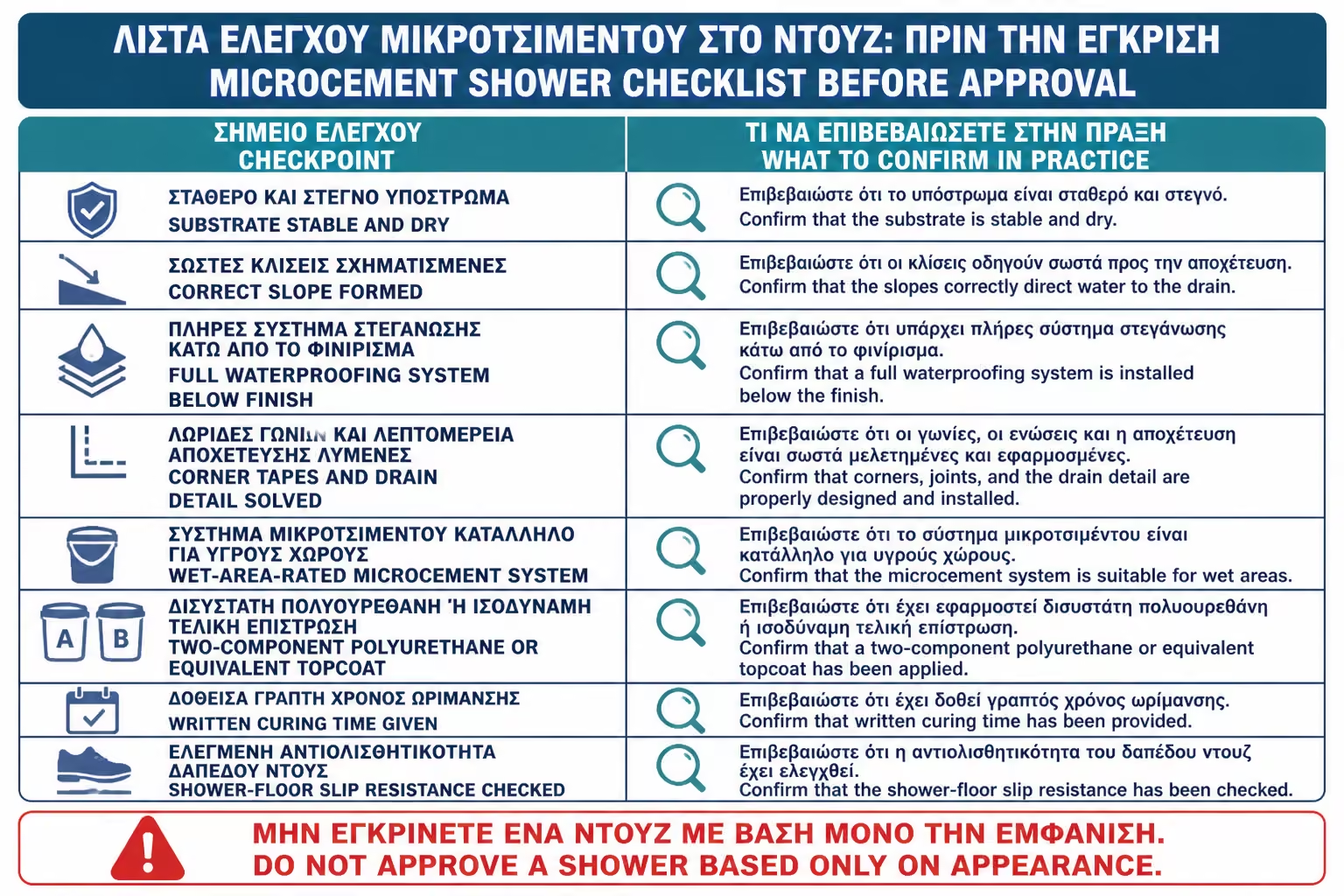
Use the table below as a quick reference for the key points of this section.
| Question | Yes / No |
|---|---|
| Has the substrate been checked for stability and moisture-free? | Yes / No |
| Have proper slopes been formed before final application? | Yes / No |
| Is there a complete waterproofing system under the microcement? | Yes / No |
| Are corner tapes provided and correct siphon detailing? | Yes / No |
| Is microcement suitable for wet areas? | Yes / No |
| Is the final varnish a 2-component polyurethane or equivalent wet area topcoat? | Yes / No |
| Do you have written instructions for the times before the shower is used? | Yes / No |
| Has the shower floor been non-slip tested? | Yes / No |
| Do you know which cleaners are allowed and which are not? | Yes / No |
| Does the offer describe all stages in detail and not just say "microcement"? | Yes / No |
If the answer to most of these questions is "no," the application should not begin. The shower is the most demanding area of the bathroom and it does not forgive vague solutions.
If you want microcement in the shower, never be satisfied with the phrase "it's 100% waterproof." Ask to see the complete system: substrate, waterproofing, corner tapes, drain detailing, microcement coats and the final 2-component polyurethane varnish suitable for wet areas. Microcement can deliver an impressive and durable result, but only when it works as part of a proper construction. The critical point is not the beautiful topcoat; it is what sits underneath it and what protects it on top.
Pressed cement mortar inside the shower can be an excellent choice for modern and Cycladic bathrooms. It offers a single surface, without tile joints, clean aesthetics and a sense of high architectural quality. When applied properly, it can withstand the wet environment of the shower very well.
But it should not be presented as "100% waterproof" by itself. Real safety comes from a system: correct substrate, waterproofing, correct slopes, siphon details, crack prevention, suitable microcement layers and high quality 2K polyurethane protection. If one of them is missing, the risk increases.
For the owner, the best attitude is neither fear nor overexcitement. Microcement in the shower is worth it when there is a serious installer, a written technical description and realistic maintenance expectations. If the project is treated casually or only as decoration, a good tile remains the safer choice. But if it is done properly, microcement can give the bathroom a result that feels genuinely designed, not merely renovated.
Return to category.
Go to categoryReturn to the central guide.
Go to guide