
Bathroom Surface Materials & Finishes
Return to category.
Go to categoryResinous additives, latex emulsions and mortar improvers are among the materials that are often heard on construction sites, but are often used in the wrong way. Another sees them as a "magic juice" that makes any glue elastic. Another throws them into any mixture to "strengthen". Another avoids them altogether because he considers that modern adhesives are already ready. The truth is more technical: latex additives can significantly improve the adhesion, elasticity, abrasion resistance and moisture resistance of a cementitious material, but only when they are compatible with the specific product and used in the correct proportions.
In the old construction site logic, many mortars were made on site with cement, sand and water. If we wanted better adhesion or greater resistance, we added resin emulsion. Today, however, most good tile adhesives are already polymer-modified from the factory. A C2TE S1 adhesive, for example, is already designed for specific adhesion, working time, reduced slip and deformability performance. If we arbitrarily add latex to such an adhesive, we may not improve it. We might upset her chemical balance.
Latex additives have real value when the manufacturer provides them. For example, Mapei Isolastic is described as a latex additive that gives elasticity to cementitious adhesives, while in combination with Kerabond Plus it gives, according to the technical data sheet, deformability S2 according to EN 12002, i.e. a highly deformable system. Accordingly, LATICRETE describes 3701 Mortar Admix as a latex admixture used in place of water to improve the working and physical properties of cementitious mixtures such as adhesives, grouts, mortars and screeds.
This shows the bottom line: latex is not just an additive "to make it waterproof". It is part of a specific system. It can increase adhesion, flexibility, thermal shock resistance, impact resistance and water repellency. For example, SikaCeram A 200, an SBR emulsion, is reported to improve adhesion, flexibility, impact and thermal shock resistance, and water resistance in sand/cement mortar mixes. But "water resistant" does not mean complete waterproofing of the shower, nor does it mean that there is no need for a membrane, the right glue or the right grout.
In this guide we will look at what latex and resinous improvers are, when they are used in adhesives, grouts and mortars, what their advantages and limitations are, when you should not add them arbitrarily, how they differ from ready-made polymer products and how to request a correct technical specification from the craftsman.
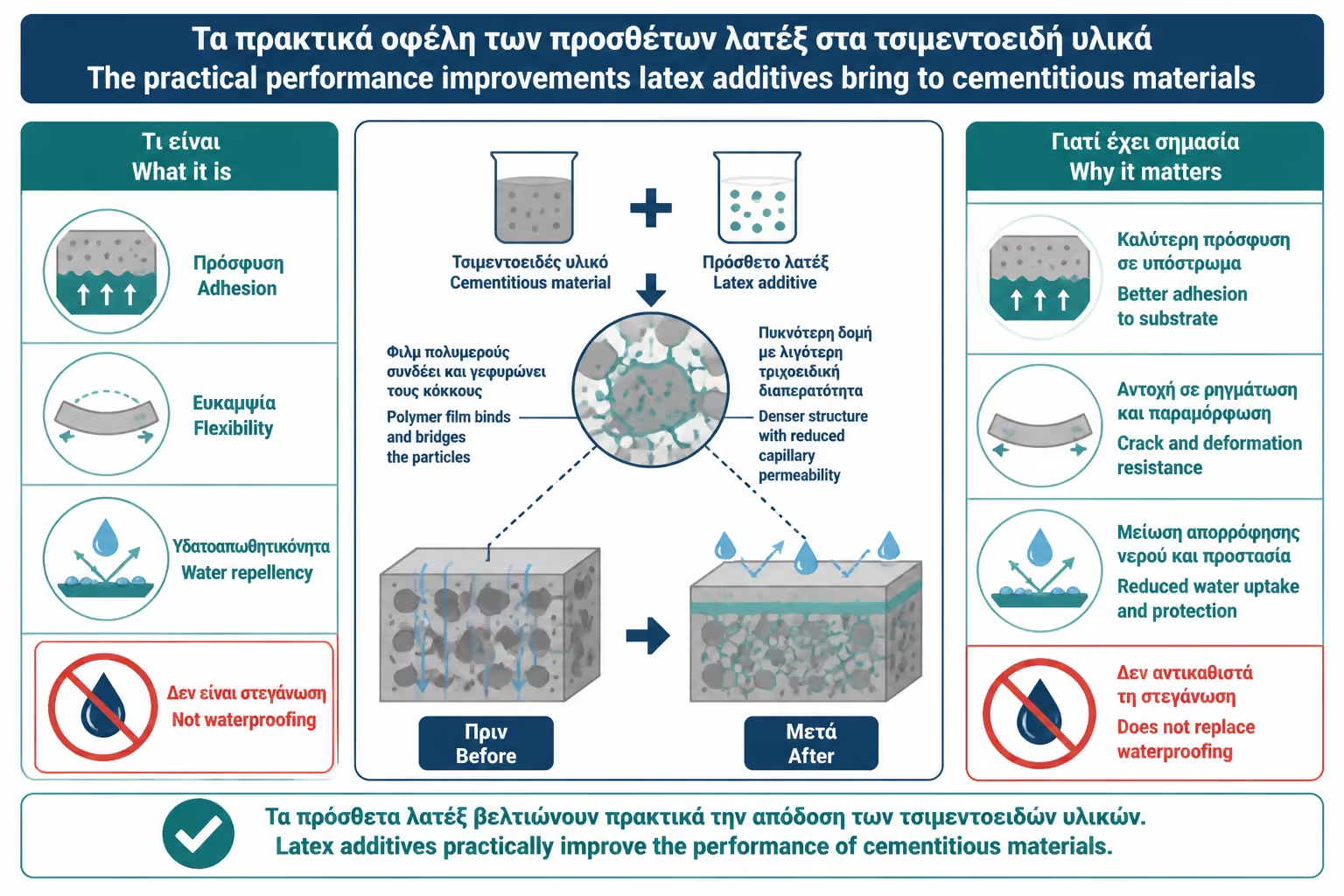
Resinous additives are liquid polymer emulsions added to cementitious materials to improve specific properties. It can be SBR latex, acrylic emulsions, synthetic resins or special polymeric additives. They are usually used in place of some or all of the mixing water, depending on the product instructions.
Their logic is that cementitious mortar does not function only as a rigid mineral mass. With the addition of polymer, it acquires better adhesion, better cohesion, greater abrasion resistance, reduced absorption and better behavior in small movements. Simply put, the mortar becomes more "bound" and less brittle.
But not all plugins should be confused with each other. Another is a latex for tile adhesive, another SBR for mortars, another an acrylic additive for grout, another a waterproofing admixture and another a primer. They may look like white emulsions, but they don't always have the same chemistry or use.
Latex additives can improve various properties of cementitious materials. The best known is adhesion. A latex mortar may adhere better to certain substrates, especially where plain cement would be marginal. This is important in repairs, thin coats, slurry bond coats, floor screeds and some tile applications.
The second property is flexibility or deformability. The polymer helps the mortar better withstand micro-movements and thermal changes. This is important in underfloor heating, outdoor spaces, large tiles or "working" substrates.
The third property is reduced water absorption. A resin-modified mortar can be more resistant to moisture than a plain one. But here you need to be careful. Reduced absorption does not mean complete sealing. A latex-modified mortar can withstand water better, but it does not replace a waterproofing system in a bathroom or shower.
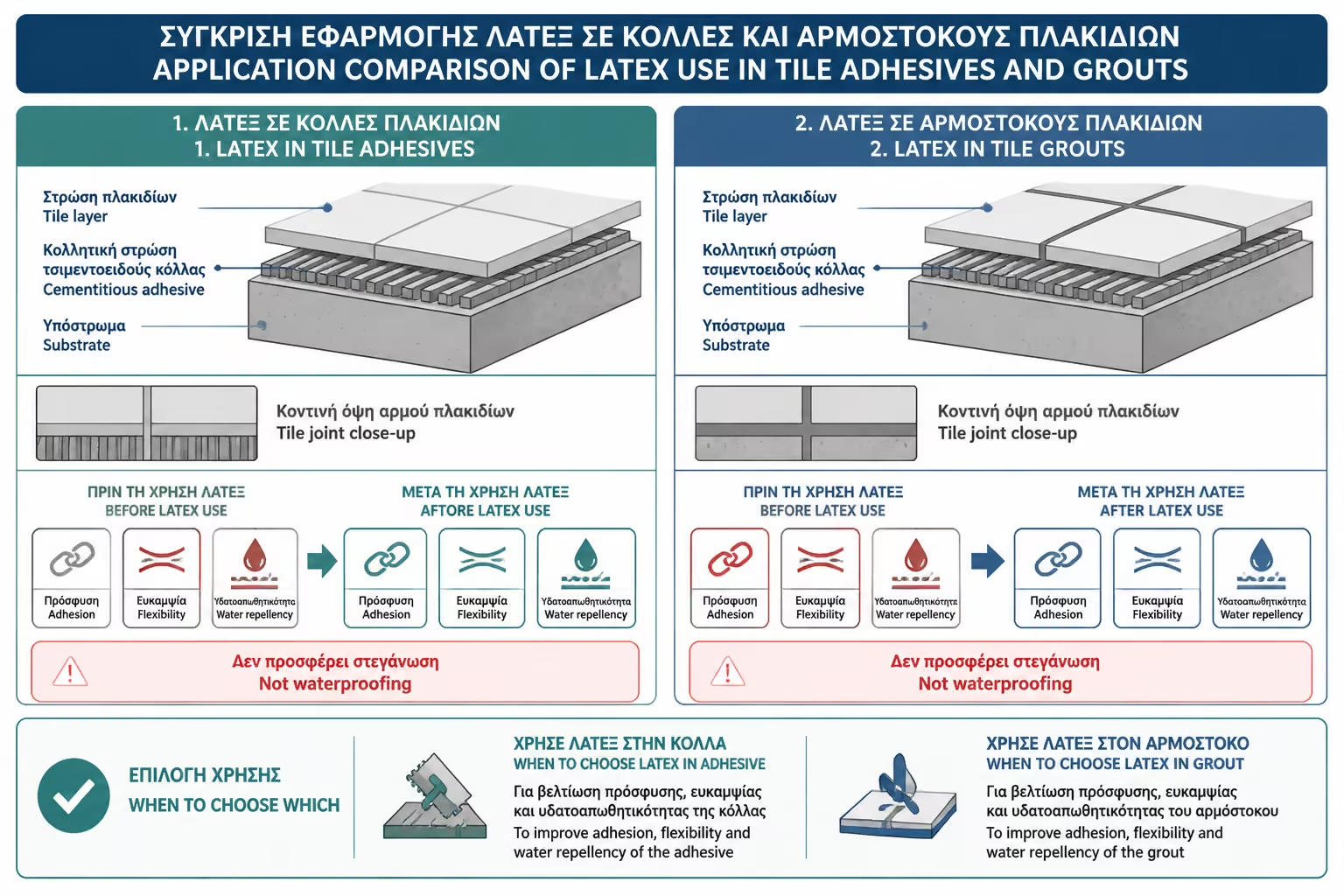
Latex additives were often used with simple cementitious adhesives or powders to create an improved system. In such systems, the powder and liquid are designed to work together. LATICRETE, for example, describes 4237 Latex Additive as a specially formulated additive for use with 211 Powder to create high-strength latex thin-set and medium-bed mortars for ceramics, natural stone and agglomerates.
Today, many adhesives are already ready and classified according to EN 12004 as C1, C2, C2TE, C2TE S1, etc. The EN 12004 standard concerns cementitious, dispersion and resin adhesives for ceramic tiles in interior and exterior applications. If you buy a ready-made C2TE S1 glue, it doesn't mean you can make it “S2” just by throwing in any latex. The ranking results from a proven system.
Therefore, latex on glue only makes sense if the technical brochure allows it. If the manufacturer says "mix with water only", we do not add emulsion. If it says “for special applications mix with such and such additive”, then we follow the system exactly.
Resinous additives can also be used in cementitious grouts when the product provides for it. The aim is to improve adhesion on the sides of the joint, reduce water absorption, improve abrasion resistance and better behavior in more demanding conditions.
In the past, in some systems, the grout was mixed with special latex instead of water. Today, many modern CG2 WA grouts already have polymeric additives, water-repellent technology and improved composition. If we add latex to such a grout without instructions, we may change the color, setting time, cleanability or final strength.
This is especially important in colored grouts. The wrong proportion of liquid can change the shade or create unevenness. If the goal is very low absorption and high stain resistance, it may be better to choose RG epoxy grout instead of trying to "trick" a cementitious grout with additives.
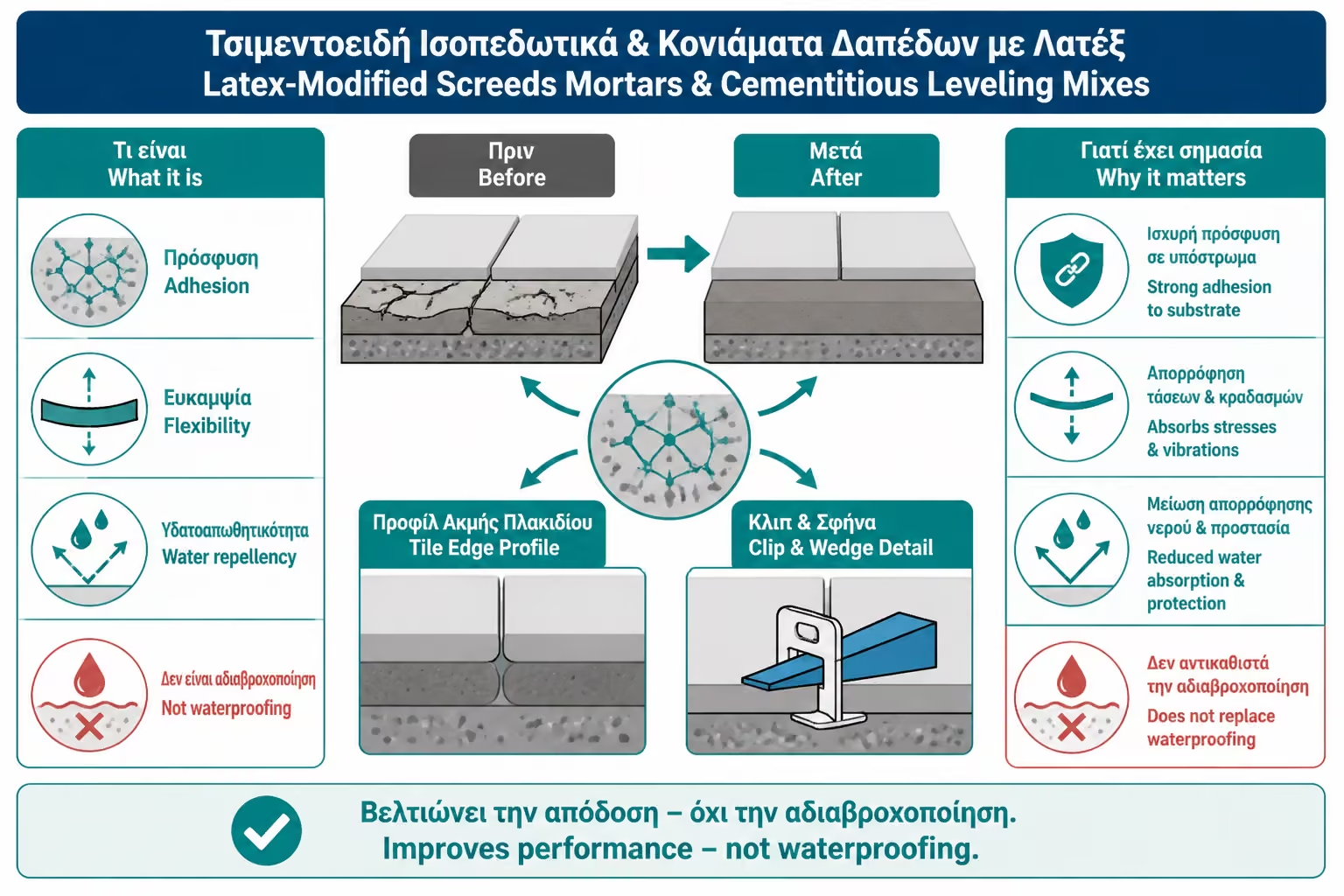
Latex additives are of great value in repair mortars, cement mortars, screeds, slurry bond coats and thin coats. In such applications, adhesion and cohesion are critical. A simple cement mortar may have limited adhesion to an old base. With latex, it can be made stronger, more durable and less absorbent.
LATICRETE describes 3701 Mortar Admix as a multipurpose latex admixture for cement tile adhesives, cement grouts, mortar beds, screeds and other cement mixes, used in place of water to improve mix properties. Such products are especially useful when we make mortar on site and want to strengthen it.
In the bathroom, however, we must separate the reinforced cement mortar from the waterproofing. A latex-modified cement mortar may be more resistant to moisture, but it is not the same as a certified waterproofing system under tiles. The shower still needs proper waterproofing where required.
It can improve the elasticity of a compatible adhesive, but only within the limits of the system. If the manufacturer has tested the powder with a specific latex and declares a category S1 or S2, then yes, the additive can turn the system into a deformable or highly deformable adhesive. Mapei Isolastic, combined with Kerabond Plus, declares S2 - highly deformable according to EN 12002.
But this does not mean that any simple commercial glue becomes hyperelastic with any latex. Classification S1/S2 is not a commercial claim of the craftsman. It is derived from laboratory testing of a specific product or system. Unless the glue has been tested with the plugin, we don't know the actual behavior.
In addition, elastic glue does not save a bad substrate. If the old tiles are hollow, if the cement mortar is loose, or if there are no expansion joints, latex will not solve the problem. It improves the hardware, not the build overall.
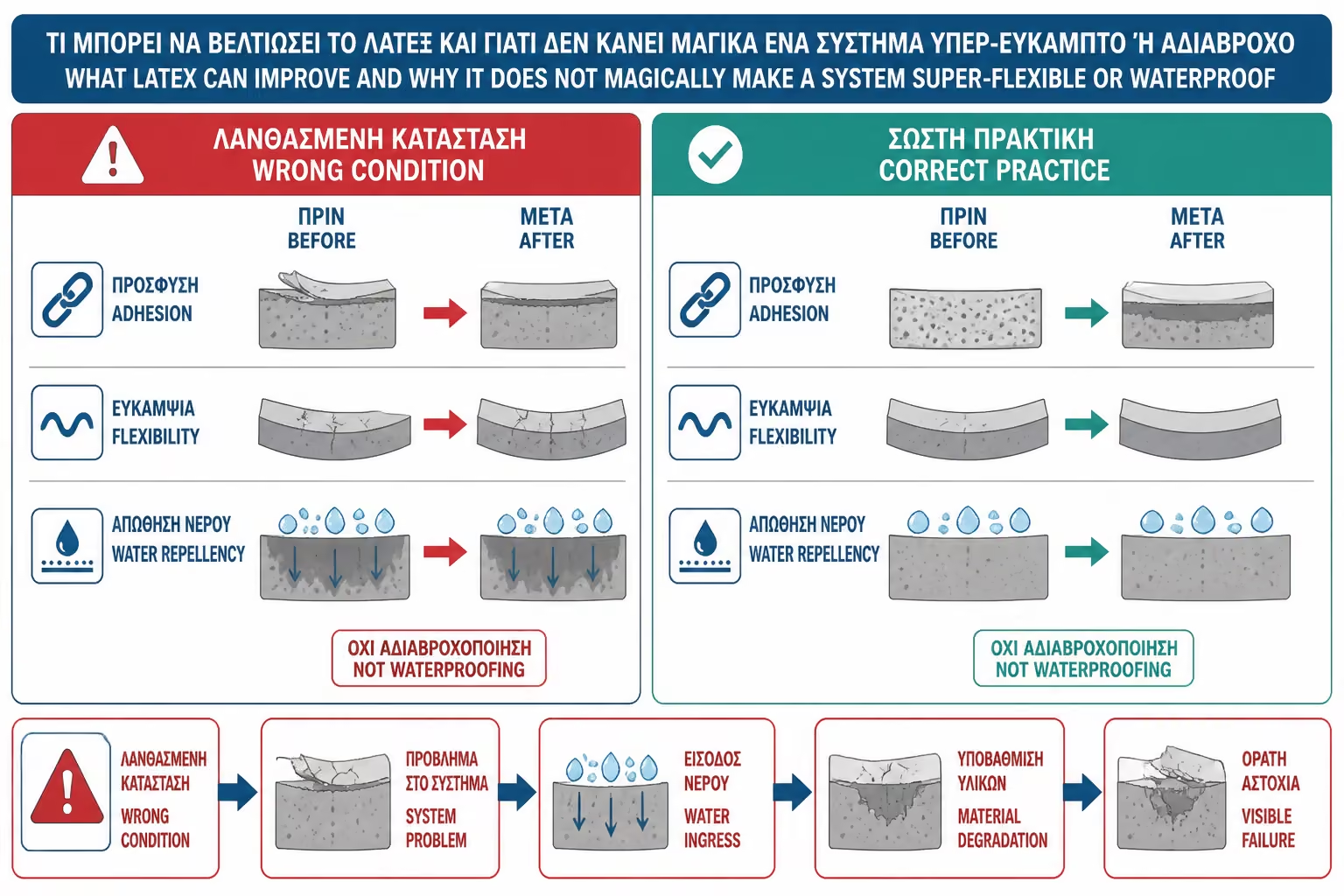
This is where the greatest care is needed. Latex additives can improve water resistance and reduce absorption. This does not mean that they create a complete waterproof membrane. SikaCeram A 200, for example, is reported to improve water resistance in sand/cement mortar mixes, along with adhesion, flexibility and thermal shock resistance. The wording is "water resistant", not "waterproofing membrane".
In the shower, the water is unforgiving. It passes through corners, siphons, supply holes, cracks, joints, water-holding slopes and bad joints. If waterproofing is required, a certified waterproofing system is used: cementitious sealant, membrane, corner strips, cuffs and compatible adhesive. We do not add latex to the glue and consider that "the shower has become waterproof".
So the correct wording is: resinous admixtures can make cementitious material more water resistant, but they do not replace waterproofing.
Latex modifiers make sense when working with simple cementitious systems that the manufacturer allows to be modified. They make sense in repair mortars, slurry bond coats, cement mortars, old bases, exterior applications, floors with thermal changes and situations where increased adhesion or flexibility is required.
They also make sense when there is an official two-component system: powder + latex. There we are not talking about "addition to chance". We're talking about products designed to work together. The result may have a specific classification, such as S1 or S2, and specific working, setting and use times.
In practice, if a project is demanding and the market has ready-made C2TE S1 glue, it is often safer to buy ready-made high-grade glue than to try to reinforce a simple glue. Additives have value, but not as a makeshift route to cheap “super glue”.
They should not be used when the adhesive or grout manufacturer specifically says to mix with water only. They should not be used to correct an expired, poor quality or unsuitable product. They should not be used in excess of the recommended ratio, as setting times, strengths, shrinkage or cleaning may be altered.
They should also not be used as a primer substitute. If the substrate is old glossy tile, it needs proper preparation and an adhesion primer, not just latex on the glue. If the surface is dusty, it needs cleaning and stabilization. If there is moisture, a diagnosis is needed.
Finally, products from different companies should not be mixed without technical confirmation. Just because a latex is "good" doesn't mean it works with any glue or grout. Systems are tested as a whole.
The addition of latex can alter working time, open time, setting time, and lead time. For example, Mapei Isolastic with Kerabond Plus gives pot life over 8 hours, open time 30 minutes, grouting on walls after 4–8 hours and on floors after 24–36 hours, and ready for use after approximately 14 days.
This matters because the installer may think he is simply "strengthening" the adhesive, while in reality he is also changing how the material works on site. In some cases, the time before the space can be used becomes longer. In a bathroom that has to be delivered quickly, that needs to be taken into account.
Mixing with latex can also change the texture of the mixture. It can become stickier, more elastic or more difficult to wash. It is not always "easier". He wants a craftsman who knows the product.
In colored grouts, the amount of liquid is critical. If latex is used instead of water that is not intended, the color may come out darker, glossier, uneven or different from the sample. The cleaning method may also change and a film may remain on the tile.
If the grout is designed to work with a specific latex, follow the instructions. If not, we don't add. Modern CG2 WA grouts already have improvers, water repellent technologies and controlled chemistry. Arbitrary addition can make the final result less predictable.
If we want very high stain and water resistance, RG epoxy grout is often the way to go, not "teased" cement grout.
In minor repairs and older masonry, a mixture of cement, sand and latex is often used to make a stronger mortar. This can have a place in repairs, fillings, slurry coats and special work, but should not be done out of proportion. The quality of the sand, the proportion of cement, the thickness of the application and the dosage of the latex are of enormous importance.
A mixture too rich in latex can become sticky, shrink strangely or not work properly. A too thin mixture may not have the improvement we want. Mortars also need to be cured. Latex does not remove cement times.
In modern bathroom renovation, it is generally better to use ready-made certified products for the main work. Site-made mixes only make sense when the installer knows exactly what he is doing and the application does not require certified performance.
Adhesives and grouts are classified by standards such as EN 12004 for adhesives and EN 13888 for grouts. If an adhesive is C2TE S1, it means that it has been tested and meets certain requirements. If you add latex arbitrarily, the new mixture does not automatically have an official classification.
This is important in projects with technical responsibility. It is not enough to say "I put emulsion so it got better". We need to know what category the system achieves. Products like Isolastic + Kerabond Plus give a declared S2 deformability according to EN 12002. This declaration is for the specific system, not any adhesive with any latex.
In the offer, therefore, if additives are used, it must be stated exactly which products are combined and what performance they give. The phrase "we will pour resin in" is not a technical specification.
Use the table below as a quick reference for the key points of this section.
| Capacity | What can improve | What should we not expect? |
|---|---|---|
| Adhesion | Better bonding to compatible cementitious systems | Does not stick to dirt, dust or hollow tiles |
| Elasticity | Greater deformability in proven systems | Not every glue automatically does S1/S2 |
| Water repellency | Reduced water absorption | It does not replace waterproofing |
| Abrasion resistance | More cohesive, durable mortar | It does not make poor quality epoxy grout |
| Thermal shock | Better behavior in changes | Does not remove expansion joints |
| Workability | It can improve plasticity | It can also change application times/difficulty |
| Frost resistance/outdoors | Can help with proper systems | It does not save wrong slopes or stagnant water |
Latex is an improvement tool, not a substitute for technical study.
Use the table below as a quick reference for the key points of this section.
| Case | Safer option |
|---|---|
| Standard bathroom with granite tiles | Ready C2TE or C2TE S1 glue |
| Underfloor heating | Ready C2TE S1 or tested latex system |
| Very demanding slab | S1/S2 adhesive according to tile manufacturer |
| Simple cement repair | SBR/latex compatible in mortar |
| Old tile as a substrate | Adhesion primer + suitable glue, not just latex |
| Shower grout | CG2 WA or RG epoxy, not arbitrary latex |
| Floor mortar / screed | Latex admix if the recipe calls for it |
| Shower sealing | Certified waterproofing system, not just latex |
The table shows that add-ons are not a substitute for choosing the right product.
The first mistake is the arbitrary addition of latex to ready-made glue that should be mixed only with water. This can break performance rather than improve it.
The second mistake is overdosing. More emulsion does not mean better result. It may change coagulation, shrinkage, color or cleaning.
The third mistake is using latex instead of primer on old tiles. Adhesion to the substrate remains a problem.
The fourth mistake is using latex instead of waterproofing. Water resistance is not waterproofing.
The fifth mistake is mixing products of different companies without technical confirmation.
The sixth mistake is adding latex to colored grout without testing, resulting in a color difference or film on the surface.
In the Greek market of 2026, resin emulsions and latex additives have a wide range of prices depending on chemistry, brand, packaging and use. A simple SBR emulsion can be relatively economical for mortars, while special latex additives for tile adhesives or highly deformable systems cost more.
But we have to compare the overall system. A simple glue + special latex can cost as much or more than a ready-made C2TE S1 glue. In some cases it is worth it because it gives specific S2 performance or special behavior. In other cases it is simpler and safer to buy ready-made improved glue.
In grouts, adding latex is not usually the economical route to "epoxy" behavior. If you want high resistance to stains, water and chemicals, calculate the cost of epoxy grout. If you want good home performance, choose CG2 WA. Do not create intermediate untested material.
A proper offer should not say "we will put resin in the glue". Must write specific product, ratio, compatibility and reason for use. For example: “glue X mixed with latex Y according to technical brochure to achieve class S1/S2”, or “cement mortar reinforced with SBR latex according to manufacturer's ratio”.
It must also state whether the additive replaces all or part of the water, what the curing time is, when grouting can be done and when the space can be used. These change from simply mixing with water.
If latex is used because "that's how the craftsman does it", without a technical brochure or compatibility, ask for clarification. In modern materials, improvised chemistry can create more problems than it solves.
Use the table below as a quick reference for the key points of this section.
| Question | Yes / No |
|---|---|
| Does the data sheet allow the use of this particular add-on? | Yes / No |
| Do we know if it replaces all or part of the water? | Yes / No |
| There is a declared performance category, e.g. S1 or S2? | Yes / No |
| Has the substrate been properly cleaned and prepared? | Yes / No |
| Does it need a separate primer? | Yes / No |
| Is the additive not used as a sealant substitute? | Yes / No |
| Has it been tested to affect setting and grouting times? | Yes / No |
| On colored grout, has it been color tested? | Yes / No |
| Are the products from a compatible system? | Yes / No |
| Does the offer state a specific additive and ratio? | Yes / No |
If most of the answers are "no", the use of latex is random. And in bathroom renovation, luck is not a technical method.
Resinous additives are very useful when used as part of a proven system. They can improve traction, elasticity and water resistance, and even raise a system to S1 or S2 when declared by the manufacturer. However, we should not throw them arbitrarily into any glue or grout. If you want super elastic glue, ask for ready C2TE S1/S2 or certified powder + latex system. If you want a waterproof shower, make a proper waterproofing. Latex improves the mortar; it does not replace system study.
Additives and resin enhancers are powerful tools in the hands of the right craftsman. They can transform a simple cement-like mixture into a stronger, more flexible and more water-repellent material. They can improve adhesion, cohesion, abrasion resistance and thermal behavior. In tested systems, they can even give official deformability classes like S1 or S2.
But it is not a magic additive that makes every glue "super" and every grout "waterproof". Indiscriminate addition of latex to finished products can spoil performance, change colors, delay setting or create incompatibility. Water resistance is not waterproofing. Elasticity does not replace expansion joints. Adhesion does not correct dirty or loose substrate.
The correct approach is to choose a system: correct substrate, correct primer, correct adhesive or mortar, correct additive where provided, correct grout and correct waterproofing. When latex is used like this, it is valuable. When used as an improvised trick, it becomes a risk.
Return to category.
Go to categoryReturn to the central guide.
Go to guide